Stuttgart to bring in city-wide diesel ban at start of next year

Close to 200,000 owners of older diesel cars will be impacted by a ban on diesel engines in the city centre of Stuttgart that was announced on Wednesday.
The state government of Baden-Württemberg decided that the diesel ban would apply to vehicles of the Euro emission standard 4 and worse and would apply to the entire centre of state capital Stuttgart.

A ban on the use of newer diesel engines complying with Euro standard 5 is not to be brought in for the time being. Any final decision on more modern diesel engines will be made dependent on the effect of a wide-ranging package to improve air quality in the smoggy state capital.

According to official figures, a total of 534,573 diesel cars are registered in the Stuttgart, and the surrounding region, of which 188,163 are registered with European standards 1 to 4.

Stuttgart is not the first German city to ban diesel – Hamburg introduced a limited ban on diesel engines early this year on two of the city’s most polluted streets. But the Stuttgart ban is much wider in scope and will encompass the entire city centre.

The Baden-Württemberg government negotiated not only the driving ban, but also exceptions. For example, residents with older diesel cars will be subject to a transition period until April 1st, 2019. Meanwhile craftsmen will be given additional time to buy new vehicles. Taxis, coaches and emergency vehicles will be completely excluded from the ban.

At the same time, the state government intends to adopt a package of measures to tackle air pollution and support public transport and electromobility. Ticket prices on public transport networks are to be reduced and sustainable vehicles such as electric buses and freight bicycles are to be promoted.

The government also presented several technical solutions that should contribute to lower nitrogen oxide emissions in the city. These include an innovative road surface that binds the gases from the air, as well as a noise barrier that is to break down both nitrogen oxides and fine dust from the air. Such measures are planned above all at the Neckartor area, where the worst air pollution values are regularly measured.

The Federal Administrative Court ruled in February that driving bans for air pollution control are permissible if proportionality is applied. Since then, the Baden-Württemberg has been under pressure to reduce nitrogen oxide levels in its famously polluted state capital. The poisonous gases have been linked to respiratory illnesses and heart problems, and are held responsible for thousands of premature deaths each year.

Around 10 million of the 15 million diesel cars registered in Germany fall short of the latest Euro 6 EU emissions regulation, potentially making them eligible for a ban.

Drivers of all but the latest diesel models that adhere to the Euro 6 standards “can no longer be certain of being allowed to drive at any time, 365 days a week,” analysts at consulting firm EY said in response to the ruling back in February.

via Stuttgart to bring in city-wide diesel ban at start of next year – The Local

Posted in Air Quality, Europe, Germany | Tagged , , , , | Leave a comment

Groundbreaking Dundee University research finds air pollution linked to rise in hospital admissions

High levels of air pollution have been linked to spikes in hospital admissions due to breathing problems.

Researchers at Dundee University studied nearly 15 years of data for air pollution levels in Dundee, Perth and the surrounding area and matched it to the medical records of 450 patients who suffer from bronchiectasis — a long-term chronic condition similar to COPD which can cause a persistent cough and breathlessness, as well as frequent chest infections.

Professor James Chalmers, GSK/British Lung foundation professor of respiratory research at the university’s school of medicine, said the study suggested air pollution was having a major impact on the health of people with respiratory problems — and potentially the wider population

He said: “When we looked at these two sets of data side-by-side the links between the periods when air pollution is at its worst and when these patients are having to seek assistance is absolutely clear.

“We found that on days when air pollution spiked there was a large increase in admissions to Ninewells Hospital and Perth Royal Infirmary with breathing problems and visits to GP’s with breathing problems, known as exacerbations.”

He said impacts were worst in the summer, when hot, still days raise the levels of air pollution and people spend most time outside.

He added: “Our data suggests that a failure to tackle air pollution is having a major impact on the health of people with lung conditions and potentially the wider Tayside population.

“The patients we looked at, who all suffer from lung conditions, are to my mind the canary in the coalmine on this issue – they are the first and most seriously affected by air pollution but it can affect us all.”

Ian Jarrold, head of research at the British Lung Foundation, said: “It is well-known that people with lung conditions are the first to become breathless when exposed to air pollution.

“But, thanks to this study, we now know that there is a clear link between high levels of air pollution and increased numbers of patients with breathing problems at hospitals and GP surgeries. The additional costs faced by the NHS in treating patients with lung conditions due to high exposure to air pollution can no longer be ignored.”

The study was a collaboration between the research team at Dundee and environmental health experts from Belgium, funded by the British Lung Foundation and published in the European Respiratory Journal.

Some areas of the city, such as Lochee Road and the Seagate, have some of the worst pollution levels in the country.

West End Liberal Democrat councillor Fraser Macpherson said the study showed the need for action to be taken to improve air quality.

He said: “There has been some progress but it is just not happening at the speed one would like.

“The bottom line is we cannot have a situation where there is any possibility of people’s health being compromised by air pollution.”

via Groundbreaking Dundee University research finds air pollution linked to rise in hospital admissions – The Courier

Posted in Air Quality, Europe, Health Effects of Air Pollution, Medical Studies, UK | Tagged , , , | Leave a comment

Asian residents are exposed to nine times more air pollution than Americans or Europeans

According to the World Health Organisation, about 88 percent of premature deaths in low- and middle-income countries in Asia can be attributed to air pollution. The number of road vehicles in Beijing increased from 1.5 million in 2000 to more than 5 million in 2014 and the number in Delhi, India, is expected to increase from 4.7 million in 2010 to 25.6 million by 2030.

In a review published by the journal Atmospheric Environment, Surrey’s Global Centre for Clean Research (GCARE) looked at studies of pollution exposure and concentration levels in Asian transport microenvironments (walking, driving, cycling, motorbike riding and bus riding). Researchers focused on the levels of fine particles, black carbon produced by carbon-rich fuels such as gasoline and diesel fuel, and ultrafine particles (UFP) small enough to travel deep into a citizen’s lungs.

The review found evidence that pedestrians walking along busy roadsides in Asian cities are exposed to up to 1.6 times higher fine particle levels than people in European and American cities. Car drivers in Asia are exposed to up to nine times more pollution than Europeans and Americans, while black carbon levels were seven times higher for Asian pedestrians than Americans. The study reported that in Hong Kong, UFP levels were up to four times higher than in cities in Europe. In New Delhi, average black carbon concentration in cars was up to five times higher compared to Europe or North America.

Professor Prashant Kumar, lead author of the study and the Director of the Global Centre for Clean Air Research at the University of Surrey, said: “Care should be taken in directly comparing and contrasting the results of different studies due to varied amounts of information available on personal exposure in studied regions. However, there is compelling evidence that people travelling in urban areas in Asian cities are being exposed to a significantly higher level of air pollution.

“A noticeable gap still exists in studies that focus on the Asian population living in rural, semi-rural or smaller cities, where pollution exposure could be as harmful as in urban areas owing to several unattended sources. There were rare data on cyclist and motorcyclist exposure despite substantial use in Asian cities; studies were limited for other transport modes too. It is important that this knowledge gap is filled if we are to get a complete picture of the pollution exposure challenge that the Asian population faces.”

Professor Chris Frey of North Carolina State University, co-author of the study, said: “There are increasing efforts in Asia to install properly designed and calibrated portable monitoring systems to measure actual exposures, using the data to better understand why high exposures occur and how to prevent them. These measurements of personal exposures will help individuals, businesses, and governments to develop and implement strategies to reduce such exposures.”

via Asian residents are exposed to nine times more air pollution than Americans or Europeans

Posted in Air Quality, Asia, China, Health Effects of Air Pollution, India, World News | Tagged , , , , , , , , | Leave a comment

Car cabin pollution scare prompts calls for new air conditioning rules

Experts have called for the regulation of car air conditioning systems after new trials revealed that popular models are letting in dangerous amounts of pollution.

Safety tests on 11 types of car have shown huge variation the the ability to purify incoming air, exposing those inside to millions of poisonous particles with each breath.

The Toyota C-HR performed worst, blocking out just 1 per cent of pollutants, while the VW Polo managed only 35 per cent and the Ford Fiesta 40 per cent.

However, the Mercedes E-Class was able to purify 90 per cent of the incoming air, demonstrating that the technology exists to substantially protect passengers.

Emission Analytics, the laboratory which carried out the tests, said the disparity was due to an absence of Government standards regulating air filtration systems.

Nick Molden, its chief executive, told The Sunday Times: “Drivers can be exposed to high pollution levels while believing themselves to be protected by the air filtration and ventilation system.”

The Society of Motor Manufacturers and Traders (SMMT) confirmed that the lack of regulation means car firms can use whatever specification of air filter they want, but said the industry is “working with policy makers” to decide if new rules are required.

The hazardous pollution comes mainly from the exhausts of other vehicles, which is full of “particulates” which measure a few millions of a millimetre.

They are dangerous because their size enables them to enter the bloodstream via the lungs.

Pollution is particularly hazardous for asthmatics, and also contributes to heart disease, stroke and some cancers.

Emissions Analytics discovered up to 57,000 particles per cubic centimeter in some roadside air samples.

Because people typically inhale around 55cc of air, that means pedestrians are inhaling 28 million particles per breath.

Even in cars whose filters remove 40 per cent of particles, such as the Ford Fiesta, those inside would still inhale nearly 13 million particles with each breath.

Tests were also carried out on the new £40,500  Jaguar E-Pace, which stopped 43 per cent of pollution, the VW Touran, which stopped 59 per cent, and the Vauxhall Astra, which blocked 83 per cent.

“There is little data to tell consumers what they are buying,” said Mr Molden.

“So if you have kids with asthma or other conditions you cannot tell if the car you are buying will protect them.”

He added the lack of protection may leave the employers of those driving as part of their work open to being sued.

Screen Shot 2018-07-09 at 09.18.47

“Their vehicles are their workplace so they may be subject to health and safety laws,” he said.

“Our research suggests many vehicles are a risk to their drivers’ health”.

While the majority of cars have a “recirculation” switch which blocks external air, this has been shown to risk causing drowsiness because it increases carbon dioxide levels caused by the occupants’ breathing.

Mike Hawes, SMMT chief executive, said: “Manufacturers have developed technology, like automatic climate control and active carbon filters, in response to consumer demand rather than legislative requirement.

“Given the absence of a regulatory standard, specifications vary”.

VW said its vehicles were fitted with multiple filters to remove particles and it intended to attach a particulate sensor to future models.

Meanwhile Toyota UK said it was not aware of pollution problems found Emission Analytics results “surprising”.

via Car cabin pollution scare prompts calls for new air conditioning rules

Posted in Air Quality, Health Effects of Air Pollution, UK | Tagged , , | Leave a comment

Air pollution – a neglected cause of death 

In 2015, around 4.5 million people died prematurely from diseases attributed to ambient air pollution, including 237,000 children under the age of five from respiratory infections. This is the result of a study published by the Max Planck Institute for Chemistry in Mainz and the London School of Hygiene & Tropical Medicine.

According to the World Health Organization (WHO), around one million children younger than five years died from lower respiratory infections in 2015. Fine particulates smaller than 2.5 microns in diameter (PM2.5) play a decisive role. Fine particulates penetrate deeply into the respiratory tract, and as a result can increase the risks of respiratory infections, ischaemic heart disease (heart attacks), chronic obstructive pulmonary disease (COPD), cerebrovascular disease (strokes) and lung cancer. Between 2000 and 2015 the global average concentration of fine particulate matter to which humans are exposed has increased from around 40 to 44.0 micrograms per cubic meter of air. This is more than four times the concentration of 10 micrograms recommended by the WHO as an upper limit for annual mean exposure. The irritant gas ozone also contributes to respiratory health effects.

The origin of particulate matter differs from country to country: in India, for example, the burning of solid fuels for cooking and heating is the most important single source , whereas power plants, transport and agriculture are the largest sources in the USA. The air inside buildings from household pollution can also pose a major health risk, but the focus of a study published in the journal The Lancet Planetary Health on 29 June 2018 is on ambient air.

122 million years of life were lost through early deaths

The researchers Jos Lelieveld, Andy Haines and Andrea Pozzer have determined the exposure to particulate matter and ozone with an established global model of atmospheric chemistry. They linked the ambient (outdoor) air pollutant concentrations to data on population as well as disease occurrence and causes of death in different countries. They calculated that in 2015 worldwide about 270,000 excess deaths occurred from exposure to ozone and 4.28 million from particulate matter. The causes of death included 727,000 people with lower respiratory tract infections, 1.09 million with COPD, 920,000 with cerebrovascular disease, 1.5 million with heart disease and 304,000 with lung cancer. As a result of these excess deaths, worldwide 122 million years of life were lost in 2015. These figures, the authors say, are lower limits because other diseases, which may also be related to air pollution, have not been taken into account.

4-airpollution

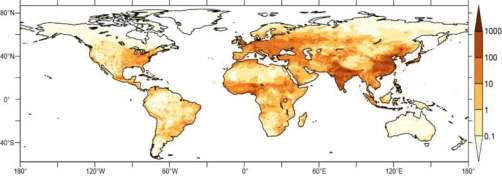
Annually, 4.55 million people lose their lives due to ambient air pollution. The graphic shows the mortality rate in individual per area of 1,000 km2 and year. Credit: MPI for Chemistry

Inadequate medical care and malnourishment increase the danger for children

The study focuses on children under the age of five who may be particularly sensitive to the effects of air pollution on respiratory infections. The calculations showed that in 2015, out of a total of 669 million children under five around the world, about 240,000 died from poor air quality as a result of lower respiratory tract infections, particularly pneumonia.

In comparison, 87,000 children died from HIV/AIDS, 525,000 from diarrhoea and 312,000 from malaria in the same year. The likelihood of children dying from polluted air was particularly high in Africa. In low-income countries, curable diseases often cause death because many children are undernourished and medical care is inadequate. In Chad for example, the health risk for children from ambient air pollution is almost ten times higher than the global average. Life expectancy is substantially reduced. In sub-Saharan Africa, children lose four to five years of life expectancy on average due to ambient air pollution.

‘A three-pronged strategy is needed’

The study also shows that in some lower to middle income countries, notably India and Pakistan, the mortality rate for girls is 1.2 times higher than for boys, which may reflect differences in nutrition and health care. On the other hand, the study shows that in India child mortality due to air pollution is declining, probably because health care, household air pollution and nutrition are improving.

Nevertheless, as ambient air quality continues to deteriorate, the cause of mortality shifts to other diseases and older people. The authors call for a three-pronged strategy to prevent child deaths from air pollution: adequate nutrition combined with improved health care and air quality.

via Air pollution – a neglected cause of death 

Posted in Air Quality, Health Effects of Air Pollution, Medical Studies | Tagged , , , , | Leave a comment

The dangers of smoke inhalation

Moorland fires continue to burn on both Lancashire’s Winter Hill and Saddleworth Moor in Greater Manchester, blanketing the region in smoke and ash.

So what can local people do to protect themselves and their families from smoke inhalation?

Smoke can irritate air passages, the skin and the eyes, leading to coughing and wheezing, breathlessness and chest pain.

It can also exacerbate asthma and, in some cases, the pungent smell and air pollution can cause headaches, nausea and dizziness.

On Sunday, a local man collapsed near the scene of the moor fires in Lancashire, after ignoring the police barrier and venturing too close.

Official advice is that if people need to be outdoors, they should try to:

  • avoid areas affected by any smoke or ash
  • limit the time they spend in them
  • wear dust masks if available

Public Health England says there is unlikely to be a significant risk from short-term contact with ash and soot.

Nonetheless, residents in areas affected by smoke should:

  • stay indoors
  • keep doors and windows closed
  • tune in to local radio station for advice and information

People who have been outdoors are advised to:

  • wash their faces with soap and water
  • keep hydrated by drinking water

Here is the key advice from nearby NHS Trafford:

  • Avoid smoky areas
  • If there is visible smoke, stay indoors and keep your doors and windows closed
  • Limit the time you spend outdoors
  • If driving in smoky areas, keep windows wound up, turn off air conditioning and keep air vents closed
  • Individuals with heart or lung diseases such as asthma should ensure they carry their medication and seek medical advice if their symptoms worsen

The hot weather may also make symptoms of smoke inhalation worse.

Those living in the vicinity are advised to:

  • wear lighter clothing
  • avoid strenuous physical activity
  • limit activities that might contribute to emissions within the home, such as cooking

Experts have commented on “the very visible particulates and smoke” common to slow-burning moorland fires, which tend to smoulder rather than flame, with some warning that children and the elderly even without pre-existing conditions “should avoid exposure”.

Vets have also advised owners to bring any small pets indoors.

However, the Greater Manchester Fire and Rescue Service has reported that smoke levels are not “toxic”.

For most people, any risks should be small and the discomfort short-term. Just be aware of your surroundings and stick to the official advice.

via The dangers of smoke inhalation – BBC News

Posted in Air Quality, Europe, UK | Tagged , , , , , | Leave a comment

Can Air Pollution Increase Risk Of Diabetes?

Can your risk of diabetes increase due to exposure to airborne particles of dust, dirt, and smoke? A new report warned that outdoor air pollution may be a significant contributor to diabetes cases around the world.

The risk does not dissipate, researchers warned, even if the pollution is at levels deemed “safe” by the Environmental Protection Agency (EPA) and the World Health Organization (WHO).

The study titled “The 2016 global and national burden of diabetes mellitus attributable to PM2·5 air pollution” was published in the journal Lancet Planetary Health on June 29.

“Our research shows a significant link between air pollution and diabetes globally,” said Dr. Ziyad Al-Aly, senior author and an assistant professor of medicine at Washington University.

He noted how even low levels of air pollution (i.e. considered to be safe levels by the EPA and WHO) could contribute to an increased risk. “This is important because many industry lobbying groups argue that current levels are too stringent and should be relaxed. Evidence shows that current levels are still not sufficiently safe and need to be tightened.”

According to previous research, airborne particles — including particulate matter, airborne microscopic pieces of dust, dirt, smoke, soot, and liquid droplets — can enter and spread through the bloodstream and the lungs. At high levels, this can affect the functioning of organs like the heart and kidney.

“Ten or 15 years ago, we thought that air pollution caused pneumonia, asthma and bronchitis and not much more than that,” said Dr. Philip Landrigan, dean for global health at Icahn School of Medicine at Mount Sinai in New York.

“We now know that air pollution is a very important cause of heart disease and stroke and contributes to chronic lung disease, lung cancer, and chronic kidney disease.”

Studies from recent years suggested pollution could reduce insulin production and trigger inflammation in the body. This can affect the conversion of blood glucose into energy which may ultimately increase the risk of diabetes.

While previous studies have attempted to link the disease to air pollution, the new paper gathered data and quantified the global burden. On a global scale, air pollution was estimated to have contributed to 14 percent of all new diabetes cases in 2016, which would mean around 3.2 million new diabetes cases that year.

Lower-income nations like India face a particular risk because of fewer resources for creating and maintaining clean-air policies. Poverty-stricken nations (such as Afghanistan, Papua New Guinea, and Guyana) also faced the higher risk. Wealthier countries (such as France, Finland, and Iceland) faced a low risk, and the United States faced a moderate risk.

Among Americans, 150,000 new cases of diabetes per year were attributed to air pollution while an estimated 350,000 years of healthy life were lost annually.

via Can Air Pollution Increase Risk Of Diabetes?

Posted in Air Quality, Health Effects of Air Pollution, Medical Studies | Tagged , , , , | Leave a comment

REVIEW: 5 best anti-pollution masks for cycling

respro-ultralight

INDY/ BEST BUY: Respro® Ultralight™ Mask (N99)

Respro’s Ultralight mask uses a stretchy fabric that allows the face to breathe in hot and humid conditions, which made it comfortable to wear for the duration of our 40-minute commute. It comes in four sizes, boasts two exhale valves (which allow the air you are breathing out to leave the mask) and an “unbreakable” nose clip that keeps the mask snug to your face. The two valves improve airflow performance, making breathing a little easier and reducing condensation that inevitably builds up in the mask, especially on cold mornings. The filters, which are designed to filter “sub-micron” particulates (those measuring smaller than one micron), were also able to cut out bad smells, something which was less noticeable with other masks we tried and which made traffic-clogged streets a little more pleasant.

by Independent


Posted in Air Quality, Respro® Mask Reviews, Respro® Products | Tagged , | Leave a comment