ALS Study Links Long-term Air Pollution with Development of the Disease

Long-term exposure to air pollution increases the risk of a person developing amyotrophic lateral sclerosis, a Dutch study shows.

The study, “Long-Term Air Pollution Exposure and Amyotrophic Lateral Sclerosis in Netherlands: A Population-based Case–control Study,” appeared in the journal Environmental Health Perspectives.

Scientists say it’s likely that 90 to 95 percent of ALS cases stem from the interaction of genetic and environmental factors. Smoking is a well-known risk factor for ALS. But there has been a shortage of information on other factors that may help trigger the disease.

Researchers have linked long-term exposure to air pollution to cardiovascular and respiratory diseases. More recently, they have linked the pollution to neurodegenerative diseases such as Parkinson’s and Alzheimer’s. But little information has been available about pollution’s association with ALS.

Based on toxicological and animal studies, researchers have hypothesized that very small airborne particles may cross or disrupt the blood-brain barrier. This may cause chronic brain inflammation, oxidative stress, and abnormalities in the brain’s white matter, collectively contributing to ALS, they have speculated. Oxidative stress is an imbalance between the body’s production of free radicals, which can damage tissue,  and its ability to counteract their harmful effects.

Scientists have found higher concentrations of fine air particles in the brains of people living in big population centers than in those living in less polluted areas.

The Dutch researchers decided to see if there were a link between long-term exposure to air pollution and people’s susceptibility to ALS.

Leaders of the research effort were Leonard H. van den Berg, a full professor of Neurology & Neurosurgery at the University Medical Center Utrecht, and Roel C.H. Vermeulen, an associate professor of Molecular Epidemiology and Risk Assessment at Utrech University’s Institute for Risk Assessment Sciences.

The team did a seven-year population-based study from January 2006 to January 2013 that involved 917 ALS patients and 2,662 controls. They used models from the European Study of Cohorts for Air Pollution Effects (ESCAPE) project to determine annual mean air pollution levels, starting in 1992.

They discovered that people exposed to the highest levels of nitrogen oxides and to fine particles in the air were at significantly higher risk of developing ALS than others. Fine particles are more likely to penetrate into the lungs and other organs.

All these air pollutants are traffic-related and therefore more concentrated in urban areas.

The nitrogen oxide and fine particulate results remained significant even after researchers accounted for the degree of urbanization where patients lived.

Researchers said the results gibed with previous studies showing that being exposed to hazardous air aromatic solvents increases the risk of someone developing ALS. They also found an elevated risk of ALS among truck and bus drivers, and machine workers and operators, underscoring a reported association between ALS and diesel exhaust.

Overall, the Dutch study provided “evidence for the association between long-term exposure to traffic-related air pollution and increased susceptibility to ALS,” the researchers wrote. “Our findings further support the necessity for regulatory public health interventions to combat air pollution levels and provide additional insight into the potential pathophysiology of ALS.”

Future studies should aim to replicate these findings in other populations, the team said.

Source: ALS Study Links Long-term Air Pollution with Development of the Disease

Posted in Air Quality, Health Effects of Air Pollution, Medical Studies | Tagged , , , , | Leave a comment

Government ‘failed to clean up air’ 

New figures show the UK government failed to reduce illegal levels of air pollution in the 18 months after a court ordered it to clean up the air.

At the end of 2016, the UK still had the same number of zones with illegal air pollution as in 2015.

That’s despite being under a Supreme Court order at the time to bring down nitrogen dioxide emissions – mainly from transport – as soon as possible.

The government said it had put in place a £3bn plan to improve air quality.

Ministers have been forced to increase their ambition on pollution by a succession of court defeats to an environmental campaign group, ClientEarth.

Its chief executive James Thornton said: “These statistics show how ministers are failing to protect people from air pollution, which is blighting the lives of thousands of people across the country.

“We’re deeply saddened to see how little progress was made last year and we will keep up the pressure to tackle this public health crisis, so that all of us – particularly young children – are protected from harmful pollution.”

In July, the government produced its second air pollution plan ordered by the court.

But in the plan, most of the responsibility was passed to local councils. And they say they’re not being adequately funded to make improvements in air quality like improving public transport or re-engineering the streets.

A government spokesman said: “We will end the sale of new diesel and petrol cars by 2040, and next year we will publish a comprehensive Clean Air Strategy which will set out further steps to tackle air pollution.

“We now have an opportunity to deliver a Green Brexit and improve environmental standards as we leave the EU.”

Source: Government ‘failed to clean up air’ – BBC News

Posted in Air Quality, Europe, UK | Tagged , | Leave a comment

Revealed: every Londoner breathing dangerous levels of toxic air particle

Every area of the capital breaches global standards for PM2.5 pollution particles, with most areas exceeding levels by at least 50%

The scale of London’s air pollution crisis was laid bare on Wednesday, with new figures showing that every person in the capital is breathing air that exceeds global guidelines for one of the most dangerous toxic particles.

The research, based on the latest updated London Atmospheric Emissions Inventory, shows that every area in the capital exceeds World Health Organisation (WHO) limits for a damaging type of particle known as PM2.5.

It also found that 7.9 million Londoners – nearly 95% of the capital’s population – live in areas that exceed the limit by 50% or more. In central London the average annual levels are almost double the WHO limit of 10 µg/m3.

The findings, described as “sickening” by London mayor Sadiq Khan, have serious health implications – especially for children – with both short and long-term exposure to these particulates increasing the likelihood of respiratory and cardiovascular diseases. Health experts say that youngsters exposed to these toxic pollutants are more likely to grow up with reduced lung function and develop asthma.

Khan said: “It’s sickening to know that not a single area of London meets World Health Organisation health standards, but even worse than that, nearly 95% of the capital is exceeding these guidelines by at least 50%.”

London is widely recognised as the worst area for air pollution in the UK, although there is growing evidence that dangerously polluted air is damaging people’s health in towns and cities across the country.

Khan added: “We should be ashamed that our young people – the next generation of Londoners – are being exposed to these tiny particles of toxic dust that are seriously damaging their lungs and shortening their life expectancy. I understand this is really difficult for Londoners, but that’s why I felt it was so important that I made this information public so people really understand the scale of the challenge we face in London.”

Levels of PM2.5 across London

The mayor’s office said around half of PM2.5 in London is from sources outside the city. However, the main sources of PM2.5 emissions in London are from tyre and brake wear, construction and wood burning.

Last week Khan unveiled plans to limit the use of wood burning stoves in the capital from 2025 and tighten up regulations to make sure all new stoves from 2022 are as clean as possible.

He has also set out a range of plans to tackle pollution from diesel cars in the capital. The first stage, the new T-Charge, which will charge older, more polluting vehicles entering central London, starts later this month.

Clean air campaigners have welcomed Khan’s plans, which include the introduction of a low emission zone in 2019, but have called on the mayor to take more urgent, immediate action in light of the scale of the crisis.

The mayor was due to release the latest findings on Wednesday morning as he signed London up to the Breathe Life coalition organised by WHO, UN Environment and Clean Climate and Clean Air Coalition, at a special conference at City Hall.

The initiative aims to connect similar world cities, combine expertise, share best practice and work together to improve air quality.

Tedros Adhanom Ghebreyesus, WHO director-general, welcomed London’s support and Khan’s measures aimed at tackling air pollution.

“To ensure good health, every person must be able to breathe clean air no matter where they live. London’s plan to clean up their air means millions of people will be able to walk to work and walk their children to school without worrying about whether the air is going to make them sick. More cities around the world must also follow suit.”

Erik Solheim, head of UN Environment, said: “This is great news for Londoners. This support for the Breathe Life campaign and Sadiq Khan’s leadership means that millions of people can cease being hostage to toxic fumes. It sets an example of positive action that we hope cities around the world will follow.”

Paul Morozzo, clean air campaigner at Greenpeace said: “London air isn’t safe to breathe. Every person in London is affected by this crisis – old or young, healthy or ill. The air you breathe in London is putting your health at risk now and in the future, whether you realise it or not.

“Restricting diesel will make a big difference to both PM and nitrogen oxide air pollution in London, which is why the Mayor has no choice but to get tough on cleaning up our roads.”

Source: https://www.theguardian.com/environment/2017/oct/04/revealed-every-londoner-breathing-dangerous-levels-of-toxic-air-particle

Posted in Air Quality, Europe, London, UK | Tagged , , , , , , | Leave a comment

Developing an air quality plan for the Thames 

This summer, the Port of London Authority announced new research to develop an air quality strategy for the Thames. The project, part of the Thames Vision programme, will look into shore-side power, emissions monitoring and creating the first port-wide air inventory for the river.

The River Thames is central to London’s identity and development as a capital city, contributing every day in trade, jobs, tourism and transportation. Since 2015, the Port of London Authority (PLA) has been working with stakeholders to develop the Thames Vision programme, which lays out a 20-year view of the river’s future at the heart of a growing city.

The latest announcement, made in June, saw PLA teaming up with the Mayor of London and Transport for London (TfL) to develop an air quality strategy aimed at increasing the green credentials of the river’s traffic.

The project involves three separate research streams: a look into the implementation of shore-side power, which allows ships to turn off their engines and plug into an electrical grid while at berth; comparable journey emissions monitoring; and a first-of-its-kind air inventory for the Thames.

“This research is on an unprecedented scale for the UK,” said PLA chief executive Robin Mortimer. “Individually the techniques are tried and tested, but we are bringing them together to create a detailed picture of vessel emissions on the Thames. This will give us the data we need to develop the first air quality strategy for the river.”

The first air inventory for the Thames

The PLA is tasked with ensuring navigational safety along the 95 miles of the tidal Thames, as well as protecting its unique marine environment.

The new air quality plan is being developed in collaboration with operators Cory Riverside Energy, Thames Shipping and MBNA Thames Clippers, as well as energy management firm Schneider Electric and environmental consultant Aether.

The first research project looked into the possibility to develop shore-side power at specific sites along the river.

Shore-side electricity (SSE), also known as “cold-ironing”, allows ships to turn off their engines and plug into an electrical grid while at berth. Currently only deployed in around 10 ports worldwide, it has the potential to reduce pollutants by about 90% and greenhouse gas emissions by 50%, according to research by the European Commission.

Renewable energy consultant Ecofys found that SSE offers the potential to mitigate 800,000t of CO2 emissions if all seagoing and inland ships in European harbours would use SSE by 2020, but the total CO2 emission reduction depends on how the electricity used is produced onshore. Furthermore, all of the noise produced by a ship would also be eliminated by using a shore connection system, and the technology is fully compliant with MARPOL 6 regulations.

To investigate this, PLA partnered with Schneider Electric, which currently has over 30 shore power installations worldwide, including in ports in California and the new Kalibaru Container Terminal in Jakarta.

“Shore-side electricity allows ships to turn off their engines and plug into an electrical grid while at berth.”

This is not the first time SSE was considered for London. Campaigners opposing the proposed Enderby Wharf cruise terminal in Greenwich argued that on-shore power could help prevent pollution from cruise ships that would otherwise run their engines 24 hours a day in a densely populated area. The idea was since repeatedly dismissed by Greenwich Council as expensive and impractical.

The second project focuses on comparable journey emissions monitoring, which will gather data on regular river-borne journeys of both passengers and cargo and contrast it with the number of vehicles used and routes needed to make the same journey through London’s road network.

According to partner company Aether, the inventory will be based on previous work undertaken in the Netherlands, including at Europe’s largest port in Rotterdam, which uses real-time ship and boat movements to build up a complex emissions profile.

“This will allow the development of a realistic baseline for London river traffic emissions, the exploration of mitigation options and will feed into the London Atmospheric Emissions Inventory,” Aether said in a May press release.

At the moment, there is no available data to evaluate the emissions from inland vessels and their impact on London’s worsening air quality problem.

Research by the Institute for Public Policy Research (IPPR) found that London is breaking legal and World Health Organization (WHO) limits for NO2, and WHO limits for particulate matter. Most air pollution in London is caused by road transport, of which diesel vehicles are the most polluting.

The three research projects are due to be completed in the early autumn and the full strategy is expected to be published before the end of the year.

Conservation of the river in years to come

The air quality announcement comes six months after the PLA introduced the UK’s first port charges discount for cleaner cargo ships at the start of this year, a move much celebrated across the industry. The discount is available for ships that exceed international emissions standards set by the International Maritime Organization (IMO) in a scoring scheme run by the World Ports Climate Initiative.

According to the PLA, the discount is “suitably high that significant improvements need to be made in order to achieve it”, and bears similarities with similar initiatives taken at other European ports.

More recently, the UK Government’s Department for Transport committed £6m towards funding trials of innovative energy saving devices, such as new propellers, rotor sails and on-board waste heat recovery, in an attempt to achieve a “zero-emissions sector”.

The new measures come as climate change poses further challenges to protecting the Thames, including the high-priority flood risk areas throughout the Thames Estuary. The Environment Agency warned that there will need to be continuing investment in both hard and soft flood defences along the estuary in the years to come.

“The strategy sets out to improve water quality, reduce litter, protect and enhance biodiversity.”

It also comes at a time when the capital is growing in population, traffic and demand, with increased pressures on every transport network, including the river. Looking towards 2025, the PLA hopes to improve navigational access to the Port of London, double the number of people travelling by river up to 20 million commuter and tourist trips every year, and make more efficient use of piers and river space.

On the environmental and conservation side, the strategy sets out to improve water quality, reduce litter, protect and enhance biodiversity and “encourage the uptake of new and green technologies to reduce the port’s environmental impact”.

Currently, 92% of the PLA’s area is covered by environmental designations, but at the same time, up to 300t of rubbish is recovered from the Thames each year, with the amount of plastic bottles growing year on year.

Some of these issues, including pollution threats to the fish living in river waters, will be tackled by the Thames Tideway Tunnel, a 25km sewer tunnel that is hoped to protect the river from further pollution. According to its strategy, PLA hopes to build and bring the tunnel into operation by 2021.

“We anticipate more trade, more passenger journeys, more sport and recreation and more people wanting to enjoy the improved environment along the tidal river,” Mortimer said. “Our ambition is for this growth to be sustainable in the widest sense.”

Source: Developing an air quality plan for the Thames – Ship Technology

Posted in Air Quality, Europe, London, UK | Tagged , , , | Leave a comment

Gurgaon India’s most polluted city on Sunday

Gurgaon was the most polluted city in the country on Sunday, with its Air Quality Index (AQI) touching the 274 mark (considered ‘poor’). In contrast, Delhi’s AQI was a ‘moderate’ 196.

PM2.5 levels were reported between 112.78 to 118.90 micrograms per cubic metre (g/m³) in Gurgaon on Sunday, while it was between 99.08 to 109.76 g/m³ on Saturday.

According to Haryana State Pollution Control Board (HSPCB) officials, a decline in wind speed and the burning of crackers during Dussehra celebrations led to an increase in the air pollution levels. “As the wind speed is declining, it is difficult for the dust particles to disperse, and they remain trapped in the lower atmosphere. It leads to a rise in the level of particulate matter. Also, firecrackers and effigy burning on Dussehra also had an impact,” said a senior HSPCB official.

Experts blamed effigy burning on Dussehra, coupled with stubble burning by farmers, for the increase. “Despite Sunday being a non-working day, the city reported the highest levels of air pollution in the country. It is evident that vehicular pollution is not the only source of air pollution in the city. It is clearly a result of Dussehra celebrations. Also, stubble burning is a major contributing factor,” said Niranjan Raje, former member of Environment Pollution Control Authority (EPCA).

Activists, on the other hand, held the non-compliance of construction norms responsible. “Despite tall claims, the authorities have failed to implement NGT’s directions at construction sites, both private and public. There is massive air pollution in front of the MCG office itself due to construction activities,” said Vivek Kamboj, a city-based environmentalist.

Source: Gurgaon India’s most polluted city on Sunday | Gurgaon News – Times of India

Posted in Air Quality, Asia, India | Tagged , , , , | Leave a comment

Air pollution: Sadiq Khan calls for ban on wood-burning stoves 

London mayor cites figures showing that the home stoves, used in 16% of households, produce up to a third of all the capital’s fine-particle pollution

Wood-burning stoves could be banned in some areas to combat air pollution under proposals by the London mayor, Sadiq Khan.

Khan has written to Michael Gove, the environment secretary, to request extra powers to improve air quality in the capital, including measures to tackle solid-fuel burning and construction pollution. The proposed measures include minimum emissions standards for vessels on London’s waterways and heavy construction machinery like diggers and bulldozers.

Wood-burning stoves, which would be banned under the proposals for urban areas with poor air quality, are increasingly popular – 1.5m have been sold across Britain. They are most popular in south-east England, where 16% of households have them, compared with 5% nationally.

Khan said: “Non-transport sources contribute half of the deadly emissions in London, so we need a hard-hitting plan of action to combat them similar to moves I am taking to reduce pollution from road vehicles.

“With more than 400 schools located in areas exceeding legal pollution levels, and such significant health impacts on our most vulnerable communities, we cannot wait any longer, and I am calling on government to provide the capital with the necessary powers to effectively tackle harmful emissions from a variety of sources.”

The mayor has asked the environment department to amend the Clean Air Act to allow for the creation of zero-emission zones where the burning of solid fuel is not allowed from 2025 onwards.

When asked to comment on Khan’s letter, a Defra spokesperson told the Guardian: “We are determined to improve air quality and have put in place a £3bn plan to reduce roadside emissions.

“Next year we will publish a comprehensive Clean Air Strategy which will address all sources of air pollution. We are also raising consumer awareness about the impact of burning wood on health and working with industry to help reduce harmful emissions.”

The mayor’s proposals come after he triggered London’s emergency air quality alert on Wednesday for the seventh time in thirteen months. Polluted air from the continent combined with toxic air in London to create dangerous levels of pollution.

Source: Air pollution: Sadiq Khan calls for ban on wood-burning stoves | Environment | The Guardian

Posted in Air Quality, Europe, London, UK | Tagged , , , , | 1 Comment

Brace for air pollution in Delhi as crop burning starts in neighbouring states

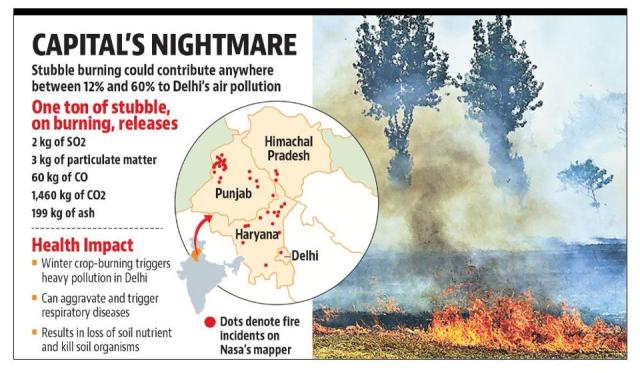
Agricultural stubble running into millions of tonnes is burnt by farmers in northern India every October. An estimated 35 million tonnes are set afire in Punjab and Haryana alone.

Winter’s coming, and Delhi’s annual nightmare is already taking shape beyond its borders.

Over a dozen cases of crop burning were reported from Haryana till Wednesday, and officials fear the number will rise drastically in the coming days. This, in turn, would trigger heavy pollution in the national capital region.

“We came across 14 confirmed cases of crop burning since September 22. While 12 cases occurred in Karnal on Wednesday, one instance each was reported from Panipat and Kaithal earlier,” said S Narayanan, member secretary of Haryana Pollution Control Board. Teams are sent to verify crop burning incidents as soon as fires show up on satellite images, he said.

Agricultural stubble running into millions of tonnes is burnt by farmers in northern India every October, before the onset of winter. An estimated 35 million tonnes are set afire in Punjab and Haryana alone to make room for the winter crop.

Experts say stubble burning accounts for anywhere between 12% and 60% of Delhi’s air pollution. The primary reasons behind farmers setting crop residue afire are cost concerns and the short time gap between summer and winter crops, besides lack of incentives and equipment to manually cut down the stubble.

Although the National Green Tribunal banned the practice in 2015, implementing the order has turned out to be a difficult task.

Even preventive exercises by various agencies, such as the Environment Pollution [Prevention and Control] Authority (EPCA), have come to naught.

The Haryana PCB launched satellite monitoring activities to detect crop-burning cases with the aid of the Haryana Space Applications Centre on September 22, and is believed to have already collected penalties amounting to Rs 5,000 from offending farmers.

Punjab PCB officials, for their part, have written to the Punjab Remote Sensing Centre to launch satellite monitoring from October 1. “No such incident has come to our notice yet. Crop burning is expected to start from the first week of October,” said a senior official with the board.

Meanwhile, red dots have already begun appearing on Nasa’s FIRM web fire mapper, which uses satellite imagery to identify fires on the ground. Officials in Punjab and Haryana, however, claimed that not all red dots imply crop-burning cases.

The EPCA is also pulling out all stops to ensure that the crop-burning situation does not go out of hand. “This year, we directed the pollution control boards of all NCR states to form patrol teams meant for visiting vulnerable areas and flagging violations,” said an agency member.

Though a recent National Thermal Power Corporation proposal to purchase agricultural residue from farmers had raised hopes of a less-polluted winter this year, authorities are doubtful if a business module can be developed in the few days that remain before crop-burning incidents start again.

In a desperate attempt, Punjab chief minister Amarinder Singh recently sought from the Centre a bonus of Rs 100 per quintal on paddy as an incentive to dissuade farmers from burning crop stubble. Sources said Haryana chief minister Manohar Lal Khattar is also taking a special interest in ending the practice.

Source: Brace for air pollution in Delhi as crop burning starts in neighbouring states | delhi news | Hindustan Times

Posted in Air Quality, Asia, India | Tagged , , , | Leave a comment

Sadiq Khan triggers alert for high air pollution in London

The mayor of London, Sadiq Khan, has triggered the capital’s emergency air quality alert as polluted air from the continent combines with toxic air in London to create dangerous levels of pollution.

The alerts will see warnings displayed at bus stops, road signs and on the underground. Khan has also asked TV and radio stations across the capital to warn their viewers and listeners in news bulletins.

Anyone with lung or heart problems is advised to reduce strenuous exercise, especially outside. The young and elderly are particularly vulnerable.

Khan said: “The shocking and illegal state of London’s filthy air means once again I am triggering a high air pollution alert today under my new comprehensive alert system.”

The government’s committee on the medical effects of air pollutants advises adults and children with lung problems, and adults with heart problems, to reduce strenuous physical exertion, particularly outdoors, and particularly if they experience symptoms. People with asthma may find they need to use their reliever inhaler more often. Older people should also reduce physical exertion.

Khan is implementing a range of measures to try to tackle the air pollution crisis in the capital, and he called on the government to do more.

“I am doing everything with the powers I have at City Hall and it’s now time for the government to step up by introducing a national diesel scrappage fund to rid our streets of dirty diesels, and to give me the powers I need to tackle non-transport sources of pollution.”

Responding to the news that the capital’s air quality emergency alert had been triggered, Prof Jonathan Grigg from Doctors Against Diesel said “dirty air is seriously damaging Londoners’ health and wellbeing.”

Grigg called on Khan to do more to tackle it. “Vulnerable people shouldn’t have to restrict their activities to stay safe,” he said. “Sadiq Khan must bring London’s air pollution down to legal levels as soon as possible, and commit to phase out diesel vehicles by 2025 to protect Londoners’ lungs.”

The government has come under increasing pressure over the UK’s air quality. It has suffered a string of humiliating defeats in the courts over its failure to clean up the nation’s air. Its latest proposal, released in July, was met with widespread criticism from clean air campaigners and regional politicians.

The latest episode of dangerously polluted air has been caused by mist, low cloud, fog and slow wind speed in London that has lead to a build up of pollution. This has combined with air arriving from the continent that has travelled slowly over industrial polluted areas giving it time to pick up emissions on the way. Experts say this is likely to produce high levels of PM2.5 and moderate levels of PM10 particulate pollution across areas of London and the south-east.

Source: Sadiq Khan triggers alert for high air pollution in London | Environment | The Guardian

Posted in Air Quality, Europe, London, UK | Tagged , , , , , , | Leave a comment