Mothers’ exposure to air pollution tied to cellular changes in kids

Women who breathe polluted air during pregnancy have babies with greater signs of “aging” in their cells when they’re born compared to babies whose mothers breathed cleaner air, a new study finds.

Babies with higher exposure to fine particle pollution during gestation had shorter caps on the ends of their chromosomes, according to the researchers, who suggest the findings offer a possible biological reason for health problems encountered by kids who live where smog and traffic exhaust is pervasive.

The protective chromosome caps known as telomeres normally shrink with age, and are also thought to erode with extreme stress.

“Reducing exposure to air pollution is a good thing, for both the parents and for the unborn baby,” said Pam Factor-Litvak, author of an accompanying editorial and a public health researcher at Columbia University in New York.

“Prenatal exposure to air pollution is associated with a host of adverse outcomes,” Factor-Litvak said by email.

For the study, Tim Nawrot of Hasselt University in Diepenbeek, Belgium, and colleagues examined telomere length from samples of cord blood and placental tissue for 641 newborns in the Flanders region. They also looked at mothers’ exposure to pollutants known as PM 2.5, a mixture of solid particles and liquid droplets smaller than 2.5 micrometers in diameter that can include dust, dirt, soot and smoke and are often found in traffic exhaust.

Some previous research has linked exposure to traffic fumes and air pollution to higher odds of infertility as well as an increased risk of delivering underweight or premature babies. Prior research has also linked shorter telomeres to an increased risk of a variety of chronic health problems in adults, including heart disease and cancer.

Telomeres shorten each time a cell divides. Once telomeres are too short, cell growth stops, which is why their length is considered a potential indicator of cellular aging and overall health.

In the current study, Nawrot’s team examined data on women who had full-term babies from 2010 to 2014.

Researchers used mothers’ home addresses to estimate average exposure to PM 2.5 during each week of pregnancy.

Overall, the women’s average weekly exposure to PM 2.5 was 13.4 micrograms per cubic meter of air (ug/m3).

Mothers exposed to higher levels of PM 2.5 gave birth to babies with shorter telomeres, researchers report in JAMA Pediatrics.

Each increase of 5 ug/m3 in PM 2.5 exposure during pregnancy was associated with roughly 9 percent shorter telomeres in babies’ cord blood on average, and 13 percent shorter telomeres in placenta samples, the study found.

The researchers accounted for other maternal factors like education, income, health conditions and smoking history, as well as the babies’ sex and weight at birth.

One limitation of the study is that women’s actual PM 2.5 exposure might differ from what researchers estimated based on home addresses, the authors note. It’s also possible that the babies’ parents had shorter telomeres and this influenced the telomere length in newborns.

Even so, the findings suggest that it’s possible for air pollution to cross the placenta barrier and directly affect the chromosomes in babies, said Mark Nieuwenhuijsen, a researcher at the Center for Research in Environmental Epidemiology and the Barcelona Institute for Global Health in Spain.

“We know that air pollution reduces the birth weight of babies and may reduce gestational age and head circumference, but we did not know about biological aging during pregnancy,” Nieuwenhuijsen, who wasn’t involved in the study, said by email. “I believe this is the first study looking at this and shows that aging due to air pollution starts already during pregnancy.”

As much as possible, people should avoid breathing smog and traffic fumes, said Dr. Shruthi Mahalingaiah, a researcher at Boston University School of Medicine who wasn’t involved in the study.

“The take home message is to limit exposure to air pollution when you can – if you bike to work during rush hour – consider biking during other times to reduce exposures to vehicular exhaust,” Mahalingaiah said by email. “If you live in areas of the world with high levels of ambient air pollution, you may consider installing appropriate air/ventilation systems so that your in-home air quality is excellent.”

SOURCES: http://bit.ly/2ztlah8 and http://bit.ly/2zshNa7 JAMA Pediatrics, online October 16, 2017.

Source: Mothers’ exposure to air pollution tied to cellular changes in kids | News | 1450 99.7 WHTC

Posted in Air Quality, Health Effects of Air Pollution, Medical Studies | Tagged , , , | Leave a comment

Northern California Wildfires Released a Year’s Worth of Pollution

A week since the wildfires in Sonoma and surrounding counties started, flames have engulfed over 200,000 acres of land and nearly 6,000 structures. At least 40 casualties have been reported while many remain missing and unaccounted for. The firestorm came without warning with some only having a moments notice to evacuate. The fires have left thousands with nothing—no home, no car and nowhere to go to. It will take years to recover from the devastation.

One thing that cannot be undone, however, are the fumes that were emitted into the air. The air quality in the Bay Area has been beyond poor all week causing breathing masks to sell out quickly. The city of San Francisco was covered in a cloud of haze most of the week. Smoke could be smelt over 100 miles south as far as San Jose.

The fires released more than 10,000 tons of PM 2.5, particles that are 2.5 micrometers in diameter or smaller. To put that in perspective, it takes the entire state of California’s drivers to release that much in one year. That is after strict statewide smog enforcement and incentives for electric vehicles. While the wildfires continue to burn, containment is underway but it is unclear when the fires will be put completely due to wind and humidity.

Source: Northern California Wildfires Released a Year’s Worth of Pollution – The Drive

Posted in Air Quality, USA & Canada | Tagged , , , | Leave a comment

California’s Fires Are Making The Air Quality Worse Than Delhi

As climate change makes wildfires more common and stronger, clean air is also at risk.

The deadly wildfires in Northern California have killed at least 23 people, with hundreds still missing, and destroyed more than 3,500 homes and other buildings. The human tragedy of the fire is devastating (here are ways you can help). And as climate change makes wildfires like these more likely, the effects will be dramatic even for people not directly affected: As a result of the fire, the entire area surrounding the fire currently has some of the worst air quality in the world, worse than many of the most polluted cities.

Early on Monday morning, the air quality index in parts of Napa was 442 for PM2.5, particles of tiny pollution that can lodge in the lungs and even enter the bloodstream. On Tuesday, it reached 486. A level above 100 is unhealthy for sensitive people; anything over 150 is unhealthy for everyone. By Wednesday morning, when the index in Beijing was in the thirties, it was well over 300 in Napa.

Even relatively far from the fires, near Richmond, the index reached 246 on Monday–higher than the extreme pollution in New Delhi, where the index went to 225 that day. In parts of San Francisco, the index reached 189. The pollution is particularly dangerous for people with asthma or heart disease; in places where such high levels of pollution are common, like New Delhi, the air quality can cause irreversible lung damage in children, strokes, and early death.

Such high levels of pollution are rare in the United States after the advent of the EPA. But climate change may make them more common. In August, pollution spiked in Portland, Seattle, and other parts of the Pacific Northwest because of wildfires; in early September, wildfires prompted air quality warnings in Colorado. While wildfires occur naturally, and multiple factors–including changes in land use–cause them, heat and drought because of climate change is making them worse. One study suggests that global warming will increase the risk of wildfires in California by six times. The U.S. has done very good work over the last few decades to clean the air of our cities. Climate-change-fueled wildfires could start to undo that work.

Source: California’s Fires Are Making The Air Quality Worse Tha | Fast Company

Posted in Air Quality, USA & Canada | Tagged , , , , | Leave a comment

Air pollution linked to nearly 400,000 premature deaths 

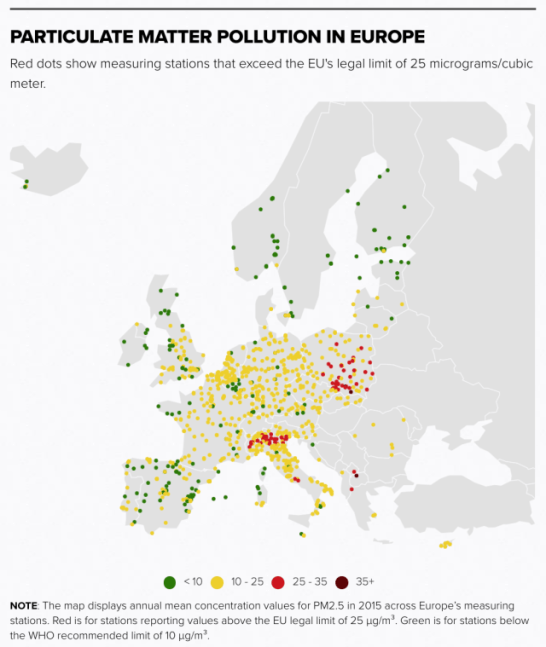
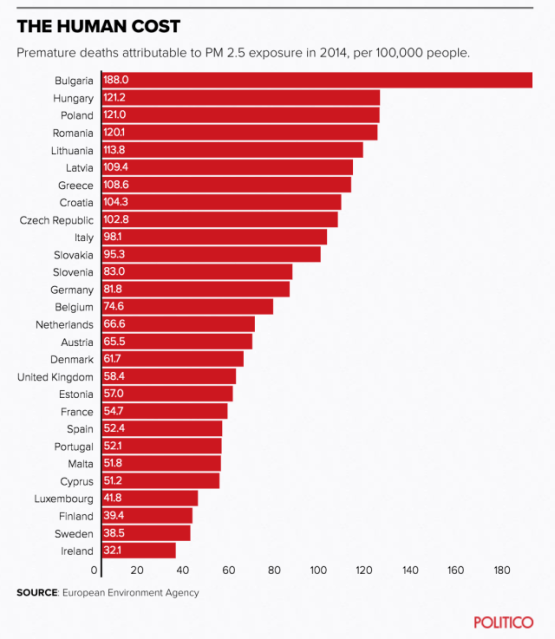
Bulgaria and Poland have the highest levels of premature deaths attributed to particulate pollution.

Air quality in Europe is improving, but pollution is still killing a lot of people.

Fine particulate matter pollution caused 399,000 premature deaths in EU countries in 2014, according to the most recent estimates on the health impact of air pollution published Wednesday by the European Environment Agency (EEA). That is an 8 percent decrease compared to the previous year. The data was submitted by national authorities and analyzed by the EEA, which came up with the estimates of premature deaths.

Air pollution causes heart and respiratory diseases, and cuts life expectancy.

“As a society, we should not accept the cost of air pollution. With bold decisions and smart investments in cleaner transport, energy and agriculture, we can both tackle pollution and improve our quality of life,” said EEA Executive Director Hans Bruyninckx in a press release.

Bulgaria had by far the highest rate of premature deaths attributable to particulate pollution, according to EEA data crunched by POLITICO. Next was Poland, where more than a third of the population heats their homes with polluting coal-fired furnaces. Sweden and Ireland had the lowest rates.

The main source for particulate pollution overall is domestic heating, followed by road transport and industrial processes.

Most countries had lower health impacts in 2014 than in 2013, but premature deaths rose in Cyprus, Denmark, Estonia, Finland, Latvia, Lithuania and Sweden.

The picture looks grimmer for specific air pollutants. Premature deaths linked to nitrogen dioxide (NO2), which is closely linked to diesel vehicle exhaust, increased to 75,000 in 2014 from 68,000 in 2013. Breaches of EU legal limits were reported in 22 of the 28 EU countries in 2015.

EU legal limits for fine particulate matter were breached less frequently in 2015, but over 80 percent of Europe’s urban population was still exposed to concentrations above World Health Organization guidelines. WHO limits are tougher than those set by the EU.

The proportion of people exposed to harmful levels of pollution was even higher for ozone (over 95 percent), which surges during heat waves, and benzo[a]pyrene (over 85 percent) — closely linked to low-quality domestic heating and of particular concern in Central and Eastern Europe.

The European Commission has launched infringement proceedings against more than 20 EU countries for breaching EU air pollution limits.

Source: Air pollution linked to nearly 400,000 premature deaths – POLITICO

Posted in Air Quality, Europe | Tagged , , , , , , , , , , , , , , , , , , | Leave a comment

Air pollution from California fires equals a year’s worth of traffic, analyst says

According to local fire officials, buildings in California’s Napa and Sonoma counties were being evacuated on Monday morning, after multiple wildfires began spreading throughout the area with a thick smoke and large flames. According to the state Department of Forestry and Fire Protection, the fire was burning in the hills above Napa County and had damaged several buildings. As of Monday morning, firefighters have continued to struggle to contain the fire. Officials said dry winds were fanning the flames and asked residents in mandatory evacuation zones to leave immediately.

There’s enough wildfire activity in California and Nevada to blanket much of both states with a layer of smoke in the coming days.

In California alone more than 140,000 acres are burning in large, wildland fires throughout the state. A fire in rough terrain near Reno is also contributing to smoke in northern Nevada.

In just the past two days, fires in California’s wine country are thought to have produced as much small particulate matter as all the vehicles in the state produce in a year.

“It’s a lot,” said Sean Raffuse, an air-quality analyst at the Crocker Nuclear Laboratory at University of California in Davis.

Although the early estimates are rough, Raffuse said the fires in the wine country have probably produced about 10,000 tons of PM 2.5, an air pollutant that’s the main cause of haze in the United States.

By way of comparison, it takes the approximately 35 million on-road vehicles in California a year to generate a similar amount of PM 2.5, Raffuse said.

“Interestingly, these fuels are relatively light compared to some areas,” Raffuse said of the fires in wine country. “For example, I would expect the Redwood Valley Fire burning in Mendocino County to produce 2-3 times more smoke per acre burned.”

The amount of smoke is significant because PM 2.5 is associated with respiratory and cardiovascular problems in people.

And smoke from the thousands of structures burned in some of the fires can be even more hazardous than typical wildland fire smoke, said Jim Roberts, a research chemist from the National Oceanic and Atmospheric Administration’s Earth System’s Research Laboratory.

“It is a little bit different because they had so many structures burn, that is a different fuel mixture … a lot of that stuff has toxic emissions associated with it,” Roberts said.

The smoke and fumes will be most hazardous to the people closest to the burning, he said.

“On the local scale when that smoke stays in the area and you are exposed to it, then it can be harmful,” Roberts said. “People who fight residential fires really worry about those materials. That is why they wear respirators when they go into a house.”

Air quality data from the Environmental Protection Agency showed a large plume of dense smoke stretching from the central California coast, across the northwest corner of Nevada and into southern Oregon and Idaho on Wednesday.

Air quality forecasts in Reno, San Francisco and Sacramento predicted varying degrees of unhealthy air throughout northern California and Nevada.

Source: Air pollution from California fires equals a year’s worth of traffic, analyst says

Posted in Air Quality, USA & Canada | Tagged , , , , , , , , | Leave a comment

Oxford aims to cut air pollution with car ban in zero emissions zone 

Oxford council will phase out polluting vehicles including taxis, cars and buses from city centre area in 2020

The introduction of a zero emissions zone could see levels of nitrogen dioxide fall by up to three quarters by 2035, the councils said. Photograph: David Williams/Alamy

Polluting vehicles could be banned from Oxford city centre under plans to bring in what officials believe would be the world’s first zero emissions zone.

The proposals aim to slash air pollution in the historic university city, which has seen levels of the harmful pollutant nitrogen dioxide plateau above legal limits in some areas.

Under the plans, which are being put out for consultation on Monday, the ban would be introduced in phases, starting with preventing non-zero emissions taxis, cars, light commercial vehicles and buses on a small number of streets in 2020.

As vehicle technology develops, the zero emissions zone would extend to cover all vehicle types, including HGVs, and the whole of the city centre by 2035, according to the joint proposals by Oxford city council and Oxfordshire county council.

The introduction of the zero emissions zone could see levels of nitrogen dioxide, much of which comes from traffic fumes, particularly diesel engines, fall by up to three quarters by 2035, the councils said.

The city has already won £500,000 of government funding to install charging points for electric taxis, and £800,000 to install 100 electric vehicle charging points for residents, but officials say more will be needed to support the zero emissions zone.

Other schemes being considered to support the zone include reduced parking fees for electric vehicles, electric taxi-only ranks and electric delivery vehicle-only loading areas.

Councillor John Tanner of Oxford city council said: “Toxic and illegal air pollution in the city centre is damaging the health of Oxford’s residents. A step change is urgently needed; the zero emissions zone is that step change.

“All of us who drive or use petrol or diesel vehicles through Oxford are contributing to the city’s toxic air. Everyone needs to do their bit, from national government and local authorities, to businesses and residents, to end this public health emergency.”

Oxfordshire county council councillor Yvonne Constance said: “We want to hear from everyone who uses the city centre, including businesses, bus and taxi firms and local residents, so that we get the fullest possible picture.

“We know that there will be a wide variety of views and we want hear them all. Pragmatism will be an important part of anything we plan but we have set the ambition and now we would like to hear people’s views on our proposals.”

Source: Oxford aims to cut air pollution with car ban in zero emissions zone | UK news | The Guardian

Posted in Air Quality, Europe, UK | Tagged , , , | Leave a comment

Wildfires causing ‘unprecedented levels’ of air pollution 

The North Bay wildfires are causing “unprecedented levels” of air pollution throughout the Bay Area, regional air quality officials said today.

The Bay Area Air Quality Management District earlier today issued a smoke advisory because of the wildfires, which have burned tens of thousands of acres in Napa and Sonoma Counties, and this afternoon issued a health advisory and Spare the Air alert.

Air district officials recommend that residents impacted by heavy smoke, particularly in Napa and Sonoma counties, take shelter in buildings with filtered air or move to areas less impacted by the pollution.

“Due to active wildfires and changing wind patterns, air quality could be impacted for many days to come,” air district officials said in a statement.

They encourage residents who see or smell smoke in the area to avoid outdoor activity or exercise. Parents and school administrators should check air quality readings before allowing children to practice outdoor sports, according to the air district.

Real-time air quality readings can be found here.

People who are indoors should set their air conditioning to re-circulate to avoid bringing outside air into buildings. Air district officials also asked that people avoid any activities like wood burning, lawn mowing, leaf blowing, driving or barbecuing that can add to the air pollution.

Children, the elderly and people with respiratory conditions are the most sensitive to the pollution and should take extra precautions, according to the air district.

Source: Air district: Wildfires causing ‘unprecedented levels’ of air pollution | News | Almanac Online |

Posted in Air Quality, USA & Canada | Tagged , , , | Leave a comment

‘Sooty birds’ reveal hidden US air pollution 

Soot trapped in the feathers of songbirds over the past 100 years is causing scientists to revise their records of air pollution.

US researchers measured the black carbon found on 1,300 larks, woodpeckers and sparrows over the past century.

They’ve produced the most complete picture to date of historic air quality over industrial parts of the US.

The study also boosts our understanding of historic climate change.

Smokey cities

Black carbon, a major component of soot, is created through the incomplete burning of fossil fuels such as coal.

The dirty air generated as a result became a major problem as industrialisation expanded across Europe and the US at the end of the 19th century.

Cities were soon coated in sooty air thanks to the unregulated burning of coal in homes and factories.

While the huge impact of black carbon on the health of people living in urban centres has been recognised for decades, it is only in recent years that scientists have understood the role it plays climate change.

When it is suspended in the air, the substance absorbs sunlight and increases warming in the atmosphere.

When it hits the ground it increases melting of snow and ice, and has been linked to the loss of ice in the Arctic region.

US researchers have struggled to find accurate records of the amount of black carbon that was emitted in the manufacturing belt of the US, around Chicago, Detroit and Pittsburgh at the end of the 19th century.

This new study takes an unusual approach to working out the scale of soot coming from this part of the US over the last 100 years.

The scientists trawled through natural history collections in museums in the region and measured evidence of black carbon, trapped in the feathers and wings of songbirds as they flew through the smoky air.

The researchers were able to accurately estimate the amount of soot on each bird by photographing them and measuring the amount of light reflected off them.

“We went into natural history collections and saw that birds from 100 years ago that were soiled, they were covered in soot,” co-author Shane DuBay, from the Field Museum and the University of Chicago, told BBC News.

“We saw that birds from the present were cleaner and we knew that at some point through time the birds cleaned up – when we did our first pass of analysis using reflectance we were like wow, we have some incredible precision.”

Their analysis of over 1,000 birds shows that black carbon levels peaked in the first decade of the 1900s and that the air at the turn of the century was worse than previously thought.

The study showed that during the great depression in the US, the use of coal fell. It boomed again during World War Two but began a long term decline straight after as new fuels like gas were used to heat homes and less polluting forms of coal were burned.

While the study has improved the timeline of air pollution across the industrial part of the US, it also indicates that current emissions inventories underestimate atmospheric levels of black carbon in the early industrial age.

“The big finding and implication of our study is that we are recovering relative concentrations of atmospheric black carbon that are higher than previously estimated from other methods,” said Shane DuBay.

“It helps constrain and inform how we understand the relative role of black carbon in past climate and by understanding that we can more accurately model future climate scenarios.”

Having refined this novel approach the authors believe that it can be adapted for use in other parts of the world with a strong industrial heritage.

“We are very excited about the prospects of expanding the project into the UK which has a longer history of industry and also a longer history of natural history collecting,” said co-author Carl Fuldner from the University of Chicago.

“Some of the resources in the UK go back much farther in time, so the results we could find in a comparative study would be very exciting.”

The study has been published in the journal Proceedings of the National Academy of Sciences (PNAS).

Source: ‘Sooty birds’ reveal hidden US air pollution – BBC News

Posted in Air Quality, USA & Canada | Tagged , , | Leave a comment