The Madrid City Hall on Tuesday reactivated its anti-air pollution protocol and advised it would step up to level two of the protocol and its subsequent restrictions on traffic after levels of over 180 micrograms of nitrogen dioxide per cubic meter were measured in two monitoring stations in the Spanish capital.
It is the fifth time the protocol has been activated in under a month, coming just a week after it was de-activated.
Although Madrid experienced rainfall for the first time in 50 days on Oct. 17, warm and dry weather returned quickly to Madrid and temperatures around ten degrees centigrade above the average for the time of year and an almost total absence of wind has seen a steady buildup of nitrogen dioxide over the past five days.
The Madrid Town Hall website advises that the first stage of the protocol means that traffic on the M-30 ring road and on access roads into the capital is “limited to 70 kilometers an hour,” both in an out of the city while recommending the use of public transport.
Meanwhile the second stage, which comes into effect on Wednesday, prohibits private vehicles of non-residents from parking in the city center.
A third level would limit the use of private vehicles on certain days of the week, with cars whose licenses end in odd numbers allowed to circulate one day and those with even numbers the next, effectively halving the number of cars on the roads.
With the current weather system expected to remain in place until at least the end of the week and perhaps, longer, it is possible level three could come into use in the coming days.
At the start of October, the Madrid Town Hall confirmed that as of December this year the central Gran Via would be closed to traffic on a permanent basis with only local residents, taxis and public transport able to use the main thoroughfare.
A total of 4,810 people died as a result of air pollution in the Iranian Capital of Tehran over a one-year period, according to Health Officials.
Air pollution in Tehran was the most dangerous in the country due to the high number of vehicles in the city, a spokesperson for the Iranian Ministry of Health said, in comments carried by the Tasnim news agency on Monday.
The reported deaths occurred over the course of the most recent year in the Persian calendar, from March 2016 to March 2017.
Particularly in warmer months, the pollution could be so acute that all primary schools, kindergartens in the city and surrounding areas are closed.
Due to a lack of adequate public transport, many Tehran residents have no alternative but to drive a car.
In addition, petrol is both cheap at about 25 cents per litre and of low quality.
Measures were introduced in 2016 that mean drivers of individual cars are only allowed on the road every other day.
Drivers of older, more polluting vehicles will have to pay almost twice as much to drive in central London.
Mayor Sadiq Khan’s £10 T-Charge, which mainly applies to diesel and petrol vehicles registered before 2006, has come into force.
It covers the same area as the existing congestion charge zone, bumping up the cost to £21.50 for those affected.
Opponents said the scheme would “disproportionately penalise London’s poorest drivers”.
The measure is the latest attempt by Mr Khan to improve air quality in the capital and according to the mayor’s office, will impact 34,000 motorists a month.
Speaking on the Today programme, Mr Khan said: “We’ve got a health crisis in London caused by the poor quality air.
“Roughly speaking each year more than 9,000 Londoners die prematurely because of the poor quality air – children in our city whose lungs are underdeveloped, with adults who suffer from conditions such as asthma, dementia and strokes directly caused by poor quality air.”
Earlier he said: “I refuse to be a mayor who ignores this and I am determined to take effective action to reduce the harm it does to Londoners.”
However, Simon Birkett, from the campaign group Clean Air London, said the move does not go far enough.
“The Mayor has pledged in his manifesto to restore London’s air quality to legal and safe limits and that means he has to do a whole lot more.
“We want him to take steps which are bigger, stronger an smarter.”
What is changing?
From Monday 23 October, there will be a £10 daily fee for those who drive more polluting vehicles in the congestion charging zone, on top of the existing £11.50 congestion charge.
Vehicles which do not comply with the Euro IV exhaust standard must pay the charge.
The standard defines emissions limits for cars, vans, buses, coaches and lorries. Most vehicles registered before 2006 are likely to exceed these limits.
The zone will operate between 07:00 and 18:00, Monday to Friday.
The T-Charge is the first of a series of new rates being introduced in London.
It is due to be replaced by a stricter Ultra-Low Emission Zone in 2020, although Mr Khan is consulting on bringing this forward to 2019.
This will mean diesel cars registered before September 2015 and petrol cars registered before 2006 will face a £12.50 charge.
The mayor hopes to expand the area covered for cars and vans up to the North and South Circular roads in 2021.
City authorities in Birmingham, Leeds, Southampton, Derby and Nottingham have also been advised to impose charges for some polluting diesel vehicles by 2020, the Department for Environment, Food and Rural Affairs (Defra) said.
Paris, Grenoble and Lyon introduced an emission sticker scheme in January which splits vehicles into six different groups depending on their Euro Emissions standard.
Vehicles deemed too polluting – which includes petrol and diesel-powered cars registered before 1997 – are not granted a sticker, banning them from driving in the city during certain times.
Sue Terpilowski, from the Federation of Small Businesses, said: “The introduction of the T-Charge, comes at a time when small and micro-businesses in London are already facing astonishingly high property, employment and logistics costs.
“There is a fear that this will be the final straw that closes businesses and takes jobs.”
Shaun Bailey, conservative environment spokesman at the London Assembly, said: “As an asthmatic I’m well aware of how critical an issue this is for London but we need policies that actually deliver progress.
“By boasting about a policy that so disproportionately penalises London’s poorest drivers and puts jobs at risk, the mayor is simply blowing more smoke into the capital’s already-polluted atmosphere.”
Friends of the Earth air pollution campaigner Jenny Bates said: “Clearly the last thing individuals want is a new charge for moving around, but the grim reality is that nearly 10,000 early deaths are caused in London each year by the capital’s toxic air, so the Mayor is right to try to dissuade drivers bringing the oldest, dirtiest vehicles into central London.
“It’s only one small step towards clean air though – we urgently need a programme of meaningful financial assistance to help drivers of the dirtiest vehicles switch to something cleaner, and bold policies to cut traffic over all.”
Air pollution levels in India’s capital soared off the charts once again as millions of Indians burst fire crackers to celebrate Diwali, the Hindu festival of lights, despite a Supreme Court ban on the sale of fireworks in the region.
Already one of the world’s most notoriously polluted mega cities, the capital saw its air quality index (AQI) gradually worsen until it reached a level of 1,031 around 9 a.m. on Friday, according to the United States embassy in New Delhi. A reading of 0-50 is considered good, while levels between 300 and 500 are considered “hazardous.” Anything above 500 is considered “Beyond Index.”
By Friday around 1 p.m., the U.S. embassy showed New Delhi’s pollution had nearly halved with AQI at 548, which still appeared to be the worst of any major city in the world.
India’s Supreme Court had banned the sale of firecrackers throughout the national capital region in the days leading up to Diwali, which fell on Oct. 19, after celebrations last year ushered in weeks of poisonous smog. The ban prompted some hand-wringing in the city of more than 20 million people because it targeted a Hindu religious festival.
Although pollution spiked on Diwali last year, firecrackers are not the main cause of air pollution in New Delhi. Air quality generally deteriorates as winter sets in because of a combination of agricultural crop burning in the nearby states of Punjab and Haryana, dust from roads and construction sites, industry, coal power plants and vehicular emissions.
A recent report from the Lancet Commission on Pollution and Health found that air contamination kills roughly 6.5 million people each year and that all forms of pollution cost the global economy an annual $4.6 trillion. The authors said deaths from pollution associated with industrial development are on the rise and that low-income countries, such as India, suffer the worse effects. For poor countries, pollution related deaths and disease cost the equivalent of 1.3 percent of gross domestic product, according to the report.
In India’s vibrant democracy, coordinated action on complex problems such as air pollution is difficult. The issue crosses political jurisdictions, and farmers — who are a key political constituency in India — continue to light fires despite a Delhi High Court directive.
Smoke from forest fires might contribute to more than half of certain gritty air pollution events in the continental U.S. during the summer, and as much as 20 percent of those events throughout the year, according to new research at The University of Alabama in Huntsville (UAH).
This research could be a step toward developing tools to warn of possible smoke-related pollution events and a better understanding of the potential health effects of smoke from planned and controlled forest burning.
“You could use something like this as a way to determine whether a particular planned burn is going to be a tipping point in going over the pollution limit downwind and whether you should burn that day,” says Aaron Kaulfus, a graduate student in UAH’s Department of Atmospheric Science.
Kaulfus and Dr. Udaysankar Nair, an associate professor of atmospheric science at UAH, used data collected by a pair of instruments on NOAA and NASA satellites to track both hot spots that indicate forest fires and the smoke plumes from those fires. They combined that with data from the Environmental Protection Agency (EPA) on surface sites where air pollution exceeded the safe limit of particles no more than 2.5 microns in size.
Particles smaller than 2.5 microns in diameter (less than one-quarter of the width of a human hair) are small enough to get into a person’s lungs. In heavy-enough concentrations, they can cause damage. EPA estimates biomass burning contributes more than 25 percent of all small particle pollution (identified by the EPA as PM2.5) in the U.S.
The UAH team found that during the summer — when the level of smoke coverage across the U.S. peaks — about 52 percent of all PM2.5 air pollution events in the continental U.S. occur when smoke from forest fires is present.
At rural pollution monitor sites in the Northwestern U.S., more than 80 percent of summer days when smoke is present also have excess PM2.5 particles in the air.
On an annual basis, “at least 20.1 percent of the total daily exceedances coincided with identifiable smoke plumes overhead,” Kaulfus says. “On average, the PM2.5 concentrations were higher for days during which smoke was present over the area.”
While the effects of smoke from forest fires and other biomass burning on levels of ozone (another pollutant) have been studied, Dr. Nair says this is the first attempt to connect smoke and particulate pollution on a nationwide basis.
“We took a national approach to it rather than a station-by-station approach,” Kaulfus says.
This research, which was supported by the National Science Foundation and NASA, has been accepted for publication in the journal Environmental Science and Technology.
While there was smoke overhead in one of five particulate pollution events during the study period, Kaulfus says there isn’t a clear-cut cause-and-effect relationship.
“It was at least plausible that smoke was influencing those surface contaminants,” he says. “But one of the biggest problems with the NOAA smoke product is that there is no way of knowing the vertical profile of where the smoke is, whether it is on the surface or up in the deep layer of the atmosphere.”
“What this really does is give us the upper limit of forest fire smoke’s effects on these pollution events,” adds Dr. Nair.
The area most affected by forest fire smoke was a large wedge in the central U.S., from Canada to east Texas. During the study period, from 2005 to 2016, the NOAA and NASA satellite instruments saw more than 600 days with smoke cover over most of North Dakota, Minnesota, and Iowa, as well as eastern portions of both Kansas and Nebraska, and the eastern half of South Dakota.
While forest fires — both wild and planned — in the continental U.S. contributed smoke over much of the contiguous 48 states, a significant fraction of the smoke recorded over that wedge of most frequent smoke coverage came from forest fires in Canada, Alaska, and even Siberia, Kaulfus says.
“We can see all the smoke being piped down from Canada, all the way down over the eastern cities, extending a couple of hundred kilometers out over the Atlantic and the Gulf Coast,” says Dr. Nair.
Under stable atmospheric conditions, smoke plumes from smoldering fires can be confined to a shallow atmospheric boundary layer near the ground, enhancing small particle pollution at the surface. In the case of high-energy flaming fires, smoke can be injected to higher altitudes.
Routine convection processes can also mix smoke from either kind of fire throughout the deep atmosphere, which can transport smoke thousands of miles from its source and impact downwind air quality.
An area of the western Gulf of Mexico off the coast of Texas and western Louisiana had more than 350 days of smoke cover during the study period, largely caused by forest fires and biomass burning in Mexico and Central America, Nair says.
Pollution has been linked to nine million deaths worldwide in 2015, a report in The Lancet has found.
Almost all of these deaths occurred in low- and middle-income countries, where pollution could account for up to a quarter of deaths. Bangladesh and Somalia were the worst affected.
Air pollution had the biggest impact, accounting for two-thirds of deaths from pollution.
Brunei and Sweden had the lowest numbers of pollution-related deaths.
Most of these deaths were caused by non-infectious diseases linked to pollution, such as heart disease, stroke and lung cancer.
“Pollution is much more than an environmental challenge – it is a profound and pervasive threat that affects many aspects of human health and wellbeing,” said the study’s author, Prof Philip Landrigan, of the Icahn School of Medicine, at Mount Sinai in New York.
The biggest risk factor, air pollution, contributed to 6.5 million premature deaths. This included pollution from outdoor sources, such as gases, and in households, such as burning wood or charcoal indoors.
The next largest risk factor, water pollution, accounted for 1.8 million deaths, while pollution in the workplace was linked to 800,000 deaths globally.
About 92% of these deaths occurred in poorer countries, with the greatest impact felt in places undergoing rapid economic development such as India, which had the fifth highest level of pollution deaths, and China, which had the 16th.
In the UK, about 8% or 50,000 deaths are estimated to be linked to pollution. This puts the UK in 55th place out of the 188 countries measured, placing them behind the US and many European countries, including Germany, France, Spain, Italy, Denmark.
Dr Penny Woods, of the British Lung Foundation, said: “Air pollution is reaching crisis point worldwide, and the UK is faring worse than many countries in Western Europe and the US.
“A contributing factor could be our dependence on diesel vehicles, notorious for pumping out a higher amount of poisonous particles and gases.
“These hit people with a lung condition, children and the elderly hardest.”
In the United States, more than 5.8% – or 155,000 – deaths could be linked to pollution.
The authors said air pollution affected the poor disproportionately, including those in poor countries as well as poor people in wealthy countries.
Study author Karti Sandilya, from Pure Earth, a non-governmental organisation, said: “Pollution, poverty, poor health, and social injustice are deeply intertwined.
“Pollution threatens fundamental human rights, such as the right to life, health, wellbeing, safe work, as well as protections of children and the most vulnerable.”
The results were the product of a two-year project. The authors have published an interactive map illustrating their data.
As Hindus across India celebrate Diwali this week, scientists fear a ban on firecrackers and other emergency anti-pollution measures deployed by authorities may not be enough to prevent a repeat of last year’s “airpocalypse” in Delhi.
Each year, as winter descends on the Indian capital, a perfect storm of seasonal crop stubble burning, dense cloud cover and smoke generated by millions of firecrackers used in Diwali celebrations turns Delhi’s skies a putrid yellow.
Last year’s unprecedented pollution disaster saw heavy smog hover above the capital for weeks, forcing schools to shut as authorities scrambled to contain the crisis.
This time they are taking few chances, as India’s environmental watchdog shut down a coal-fired power plant on Wednesday and banned the use of diesel generators in Delhi.
On Delhi’s outskirts however, farmers are busy burning crop remnants to clear their land before replanting, and the acrid smoke has already begun to drift south, casting a pall over the world’s most polluted capital and leaving millions gasping for breath.
The illegal practice shows no signs of ending, as low-income farmers like Devi say they have no alternative, even if it harms city dwellers miles away.
“We have to burn it. We know this is harmful but what can we do?” Devi, who only gave her last name, told AFP on her farm in Sonipat just 60 kilometres (37 miles) from Delhi.
“We also need to make money for our families,” she said, stoking the smouldering stubble and defending the practice for being cost effective and quicker than other methods to clear her less than an acre farmland.
The sharp reek of burning stubble marks the onset of the pollution season in Delhi as air contaminants soar to dangerous levels.
A NASA satellite image taken early October showed widespread fires across India’s northern breadbasket, with a thick grey haze streaking toward Delhi and its 20 million inhabitants.
Nearly 35 million tonnes of post-harvest stubble is burnt annually in Haryana and Punjab, two predominantly rural states near Delhi, despite a nationwide ban on the practice since 2015.
FIGHT FOR CLEAN AIR
But farmers protest that they alone are not responsible for Delhi’s atrocious air, and say they need more support to shift to a different method of farming.
“The farm fires in northern India certainly worsen the pollution situation, but we need alternatives for it to end,” said Gufran Beig, chief scientist at state-run System of Air Quality Weather Forecasting and Research.
Government-led efforts — from shutting brick kilns to limiting cars on the road — have failed to tackle air pollution, which a US study in February found kills one million people prematurely in India every year.
Last year, levels of PM2.5 — the fine particles linked to higher rates of chronic bronchitis, lung cancer and heart disease — soared to 778 in the days that followed Diwali, prompting the Supreme Court to warn of a public health emergency.
Levels of PM2.5 between 301 and 500 are classified as “hazardous”, while anything over 500 is beyond the official index.
“If there are no remedies, we might see a repeat of last year’s situation,” Beig said.
On Thursday, levels of PM2.5 pollutants in Delhi were hovering around 200 — still eight times the World Health Organization’s safe limit of 25.
In the run-up to Diwali, the government banned a host of older diesel vehicles, temporarily closed some polluting industries and prohibited the burning of waste material.
The emergency measures followed a controversial Supreme Court ban earlier this month on the sale of firecrackers in Delhi during the festive season.
The move upset some revellers, who enjoy setting off crackers to ring in the season, and fireworks vendors who feel they are being unfairly targeted.
“We also live in the city and know our responsibilities,” said Amit Jain, a despondent firecracker vendor in Delhi’s old quarter.
“We also want to breathe clean air, but why target firecrackers and not ban cars, industries and construction?” he told AFP.
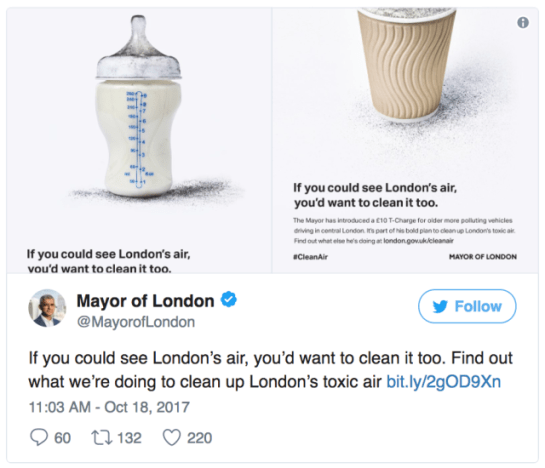
A hard-hitting poster campaign highlighting the health risks posed by London’s dangerous air pollution levels is to go on display across the Tube network.
Posters featuring stomach-churning images of everyday objects covered in black soot will be plastered across the capital’s train and London Underground stations from early November.
The campaign is being launched by London Mayor Sadiq Khan who has made it his aim to clean up the city’s air quality.
One of the posters shows a baby’s bottle, with the teat coated in black dust with the slogan: “If you could see London’s air, you’d want to clean it too.”
The other images show a toddler’s cup, a pint of beer and a coffee dusted with soot.
City Hall said the campaign is designed to be honest with Londoners about the scale of the pollution problem and provide them with the information they need on air quality.
The images began to appear on social media on Wednesday ahead of the introduction of the T-charge next week where older, more polluting vehicles will have to pay to enter central London.
The £10 Emissions Surcharge, which comes into effect, on Monday will mean drivers of vehicles that do not meet the minimum emission standards will have to pay extra on top of the Congestion Charge, which is already in place.
The Mayor, who has pledged to tackle air quality since taking office in 2015, faced criticism last week after it emerged that every borough in London exceeds World Health Organisation limits for PM2.5 – toxic air particles.
Green campaigners called on him to do more to deal with the problem after the report revealed the shocking reality that all Londoners are exposed to the tiny particles – which can cause respiratory and cardiovascular diseases and cancer – every day.
On the launch of the poster campaign, Mr Khan said: “London’s air is a killer and is linked to asthma, strokes, heart disease and dementia.
“I’m committed to doing all I can to cut pollution and help Londoners protect themselves from the harm it causes.
“These arresting images are designed to show Londoners how serious a threat air pollution is to their health, and explain the range of measures I’ve brought in and am working to introduce to make our air safer.
“The next stage will be the introduction of the £10 T-charge on Monday, which will help remove the oldest, most pollution vehicles from the heart of the capital.
“I refuse to be a Mayor who ignores this and I am determined to take effective action to reduce the harm it does to Londoners.”
The campaign appeared on social media from October 18 and will be across the TfL network from November 3.
Pollution Masks since 1993 - The 'Original' and still the best - Made in the UK - respro.com
THE AIR WE BREATHE
The Respro® Bulletin Board is designed to keep you up to date with current views and issues relating to Air Pollution and its health implications in our daily lives.









 Respro® Masks are reusable