Time is ‘running out’ to protect London children: major air pollution warning from top doctors 

More than 220 doctors today warned time is “running out” to tackle Britain’s toxic air scandal to protect a generation of young children.

The medics, including more than 100 from London, wrote to Theresa May urging her to start phasing out diesel vehicles as soon as possible to cut harmful fumes on the streets of the capital and other cities and towns.

“A national diesel reduction initiative, led by Government, will represent a major public health advance,” they said.

“However, time is running out, without urgent action emissions from diesel vehicles will cause irreversible lung damage to the current generation of children.”

They highlighted “strong and growing” evidence of a wide range of health impacts over lifetimes from nitrogen dioxide (NO2) and black carbon (soot) emissions.

“For example, in infants and children there is strong evidence, including data from children in London, that exposure to fossil fuel-derived air pollution stunts lung growth,” they explained.

They highlighted that 45 per cent of nitrogen oxide emissions in Greater London come from road transport.

“Modelling has shown that, alongside other measures, the percentage of cars that are diesel will need to be reduced from 57 per cent to five per cent of the total if Greater London is to become compliant with legal limits on NO2 emissions,” they added.

Ministers have so far shied away from a nationwide diesel car scrappage scheme, arguing that air pollution is largely an urban problem, or from changing vehicle excise duty to discourage motorists from buying diesel models.

However, the more than 280 doctors, nurses and other health professionals who signed the letter called for national action to dramatically cut the number of diesel cars, vans, taxis and light trucks.

In the letter drawn up by campaign group Doctors Against Diesel, they emphasised that there are now 585 Air Quality Management Areas across the UK, so most town halls had a statutory duty to take action on illegal levels of air pollution but their hands were tied as they had no powers to ban diesel vehicles.

screen-shot-2017-02-15-at-08-24-28

Professor Jonathan Grigg, Professor of Paediatric Respiratory and Environmental Medicine, Queen Mary University of London, said: “In London, we know that diesel engines are a major and unnecessary cause of air pollution along our roads.

“Cutting diesel emissions would have an immediate impact on children’s personal exposure, and improve their long-term health.”

Professor John Middleton, President of the UK Faculty of Public Health, said: “Diesel…is linked to health effects that begin before birth and extend throughout the life course, from childhood lung development and asthma, to increased risk of heart disease, stroke, lung cancer and dementia.

“It is time for diesel to be recognised as the health emergency that it is.”

Scientists estimate the death toll in London from NO2 and small particulate pollution is up to 9,400-a-year, with many more people suffering health problems when toxic air peaks such as in mid-January.

Dr Isobel Braithwaite, a junior doctor at the children’s unit at the North Middlesex Hospital in Tottenham, north London, said: “I’ve seen a lot of patients, including children, come to A&E with asthma attacks, which are much more likely when pollution levels are higher.”

Dr Rajive Mitra, a cycling GP in North Lambeth, said: “I’d advise people heading out onto London’s busier streets to try to walk on quieter roads and walk away from the side of the road.”

Other signatories of the letter include Professor Inderjeet Dokal, Professor of Paediatrics, Centre for Genomics and Child Health, Queen Mary University London, Professor Adrian Martineau, Clinical Professor of Respiratory Infection & Immunity at Queen Mary University of London, Sir Andrew Haines, Professor of Public Health and Primary Care, London School of Hygiene & Tropical Medicine, David McCoy, Professor of Global Public Health, Queen Mary University London, Professor Chris Griffiths, Joint Centre Lead at the Centre for Primary Care and Public Health, Barts and the London School of Medicine and Dentistry, Professor Martin McKee, Professor of European Public Health, London School of Hygiene and Tropical Medicine, Professor Robert Walton, Clinical Professor of Primary Care, Queen Mary University London, Professor Stephen Holgate, Clinical Professor of Immunopharmacology at the University of Southampton, Professor John Yudkin, Emeritus Professor of Medicine, University College London, Professor Alan Maryon-Davis, Honorary Professor of Public Health, Kings College London, Dr Susan Hill, Consultant Paediatric Gastroenterologist, Great Ormond Street Hospital for Children, London, as well as more than 70 GP doctors, registrars, trainees or retired general practitioners.

Source: Time is ‘running out’ to protect London children: major air pollution warning from top doctors | London Evening Standard

Posted in Air Quality, Europe, Health Effects of Air Pollution, London, UK | Tagged , , , , | 1 Comment

Nigeria declares pollution in southern city an emergency, closes plant 

Nigeria declared an air pollution emergency in a major southern city on Tuesday and closed an asphalt plant there after residents complained about the fumes from its furnaces, in a country plagued by corruption and poor governance.

Residents staged a protest in Port Harcourt, a harbor city in the oil-producing Niger Delta region, waving their hands in the air to show the soot stains from touching cars.

“The Federal Ministry of Environment has declared the air pollution in Port Harcourt an emergency situation and has subsequently issued a notice to temporarily shut down an asphalt processing plant…belching out thick smoke,” the government said in a statement.

It did not name the firm, but a state government statement said it was from China.

“If I am having my bath, the color of the water, the stains on the sink are always black,” businessman Charles Adolor said. “Before we can use already-washed plates we have to rewash them again.”

Adolor and his wife and son have been wearing face masks inside their apartment to protect themselves from the soot that covers everything from the windows to the bathroom.

In the Niger Delta’s oil-producing swamps, residents complain about crude spills from broken or blown-up pipelines and acid rain from gas flaring, the burning of natural gas at oil wells.

Source: Nigeria declares pollution in southern city an emergency, closes plant | Reuters

Posted in Africa, Air Quality | Tagged , , , | Leave a comment

Diesel trains may expose passengers to exhaust: Levels of certain airborne pollutants are up to nine times higher in train cars directly behind diesel locomotives than on a busy city street

A new study from U of T Engineering finds that diesel trains may expose passengers to elevated levels of certain pollutants, especially if they are sitting directly behind the locomotive.

“Imagine yourself driving down a busy highway in a convertible, and spending your entire commute sitting behind a very large diesel truck,” said Greg Evans, a professor of Chemical Engineering and director of the Southern Ontario Centre for Atmospheric Aerosol Research (SOCAAR). “That’s comparable to the levels we see here.”

Evans and Dr. Cheol-Heon Jeong, a senior research associate at SOCAAR, measured the concentration of airborne particles using two types of portable instruments: one that detects black carbon (BC) and one that detects ultrafine particles (UFP).

“Black carbon is essentially soot, and is formed right in the cylinder of the diesel engine,” said Evans. UFP are formed when gases in the exhaust condense into microscopic particles less than 100 nanometres in diameter, or about 1000 times smaller than the width of a human hair.

Studies have linked both BC and UFP to detrimental health effects, although evidence is still emerging and not conclusive. However, both measurements also act as proxies for the complex mixture of gases in diesel exhaust, which is an established carcinogen and associated with respiratory, cardiovascular and reproductive health effects.

In prior research, Evans and his team have found elevated levels of BC and UFP next to busy streets and highways. One day, Jeong left the sensors turned on during his morning commute on the train — it wasn’t until he saw the data that he and Evans realized how high the numbers were inside cars pulled by diesel locomotives.

“We were quite surprised, and after making confirmation measurements we got in touch with Metrolinx to let them know of the potential issue,” said Evans. Metrolinx is the transit authority for the Greater Toronto and Hamilton Area.

Over the course of 43 trips, the team gathered more data from inside commuter train cars. They also took measurements while walking along busy streets in downtown Toronto for comparison. In a paper published in Atmospheric Environment, they report that:

  • Cars being pulled by diesel trains and located directly behind the locomotive had an average of nine times the levels of BC and UFP compared to air next to a busy city street.
  • Cars being pushed by diesel trains during a return trip had air that was generally cleaner than that next to busy city streets.
  • When being pulled, cars in the middle of the trains had levels three times lower than the front-most cars. The average BC and UFP concentrations across all pulled cars was about five times higher than on city streets.

“The health and safety of our customers and staff is our number one priority, which is precisely why we’ve supported the work of Dr. Evans and his research team,” said Greg Percy, Chief Operating Officer for Metrolinx. “We welcome any findings that can help us run a healthier, safer transit service and we’re hopeful this work will result in improvements that will be applied throughout the industry and within other public transit agencies in Canada and abroad.”

Percy said that Metrolinx is taking a number of steps to address the issue, such as installing high-efficiency filters in the ventilation systems of its train cars. The organization is also moving to locomotives with improved emissions standards and to electrified service on key routes, which will eliminate the diesel emissions altogether.

Evans and his team are currently working with Metrolinx and SNC Lavalin to test the new improved filters for the air intake vents. Preliminary results are positive. “Installing the higher grade filters did produce a marked improvement, with an 80 per cent reduction in the levels of black carbon,” said Evans.

“Metrolinx has been very supportive of our research.” said Jeong. “Our collaboration with them is most welcome as it will help translate our research findings into action. Further research is also required to evaluate in-transit exposure for all types of diesel-powered passenger trains.”

In the meantime, there are practical steps that passengers can take. “I would advise pregnant women and passengers with heart or respiratory health problems not to travel in the front car,” said Evans. But he would not necessarily suggest avoiding the train entirely.

“I commute by train on a regular basis myself and have done so for years,” said Evans. “As an air quality researcher, I want to see a reduction in overall emissions, and trains are a more efficient system than people commuting in their cars. I don’t want to discourage people from taking transit, or alarm them unduly, but there is an issue here. It underscores the importance of train electrification, which will address this indoor air issue in addition to helping to combat climate change.”

Source: Diesel trains may expose passengers to exhaust: Levels of certain airborne pollutants are up to nine times higher in train cars directly behind diesel locomotives than on a busy city street — ScienceDaily

Posted in Air Quality, Health Effects of Air Pollution | Tagged , , , | Leave a comment

Welcome to Onitsha: the city with the world’s worst air 

The Nigerian city has recorded the world’s worst levels of PM10 air pollution. But although the results are lethal, the problem is not taken seriously here
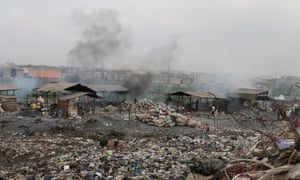
Approaching Okpoko market through thick smog on the back of an okada (motorcycle taxi), the natural reaction is to cover your nose to protect yourself from the dust storm – but the effort is futile.

When a lorry zooms past, kicking up yet another red cloud of dirt, a trader turns the head of a sleeping toddler away from the road, a protective act that is as poignant as it is pointless.

This is a typical day in the southern Nigerian port city of Onitsha – which last year gained notoriety when it was ranked the worst city in the world for the staggering levels of PM10 particulate matter in its air.

Onitsha’s mean annual concentration was recorded at 594 micrograms per cubic metre by the World Health Organization – massively exceeding the WHO’s annual guideline limit for PM10s of 20μg/m3.

PM10 refers to coarse dust particles between 10 and 2.5 micrometres in diameter, while PM2.5s are even finer and more dangerous when inhaled, settling deep in a person’s lungs. Sources of both include dust storms, gases emitted by vehicles, all types of combustion, and industrial activities such as cement manufacturing, construction, mining and smelting. Onitsha scores highly on most of the above – as do other rapidly growing Nigerian cities such as Kaduna, Aba and Umuahia, all of which also featured in the WHO’s 20 worst offenders for PM10s.

In Onitsha’s very busy Okpoko market, my air quality monitor registers 140 for PM10s and 70 for PM2.5s – all way over recommended healthy levels, but still nothing compared to the readings triggered in other parts of this densely populated commercial and industrial hub.

The entire vicinity of the market is perpetually dusty, as wood-sellers saw lumber into different shapes and sizes. The air here is made worse by all the fine sand particles that fly off the back of trucks as they visit one of the many dredging companies on the bank of the River Niger, just behind the wood market.

One female traffic warden has been working in the same spot here for two days. How does she cope with the dust? “I am just doing my job,” she replies reluctantly. “Dust does not kill people.”

But she is mistaken. According to the United Nations Environment Programme (Unep), around 600,000 deaths throughout Africa every year are associated with air pollution, while an October 2016 report by the Organisation for Economic Co-operation and Development (OECD) suggested that polluted air could be killing 712,000 people prematurely every year across the continent.

The warden’s attitude towards this invisible but deadly threat is widespread among Onitsha’s residents – but not necessarily because they are nonchalant about their health. Most are simply unaware of the issue.

Some say they have more pressing concerns, such as how to feed their family. Others have simply become accustomed to living in a dirty and polluted environment.

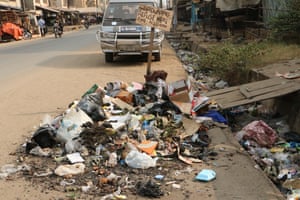
Onitsha is grossly polluted – not just in terms of the air quality, but also the solid waste that litters the streets, blocking drainages and canals. With not a single waste bin in sight, heaps of unregulated rubbish dumps occupy roadsides and street corners.
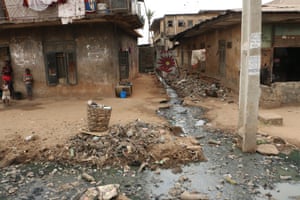
Ikechukwu Obizue, a businessman in the neighbourhood of Nwangene, says residents can only do so much when there is little corresponding effort by the city’s government.

“Onitsha is quite dirty, but the government is not doing anything about it. We do environmental sanitation monthly, but then the city returns to being dirty,” Obizue says. “It is the government’s responsibility to keep the city clean, not the work of the residents – people in this city are too busy hustling to make an income.”

‘We don’t take air pollution seriously’

In Nwangene, my air monitor shows 667μg/m3 for PM10s – a reading in excess of the 594 annual figure that gave Onitsha its title of the world’s most polluted city. What’s more, the smaller and even more dangerous particulate (PM2.5) reading of 290 is far in excess of the WHO’s annual figure of 66.

The air quality proves just as bad at Ochanja market, with PM10s registered at 586 micrograms and PM2.5s at 266. Yet in these highly polluted areas, few people show any sign of trying to protect themselves from the threat.

There are only a few air masks in sight. A good number of aluminium and copper recyclers are not wearing masks, even while smelting metal scraps. Worse still, most smelting activities are done in the open, releasing monstrous clouds of smoke into the core of the city.

At one of the few state-approved dump sites on Creek Road, Ikechuckwu works at a smelting workshop. He is sweating profusely as he sits on a pile of ash, taking a break from work. He explains he has been smelting iron for a little over five years – but says not to worry about his health.

“I know how to take care of myself,” he brags. “I am not wearing a nose mask because I don’t need it. I take medicine to cater for my health.”
It is hard to determine to what extent these high concentrations of particles are affecting the residents of Onitsha, since there is no official data – but the health effects attributed to sustained exposure to PMs, especially PM2.5s, are well proven.

For a state government that can barely manage its waste disposal system, however, regulating its air quality appears a far-fetched aspiration. The now defunct Anambra State Environmental Protection Agency was widely criticised for failing in its responsibility to effectively tackle environmental pollution, and in its place, the Anambra State Waste Management Agency was created – with little effect.

The state’s Ministry of Environment, Beautification and Ecology did not respond to the Guardian’s questions regarding air pollution in Onitsha.

“The major problem is that we don’t take air pollution seriously in Nigeria,” says medical practitioner Dr Nelson Aluya. “As the population increases and we become more industrialised, we ought to have active air-monitoring agencies and a federal environmental protection agency. We say they are there – but are they active?”

In truth, air quality monitoring and control is not on the radar of many African governments. Nigeria has a long list of environmental protection laws and regulations that are barely enforced.

“Even in the healthcare sector,” Aluya continues, “there is no standardised care to monitor those who have chronic obstructive pulmonary diseases resulting from exposure to bad air, and no standard procedure in hospitals to check for oxygen levels.

“So you see, we are in deep trouble. If we have not recognised the fact there’s a problem, then how do we solve it? Unfortunately, people will keep dying as stakeholders remain nonchalant.”

Source: Welcome to Onitsha: the city with the world’s worst air | Cities | The Guardian

Posted in Africa, Air Quality | Tagged , , , , , | Leave a comment

Beijing bans higher emission vehicles to control air pollution 

Light-duty gasoline-powered cars that fail to meet the National Emission Standard III will be banned from entering Beijing’s fifth ring on weekdays.

Beijing has banned high-emission vehicles in a bid to control recurring air-pollution enveloping the city with a population of 21.7 million people.

Starting from tomorrow, light-duty gasoline-powered cars that fail to meet the National Emission Standard III will be banned from entering Beijing’s fifth ring on weekdays.

Substandard cars will also be taken off the road through annual inspections or spot checks.

The Chinese capital currently requires new cars to comply with the “Beijing VI” emission standard, which is higher than the widely-used National Emission Standard V and equivalent to the Euro VI standard, the strictest in China.

“After weeding out yellow-labelled cars (outdated and heavy-polluting vehicles), vehicles consistent with the National Emission Standards II and III release most of the pollutants on the roads,” state-run Xinhua news agency quoted Yu Jianhua, chief engineer of the Beijing Municipal Environmental Protection Bureau.

Higher-polluting gasoline vehicles account for less than 10 per cent of vehicles on the road, but discharge over 30 per cent of nitrogen oxide and 25 per cent of volatile organic compounds, Yu said.

Beijing’s 5.7 million vehicles produce 500,000 tonnes of various pollutants annually and account for 31 percent of locally-generated PM 2.5, a particulate matter associated with hazardous smog, making it the prime source of PM 2.5, according to the environmental authority.

Plagued by smog over the past decade, the capital city has initiated a series of regulations to improve its air quality but the pollution persisted sparking public criticism.

It has moved out high-polluting industries, pulled outdated cars off the road, continued to improve the public transportation system and rolled out policies to support new energy vehicles.

Average density of PM 2.5 in the capital was 73 micrograms per cubic meter in 2016, down 9.9 per cent from the previous year, the Beijing Municipal Reform and Development Commission said.

A new round of air pollution hit Beijing and 20 other cities in eastern China due to unfavourable weather conditions.

Apart from the Beijing-Tianjin-Hebei region, which is expected to see heavy pollution till tomorrow, air quality in more than 20 cities in provinces such as Shandong and Henan is forecast to deteriorate due to unfavourable weather conditions.

A cold front is expected to help disperse the pollution on February 16.

The pollution returns to these cities after a fortnight holiday during which most of the factories have been shutdown now resumed production affecting the air quality.

Source: Beijing bans higher emission vehicles to control air pollution – The Economic Times

Posted in Air Quality, Asia, China | Tagged , , | Leave a comment

Improvements in short-term forecasting of air pollution levels 

The research project carried out by a researcher at UPM has successfully predicted the daily maximum ozone threshold exceedances in the Hong Kong area. The results show that an accurate and prompt prediction of tropospheric ozone concentrations is of great importance to the management of the public pollution warning system.

In recent years the air pollution has caught the public attention since it can cause health problems. The United States Environmental Protection Agency (EPA), the European Union and other countries have established different thresholds for both warning and risk to vegetation or human health taking into account the pollutant and the context.

The goal of governments is to guarantee that these thresholds do not exceed the limits, but when this occurs, the prediction of the evolution of values in the following hours becomes an essential element, at least for the corrective measures.

The problem arises because computational models have severe limitations in terms of accuracy as they are sensitive to the boundary conditions at certain points thus uncertainty grows rapidly. Besides, the techniques based on regression models often undervalue the pollutant peaks since they tend to minimize the errors made in the dataset. Precisely these peak values are indeed the most interesting to predict since their values will usually mark the measures to be adopted in each case.

In order to face this difficulty of predicting the highest values, a researcher from Projects & Quality group from Universidad Politécnica de Madrid has developed a methodology that combines the pre-processing of the datasets to learn the behavior of physical phenomena with regression and artificial intelligence techniques, using a voting technique among different models to improve predictive capacity. Bing Gong, the main author of the study says “the obtained data have good properties of sensitivity and stability and the results improve the traditional techniques between 30% and 80%.”

This study was carried out in Hong Kong, however other members of the research group are conducting similar projects in other cities such as Marrakech or Mexico.

In addition, the team of researchers is currently working on the estimation of human exposure to pollutants, based on the immission values and the geographical location of the person. Joaquín Ordieres, the leader of the research group, says “we aim to add additional elements such as the consideration of the quality of home or office air.” It is understood the adding of these elements is the next logical step in order to provide people and health systems with more conclusive evidences of exposure than the registered generic immission values.”

Source: Improvements in short-term forecasting of air pollution levels — ScienceDaily

Posted in Air Quality, Asia, China | Tagged , , , | Leave a comment

Public transport users exposed to more pollutants

Commuters who use public transport are exposed to up to eight times the level of pollutants as motorists, a study has found.

Researchers discovered that passengers are exposed to cancer-causing particulates, which come from dust in the air and vehicle fumes, when windows are kept open on buses and trains for ventilation. Those in cars are insulated from this by closed windows and air conditioning systems.

The report, by scientists at the University of Surrey, found those who travelled on the London Underground experienced the worst quality air levels. This is because trains on deep lines kick up harmful dust, which becomes concentrated in the air, and use open windows for ventilation.

After the Tube the next highest level of exposure to pollutants came on buses, due to the length of journey and similar reliance on open windows for ventilation.

While those who drove diesel cars into work were typically exposed to the least pollution, the study found that per person they added six times the amount of particulate matter to the environment compared with those who take the bus.

The study also found that because those from areas of greater affluence were more likely to have access to a car, they would in turn experience less pollution to those living in more deprived areas who relied predominantly on the bus or other forms of public transport to get to work.

Poor air quality is estimated to cost Britain’s economy £3.7billion a year, and contributes to 9,400 deaths annually in London alone.

Academics assessed air pollution levels on typical commuting routes, checking hundreds of journeys by commuters using buses, cars and Tube.

Because bus journeys were 17-42 minutes longer than car journeys, it meant that bus passengers were exposed to higher levels of pollution for longer periods of time.

As such, the levels of PM that commuters using the bus were exposed to were up to five times higher than those who travelled in the car.

Dr Prashant Kumar, of the University of Surrey, who led the study, said: ‘There is an interesting trade-off of pollution exposure between different modes of transport.

‘For example, commuters travelling to work on Underground trains are exposed to the highest levels of large-sized particles while being exposed to the highest level of black carbon and ultrafine particles during commute in buses.

‘The relatively new airtight trains with closed windows showed a significant difference to the levels of particles people are exposed to over time, suggesting that operators should consider this aspect during any upgrade of Underground trains, along with the ways to improve ventilation in underground tunnels.’

‘We found that there is definitely an element of environmental injustice among those commuting in London, with those who create the most pollution having the least exposure to it.’

Typically, those who travelled into work by car left their windows up and so the driving cabin was sealed from outside pollutants. Those who used the bus, while exposed to pollutants through the open windows, also experienced the pollution at each bus stop when doors opened to allow passengers off.

The study comes as Sadiq Khan, the Mayor of London, is to introduce a £10 daily charge on any pre-2005 diesel car driving in central London, while encouraging diesel drivers to buy cleaner alternatives with calls for a national scrappage scheme.

Source: Public transport users exposed to more pollutants | Daily Mail Online

Posted in Air Quality, Health Effects of Air Pollution | Tagged , , , , , , , | Leave a comment

Tipping point: revealing the cities where exercise does more harm than good 

In at least 15 cities, air pollution has now become so bad that the danger to health of just 30 minutes of cycling outweighs the benefits of exercise altogether, according to new research

screen-shot-2017-02-13-at-10-13-44

Who says exercise is always good for you? Cycling to work in certain highly polluted cities could be more dangerous to your health than not doing it at all, according to researchers.

In cities such as Allahabad in India, or Zabol in Iran, the long-term damage from inhaling fine particulates could outweigh the usual health gains of cycling after just 30 minutes. In Riyadh, Saudi Arabia, this tipping point happens after just 45 minutes a day cycling along busy roads. In Delhi or the Chinese city of Xingtai, meanwhile, residents pass what the researchers call the “breakeven point” after an hour. Other exercise with the same intensity as cycling – such as slow jogging – would have the same effect.

“If you are beyond the breakeven point, you may be doing yourself more harm than good,” said Audrey de Nazelle, a lecturer in air pollution management at Imperial College’s Centre for Environmental Policy, and one of the authors of the report.

The study, originally published in the journal Preventive Medicine before the World Health Organization’s latest global estimates, modelled the health effects of active travel and of air pollution. They measured air quality through average annual levels of PM2.5s, the tiny pollutant particles that can embed themselves deep in the lungs. This type of air pollution can occur naturally – from dust storms or forest fires, for example – but is mainly created by motor vehicles and manufacturing.

Breathing polluted air has been linked to infections including pneumonia, ischemic heart disease, stroke and some cancers. The Institute for Health Metrics and Evaluation’s Global Burden of Disease study ranks it among the top risk factors for loss of health.

The report in Preventive Medicine assumed cyclists moved at speeds of 12/14kph, with health benefits calculated in a similar way to the WHO’s Heat assessment tool. It also assumed cyclists used roads with double the background levels of air pollution, which may underestimate how poor air quality is in many developing world cities: for example, a study in Lagos found five out of eight sites exceeded Delhi’s annual PM2.5 concentration.

People commuting to work along busy roads in a city with average annual background PM2.5 levels of 160 micrograms per cubic metre (μg/m3) or above will pass the breakeven point at just 30 minutes a day, the study found. Using the WHO’s latest global estimates, published in May, those levels are only reached in Zabor, and in Allahabad and Gwalior in India – although many large cities in the developing world do not accurately measure air pollution so were not included in the WHO database.

screen-shot-2017-02-13-at-10-14-44

Fifteen cities (see map above and table below) have annual mean PM2.5 levels of 115μg/m3 or above, according to the WHO data, so the breakeven point is reached after an hour of active travel. Fine particulate levels above 80μg/m3 were found in 62 cities, making cycling more harmful than beneficial after two hours.

The study found people in western cities such as London, Paris or New York would never reach the point where PM2.5 air pollution’s negatives outweigh exercise’s positives in the long term.

“The benefits of active travel outweighed the harm from air pollution in all but the most extreme air pollution concentrations,” said Nazelle. “It is not currently an issue for healthy adults in Europe in general.”

London’s annual average PM2.5 pollution was estimated at 15μg/m3 by the WHO – above the WHO’s guideline of 10, but still at a level at which the study estimated active travel would always be beneficial. Paris had ambient PM2.5 levels of 18μg/m3, while New York had 9μg/m3.

However, the study did not consider the health impacts of short-term spikes in PM2.5 pollution, or take into account the effect of exercising in air containing larger PM10 particulates, ozone, or toxic nitrogen oxides (NOx) from diesel cars.

London mayor Sadiq Khan issued his first “very high” air pollution alert last month when air in the UK capital hit the maximum score of 10 on the Air Quality Index, equivalent to PM10 in excess of 101μg/m3. NOx pollution causes 5,900 early deaths a year in the city, and most air quality zones across Britain break legal limits.

“This is the highest level of alert and everyone – from the most vulnerable to the physically fit – may need to take precautions to protect themselves from the filthy air,” Khan warned.

screen-shot-2017-02-13-at-10-15-37

Source: Tipping point: revealing the cities where exercise does more harm than good | Cities | The Guardian

Posted in Air Quality, Asia, Cycling, Exercise & Air Pollution, India, Iran, Middle East, Running, Sports, World News | Tagged , , , , , , , , , , | Leave a comment