The war against air pollution has begun – and it will be fought in cities 

The air pollution crisis is getting worse. As the world becomes increasingly urbanised, the battle will be won or lost on the streets of our cities

You never see ‘air pollution’ written as the cause on death certificates,” an expert once told me. If it was, she suggested, the enormous toll toxic air takes on the health of billions of the world’s people would prompt a global emergency response.

But the winds of change are now blasting the air pollution crisis to greater prominence – driven by new data, revelations about the impact of poisonous air on virtually all aspects of health and, crucially, the increasing anger of affected people and communities.

There is no doubt that air pollution is a global crisis: it causes 6.5 million early deaths a year. That is double the number of people lost to HIV/Aids, tuberculosis and malaria combined, and four times the number killed on the world’s roads. In Africa, air pollution kills three times more people than malnutrition.

Half the early deaths result from indoor cooking with smoky fuels, a problem linked closely to poverty and readily solved, if the will and means exist. But the other half results from outdoor air pollution – caused by traffic, power stations, factories, construction, heating and more – and is far more dispersed and harder to tackle.

It is also getting worse, as the world’s population swells towards 9 billion and cities rapidly grow. Particulate pollution is the scourge of India, home to a host of terribly polluted cities, and many parts of the developing world where urbanisation is most rapid.

But developed nations face air pollution problems too. In Europe, the deviousness of car manufacturers and the failure of regulators have left diesel vehicles belching out many times more nitrogen dioxide than was ever thought safe. In the UK alone, illegal levels of NO2 cause more than 60 premature deaths a day.

Toxic air is a major cause of heart attacks, strokes and lung diseases – the causes that are put in death certificates. But researchers are finding ever more varied and worrying impacts of breathing noxious air.

Air pollution has now been linked to increased mental illness, diabetes and kidney disease, and toxic nanoparticles have been recently discovered in brains, suggesting a link to degenerative brain diseases such as Alzheimer’s. It is even thought to be prematurely ageing the faces of city dwellers, by accelerating wrinkles and age spots.

But perhaps the most worrying impacts are on children, whose lung development is stunted and whose intelligence can be reduced. Unicef found recently that 300 million children live in areas with extreme air pollution – six times higher than international guidelines – and that almost 90% of the world’s children live in places where outdoor air pollution exceeds World Health Organization limits.

Amid this gloom, there are glimmers of hope. China, for many years home to the worst air pollution hotspots in the world, has seen remarkable improvements in many places. Its drive to clear the air has been propelled by both the public’s concern for their health and fears about climate change.

Increasing efforts to fight global warming by cutting fossil fuel burning will help cut air pollution, not least because the rollout of electric cars is finally gathering pace. Some major world cities are also tackling direct action against their traffic smog, by setting dates by which the worst polluting cars will be banned. The huge cuts in health costs that could be won with cleaner air are also becoming better understood.

The battle against air pollution has finally begun, and it is on the streets of the world’s burgeoning cities that it will be won, or lost.

Guardian Cities is dedicating a week to exploring one of the worst preventable causes of death around the world: air pollution. Explore our coverage here and follow Guardian Cities on Twitter and Facebook to join the discussion

Source: The war against air pollution has begun – and it will be fought in cities | Cities | The Guardian

Posted in Air Quality, Health Effects of Air Pollution | Tagged , , , , | Leave a comment

A plan to clean up Britain’s toxic air 

Pollution shortens Londoners’ lives by between nine and 16 months

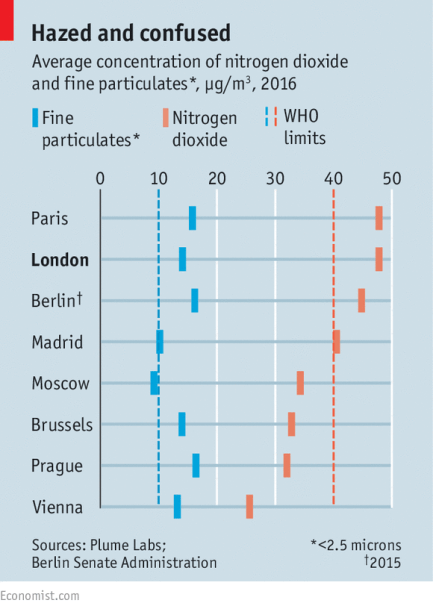
GAZING out over London’s chimneys, Liverpool’s docks or Edinburgh’s spires can cloud a tourist’s judgment. Air pollution “plagues” Britain, says one UN official. The capital is particularly nasty, and compares poorly with other European cities (see chart). On some days last month particulate levels in London were higher even than in Beijing. On February 17th the mayor, Sadiq Khan, will launch a £10 ($12) “toxic charge” on the most polluting vehicles—broadly speaking those registered before 2005—to come into force in October.

Three pollutants cause most worry: nitrogen dioxide (a gas emitted in vehicle exhausts), ozone (a triatomic form of oxygen which harms the lungs) and tiny particulates, the smallest of which are the most damaging as they get deep into the lungs.

Chronic exposure means Londoners’ lives are between nine and 16 months shorter than they would otherwise be, according to a study by King’s College London. And sudden spikes leave inhabitants gasping. Acute episodes occur in three main ways, says Gary Fuller, who helps run King’s College’s air-quality monitoring network. First, pollution lingers if a layer of cold air forms close to the ground without wind, as happens during chilly months. Second, the circulation of dirty air around Europe’s large cities, as often happens in spring, causes southern England to suffer. And third, in summer, heat and the sun’s ultraviolet rays help to create smog.

British courts have given the government until the end of July to come up with a new plan to cut air pollution. It is likely to focus on cars. Poor air quality is a localised problem that can be caused by nearby airports, factories or power plants. But curbing vehicle-use helps in all cities—and traffic is one area in which Britain’s generally feeble city mayors have some power.

Because about half of certain particulate-matter that vehicles release comes from sources other than the exhaust pipe, such as brakes and tyres, stricter standards on emissions alone do not solve the problem. Paris, Madrid and Athens want to ban diesel cars and vans by 2025.

London will struggle to copy them. Less than a year ago British ministers rejected a diesel scrappage scheme, in which drivers would have been paid for trading in dirty old vehicles for cleaner ones. The political cost of angering diesel drivers, previously encouraged to buy the vehicles because of their lower carbon-dioxide emissions, made such a move impossible. But reports now suggest an updated scheme is under discussion. Mike Hawes of the Society of Motor Manufacturers and Traders, a lobby group, supports such a plan in principle, but frets that even with incentives, the poorest drivers may balk at shelling out for new, cleaner models.

Other schemes are needed. Company cars, which comprise about half of the new ones sold in Britain, are a taxable benefit. The levies paid on them are based largely on the amount of carbon dioxide they produce, making diesel cars the best to buy. Tweaking fiscal rules could change that. Investing in electric and other low-emission vehicles also helps: the government plans to spend £600m on them and the infrastructure they need, such as charging stations, by 2020. Even London’s buses, police cars and black cabs are cleaning up.

More people could stay away from the steering wheel altogether. Lesley Hinds, who has responsibility for transport and the environment on Edinburgh council, says a pilot scheme there to encourage children to walk to school, by closing roads outside nine primaries, has been so successful that it may become permanent. A trade-off exists, however. More space on the streets for pedestrians and cyclists means less for cars, leading to congestion. And the exhaust systems of snarled-up vehicles work less efficiently than those of ones on the move. So the fog of politics makes deciding on what mix of policies to use even harder.

Source: A plan to clean up Britain’s toxic air | The Economist

Posted in Air Quality, Europe, Health Effects of Air Pollution, London, UK | Tagged , , , , , , | Leave a comment

Chinese air pollution linked to respiratory and cardiovascular deaths 

In the largest epidemiological study conducted in the developing world, researchers found that as exposures to fine particulate air pollution in 272 Chinese cities increase, so do deaths from cardiovascular and respiratory diseases.

The researchers reported their results in “Fine Particulate Air Pollution and Daily Mortality: A Nationwide Analysis in 272 Chinese Cities,” published online ahead of print in the American Thoracic Society’s American Journal of Respiratory and Critical Care Medicine.

“Fine particulate [PM2.5] air pollution is one of the key public health concerns in developing countries including China, but the epidemiological evidence about its health effects is scarce,” said senior study author Maigeng Zhou, PhD, deputy director of the National Center for Chronic and Non-communicable Disease Control and Prevention, Chinese Center for Disease Control and Prevention. “A new monitoring network allowed us to conduct a nationwide study to evaluate short-term associations between PM2.5 and daily cause-specific mortality in China.”

The researchers found:

* The average annual exposure to PM2.5 in the Chinese cities was 56 micrograms per cubic meter — well above the World Health Organization air quality guidelines of 10 ?g/m3.

* Each 10 μg/m3 increase in air pollution was associated with a 0.22 percent increase in mortality from all non-accident related causes.

* Each 10 μg/m3 increase in air pollution was associated with a 0.29 percent increase in all respiratory mortality and a 0.38 percent increase in chronic obstructive pulmonary disease (COPD) mortality.

* Mortality was significantly higher among people age 75 and older and among people with lower levels of education.

* The association between PM2.5 levels and mortality was stronger in cities with higher average annual temperatures.

The researchers speculate that differences in educational attainment may result in environmental health inequalities and access to health care that affect mortality. In warmer cities, the authors hypothesize residents may spend more time outdoors and open windows, increasing their exposure to PM2.5.

The researchers said their study suggests a weaker association between increases in PM2.5 and mortality than studies conducted in Europe and North America. They suggest a number of possible explanations for this difference, including that in most Chinese cities there was a plateauing of mortality at the highest levels of pollution and the components of PM2.5 pollution in China may be less toxic than the components in Europe and North America. Crustal dust from arid lands and construction make up more PM2.5 pollution in China than it does in Europe and North America.

In 2013 China began introducing PM2.5 monitoring in urban areas. The current study analyzed available data between 2013-15. For nearly half the cities in the study, there was only one year of PM2.5 data available, and the authors note that a limitation of their study is that it does not look at the cumulative effect of PM2.5 over many years.

“Our findings may be helpful to formulate public health policies and ambient air quality standards in developing countries to reduce the disease burden associated with PM2.5 air pollution,” said study co-author Haidong Kan, MD, professor of public health at Fudan University in China. “Further massive investigations, especially looking at the long-term effect studies, are needed to confirm our results and to identify the most toxic components of PM2.5 in China.”

The report can be found online at: http://www.thoracic.org/about/newsroom/press-releases/resources/chinese-air-pollution.pdf

Source: Chinese air pollution linked to respiratory and cardiovascular deaths — ScienceDaily

Posted in Air Quality, Asia, China, Health Effects of Air Pollution, Medical Studies | Tagged , , , , | Leave a comment

EPA issues air pollution warning for southern Taiwan

The Environmental Protection Administration (EPA) issued an air pollution warning on Thursday for southern Taiwan the following day. It forecast that the air quality index (AQI) in the cities and counties of Yunlin, Chiayi, Tainan, Kaohsiung and Pingtung would flash orange, which indicates a level unhealthy for sensitive groups.

High particulate air pollution in areas of southern Taiwan on Friday will be caused by strong winds in the wake of a cold front that arrived on Thursday sending temperatures to new lows nationwide for the winter season, the EPA said.

The AQI in the other areas of the country will remain good to moderate, it added.

The EPA forecast that the AQI in southern Taiwan will remain orange from Feb. 11-12, while the index in central Taiwan will fall to the same level. During that period, air quality in other areas of the country will remain good to moderate, it said.

The EPA has a six-color AQI system; green represents good, with an index reading of 0-50; yellow indicates moderate at 50-100; orange means unhealthy for sensitive groups with a reading of 101-150; red indicates unhealthy with a range of 151-200; purple signifies very unhealthy with a level of 201-300; maroon represents hazardous with an index reading of 301-500.

Source: EPA issues air pollution warning for southern Taiwan | Society | FOCUS TAIWAN – CNA ENGLISH NEWS

Posted in Air Quality, Asia, Taiwan | Tagged , , , , , , , | Leave a comment

Toxic Smog in Mongolia’s Capital Worsens Amid Harsh Winter

On most winter mornings, Setevdorj Myagmartsogt wakes up to a cloud of toxic smog blanketing his neighborhood in the Mongolian capital Ulaanbaatar, where the air quality is among the worst in the world.

The city’s air, which is at times far worse than Beijing’s infamous smog, has become more polluted because of smoke from thousands of chimneys burning coal, wood and even trash, as poor residents try to stay warm during brutal winters.

“Because of the air pollution, our health is getting worse,” Myagmartsogt told Reuters. “When my two youngest kids go to kindergarten, they get ill every week and they have to stay away. … It’s because of the air pollution.”

The capital’s total emissions of harmful breathable particles known as PM2.5 surged to as high of 855 micrograms per cubic meter late last month. In comparison, Beijing’s air on the same day measured 70 micrograms.

The acceptable standard, according to the World Health Organization, is 20 to 25 micrograms. The reading in Ulaanbaatar has been known to hit 1,000 micrograms.

About 80 percent of the city’s smog comes from poor “ger” districts, a sprawl of traditional tents that have sprung up on the edge of the city, said Tsogtbaatar Byamba, director of Mongolia’s Institute of Public Health.

Many residents are former herders who migrated to the city after their livestock was wiped out by recent extremely harsh winters, which have become more common, partly because of climate change.

As temperatures plunge to as low as minus 40 Celsius, ger residents with no access to the state heating grid burn whatever they can to keep warm.

To combat this, the government last month bolstered restrictions on migrants to the capital, allowing only those in need of long-term help and people who own homes until the end of the year.

But the pollution persists.

Hundreds of residents gathered recently in the city’s Chinggis Square to protest against the government’s inability to tackle the smog. Demonstration organizers collected more than 7,000 signatures.

“The air pollution has had real consequences in my life,” said protester Otgontuya Baldandorj. “I was pregnant three times, but I lost all of them. With my fourth child, I had to go to the countryside to get fresh air to give birth.”

Source: Toxic Smog in Mongolia’s Capital Worsens Amid Harsh Winter

Posted in Air Quality, Asia, Mongolia | Tagged , , , | Leave a comment

Data linking death with air pollution inconclusive, says Indian minister

Environment minister Anil Madhav Dave overlooks Greenpeace research stating 1.2m Indians die each year from airborne pollutants

India’s environment minister has been accused of playing down the health risks of the country’s extremely polluted air by claiming, contrary to research, that there is no conclusive data available linking “death exclusively with air pollution”.

The environmental group Greenpeace released a report in January citing Global Burden of Disease (GBD) research that estimated nearly 1.2 million Indians die each year due to high concentrations of airborne pollutants such as dust, mould spores, arsenic, lead, nickel and the carcinogen chromium.

It found that no cities in northern India, and only a handful of regions in the rest of the country, met international air quality standards, with pollution rates particularly high in the capital, Delhi, and the neighbouring state Uttar Pradesh.

Asked about the report in India’s upper house, the environment minister, Anil Madhav Dave, said on Tuesday: “There is no conclusive data available in the country to establish direct correlation-ship of death exclusively with air pollution.”

He said the health effects of air pollution were a “synergistic manifestation of factors which include food habits, occupational habits, socio-economic status, medical history, immunity, heredity etc of the individuals”.

“Air pollution could be one of the triggering factors for respiratory associated ailments and diseases,” he added.

Sunil Dahiya, a campaigner with Greenpeace India, said the remarks were contrary to the findings of the GBD survey, a comprehensive global research program that monitors the causes of illness and death in every country in the world.

The 2015 edition of the survey estimated that 3,283 Indians died each day due to outdoor air pollution, making for around nearly 1.2 million deaths annually. Dahiya said the air pollution estimate controlled for “all imaginable risk factors, from obesity, to smoking and insufficient consumption of fresh fruit … and many other risks”.

“The number of deaths attributed to air pollution in the study are only due to air pollution,” he said.

Researchers have argued that the frequent inhalation of tiny pollutantsin particular may increase the likelihood of blood clots, damage the body’s ability to oxygenate blood and inflame tissue in the nervous system.

India has been slower than its neighbour, China, to address the problem of toxic air, which in Delhi is attributed to a range of sources including road dust, vehicle exhaust fumes, open fires, industrial emissions and the burning of crop residues in neighbouring states.

But India has taken steps in the past two years to grow its network of air-quality monitors, push cleaner fuels, upgrade vehicle emissions standards and has mandated – but not yet fully rolled out – new technology to limit emissions from coal-fired power stations.

While acknowledging the problem, Indian government bodies have been sensitive about accepting international findings on the issue, rejecting a 2014 World Health Organisation study that declared Delhi the world’s most polluted city.

It has also repeatedly had run-ins with Greenpeace, temporarily freezing the NGO’s funding and accusing it of being one of several groups conspiring to stymie India’s economic growth.

Polash Mukherjee, a researcher with the Delhi-based Centre for Science and Environment, said different groups came up with different estimates of the number of deaths caused by air pollution because of varying methodologies or interpretations. “But what is undeniable is that there is an effect on the health of people,” he said.

The burden of harm from air pollution falls mainly on the poor, the elderly and children. A report from Unicef in October estimated that poor air quality contributed to the deaths of 600,000 children around the world each year.

Source: Data linking death with air pollution inconclusive, says Indian minister | Environment | The Guardian

Posted in Air Quality, Asia, India | Tagged , , , | Leave a comment

Air pollution linked to heightened risk of type 2 diabetes in obese Latino children

High levels of pollution may make insulin-creating cells become less efficient, increasing the risk for type 2 diabetes, researchers say

Latino children who live in areas with higher levels of air pollution have a heightened risk of developing Type 2 diabetes, according to a new USC-led study.

Scientists tracked children’s health and respective levels of residential air pollution for about 3.5 years before associating chronic unhealthy air exposure to a breakdown in beta cells, special pancreatic cells that secrete insulin and maintain the appropriate sugar level in the bloodstream.

By the time the children turned 18, their insulin-creating pancreatic cells were 13 percent less efficient than normal, making these individuals more prone to eventually developing Type 2 diabetes, researchers said.

“Exposure to heightened air pollution during childhood increases the risk for Hispanic children to become obese and, independent of that, to also develop Type 2 diabetes,” said Michael Goran, co-director of the Diabetes and Obesity Research Institute at the Keck School of Medicine of USC and corresponding author of the study. “Poor air quality appears to be a catalyst for obesity and diabetes in children, but the conditions probably are forged via different pathways.”

Published in the journal Diabetes on Jan. 30, the study, researchers said, is the first to follow children for years to find a connection between air pollution and diabetes risk in children.

These children lived in neighborhoods that, according to the U.S. Environmental Protection Agency, had excess nitrogen dioxide and tiny air pollution particles that are generated by automobiles and power plants, formally called particulate matter 2.5 (PM2.5).

Researchers found that the beta cells that were still functional were overworking to compensate for the damaged cells, leading to burn out. As the cells failed to secrete insulin efficiently, regulation of sugar in the bloodstream overwhelmed the system, heightening the risk of Type 2 diabetes.

Diabetes has quadrupled in the past four decades, according to the Centers for Disease Control and Prevention. If the trend continues, 1 in 3 Americans will have diabetes by 2050. Serious complications include blindness, kidney failure, limb amputation or early death.

“Diabetes is occurring in epidemic proportion in the U.S. and the developed world,” said Frank Gilliland, senior author and a professor of preventive medicine at the Keck School of Medicine. “It has been the conventional wisdom that this increase in diabetes is the result of an uptick in obesity due to sedentary lifespans and calorie-dense diets. Our study shows air pollution also contributes to Type 2 diabetes risk.”

Latino children living in polluted areas are at higher risk

Researchers examined the data of 314 overweight and obese Latino children who were between 8 and 15 years old when they enrolled in the National Institutes of Health-funded Study of Latino Adolescents at Risk of Type 2 Diabetes (SOLAR) study, a 12-year undertaking.

Scientists tracked the Los Angeles County children for an average of 3.5 years. None of them had Type 2 diabetes when they enrolled, but some may have been on the road to the disease toward the study’s end.

Each year the participants fasted and then came to the Childhood Obesity Research Center at USC for a physical exam and to have their glucose and insulin levels measured over a span of two hours.

When they turned 18, the participants had nearly 27 percent higher blood insulin after having fasted for 12 hours. During their two-hour glucose test, they had about 36 percent more insulin than normal, indicating that the body was becoming less responsive to insulin. This observation illustrated that increased exposure to air pollution was associated with increased risk factors for Type 2 diabetes.

The researchers adjusted for body fat and socioeconomic status. In some instances, at age 18, the effect of long-term exposure to higher air pollution was larger than the effect of gaining 5 percent body weight, meaning air pollution is definitely a risk factor for diabetes, said Tanya Alderete, lead author of the study and a postdoctoral research scholar at the Keck School of Medicine.

Steps people can take to reduce their risk

The findings suggest that the negative effects of elevated and chronic exposure to nitrogen dioxide and tiny dirty air particles begin in early life. If other risk factors such as having an unhealthy diet persist, then risk for Type 2 diabetes is compounded, researchers said.

“Air pollution is ubiquitous, especially in Los Angeles,” Alderete said. “It’s important to consider the factors that you can control — for example, being aware that morning and evening commute times might not be the best time to go for a run. Change up your schedule so that you’re not engaging in strenuous activity near sources of pollutants or during peak hours.”

None of the children developed Type 2 diabetes during the study, but many showed signs that they may eventually develop it and were characterized as pre-diabetes.

Some 8.1 million people in the United States have diabetes but haven’t been diagnosed, according to the CDC. That means some 28 percent of people with diabetes do not even know they have diabetes. Undiagnosed diabetes raises the risk of afflictions such as stroke, kidney damage and Alzheimer’s disease.

Future studies will also include participants who are not overweight or obese and should collect data on diet and physical activity, researchers said.

Findings from this study may be generalized only to overweight and obese Latino children, mostly of a lower socioeconomic status, according to the study.

Source: Air pollution linked to heightened risk of type 2 diabetes in obese Latino children: High levels of pollution may make insulin-creating cells become less efficient, increasing the risk for type 2 diabetes, researchers say — ScienceDaily

Posted in Health Effects of Air Pollution | Tagged , , , | Leave a comment

Macedonian capital offers free transport to fight pollution 

Municipal authorities in Macedonia’s heavily polluted capital are offering residents free use of public transport to reduce the use of cars.

Concentrations of toxic airborne particles in Skopje have been about 20 times above safe levels for the past 10 days.

Macedonian health authorities say that the city of around 750,000 is now Europe’s most polluted capital, with poor air quality blamed for the premature death of 1,300 people each year.

The problem is mainly attributed to heavy use of wood-burning stoves and road traffic. The measure announced Tuesday will apply until pollution levels drop.

Officials say pollution contributed to 30-35 percent of deaths during the winter period over the past three years in Skopje, with the figure in other capitals rarely exceeding 20 percent.

Source: Macedonian capital offers free transport to fight pollution – Business Insider

Posted in Air Quality, Europe | Tagged , , | Leave a comment