An invisible tango with death as Bangladesh deals with pollution: Statesman

More than 215,000 people in Bangladesh succumbed to pollution in 2019. The ever lurking, at times invisible, killer – air pollution – alone claimed about 175,000 lives.

Water pollution was responsible for 30,000 deaths, while soil contamination, lead pollution, and occupational hazard-related pollution factors, including exposure to harmful chemicals and substances at work, made up for the rest of the death pie. This was revealed in a recent report titled “Pollution and Health: A Progress Update,” by the medical journal The Lancet.

While these numbers are new, the scenario is not. This dark underbelly of the growing, flourishing nation is known to all of us. Day in and day out, we breathe, we drink, we eat, we touch death like it is nobody’s business. In fact, for us, it is business as usual. Unfortunately, for our lawmakers and the government, this daily brush of the common people with death has also become an acceptable norm, which is why, despite the publication of multiple reports flagging this morose reality and the concerns raised by various quarters, little to no action has been taken to rectify this.

As late as March this year, it was revealed in a report by US-based organisations Health Effects Institute (HEI) and the Institute for Health Metrics and Evaluation (IHME) that, on an average, almost three years of a person’s life expectancy is cut by air pollution in Bangladesh. The report, titled “State of Global Air 2020: How Does Air Pollution Affect Life Expectancy around the World?”, added that outdoor air pollution is responsible for reducing 1.16 years, while indoor air pollution is responsible for reducing 1.53 years.

And Bangladesh often, unfortunately, finds itself at the top of the list of the most air-polluted countries in the world, based on the AQI score. According to IQAir, Bangladesh was the most air-polluted country in the world in 2021 with an average AQI of 161.

Despite these, the brick kilns keep operating at full throttle, non-compliant factories keep emitting harmful gases and discharging toxic wastes in rivers and water bodies, unfit vehicles keep polluting the air, and biomass burning, fossil fuel combustion, and dust from the various ongoing development works keep choking the life out of us. And no one bothers to take any measure to stop these.

Similarly, water pollution has exposed us to various health complications, including diarrhoea and cholera outbreaks, among other diseases. Over the years, we have allowed industries to discharge their chemical and factory wastes into the rivers without a worry, which has made the waters of our rivers so toxic and polluted that they have now become hotbeds for various diseases, including harmful skin diseases and cancer. A dip in the Buriganga, and one would emerge carrying a host of germs and bacteria, resulting in immediate reactions.

And while water sources have been compromised, the lack of an efficient water purification and distribution system by Wasa has exposed the population, especially in the big cities, to deadly bacteria and viruses, which can cause a wide variety of fatal liver diseases, including Hepatitis A and Hepatitis E.

An invisible tango with death as Bangladesh deals with pollution: Statesman | The Straits Times
Posted in Air Quality | Leave a comment

Size of air pollution particles may affect a person’s risk of dying from stroke, study finds

Living in areas with higher air pollution is associated with an increased risk of in-hospital death from stroke, and the risk varies depending on the size of the air pollution particles, according to a new study published in the May 25, 2022, online issue of Neurology®, the medical journal of the American Academy of Neurology.

The study looked at three sizes of air pollution particulate matter. Particulate matter consists of liquids or solids suspended in air. Submicron particulate matter, PM1, is less than one micron in diameter and includes soot and smog. Fine particulate matter, PM2.5, is less than 2.5 microns in diameter and includes fly ash from coal combustion. Respirable particulate matter, PM10, is less than 10 microns in diameter and includes cement dust.

“Air pollution has been previously linked to a greater risk of stroke, and stroke is a leading cause of death worldwide. What is lesser known is how the different sizes of particulate matter affect that risk. Our research found that the size of air pollution particles may affect a person’s risk of dying from stroke.”

Hualiang Lin, PhD, study author, Sun Yat-sen University in Guangzhou, China

For the study, researchers examined electronic medical records in China to identify over 3.1 million hospitalizations for stroke, both ischemic stroke caused by a blood clot, and hemorrhagic stroke caused by bleeding in the brain. Participants had an average age of 67. Of this group, 32,140 people, or 1%, died of stroke while hospitalized.

Researchers identified individual levels of air pollution exposure for each participant by using their home addresses and an air pollution data source that records daily concentrations of different types of particulate matter. Researchers then calculated seven-day air pollution exposure immediately before hospitalization for stroke, which was 31.38 micrograms per cubic meter (µg/m3) of PM1, 45.43 µg/m3 of PM2.5 and 78.75 µg/m3 of PM10. They also calculated a person’s average daily exposure to pollution particles in the year before hospitalization, which was 32.98 µg/m3 of PM1, 49.08 µg/m3 of PM2.5 and 87.32 µg/m3 of PM10.

After adjusting for factors such as age, sex, socioeconomic status, diabetes and high blood pressure, researchers found each 10 μg/m3 increase in annual average exposure to particulate matter was associated with increased risk of dying of stroke while hospitalized, with a 24% greater risk for exposure to PM1, a 11% greater risk for exposure to PM2.5, and a 9% greater risk for exposure to PM10. The seven-day average exposure to particulate matter included a 6% increased risk for exposure to PM1, a 4% increased risk for exposure to PM2.5, and a 3% increased risk for exposure to PM10.

The risks were stronger in people with ischemic stroke than in people with hemorrhagic stroke. The greatest risk of death from stroke was in people with ischemic stroke and exposure to the smallest air pollution particles, PM1.

Yet researchers also found that a reduction in PM10 would have the largest impact on reducing overall deaths from stroke, reducing the number of hospital deaths by 10% for short-term exposure and 21% for long-term exposure.

Lin said it is important to note that the study results do not prove that air pollution causes stroke deaths, they only show an association.

“Our study includes measurements of PM1, which may be small enough to be inhaled deeply into lungs, pass through lung tissue, and circulate in the bloodstream,” said Lin. “Obtaining a deeper understanding of the risk factors of all particulate matter sizes and the magnitude of their possible effects may help reduce the number of deaths and improve the outcomes for people with stroke.”

A limitation of the study was that results were not adjusted for a person’s smoking status or the severity of stroke. Researchers also examined air pollution exposure only at a person’s current residence and not at previous residences.

Source:American Academy of NeurologyJournal reference:Cai, M., et al. (2022) Association of Ambient Particulate Matter Pollution of Different Sizes With In-Hospital Case Fatality Among Stroke Patients in China. Neurology. doi.org/10.1212/WNL.0000000000200546.

Size of air pollution particles may affect a person’s risk of dying from stroke, study finds
Posted in Air Quality, Health Effects of Air Pollution, Medical Studies | Tagged , , , , , , , | Leave a comment

Air pollution linked to more severe COVID-19: study

Several common air pollutants are linked to more severe outcomes following a coronavirus infection, a new study has found. 

Individuals who lived in areas of Ontario, Canada with higher levels of three common air pollutants — fine particulate matter, nitrogen dioxide and ground-level ozone — were at increased risk of being admitted to the intensive care unit, according to the authors, who published their findings on Tuesday in the Canadian Medical Association Journal. 

Chronic exposure to ozone specifically carried an elevated risk of death from COVID-19, the scientists determined. 

To draw these conclusions, researchers from the Canadian government’s Health Canada analyzed data on all 151,105 people ages 20 years and older who had confirmed coronavirus infections in 2020 in Ontario. 

Information about fine particulate matter, nitrogen dioxide and ground-level ozone was readily available to the researchers, as these substances are all regularly monitored by the Canadian government, the authors noted. 

These pollutants are emitted from a variety of different sources, including fuel combustion and reactions of volatile organic compounds or other chemicals. 

The scientists calculated each infected individual’s long-term exposure to the three air pollutants based on their residence from 2015-2019, according to the study. 

The authors excluded infected individuals living in long-term care facilities and adjusted for date of diagnosis, sex, age, essential worker status, socioeconomics, healthcare access and other factors. 

Long-term exposure to air pollution, the authors explained, could increase the risk of developing severe COVID-19 by several different mechanisms. For example, air pollutants can reduce immune responses and antimicrobial activities in the lungs, thereby boosting viral loads, according to the authors. 

These substances can also cause chronic inflammation and the over expression of a specific receptor protein that enables the entry of coronavirus into human cells, the researchers added. 

“Given the ongoing pandemic, our findings that underscore the link between chronic exposure to air pollution and more severe COVID-19 could have important implications for public health and health systems,” the authors stated.

Air pollution linked to more severe COVID-19: study | The Hill
Posted in Air Quality, Health Effects of Air Pollution, Medical Studies | Tagged , , , , | Leave a comment

AFRICA: The continent tops a global ranking on pollution levels

The results of the “Global Health” study published recently in the British scientific journal The Lancet, reveal that the African continent is the most affected of the 9 million deaths caused annually by air pollution across the planet. This phenomenon, which affects people and biodiversity, is increasingly attracting the attention of African policy makers.

Chad, Central African Republic (CAR), Niger, Burkina Faso, Somalia and South Africa are among the top 10 countries in the world with the highest number of air pollution-related deaths. In total, the phenomenon has been killing 9 million people each year across the planet since 2015. According to the British scientific journal The Lancet, which published the results of the study, this is an increase of 7% compared to the previous decade.

“This puts pollution on a par with smoking in terms of deaths. Covid-19, by comparison, has killed about 6.7 million people worldwide since the start of the pandemic,” says the report, called “Global Health” and based on data from the University of Washington.

While industrial processes (toxic chemicals, fumes) and urbanisation have usually been blamed, contaminated water and soil have rapidly increased pollution levels on the continent, with economic losses estimated at $4.6 trillion annually. Yet some countries, such as Ethiopia and Nigeria, have cut pollution-related deaths by two-thirds between 2000 and 2019 thanks to a number of government programmes, the report says.

Breaking the deadlock

While 51% of Uganda’s 600 tonnes of annual waste ends up in the environment, according to the International Union for Conservation of Nature (IUCN), the East African country has developed air quality regulations and standards, including for emissions from vehicles and industries.

In Morocco, where fossil fuels, notably coal, oil and gas, still account for more than 63% of the energy mix, according to the Moroccan National Office of Electricity and Drinking Water (ONEE), the authorities are focusing on the energy transition for climate change resilience. Togo has also developed major renewable energy projects in recent years with a view to diversifying its electricity mix and pursuing the objective of carbon neutrality.

AFRICA: The continent tops a global ranking on pollution levels | Afrik 21
Posted in Africa, Air Quality | Tagged , , , , , , , | Leave a comment

Air pollution linked to deadly heart rhythm disorder

Life-threatening arrhythmias are more common on days with highly polluted air, according to research presented today at Heart Failure 2022, a scientific congress of the European Society of Cardiology (ESC).1 The study was conducted in patients with an implantable cardioverter defibrillator (ICD), enabling the authors to track the occurrence of arrhythmias and delivery of life-saving therapy.

“Our study suggests that people at high risk of ventricular arrhythmias, such as those with an ICD, should check daily pollution levels,” said study author Dr. Alessia Zanni, now working at Maggiore Hospital, Bologna and previously at Piacenza Hospital, Italy. “When particular matter (PM) 2.5 and PM 10 concentrations are high (above 35 μg/m3 and 50 μg/m3, respectively), it would be sensible to stay indoors as much as possible and wear an N95 mask outside, particularly in areas of heavy traffic. An air purifier can be used at home.”  

Outdoor air pollution kills an estimated 4.2 million people every year, according to the World Health Organization.2 Nearly one in five cardiovascular disease deaths are due to dirty air, which was ranked the fourth highest risk factor for mortality after high blood pressure, tobacco use and poor diet.

This study investigated the relationship between air pollution and ventricular arrhythmias in Piacenza, Northern Italy. The European Environment Agency graded the city 307 worst out of 323 cities for annual mean PM2.5 concentrations in 2019 and 2020, with a figure of 20.8 μg/m3.4“We had observed that emergency room visits for arrhythmias in patients with ICDs tended to cluster on days with particularly high air pollution,” noted Dr. Zanni.

“We therefore decided to compare the concentration of air pollutants on days when patients had an arrhythmia versus pollution levels on days without an arrhythmia.”The study included 146 consecutive patients who received an ICD between January 2013 and December 2017. Of those, 93 received an ICD because of heart failure after a heart attack while 53 had a genetic or inflammatory heart condition. Just over half (79 patients) had never experienced a ventricular arrhythmia, and 67 patients had previously had a ventricular arrhythmia.

Data on ventricular arrhythmias (ventricular tachycardia and ventricular fibrillation) were collected remotely from the ICD until study completion at the end of 2017. The researchers also recorded the therapy delivered by the device. This included antitachycardia pacing for ventricular tachycardia (fast heartbeat), which delivers electrical impulses to the heart muscle to restore a normal heart rate and rhythm. The second therapy was an electric shock to reset the heartbeat during ventricular fibrillation.

Daily levels of PM10, PM2.5, carbon monoxide (CO), nitrogen dioxide (NO2) and ozone (O3) were obtained from Regional Environmental Protection Agency (ARPA) monitoring stations. Patients were assigned exposures based on their home address. The researchers analysed the association between pollutant concentrations and the occurrence of ventricular arrhythmias.

A total of 440 ventricular arrhythmias were recorded during the study period, of which 322 were treated with antitachycardia pacing and 118 were treated with a shock. The researchers found a significant association between PM2.5 levels and ventricular arrhythmias treated with shocks, corresponding to a 1.5% increased risk for each 1 μg/m3 rise in PM2.5. They also found that when PM2.5 concentrations were elevated by 1 μg/m3 for an entire week, compared to average levels, there was a 2.4% higher likelihood of ventricular arrhythmias regardless of the temperature. When PM10 was 1 μg/m3 above average for a week there was a 2.1% raised risk of arrhythmias.

Dr. Zanni said: “Particulate matter may cause acute inflammation of the heart muscle which could act as a trigger for cardiac arrhythmias. As these toxic particles are emitted from power plants, industries and cars, green projects are needed to protect health, on top of the actions individuals can take to protect themselves.”

She concluded: “These data confirm that environmental pollution is not only a climate emergency but also a public health problem. The study suggests that the survival of patients with heart disease is affected not only by pharmacological therapies and advances in cardiology but also by the air that they breathe. This battle can be won by an alliance between scientific societies and politicians to protect not only the environment but also the health of the human population.”

Air pollution linked to deadly heart rhythm disorder
Posted in Air Quality, Health Effects of Air Pollution, Medical Studies | Tagged , , , , , , , , , | Leave a comment

Iraq faces an increasing number of severe dust storms

Today’s Image of the Day from NASA Earth Observatory features a severe dust storm in Iraq. Dust storms are most common in this region in the late spring and summer, triggered by seasonal winds such as the “shamal” that blows in from the northwest. 

In the past two weeks in the Middle East, poor air quality from two major storms has sent thousands of people to the hospital for asthma and other respiratory diseases.

“The skies above Baghdad, Najaf, Sulaimaniyah, and other cities turned orange as visibility dropped to a few hundred meters. Several airports were closed during the dust events, and schools were closed nationwide. Government offices were shuttered in seven of the Iraq’s 18 provinces, and several governors declared states of emergency,’ reports NASA.

According to news media reports, Iraq has endured at least eight dust storms in the past six weeks. Recent studies have shown that these events have become more frequent in Iraq. 

“The country has been facing drought conditions in recent years, as well as land-use changes and overuse that mean there is more loose soil available to be lofted into the atmosphere,” says NASA. “The World Bank cited Iraq as one of the countries most vulnerable to desertification and climate change.”

The image was captured on May 16, 2022 by the Moderate Resolution Imaging Spectroradiometer (MODIS) instruments on NASA’s Aqua satellite. 

Image Credit: NASA Earth Observatory 

Iraq faces an increasing number of severe dust storms • Earth.com
Posted in Air Quality, Iraq, Middle East | Tagged , , , , , , , | Leave a comment

Study Identifies Outdoor Air Pollution as the ‘Largest Existential Threat to Human and Planetary Health’

Deaths from exposure to emissions from vehicles, smoke stacks and wildfires have increased by more than 50 percent this century, with poorer countries bearing the brunt of the impacts.

Since the turn of the century, global deaths attributable to air pollution have increased by more than half, a development that researchers say underscores the impact of pollution as the “largest existential threat to human and planetary health.”

The findings, part of a study published Tuesday in The Lancet Planetary Health, found that pollution was responsible for an estimated 9 million deaths around the world in 2019. Fully half of those fatalities, 4.5 million deaths, were the result of ambient, or outdoor, air pollution, which is typically emitted by vehicles and industrial sources like power plants and factories.

The number of deaths that can be attributed to ambient air pollution has increased by about 55 percent—to 4.5 million from 2.9 million—since the year 2000.

Deaths from ambient air and chemical pollution were so prevalent, the study’s authors said, that they offset a decline in the number of deaths from other pollution sources typically related to conditions of extreme poverty, including indoor air pollution and water pollution.

“Pollution is still the largest existential threat to human and planetary health and jeopardizes the sustainability of modern societies,” said Philip Landrigan, a co-author of the report who directs the Global Public Health Program and Global Pollution Observatory at Boston College.

The report noted that countries with lower collective incomes often bear a disproportionate share of the impacts of pollution deaths, and called on governments, businesses and other entities to abandon fossil fuels and adopt clean energy sources.

“Despite its enormous health, social and economic impacts, pollution prevention is largely overlooked in the international development agenda,” says Richard Fuller, the study’s lead author, who is the founder and CEO of the nonprofit environmental group Pure Earth. “Attention and funding has only minimally increased since 2015, despite well-documented increases in public concern about pollution and its health effects.”

The peer-reviewed study, produced by the 2017 Lancet Commission on Pollution and Health, using data from the 2015 Global Burden of Disease (GBD), found that roughly 1.2 million deaths were attributable to household air pollution (which generally comes from tobacco smoke, household products and appliances); about 1.3 million deaths were attributable to water pollution and 900,000 deaths were attributable to lead pollution.

All told, the study’s authors wrote, roughly 16 percent of deaths around the world are attributable to pollution, which resulted in more than $4 trillion in global economic losses.

Ambient air pollution can be generated by a range of sources, including wildfires.

Deepti Singh, an assistant professor at the School of the Environment at Washington State University, co-authored a separate study into how wildfires, extreme heat and wind patterns can deteriorate air quality.

She noted how in recent years smoke from wildfires in California and the American West has traveled across the United States all the way to the East Coast. At one point during the 2020 wildfire season, Singh said, residents in as much as 70 percent of the country experienced negative air quality because of the blazes in the West.

“That wildfire smoke, you know, it has multiple harmful air pollutants,” Singh said. “We don’t even fully understand all the things that are in that smoke. But we know that it’s increasing fine particulate matter, which is something that directly affects our health. It’s something that we can inhale and it affects our cardiovascular respiratory system, and it can cause premature mortality and developmental harm—many, many different health impacts associated with that.”

Study Identifies Outdoor Air Pollution as the ‘Largest Existential Threat to Human and Planetary Health’ – Inside Climate News

Posted in Air Quality, Health Effects of Air Pollution, Medical Studies | Tagged , , | Leave a comment

Australian Conservation Foundation names Mount Isa the most polluted postcode in the country

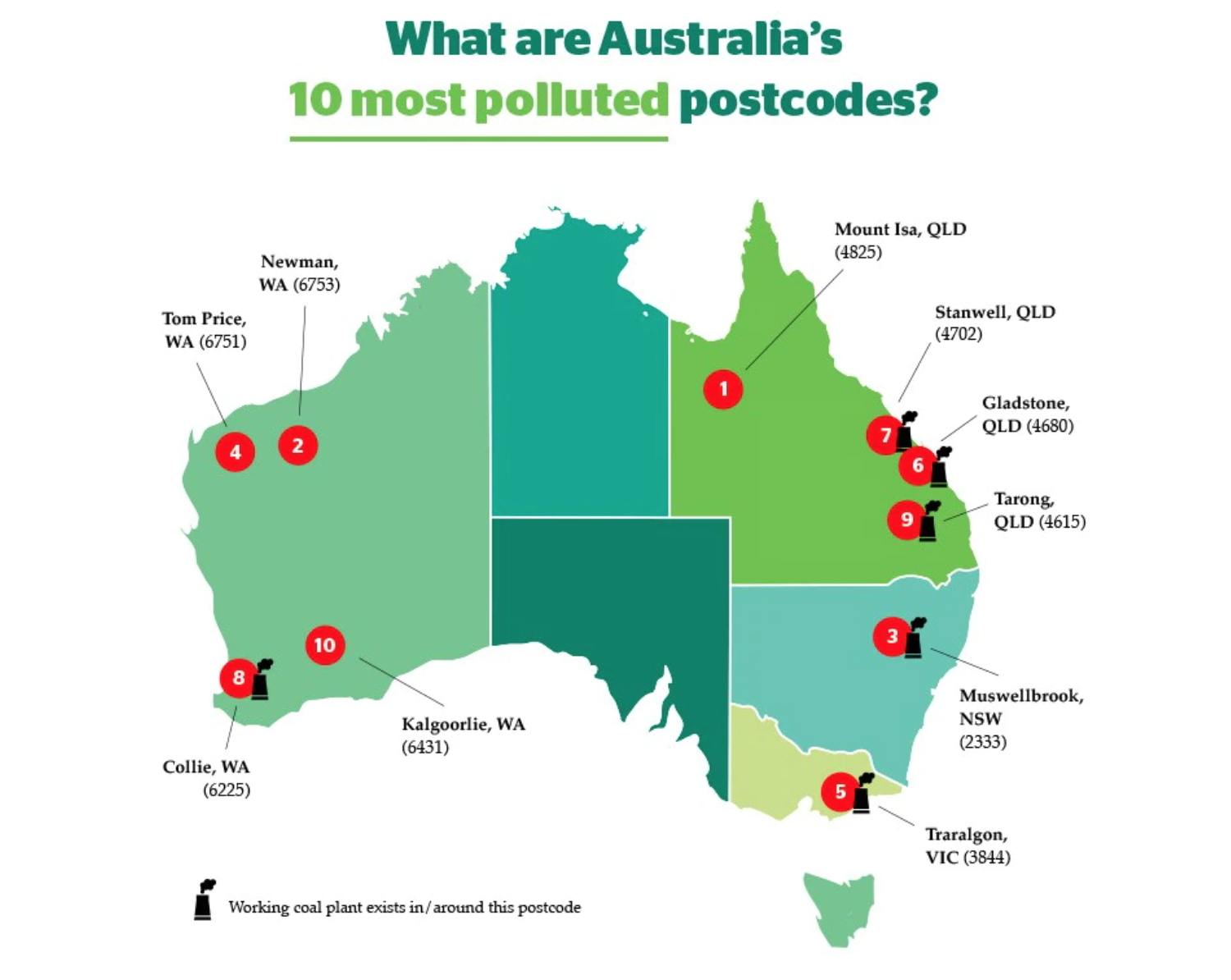
The top polluted towns in Australia for 2022 according to National Pollutant Inventory emission data.(Supplied: Australian Conservation Foundation)

Mount Isa Mines responsible for 91% of emissions in the outback city despite having an ‘industry-leading air quality management framework’

Mount Isa has been named the most polluted postcode in Australia in a new report from the Australian Conservation Foundation (ACF).

The ACF said the outback city is one of four Queensland locations listed among the Top 10 most polluted postcodes in the country, alongside Gladstone, Stanwell and Tarong.

The report was based on analysis of five pollutants of concern in the National Pollutant Inventory: sulfur dioxide, mercury, coarse and fine particles and oxides of nitrogen.

Mount Isa hosts copper, lead, zinc and silver mines, with 17 facilities reporting pollutants of concern to the NPI.

Mines in around the city emitted 400,000 tonnes of sulfur dioxide, 3,800 tonnes of oxides of nitrogen and 860kg of mercury and compounds in the air in the 2020/21 reporting period, according to the NPI.

Local residents told Guardian Australia that when they take their children to play at the local park, they can sometimes taste the sulfur dioxide blowing in from the copper smelter nearby.

They also spoke of one occasion where a school assembly finished early because children were coughing due to fumes drifting into the grounds from a nearby mine.

One resident – a former school teacher in the town, who did not wish to be named – said she decided to move away from Mount Isa last year when she fell pregnant.

As an asthmatic, she said remembers times where she had to cover her mouth and nose while walking between buildings at work.

Mount Isa Mines, operated by Glencore, is responsible for 91% of the postcode’s emissions, according to the ACF.

Glencore said Mount Isa Mines has the “most intensive air quality monitoring network of any city in Australia”, as part of an “industry-leading” framework used to control emissions and dust at the source and prevent contaminates from escaping.

“Mount Isa Mines is regulated by over 75 separate permits and authorities, with stringent and transparent reporting of environmental performance and we operate within our environmental limits for sulphur dioxide emissions and lead,” the company said.

“Every resident of Mount Isa is within 1,200 metres of a sulphur dioxide monitor. Mount Isa Mines also engages openly about operations to ensure the community and stakeholders can stay informed.”

Matthew Rose, ACF’s economy and democracy program manager, said sulfur dioxide is associated with “increased respiratory symptoms, difficulty in breathing and ultimately, for some people, premature death.”

“Air pollution kills about 3,000 Australians every year and worsens conditions such as asthma, emphysema, chronic bronchitis and other respiratory diseases,” Rose said.

But he said Mount Isa was one of the few “polluted” postcodes in the country that does not host coal-fired power stations or coalmines.

Muswellbrook in the New South Wales Hunter Valley, Traralgon in Victoria’s Latrobe Valley, Collie in Western Australia and Queensland’s Gladstone, Stanwell and Tarong are all centres for coal burning, according to the ACF.

Danielle Slade, the mayor of Mount Isa, said Glencore has a comprehensive system of emission capturing technology in place.

“They probably have one of the most intense air monitoring networks in any city in Australia. It operates 24/7,” Slade said.

Slade said the city’s copper smelter has an acid plant attached to it that captures all the fumes coming out of the stack. She said the copper smelter’s emissions are then turned into fertiliser.

“There are some good, sort of green ways to turn to manage this,” she said. “Mining of these minerals is critical so that we can have electric cars, smartphones, smart TVs.”

Slade acknowledged it was “very rare” to have a community living so close to a mine, but described moments where residents can taste sulfur as “isolated incidents” that occur only when the acid plant was down.

“I grew up in Mount Isa and before the acid plant was here you could taste the sulfur. The mine’s been doing a great job to mitigate this,” she said.

Queensland’s environment minister, Meaghan Scanlon, said the Environment Department “takes air quality very seriously and plays an active role in monitoring air quality across Queensland”.

“Right now, the department reports and monitors close to 40 monitoring stations throughout Queensland, including in Mount Isa and in Gladstone, where we have installed eight monitoring stations,” Scanlon said.

Scanlon said overall air quality has improved over the last three decades and remains “relatively good as a result of industry regulation, stricter emission standards for motor vehicles and new emission reduction technology.”

But Rose said Australia needs new, nationally consistent air quality standards and a coherent national plan to transition to a clean energy future.

Australian Conservation Foundation names Mount Isa the most polluted postcode in the country | Pollution | The Guardian
Posted in Air Quality, Australia & Oceania | Tagged , | Leave a comment