‘There is no escape’: Nairobi’s air pollution sparks Africa health warning 

Pollution in the Kenyan capital is ‘beyond imagination’. With Africa’s predicted rise in population – and a constant stream of dirty secondhand cars from Europe and Japan – this urban health crisis could kill 1.5 million within a generation
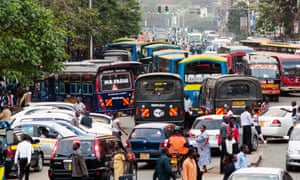
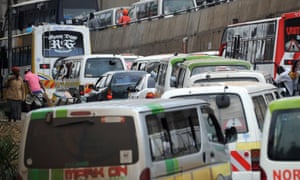
A minibus belches black smoke; the lorry behind it in the traffic jam billows white fumes. Eyes smart in the smog as diesel gases from thousands of 10 and 15-year-old vehicles fill Nairobi’s hazy evening air, adding to pollution levels that are “beyond imagination”, according to one resident. This jam could last for one, three, even five hours – last year, one stretched for 30 miles.

We could easily be in Cairo, Lagos or another African megacity, but this is the eight-lane Mombasa Road in Kenya’s capital – a permanently clogged artery in a metropolis where the number of vehicles doubles every six years.

Kenya is one of the few countries in Africa to have banned cars using the most sulphurous fuels, but what research there is suggests this is still one of the most polluted cities in the world – made worse by smoke from roadside rubbish fires, diesel generators and indoor cooking stoves.

No one knows for sure, however, because like nearly all African cities, Nairobi does not regularly monitor its urban air quality.

“In 28 years of living in Nairobi, I have seen the number of people quadruple and car ownership go from 5% to 27% of people. The pollution is mind-boggling,” says Dorothy McCormick, a Nairobi university economics researcher and author of books on African transport.

“There are 16 times as many vehicles on the road as when I came – the city just cannot cope. We have no tarmac left, no congestion charge and people use charcoal, paraffin and wood to heat their homes. You can see the haze building up from the early morning. What do you do – stop breathing? There is no escape.”

With half the world’s population growth over the next 30 years predicted to occur in Africa, the United Nations Environment Programme (Unep) expects the number of cars in African cities to rise dramatically. “The vehicle fleet will double in the next seven years in Nairobi,” says Rob de Jong, Unep’s head of transport. “The number of cars in Africa is still relatively small, but the emissions per vehicle are much higher [than the rest of the world].”
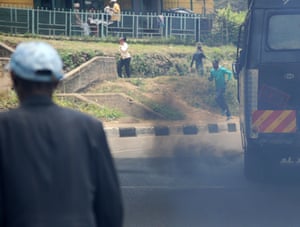
Africa’s urban air is especially bad because so few cars are new, the vast majority having been shipped in secondhand from Japan and Europe with their catalytic converters and air filters dismantled. It is in danger of becoming a dumping ground for the world’s old cars – importing vehicles that no longer meet rich countries’ pollution standards.

Across the continent, this explosion in car numbers, coupled with people cooking indoors on wood-fired stoves, is creating an urban health crisis already estimated by the UN to be killing 776,000 people a year. If unchecked, within a generation it is likely to kill twice as many annually, with devastating costs to public services and economies.

“Africa is urbanising and ‘motorising’ faster than any other region in the world,” says De Jong. “Its pollution is not yet level with New Delhi or Beijing, but it is getting there quickly. Respiratory diseases are now the number one disease in Kenya – and that is directly linked to air pollution. It is rapidly on the rise.”

According to Marie Thynell, an urban researcher at Sweden’s Gothenburg University who led a study of Nairobi pollution in 2015, the amount of cancer-causing elements in the air within the city is 10 times higher than the threshold recommended by the World Health Organisation.

Thynell’s research uncovered dramatic pollution spikes on all of Nairobi’s main roads. “The pollution is uncontrolled and particularly deadly in slum districts and for drivers, street vendors and traffic police,” she says.

Michael Gatari, an environmental scientist at the Kenyan Institute of Nuclear Science and Technology, predicts the country will have “a very sick population in years to come. Even what limited data there is suggests it is around 30 times worse than in London, and that Kenya is building up an immense health problem. Thirty percent more diesel is being burned in Nairobi compared with five years ago. Without doubt, the pollution will have a huge economic and health impact. We will see more and more cancers and heart disease, many more asthma cases and respiratory diseases.”
African air pollution is closely linked to poverty, according to Gatari. “In the slums, people light an open fire and close their windows; they are enclosed in very high pollution. Drivers mix good diesel with kerosene. There is a lot of burning of plastics and no proper incineration. Dust is blown everywhere by the wind, and there is loose soil from farming.”

In west Africa, the manmade air pollution from the string of coastal cities including Lagos, Accra, Abidjan and Cotonou is now so bad that it is mixing with natural pollutants blown from the Sahara and affecting cloud cover and rainfall, according to Mat Evans, professor of atmospheric chemistry at York University, who is leading a large-scale investigation of air pollution in the region.

“A chain of megacities is building in Africa. The continent is in the same position that China was 20 years ago – if Africa does not regulate its air pollution, it will be a disaster.”

The WHO highlighted the danger from air pollution last month when it released data on 3,000 cities worldwide. The few African cities which had any public monitoring records all had particulate (PM) levels way over UN guidelines, and four Nigerian cities were among the world’s 20 worst-ranked.

Unless action is taken, says the WHO, the continent’s urban air pollution levels could triple or quadruple within 15 years.

Onitsha, a commercial hub in eastern Nigeria, had the world’s worst official air quality. A roadside monitor there registered 594 microns/cubic metre of PM10s, and 66 of the more deadly PM2.5s – nearly twice as bad as notoriously polluted cities such as Kabul, Beijing and Tehran, and 30 times worse than London.

Evans says that African cities such as Lagos have entirely different problems to London, where “pollution is mainly due to the burning of hydrocarbons for transport that can be addressed by tackling fuel usage through electric vehicles, and car-free zones.

“African pollution isn’t like that. There is the burning of rubbish, cooking with inefficient solid fuel stoves, millions of small diesel electricity generators, cars which have had their catalytic converters removed and petrochemical plants, all pushing pollutants into the air over the cities.

“Compounds such as sulphur dioxide, benzene and carbon monoxide that have not been a problem in western cities for decades may be a significant problem in African cities. We simply don’t know.”

One important step forward, according to De Jong, would be to stop the dumping of old cars in Africa. “If African countries could set an age limit on imports, they could quickly improve pollution, and leapfrog technologies. The majority of vehicles which will be on the road in Africa in 10 years’ time are not here yet. If these countries impose higher import standards, the majority of the fleet will soon be compliant – but if we wait nine years, the majority of cars will have come to Africa and it will be locked in to heavy pollution.”

De Jong advocates the widespread introduction of electric bikes in Africa: “In China there will be 300 million of them by 2020. They are cheaper than petrol – it’s purely a policy and awareness problem.

“The problem can be avoided by acting now. There is a massive opportunity for Africa to go down another road. Its air pollution must be a priority for the world.”

Source: ‘There is no escape’: Nairobi’s air pollution sparks Africa health warning | Cities | The Guardian

Posted in Africa, Air Quality | Tagged , , , , , | Leave a comment

Air pollution hits a high 

Hong Kong’s air pollution hit the highest level, posing “serious health risks”, the governent has warned.
The Environmental Protection Department reported that the pollution was mainly caused by smog and ozone as a result of the hot weather, while super typhoon Nepartak churned its way into southern China after battering Taiwan.
The department said the condition would linger until there are showers early next week.
Almost all 16 general and roadside air pollution monitoring stations have recorded the highest possible reading on the air quality health index.
The stations that did not hit the peak level showed a level just below that, indicating “very high health risks”.
The department urged people to spend less time outdoors.

Source: Air pollution hits a high – The Standard

Posted in Air Quality, Asia, China | Tagged , , | Leave a comment

Bees’ ability to forage decreases as air pollution increases 

Air pollutants interact with and break down plant-emitted scent molecules, which insect pollinators use to locate needed food, according to a team of researchers. The pollution-modified plant odors can confuse bees and, as a result, bees’ foraging time increases and pollination efficiency decreases. This happens because the chemical interactions decrease both the scent molecules’ life spans and the distances they travel.

Air pollutants interact with and break down plant-emitted scent molecules, which insect pollinators use to locate needed food, according to a team of researchers led by Penn State. The pollution-modified plant odors can confuse bees and, as a result, bees’ foraging time increases and pollination efficiency decreases. This happens because the chemical interactions decrease both the scent molecules’ life spans and the distances they travel.

While foraging for food, insects detect floral scent molecules in the air. Wind currents can carry these molecules up to thousands of feet from their original source to where bees have their hives.

“Many insects have nests that are up to 3,000 feet away from their food source, which means that scents need to travel long distances before insects can detect them,” said Jose D. Fuentes, professor of meteorology and atmospheric science, Penn State. “Each insect has a detection threshold for certain kinds of scents and they find food by moving from areas of low concentrations of scents to areas of high concentrations.”

Plant-emitted hydrocarbons break down through chemical interactions with certain air pollutants such as ozone. This breakdown process results in the creation of more air pollutants, including hydroxyl and nitrate radicals, which further increase the breakdown rate of plant odors.

The researchers sought to understand how these chemical interactions, which start with the presence of air pollutants, would impact bees’ ability to find food. They first estimated the changes in concentrations of flower scents as a result of air turbulence and chemical interactions using a computer simulation, which allowed them to track the concentration and movement of multiple plumes of scents from different flower beds over time. Then, the researchers ran 90,000 simulations representing various bees’ foraging and movement patterns amid differing scent levels modified by air pollution and diluted by wind speeds.

The team reported in the current issue of Atmospheric Environment that, as air pollution increases, hydrocarbons’ lifetime and travel distance decreases. For example, at 60 parts per billion ozone levels, which the U.S. Environmental Protection Agency considers a ‘moderate’ level, the researchers found that enough chemical changes took place to thoroughly confuse bees and hinder their ability to identify the plumes of floral scents they needed to locate food.

The scent molecule alpha-pinene, which survives nearly 40 hours in an ozone-free environment, survived fewer than 10 hours when ozone rose to 60 parts per billion and only 1 hour when ozone was at 120 parts per billion. Another molecule, beta-myrcene, which travels more than 3,000 feet in an ozone-free, windy environment, traveled an average of 1,500 feet when ozone was 60 parts per billion and, when ozone rose to 120 parts per billion, most traveled fewer than 1,000 feet.

The changes in air chemistry impacted the number of bees able to detect food sources in a given time frame. In an ozone-free environment, it took 10 minutes for 20 percent of foragers to find the scent molecule beta-caryophyllene. When ozone rose to only 20 parts per billion, it took 180 minutes for the same amount of bees to find the scent. The team found similar results for the six different scent molecules they analyzed.

“We found that when we confused the bees’ environment by modifying the gases present in the atmosphere, they spent more time foraging and would bring back less food, which would affect their colonies,” said Fuentes. “It’s similar to being asked to get a cup of coffee at the nearest cafeteria while you are blindfolded. It will be hard to locate the coffee shop without using visual cues. The same could happen to insect pollinators while foraging for food in polluted air masses.”

Because the concentration of scents changes drastically in air polluted environments, this could impact important interactions between plants and insects.

“There are two types of pollinators, generalists and specialists,” said Fuentes. “Generalists can detect a mixture of scents, while specialists can only detect one type of scent. This means that as certain scents decrease their travel distance and life span, specialists and generalists may both have trouble finding food.”

Declines in the pollination of wild plants may lead to increases in the population of plants that do not rely on pollinators, and pollinator declines would lead to decreases in crop yields, Fuentes noted.

These findings highlight that air pollution is one of many factors influencing the decline of the bee population.

According to the U.S. Department of Agriculture, managed honeybee populations in the U.S. have declined between 25 and 45 percent per year since 2010, including a 44 percent decline from 2015 to 2016.

“Honeybees and other pollinators are in trouble almost everywhere, and they pay us a lot of services through their pollination,” said Fuentes. “The more we can understand about what factors are affecting their decline in numbers, the more equipped we will be to intervene if needed.”

Source: Bees’ ability to forage decreases as air pollution increases — ScienceDaily

Posted in Air Quality | Tagged , , | Leave a comment

Mexico City chokes on its congestion problem

Authorities are trying to reduce pollution in the capital but confused policy-making and rising car ownership are reducing the city to poisonous gridlock

Every morning, Adriana Carlos leaves her home on the southern fringes of Mexico City at 7am for what should be a manageable journey to her office job. Instead, her commute from the southern borough of Xochimilco takes two hours and involves three separate transfers before she reaches her office on the south-west edge of the city.

“You spend a lot of your day stuck in traffic,” says Carlos, 32, who works as a sales representative. On the bright side, she says, the traffic jams give her plenty of time to catch up on her sleep.

Severe traffic congestion has long tormented Mexico City’s 21 million inhabitants, but in recent months it has also turned the air toxic.

So far this year, Mexico’s capital has had just 26 days with acceptable air quality levels, causing authorities to take drastic action, declaring environmental emergencies and ordering a million cars off the road.

Authorities recently changed its rules for determining which cars can travel on a given days – a programme known as Hoy no Circula, or Don’t Drive Today – and overhauled its emissions-testing system to root out corruption.

The traffic controls oblige drivers whose vehicles don’t meet emissions standards – around 20% of vehicles – to keep their cars off the road one day a week. (A more restrictive version ended on 1 July, allowing an estimated 600,000 vehicles back on the streets.)

But the soupy haze of pollution has not dispersed and solutions appear to be in short order.

Carlos says she would like to live closer to work, but rents in Mexico City are more expensive than in the outlying boroughs and dormitory suburbs in the state of Mexico – the sprawling conurbation that wraps around three sides of the capital.

“There’s a structural problem,” says Father Raúl Martínez, a Catholic priest who has a degree in urban studies. Martínez points out that the capital’s fast-growing outskirts are home to newcomers from many of Mexico’s more impoverished states, who arrive seeking economic opportunities in the capital of a heavily centralised country – and often end up working as maids, gardeners and construction workers far across the city.

Mexico’s topography contributes to the problem: Mexico City lies in a high-altitude lakebed and is surrounded by mountains – keeping pollution trapped overhead.

The current rainy season has helped somewhat, but Martínez and many others are sceptical that the government’s anti-pollution measures have made any difference.

The federal government has introduced plans allowing 2016 or newer model cars to circulate without restrictions. Critics contend the plan will only promote new car sales – something that’s allegedly already happening as residents buy extra vehicles to be able to drive every day.

Air quality in Mexico City had been improving over the past two decades, but no longer. A raft of public policy choices has made owning a car cheaper, easier and more necessary, according to analysts.

Subdivisions of tax-subsidised housing have been constructed long distances from workplaces. Petrol is subsidised too – to the tune of $20bn (£15.4bn) in 2008. And elevated freeways have been built – an idea replicated in other parts of the country.

“Saying that Mexico City is now a motorised city is not inappropriate,” urban planner Rodrigo Díaz wrote in the newspaper Reforma. Census statistics, he added, showed 39% of households in Mexico City owned a car in 2000. Ten years later 46.5% of households had cars.

Public transport also has been neglected as the often-saturated subway system ages and fleets of uncomfortable microbuses and combis ply the streets. Incidents of sexual assault are staggeringly high on subway lines and buses, while the middle and upper classes – and anyone able to own a car – mostly stay away.

docking stations in four downtown Mexico City for ecobici bicycles

In the entire system, “the least-important person is the passenger”, says Enrique Soto, an urban studies professor at Nation Autonomous University of Mexico.

Mexico City has pushed cycling as an option over the past decade and a bike-sharing service known as Ecobici has attracted some 120,000 users. Cycling, though, isn’t for the faint of heart.

“It’s great for short trips around the neighbourhood,” says David Alvarez, a dentist who barely drives any more. “It’s like Mad Max out there,” he says.

Source: Mexico City chokes on its congestion problem | World news | The Guardian

Posted in Air Quality, Latin America, Mexico | Tagged , , | Leave a comment

Air pollution from ground-level ozone prompts health advisory for Wednesday 

An air quality alert in effect from 11 a.m. to 11 p.m. tomorrow (Wednesday, July 6) for Suffolk and Nassau counties, the five boroughs of NYC, and Westchester, Rockland, Orange and Putnam counties.

The New York State Department of Environmental Conservation issued an air quality health advisory for tomorrow for the pollutant of ground-level ozone. Outdoor air quality levels tomorrow are expected to have an air quality index value of 130 on Long Island. An air quality index of greater than 100 is considered “unhealthy for sensitive groups,” according to health officials.

Active children and adults, and people with lung disease, such as asthma, should reduce prolonged or heavy exertion outdoors.

The air quality index, or AQI, was created as an easy way to correlate levels of different pollutants to one scale. The higher the AQI value, the greater the health concern. An AQI of greater than 150 is considered unhealthy for all. If the AQI exceeds 200, the air is considered “very unhealthy.”

The NYC metro region, including Long Island, had 35 days in 2015 when air quality was considered unhealthy for sensitive groups.

A number of factors influence ozone formation, including emissions from cars, trucks, buses, power plants, and industries, along with weather conditions, according to the federal Environmental Protection Agency. Weather is especially favorable for ozone formation when it’s hot, dry and sunny.

When pollution levels are elevated, the New York State Department of Health recommends that individuals consider limiting strenuous outdoor physical activity to reduce the risk of adverse health effects. People who may be especially sensitive to the effects of elevated levels of pollutants include the very young and those with pre-existing respiratory problems such as asthma or heart disease. Those with symptoms should consider consulting their personal physician.

A toll-free air quality hotline has been established so New York residents can stay informed on the air quality situation. The toll-free number is 1-800-535-1345.

Source: Air pollution from ground-level ozone prompts health advisory for Wednesday – SoutholdLOCAL

Posted in Air Quality, USA & Canada | Tagged , , , , , , , | Leave a comment

Cars older than 2005 may have to pay extra London ‘air pollution charge’

Cars made before 2005 may have to pay an additional charge for entering the congestion zone in London, under proposals put forward by the mayor.

Diesel cars could have to pay an additional charge to come into inner London by 2019 and buses should be retrofitted to meet European standards.

The mayor said they must act because nearly “9,500 Londoners” a year were dying from respiratory problems.

More than 440 schools also break safe legal limits on pollution.

The Supreme Court ruled in April that London’s air quality breaches European clean air rules.

London air pollution

9,400 People die from air pollution in London each year

  • 500,000 aged under 19 who live in areas that breach EU limits
  • 443 schools that have unsafe pollution levels
  • 86 of these are secondary
  • 2025 year London is expected to meet EU limits

“The air in London is a killer, it makes people sick and it’s illegal so it’s time for action,” said Mr Khan, who has adult onset asthma.

Speaking to BBC Radio London, he added: “We can’t carry on with business as usual,” and urged the government to pass national legislation on air pollution in 2017.

Hundreds of schools in London break European Union legal limits on safe air levels

Announcing his plans on the 60th anniversary of the Clean Air Act, the mayor also wants to:

  • Charge £10 for the most polluting vehicles in the Congestion Charge Zone. This will be on top of the current congestion charge
  • Bring in the Ultra Low Emission zone – where all vehicles must meet exhaust emission standards or face a charge – a year earlier in 2019 and extend it to the North and South Circular by 2020
  • Operate the cleanest buses in the dirtiest parts of London by creating “clean bus corridors”

He said these proposals would be cost-neutral and would not impact a promised fares price freeze.


Analysis: BBC London politics editor Tim Donovan:

Doctors, environmentalists and think tanks seem pretty supportive of the mayor’s direction of travel.

But there are details to fill in, and this is the first stage of a two-part consultation.

The Institute for Public Policy Research says the change is not so burdensome for domestic car owners as there is a big choice in the car showroom, and competitive prices.

But innovation has been slower in the commercial vehicle sector, which means there are not many cheap options on the market for van owners at the moment.

The mayor would not say whether he would offer exemptions or discounts over a transitional period.

His answer is to push the responsibility to government which – he says – should introduce a diesel scrappage scheme as soon as possible.


The Federation of Small Businesses said although it supported the plans in principle, it was concerned about the cost of implementing them.

Sue Terpilowski OBE, London Policy chair at the organisation, said: “Micro and small businesses face disproportionately higher costs than medium and large-sized ones in carrying out business activities.

“We do not want to see tradesmen, coach companies, construction business owners or market traders refusing to serve London, which is why transport policy in London needs to recognise the difference between essential and non-essential journeys.”

Caroline Pidgeon, Liberal Democrat London Assembly Member, said the measures did not go far enough.

She called for more charging points for electric vehicles and for Transport for London to bulk purchase electric taxis to help drive down their price and to then lease or sell them on to taxi drivers or garages.

The announcement was made at Great Ormond Street Hospital (GOSH).

Its chief executive, Dr Peter Steer, said: “Children living in highly polluted areas are four times more likely to have reduced lung function in adulthood, yet improving air quality has been shown to halt and reverse this effect.

“When the UK’s most seriously ill children come to GOSH for world class care, we want to ensure that they are not exposed to high levels of harmful pollution and so we are pleased improving London’s air quality is a priority for the Mayor.”

The consultation closes on 29 July.

Source: Cars older than 2005 may have to pay extra London ‘air pollution charge’ – BBC News

Posted in Air Quality, Europe, London, UK | Tagged , , , , , , , | Leave a comment

To stop crippling air pollution, Iranians do car-free Tuesdays

Cities in Iran are some of the most polluted in the world. It’s estimated that 27 people a day die in Tehran from the low quality of air.

Mohammad Bakhtiari, 25, from Arak decided he couldn’t take it anymore, and started car-free Tuesdays –- a day when he’s encouraging Iranians to find alternative ways to get around. He told local media, “With air pollution getting worse, I did not like to sit back doing nothing. I thought everybody is responsible for this problem. And I was thinking of a way to involve more people to help with it.”

So he proposed that people go car free on Tuesdays. Residents in Tripoli, Lebanon tried it once a long time ago, but it didn’t stick.

Mohammad wanted the idea to stick. He went with posters and flyers and explained to locals in Arak until the Department of Environment gave its stamp of approval. It’s catching on in all Iranian cities but there are no reports on how many people are actually doing it.

Tuesday was the day picked because it is in the middle of Iranian week when traffic congestion is high and air pollution is at its worst.

The World Bank estimates losses inflicted on Iran’s economy as a result of deaths caused by air pollution at $640 million, which is equal to 5.1 trillion rials or 0.57 percent of GDP. Diseases resulting from air pollution are inflicting losses estimated at $260 million per year or 2.1 trillion rials or 0.23 percent of the GDP on Iran’s economy.

Leaving cars at home can reduce air pollution: The campaign that started this spring is expected to run for 600 weeks. The idea is to get people to use bikes and more public transport.

Mohammad said: “Sixty percent of the people who know there is such a campaign have supported it. Our first step is to tell people that there is such a movement. The second step is to tell them why they should support it.

“The third step is to have incentives for those who join the campaign.

“And the fourth step is to push the government to carry out its responsibilities at a more rapid pace.”

He is now pushing the government for safe bike routes, and more people to start using electric motorbikes. As well as an overhaul of public transport.

Cities in Russia and India, have made a similar pledge to be car free on Tuesdays.

Source: To stop crippling air pollution, Iranians do car-free Tuesdays | Green Prophet

Posted in Air Quality, Iran, Middle East | Tagged , , | Leave a comment

How air pollution affects your health – infographic 

Exposure to air pollutants has been linked to suppressed lung growth, asthma, heart disease, foetal brain growth damage and the onset of diabetes

Air pollution is causing long-term impairment to children’s lungs, according to studies in the US and UK. Image: Guardian

Air pollution from traffic and industry is leading to the premature death of more than three million people a year. Globally, that’s more than malaria and HIV/Aids combined.

Pollutants including nitrogen dioxide and particulate matter from road traffic and sulphur dioxide, from the burning of fossil fuels, have been linked to suppressed lung growth in children, asthma, heart disease and the onset of type 2 diabetes. The exposure of pregnant women to air pollution has also been found to affect to foetal brain growth.

It is an avoidable and unequal health burden. In London, for example, more than 400 schools are located in areas that exceed limits for nitrogen dioxide pollution, but four-fifths of those are in deprived areas.

Even in countries with a long history of tackling air pollution, the problem has not gone away. The UK, which passed its first anti-air pollution legislation 60 years ago today, is currently involved in a long-running legal battle over its failure to cut pollution to legal levels.

This infographic helps explain the main pollutants and their health impacts.

Screen Shot 2016-07-05 at 07.52.32

Screen Shot 2016-07-05 at 07.53.34

https://interactive.guim.co.uk/embed/labs/2016/jun/anglo-american/index.html

Data contained within this graphic was compiled from the report ‘Every breath we take: the lifelong impact of air pollution’ by the Royal College of Physicians

Source: How air pollution affects your health – infographic | Guardian Sustainable Business | The Guardian

Posted in Air Quality, Health Effects of Air Pollution | Tagged , , , , , | Leave a comment