Law firm in new legal threat over UK air pollution 

The UK government has been warned to drastically reduce air pollution or face renewed legal action.

In April the Supreme Court ruled an immediate plan was needed after the UK breached EU limits for nitrogen dioxide (NO2).

The government said it was committed to cleaning the air and had delivered its plans accordingly.

But environmental law firm ClientEarth, which took the original case, said the plans still do not protect health.

ClientEarth says the government can and must do better, and it believes the courts will back it again unless the government improves its current policies.

The firm has given ministers 10 days to respond.

Around 40,000 people are estimated to die prematurely every year in the UK because of bad air quality.

Nitrogen pollution from diesel vehicles is creating much of the problem – and this has been exacerbated by the scandal over testing which has made cars appear cleaner than they really are.

Ministers have responded by creating special anti-pollution zones in Leeds, Southampton, Birmingham, Nottingham, Derby and London.

They say they have also committed £2bn from 2011 to improving standards of buses, dustbin lorries and fire engines.

Diesel emissions problem

But they still do not envisage that the air will meet EU health standards around the UK until 2020 – and 2025 in London because of the delay in getting older dirtier vehicles off the roads altogether.

Alan Andrews from ClientEarth told the BBC the government had itself to blame for failing to act sooner against diesel cars.

“Throughout our five-year legal battle the government have claimed they couldn’t achieve legal limits because of the problems with the EU standards for diesel vehicles not delivering pollution reductions under normal driving conditions – but they failed to investigate why.

“Then they lobbied the EU to water down new regulations which will require new diesel cars to meet emissions limits on the road. As a consequence, new diesel cars will be able to emit double the emission limit until 2021.”

The involvement of diesel cars has caused discomfort for the government, which has long incentivised drivers to buy diesel vehicles because they produce less of the CO2 emissions that cause climate change.

Client Earth says if the government declines to propose new measures it will ask the High Court to compel ministers to submit improved plans. It says the ministerial code obliges ministers to abide by court rules.

The European Commission has the powers to fine the UK – among many other nations in breach of the air quality rules – but it is waiting to see the British legal process exhausted before it considers intervention.

A government spokesman said: “Our plans clearly set out how we will improve the UK’s air quality through a new programme of Clean Air Zones, which alongside national action and continued investment in clean technologies will create cleaner, healthier air for all.”

Source: Law firm in new legal threat over UK air pollution – BBC News

Posted in Air Quality, Europe, London, UK | Tagged , , , , , , , , , , , | Leave a comment

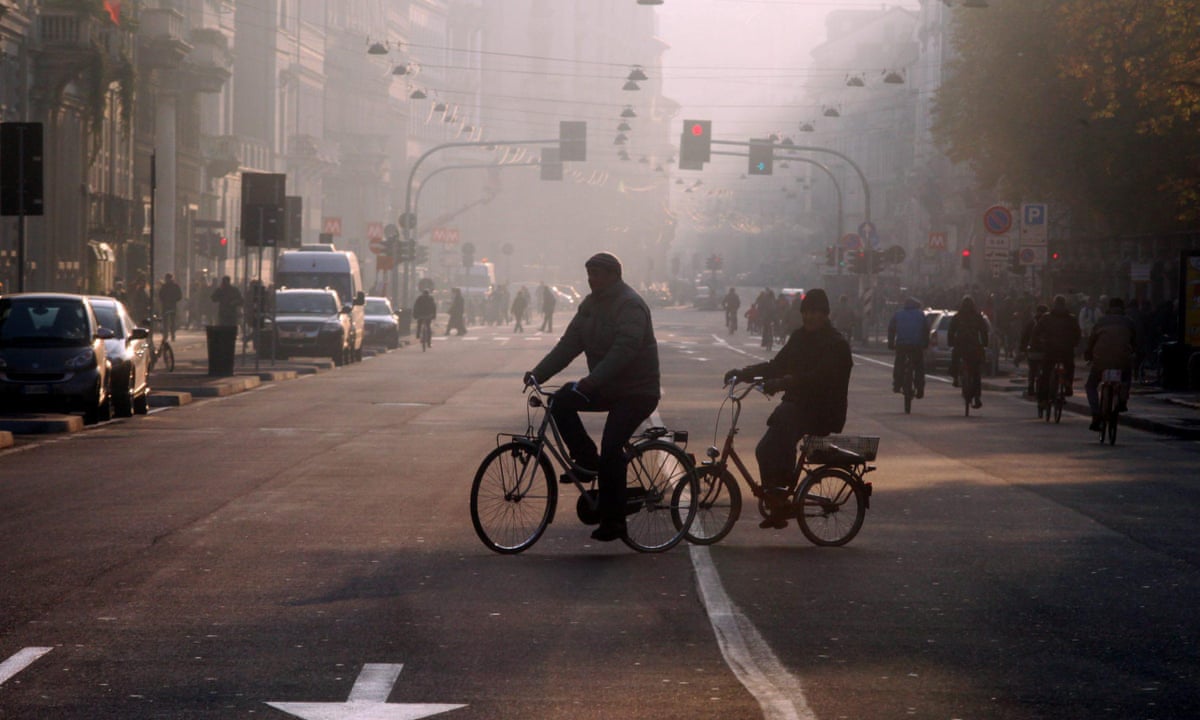
Cash for cycling: polluted Milan might pay commuters to bike to work 

With its serious pollution problem and notorious driving styles, Milan is hardly renowned as a cycle-friendly city – but a radical new scheme aims to change that

Is cycling a way to tackle Milan’s pollution problem? Photograph: Ropi/Alamy Stock Photo

Famed for Vespas, Fiat 500s and a somewhat erratic driving style, Italy is not a land known for a thriving cycling culture. While the metropolises of northern Europe have invested in innovative solutions to get citizens on their bikes, in the bel paese the car remains king.

But now Italy’s economic powerhouse, Milan, is seeking to bring back the bicicletta by paying people to cycle to work. The move follows the announcement in December of a €35m (£27m) government fund for sustainable mobility solutions, after Milan and other parts of the country were hit by dangerous levels of pollution.

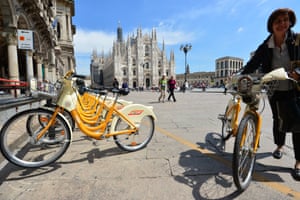
Within the next few weeks local authorities nationwide will begin competing for the state cash, with Milan’s councillor for mobility, Pierfrancesco Maran, hoping to be first in line. While there is already a movement in Milan to make the city cycle-friendly, such as a successful bike sharing scheme, he believes more could be done.

“Reimburse those who go to work by bike; a project similar to the one in France,” Maran said. Under the French system trialled in 2014, employees were paid 25 cents per kilometre they pedalled to work. A pilot on the same principle is currently being rolled out in Massarosa, a small Tuscan town where 50 people are said to be taking part.

The introduction of Milan’s bike share scheme is part of a bid to make the city cycle-friendly. Photograph: Giuseppe Cacace/AFP/Getty Images


With the numbers in Milan likely to be considerably higher, Maran’s office has suggested using an app to keep track of people cycling to work: “The software exists; it’s not 100% flawless but no one’s thinking of giving large sums,” he said.

Maran has sought help from Milan’s Polytechnic University to work out the practicalities, with the institute’s mobility manager, Eleonora Perotto, advising on how to potentially set up the scheme.

One idea includes a system to monitor a person’s travelling speed, to check whether they are really cycling to work – although Milan’s heavy traffic could make this challenging. “In the city, those who travel by bike are almost faster than cars,” Perotto said. She is supportive of the scheme as a way to promote cycling in Milan, but admits she doesn’t cycle to work herself because of the distance and difficulty of the route.

Her sentiment reflects a key flaw in the proposal to pay people to cycle to work: that money alone is not enough of an incentive. The French scheme had moderate results, with only a few hundred people reportedly signing on out of more than 8,000 eligible, while later this year it will become clear how well Italians in Massarosa take to the idea.

Ralph Buehler, an associate professor in urban affairs and planning at Virginia Tech in the United States, believes a paying scheme has to be accompanied by other measures to make cycling a realistic option. He cited US research that found about 60% of the population are “interested but concerned” about cycling.

In 2015 Milan banned cars for three days to tackle the pollution and smog. Photograph: Ropi/Alamy

“If you don’t provide a safe cycling environment, you will only get a very small group of people,” Buehler said. “Just paying people alone will not have that much of an effect, because you don’t get to that part of the population which are ‘enthusiastic but concerned’.”

The availability of bike paths, secure parking and showers are all areas which could affect a person’s willingness to cycle to work. The relative ease of driving is also a factor, although Buehler warned it is difficult to enforce measures against cars before other options are in place.

“Experience shows that you can make it more difficult for people to drive, but it’s politically easier if you have other options: good incentives to cycle, good public transport, easy to walk.”

Even with all of these options available, people are less likely to cycle to the office if they are also incentivised to drive. Holger Haubold, a fiscal and economic policy officer at the European Cyclists’ Federation, says a counter-productive scheme exists in Belgium whereby people are offered company cars alongside a cycle-to-work scheme.

Despite this, Haubold says Belgium’s programme to pay people to cycle to the office has been successful. “The fiscal incentive is the most efficient way to promote cycling to work. Companies that have this incentive in place have significantly more employees cycling to work than those that don’t.” But he echoed Buehler’s view that broader bike infrastructure is fundamental to the success of the scheme.

In Copenhagen, which already boasts some of the world’s best cycling infrastructure, few people cycle as a way to save money on fuel or public transport. According to figures from Copenhagenize Design Company, which advises governments and organisations on making cities cycle-friendly, only 6% of people in Copenhagen cycle because it’s inexpensive.

The main reason people pedal their way through the city is because it’s quick and easy, 56% of cyclists said, while 19% do so for the exercise. Just 1% of people are motivated by environmental concerns; noteworthy in Milan, where cycling is seen as a way to tackle the city’s pollution problem.

Mikael Colville-Andersen, Copenhagenize’s chief executive, points out that poor air quality puts people off cycling. “Pollution creates an undesirable environment in a city, which doesn’t exactly encourage people to spend more time outdoors,” he said. “Pay-to-bike schemes are a nice idea, but if the city is clogged with toxic emissions, telling people to get out and cycle in it is a bit ridiculous.”

Pollution instead serves as a motivational factor for politicians, such as in Milan where all traffic was banned for a period in December owing to poor air quality. City hall also introduced a reduced €1.50 day ticket for public transport.

Ultimately, Buehler says, potential cyclists are more likely to respond to individual benefits – such as a cash in their pockets: “Many people are idealist and think the environment should be safe, but for many adding this direct, selfish benefit is a good strategy.”

Source: Cash for cycling: polluted Milan might pay commuters to bike to work | Cities | The Guardian

Posted in Air Quality, Europe, Italy | Tagged , , | Leave a comment

London’s air pollution ‘is caused by drivers from outside the capital’ 

More than three quarters of car pollution in the south-east is produced by drivers living outside London, according to new research.

An Oxford University study found the reliance on cars in the areas beyond the M25 meant carbon emissions targets would not be met.

The report, published in Transport Policy journal, found that in 2012 the population of 12 million living in the south-east but outside the capital produced 77 per cent of the region’s car emissions, compared with just 23 per cent by the eight million people within London.

Researchers found that the average daily car mileage per person was 7.7 miles by Londoners, less than half the 15.6 miles driven by those neighbouring the capital.

The study’s author, Dr Caralampo Focas, said the “patchwork” of targets for reducing emissions outside London were unlikely to be met.

“London and New York have been studied as role models for other cities in terms of land use and transport policies. Yet this approach neglects to look at the bigger picture,” he said.

“Both capital cities are surrounded by sprawling developments that extend well beyond the main urban centres where residents are heavily reliant on their cars and often have to drive to their nearest shop or other facilities.

“Neither London nor New York has a regional planning or transport authority covering the entire region. These findings suggest that policymakers should view cities in their wider regional context given this is where the greatest use of energy and greenhouse gas emissions is now concentrated.”

A debate around air quality was sparked in September last year when VW Group admitted 482,000 of its diesel vehicles in the US were fitted with defeat device software that could cheat emissions tests.

The German-based manufacturer also announcing that some 11 million vehicles were affected worldwide – including almost 1.2 million in the UK.

The Oxford University study included Bedfordshire; Essex; Herfordshire; Buckinghamshire; East and West Sussex; Hampshire; Kent; Oxfordshire; and Surrey as being in the South East region, but outside London.

It also includes unitary authorities Luton; Southend-on-Sea; Thurrock; Bracknell Forest; Brighton and Hove; Isle of Wight; Medway; Milton Keynes; Portsmouth; Reading; Slough; Southampton; West Berkshire; Windsor and Maidenhead; and Wokingham.

The research was financed under the Marie Curie programme of the European Union.

Source: London’s air pollution ‘is caused by drivers from outside the capital’ | London | News | London Evening Standard

Posted in Air Quality, Europe, London, UK | Tagged , , | Leave a comment

HOW A RESPRO® MASK WORKS

Posted in Air Quality, Respro® How To Videos, Respro® Products | Tagged , , | Leave a comment

Air pollution is endangering children’s health in Mongolia 

In Ulaanbaatar, Mongolia, children like Nandin-Erdene face air so dense with pollution that they cannot view the colour of traffic lights. See what the air quality means for children’s health, and learn what UNICEF and partners are doing to cut through the smog.

ULAANBAATAR, Mongolia, 22 February 2016 – “When I go to school, it is very smoggy and I can’t see anything. When I cross the road in the morning on my way to school, I can’t tell if the light is red or green,” says Nandin-Erdene, her cheeks red from the cold.

The 9-year-old girl lives with her parents and siblings in a ger district, an area that does not benefit from urban planning or most basic services, in Ulaanbaatar, the capital city of Mongolia. Like 200,000 other households in the peri-urban areas, Nandin-Erdene’s family burn raw coal for heating and cooking during the winter – during which time temperatures can plummet to –40 °C.

Coal combustion and a high smoking rate have brought considerable indoor and outdoor air pollution, the dense curtain through which Nandin-Erdene tries to cross the street.

The air Nandin-Erdene breathes

Schoolchildren like Nandin-Erdene breathe in heavily polluted air not only in the streets, but also at both school and home.

Ulaanbaatar is among the 10 most polluted cities in the world. Air pollution levels in the ger have reached dangerous levels: 2011 data showed that fine particulate matter, or PM 2.5, which increases the risk of respiratory infections among children, is usually 6–7 times higher than World Health Organization standards allow. The measurement can peak at up to 25 times the allowance, in December.

“My children get flu and sore throat very often during winter. I think that it’s because of the air pollution,” says Nandin-Erdene’s mother Khongorzul.

“Because of the smog, my throat burns and it gets sore,” agrees Nandin-Erdene. “I get sick often.

“I heard that smog is very bad for health. It makes lungs and other organs sick.”

“I am worried more about the long-term effects,” says Khongorzul. “I don’t know what will happen to them in the future.”

Nandin-Erdene and her mother are right to worry. The health risks to children like her are significant.

Children and air pollution

Globally, indoor air pollution contributes to the death of 4.3 million people each year, of whom 13 per cent are children under 5. Of this age group, more than 50 per cent of deaths are attributed to pneumonia caused by particulate matter.

In Mongolia, the three diseases that have resulted in the most lost life-years in Mongolia are related to air pollution. Among children under 5, acute lower respiratory infection, and in particular pneumonia, is one of the leading causes of death. Children living in highly polluted districts of Ulaanbaatar have been found to have lower lung function than children living in rural areas, with concrete risks of chronic respiratory disease later in life.

There are real reasons that air pollution affects children differently, and profoundly. According to Dr. Malchinkhuu Danzan, of the National Centre for Maternal and Child Health, “Children’s exposure to air pollution is of special concern because their immune system and lungs are not fully developed. The younger the children, the greater the impact of air pollution will be on their health.” The net effect? “Air pollution leads to respiratory insufficiency, which is complicated with inflammation and can damage a child’s lungs, and cause a dangerous risk to child’s life,” concludes Dr. Malchinkhuu.

Acting on the data

“I want my children to live in an environment with clean air to breathe. It should be an essential right for every human being.” –Khongorzul 

UNICEF is responding to the urgent needs of children like Nandin-Erdene. UNICEF Mongolia is scaling up its engagement in environment and air pollution.

In January, UNICEF convened an international conference with world and national experts to discuss scientific evidence on air pollution and child health, and to foster a policy discussion – all in close collaboration with national partners. The conference and its recommendations have triggered accelerated actions to reduce the burden of pneumonia among children in Ulaanbaatar, while simultaneously focusing on measures to reduce air pollution exposure in older children that contribute to the burden of chronic respiratory disease.

UNICEF will also focus on reducing the incidence of pneumonia by supporting vaccine introduction and treatment, complementary interventions like better nutrition and breastfeeding, and measures to promote positive behaviour change.

“Current exposures of children to air pollution have not been experienced by previous generations, and this generation is projected to suffer from unprecedented levels of chronic respiratory disease later in life. The disease burden of pneumonia can and should be prevented, as too many children still die during the longest cold season,” says UNICEF Mongolia Representative Roberto Benes. “That is why reducing air pollution is a moral imperative but also a most effective investment for Mongolia’s future generations and sustainable development built on health and human capital.”

It is only with collective urgent efforts and aggressive policy measures that this hope can become a reality. For its part, UNICEF Mongolia is continuing to scale up its efforts to provide children with the essence of development: a healthier environment to live in.

Source: Air pollution is endangering children’s health in Mongolia | At a glance: Mongolia | UNICEF

Posted in Air Quality, Asia, Mongolia | Tagged , , , , | Leave a comment

The country with the worst air pollution is not the one you’re thinking of 

A man wearing a mask walks past trees shrouded with pollution haze in Beijing in 2014. (Andy Wong/AP)

It’s a never-ending debate in Asia — whose air quality is worse, China’s or India’s? A new study by Greenpeace released Monday is trying to answer that question.

Analysts looked at NASA satellite images and found that measurements of particulate matter — the microscopic particles that invade your lungs and can cause cancer and heart disease — improved impressively in China over the past few years while air quality in India has worsened, with 2015 ranking as India’s most polluted year on record.

The satellite images showed that the levels of PM2.5 particles decreased by 17 percent in China from 2010 to 2015 and 15 percent in the United States while rising 13 percent in India, the study found.

For the first time, Greenpeace found, the average Indian citizen was exposed to more particulate matter than the average Chinese. The images below from Greenpeace show China’s air quality worsening, then improving — while India’s has steadily worsened:

Satellite data shows China’s air quality worsening from 2005 to 2011, then improving from 2011 to 2015. However, India’s air quality has steadily worsened. (Greenpeace)

The study also found that the average annual PM2 level for India’s capital, New Delhi, was also higher than in Beijing — an average of 81 for Beijing, 128 for Delhi and 12 for Washington, D.C.

China has made a concerted effort to address its air pollution problem in recent years after widespread public outcry over filthy air that put pressure on the government to release better pollution data. The Greenpeace study credits China’s national pollution action plan launched in 2013 for its “impressive” improvement. That included tightening emission standards for coal-fired power plants and heavy industry and increasing emissions monitoring and enforcement.

However, the study notes that pollution levels in China remain “alarmingly high.”

Meanwhile, in India, public outrage has only just begun to coalesce around the problem. Indian newspapers have run high-profile series on air pollution in recent months and the Delhi government has instituted an odd-even day driving plan this winter to control the worsening air.

The study suggests that India should put in place a pollution action plan that sweeps from Punjab to West Bengal in the northern part of the country, where pollution is the worst, enforce compliance for coal-fired power plants and institute air quality monitoring systems for all major urban centers. India has a dearth of online monitoring systems in place in its cities — only 39 such stations compared to 1,500 in China, 770 in the United States and 1,000 in Europe, the study found.

Source: The country with the worst air pollution is not the one you’re thinking of – The Washington Post

Posted in Air Quality, Asia, China, India | Tagged , , , , , , | Leave a comment

Transport largest source of air pollution

Yangon’s traffic congestion is a major factor in fouling the city’s air, experts say. Speaking at an air quality seminar, Dr Than Htut, a retired head of the Occupational Health Unit, said it was the most important of three major causes of air pollution, the other two being electricity distribution and industry.

Particles and dust known as PM10, detected in quality control tests around the city, could cause respiratory diseases and chronic lung ailments, he said.

Daw Than Than Win, deputy head of Yangon City Development Committee’s Environmental Conservation Department, told the seminar at the Health Museum on February 19 that a range of harmful gases, including sulphur dioxide, had been detected.

Yangon began monitoring its air quality in 2007. The ASEAN Working Group on Environmentally Sustainable Cities (AWGESE), the German Corporation for International Cooperation (GIZ) and YCDC had begun working together to test air quality in Yangon and Nay Pyi Taw in 2012. Testing is still proceeding in 22 separate locations.

The four air quality testing instruments in use measured 11 factors: carbon dioxide, carbon monoxide, relative humidity, nitrogen dioxide, hydrogen dioxide, sulphur dioxide, particulate metal 10 micron (PM10), PM 2.5, wind speed, wind direction and temperature. Yangon air is marked by the presence of PM10, sulphur dioxide and nitrogen dioxide, she said.

The heaviest concentrations were in industrial zones in Hlaing Tharyar and Thilawa.

However, air pollution in Yangon is still less than that in large cities in neighbouring countries.

Source: Transport largest source of air pollution

Posted in Air Quality, Asia | Tagged , , , | Leave a comment

Air pollution could be killing 2500 people a year in Scotland

New research estimates that air pollution is responsible for 2500 deaths a year in Scotland.

A report from the Royal College of Physicians and the Royal College of Paediatrics and Child Health has shown that 40,000 deaths are attributable to exposure to outdoor air pollution each year across the UK.

And based on this research, Friends of the Earth Scotland calculates this equates to between 2500 and 3500 deaths a year in Scotland.

Emilia Hanna, air pollution campaigner for Friends of the Earth Scotland said: “This new research shows that the previous official figure for how many people die early from air pollution (29,000) underestimated the scale of the problem, and that air pollution is a much more serious public health crisis than previously understood.

“Based on this new research we can estimate that over 2500 people in Scotland are dying early from air pollution each year.

“Breathing in toxic fumes increases the risk of having a heart attack, stroke, or cancer. Children, especially those growing up in urban settings, are forced to breathe in tiny harmful chemicals and studies have shown a link between exposure to nitrogen dioxide and children’s lung development. Air pollution can also cause developing foetuses to fail to grow to their full potential.”

She continued: “Traffic is the main cause of today’s air pollution, so the solutions are simple, we need less traffic on the roads and vehicles need to have cleaner emissions.

“The Government must invest more money into sustainable travel modes like walking and cycling so that it is easier for people to do without a car. It must also roll out Low Emission Zones in each major city in the country by 2018, which would ban the most polluting vehicles from city centres.

“It is shocking that despite the overwhelming evidence showing that air pollution is a top killer and that traffic is the key cause, the Scottish Government continues to pour millions of pounds into unnecessary road building.”

She added: “When the Scottish Government decides its budget this Wednesday, this new evidence must make it reinvest a portion of its motorways budget back into walking and cycling projects.”

Source: Air pollution could be killing 2500 people a year in Scotland – Montrose Review

Posted in Air Quality, Europe, UK | Tagged , , | Leave a comment