Exposure to high levels of air pollution associated with higher risk of preterm birth 

Exposure to high levels of small particle air pollution is associated with an increased risk of preterm birth — before 37 weeks of pregnancy, according to a new study published online in the journal Environmental Health.

The study, by researchers at Cincinnati Children’s Hospital Medical Center and the University of Cincinnati, identified a 19 percent increased risk, with the greatest risk when high exposure occurred during the third trimester of pregnancy.

Diesel exhaust particles make up a substantial portion of particulate matter in urban areas. The size of particles is linked to their potential for causing health problems. Smaller particles have greater potential to be inhaled into the lungs and can cause serious health problems, including several heart and pulmonary diseases.

“Although the risk increase is modest, the potential impact is robust, as all pregnant women are potentially at risk,” says Emily DeFranco, DO, a physician-researcher at the Center for Prevention of Preterm Birth at Cincinnati Children’s and an associate professor of maternal-fetal medicine at the University of Cincinnati. “We estimate that decreasing the amount of particulate matter in the air below the EPA’s standard threshold could decrease preterm birth in women exposed to high levels of small particulates by about 17 percent, which corresponds to a 2.22 percent decrease in the preterm birth rate in the population as a whole.”

The researchers studied birth records in Ohio between 2007 and 2010. The population included nearly 225,000 singleton (not multiples) live births. Of these, more than 19,000 births were preterm. The birth records were linked to average daily measures of fine particulate matter of 2.5 microns or less in width. These measures were recorded by 57 EPA network air monitoring stations across the state. The vast majority of births, 97 percent, occurred in very urban areas, where most monitoring stations are located and exposure levels likely to be highest.

Preterm birth rates were higher among mothers exposed to high levels of airborne particle pollution above the EPA standard, as well as among mothers 40 or older, black mothers, and women with no prenatal care or with lower education level.

In 2015, Dr. DeFranco published a study in the journal PLOS One showing that exposure to high levels of particulate matter in the third trimester of pregnancy was associated with a 42 percent increased risk of stillbirth.

Also last year, the American Lung Association named the Cincinnati-Wilmington-Maysville statistical area as the nation’s 8th most polluted by year-round particle pollution. The Cleveland-Akron-Canton area ranked 10th.


Story Source:

The above post is reprinted from materials provided by Cincinnati Children’s Hospital Medical Center. Note: Materials may be edited for content and length.


Source: Exposure to high levels of air pollution associated with higher risk of preterm birth — ScienceDaily

Posted in Air Quality, Health Effects of Air Pollution, Medical Studies | Tagged , , , | Leave a comment

REVIEW: Choosing an Air Pollution Mask for China

It’s not something we typically think about while preparing for a trip – what will the air quality be like? Destinations like the Faroe Islands are known for having superb air quality, but what about big cities in Asia? While preparing for a recent trip to Qatar and China, I had a lot of questions about choosing an air pollution mask for China, especially since everyone kept warning me about how smoggy it can get in Beijing and Shanghai.

I decided to investigate it a little further, partly out of curiosity and partly because my father and I (we were traveling together) both suffer from allergies. I knew that popping a Zyrtec wasn’t going to cut it.

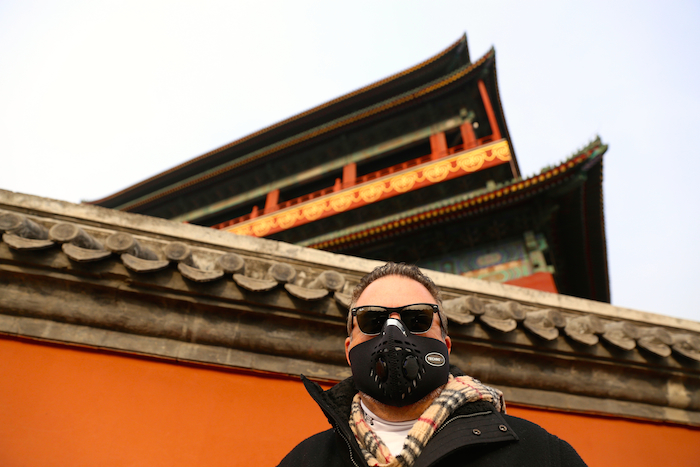
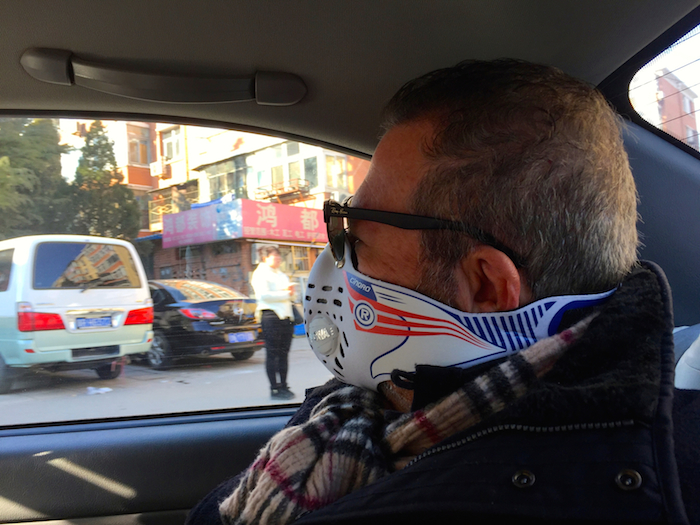
My father wearing his pollution mask at the Drum Tower

This is my story with a few tips and photos from my trip for anyone trying to choose the best air pollution mask for China.

First, I explored all the options available. Basically, there are a myriad of air pollution masks, but not all are created equal. Let’s get started with the three basic types.

Types of Air Pollution Masks

Surgical Masks

This is your basic surgical mask. As you might imagine, it’s exactly what a surgeon wears in the operating room to protect the patient from any contaminants from his/her saliva. It also protects the surgeon from inhaling or ingesting any fluids from the patient.

Pros: In terms of comfort, they are quite comfortable because they hardly weigh anything at all. They are typically made of cotton and are inexpensive (about 80 cents each). Great for mild days when allergens may be present, which is a very rare occurrence in China.

Cons: These masks do not fit well against the face, even when you pinch the metal band at the bridge of the nose. They don’t create a seal to block out air pollutants and they have no filter, which is what contributes to their dismal filtering efficiency rating of 57 (A rating of 100% indicates a perfect seal where nothing can get in or out). When I was in China I saw hundreds of people wearing surgical masks and it made me sick to my stomach to think of the false sense of security they had. Then again, there were others with no mask at all, which is also pretty scary to think about when you consider the recent story of a Chinese artist whose air pollution vacuum video went viral. He literally made a brick (yes, a brick) from the pollutants he managed to collect by just walking around Beijing with an industrial vacuum.

Overall: Don’t do it. All you will be getting is a false sense of protection with a mask that you can’t adjust. 

Disposable Masks

These are masks that you can wear a few times before tossing. They were developed with factory and construction workers in mind so they are meant to create a good seal around the face to stop any particles from entering the nose or mouth. A popular model is the 3M® 9332 with exhalation valve to remove moisture from the face (see below).

Pros: Price point is excellent. A single mask will run you about $5.50, depending wear you buy it. It also has an excellent filtering efficiency of over 90%.

Cons: If you want to look like you’re headed to a nuclear plant disaster or anthrax contaminated zone, then this is the mask for you! No, seriously they are not very attractive and have to be thrown away after 3-4 uses, or until they start getting grayish, indicating they are dirty. That’s because you can’t change the filter. Additionally, they aren’t going to stay put during exercise or outdoor activities like extensive sightseeing around Beijing.

Overall: This is a good mask if you don’t plan on spending too much time outdoors in a place where there is significant air pollution.

Reusable Masks

My father wearing his Respro® Cinqro™ mask with a special HEPA filter

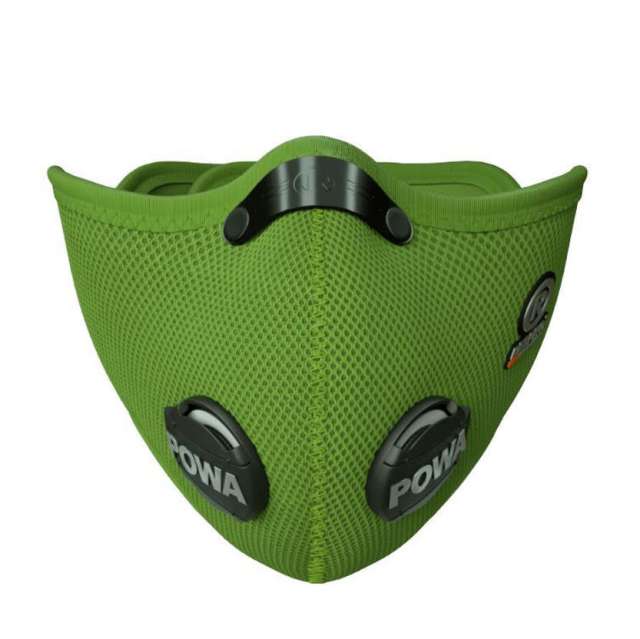
Reusable masks are those that allow you to change out the filter, which means once you’ve got a keeper, it’s yours to keep. They typically come in a variety of prints and colors, and are perfect for frequent travelers like myself. Respro® is a brand of reusable pollution mask that has created more than 15 models, each designed for a specific lifestyle in mind, whether it’s playing sports in freezing temperatures, or reducing allergies in urban places.

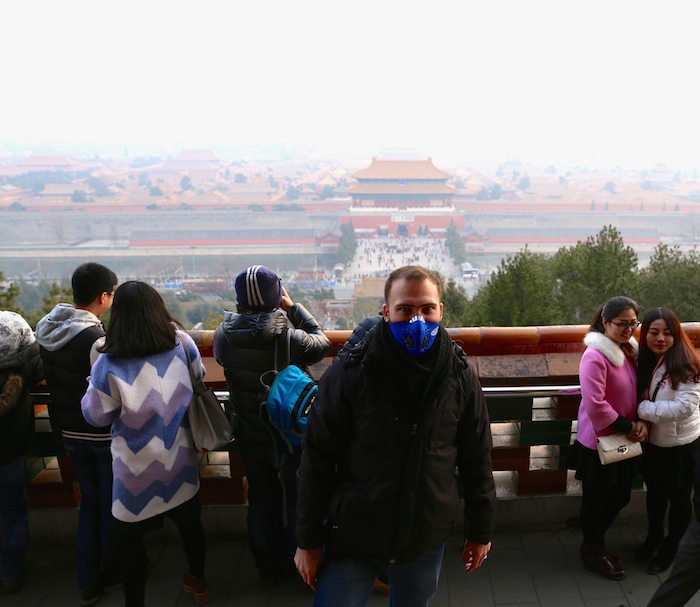
Here I am admiring the view of the Forbidden City one particularly smoggy afternoon

Pros: Brands like Respro® offer you choices so you’re not just stuck with a white clinical-looking mask (although they have those models too). These masks typically come in different sizes so you can find the perfect fit (this is the key!) Once you have it, you can just change out the filters and keep using the same mask. They are made out of fabric and are machine washable, which is nice if you want to freshen it up in the washing machine. They are also ideal for biking or playing sports (or sightseeing around Beijing trying to cram all the main sites in like my father and I).

Cons: Reusable pollution masks are the priciest of the three ($40 – $65) and filter refills are sold separately. For most models, filters must be replaced after 50-70 hours of use.

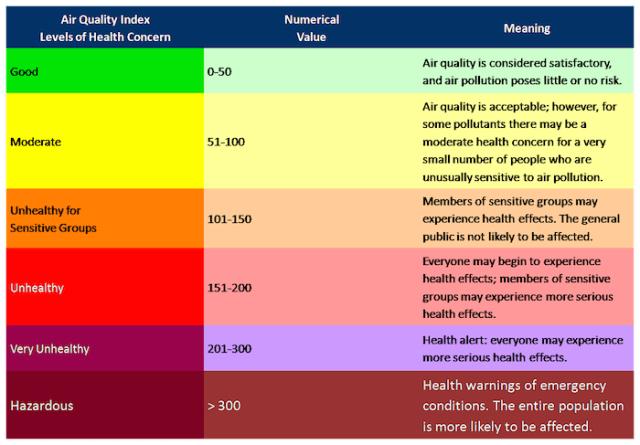
Overall: Reusable masks cost more, but at least you can pick the “look” you want. The mask I used (Respro City Mask) has a charcoal filter that is ideal for “regular” days in China. By this, I mean days with an API of “Good” to “Unhealthy” (0-200 API). I wore it in Beijing, Shanghai, and Xi’an and never once experienced an irritation or allergy attack.

Choosing an Air Pollution Mask for China

So, how do you choose the right mask?

It all depends on fit, which is why I went with the Respro. I liked how the neoprene fabric stretched over my face to create a good seal while still being comfortable, and that I could wear it with sunglasses without a problem. I also didn’t get any moisture buildup in the mask, which was one of my main concerns.

Dangers of Air Pollution 

There are plenty of people who go mask-free in China, which, after learning about air pollutants, makes me cringe. According to the World Bank, 16 of the world’s top 20 cities with the worst air pollution are in China. The main source of all this pollution? Coal. China’s primary source of electricity comes from coal – about 6 million tons are burned daily. Add vehicle emissions and other sources and you’ve got a deadly smog cocktail made up of cancer-causing gases and particles.

This is exactly why protecting your lungs is important and why I wanted to write about my experience choosing an air pollution mask for China.

Images: David Hoffmann

Source: Choosing an Air Pollution Mask for China – David’s Been Here

Posted in Air Quality, Respro® Mask Reviews, Respro® Products | Tagged , , | 2 Comments

Nepal’s air pollution among worst

Nepal continues to rank among the worst four performers in protecting the human health and environment due to degrading air quality.

The latest Environment Performance Index (EPI) 2016 released this week at the World Economic Forum puts Nepal 177 among 180 countries in terms of air quality. India, China and Bangladesh are the only countries performing worse than Nepal in an effort to improve the dramatic decline in air quality—a leading cause of death worldwide—accounting for 5.5 million deaths in 2013.
It has ranked Nepal 149 among 180 countries, in overall performance. Finland is ranked on the top with Somalia in the bottom in EPI ranking released biennially. The previous EPI ranked Nepal at 139 in 2014.
The index, a Yale University-based initiative, measures national and global protection of ecosystems and human health from environmental harm, draws out trends and highlights data gaps in priority areas including air quality, water management, and climate change.
Under the air quality, one of the nine assessment areas to determine the overall EPI ranking, the exposure to fine particulate matter (PM2.5), nitrogen dioxide, and percentage of the population burning solid fuel indoors were measured. The particulate matter (PM 2.5) is considered one of the most harmful air pollutants that lodge into human lungs and blood tissues, increasing the chances of lung cancer and other life-threatening respiratory diseases, among others.
“Air pollution has emerged as a biggest environmental health risk for the country, particularly for Kathmandu where the rapid urbanisation and population growth makes the situation even worse,” said Dhiraj Pokharel of the Society for Legal and Environmental Analysis and Development Research (Leaders Nepal), an NGO working on indoor air pollution. Over the years, the government has made no significant effort to improve the air quality and mitigate the risks except for introducing policies and programmes but lacking implementation, he said. “We are still struggling to have a research on identifying the sources of harmful air pollutants, and level of exposures to human life,” Pokharel said.
The EPI report says that 75 percent of the total populations in Nepal and India are exposed to unsafe levels of fine particulate matters as air pollution is a growing global problem. It situation is worse in rapidly developing economies like China and India than in wealthy and very poor countries. The report mentioned that many Asian and African countries have not fared well in addressing environmental problems, including air quality as all have broad governance problems with long, troubled legacies. “Only well-functioning governments are able to manage the environment for the benefit of all,” the report added.

Source: The Kathmandu Post :: Nepal’s air pollution among worst

Posted in Air Quality, Asia | Tagged , , , | Leave a comment

Leeds named hotspot for air pollution deaths as epidemic costs local NHS £480m

Almost 700 people in Leeds will die this year from illnesses related to air pollution, with an overall cost to the local health economy of £480m, it has been claimed.

Newly released research from environmental campaign group Global Action Plan (GAP) – based on World Health Organisation and regional Public Health data – predicts there will be 2,567 premature adult deaths in Yorkshire this year from bad air quality.

Leeds is the worst regional hotspot – and third nationally – with 680 predicted deaths in 2016.

The projection for Wakefield is 178, Bradford 222, Sheffield 500 and York 82.

The campaign group has now launched a five-point manifesto urging local authorities – which oversee public health matters – to help curb the toll of the silent killer.

GAP’s research found that air pollution costs Leeds more than obesity, one of the biggest national health challenges. Air pollution costs Leeds £480m, while obesity costs £304m.

Caroline Watson, partner at GAP, said: “You might imagine the deaths and illnesses that result from air pollution were consigned to the history books when Leeds was in the midst of the Industrial Revolution, but today’s research shows that at least 680 will die early this year. That is simply unacceptable. Individual people must be empowered to take steps to avoid pollution’s worst effects.

“Air pollution is not just an environmental threat it is a public health risk. Our five-point manifesto shows the council that there are steps they could take to improve the lives of the people who live here.”

The group has today launched its Air Quality Manifesto, setting out how the city might reduce the impact of poor air quality. Its five point plan includes practical solutions such as car free days in Leeds City Centre.

One GAP initiative, the Cleaner Air Programme, has already seen the introduction of Clean Air Zones around hospitals in other parts of the UK. The group is now looking to bring the idea to Leeds.

Simon Bowens, Yorkshire campaign lead for Friends of the Earth, said: “Air pollution is the second biggest cause of premature death after smoking in Leeds and across Yorkshire and yet many of the thousands of these deaths are avoidable.

“The proposals within the Air Quality Manifesto are welcome and a Clean Air Zone is needed to get the dirtiest vehicles off our roads, but ambitious action needs to be taken to reduce traffic in the worst affected areas.

“Local action by councils and central Government to promote public transport and active travel such as walking and cycling is essential.”

“Devolved transport spending needs to be targeted at reducing traffic and pollution and not on building roads which will just stimulate traffic growth.”

A spokesman for Leeds City Council said: “The council has been working on a number of initiatives to help tackle air pollution in the city, including working to improve our own fleet, for example seeking to use Compressed Natural Gas for our council refuse collection vehicles, fitting solar panels to our own buildings and more than 1,000 council homes and encouraging people to use sustainable transport and seeing where we can influence others or help the transport industry to make positive changes.

“We are also encouraging businesses, communities and individuals to think about ways they may be able to contribute to cutting pollution with the aim of improving both air quality and public health in the city.

“We are always keen to work with groups and organisations who may be able to help and will look very closely at any proposals to see if they will help us achieve these goals.”

As previously reported, Leeds is one of seven cities in England at risk of missing European targets on air quality – which come into force in 2020 – and could face financial penalties.

Public Health England has previously estimated that long term exposure to pollution contributed to 5.5 per cent of all adult deaths in the city in 2010.

Nitrogen Dioxide is estimated to be responsible for 23,500 deaths in the UK each year, while a further 29,000 are killed by particulates – which are tiny particles of soot.

Source: Leeds named hotspot for air pollution deaths as epidemic costs local NHS £480m – Yorkshire Evening Post

Posted in Air Quality, Europe, UK | Tagged , , , , | Leave a comment

Worst Kind of Heart Attack Linked to Air Pollution, Experts Say 

Medical experts from Intermountain Medical Center met Wednesday morning to discuss recent findings linking increased short term air pollution in the Beehive state to serious health problems.

“It primarily effects the worst kind of heart attack, which is STEMI heart attack,  where there is a very severe affect on specific vessels of the heart that can cause the major pumping chamber to stop,” said Dr. Benjamin Horne, Intermountain Medical Center Heart Institute.

Dr. Horne and a team of medical experts have been studying air pollution and health along the Wasatch Front for over a decade. They know that on bad air days they can count on an increase of people admitted to the hospital.

“It’s just something that we’ve become used to. That we see higher activity for heart attack and chest pain and people whose hearts are laboring more to pump the right amount of blood out to the body–that they come in not feeling well,” said Dr. Horne.

From their research they’ve found those most at risk are people with underlying heart disease. “A lot of people don’t necessarily know if they have it, but we know the risk factors. People who are older, people who have high cholesterol, or blood pressure or diabetes and especially smokers,” said Dr. Horne.

Their findings have led the team to develop a care process model to help physicians understand what can be done during consultations with patients.

“We’ve developed some fact sheets for people with heart disease, or stroke, or asthma and COPD, and pregnant women that air pollution tends to effect these groups more,” said Dr. Horne.

Fact sheets, common sense guidelines and more information on air quality and health can be found here.

The full study can be found here.

Source: Worst Kind of Heart Attack Linked to Air Pollution, Experts Say –

Posted in Air Quality, USA & Canada | Tagged , , , , , | Leave a comment

Should cars be banned from Manchester city centre for one day a month to cut pollution? 

The idea is part of a ‘Air Quality Manifesto’ drawn up by the environmental charity Global Action Plan

Pollution is so bad in Manchester city centre that there are calls for cars to be banned for a whole day every six months.

Other suggestions in a new ‘Air Quality manifesto’ include air quality being incorporated into the weather forecast and workers being allowed to work from home when pollution levels are high.

Manchester’s air is among the most polluted in the country and Public Health England has predicted that 458 people will die prematurely from air pollution in the city in 2016 – more than from obesity.

Environmental charity Global Action Plan (GAP) believe something needs to be done and so have created the manifesto.

They are also calling for a ‘low emission zone’ in the city centre.

Caroline Watson, Partner at Global Action Plan, said: “You might imagine the deaths and illnesses that result from air pollution were consigned to the Manchester of the Industrial Revolution, but today’s research shows that at least 458 will die early this year.

“In 2015 that is simply unacceptable. Individual people must be empowered to take steps to avoid pollution’s worst effects and we want to work with local and national governments to tackle the problem too.

“Air pollution is not just an environmental threat it is a public health risk. Our five-point manifesto shows the council that there are steps they could take to improve the lives of the people who live here and Global Action Plan would welcome any opportunity to help out.”

One GAP initiative, the Cleaner Air Programme, has seen the introduction of Clean Air Zones around hospitals in other parts of the UK.

Graeme Sherriff from Manchester Friends of the Earth said: “For the sake of everyone’s health and quality of life we need commitments to reduce air pollution and bold investment in cleaner forms of transport including walking, cycling and public transport. Manchester Friends of the Earth supports the actions in this air quality manifesto.”

Manchester City Council indicated the manifesto did not apply to them.

But Councillor Kate Chappell, Executive Member for Environment, added: “Air quality is an issue which we take extremely seriously.

“There is extensive action being taken Greater Manchester-wide to address this including improvements to public transport and cycling routes and investment in electrical vehicle charging points.

“It makes sense for this action to be at a Greater Manchester-wide level to make an impact and so that different places don’t simply do different things.

“There will be consultation this year on Greater Manchester’s Low Emissions Strategy and Air Quality Action Plan and while we welcome their views we would encourage GAP and other interested groups and individuals to get involved in that.”

A Transport for Greater Manchester spokesman said they had noted the manifesto and recognised Greater Manchester faces a ‘significant challenge’ due to emissions from road traffic and congestion.

He said they were committed to reducing emissions and improving air quality to bring health benefits to people.

He said to ensure EU nitrogen dioxide emission levels were met they had drafted an air quality plan to improve air quality, reduce ill health and promote low emission culture.

The plan will go to public consultation in 2016.

He added: “We would encourage Global Action Plan, and all interested parties, to engage with us on these important issues during the consultation.”

Air Quality Manifesto

Global Action Plan are asking Manchester City Council to consider the following:

1. Manchester council could create a city centre Low Emission Zone, similar to London where high-pollution vehicles such as lorries, coaches and buses are charged, while smaller vehicles can travel for free.

2. A car free day in Manchester – The Council could look at introducing periodic car-free days in Manchester to reduce air pollution. They could also ask their employees to leave their cars at home for one day every six months as a way of leading by example.

3. Regional weather forecasters could report local air quality levels alongside the weather – Official channels can really get people to think about an issue and increase its prominence in their daily lives. Weather forecasters could help people understand the impact of air quality better if they included it in their broadcasts.

4. Employees should be given flexi-working days if air pollution is too high – Manchester Council could lead the way on this and ask employees to work from home if air pollution hits dangerous levels – this would increase awareness and limit the effects of exposure. They could then lead a campaign to ask other organisations and businesses to follow suit.

5. Manchester City Council should explore making front-line institutions, such as hospitals, schools and care homes, clean air zones – This would raise awareness about poor air quality and reduce the impact of air pollution on the most vulnerable.

Source: Should cars be banned from Manchester city centre for one day a month to cut pollution? – Manchester Evening News

Posted in Air Quality, Europe, UK | Tagged , , , | Leave a comment

Beijing to invest 16.54 bn yuan to tackle air pollution in 2016

Beijing plans to invest 16.54 billion yuan to tackle the air pollution and sets a target to reduce average annual PM2.5 concentration by 5 percent this year, according to the municipal government work report released Saturday.

According to the annual report on air pollution control from the Beijing EnvironmentalProtection Bureau, Beijing enjoyed 186 blue-sky days, or 51 percent, during 2015. Additionally, the number of days with good air amounted to two weeks longer than in2014. PM 2.5 concentrations decreased by 10 percent since 2013. Especially in the first tenmonths of last year, PM 2.5 concentration decreased to 69.7 cumulative micrograms/cubicmeter, down 21.8 percent.

The report said the four main pollutants which directly affect air quality have beenreduced. Compared with 2014, the concentrations of sulfur dioxide, nitrogen dioxide, PM10 and PM2.5 have dropped respectively by 38.1 percent, 11.8 percent, 12.3 percent and6.2 percent.

In 2016, Beijing will implement the clean energy project in 400 villages, complete thetransformation of coal-fired boilers of 2,100 MW and eliminate 200,000 cars with highemissions. At the same time, it will improve proportion of new energy vehicles used inpublic transportation, sanitation and postal industries. It will also speed up the elimination of the small polluting companies in the rural–urban fringes.

Source: Beijing to invest 16.54 bn yuan to tackle air pollution in 2016 – People’s Daily Online

Posted in Air Quality, Asia, China | Tagged , , , , | Leave a comment

Three maps that show just how bad air pollution is in Britain and around the world

The World Health Organisation (WHO) on Tuesday said that air pollution now constitutes a “public health emergency” across the world.

Eight days into 2016, London breached its own legal limit for air pollution for the entire year. Under regulations, the city is allowed to exceed maximum safe limits for 18 hours a year, an allowance that had already been exhausted by 8 January.

The below graphic from the i newspaper shows air pollution readings for the UK taken at 7pm on Wednesday 20 January, according to data from the World Air Quality Index.

The World Air Quality Index also run a real time map with current readings around the globe, as measured by the same scale in the graphic above.

Screen Shot 2016-01-25 at 07.36.06

Pollution is particularly heavy in south east Asia, which is why the index runs an eight-day forecast for the region, the outline of which looks roughly like this:

In December, Chinese authorities issued a pollution ‘red alert’ in Beijing which closed schools and business and urged people to stay indoors to avoid the smog.

Source: Three maps that show just how bad air pollution is in Britain and around the world

Posted in Air Quality, Asia, China, Europe, London, UK | Tagged , , , , , | Leave a comment