Utah sees worst air pollution since 2013

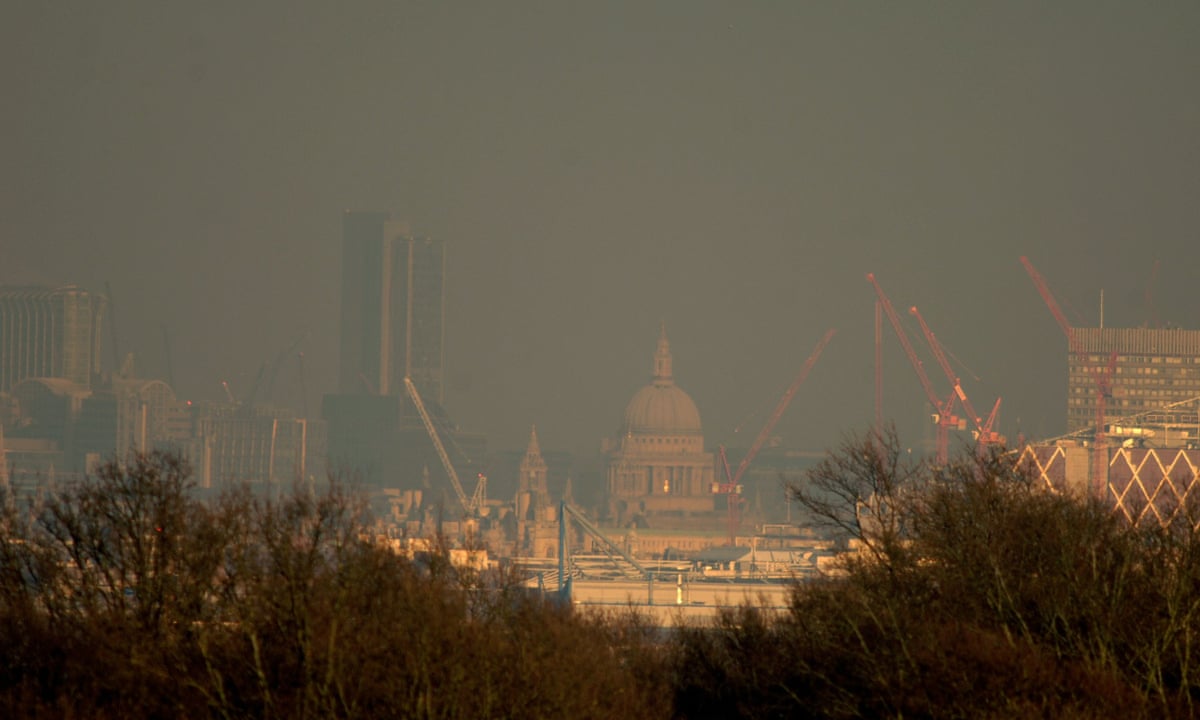
Utah’s pollution is at its highest levels since 2013 thanks to an inversion that is trapping murky air above Salt Lake and Utah valleys.

Salt Lake City registered a red-air day on Wednesday, with the Utah Division of Air Quality reporting PM 2.5 concentrations as high as 70 micrograms of particles per cubic meter, well above the Environmental Protection Agency’s acceptable level of 35 micrograms per cubic meter, The Salt Lake Tribune reported.

DAQ Air-Quality Monitoring Manager Bo Call said the high pollution levels can be blamed on a prolonged temperature inversion that started earlier this week. The inversion moves warm air over Utah’s valleys, acting as a lid to keep cold air — and pollution — beneath it.

Call says a prolonged period of low air quality hasn’t occurred since January 2013 when a similar inversion moved over the city.

“There’s been the odd day that’s a high value, but not nearly as much,” Call said.

The current inversion is expected to stick around for a while. Salt Lake, Utah, Davis, Weber, Cache, Box Elder and Tooele counties have instituted mandatory solid-fuel burning bans.

Call said a weak storm system expected this weekend may break the inversion or at least weaken it, but otherwise a storm isn’t on the forecast until Feb. 18.

The Utah Climate Center expects the current inversion to continue for about a week.

Source: Utah sees worst air pollution since 2013

Posted in Air Quality, USA & Canada | Tagged , , , , , | Leave a comment

London drivers urged to turn off engines in bid to tackle air pollution

Plans announced by Boris Johnson would see the capital’s drivers encouraged by signs and volunteers to turn off their engines in traffic jams

London drivers will be encouraged by volunteers and signs to turn off their engines in traffic jams to tackle the capital’s illegal air pollution levels, under plans announced by Boris Johnson on Thursday.

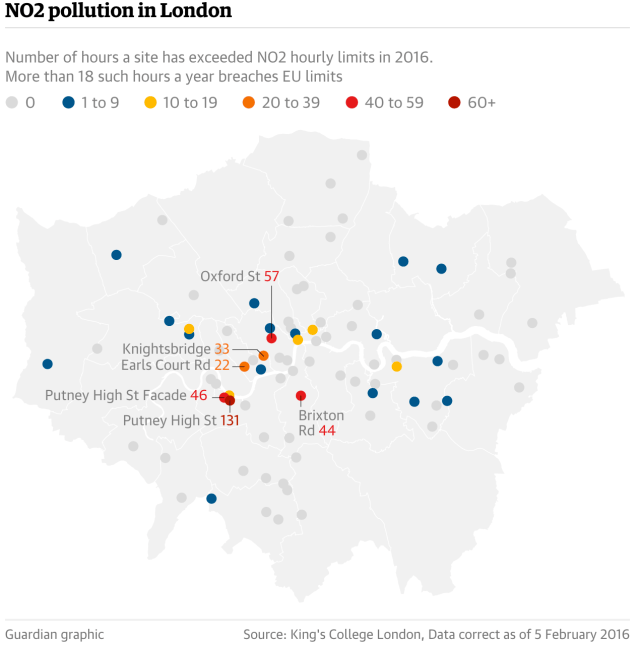
But campaigners accused the mayor of failing to take hard measures to cut the city’s pollution problem, which has seen six sites including Oxford Street, Knightsbridge and Brixton Road already breach annual limits just weeks into 2016.

Johnson’s Ultra Low Emissions Zone (ULEZ) for cutting pollution does not come into effect until 2020 and only covers central London. The schemes unveiled today are those that have won £5m from an air quality fund.

Nearly £200,000 will be spent on new electronic signs and measuring equipment at Tower Bridge to ask drivers not to leave their engines idling when the bridge opens, causing congestion for the 31,000 cars that cross it daily. But there will be no enforcement or incentive for doing so.

Another scheme will see “friendly, trained volunteers” sent out on to the streets of eight boroughs including the City of London on high pollution days, to talk to drivers about turning their engines off.

Screen Shot 2016-02-12 at 08.21.06

“Behavioural change has its place, but it’s no substitute for hard measures,” said Green party London assembly member, Darren Johnson.

“For example, one-fifth of the nitrogen dioxide pollution on Tower Bridge comes from Transport for London’s (TfL) buses. The mayor should at least have kept his promise to ensure that all new TfL buses were clean hybrids or better, and focused on eliminating its outdated polluting fleet.”

Simon Birkett, director of Clean Air in London, said: “With many London roads in central London tending to have the highest concentrations of nitrogen dioxide (NO2) from diesel fumes, in the world, Boris’s track record looks like being the worst in the world.” However, he said that some of the projects awarded under the grant scheme looked good.

ClientEarth, an environmental law firm that successfully forced the government to issue a national air clean-up plan last year, said that Johnson should bring forward the start date of the ULEZ, a move called for by the London assembly last year.

“Any attempt to lower air pollution in London is welcome. However, to really tackle this public health crisis in the shortest time possible the mayor must bring in a much bigger and better Ultra Low Emissions Zone sooner than 2020,” said the group’s healthy air campaigner, Andrea Lee.

Dangerous air pollution in the capital has become a key issue in the 2016 London mayoral contest, with Zac Goldsmith promising a “comprehensive plan to tackle it” and Sadiq Khan saying he will consult on expanding the ULEZ to all of zones one and two to improve air quality. As it stands, Tower Bridge will be outside the current planned ULEZ.

Source: London drivers urged to turn off engines in bid to tackle air pollution | Environment | The Guardian

Posted in Air Quality, Europe, London, UK | Tagged , , , , , , , , , , , | Leave a comment

Utah Air Getting Dangerous 

Air quality along the Wasatch front isn’t just unsightly, but getting dangerous. Hospitals are seeing an increase in the number of patients having lung and heart issues. Studies have shown when air is this bad it can lead to more serious heart attacks.

Dr. Denitza Blagev is a Pulmonologist at Intermountain Medical Center, and sees the effects of the bad air first hand. Those with respiratory issues are suffering from the air quality. She notes why those with heart issues need to be careful.

“People with underlying heart disease can actually have an increased risk of heart attack or stoke as well,” said Dr. Blagev.

According to studies people suffer more serious heart attacks during prolonged orange and red air quality days. Intermountain Healthcare has resources to help people know the steps they should take during these conditions.

Dr. Blagev notes that even those not having lung and heart issues can see problems and be more susceptible to getting sick.

“The problem when you have air pollution exposure and then on top of that you get the viral infection your body just has less reserve to cope with that,” said Dr. Blagev.

Experts have said red air days are like smoking a half pack of cigarettes. Those who do outside activities have even more exposure during the same period because they’re breathing heavier. Runner Michael Croxton said he’s started noticing the bad air on his health, but still runs outside because it’s how he exercises.

“Been congested and just feels like I’m running behind a couple of semis the whole time,” said Croxton.

Some people have even resorted to wearing special masks as they walk around. Experts say people should try to stay indoors. Make sure the air filter is clean so the inside air is not as bad.

Source: Utah Air Getting Dangerous – Story | Utah | Good4Utah

Posted in Air Quality, USA & Canada | Tagged , , | Leave a comment

Traffic-Related Air Pollution Linked To Formation Of Facial Dark Spots In Women

Older women often struggle to control dark spots, because no matter what product they use, these spots would not go away. In a new study, researchers found the link between traffic-related air pollution and the formation of facial dark spots in women.

The study, published in theJournal of Investigative Dermatology, included women from Germany and China to demonstrate the link between the levels of traffic-related gas emissions and the formation of dark spots known as lentigines on the skin

They found that Asian women older than 50 years old usually had the most pronounced changes on their cheeks. Aside from particulate matter, air pollution contains increased amounts of nitrogen dioxide (NO2), which has been linked to the development of health conditions like lung diseases and cardiovascular problems. Its effect on the skin, however, has never been investigated, the researchers said.

With an aim to demonstrate the link, the researchers studied two groups of women. The first group involved 806 Caucasian German women and the second group included 743 Han Chinese women. The first group had 2.6 hours a day exposed to the sun while the other group had 3.5 hours. In terms of smoking, about 20 percent of both groups had done the habit.

For the levels of NO2 exposure, the German women had 28.8 micrograms per cubic meter (µg/m3) and the Chinese group had 24.1 µg/m3.

The researchers found no link between the levels of NO2 and formation of lentigines on the forearms and back of the hands, but they noted the increased formation on the cheeks in both groups.

“To the best of our knowledge, this is the largest epidemiological study demonstrating a link between traffic-related air pollution and the formation of lentigines,” the study says (PDF).

An increase of 10 µg/m3 NO2 concentration was linked to 25 percent increase in dark spots. The researchers also performed sensitivity analysis and unveiled that the NO2 gas had a stronger effect than particulate matter concentration.

“The findings also strengthen the concept that the pathogenesis of lentigines might differ depending on the anatomical site,” Li Jin, Ph.D., from the Fudan University’s State Key Laboratory of Genetic Engineering, said.

Lentigines are benign lesions that usually occur on sun-exposed parts of the body. The number and size of the dark spots usually increase with age. They are most commonly found on the face, forearms, hands, and upper trunk.

Source: Traffic-Related Air Pollution Linked To Formation Of Facial Dark Spots In Women : LIFE : Tech Times

Posted in Air Quality, Health Effects of Air Pollution | Tagged , , , | Leave a comment

Air pollution raises risk of death ‘for decades after exposure’ 

Longest-running study to date analyses long-term mortality risks of Britons exposed to historic particulate pollution

High pollution levels were recorded in London in late January. The new study shows that health impacts from air pollution persist for a long time. Photograph: Matt Dunham/AP

Air pollution raises the risk of death for many decades after exposure, according to the longest-running study to date.

The analysis of 368,000 British people over 38 years also showed that those living in the most polluted places have a 14% higher risk of dying than those in the least polluted areas. Those exposed to particulate air pollution were more likely to die from respiratory problems, like pneumonia, emphysema and bronchitis, and also from cardiovascular problems, like heart attacks.

“What this study shows is that the [health] effects of air pollution persist for a very long time,” said Dr Anna Hansell, at Imperial College London, who led the new study. “There is an imperative that, because the effects are so long-lasting, we really ought to act on it. We have to think about what we are doing to the long-term health of the population.”

Many Britons are currently exposed to illegal levels of air pollution, with 29,000 premature deaths a year – or 5% of all deaths – blamed on air pollution. The UK government lost a supreme court legal battle in 2015 and was forced to produce an action plan.

If successful, this will cut air pollution to legal levels by 2020 in most cities and 2025 in London. The impact on children, whose lungs can be stunted for life, has been of particular concern to experts.

The new research, which is published in the journal Thorax on Tuesday, selected individuals at random from anonymised Office of National Statistics data and tracked them via the national censuses in 1971, 1981, 1991 and 2001. The study also estimated their exposure over time to particulate air pollution, which is produced mainly by the burning of fossil fuels in power stations and by vehicles.

“We found a statistically significant association between [air pollution] exposure in 1971 and mortality in 2002-09,” said Hansell. The risk of death rises by 2% for each extra unit of pollution (10 micrograms of particulates per cubic metre) a person was exposed to in 1971.”

Hansell added: “The more recent exposures appear to be the more harmful to health.” For each extra unit of pollution exposure in 2001, the risk of death in 2002-09 rises by 24%. Hansell said this gave another urgent reason to reduce air pollution, as cuts now would improve health in the next few years as well as in the long term.

The reason the risk of death falls with time since the exposure is probably because the health impacts of air pollution fade over time, said Hansell, although the different mix of pollutants today compared to 1971 might be more toxic.

The researchers found that the 36,800 people exposed to the highest levels of air pollution had a 14% greater risk of dying than those exposed to the lowest levels of air pollution. By coincidence, that applied to exposure in both 1971 and in 2001, although overall particulate pollution levels have fallen significantly – about 80% – in the decades between.

Gary Fuller, an air pollution expert at King’s College London and not part of the new new study, said: “It feeds into the developing body of evidence about air pollution affecting us throughout the course of our lives. It increases the imperative for action to reduce the way in which the air that we breathe today can compromise our health and our children’s health later in life.”

The research did not assess the impact of nitrogen dioxide, a toxic pollutant present at very high levels in some of the UK’s cities, which is linked to the failure of car manufacturers including Volkswagen to produce cars with emissions below official limits in real driving conditions.

Hansell said: “It’s important to remember that the effects of air pollution are small compared to other risk factors. Your risk of dying early is much more dependent on other aspects of your lifestyle, like whether you smoke, how much you exercise and whether you are overweight.”

In the study, those who died in accidents or could not be traced in later censuses were excluded. The researchers adjusted the data for the effect of age, sex, and social deprivation. They also accounted for lung cancer deaths, which are strongly related to smoking, but this made little difference to the conclusions.

Source: Air pollution raises risk of death ‘for decades after exposure’ | Environment | The Guardian

Posted in Air Quality, Europe, UK | Tagged , , , | Leave a comment

The deadly toll of city smog 

In mid-January 2016 a three-day smog covered London, Nottingham, Leicester and Birmingham. January used to be a peak month for pea-souper smogs. Between 1952 and 1962 these killed nearly 15,000 Londoners and many people in other cities including Glasgow and Manchester. These days our winter smogs are full of nitrogen dioxide and particles from diesel exhaust rather than smoke from coal.

Madrid is the latest European capital to introduce emergency measures to control pollution episodes. If Madrid’s new laws applied in London we would have had public health warnings on 19 January, lower speed limits and parking restrictions on 20 January followed by a ban on even-number-plate cars in central areas on 21 January.

So why don’t Londoners get the same protection as the people of Madrid?

The UK focuses on controlling air pollution all of the time; not just during emergencies. This makes sense: the harm from the pollution that we breathe every day is greater than the effects of short smogs. Each year in the UK an estimated 29,000 to 50,000 people die with their life shortened by air pollution; more than died during smogs of the 1950s. But focusing on managing air pollution every day is only justified if the policies work. Most cities and big towns have not met legal limits set for 2010. London will not meet them before 2025.

This year is the 60th anniversary of the Clean Air Act. This radical law changed home heating and funded upgrades to fires and boilers. The UK led the world in air pollution management for decades. We could do so again.

Source: The deadly toll of city smog | Environment | The Guardian

Posted in Air Quality, Europe, London, UK | Tagged , , , , , , , , , , | Leave a comment

The truth about London’s air pollution 

Invisible pollution kills up to 9,000 people a year in the capital. But under government plans, from school gates to shopping streets, Londoners will be breathing dangerous air until 2025. What more can be done?

In the morning, this traffic island is packed with children and pushchairs and they are about a metre from all the exhausts,” says Shazia Ali-Webber. She is walking her three boys to school in Hackney, the eldest of whom, Zain, is eight and asthmatic.

Crossing choked Mare Street, where the heavy traffic grinds slowly past, is her biggest concern. “Children’s lung development is affected by air pollution: they have smaller lungs for life,” she says. “The government’s new plan says pollutionwill not fall to legal levels till 2025. But I don’t have time to wait: Zain will be 18 by then. They are condemning a generation of children to ill-health.”

Ali-Webber, like a growing number of people, is alarmed by the illegally high levels of air pollution across London and other UK cities, largely caused by diesel vehicles that meet emissions limits in official lab tests but emit far more on the road.

The greatest problem is with nitrogen dioxide (NO2), a pollutant that inflames the lungs, stunting their growth and increasing the risk of respiratory diseases such as asthma and lung cancer. London has an acute problem with NO2, possibly the worst in the world. Putney high street broke its annual emission limits just eight days into the new year, with Knightsbridge, Oxford Street, Earls Court and Brixton all following suit before the end of January. Across the country, the government estimates 23,500 people die prematurely from NO2 pollution.

Screen Shot 2016-02-06 at 00.08.32

Following Ali-Webber on her walk to school is Duncan Mounsor, of Enviro Technology Services, in the company’s brand new electric van, kitted out with £75,000 of the latest pollution monitoring equipment. The existing static network of monitors is vital, he says, but the van allows him for the first time to track the exposure of people in everyday life. “With the van we can really get amidst the hotspots and raise awareness,” he says. As the van crosses Mare Street, the NO2 reading spikes upwards.

Unlike the smoky pollution of the past, NO2 is a hidden killer. “These days you can’t see pollution, you can’t smell it or taste it, so you’d be forgiven for thinking there was no pollution – but there certainly is,” says Monsour.

His next stop is a primary school in Poplar, one of the 1,000 schools in London sitting just 150 metres or less from roads on which at least 10,000 vehicles go past. This school is just 10m or so from the roaring A12, where more than 100,000 HGVs, coaches, construction trucks and cars roar past, while others queue for the nearby exit to the equally busy A13.

Parents start arriving to collect their children, who stream out noisily. Most are walking but some are in cars – one has “Prince on Board” in the rear window – and the NO2 level rises. At a school in Cheltenham, where many children are picked up by car, Mounsor recently measured a tripling in NO2 levels during the school run.

But the more surprising discovery takes place when Mounsor moves off to simulate a car journey home from school. He finds that NO2 levels are 2.5 times higher inside the vehicle than outside. “There’s a concentrating effect of being in a confined space,” he says. Ali-Webber calls it “sweet justice”.

“The public health message is, you can’t hide from air pollution inside a car,” says Ben Barratt, an air quality expert at King’s College London (KCL). “We advise the public to leave the car at home whenever possible. This exposes you and your family to lower levels of air pollution, you’re not contributing to the problem, and you’re also getting the benefits of exercise. That’s tackling three of our biggest public health challenges in one go: air quality, climate change and obesity.”

The parents at the Poplar school spoken to by the Guardian were unaware of the pollution hotspot and the school declined to comment. But the local MP, Jim Fitzpatrick, says: “Air quality is a huge issue. The new cruise ship terminal at Enderby Wharf [which people fear will increase pollution] is a big local issue and reducing emissions from vehicles is another.”

Awareness of the invisible problem is vital, says Barratt: “If you have awareness and concern then people are more likely to accept political strategies which will infringe upon their lives. If politicians come along and say they are going to restrict diesels in their city but the population doesn’t believe there is a problem, they will say no.”

One measure in place in London since 2008 is the Low Emission Zone, which charges highly polluting vans and lorries for entering London. But it has had no impact, according to Ian Mudway, another of KCL’s air pollution experts.

“We found the air quality did not change and when you look at the symptoms of the children [at schools in Hackney and Tower Hamlets], you can show no improvements year on year,” he said. “If anything is a marker that the diesel technology was not working, it was the fact that NO2 did not decrease.”

“I am a concerned parent too,” says Mudway. “The whole of central London is non-compliant with EU standards and I live there. I know it and I take precautions. I always take back routes. I always avoid, if I am with my children, walking down busy congested roads. It’s really important because although the individual risks [of one trip] are small they are additive across time.”

“The life-shortening effects of air pollution are equivalent if not greater than the risks of inactivity and obesity and alcoholism,” he says. “They should be in that bundle.”

Mudway says his litmus test for how seriously authorities take air pollution is if they put new schools, care homes for the elderly and affordable homes for young families by busy roads: “That drives me absolutely insane.” The school in Poplar was rebuilt recently – and moved closer to the heavy traffic on the A12.

Simon Birkett, director of the Clean Air in London campaign group, says: “Children are ultimately defenceless. They can’t vote but they are lumped with the health effects for life.” His research revealed that one-third of London’s schools are close to busy roads and suffer illegal levels of pollution: “That was one of the most upsetting things I ever discovered.”

For the solution, Birkett cites the great smog of London, which killed 4,000 people over the course of a few weeks in 1952. It led to the landmark Clean Air Act of 1956, which rapidly improved air quality, but recent decades have seen air pollution climb again with the rise of diesel vehicles. “We are back where we were in a sense,” he says. “There were 4,000 deaths from the great smog and we did something about it. Now it’s 4,000-9,000 deaths a year in London.”

“We need to ban diesels as we banned coal 60 years ago. That is the only way we can comply with World Health Organization (WHO) guidelines,” Birkett says. Paris is planning such a ban for 2020 and a ban on older diesels in Berlin started in 2010. An Ultra Low Emission Zone (Ulez) coming into force in London in 2020 will charge – not ban – more polluting vehicles but only covers 300,000 people in the capital, not the 3 million living in polluted inner London boroughs.

Richard Howard, at the thinktank Policy Exchange, says a complete diesel ban is not feasible. “Diesel vehicles are worse than petrol, but we as a nation have gone out and bought 11m diesel vehicles.”

His report, which found a Londoner’s life expectancy is cut by about 16 months by air pollution, was published in December. It says that, on top of the legal and moral reasons for action, there is an equality case too, as poorer neighbourhoods are worst affected.

“There is a lot going on, but this is a very difficult problem to solve,” Howard says. “There are no silver bullets.” He says action is needed at EU level, to set and enforce tough vehicle emissions standards, at national level, to reform tax incentives for diesels, and at local authority level, to create low emissions zones.

Prof Sir Malcolm Green, founder of British Lung Foundation and an eminent respiratory physician, is in no doubt about the scale of the issue. “London certainly has significant pollution, enough to have effects on health. It is a hidden killer.”

In addition to NO2, particulate matter (PM) remains at double the WHO guideline levels. “It’s like inhaling little particles of tar,” says Prof Green. “They go right down into the lungs and can pass through the membrane into the bloodstream”, increasing the risks of strokes and heart attacks. Though levels in London are close to the higher EU limits for PM, no threshold has yet been established below which harmful effects end.

But while particulate traps have been fairly effective in cutting this type of pollution from vehicles, standards to cut NO2 emissions have been a huge failure. The Volkswagen scandal exposed devices enabling diesel cars to cheat their way through NO2 emissions tests but most other manufacturers found legal ways to circumvent the regulations, by tuning their cars to emit low levels of NO2 in test conditions but belch out far more when actually on the road.

“The car manufacturers told us their vehicles were very clean, but now we know that was not true,” says Prof Green. “I think the VW fiasco may be a blessing in disguise because it has brought the problem to everybody’s attention. I hope and pray it will cause a step change in the regulation of emissions and I really hope it will be a wake-up call for vehicle manufacturers that they will have to spend serious money and energy on improving the emissions from vehicles. I am absolutely convinced it is doable.”

On Wednesday the EU passed new standards for diesel emissions but these were heavily criticised for being double the legal limit and followed lobbying from the motor industry.

Birkett agrees that the issue is finally getting the attention it deserves and is starting to drive change: “I think we will see some quite dramatic changes by 2020, but anything can go backwards again, so we need to redouble our efforts.”

Back in Hackney, Ali-Webber and her small group of concerned parents are ramping up their campaigning ahead of the London mayoral elections. She wants the Ulez expanded to all inner London boroughs, protecting 3 million people, not just the 300,000 covered by the current plan.

But the air pollution is not only a political one for her, but also very personal. “I said to Zain don’t run around in the playground so much. But he loves football, so what’s he supposed to do?”

How to reduce your exposure to air pollution

The first step in reducing your exposure to air pollution is to be aware of peaks in pollution, via monitoring on websites, Twitter or via mobile phone apps.

On high pollution days, the government recommends adults and children with respiratory problems such as asthma, adults with heart problems and older people should avoid strenuous exercise.

But, across the year, London and other UK cities suffer average levels of air pollution above legal limits, meaning people may want to cut their exposure from day to day.

Air pollution largely comes from road traffic, so avoiding busy roads and junctions will help, especially if the street is flanked by high buildings and there is little wind.

“Walking along back roads rather than beside busy roads will reduce your exposure,” say the experts at KCL. One recent study also showed that air pollution can be a third lower on the inside of the pavement, compared to the kerbside.

Perhaps surprisingly car drivers can be exposed to higher levels of air pollutioninside their vehicle than on the pavement, suggesting that walking or cycling could be healthier. For those who need to drive, the British Lung Foundation (BLF) recommends keeping the windows closed and recycling the air in the car, rather than keeping air vents open.

The BLF also says: “There is little evidence to recommend the use of face masks. Wearing one can be uncomfortable and can make breathing more difficult.”

Choosing when to exercise may be important, say KCL: “The faster you breathe the more airborne pollutants are delivered to your lungs. By changing your exercise routine [to times or places with lower pollution] you can reduce your exposure.”

KCL also notes that diet is believed to help protect against pollution: “A study conducted in Mexico City has shown that children eating more antioxidants, from fresh fruit and vegetables, are better protected against the oxidative effects of ozone and other ambient pollutants.”

Source: The truth about London’s air pollution | Environment | The Guardian

Posted in Air Quality, Europe, London, UK | Tagged , , , , , , , , , , , , , , , , , , | Leave a comment

Delhi air will never be safe because of its geographical disadvantage: Panel to High Court 

Incidentally, the DPCC report claimed that “trends” showed that levels of PM10 and PM2.5 in the city were “decreasing”.

A senior scientist with the Delhi Pollution Control Committee (DPCC) told the Delhi High Court Thursday that pollution levels in the city will never come down to “safe limits” because of its “geographical disadvantage”.

Dr M P George of the DPCC told the bench of Justices Badar Durrez Ahmed and Sanjeev Sachdeva that due to the movement of air and dust storms in the Indo-Gangetic plain, Delhi was at a “geographical disadvantage”. The submission was made in response to a query from the bench on whether particulate matter levels in the city could “ever” be brought down to “safe” limits.

“Are we fooling ourselves then,” asked the bench, which then asked the scientist to give his opinion on the “realistic” air quality standards for the city. George told the court that “as a scientist” it was “his opinion” that particulate matter levels of “100-150” (micrograms per cubic meter) which fall under “moderate pollution” limits were an “achievable” target for Delhi. The submissions were made during a hearing on a suo motu PIL take up by the High Court on the issue of air pollution in the Capital.

The bench had asked George to explain details of the report submitted by the DPCC of its analysis of air quality trends in the city for the last five years. Incidentally, the DPCC report claimed that “trends” showed that levels of PM10 and PM2.5 in the city were “decreasing”.

Contrary to claims made by the DPCC and Delhi government during the debate on the odd-even car number policy, the DPCC report claimed that since 2012, the annual mean for PM10 and PM 2.5 was lowest in 2015. George informed the court that public perception was “contrary to scientific information”.

“The media looks at the highest peak level of the day and splashes it. People see fog in the thick of winters and call it smog. That is not correct,” he said.

According to the report, the average concentration of PM10 in the city has ranged between 245 to 509 microgram per cubic meter for the past five years. The maximum value observed by the air quality monitoring station at Anand Vihar was 1176 microgram per cubic meter in November 2013.

For pollutants such as sulphur dioxide, minimum values were observed in 2014 while maximum concentration of nitrogen dioxide was observed in November 2014. Taking up the issue of traffic snarls in the city, the bench asked the Centre to file a reply explaining the delay in implementation of a proposed “intelligent traffic management system”.

In February 2015, the traffic police had sent a proposal including redesign of roads, introduction of “smart” technology and coordinated traffic signals to the Home Ministry.

The bench asked the Centre to file a reply by next Wednesday on why no action had been taken so far on the proposal.

Meanwhile, Delhi government standing counsel Rahul Mehra informed the court that the AAP government was considering a proposal for a “pilot project” to “completely redesign” ten roads which see serious traffic congestion.

He said the decision had been taken since most “congestion points” were due to “bad road design” where 6-8 lane roads suddenly narrowed into 4-lane roads. “If the pilot is successful, then all roads may be redesigned in the next five years,” he said.

Source: Delhi air will never be safe because of its geographical disadvantage: Panel to High Court | The Indian Express

Posted in Air Quality, Asia, India | Tagged , , , | Leave a comment