Most parts of Taiwan suffering from poor air quality

The air quality in western parts of Taiwan was at an unhealthy level on Wednesday, with the index for fine particulate matter smaller than 2.5 micrometers (PM2.5) hitting hazardously high levels, according to the Environmental Protection Administration (EPA).

Except for the eastern counties of Hualien and Taitung, other parts of Taiwan hit hazardous air quality levels, with most EPA stations in western Taiwan recording the highest level of 10 on the 1-10 PM2.5 index Wednesday morning.

Level 10 on the index represents PM2.5 concentrations of 71 micrograms per cubic meter or above.

The poor air quality was attributed to a cold air mass moving into Taiwan from the northwest that brought with it pollutants from China, according to the EPA.

The air quality is expected to turn better beginning Wednesday afternoon in northern Taiwan but remain poor in central and southern Taiwan for an extended period because of local pollutants from factories and the lack of conditions enabling the pollutants to disperse, the EPA said.

According to the EPA, measurements above level 7 on the PM2.5 index (54 to 58 micrograms per cubic meter) are deemed severe enough to cause tangible discomfort and health problems.

The elderly and those with chronic lung problems or heart disease in affected areas should avoid prolonged or strenuous outdoor physical activity, the EPA advised, urging people to wear facial masks when going out.

People with asthma may also need to use inhalers more often, it said.

In 2005, the World Health Organization set guideline values for PM2.5 particles of 10 micrograms per cubic meter as an annual mean and 25 micrograms per cubic meter as a 24-hour mean to reduce pollution-related deaths.

It warned, however, that PM2.5 concentrations below those levels could still have an adverse affect on average life expectancy.

Source: Most parts of Taiwan suffering from poor air quality | Society | FOCUS TAIWAN – CNA ENGLISH NEWS

Posted in Air Quality, Asia, Taiwan | Tagged , , , , | Leave a comment

Tehran’s air pollution hits worst level in months 

Air pollution in Iran’s capital hit its worst level — for a day without a sandstorm — in at least nine months on Monday, prompting warnings that all citizens should stay indoors.

“Tehran’s air is unhealthy for all,” said the city’s transport and traffic department on a municipality-owned website.

“Citizens, and especially sensitive groups, are asked not to leave their homes unless urgent,” it said, referring to children and the elderly.

Visibility was low as a grey fog blanketed the capital, a megacity with an estimated 14 million people within its metropolitan area.

Monday’s Air Quality Index showed an average level of 162, within a “red status” that means the air is unhealthy for everyone, according to World Health Organization standards.

A normal healthy level is between zero and 50.

Monday’s high pollution level was the second highest recorded since the start of the Iranian year on March 21.

The metre hit 252 during an isolated dust storm in September.

Floating particles from car emissions were the worst pollutant Monday — registering “seven times the standard level,” Air Quality Control Organisation chief Vahid Hosseini told official media.

Officials may move to shut down schools should the index reach 200, the deputy for Tehran’s environmental monitoring department said.

Peak pollution hit 180 in some areas of Tehran, whose poor air is worsened because of high altitudes — between 1,100 and 1,700 metres (3,600-5,600 feet) — above sea level in a land basin surrounded by mountains.

Iran’s government has tried to cut pollution by supplying Euro 4 standard fuel in large cities, Masoumeh Ebtekar, a vice president responsible for environmental protection, said on state television on Sunday.

Still, the exhaust fumes of five million cars make up 80 percent of Tehran’s pollution, which increases in winter as emissions fail to rise above cold air in the atmosphere.

In 2012, pollution contributed to the premature deaths of 4,500 people in Tehran and about 80,000 in the country, according to the health ministry.

Last December, almost 400 people were hospitalised with heart and respiratory problems caused by heavy pollution in Tehran, with nearly 1,500 others requiring treatment.

Source: Tehran’s air pollution hits worst level in months – Yahoo News UK

Posted in Air Quality, Iran, Middle East | Tagged , , | Leave a comment

Shanghai Warns People to Stay Indoors on ‘Severe’ Air Pollution

Shanghai warned children and elderly to remain indoors and everyone else to avoid physical activity outdoors as air pollution levels worsened.

The city’s air was classified as “severely polluted,” the worst level of a 6-grade scale, as the air quality index hit 315 as of 6 a.m., the Shanghai Environmental Monitoring Center said on its website. The concentration of PM2.5 — particulates considered the must dangerous to people’s health — was 265 micrograms per cubic meter, the center said. The World Health Organization recommends no more than daily exposures of 25 micrograms.

The air is expected to clear up by the afternoon with light or medium pollution levels forecast, the center said.

The warning followed a red pollution alert by Beijing last week for the first time, that triggered limits on industrial production, bans of outdoor construction and primary school and kindergartens suspensions.

Source: Shanghai Warns People to Stay Indoors on ‘Severe’ Air Pollution – Bloomberg Business

Posted in Air Quality, Asia, China | Tagged , , , | Leave a comment

Delhi’s pollution one-and-half times worse than Beijing 

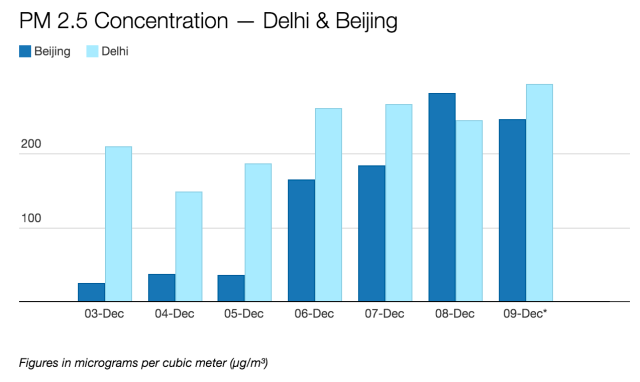
Delhi’s air pollution has been one-and-a-half times worse than in Beijing over the past week, according to an IndiaSpend analysis of PM 2.5 (Particulate Matter) concentration data.

The analysis is based on a comparison of data generated by IndiaSpend’s #Breathe air quality monitoring sensor placed at RK Puram, Delhi with the one placed by the US government in its embassy at Beijing.

The average weekly PM 2.5 concentration in Delhi’s air was 230.9 micrograms per cubic metre (µg/m³), giving it a ‘very poor’ rating of air quality under the guidelines of the Central Pollution Control Bureau (CPCB). The rating could lead to ‘respiratory illness on prolonged exposure’.

Beijing, by comparison, recorded a PM 2.5 concentration of 139.7µg/m³ during the same period.

Screen Shot 2015-12-14 at 00.24.25

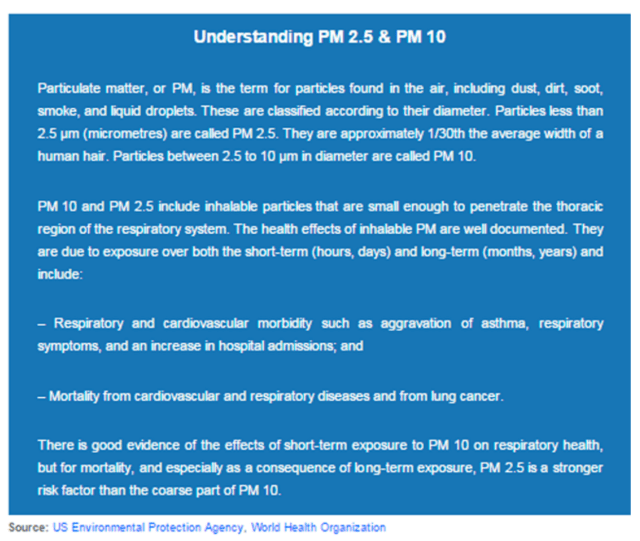
PM 2.5 are fine particulate matter found in the air with a diameter of 2.5 micrometres or less and are known to pose the greatest risk to human beings. Their measurement is considered to be the best indicator of the level of health risks from air pollution, according to the World Health Organization (WHO).

The PM 2.5 concentration level in Delhi has been higher than Beijing for six out of seven days under consideration, based on a comparison of daily averages.

Screen Shot 2015-12-14 at 00.25.20

Delhi’s PM 2.5 concentration exceeded 250 µg/m³ thrice over the last week, placing it under ‘severe’ category.

The ‘severe’ rating means the PM 2.5 concentration is so high that it might affect healthy people and seriously impact those with existing diseases.

Beijing, by comparison, recorded ‘severe’ rating only once in the same period.

Both Beijing and Delhi recorded ‘very poor’ air quality in terms of PM 2.5 concentration (151 to 250 µg/m³) on three out of the last seven days.

Delhi had only one day with ‘poor’ air quality (PM 2.5 concentration between 91 to 150 µg/m³) that could lead to breathing discomfort to most people on prolonged exposure.

Beijing recorded ‘good’ to ‘satisfactory’ air quality on three days (3 to 5 December 2015), which has contributed to a lower weekly average of PM 2.5 concentration. This was the result of strong winds that blew over the city on December 2, 2015 and dispersed the smog.

Delhi’s air recorded an annual mean PM 2.5 concentration of 153 µg/m³, nearly three times higher than Beijing (56 µg/m³), according to data released by the World Health Organization (WHO) last year.

The WHO data reveal that Delhi has the world’s worst air pollution with the highest PM 2.5 concentration levels among cities. Beijing, by comparison, is not even in the top 50 cities by air pollution.

Coming to concentration of PM 10 (particles between 2.5 to 10 µm in diameter), Delhi air recorded ‘severe’ rating for one day, ‘very poor’ ratings for three days, and ‘poor’ and ‘moderate’ ratings for one day each.

Screen Shot 2015-12-14 at 00.27.30

Screen Shot 2015-12-14 at 00.27.57

Beijing, Delhi move to control pollution

The daily PM 2.5 concentration rising to unhealthy levels, i.e. above 150 µg/m³ since December 6, 2015, has prompted Beijing to issue the first-ever “red alert” for pollution. The alert is a pre-emptive measure to protect the city’s citizens from a new blanket of smog expected to descend on the city over the coming days.

While schools in Beijing have been urged to close temporarily, odd-even number plate system for cars has been enforced.

The odd-even formula for private cars comes at a time when a similar measure announced by Delhi Chief Minister Arvind Kejriwal is being debated by lawmakers and civil society, with doubts being raised regarding the effectiveness with which the formula can be executed.

“First of all, this is Delhi, where being ill-informed and rich is a virtue. Most people have multiple cars and will just take out their second or third or fourth car—or buy a new one if required—to get around this rule,” Rajyasree Sen wrote in an article in Mint.

It is worth noting here that when the odd-even formula for private cars was enforced in Beijing for a two-week period starting August 20, 2015, the city’s usually smog-filled skies had turned perfectly blue.

The pollution level in India’s national capital has reached alarming proportions, prompting a bench of Delhi High Court judges to compare the city to a gas chamber last Thursday.

Unlike Beijing, Delhi currently has no formal mechanism for issuing alerts and advisories for pollution, leading the National Green Tribunal to recently issue a directive to warn people about the deteriorating air quality in the capital and suggest ways to deal with it.

Nearly half of the state’s 4.4 million school children are growing up into adults with irreversible lung damage, according to a report by the Kolkata-based Chittaranjan National Cancer Institute (CNCI).

Screen Shot 2015-12-14 at 00.28.42

Source: Delhi’s pollution one-and-half times worse than Beijing | cities | Hindustan Times

Posted in Air Quality, Asia, China, India | Tagged , , , , , , , | Leave a comment

UK pushing for limits on air pollution to be relaxed, documents reveal 

In papers seen by the Guardian, government calls for carmakers to be allowed to far exceed the nitrogen oxides limit until 2021

The UK is pushing for a weakening of air pollution limits and a delay to their introduction in response to lobbying from the motor industry, documents reveal.

In revelations that will raise questions over the British government’s commitment to the climate change deal agreed in Paris at the weekend, papers obtained by ClientEarth, a firm of environmental legal experts, and seen by the Guardian, showed the UK had pushed for limits on pollution to be relaxed.

The government’s papers called for carmakers to be allowed to far exceed the nitrogen oxides (NOx) limit of 80mg/km until 2021, and to be allowed to go 40% over the current limit after that.

The revelation comes before a meeting of the European parliament’s environment committee on Monday evening, which is expected to voice strong objection to the decision to water down emissions limits.

Alan Andrews, a lawyer for ClientEarth, said: “The decision to water down vehicle emission standards was a political stitch-up by the commission and an unelected committee of technocrats that will force us all to breathe illegal levels of air pollution for years to come. These rules are illegal and should be vetoed by the European parliament. If they fail to, the British government should take legal action to strike them down.

The Department for the Environment and Rural Affairs (Defra) has accepted that more than 50,000 people a year die prematurely as a result of air pollution in the UK. The figure includes about 29,000 deaths hastened by inhaling minute particles of oily, unburnt soot emitted by all petrol engines and an estimated 23,500 by the invisible but toxic gas NOx emitted by diesel engines.

According to ClientEarth, the British government’s position in October showed that despite the VW scandal, it was more concerned about protecting the motor industry than Britons’ health. Volkswagen has been engulfed in a scandal after it emerged that some of its diesel cars had been fitted with devices that could detect when they were being tested, concealing the real level of pollutants being emitted when on the road.

This is not the first time the government’s commitment to reducing air pollution has been called into question. In September, it emerged that Defra lobbied against part of a proposed EU directive that would force member states to establish national testing regimes to catch out those who tried to conceal the damage they were doing.

The proposed legislation – the national emissions ceiling directive – is designed to “ensure that policies and measures are effective in delivering emission reductions under real operating conditions”, according to the European commission.

In April, the supreme court ordered the government to make plans for tackling the UK’s air pollution problem, which has been in breach of EU limits for years. The five judges unanimously ruled in favour of a legal challenge by ClientEarth and said the next environment secretary must draw up a plan to meet the EU rules by the end of 2015.

In October, the European commission controversially backed a relatively weak air pollution limit. Member states focused on the introduction of “real driving emissions tests” to bring closer the implementation of the EU limit of 80mg/km of NOx.

The new tests are intended to better reflect actual emissions during on-road driving. Because of uncertainty over the tests, however, carmakers lobbied for a generous margin of error, what is known as the conformity factor.

Most EU members – apart from Belgium, Denmark, Ireland and the Netherlands – also favoured weaker new tests. The UK said before the October decision: “On the limited evidence we have seen, we currently do not see a rationale for agreeing a conformity factor less than the 2.2 upper limit of the commission’s stated range.”

In other words, the UK wants carmakers to be allowed to far exceed EU NOx limit until 2021. After that, Defra wants a conformity factor of 1.4, or 40%.“It is also our judgement that the conformity factor should be set at a realistic and achievable limit for the industry, recognising that diesel is an inherent part of many manufacturers planning to deliver their CO2 obligations to to 2020,” said the position paper.

By voting to weaken rules on diesel vehicles, the government will undermine efforts to introduce an ultra low emission zone (Ulez) for London, say campaigners. Under the scheme, vehicles face an additional charge on entering the congestion charging zone unless they meet the EU NOx limit. However, if the EU regulations are watered down the Ulez will fail to deliver clean air for London.

A government spokesperson said: “The UK government is committed to taking action on emissions testing and we see real world testing (RDE) as the ultimate solution and a vital step in tackling air pollution. The vote to introduce RDE in 2017 is an important milestone but we will continue to press for a comprehensive approach at an EU level on emissions testing that restores consumer confidence and delivers our wider air quality and climate objectives.”

Source: UK pushing for limits on air pollution to be relaxed, documents reveal | Environment | The Guardian

Posted in Air Quality, Europe, UK | Tagged , , , , , , | Leave a comment

Urban air pollution: What are the main sources across the world? 

Particulate matter (PM) in the air can enter the human body, affecting the cardiovascular system as well as other major organs. Chronic exposure leads to a number of health risks. Researchers have identified the main categories of PM in urban air in 51 different cities around the world. On average, traffic is the biggest source of air pollution, responsible for one quarter of particulate matter in the air.

Particulate matter (PM) in the air can enter the human body, affecting the cardiovascular system as well as other major organs. Chronic exposure leads to a number of health risks. The European Commission’s in-house science service, the Joint Research Centre (JRC) and the World Health Organization (WHO) have identified the main categories of PM in urban air in 51 different cities around the world. On average, traffic is the biggest source of air pollution, responsible for one quarter of particulate matter in the air.

In order to reduce the negative health impact of air pollution, it is important to know its sources and quantity. Measurements of fine particles PM2.5 and PM10 serve as indicators of air quality. The recently published study shows, based on the available information, that traffic (25%), combustion and agriculture (22%), domestic fuel burning (20%), natural dust and salt (18%), and industrial activities (15%) are the main sources of particulate matter contributing to cities’ air pollution. However, there are significant differences between various regions of the world.

Atmospheric processes that lead to the formation of particles as a result of gaseous traffic, heating and agriculture emissions appear to be most considerable in North America, Western Europe, Turkey and the Republic of Korea. Domestic fuel burning dominates the contributions to particulate matter in Eastern Europe and in many developing countries in Africa. In the developing countries, this source is likely to be associated with cooking, while in Eastern Europe the use of coal for heating seems to be the most probable reason. Natural dust is the main source of PM10 in the Middle-East and Northern African countries, likely due to their vicinity to arid areas. Sea salt is the most important natural source of PM10 in north-western Europe.

The database resulting from this study is published on the WHO website.

Posted in Air Quality | Tagged , , , , , , , , , , | Leave a comment

Here’s why fixing Beijing’s air pollution problem is so complicated 

Beijing’s 21 million residents have just suffered through the first-ever “code red” pollution warning. And with winter only beginning, there may be more to come.

That’s because air pollution in Beijing is directly correlated to the time of year. There are other important factors, too, like the region’s topography.Here is an explanation of why the capital city’s air pollution is cyclical. And why it’s made worse by factors other than emissions.

Topography
Beijing lies in a plain, far below the elevation of mountains that surround it on one side. That can keep some pollution trapped in the city. It also alters wind and weather patterns.Beijing is at the northwest corner of the North China Plain. The Yanshan Mountains surround the city to the west, north and northeast. Beijing’s topography and location creates a climate described as “warm temperate and semi-humid monsoon.” Beijing’s winter season lasts five months or more. There is not usually much snow, but there is cold. Temperatures routinely fall below 0℃The cold weather means people put on heaters, which creates a higher demand for power. Because around 66 percent of China’s power is generated by coal, more demand for power means more coal burned.This climate means Beijing can sometimes be steamy. Humidity is common during the warmer months, averaging about 77 percent in August. The wetter air keeps pollutants trapped and makes it more difficult to blow away. The water molecules actually condense around pollutants, creating the infamous smoggy haze. Then, there’s Beijing’s “man-made” topography. As the city’s population booms – from 10 million in the 1990s to around 20 million today – more housing is needed. One solution has been to build skyscrapers. But tall buildings can also trap pollutants, preventing winds from blowing them out of the city.

Wind
Wind tends to blow into Beijing from three directions: from the east, from the south and from the north.When the wind blows from the east, it draws in clean air from over the ocean. The breezes are pleasant and help clear the air in the city. The worst pollution tends to blow in from the south, from provinces like Hebei, Shanxi and Shandong. Their heavily industrialized cities contribute to the capital’s polluted air.So cleaning the air over Beijing starts outside the city.So Beijing’s pollution problem is part meteorological and part man-made. Cleaning the man-made part will require work well outside the capital’s ring roads.

Source: Here’s why fixing Beijing’s air pollution problem is so complicated | CCTV America

Posted in Asia, China | Tagged , , | Leave a comment

October, November witnessed ‘unhealthy’ air quality levels in Gurgaon too 

WHILE Delhi continues to be in the spotlight for its unhealthy air quality, its neighbour Gurgaon is not far behind. In response to an RTI by a city-based activist, the Haryana State Pollution Control Board (HSPCB) said Gurgaon’s air quality index (AQI) in October and November was relatively worse when compared to the rest of the year.

Incidentally, a recent survey of Gurgaon bureaucrats revealed that 68 per cent of them reported shortness of breath while 57 per cent showed reduced capacity of lungs.

According to the board’s response, the AQI for October was 152 — well within the unhealthy range of 151-200 as per the World Health Organisation’s benchmark and the national safe standard.

According to the pollution board’s Continuous Ambient Air Quality Monitoring Report, air quality in November took a turn for the worse as PM 10 and PM 2.5 levels shot up further.

“The levels of PM 10 and PM 2.5 exceeded the prescribed norms while other pollutants are well below the prescribed norm. In October, PM 10 was 153.60 per cent higher than the prescribed norm while PM2.5 was 125.8 per cent higher,” said the response from the pollution board.

In October, PM 10 levels was 256.36 micrograms per cubic metre (g/m3) while PM 2.5 level reached 114.52 g/m3. In November, PM 10 level touched 361.63 g/m3 whereas PM 2.5 levels were 114.52 g/m3.

However, officials feel Gurgaon’s air is better in comparison to neighbouring areas.

“Gurgaon has not been included in the real time monitoring of AQI as conditions are controlled here. All air polluting units in Gurgaon, which mostly fall under the Orange and Green categories, have air pollution control measures in place. Diesel-run share autos are mainly responsible for pollution,” said a senior scientist at HSPCB.

Meanwhile, citizens have resorted to protective measures against the noxious air by installing air-purifiers in their homes and offices. Vijay Kannan of Blueair air purifiers said the demand for the device increased five-fold post Diwali, mostly because of perpetual construction work in the city.

However, pulmonologists feel that it will require years of research to know if air purifiers actually work. “There has been an increase of about 20-25 per cent in the number of patients complaining of various respiratory problems post Diwali…. The concept of indoor air quality is new. Air-purifiers may help to control the air we breathe inside, there is no scientific evidence that it can improve overall air quality,” said Dr Himanshu Garg, a pulmonologist at Artemis hospital.

Source: October, November witnessed ‘unhealthy’ air quality levels in Gurgaon too | The Indian Express

Posted in Air Quality, Asia, India | Tagged , , , , , , , , | Leave a comment