A view of Paris from a hot air balloon: putting pollution on the climate agenda 

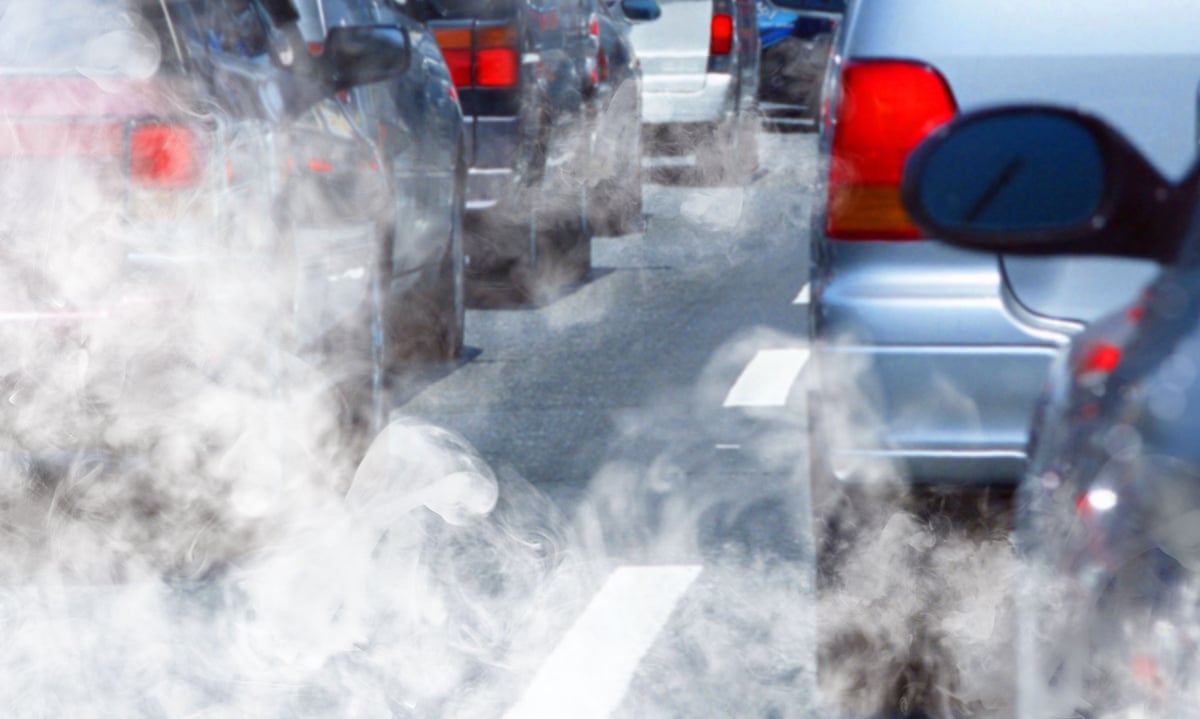
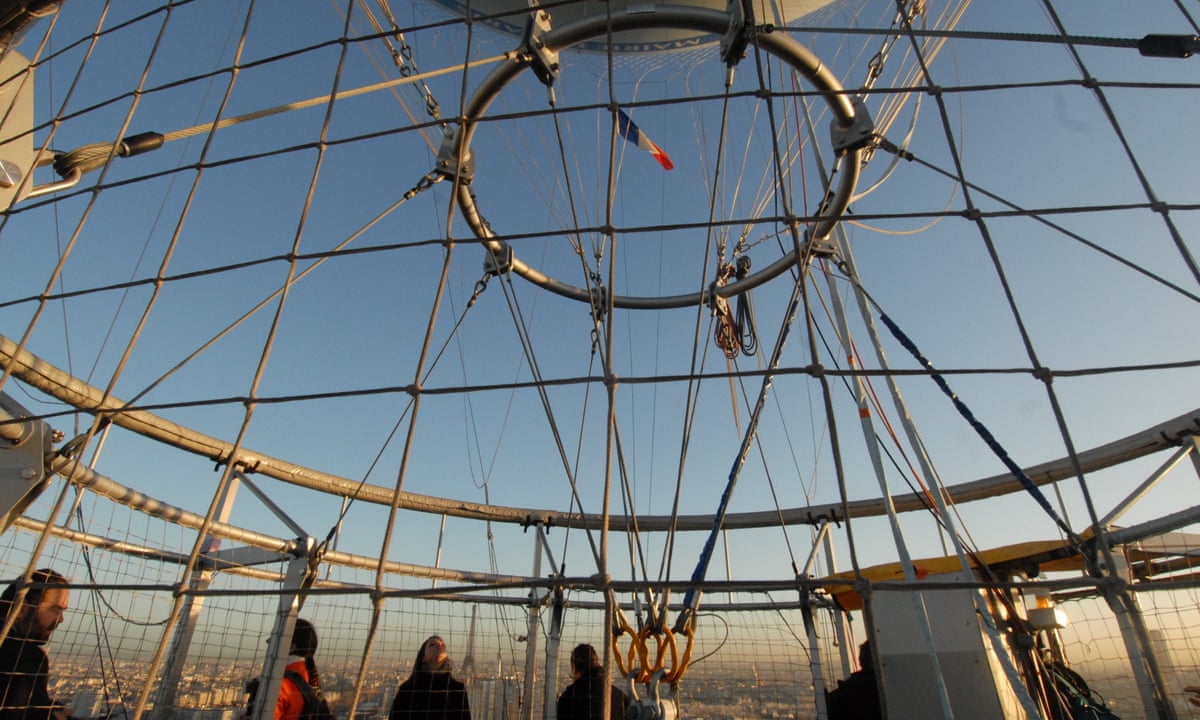
The air quality is officially “good”, 400ft above Paris in a balloon at rush hour. From that height you can see the ring road and many of the city’s 37 bridges blocked with traffic, the commuting trains coming in, and – on the first cold day of winter – water vapour rising from several power stations as thousands of central heating systems fire up .

A yellowish haze has formed on the horizon as air pressure builds, but the pollution from Paris’s transport, construction sites and power stations is minimal compared to that of Beijing or New Delhi at this time of year.

Paris measures its air pollution from 20 official sites, one of which is a large helium-filled balloon tethered to the ground with a small measuring device strapped to its base. At 9am at ground level, it registers 66,500 particles in a single litre of air; 400ft up, however, it reads 78,000. The most it has recorded is more than 6m in November 2013 when the city’s fumes were trapped for days in a particular weather pattern.

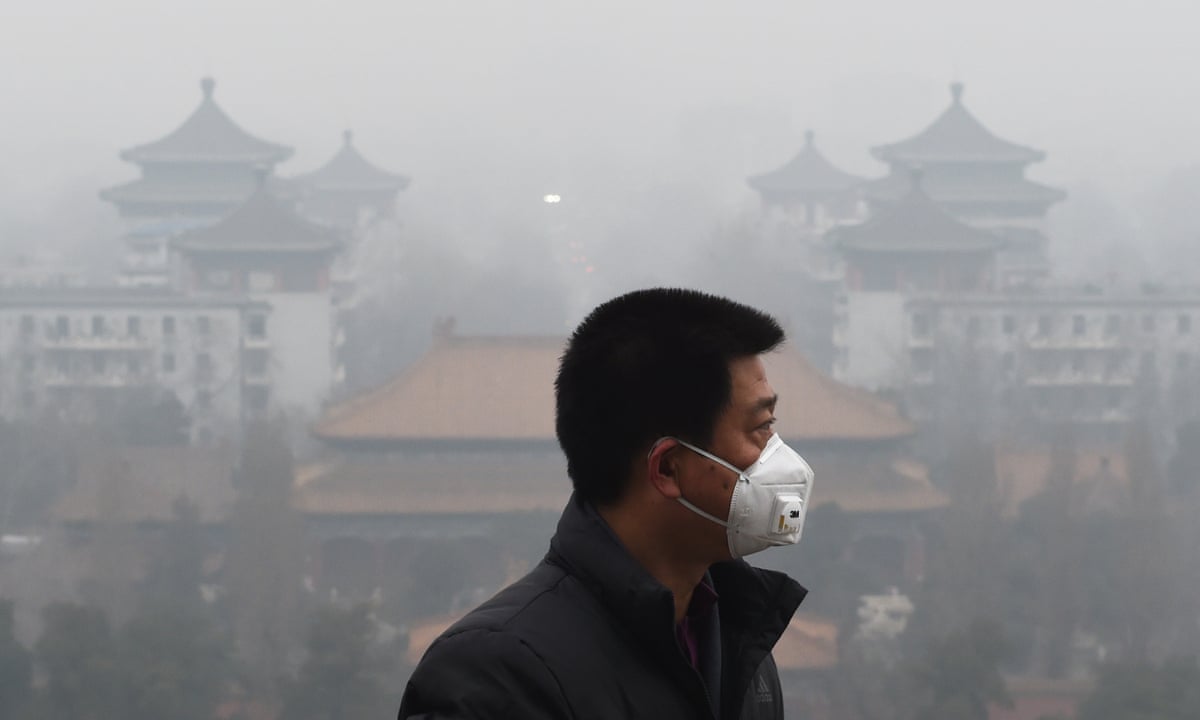
Then, says Jean-Baptiste Bernard, a senior scientist at France’s national research station ( LPC2E ) in Orleans, it was not possible to see the Eiffel Tower from just 400 yards away. But even 6m particles a litre is nothing compared to what developing countries regularly suffer. At this time of year, he says, Chinese and Indian cities are likely to be 12 times as bad. This week Beijing was put on red alert as pollution levels from thousands of cars and factories rose to their highest levels in more than a year.

“Pollution at altitude is worse than at ground level. It is dominated [in Paris] by very small carbon particles. It is worst in spring. Paris, like London gets two or three incidents a year when particulate pollution can spike. When it reached 6m per litre in 2013 it was the equivalent of smoking 6-8 cigarettes,” he said.

Paris, which like London regularly exceeds EU pollution limits for some pollutants, such as NO2 gas, has begun “days without cars” and other measures to reduce traffic during the spikes of pollution which it experiences a year. When an alternate licence-plate system was introduced in September, it reduced NO2 levels by 10-40% in the city centre, said Bernard. It now plans to greatly increase cycling and reduce traffic with more public transport.

“This year it has not been too bad because of the wind and the rain. The real issue is not the spikes at peak times but the air we breathe all the year. It’s the everyday pollution which is the problem,” said a spokeswoman for Airparif, the independent monitoring organisation which works for the city of Paris.

“We need to reduce the number of diesels. We have a problem with heating systems, especially in the suburbs where people burn wood. In the spring there is a lot of pollution blown in from farms applying fertiliser,” said Bernard.

Bernard, one of France’s leading particle researchers, increasingly finds air pollution crossing national boundaries. Indian air now is affecting weather on a regional scale in the east European countries, he says. “There is a strong pollution effect in the eastern Mediterranean from India. This is climate change on a regional scale. New Delhi’s pollution spreads far. China’s pollution has been detected thousands of miles away.”

But there is conflicting evidence, he says, on how far that air pollution is linked to global warming. Some pollutants allow heat to escape, but others reflect the heat back to the ground, increasing warming and leading to the “heat island” effect.

Concern is growing that “short-lived climate pollutants”, like ozone, methane and black carbon emitted largely from diesels, are potential warming agents with dangerous impacts on human health and food production.

Black carbon, says the World Health Organisation, is largely soot, much of it emitted from diesel motors. “It is a primary component of particulate matter in air pollution that is the major environmental cause of premature death globally. It has a warming impact on climate 460-1,500 times stronger than CO2,” said a spokeswoman at a health summit in Paris this week.

“Equally, methane, a powerful greenhouse gas, is emitted largely from landfill sites,” she said. “People are beginning to understand that there is a direct link between air pollution and climate change, and that if they address air pollution they will also reduce climate change and improve health quickly. It’s a win-win situation.”

Source: A view of Paris from a hot air balloon: putting pollution on the climate agenda | Environment | The Guardian
Posted in Air Quality, Europe, France | Tagged , , , , , | Leave a comment

China Bans Cars As Air Pollution Hits Red-Alert Status 

Beijing is at whit’s end about how to solve its awful air pollution problem. Air quality continues to worsen year over year. And after a week of heavy smog in the capital city, authorities banned millions of people from driving on Tuesday.

The city ordered private cars off the streets and demanded the immediate stop on some construction projects. Industrial sites were closed temporarily, as were schools as air quality hit a red alert level for a second day.

Beijing has been lost in a gray cloud for the past week, with tiny carcinogenic particles known as PM2.5 reportedly at times above 300 micrograms per cubic meter. The World Health Organization’s recommended maximum exposure is 25 micrograms.
Traffic wasn’t entirely ground to a halt. The two year old color coded alert system allows for either even or odd number license plans to stay off the roads whenever there is a red alert. This is China’s first ever red alert, despite the fact that blinding smog has been worse before the system was enacted in 2013.

The move took an estimated 2 million cars off the road.

Cars aren’t the only polluters in China.

Most of the country’s smog is being born every day at coal fired power plants. China generates nearly all of its electricity from coal, even though it is the world’s largest producer of solar panels. Cheapeer coal is easier on the government’s coffers than a massive subsidized solar energy program. Solar doesn’t even register 3% in China’s electric power matrix.

The Chinese government is moving quickly to sign natural gas pipeline deals with Russia’s Gazprom in order to reduce its use of coal in the energy grid, but that sets up Beijing for a fight with provincial governments, where coal mining employs thousands of uneducated workers. Air quality is not only a health matter, it’s a deeply political one in China as well.

China’s growing middle class are becoming more aware of the impact of poor air quality on their health. Last year, the government cited air pollution as one of its most pressing problems following the Inconvenient Truth-style documentary titled “Under the Dome” that alerted hundreds of millions of locals to the health hazards associated with inhaling polluted air.

The government moved to provide more incentives such as tax breaks and increased subsidies to clean tech companies while increasing taxes on polluting industries like coal and chemicals.

Source: China Bans Cars As Air Pollution Hits Red-Alert Status – Forbes

Posted in Air Quality, Asia, China | Tagged , , , , | Leave a comment

Beijing Issues Red Alert Over Air Pollution for the First Time

Officials in Beijing declared on Monday that the thick smog blanketing the city was bad enough to require a red alert, the first time they had raised the alarm to its highest level since an emergency air-pollution response system was announced in 2013.

Across the city, residents braced for another “airpocalypse” — the term that some English speakers here use for the most toxic bouts of air pollution.

If carried out properly, the temporary restrictions will affect many of Beijing’s more than 20 million residents. From 7 a.m. on Tuesday to noon on Thursday, schools will be required to close; cars will be allowed to drive only on alternate days, depending on their license plate numbers; and fireworks and outdoor barbecuing will be banned (grilled kebabs are a hugely popular street food in the city). In addition, government agencies will have to keep 30 percent of their automobiles off the streets.

An official signal of the announcement came around 6:30 p.m. Monday, when Xinhua, the state news agency, posted on its English-language Twitter account: “#Beijing issues first red alert for heavy #smog. Odd-even car ban imposed; schools suspended.” The post included a photograph of the Bird’s Nest, the stadium built for the 2008 Summer Olympics, shrouded in charcoal-gray smog and barely visible.

http://graphics8.nytimes.com/video/players/offsite/index.html?videoId=100000004078793

Around the same time, an official website of the Beijing government posted advisories on how to respond to the alarm.

One big question was whether officials would strictly enforce the regulations immediately, especially given the late notice on Monday. Many residents were left scrambling to plan for the next morning: what to do with children staying home from school, how to get to their jobs if they could not drive, whether they should even go to work.

The city government did not explain the timing of its announcement. Thick smog had already settled over Beijing by Sunday afternoon, with pollution reaching levels that the United States government labels “very unhealthy,” when everyone may experience the effects of toxic air and should avoid unnecessary outdoor activity. On Monday, even before the red alert, announcements in Beijing subway stations warned that a spell of toxic air was hitting the city and that it would last until Wednesday.

The red alert may be the Beijing government’s response to withering criticism it received from many residents last week who wondered why it had issued only an orange alert, the second highest, during the most recent “airpocalypse.” On Dec. 1, a blog post by Zhang Kai of Greenpeace East Asia asked, “What will it take for Beijing to call a Red Alert on pollution?”

Starting Nov. 28, an expanse of toxic air smothered northern China. Pollution in Beijing reached hazardous levels the next day and surged well beyond those levels on Nov. 30, when the air in some parts of the city contained deadly particulate matter called PM 2.5 that was nearly 40 times the limit recommended by the World Health Organization. It was the worst pollution of the year. The smog did not begin dissipating until late on Dec. 1, when strong winds blew across the city.

Under the system announced in 2013 and strengthened this year, Beijing is supposed to issue an alert at least 24 hours before the onset of bad smog. Officials can predict pollution levels based on wind and weather forecasts.

A red alert should go into effect if there is a prediction that the air quality index will stay above 200 for more than 72 hours. The United States government rates above 200 as “very unhealthy,” and 301 to 500 as “hazardous.” At 7 p.m. Monday, the Beijing municipal reading was 253.

The red alert was an upgrade from an orange alert issued on Saturday. By then, official Chinese news reports had already said a period of bad smog would start on Monday. Orange means outdoor construction should be halted, as well as the operations of companies that emit heavy pollution.

Chinese cities, especially northern ones, have some of the world’s worst air pollution. Most of it comes from industrial coal burning, and some from motor vehicles. The leaders in Beijing can ensure clear skies by ordering factories to shut down, but they have done so only during international summit meetings here and signature events like the military parade on Sept. 3 for the victory over Japan in World War II.

At international climate change talks, including the ones now underway in Paris, Chinese officials have promised to curb coal use in order to address both air pollution and carbon dioxide emissions.

“This week in Paris, China is rightfully getting credit for its policies to tackle climate change,” said Alex Wang, a law professor at the University of California, Los Angeles, who studies Chinese environmental policy. “But the extraordinary air pollution in Beijing right now demonstrates just how much remains to be done to make these policies work in practice.”

Source: Beijing Issues Red Alert Over Air Pollution for the First Time – The New York Times

Posted in Air Quality, Asia, China | Tagged , , | Leave a comment

Beijing’s ‘airpocalypse’: city shuts down amid three-day smog red alert 

Children kept at home, building sites and factories closed and cars kept off roads as pollution engulfs Chinese capital

“Create a paradise,” urges the motto of Beijing’s Baijiazhuang primary school – a message stamped on to its front gate in bright red calligraphy.

On Tuesday morning, as China’s smog-choked capital declared its first ever air pollution red alert, the school, normally buzzing with over-energetic 10-year-olds, was almost silent. A pungent mist hung over the outdoor basketball courts and running track.

And inside the four-floor main building, hundreds of small wooden desks and chairs were empty.

“Usually it won’t be this quiet,” said Wang Ye, a 24-year-old English teacher, as she toured its ghostly corridors and classrooms where forgotten rucksacks and winter coats were among the few reminders of its normal routine.

Across Beijing, thousands of other schools and nurseries were in a similar state of almost total shutdown after the city’s authorities announced a three-day state of emergency because of the pollution.

Building sites and factories were forced to close; millions of cars were ordered off the roads; and teams of environmental inspectors fanned out across the surrounding region to ensure that coal-fired power stations and steel mills were not secretly churning out even more filth into the already putrid atmosphere.

“Environment authorities must closely follow the situation, improve monitoring and forecasting, and guide local governments’ emergency response plans,” China’s environment minister, Chen Jining, said, according to Xinhua, the official news agency.

At 7am, when the red alert – the first in Chinese history – officially came into force, a thick gloom hung over Beijing.

Pollution levels were already nearly 15 times higher than the World Health Organisation deems safe.

Wearing an anti-smog facemask, Wang set off from home just before sunrise and turned up for work alongside about 60 fellow teachers.

But following government advice, just 20 of the school’s 250 children – those whose working parents had nowhere else to send them – had showed up for class.

“Learning is quite important to them but health is more important. Under the circumstances I think they should stay at home,” said Wang.

“It’s quite difficult because we must develop and developing can bring some problems,” the teacher said of the smog. Asked about its physical effects, she croaked: “You can hear my throat.”

Those who missed the government’s high-profile announcement of the pollution alert on Monday evening needed only to pick up Tuesday morning’s papers for the gory details.

“The first ever red alert for heavy air pollution,” read the Beijing Times’ front-page headline, pointing readers to an inside spread detailing the city’s latest “airpocalpyse”.

Beneath was an image designed to highlight the Communist party’s determination to crack down on polluters: an environmental inspector using a camera to photograph an oil refinery not far from the capital.

Liao Yuxi, a news stand owner, said the alert had proved a double dose of bad news for his family. Not only had he been unable to send his 10-year-old son to school but newspaper sales were also down as many of Beijing’s 23 million residents avoided venturing out into the foul-tasting murk.

“Business isn’t good,” the 44-year-old said, as his child sat in the corner filling in a colouring book. “I read the papers every day. The government always says it is taking measures. But I haven’t seen any details of them.”

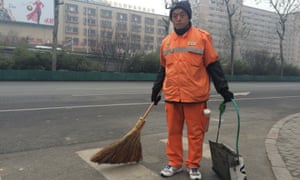
Li Biwen, a 55-year-old street sweeper, said he had no plans to hang up his broom despite the risk the smog posed to his lungs.

“In my village the air is much better,” said Li, who came to the Chinese capital from Sichuan province’s Luozi county almost two decades ago. “[But] in Sichuan I was a farmer. I can make more money in Beijing.”

He said his employers had handed out facemasks when the red alert was announced. “But I don’t want to wear it,” Li said, sweeping cigarette butts from a dust-clogged gutter. “It’s at home.”

Others were making the most of the three-day shutdown, which is set to last until Thursday when rain should clear the smog.

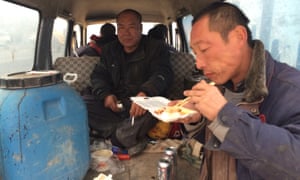
“We’re off today. Everything has stopped,” said Zhang Lijun, a plumber who would normally have been working on one of several skyscrapers being built in the central business district.

In the absence of work, Zhang, 37, was sprawled out in the back of a transit van parked near his building site enjoying a pre-lunch can of Blue Ribbon beer and a cigarette.

But the plumber, who had travelled from the neighbouring province of Hebei to find work, was unimpressed at the suspension. “I don’t think it’s a good thing. If we don’t work we don’t get paid,” said Zhang, who usually receives 200 yuan (£20.70) a day.

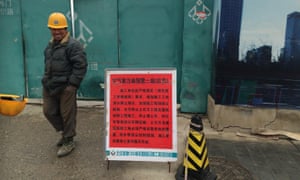
Jin Yingtang, a 44-year-old carpenter, turned up at another construction site to find a red placard informing workers of the shutdown. “Halt all dirt trucks, gravel trucks and other vehicles which are prone to produce dust and smog,” the sign read. “All construction units must stop outdoor work.”

Jin shrugged when asked about the red alert’s impact on his life. “I don’t feel good or bad about it,” he replied. Asked about his plans for his day off, he grinned. “I’ll have a little rest,” he said.

As the pollution levels climbed on Tuesday afternoon, teachers at Baijiazhuang primary school battled to minimise the disruption for their children.

Zhang Guohui, the dean, said staff were using the internet and social messaging networks such as WeChat to help pupils study from home.

Wang said she thought her 35-strong class would take advantage of such methods rather than using the smog as an excuse to slack off. “I believe they won’t just play. They will learn.”

Sat in an office beside the school’s deserted reception, she said her workplace was a lonely one without the boisterous youngsters it was built to educate. “Usually there would be a lot of noise,” Wang said. “But we love to hear them laugh. That’s quite beautiful.”


Source: Beijing’s ‘airpocalypse’: city shuts down amid three-day smog red alert | World news | The Guardian

Posted in Air Quality, Asia, China | Tagged , , , | Leave a comment

China pollution: Beijing issues first red smog alert 

Schools in Beijing are to close and outdoor construction to stop after the Chinese capital issued its first “red alert” over smog levels.

The red alert is the highest possible, and has not been used in the city before, the state-run Xinhua news agency says.

Authorities expect more than three consecutive days of severe smog.

Cars with odd and even number plates will be banned from driving on alternate days.

The alert comes as China, the world’s largest polluter, takes part in talks on carbon emissions in Paris.

Current pollution levels in Beijing are actually lower than last week’s, but the red alert has been placed because of levels expected over the coming days.

The order will last from 07:00 local time on Tuesday (23:00 GMT on Monday) until 12:00 on Thursday, when a cold front is expected to arrive and clear the smog.

China’s CCTV news channel reported at the weekend that some parts of Beijing had visibility of only 200m (660 feet).

Coal-powered industries and heating systems, as well as vehicle emissions and dust from construction sites, all contribute to the smog which has been exacerbated by humidity and a lack of wind.

At 18:00 local time (10:00 GMT) on Monday, the air pollution monitor operated by the US Embassy in Beijing reported that the intensity of the poisonous, tiny particles of PM 2.5 was 10 times above the recommended limit.

China’s air quality is a key factor in its push for a new global deal on climate change.

Its negotiators here point to their continued investment in renewable sources of energy, in an effort to cut down on coal consumption, particularly in urban areas. Around 58% of the increase in the country’s primary energy consumption in 2013-14 came from non-fossil fuel sources.

These efforts to go green may not be having an immediate effect on the air in Beijing but they have had an impact on global output of carbon dioxide. This year’s figures, just published, show carbon levels have stalled or declined slightly even while the world economy has expanded.

A strong agreement here in Paris won’t immediately solve China’s air woes, but if it ultimately pushes down the price of renewables even further, it could play a part in solving the issue long term.

_72046526_science_hair_graphic_624

The level in Beijing reached more than 256 micrograms per cubic metre in some of the worst-affected areas. The World Health Organization considers 25 micrograms per cubic metre to be a safe level.

Activists said the level hit 1,400 micrograms per cubic metre in the north-east city of Shenyang last month, saying it was the worst seen in China.

In comparison, London’s PM 2.5 average on 6 December was 8 micrograms per cubic metre, the Environmental Research Group at King’s College said. It said more than 70 was reached during spring 2014 and 2015, and the highest was on bonfire night, 5 November 2006, at 112.

Last week, activists from Greenpeace had urged the Chinese government to declare a red alert. Another Chinese city, Nanjing, issued a red alert in December 2013.

On 30 November, Beijing issued an orange alert – the second-highest of the four-tier system adopted in 2013.

Correspondents say Chinese officials had been unwilling to commit to hard targets on reducing carbon emissions, but have now realised that the dependence on fossil fuels has to stop.

President Xi Jinping vowed to take action on the emissions at the current global climate change talks in Paris.

Source: China pollution: Beijing issues first red smog alert – BBC News

Posted in Air Quality, Asia, China | Tagged , , , , | Leave a comment

New Delhi announces car restrictions to fight air pollution

New Delhi is imposing new rules to reduce its notorious traffic jams and fight extreme air pollution that has earned India’s capital the title of the world’s most polluted city.

New Delhi is imposing new rules to reduce its notorious traffic jams and fight extreme air pollution that has earned India’s capital the title of the world’s most polluted city.

From January 1, for several weeks, private cars will only be allowed on roads on alternate days, depending on whether their licence plates end in even or odd numbers.

The city’s pollution peaks during the cold winter months.

The city also plans to shut down one of its thermal power plants and to buy special vacuum cleaning equipment to reduce the dust that shrouds the city.

The Badarpur power plant, commissioned in the early 1970s, uses outdated equipment and often breaks down.

Traffic police will also be told to ensure that diesel-guzzling trucks, which move through the city at night, enter only after 11pm. Currently trucks are allowed to enter the city at 9pm, often resulting in massive traffic jams.

Kewal Kumar Sharma, the city’s chief secretary, said the government plans to have the vacuum cleaning equipment in place by April.

The announcement came a day after the Delhi High Court upbraided the city’s government for “alarming” air pollution levels in the city.

Earlier this year the city ordered all private cars older than 10 years to be taken off the roads, becoming the second major city in the world to do so after Beijing.

Last year, the World Health Organisation named the Indian capital as the world’s most polluted, with 12 other Indian cities ranking among the worst 20.

In November and early December the city’s air quality slumped to hazardous levels, with levels of PM2.5 pollutants, the very fine particles that get lodged inside the lungs and cause the most damage, soaring to 12 times above the WHO’s safety level of 25 micrograms per cubic metre.

The city has been blanketed in grey smog, and while there is no reliable data on respiratory diseases, most doctors in the capital report a sharp spike in pollution-related illness during the winter months.

Sunita Narain, director of the Centre for Science and Environment, a Delhi-based research and advocacy group, said the government had responded “to a public health emergency”.

“I would like to thank the Delhi government,” she told reporters.

Source: New Delhi announces car restrictions to fight air pollution – BT

Posted in Air Quality, Asia, India | Tagged , , , , | Leave a comment

Where is the world’s most polluted city? 

Outdoor air pollution kills 3.3 million people, mostly in cities, every year. That’s more than HIV, malaria and influenza combined – yet the sparse coverage of official data means many cities are not even monitored

Every day, hundreds of millions of people step outside into an environment that has become unsafe for human survival. Outdoor air pollution kills 3.3 million people every year, mostly in cities; more than HIV, malaria and influenza combined. But the search for this insidious mass killer reveals something astonishing. As the governments of more than 190 nations gather in Paris to discuss a possible new global agreement on climate change, not only don’t we know where it kills the most, in many places we aren’t even looking.

As November’s cold winds sweep down from Mongolia, the coal burning season begins in northern China. At the time of publication, Chinese maps on the World Air Quality Index website were awash with red, purple and maroon flags, indicating dangerous levels of fine particulate matter (PM2.5) – the world’s primary air pollutant.

It is thought that as many as 1.6 million Chinese are killed by breathing bad air every year. Beijing, in particular, is synonymous with the problem. Last weekend, the US embassy there reported the level of PM2.5 at 391 micrograms per cubic metre (µg/m3) and China’s environmental protection agency recommended residents stay indoors. And yet, the most definitive database of PM2.5 pollution, produced by the World Health Organisation (WHO) earlier this year, places only one Chinese city, Lanzhou, in the worst 50.

Screen Shot 2015-12-02 at 08.43.21Screen Shot 2015-12-02 at 08.43.29The top of this list is dominated by the ultra-miasmic cities of India and Pakistan and shaded at the top by Delhi. On an average day, the residents of the Indian capital breathe air fouled by fine particles at a concentration of 153µg/m3. This is close to three times the Beijing mean and 15 times the WHO guideline of 10µg/m3.

In Delhi, the fumes from 8 million cars, small-scale diesel electricity generators and surrounding coal plants have damaged the lung function of half the city’s 4.4 million children so severely that they will never fully recover. There is no escaping this chemical haze. Doctors have begun prescribing that patients simply leave the city. This year, Delhi’s chief minister spent time in a rehabilitation clinic in the country’s south, allowing his lungs to recover.

Hospitals don’t record air pollution as a cause of death. It manifests through an increase in already prevalent human heart and lung diseases. Therefore its impact can only be assessed by taking samples directly from the air.

The WHO data has lead many, including the Guardian, to name Delhi as the“world’s most polluted city”. But the basis for this is flimsy. The WHO takes information from monitoring stations in more than 1,600 cities on every populated continent. This sounds comprehensive but, according to at least one count, covers less than a third of cities of over 100,000 people. Not all very polluted cities are big, although it helps.

The database is based on voluntary monitoring by governments. A spokeswoman for the WHO said the UN organisation cannot compare or rank cities because many do not have the resources or political will to set up a monitoring system. Gary Fuller, an air pollution expert at Kings College, said continent-sized blank spots made it impossible to know where people were suffering the most.

“When we compare air pollution in cities, we only look at those with measurements,” he said. “This focuses our attention on big cities and the developed world. Initial attempts to measure air pollution from satellites have revealed more areas of the world with dense populations and high air pollution.”

Of the 1,622 cities covered in the WHO data, 510 are in two countries – the US and Canada. Just 16 are in Africa (half of these in relatively wealthy South Africa and Egypt). That’s 0.75% of the monitoring for 15% of the world’s population, an increasing number of whom live in high-risk cities. Latin America’s 604 million people are among the most heavily urbanised on earth. Their air is monitored in 109 cities. Across the Middle East, data is collected in just 24 cities.

Screen Shot 2015-12-02 at 08.44.03A vast swathe of humanity is unknowingly breathing poison on a daily basis. The implication is profound, because without knowing the air is bad, nothing will be done to fix it.

“Cities that collect and disseminate information on outdoor air quality need to be praised for their action. This is the first crucial step to identify if there is an outdoor air pollution problem and to begin to take corrective action,” said the WHO spokeswoman.

Professor Randall Martin is the leader of the Spartan project, which is working to improve satellite observations that might identify high risk cities.

“I think Delhi is getting attention because it is being measured. There may be other cities lurking out there that are just not being measured. It’s certainly hard to know what’s going on in places such as West Africa and the Middle East. There are vast areas of ground where there is virtually no monitoring,” he said.

One early satellite study found that 96% of West Africans live above the WHO guidelines. The human-caused fumes mix with a strong background of Saharan dust and sea salt, all of which, said Martin, are dangerous to lung function. Earlier this year, in the Nigerian capital of Lagos, a regular, persistent smog began hanging over the city.

“Though the people are aware that the situation is not healthy, they feel it’s not yet dangerous, hence there’s no pressure on the government to remedy the situation,” said Udeh Chiagozie, a Nigerian youth ambassador for the UN environment programme’s Eco-Generation scheme.

“You find lots of cars that are not road-worthy plying the roads, generators as well as industries, especially oil and gas, that contribute to the city’s emissions. It shouldn’t be a surprise if the smog continues to happen,” said Chiagozie.

A five-month study in Lagos found five out of eight sites exceeded Delhi’s annual PM2.5 count. Across the time period some locations came close to doubling the Indian capital’s average pollution. This is one of the most comprehensive air quality surveys to have been conducted in Lagos, though it is not enough to form a definitive annual average.

Another concern is that some neighbourhoods slip past city-wide averages. The Mongolian capital of Ulaanbaatar lies in a natural basin, and temperature inversions of dry, cold desert air cause pollution to pool above the city. The city’s WHO average is 68µg/m3, making it bad but not terrible. But in 2012, the World Bank measured the poisonous grey puddle above ger (yurt) neighbourhoods where 175,000 families have set up traditional tents and burn coal for warmth. Here, pollution averages between 200 to 350µg/m3 – far surpassing Delhi.

The silver lining to Delhi’s smog is that the stigma is forcing politicians to act. The government is seeking to introduce tougher regulations on vehicle makers and build a bypass around the city. In China, a recent poll found 94% of adults believe air pollution is a problem the government should prioritise. As a result, substantial action has already been taken. The Beijing government has launched a programme of alternate driving days based on licence plate numbers and mass coal plant shutdowns are under way.

Not the least of China’s responses has been the development of mass monitoring. Hourly warning systems have lead to commonplace photographs of Chinese pedestrians wearing masks to protect themselves on days when an alert is sounded.

PM2.5 is not the only form of air pollution – in fact there are many – but it is responsible for the greatest number of deaths worldwide. Another notable killer is NO2 – now notorious because of VW’s scandalous attempt to rig its emissions reporting. In Europe, high-NO2 emitting diesel cars became prevalent after a huge subsidy programme. In London, this pollutant kills more people than PM2.5. In the city centre, where the iconic (diesel-powered) red buses queue, Oxford Street has been named the most polluted street on earth when it comes to this particular nasty.

Again, when this information was made public, Londoners were shocked. Plans are now in place to develop an ultra-low emission zone in the UK capital. New red buses are now electric-diesel hybrids. One small environmental NGO used air pollution data against the UK government in the European Court of Justice, where it was sanctioned for its failure to protect citizens in 40 of the country’s 43 urban zones.

Residents of hundreds, perhaps thousands, of cities cannot make these demands because the necessary measurements are not recorded by their governments.

Source: Where is the world’s most polluted city? | Cities | The Guardian

Posted in Air Quality, Asia, China, Health Effects of Air Pollution, India, Mongolia, World News | Tagged , , , , , , , , , , , , , , , , , , , , , , , | Leave a comment

Air Pollution is Choking Bosnia, Experts Warn 

Bosnian towns like Sarajevo, Tuzla, Zenica, Lukavac and Kakanj are suffering from serious problems with air pollution, experts from the Federal Hydro-Meteorological Institute of Bosnia and Herzegovina [FHMZBiH] told BIRN.

“Sarajevo is definitely one of the most polluted cities in Europe when it comes to air pollution,” said Enis Omercic, an air-quality expert for the FHMZBiH.

“The air pollution is even bigger in industrial cities like Tuzla and Zenica,” Omercic added.

The airborne concentration of sulphur dioxide, a gas considered dangerous to human health, can sometimes exceed 1,000 microgrammes per cubic metre, according to official figures provided by the FHMZBiH.

A concentration of 500 microgrammes per cubic metre is considered risky enough to raise a warning, according to the FHMZBiH.

A high level of air pollution is at the root of serious medical conditions like lung cancer and cardiovascular disease, according to the World Health Organisation.

“The situation is very critical,” Lejla Hatibovic, a specialist working for the Institute for Public Health of Sarajevo Canton, told BIRN.

Pollution from cars and the burning of coal, which is still used in industrial power plants and in many houses, are major contributors to the problem.

“Sarajevo used to be the most polluted city in Yugoslavia because people were burning coal to warm their houses,” said Hatibovic.

“In the 1970s, the authorities decided to increase the use of gas heating, which helped a lot in reducing the air pollution. Unfortunately, after the war and with the worsening of the economic situation in Bosnia, a lot of people are going back to coal, as it’s cheaper than gas,” she said.

Despite the warnings, the Bosnian authorities haven’t taken any concrete measures to lower the pollution in the country.

On the contrary, they are planning to increase the number of active coal power plants by building a new one in Stanari, a town in central Bosnia, and by expanding the already existing plants in Tuzla.

“The authorities in Bosnia are doing too little, and too late, to reduce the impact of pollution,” Samir Lemes, the President of Ekoforum, an environmental NGO based in Zenica, told BIRN.

Back in September, Ekoforum decided to launch criminal charges against the local administration in Zenica, together with Arcelor-Mittal, which owns the local steel factory, for not reducing the air pollution in the city.

“It’s the first charge for environmental crimes in our country,” Lemes told, adding that however the trial “will probably take a lot of time”.

Despite general agreement that the high level of air pollution could seriously affect the health of Bosnian citizens, specialists still argue that the lack of official data about cancer cases in the country makes it less easy to establish if the increase in pollution has directly increased the number of deaths from cancer.

“So far, there is no concrete study in the country which could show any connection between the level of powders in the atmosphere and the increase in cancers in Bosnia,” Semir Beslija, head of the oncology clinic of Sarajevo, told BIRN.

Even though hard data on cancer cases doesn’t exist, experts are warning that air pollution in Bosnia and Herzegovina is damaging the health of its citizens.

“In past years, cases of chronic respiratory diseases have constantly increased, which is a clear sign of the impact of air pollution on the population,” Aida Velic, a doctor from the Institute of Public Health of the Federation of Bosnia and Herzegovina, told BIRN.

Velic said that her institute has been asking for years to conduct a more precise analysis at the national level, but has not been given the green light.

“We know for sure that air pollution is a carcinogenic factor, and we know that lung cancer is the most common cancer among Bosnian men. However, in the current situation we cannot tell if this might depend on other factors as well,” she said.

Source: Air Pollution is Choking Bosnia, Experts Warn :: Balkan Insight

Posted in Air Quality, Europe | Tagged , , , , , | Leave a comment