Respro® Masks FAQ: Are children’s masks availiable?

Respro® Allergy™ Mask; Image: Respro® UK

Our concern in providing masks for children is that the size variation in children is so wide, that a ‘childs’ mask will not fit the range of sizes that children come in.

A 3-year-old will not require the same mask sizes as a 7 -to 10-year-old. We do not recommend the use of face masks for children younger than 11 years, but to seek alternative ‘common sense’ precautions ie hood on push chairs, keep away from large congested or dense traffic environments; if you cannot, then place something in front of their faces more like a guard to prevent air/wind/ polluted air from direct contact.  Children’s breathing rates are considerably lower that that of a walking adult so they should not be in too much danger. Generally common sense practice where at all possible should be considered. If a child has a particular respiratory issue then medical advice should be considered first and foremost.

The small Respro® Allergy™ mask is the smallest size available and useable by very small adults and older children above the age of 10 years.

Respro® mask size guide.

Posted in Air Quality | Tagged | Leave a comment

MEPs vote for tougher air pollution limits

Governments across the EU could soon face a new round of tough new air pollution targets, after MEPs on the European parliament’s environment committee narrowly voted in favour of fresh round of air quality standards.

The committee on Wednesday voted 38 in favour and 28 against, backing a new package of measures that would require member states to meet limits on six pollutants by 2030.

The MEPs also voted for interim binding targets for 2025 for all of the designated pollutants except methane and backed plans for tougher rules on emissions testing, including specific tests for diesel vehicles that have been blamed for poor air quality in many European cities.

The committee said the targets would prevent an estimated 74,200 premature deaths a year, 16,200 more than the commission’s original proposal, and lead to health savings worth between £28bn and £98bn.

Nearly 9,500 people die each year in London because of air pollution – study

“This is an invisible killer that we cannot afford to ignore,” said Liberal Democrat MEP Catherine Bearde, who backed the new plan. “More than 10 times as many people die in the UK each year as a result of air pollution than from accidents on our roads. If people were being forced to drink dirty water rather than breathing dirty air, no one would be questioning the need to take action.”

The package will now move to a full vote of the European parliament this autumn, although elements of the proposed programme are likely to face opposition from member states and some industries.

The UK government is known to be opposed to the adoption of interim targets for 2025 and the MEPs voted for ammonia and methane to be included in the list of pollutants, despite opposition from the farming lobby and the UK and French governments.

However, if adopted the new regulations would increase pressure on governments and businesses to introduce a host of new policies and technologies to curb air pollution levels, such as electric vehicles, congestion charging and restrictions, and increased investment in public transport.

The discussion around a new wave of targets is further complicated by the fact a number of member states, including the UK, are still struggling to comply with current air quality standards.

The UK government is currently working on a major new strategy to tackle the UK’s air pollution after the supreme court ruled it was in breach of air regulations.

The vote comes on the same day as London mayor Boris Johnson issued new estimates from Kings College for how many premature deaths can be attributed to NO2 air pollution. The study estimates there are 5,900 premature attributable deaths in the capital due to NO2, rising to 9,400 premature deaths when particulate emissions are also accounted for.

“The better we understand the science of air pollution, the more we can see that the health impacts are dire,” said Green London assembly member Jenny Jones. “The government and London’s City Hall have failed to deal with this issue for the past 15 years. These new figures on premature deaths show how much work the next Mayor will have to do.”

via MEPs vote for tougher air pollution limits | Environment | The Guardian.

Posted in Air Quality, Europe, London, UK | Tagged , , , , , , | Leave a comment

Invisible killer – need for better air quality standards is urgent

In Australia there are 3000 deaths each year from air pollution, which is more than from traffic accidents. Imagine the nightly TV news – instead of the twisted car metal and bodies, they show a child fighting for breath from asthma being loaded into an ambulance in Bulga, or a patient with a heart attack in the Latrobe Valley.

Air pollution is an invisible killer. Tiny, unseen particles from coal combustion, from other industries and from vehicles are breathed deep into the lungs where they cause diseases of the lungs, heart and blood vessels.

Some of these particles have an association with the only sort of lung cancer that occurs in a substantial number of non-smokers. They worsen lung disease and restrict lung growth in children.

Yet ill health and death from air pollution are preventable. This week, the environment ministers of all states and territories meet to decide on better air quality standards. Their task is to reduce the level of particulates allowed in ambient air and to ensure they protect the health of all Australians and not just those in large centres of population. As well as making stricter standards, we hope they will recognise that their monitoring and enactment of existing standards for particulates has been inadequate. Australia does not have a national EPA (like the United States) that can direct states to act in the interest of the health of all citizens wherever they reside.

With such major implications for our health, why weren’t the federal and state health ministers invited? Unfortunately, this vital health responsibility is treated as a purely environmental issue and has been devolved to the states. States enact the national advisory standards, a responsibility they do not always undertake efficiently or without conflict of interest arising from the economic need to approve projects with potentially damaging health implications.

Doctors believe that justice and equity demand air pollution regulations apply to all Australians living in established residential areas, irrespective of the population size. In particular we refer to the small communities polluted by coal mine development, where there is a trade off between health and jobs, Bulga is a current example.

Particulates are produced from dusty mines, the combustion of coal, other industrial activity and by vehicles. Approximately half of all air pollution deaths are due to coal. Approximately 80 per cent of the electricity generated in Australia is from coal and this has increased with the repeal of the carbon price. It is no wonder doctors considered a price on carbon to be a powerful public health measure!

Air pollution from coal demands a consideration of the real cost of coal. Doctors are tired of media and politicians saying coal is cheap. Not included in the market cost of coal is the huge heath cost; you pay. For Sydney alone, the total cost of air pollution is $5 billion and coal may account for nearly half of this.

In the US, full cost accounting, including health and environmental harms, indicates that at best, coal-fired power generation has no economic value to the community. At worst, the industry is a huge economic burden.

It is clear, therefore, why Doctors for the Environment Australia has made a submission to the ministers indicating the harms of air pollution and the need for action.

If this opportunity to update Australia’s air quality standards is subverted, it is likely to be many years before we get another opportunity to implement standards to ensure health gains.

via Invisible killer – need for better air quality standards is urgent.

Posted in Air Quality, Australia & Oceania | Tagged , , , , | Leave a comment

Diesel cars: Is it time to switch to a cleaner fuel?

In the 1920s, pregnant women were encouraged to drink Guinness to increase their iron intake.

For decades we were all told to avoid fatty butter and eat synthetic margarine. Both pieces of so-called health advice have since been debunked.

We are now learning that millions of motorists who’ve bought diesel cars believing they were less harmful to the environment have been equally misguided.

Diesel cars emit less carbon dioxide (CO2) than their petrol equivalent, we were told. In fact, not only are CO2 emissions almost identical on average, but they also produce large quantities of other pollutants linked with thousands of premature deaths.

Carmakers say they have already taken action to reduce emissions greatly in the past decade and regulators are beginning to acknowledge the problem, but the challenge remains enormous.

The reason is simple: about half of all cars currently sold in Europe are diesel powered.

As Greg Archer at Brussels-based think-tank Transport & Environment says: “The car industry is fighting to keep selling diesel because it has invested so heavily in the wrong technology”.

Different reality

Air pollution caused by diesel engines is, for now, a peculiarly European problem. Of the 70 million cars sold worldwide last year, only 10 million were diesel. Three quarters of those were sold in Europe.

Quite why European carmakers developed diesel in the first place is a moot point, but some have argued that as domestic heating systems turned from oil to gas, oil companies needed to find an alternative market for their mid-range distillate, or diesel fuel.

The industry itself points to government incentives, such as lower tax rates for companies buying fleets of diesel vehicles. “All manufacturers followed this political direction,” says the European Automobile Manufacturers Association.

And, in theory, it was an easy sell – diesel engines are more efficient than petrol engines, so running costs are cheaper. Using less fuel should mean lower emissions.

In practice, however, laboratory measurements of CO2 emissions from diesel and petrol engines are the same, according to Martin Adams at the European Environment Agency (EEA). And as diesel cars tend to be bigger and heavier, any advantages in efficiency are wiped out.

As a result, average CO2 emissions from diesel cars are only fractionally lower than those from petrol cars, figures from the UK’s Society of Motor Manufacturers show. The industry counters that of course emissions would be greater from larger cars, and maintains that when comparing like-for-like models, diesels do emit noticeably less.

But carbon emissions aren’t the main problem when comparing diesel with petrol. So-called particulate matter, which causes cancer, and nitrogen oxide and dioxide (NOx) are the real concern. Recent studies have shown that nitrogen dioxides (NO2) can cause or exacerbate a number of health conditions, such as inflammation of the lungs, which can trigger asthma and bronchitis, increased risk of heart attacks and strokes, and lower birth weight and smaller head circumference in babies.

Screen Shot 2015-07-16 at 13.58.38

In some European cities, NO2 levels are more than double World Health Organization guidelines, with diesel vehicles the single biggest contributor.

Indeed air pollution as a whole causes more than 400,000 premature deaths in Europe, with road transport, and diesel in particular, contributing a meaningful chunk.

Inconsistencies

Most of these deaths are caused by particulate matter. Carmakers have recognised this and modern diesel cars are fitted with extremely effective filters that stop almost all of this carcinogenic soot entering the atmosphere. But there is a “significant problem with tampering with filters”, according to Mr Archer.

So when you see a car belching out thick black smoke, the chances are it will be a diesel with a faulty or a missing filter.

Although it is illegal to drive a diesel vehicle without a filter, there are a number of specialist companies which advertise doing just this for drivers who want to improve fuel economy and performance. Removing them isn’t against the law.

These filters also perform best when hot, and short trips around town won’t heat your engine sufficiently. Nor do they help with secondary particulate matter, which is formed from NOx, the effects of which are not fully understood.

How to reduce emissions from your diesel car

  • Don’t accelerate unnecessarily
  • Get your car serviced regularly
  • Turn your engine off if you are stationary for more than one minute
  • Stick to the speed limits, especially on the motorway
  • Check your car’s levels of urea (ammonia used to trap NOx)
  • Be very careful buying any retrofit solutions – none are fit for purpose according to Transport & Environment
null

Carmakers also have a number of technologies to reduce nitrogen oxide and dioxide levels. These include catalysts, re-circulating some of the exhaust fumes back into the cylinder, and injecting urea, made from ammonia, to trap these gases.

The problem is they are not being used widely enough and, when they are, they don’t work as well as they should.

As the respected International Council on Clean Transportation (ICCT) says, “the technologies for real-world clean diesels already exist, but they are not being employed consistently by different [carmakers]”. Some have speculated it’s simply a question of cost.

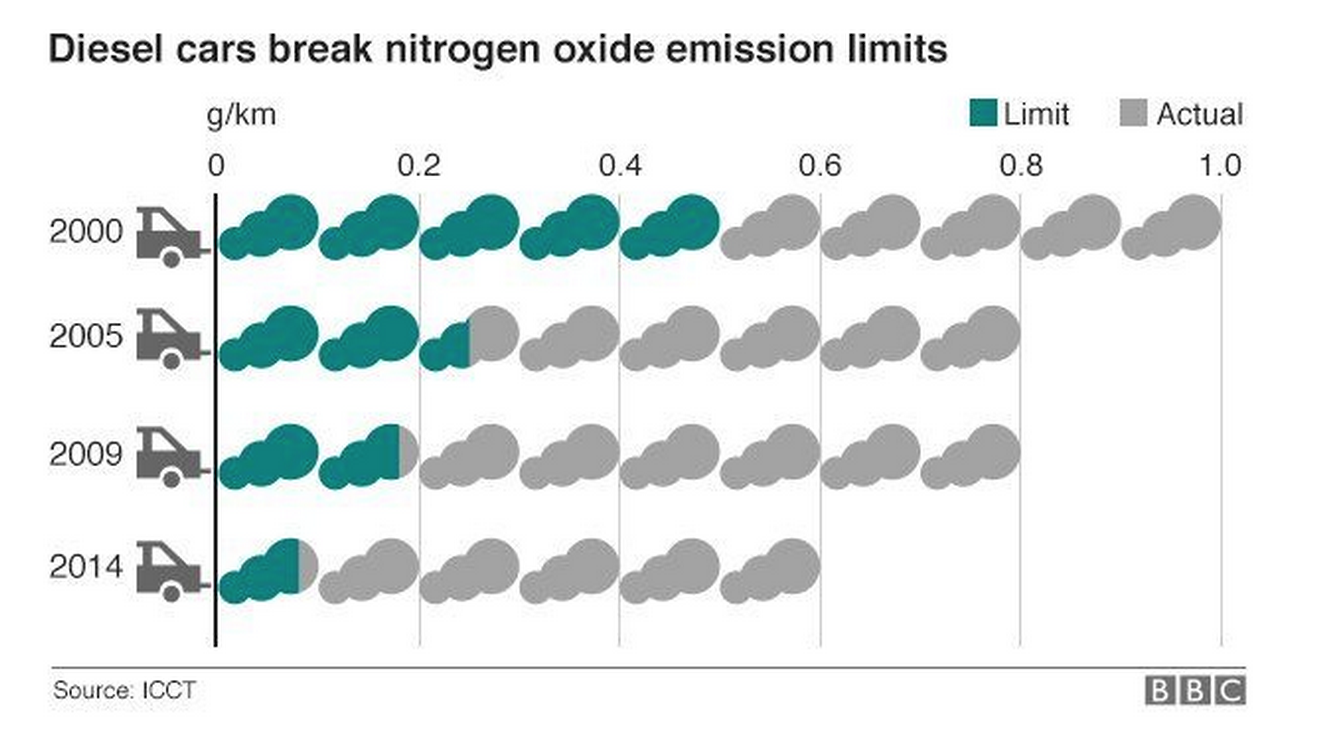
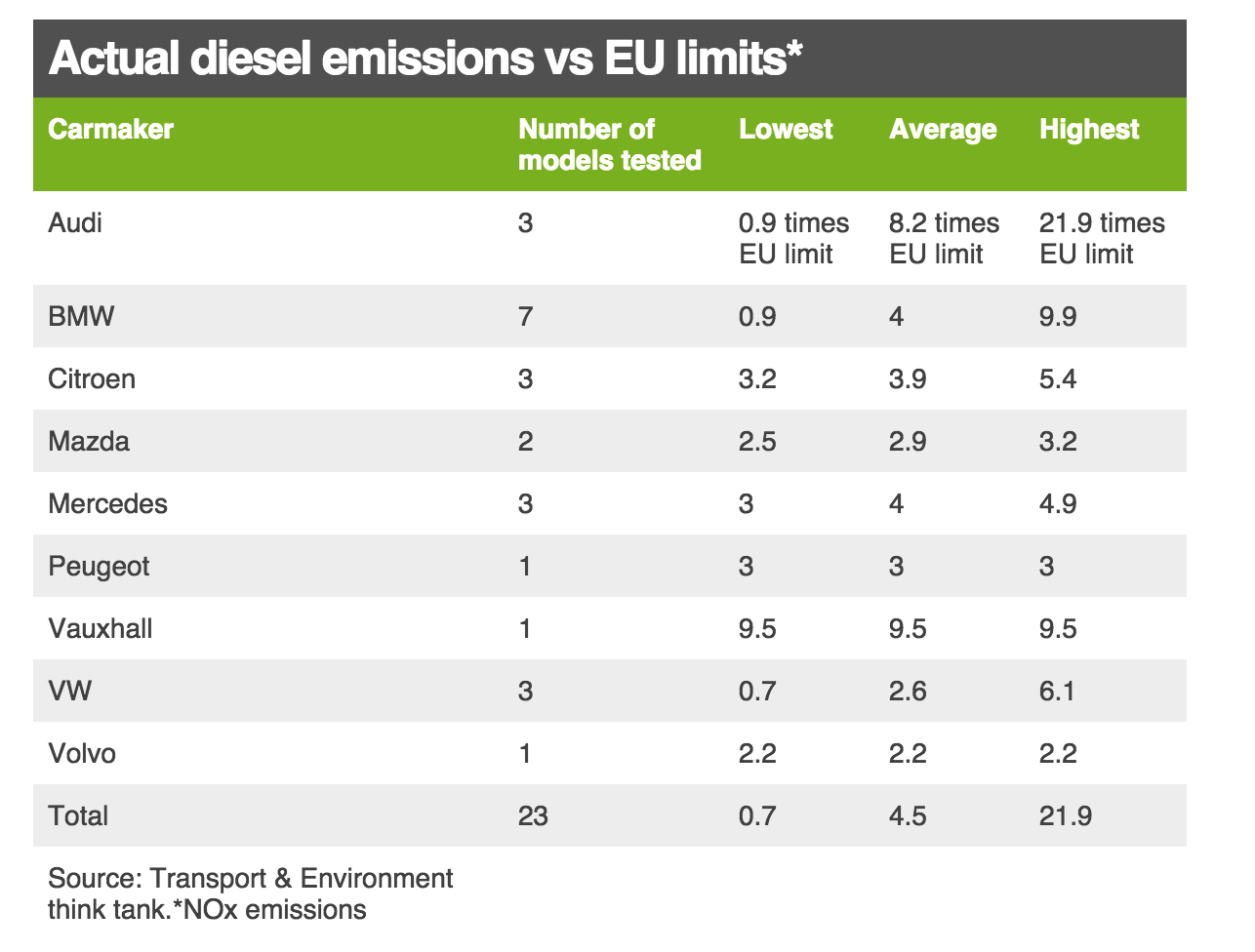
Just how ineffective they are is staggering. Tests conducted by the ICCT show that modern diesel cars emit on average seven times the EU limit for NOx.

Screen Shot 2015-07-16 at 13.58.56

A separate test showed that some individual cars emit even more – an Audi A8 emitted 22 times the limit. Only three cars – an Audi A5, a VW Golf and a BMW 3-series – complied with EU regulations.

‘Meaningless’

The reason carmakers are allowed to keep selling these cars is that EU limits are set according to tests conducted in a laboratory, where conditions bear little relation to real-world driving out on the open road.

Screen Shot 2015-07-16 at 13.59.04

This extraordinary situation, which has effectively rendered current emission limits meaningless, has not escaped the attention of the EU. It wants to introduce limits based on real-world testing by 2017, but needs the agreement of all member states.

Carmakers agree real-world tests are needed, but would prefer more time. Discussions are ongoing, but the likelihood is that new limits will be higher than the current 80mg/km.

Given that this limit was first agreed in 2007, we may well end up with new limits for harmful diesel emissions that are less stringent than those agreed more than a decade earlier – an absurd situation that carmakers and policymakers must do more to address.

via Diesel cars: Is it time to switch to a cleaner fuel? – BBC News.

Posted in Air Quality, Europe, London, UK | Tagged , , , , , , , | Leave a comment

Air pollution caused by wildfires could trigger heart problems: study

New research shows that exposure to air pollution caused by wildfires could increase the risk for acute heart incidents such as cardiac arrest.

A new study published in the Journal of the American Heart Association on Wednesday linked cardiac arrests, heart attacks and other cardiovascular “events” to wildfire smoke.

Air pollution from wildfires has long been linked to respiratory problems such as asthma, but evidence of an association between wildfire smoke exposure and adverse effects on the heart has been “inconsistent,” study author Anjali Haikerwal said in a statement after the findings were released on Wednesday.

In the study, scientists researched the association between wildfire-related “particulate pollutant” exposure and the risk of heart-related incidents in Victoria, Australia in December 2006 and January 2007.

At that time, smoke from wildfires travelled to surrounding Australian cities. On most days, the smoke also reached levels of particulate pollution that exceeded air quality limits.

After examining particles smaller than 2.5 thousandths of a millimetre in diameter, researchers found an increase in particulate concentration over two days during the wildfires.

Comparing the particle matter data to Victoria’s health registry data over the same period, the researchers found:

A nearly 7 per cent increase in “out-of-hospital cardiac arrests,” which are unexpected heart-related medical emergencies

More than 2 per cent increase in emergency department visits for ischemic heart disease

Nearly 2 per cent increase in hospitalizations for ischemic heart disease

Haikerwal said the data suggests the particles may act as a “trigger factor” for acute cardiovascular health episodes.

“During a fire, please take precautionary measures as advised by public health officials,” said Haikerwal, who is a doctoral candidate at the School of Public Health and Preventative Medicine at Monash University in Melbourne. “This is especially important for older adults who are at higher risk of adverse health effects during wildfire smoke exposure.”

She also said the medical community must understand the impact of smoke exposure, given a recent increase in frequency and intensity of wildfires around the world.

Wildfires in western Canada have prompted Environment Canada to issue several air quality advisories in recent weeks, as firefighters try to contain and extinguish blazes in B.C., Alberta and Saskatchewan.

via Air pollution caused by wildfires could trigger heart problems: study | CTV News.

Posted in Air Quality, Health Effects of Air Pollution | Tagged , , , , , , , , | Leave a comment

Revealed: London’s air pollution ‘is making thousands more people die early each year’

Thousands more Londoners are dying early each year due to toxic air than previously thought, ground-breaking research reveals today.

The study by respected academics has the death toll from air pollution in the capital hitting nearly 10,000 a year.

For the first time, the experts calculated the deadly impact of nitrogen dioxide on the city’s streets.

Millions of people are having their lives shortened by this killer pollutant, blamed to a large extent on diesel fumes.

The report by academics from King’s College, London, estimated that once all this loss of life is added together it was the equivalent to 5,879 deaths a year in 2010.

Previous research on the health impact of PM2.5, tiny particulates of pollution suspended in the air, put the annual death toll at 4,267 in 2008.

The updated study, commissioned by City Hall and Transport for London, found this had fallen to 3,537 in 2010, partly due to air quality improvements.

But the combination of premature deaths from NO2 and PM2.5 was estimated by the experts to amount to 9,416 fatalities in the capital in 2010 – or more than 25 a day.

Across the country, this pollution death toll is expected to have hit around 80,000, up from 29,000 for just PM2.5, once a committee of academics completes its report later this year.

While the NO2 research needs treating with caution as it’s so cutting-edge, the report’s shock findings will inevitably spark fresh calls for the Government and Mayor of London to step up action against pollution.

To his credit, though, Boris Johnson can claim that London is being open about its filthy air problem, especially compared to some other cities around the world.

With pollution levels having fallen since 2010, the death toll is also expected to have gone down “significantly” though this it yet to be quantified.

The Mayor stressed the study was a “snapshot” which revealed:

  • A boy born in 2010 in London could expect to see a loss of life of around 17 months on average due to NO2, if such pollution levels in London did not change, and a girl 15.5 months. For PM2.5 it was around nine months for both sexes.
  • PM2.5 and NO2 were associated with about 1,990 and 420 respiratory hospital admissions in 2010 respectively, together with 740 cardiovascular admissions linked to PM2.5.
  • The annual economic impact of these forms of pollution ranged from £1.4 billion to £3.7 billion.
  • Around a 1,000 of the totalled deaths could be saved by 2020 by measures previously brought in by Boris Johnson, without his flagship ultra low emission zone (ULEZ). Once this is included and other steps being taken by the Government, the death toll may possibly be 3,000 lower.
  • Nearly half of the health impacts of pollution in London is from dirty air blown in from outside the capital, including diesel and industrial fumes from Paris and other parts of the Continent.

While the Mayor has been accused by environmentalists of dragging his feet over tackling pollution, he has also been criticised for going to far by other groups.

Defending his actions, including ordering all taxis to be zero-emission capable by 2018 and his ULEZ, Mr Johnson said: “This study shows imperatively why these bold measures are required.

“My greatest priority remains to protect the well-being and environment of Londoners, and this scientific evidence will ensure we have all the information needed to continue delivering comprehensive measures that bring real change.”

A borough-by-borough breakdown showed NO2 pollution claiming the equivalent of 279 lives in Barnet in 2010, followed by Bromley and Croydon on 271, and Ealing on 245.

There were at least 200 in Wandsworth, Bexley, Enfield, Greenwich, Havering, Lewisham, Redbridge and Southwark.

Mr Johnson urged the Government and the European Commission to do more on cleaning up London’s air, including by ensuring that new standards for diesel engines meet real-world conditions rather just passing tests in laboratories.

He also warned that a third runway at Heathrow was “inconceivable” if the Government is to meet EU legal limits on pollution. The capital is not set to meet EU legal limits for NO2 before 2030.

Mr Johnson stressed that action by City Hall could get around 80 per cent of central London compliant with EU laws by 2020 but the Government and EU also needed to step up their efforts.

The Supreme Court has ordered ministers to come up by the end of the year with a new plan to cut NO2.

via Revealed: London’s air pollution ‘is making thousands more people die early each year’ – London – News – London Evening Standard.

Posted in Air Quality, Europe, London, UK | Tagged , , , , , , , , , , , , , , , , , , | Leave a comment

Nearly 9,500 people die each year in London because of air pollution – study

Counting impact of toxic gas NO2 for the first time suggests more than twice as many people as previously thought die prematurely from pollution in UK capital

Nearly 9,500 people die early each year in London due to long-term exposure to air pollution, more than twice as many as previously thought, according to new research.

The premature deaths are due to two key pollutants, fine particulates known as PM2.5s and the toxic gas nitrogen dioxide (NO2), according to a study carried out by researchers at King’s College London.

The study – which was commissioned by the Greater London Authority and Transport for London – is believed to be the first by any city in the world to attempt to quantify how many people are being harmed by NO2. The gas is largely created by diesel cars, lorries and buses, and affects lung capacity and growth.

London, Birmingham, and Leeds are among the UK cities that have been in breach of EU safety limits on NO2 for five years, prompting legal action that led to a supreme court ruling in April that the government must publish a clean-up plan by the end of the year.

Previous research attributed 4,267 annual premature deaths to PM2.5s in 2008, based on 2006 levels of the particulates. Subsequent falls in those particulates and a change in methodology that excludes natural sources of the pollutant sees that figure fall to 3,537 for 2010 levels of PM2.5s in the new study.

However that fall is more than cancelled out by the addition of an estimated 5,879 deaths from NO2 each year, bringing the total early deaths from both pollutants in 2010 to 9,416.

Matthew Pencharz, the deputy mayor for environment and energy, said that local authorities could only do so much and the government needed to step in. “It’s [the new research] an important message for government, where the supreme court judgment has already focused minds.”

Although the report found that a larger proportion of deaths caused by PM2.5 were from particulates that originated outside the city than within it, it found that most of the deaths linked to NO2 were because of NO2 emissions from diesel vehicles and other sources within the capital.

Last year, mayor Boris Johnson came in for criticism after a King’s researcher published figures showing Oxford Street had the worst NO2 levels in the world, largely because of its high concentration of diesel buses. The mayor later called for a diesel scrappage scheme to tackle pollution in the capital.

But Pencharz said London was a pioneer when it came to tackling air pollution, with the mayor due to introduce an Ultra Low Emissions Zone (ULEZ) in 2020 that will see the most polluting HGVs and coaches charged £100 to enter.

“No other city is doing half what we’re doing, when it comes to the ULEZ which is a world first, zero emissions taxis which is a world first, the regulations on construction equipment due in September,” he said.

But campaigners said the evidence showed the need for more action. Alan Andrews, a lawyer at the NGO ClientEarth, which brough the case which lead to the supreme court ruling, said: “This new research piles more pressure on the government to come up with a clear and credible plan to cut pollution from diesel vehicles.”

He added: “As shocking as they are, these deaths are really only the tip of the iceberg. For every person who dies early from air pollution, many more are made seriously ill, have to visit hospital or take time off work.”

Philip Insall, health director at cycling and walking charity Sustrans, said: “The evidence of damage caused by air pollution is so damning that the government can’t afford not to act, and act now.”

Jenny Bates, air pollution campaigner at Friends of the Earth, said: “People have no choice with the air they breathe. This means we have to redouble our efforts, stop tinkering around the edges, and take really bold immediate action with a mix of cleaner vehicles and cutting traffic levels, massive investment in safe cycling and walking, and London-wide road charging.”

On Tuesday, the London Assembly’s environment committee published a reportblaming diesel vehicles for the capital’s NO2 problem. Assembly member Stephen Knight, who is on the committee, said: “As petrol engines become cleaner with time it’s becoming clear that diesel emissions are a large part of the problem.”

The study also looked at the impact of short-term exposure to PM2.5s and NO2 during high pollution episodes, such as the one that affected much of England in April, and found that 2,411 hospital admissions for respiratory problems a year could be blamed on the pollutants.

The government’s scientific advisers on the issue, the committee on the medical effects of air pollutants, are expected to conclude later this year that across Britain up to 60,000 early deaths annually can be attributed to the two pollutants, because NO2 will be factored in for the first time. The figure would represent a doubling on the current 29,000 from PM2.5s, and would put air pollution much closer to smoking, which kills around 100,000 people a year.

A King’s study due to be published in the autumn is expected to put the figure for deaths annually in the UK for the two pollutants at 80,000 compared to London’s 9,416, Pencharz told the Guardian.

The mayor launched a consultation today on measures for boroughs to tackle pollution hotspots. All but two boroughs, Bromley and Sutton, failed to meet EU limits on NO2 in 2013, the latest year for which data is available.

TfL announced on Wednesday that two bus routes, the 507 and 521, will be run by 51 100% electric buses from next year, which do not have any tailpipe emissions. The first fully electric double decker bus will enter service in October,Johnson said last month.

via Nearly 9,500 people die each year in London because of air pollution – study | Environment | The Guardian.

Posted in Air Quality, Europe, London, UK | Tagged , , , , , , , , , , , , | Leave a comment

Air pollution protestors’ Newcastle city centre protest

Tyne and Wear Transport Users’ Group are calling for traffic into the city centre to be cut back amid concerns for people’s health

Dangerous levels of air pollution are damaging the health of people living on Tyneside, protestors in Newcastle say.

The Tyne and Wear Transport Users Group took part in a protest outside of Newcastle city centre’s Haymarket Bus Station.

They say urgent action is needed on air pollution, which is estimated by Public Health England to contribute to the death of one in 20 people nationwide.

It also comes after Newcastle University academics said health-threatening traffic emissions in the city could be 60% worse than previously thought.

The protestors were at Percy Street handing out leaflets in a bid to raise awareness.

Vicki Gilbert, chairwoman of Tyne and Wear Public Transport Users Group, said: “We are determined to raise awareness of the impact of air pollution on everyone’s health.

“We all have a right to clean air to breathe but action to reduce air pollution will particularly help older people and children with conditions like asthma, heart and lung conditions.

“In addition, another side effect is lowered sperm count in men.”

The group has launched the Clean Air Now campaign to demand that clear air zones are extended, car journeys are discouraged in the city through improved public transport and investment in cleaner bus engines.

The group is also calling for greater government funding for bus services.

A council spokesman said: “Air pollution is an issue in all major cities in the UK but in Newcastle the quality of the air is improving thanks in part to clean technology that has been fitted to buses. We have also been extremely successful in securing funding for major transport schemes which will reduce congestion in the city centre and make it more friendly to pedestrians and cyclists.”

via Air pollution protestors’ Newcastle city centre protest – Chronicle Live.

Posted in Air Quality, Europe, UK | Tagged , , , , , | Leave a comment