How diesel fumes give city dwellers old people’s skin

Diesel fumes from cars in cities can seriously damage your skin, new research has found.

Particulates, the microscopic sooty specks emitted mainly by diesel engines, can not only damage lungs and cause asthma, but also make our skin come out in blotches.

As a result, city dwellers can look older than country folk because their skin ages more quickly.

Researcher Jean Krutmann said: ‘The blemishes are very visible. People exposed to high urban air pollution have more pigment spots because the pollution makes their skin age faster than those living in the country.’

Professor Krutmann, of Leibniz Research Institute for Environmental Medicine in Dusseldorf, analysed the effects of pollution in five studies – two in Germany and three in China, chosen because air pollution there is often at far higher levels than Europe.

He said: ‘We found that people living in cities have skin that ages faster, with many more pigment spots over their faces.

‘Someone working in the middle of London, or other UK cities with high pollution levels, will be at risk of all the same effects of air pollution, including skin-ageing and pigmentation.’

As well as particulates, which can be tinier than one thousandth of a millimetre, nitrogen dioxide (NO2) can also damage skin.

The findings show even relatively small rises in pollution levels can accelerate skin-ageing. Prof Krutmann said: ‘We found that a long-term increase in NO2 of just 10 micrograms (millionths of a gram) per cubic metre of air was associated with a 25 per cent increase in pigmentation spots.’

Both NO2 and particulates are highly toxic. EU rules stipulate the level of each should not be above 40 micrograms per cubic metre of air each year. 

Air monitors in London at Putney and Brixton have recorded levels three times higher than this.

THE NEW EU FUEL THAT COSTS £80 A YEAR MORE

A ‘green’ fuel which the EU wants all European countries to adopt would add to British motorists’ costs at the pumps.

The cleaner petrol – which contains 10 per cent ethanol, a form of alcohol made from plant material – could add £80 to annual fuel bills.

The petrol – known as E10 – will result in the higher cost because it is less efficient than regular unleaded petrol. The £80 estimate is based on a car travelling 10,000 miles a year.

Many cars made before 2000 will not be able to run on the new petrol, and Transport Secretary Patrick McLoughlin is expected to resist the introduction of E10 at an EU Commission meeting in September.

E10 was introduced in France in 2009, where it now has about 30 per cent of the market.

It is thought particulates – which are covered in a slippery film of unburnt fuel – are tiny enough to penetrate the skin’s outer layer.

Underneath the skin, they cause a growth in the number of melanocytes, which release the dark pigment melanin into the skin.

As well as creating blotches, particulates and NO2 can cause skin inflammation and exacerbate eczema, the researchers found.

Ultra-violet light, which can itself damage skin, can act together with air pollutants to make skin damage even worse.

Prof Krutmann said the only long-term solution was regulatory changes to cut air pollution.

He added: ‘This is a global problem, affecting every big city in the world.’

Commenting on the study, Professor Frank Kelly, of King’s College London, said: ‘The possible impacts of pollutants (other than UV radiation and ozone) on skin have not been examined by enough investigators. I’m not aware of any appropriate studies that have been undertaken in a UK city.’

He added: ‘Advances in knowledge on the impact of urban pollution on organs such as heart and lungs imply that there would be possible effects on the skin, but we are a long way from having sufficient evidence to indicate that people should be applying barrier creams.’

via How diesel fumes give city dwellers old people’s skin | Daily Mail Online.

Posted in Air Quality, Europe, Health Effects of Air Pollution, London, UK | Tagged , , , , , , , , | Leave a comment

Air pollution costing French economy 100bn a year

Air pollution cost is ‘€100bn a year’

AIR pollution is costing the French economy almost €100billion a year – about a third of Greece’s debt – according to a report by senators due to be published later today.

The study, based on interviews with 70 experts, economists, industry leaders and government ministers, was commissioned after a series of smog alerts in Paris in March.

It says 42,000 premature deaths in France are linked to poor air quality – whether through asthma, cancer or cardiovascular problems.

The study says air pollution can also be linked to 650,000 days off work each year and puts a strain on the French healthcare system.

It also having an effect on buildings, with an estimated €4billion a year spent on cleaning façades that have become stained by pollution. French agriculture is also suffering, with lower crop yields.

Today’s report lists 60 recommendations, including more fuel duty on diesel to bring its price in line with petrol within five years.

The senators say a working group should be set up to develop the electric buses of the future – and towns and cities should have more initiatives to promote the use of green vehicles.

Paris is leading the way, with a ban on the most polluting cars and buses from this autumn.

via Air pollution costing French economy 100bn a year – The Connexion.

Posted in Air Quality, Europe, France | Tagged , , | Leave a comment

The quality of air you breathe in Chennai is worse than in Delhi

Chennai had the highest proportion of ‘severe’ days based on AQI

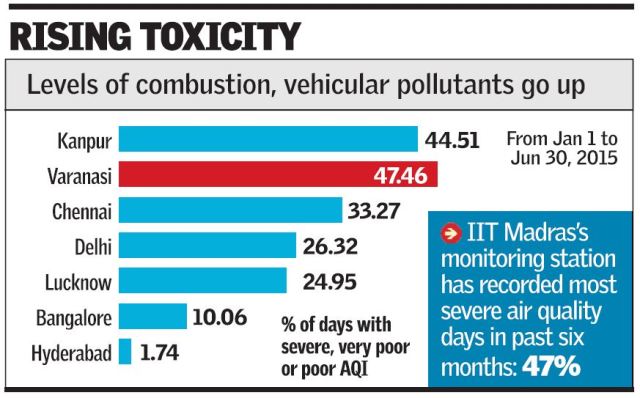
Official air quality data for the first half of this year shows that while Delhi does indeed face high levels of air pollution, Kanpur, Varanasi and Chennai are worse off.

Averaging across the ten pollution monitoring stations in the city, a little over a quarter of the days from January to June this year in Delhi had an Air Quality Index (AQI) value of severe (3.2 per cent), very poor (8.7 per cent) or poor (14.4 per cent). In comparison, nearly half of all days in Kanpur were of severe, very poor or poor air quality. Varanasi had no ‘severe’ days, but nearly half of all days were either of very poor or poor air quality. Averaging across its three monitoring stations, Chennai had the highest proportion of ‘severe’ days (17.7 per cent), and a third of all days were either of severe, very poor or poor air quality.

The average AQI value for the last six months for these three cities as well as Lucknow was also higher than Delhi’s.

Screen Shot 2015-07-15 at 07.55.16SO2, CO prominent pollutants in Chennai

In the first week of April, the union government unveiled a colour-coded index of air quality based on recommendations from the Indian Institute of Technology Kanpur. The government’s tracking website currently has live data for 11 cities across the country. Central Pollution Control Board (CPCB) monitoring stations are able to read concentration levels for one or more pollutants of the following – Particulate Matter with a diameter less than 10 micrometres (PM10), Particulate Matter with a diameter of less than 2.5 micrometers (PM2.5), ozone (O3), Nitrogen Dioxide (NO2), Carbon Monoxide (CO), and Sulphur Dioxide (SO2). The values for any of these pollutants the station is able to pick up are converted into an AQI value. The pollutant with the highest AQI value at the time for that city is determined to be the ‘prominent pollutant’ and its AQI value becomes the station’s overall AQI value.

According to the index, days when the AQI value is between 401 and 500 are ‘severe’ and “may cause respiratory impact even on healthy people, and serious health impacts on people with lung/heart disease. The health impacts may be experienced even during light physical activity.” Among all 26 monitoring stations for which data is available, the IIT Chennai monitoring station has by far the most ‘severe’ air quality days – over 47 per cent of all days in the last six months. Two monitoring stations in Lucknow – Central School and Lalbagh West Lucknow – have the second and fourth highest proportion of severe days, while Anand Vihar in Delhi is third, and Nehru Nagar in Kanpur is fifth.

In Delhi, high AQI values are driven primarily by PM 2.5, while in Chennai, they are driven by sulphur dioxide and carbon monoxide. In Bengaluru, ozone is additionally often the prominent pollutant. The AQI is normalised for the concentration levels of different pollutants, with a common scale, and so comparing AQI values, even if the prominent pollutant is different, is valid, a senior official connected with the AQI told The Hindu. Similar AQI values, even if for different pollutants, indicate that the health impact on humans will be similar, and also suggest which pollutant that city needs to curb, the official added.

“Northern India tends to have higher PM levels than southern India, and the impression in the south sometimes is that there is less pollution there. What you’ve found shows that there is high concentration of gaseous pollutants in other cities, and all pollutants have health risks,” Anumita Roychowdhury, head of the Centre for Science and Environment’s air pollution and clean transportation programmes, told The Hindu. This indicates high levels of combustion and vehicular pollutants, she added.

via The quality of air you breathe in Chennai is worse than in Delhi – The Hindu.

Posted in Air Quality, Asia, India | Tagged , , , , , , , , , , , , , , | Leave a comment

Twin Cities air pollution linked to 2,000 deaths a year

Every year air pollution in the Twin Cities contributes to the deaths of about 2,000 people and sends another 1,000 to the hospital for asthma and heart disease treatment.

Two state agencies released those findings Monday morning in an analysis of air quality and health data from 2008, the most recent data available.

“This report helps us see much more clearly than we could before just who is affected by air pollution, how serious the effects are and where we have health disparities that need to be addressed,” said Ed Ehlinger, commissioner of the Minnesota Department of Health.

Air quality in Minnesota is generally good and meets current federal standards. But even low and moderate levels can contribute to illness and early death. The report, jointly produced by the health department and the Minnesota Pollution Control Agency, estimated that 6 to 13 percent of all deaths and 2 to 5 percent of all hospital visits were aggravated by small particle and ozone pollution, the two types of air pollution that cause the greatest health risk.

“We can’t control Canadian wildfires or who is burning coal around the world,” says MPCA Commissioner John Linc Stine. “We can look at our own choices every day. We can choose the most fuel-efficient transportation we can afford or use mass transit.”

People in ZIP codes with more people of color and residents in poverty show more public health effects from air pollution, primarily because these populations already have higher rates of heart and lung conditions, state officials said. They experience more hospitalizations, emergency-room visits for asthma, and death related to air pollution.

A haze settled in over the Minneapolis skyline one day in early July as smoke from Canadian wildfires drifted across Minnesota, leading to air quality warnings.

“Places that have more elderly people with heart and lung conditions and children with uncontrolled asthma are places where air pollution has a greater impact,” said Ehlinger.

The commissioners say newer data from 2014 suggest that air quality has improved since 2008, but whether health outcomes also have improved is not yet known. Scientists say it may be possible to update the study in the near future.

via Twin Cities air pollution linked to 2,000 deaths a year – StarTribune.com.

Posted in Air Quality, USA & Canada | Tagged , , , | Leave a comment

London pollution reports add to pressure for clamp on diesels

The impact of diesel vehicles on London’s air quality will come under the spotlight this week with the publication of two studies pressing the government to curb pollution and the use of such engines.

The London Assembly’s environment committee will on Tuesday blame the “failure” of EU engine standards and government policy that encouraged the take-up of diesel cars for leaving “a generation of dirty vehicles on our roads”.


“Where it was once a deadly mixture of soot and smoke from coal-fired power stations and factories that was largely responsible for London’s air pollution, today it is the combustion of diesel that is to blame for much of the problem,” said Stephen Knight, a member and former chair of the environment committee.

A separate study on the health impacts of air pollution in London, to be published on Wednesday, will put a figure on the number of premature deaths in the capital linked to nitrogen dioxide.

This report does not specifically mention diesel, according to a person with knowledge of the contents, but the fuel is a significant contributor to N02 levels.

Whereas previous studies have focused on PM2.5, a kind of small particulate matter, this study — carried out by researchers at King’s College London, with funding from the Transport for London authority — concludes that the impact of N02 is at least as great as PM2.5. The number of premature deaths caused by PM2.5 in the whole of the UK is 29,000, according to official figures.

The studies come as the motor industry is gearing up for an extended fight to prevent a wholesale shift away from diesel, which accounts for half of passenger car sales in the UK and is the main fuel source for buses, taxis and commercial vehicles.

The UK’s highest court ruled in April that the government must draw up a plan to tackle the dangerously high levels of nitrogen dioxide, which is known to cause respiratory problems. The country faces EU fines for failing to meet air quality targets.

In response, Boris Johnson, the London mayor, plans to set up an “ultra-low emission zone” in 2020, which would see the capital’s congestion charge that is payable by all vehicles almost doubled for older diesel engines.

Where it was once a deadly mixture of soot and smoke from coal-fired power stations and factories that was largely responsible for London’s air pollution, today it is the combustion of diesel that is to blame for much of the problem

– Stephen Knight, London Assembly environment committee

The environment committee report, called “Driving away from diesel” and seen by the Financial Times, will recommend that the ultra-low emission zone should be brought forward from 2020 and should be widened beyond the congestion charging area “as soon as is practically possible”. The committee had previously told the mayor that to wait until 2020 to introduce the zone would be inexcusable.

The report also urges the government to take toxic pollutants such as N02 and particulate matter into account under an “urgent” review of the vehicle excise duty on cars. The duty, which was subject to sweeping reforms in last week’s Summer Budget, is currently based only on the amount of carbon dioxide emitted by cars.

The government is being also urged take forward Mr Johnson’s proposal for a “scrappage” trade-in scheme for all but the latest diesel cars.

Buses with older “Euro 5” engines should be retrofitted to meet the latest standards or redeployed away from central London, the report will say.

It will also urge the mayor to consult further with the taxi industry and ensure that sufficient zero-emission taxis will be available from 2018, when new minicab standards are due to come into force, as well as the necessary electric vehicle charging infrastructure.

via London pollution reports add to pressure for clamp on diesels – FT.com.

Posted in Air Quality, Europe, London, UK | Tagged , , , , , , , , | Leave a comment

UAE questions damning World Bank report into air quality

The Ministry of Environment and Water has said his department is in contact with the World Bank over its report that said the UAE has the worst air pollution in the world.

The recently-published World Bank’s The Little Green Data Book said the UAE had a rating of 80 micrograms of pollutants per cubic metre – higher than China (73) and more than double that of India (32).

The report was also at odds with data provided by the National Oceanic and Atmospheric Administration, which said the UAE has worked on improving the quality of air in the country.

Fahed Hareb, director of air quality at the ministry, said he didn’t understand where the World Bank was getting its data from.

“The data we measure doesn’t even reach half of what they are talking about,” Hareb told The National newspaper.

“There’s no mention of where they get their information. They never contacted us for data so those models can be based on anything. It’s like saying, ‘I think the population of India is 30 million because I heard it somewhere’. We’re in contact with them to try to understand where they got this information.”

With 46 air quality stations in the country, the UAE has a target of 90 percent adherence to the WHO air quality guidelines by 2021.

via UAE questions damning World Bank report into air quality – ArabianBusiness.com.

Posted in Air Quality, Middle East | Tagged , , , , | Leave a comment

Bees recruited by scientists to monitor air pollution

Bees are crucial for crop pollination and honey production but now scientists have recruited the pollinators for pollution monitoring.

Scientists at the Natural History Museum are capitalising on the fact that pretty much everything will stick to a bee’s body and wings. It is why they are so vital for pollination because so much static electricity builds up in their fur that it draws in tiny particles.

Researchers realised that the build-up of industrial pollution on bees can be used to monitor air quality.

The insects can fly up to 2.5km a day around their hives, so they can provide a much more accurate sample of particulate matter in an area than ground-based observations.

The researchers studied bees in an industrial area of Sardinia where dozens of lead-zinc mines operated until recent times, leaving thousands of tonnes of finely ground ore materials exposed.

Industrial and mining activity releases a range of fine particles that can remain suspended in the atmosphere; some of these can be particularly harmful to humans.

Mineralogist Dr Christian Mavris, one of the lead authors of the study, said: “Using our novel method, bees dynamically sample airborne particulate matter.

“This allowed us to discern between different emission sources. Stationary observation stations allow for more accurate estimates of particle quantities, but they cannot match our new method’s ability to determine emission sources.”

The Sardinian samples showed that The bees’ head, wings and legs were coated with particulate matter of industrial and mining origins, accumulated during their adult life span of about six weeks.

The researchers were able to track the origin of these particles, including emission sources several kilometres from the beehives.

Their findings suggest that the exposure of humans living in the area to post-mining and industrial pollutants could be far higher than previously thought.

Dr Mavris believes that bees could be used in the British countryside to monitor former industrial areas such as old coal and lead mines.

“There are lots of applications for this kind of bee monitoring,” he said. “We often have an assumption that air in the countryside is very good but that is probably not a precise estimate.

“If we wanted to test an area we could take some honeybees and put some hives there and then check the level of particles that stick to them. It could give us a good indication of how air quality was changing over time.

“The Sardinian experiments have shown us that in old mines, even when the ore dumps had been covered over by soil, the particles were still getting into the air.

“It could help narrow down sources of air pollution.”

The research was published in the journal PLoS One.

via Bees recruited by scientists to monitor air pollution – Telegraph.

Posted in Air Quality | Tagged , , | Leave a comment

Air pollution: Which areas of west London emit most pollution?

Harrow is one of the greenest areas in the UK when it comes to emissions of CO2, new figures have revealed.

According to figures published by the Department for Energy and Climate Change, just 3.4 tonnes of CO2 per head were emitted in the local authority area in 2013.

This figure is the ninth smallest number for any local authority area in the UK.

The CO2 emissions per head was also 24% lower in Harrow in 2013 compared to 2005.

Elsewhere in west London, Westminster emitted the most CO2 with 13.4 tonnes per head in 2013.

Screen Shot 2015-07-12 at 23.40.24

Across the whole of the UK, seven tonnes of CO2 were emitted per head of the population in 2013, a slight decrease on the 7.1 tonnes emitted per head in 2012.

via Air pollution: Which areas of west London emit most pollution? – Get West London.

Posted in Air Quality, Europe, London, UK | Tagged , , , , , | Leave a comment