Haze from Canadian wildfires spreads across many US states

Large wildfires raging across Canada have contributed to a smoky haze lingering above the Western U.S., blazes fueled by the familiar hot, dry conditions that have turned much of the region into a tinderbox.

The smoke has caused spectacular red sunsets in places including Seattle and prompted air quality warnings in many states.

FIERY CANADA

Blazes are burning in parts of British Columbia, Alberta and Saskatchewan.

In Saskatchewan, more than 10,000 people have been forced from their homes, and the Canadian Interagency Forest Fire Centre, which coordinates firefighting services for the provinces and territories, said more help from the U.S. and abroad could be necessary.

Alberta said Wednesday it was bringing in 62 firefighters from Mexico to help battle 92 wildfires burning in the province, including 33 listed as out of control.

British Columbia, with more than 180 fires, was bringing in crews from Australia.

SMOKE SOUTH OF THE BORDER

Haze that lingered over parts of eastern Colorado for three days was rapidly dissipating Thursday.

The smoky conditions had prompted a health warning for the Denver area Wednesday and combined with clouds to cast unusually gloomy skies that blocked mountain views.

The tiny particles of wildfire debris in the air pose a health risk for people with lung disease, older adults and children and anyone who exerts themselves outdoors, said Christopher Dann of Colorado’s air pollution control division.

He said Colorado — which remains free of large wildfires after a wet spring — could be again dealing with smoke from the Canadian fires over the coming days and weeks depending on weather and the progress of firefighters.

Joanne Todd of the Puget Sound Clean Air Agency said smoke from wildfires in British Columbia has crossed into Washington state, but is sitting high in the atmosphere and has little impact on the health of residents. “It’s not affecting us at ground level,” Todd said.

She said, however, that could change in the future.

Air quality advisories have also been issued in North and South Dakota.

Canadians, obviously, have been affected as well. Environment Canada continued to issue special air quality advisories for parts of British Columbia, Saskatchewan, Manitoba and northwest Ontario due to wildfire smoke.

HOT AND DRY

Western Canada has seen very hot, dry and windy conditions.

Kerry Anderson, a research scientist with the Canadian Forest Service, said the weather pattern known as El Nino, which is caused by the warming of the Pacific Ocean off the coast of South America, is responsible.

He expects weather conditions will settle down in Saskatchewan in the coming weeks, but warmer than normal temperatures will likely persist for a while in B.C. and Alberta.

Anderson said even if crews bring the Saskatchewan fires under control, they may not actually be put out until the fall.

Similar conditions across the American West have helped fuel for large, destructive blazes, including one in Wenatchee, Washington, that began in late June that destroyed nearly 30 homes.

via Haze from Canadian wildfires spreads across many US states | News & Observer News & Observer.

Posted in Air Quality, USA & Canada | Tagged , , , , , , , , , , , , , | Leave a comment

Action to be taken over Truro’s air quality

Following a public consultation Cornwall Council has taken the steps required to formally declare Truro as an Air Quality Management Area (AQMA).

Improving local air quality is a priority for Cornwall Council and regular monitoring is carried out across the county. Results of this monitoring have indicated that Truro suffers from excessive levels of traffic related nitrogen dioxide (NO2).

Truro becomes the sixth AQMA in Cornwall. The five others named across the county since 2005 are St Austell, Gunnislake, Tideford, Bodmin and Camborne-Pool-Redruth.

This designation highlights the council’s commitment to Truro as an area for improvement in air quality, and an action plan is now being prepared. The action plan is likely to be published in the next year and aims to introduce measures to help improve air quality. There will be a further consultation on the draft action plan when residents and businesses will again be invited to have their say.

Geoff Brown, portfolio holder for communities, said: “The declaration of this new Air Quality Management Area is an important positive step towards improving the quality of the air in Cornwall, and the well-being of our residents and visitors.”

Allan Hampshire, head of public protection and business support, added: “Air pollution is amongst the top ten causes of mortality in the UK, with nearly 30,000 people dying prematurely each year as a result of exposure to air pollution. While many people think Cornwall has clean unpolluted air the declaration of a sixth air quality management area in the county confirms that this is not necessarily the case, however the declaration is an important step towards improving air quality within Truro and with it the health of those living and working in the city.”

For more information on air quality in Truro, visit http://www.cornwall.gov.uk/airquality.

via Action to be taken over Truro’s air quality (From Falmouth Packet).

Posted in Air Quality, Europe, UK | Tagged , , , , , , , , , , | Leave a comment

Smoke from hundreds of North American wildfires is taking a toll on U.S. air quality

There are hundreds of active wildfires burning in Canada and Alaska this week in what has been a horrible fire season so far. Unfortunately, the smoke from all of these fires has to go somewhere, and the jet stream has been ushering it straight into the U.S. for days.

There are over 350 wildfires burning in Canada this week, 45 of which have just been ignited in the past 24 hours. Most of the fires stretch from northern British Columbia and Saskatchewan. Over 8,000 square miles of land in Canada has burned so far this year, as a result of more than 4,600 wildfires.

“These [wildfire] figures are likely to continue to grow, likely breaking some records in particular provinces,” writes Mashable’s Andrew Freedman, “though all-time national records are more difficult to break.”

To the northwest, 300 wildfires are burning in Alaska, most of which are “very large,” covering more than 2,500 acres. That brings the total number of fires to nearly 700 north of the 49th parallel, and all of that smoke has been riding south on the jet stream for the past couple of weeks, reaching as far south as Florida and lingering over the Mid-Atlantic and Northeast for days.

The tiny smoke particulates have pushed air quality into unhealthy ranges in Colorado and the Upper Midwest. An action day was issued for the urban corridor of the Front Range region on Tuesday afternoon, in effect until at least Wednesday afternoon. So far on Wednesday, Fort Collins has been suffering through air quality levels deemed “unhealthy for everyone,” with an index over 150. The Colorado Department of Public Health and Environment suggests everyone in the Front Range, even people without pollution-sensitive health issues, refrain from prolonged or heavy exertion.

Minnesota endured similarly hazardous levels on Monday as smoke from the fires pushed air pollution at the ground into the danger zone. Usually most of the smoke stays in the upper atmosphere as it rides the jet stream, but a cold front caused the smokey air to sink to the surface earlier this week. The Star Tribune reports:

On an air-quality scale that ranges from 0 to 200, some parts of Minnesota, including the Twin Cities, pushed into the mid-170s and 180s, said Steve Mikkelson, a spokesman for the MPCA.

“That’s unusually high,” Mikkelson said, pointing out that he hasn’t seen readings this high for more than a decade. “We’ve had alerts in the ‘unhealthy for everyone’ range of the scale before, but not this high.”

“The same storm that dumped 2 to 7 inches of rain in central and southeaster Minnesota also helped to pull some of the smoke down to the surface,” said meteorologist Paul Douglas. “Usually this plume of smoke is a few miles above the ground. It was a little disconcerting to see visibility down to a half mile to a mile because of smoke. It looked like LA on a bad day.”

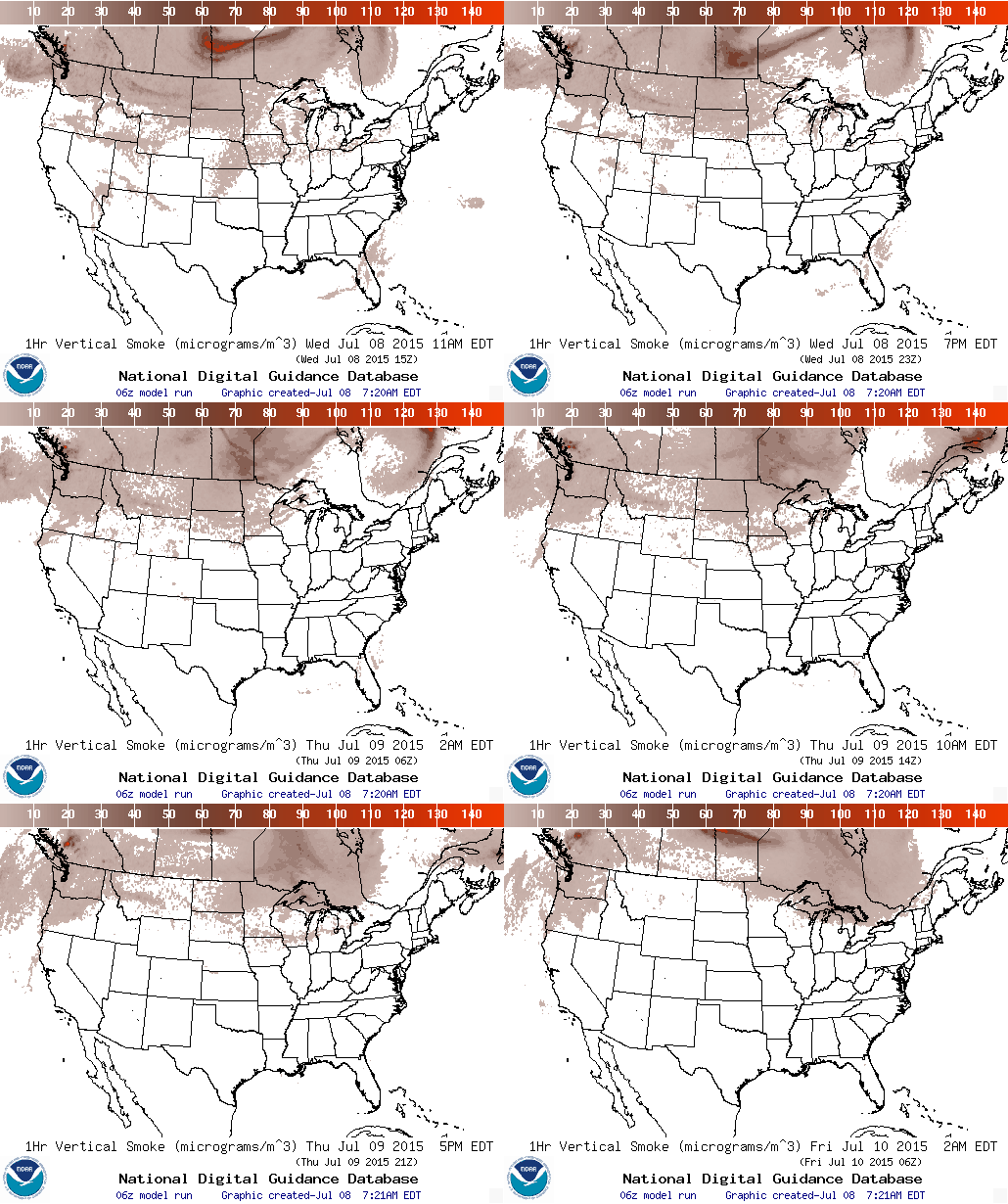
The Upper Midwest and Colorado will get a break starting Friday when the jet stream shifts to the Northeast. This will likely bring hazy, brown air to the Northeast states into the weekend. The forecast from the National Weather Service shows increased smoke concentration shifting east through Thursday night.

downloadSmoke forecast through Thursday night. (NWS)

via Smoke from hundreds of North American wildfires is taking a toll on U.S. air quality – The Washington Post.

Posted in Air Quality, USA & Canada | Tagged , , , , , , , , , , , | Leave a comment

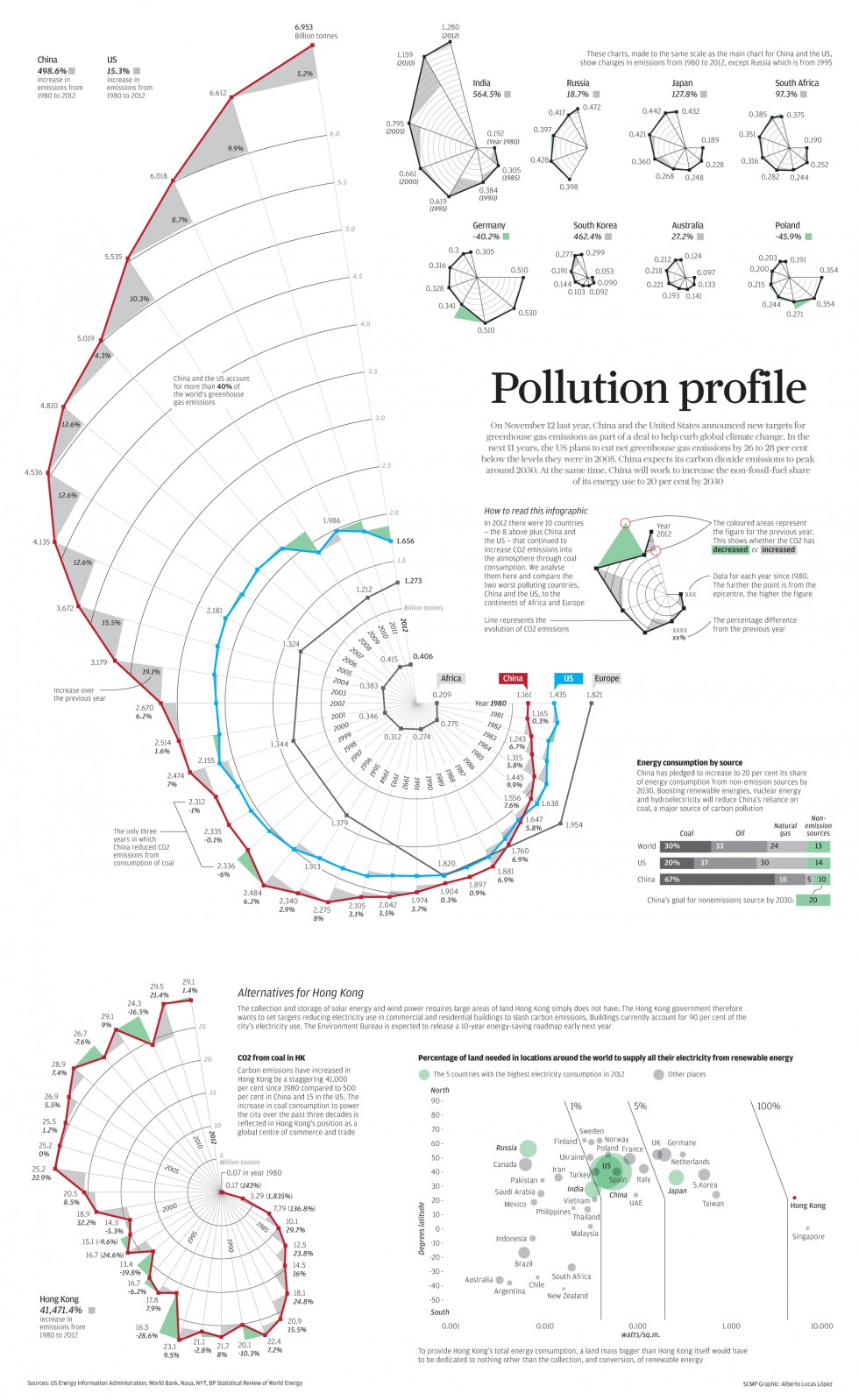
INFOGRAPHIC: Pollution profile

China expects its carbon dioxide emissions to peak around 2030. At the same time, China will work to increase the non-fossil-fuel share of its energy use to 20 per cent by 2030

On November 12 last year, China and the United States announced new targets for greenhouse gas emissions as part of a deal to help curb global climate change. In the next 11 years, the US plans to cut net greenhouse gas emissions by 26 to 28 per cent below the levels they were in 2005. China expects its carbon dioxide emissions to peak around 2030. At the same time, China will work to increase the non-fossil-fuel share of its energy use to 20 per cent by 2030

back-infographic-0103-net

via INFOGRAPHIC: Pollution profile | South China Morning Post.

Posted in Air Quality, Asia | Tagged , , , , , , , | Leave a comment

Almost all London boroughs failed EU air pollution limit for toxic NO2 gas

Bromley and Sutton only two boroughs to meet limit set for nitrogen dioxide gas linked to respiratory health problems, data shows

All but two of London’s boroughs are exceeding EU limits for a toxic gas linked to respiratory problems, ministers have admitted.

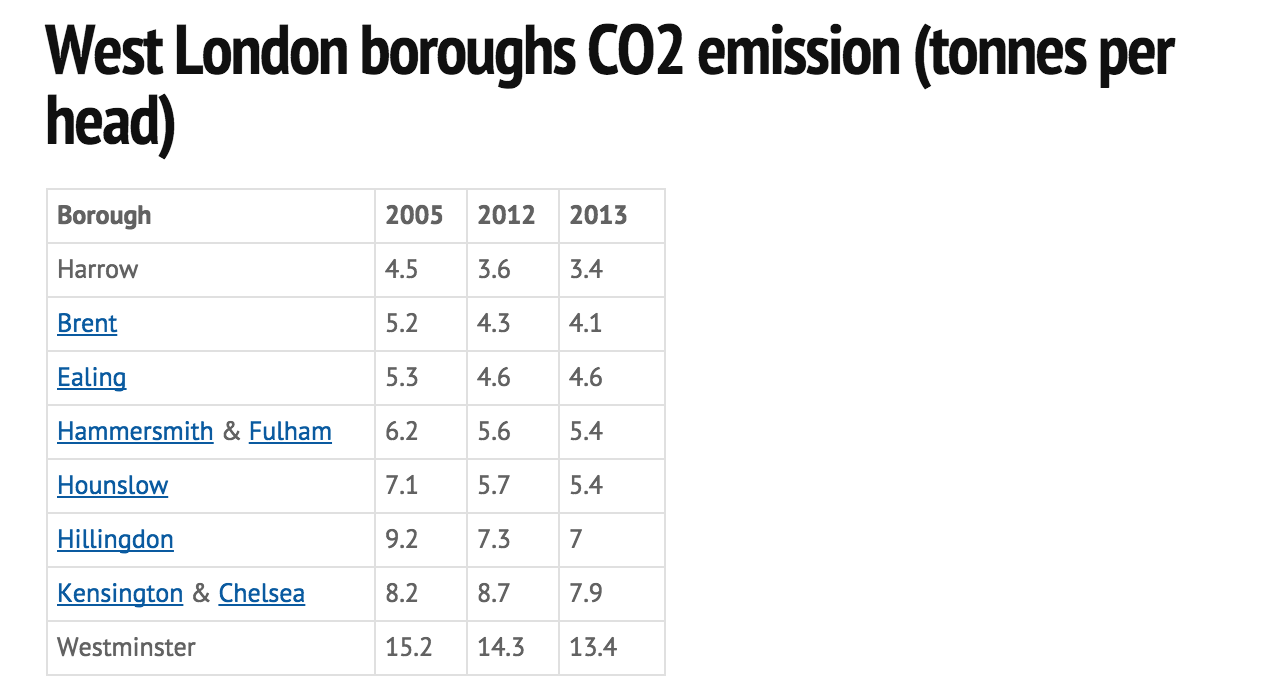
Bromley and Sutton were the only two boroughs to meet the annual mean limit for nitrogen dioxide (NO2) in 2013, the latest year for which data is available. NO2 is a pollutant created by diesel vehicles.

The figures suggest that 24-hour EU limits for another pollutant, fine particulates known as PM10s, were met in every borough. But limits for a more harmful, smaller pollutant, PM2.5, were missed in seven boroughs: Hammersmith & Fulham, Kensington and Chelsea, Westminster, Ealing, Tower Hamlets, Camden and Brent.

Sadiq Khan, the Labour MP who is campaigning for his party’s nomination as mayoral candidate, and who requested the numbers, said: “These figures paint a dismal picture of London’s long-term efforts to tackle air pollution and underline the need for a much bolder and more radical approach.

“When it comes to reducing certain pollutants, it’s clear that any progress we have seen has been lacklustre at best, and in some cases simply non-existent.”

The capital’s air pollution problem was brought to the fore last week when an independent review into airport expansion backed a third runway at Heathrow. The Davies Commission said it supported Heathrow only with the proviso that there was a “legal commitment on air quality” that new aviation capacity would not be added if it delayed compliance with EU limits.

The capital as a whole is not expected to comply with NO2 limits until 2030, even without expansion at Heathrow. As recently as 2011 every single borough failed to meet the limits, according to the figures released by Rory Stewart, minister for the natural environment.

Khan and several of the other London mayoral hopefuls, including Conservative Zac Goldsmith, oppose building a third runway at Heathrow on air and noise pollution grounds. The consultation for the Davies review was extended to take in further evidence on air pollution after the government was ordered in April by the Supreme Court to submit a plan for tackling NO2 by the end of the year

Simon Birkett, founder of the Clean Air in London campaign, said: “With most of the breaches of NO2 laws in London due to diesel vehicles on Transport for London roads, it is clear the mayor has failed to help boroughs comply with these limits.

“The situation is starkest around Heathrow… where a third runway would result in staggering increases in NO2 concentrations beside nearby roads.”

The mayor of London, Boris Johnson, plans to introduce an “ultra low emission zone” (ULEZ) in 2020 to tackle the capital’s pollution problem, charging the owners of the most polluting vehicles up to £100 a day.

Last week, Transport for London announced that a fully electric double decker bus would go into service from October in a bid to cut pollutants. NO2 pollution hotspots such as Oxford Street are caused largely by a high concentration of diesel buses.

Later this year the government’s Committee on the Medical Effects of Air Pollutants is expected to factor NO2 into its calculations on the number of prematurely deaths caused annually by pollution. This is expected to see the number of deaths double from around 30,000 to 60,000.

The latest borough-by-borough data on pollutants, for 2014, will be published in September, Stewart said.

via Almost all London boroughs failed EU air pollution limit for toxic NO2 gas | Environment | The Guardian.

Posted in Air Quality, Europe, London, UK | Tagged , , , , , , , , , , , , , , , , , | Leave a comment

Air Pollution Kills 3.2 Million People Worldwide Every Year!

Reducing air pollution could save millions of lives according to new research. The World Health Organisation reported that in 2012, around 7 million people died as a result of exposure to air pollution. You can find out more about the number of deaths caused by air pollution in the following article, EU Environment Watchdog Claims Air Pollution Kills Thousands in Europe Every Year.

A total of 4.3 million deaths were linked to indoor air pollution and 2.6 million deaths were attributed to outdoor air pollution. This equates to one in eight of all total global deaths, and accounts for more than the number of AIDS and malaria fatalities combined.

This new research shows that air pollution is now the single largest environmental health risk, and has doubled previous estimates.

How does air pollution affect the body?

Air pollution primarily affects our lungs and respiratory organs. This form of pollution is so minuscule that is can bypass the tiny little hairs in your nose and travel into your lungs. In mild cases where exposure is low, it can cause irritation of the throat and nose. When the lungs are inflamed, this can result in wheezing and coughing.

Air pollution has also been linked to asthma and when children are exposed from an early age their lungs are at risk of not developing properly. In cases where pollution is particularly high, there is a correlation between an increase in acute respiratory infections and chronic obstructive pulmonary diseases.

However, the new research shows that air pollution now has a surprisingly strong link with cardiovascular diseases, which include strokes and ischaemic heart disease.

What is the difference between indoor and outdoor pollution?

When we think of air pollution we automatically assume of the outdoors, but according to the EPA, indoor pollution is two to five times more toxic than the outdoors. In some cases, the indoors has been found to be 100 per cent more polluted.

Indoor Pollution

As we spend nearly 90 per cent of our lives indoors, it is important to understand what causes indoor pollution.

Poor ventilation is the main cause of indoor air pollution, as it increases the levels of toxins inside the home. These can include cooking gases, household cleaners, mould and mildew and heating. Radon is a toxic gas that comes from the earth underneath homes and can lay in building materials. Exposure to radon is the second-leading cause of the development of lung cancer.

Tobacco smoke contains many toxins that are proven to cause cancer and even if you do not smoke, second-hand smoke contains the same toxins.

Household cleaners contain toxic chemicals such as ethylene-based glycol ethers and terpenes. Ethers are toxins that are immediately poisonous, whereas terpenes interact with ozone to create a toxic compound.

Outdoor pollution

Outdoor air pollution is caused by small particles, typically less than 2.5 microns, which come from a number of sources.

Traffic causes a large amount of outdoor pollution, in the form of car exhausts which emit nitrogen dioxide, a toxic gas that contributes to photochemical smog. This affects the body by inflaming the lining of the lungs and reducing the immunity to lung infections. Air pollution is also associated with burning fossil fuels such as coal, coal power plants, plus agricultural and industrial emissions.

High pollen counts reduce the quality of outdoor air by increasing the particle pollution. When pollutants and pollen mix, the pollen can be carried further into the lungs and can cause irritation.

In poorer countries, air pollution is caused by burning rubbish out in the open, coal and wood burning, getting rid of crop waste by burning and lighting animal dung for cooking and heating.

What should be done to reduce air pollution?

The WHO has issued air quality guidelines of 10 micrograms per cubic metre, but many people live in areas of a much higher concentration. In fact, some parts of China and India experience levels of over 100.

However, if countries manage to meet WHO’s air quality guidelines, up to 1.4 million premature deaths could be prevented per year in the most polluted areas.

“The risks from air pollution are now far greater than previously thought or understood, particularly for heart disease and strokes,” says Dr Maria Neira, Director of WHO’s Department for Public Health, Environmental and Social Determinants of Health. “Few risks have a greater impact on global health today than air pollution; the evidence signals the need for concerted action to clean up the air we all breathe.”

via Air Pollution Kills 3.2 Million People Worldwide Every Year! – Jul 06 2015 10:16 AM – Breaking News – Pollution Solutions Online.

Posted in Air Quality, Health Effects of Air Pollution | Tagged , , , , | Leave a comment

Take Euston back route to avoid toxic fumes

PEDESTRIANS were today told they could cut exposure to toxic fumes by 65 per cent by avoiding Euston Road.

A back-street route linking Euston and St Pancras stations was unveiled to encourage people to avoid one of the 50 most polluted roads in the country.

Levels of nitrogen dioxide, a pollutant from diesel vehicles, are typically almost three times the maximum legal level of 40 micrograms per cubic metre. Last week they soared to seven times the maximum, according to King’s College London research.

Urban Partners, a partnership of businesses from across King’s Cross, St Pancras and Euston, has launched London’s first “wellbeing walk” via Eversholt Street, Phoenix Road and Brill Place.

It says air-quality monitoring shows that the route exposes walkers to up to 65 per cent less pollution than if they used pavements on Euston Road.

The aim is also to attract custom to local businesses and Chalton Street market. Busi‐ nesses and residents along the route are being encouraged to suggest ways of improving the environment, such as by installing window boxes.

London has the highest recorded level of NO2 of any European capital and in some ar‐ eas as many as one in 12 deaths can be partly attributed to the effects of particle air pollu‐ tion.

More than 4,000 Londoners a year are estimated to die early due to pollution. Boris Johnson plans to introduce an Ultra Low Emission Zone by 2020 but Euston Road would not be included.

Joyce Lorigan, chairwoman of Urban Partners, said: “Commuters experience the im‐ pacts of the city’s worsening pollution levels every day. Our Wellbeing Walk is part of the solution.”

via http://www.pressreader.com/uk/london-evening-standard-west-end-final-b/20150706/281943131548425/TextView

Posted in Air Quality, Europe, London, UK | Tagged , , , , , | Leave a comment

Health warning issued as Hong Kong air pollution expected to hit ‘serious’ levels

Health alert issued as pollution hits ‘very high’ levels in busy districts

Hong Kong was shrouded in higher-than-normal pollution yesterday as “very high” levels were recorded across some of the busiest areas of the city.

Areas such as Central and Western District, Causeway Bay, Mong Kok and Kwun Tong recorded “very high” levels of 10 at intervals throughout the day.

The Environment Protection Department warned some districts could reach “serious” levels above 10, as a continental airstream closes in on the area, affecting the coastal areas of Guangdong.

air-quality-health-indexOut of the 15 monitoring stations across the city, 11 reached the “very high” level at 6pm, according to the department’s website. These stations recorded an index between 7 and 10.

However, the environment watchdog stopped short of confirming whether the choking condition was likely to continue today, as a spokesperson said the index was only reflective of a short timeframe.

The index, introduced in 2013, is an indicator of the short-term health impact pollutants have on people.

The watchdog warned the “very high” level meant children, the elderly and people with existing heart or respiratory illnesses were advised to reduce outdoor activities to a minimum or even avoid them.

Others, the department warned, were advised to stay out of areas with heavy traffic.

When the serious level is reached, those who are particularly vulnerable are advised to avoid all outdoor exposure, especially in areas with heavy traffic.

Despite uncertainties on the index levels, the weather conditions forecast over the next couple of days are expected to be more conducive to a continued high pollution level.

Chan Yan-chun, scientific officer of the Hong Kong Observatory said the city would be influenced by a dry continental airstream. “It will bring us hot, cloudy weather with haze and isolated showers,” he said.

The environmental watchdog said the airstream was likely to enhance the formation of ozone, while a light wind would facilitate the trapping of pollutants.

Meanwhile, tropical storm Linfa is gradually approaching the southern part of Taiwan and Chan said the Observatory would keep an eye on its movement in case it affected the region.

via Health warning issued as Hong Kong air pollution expected to hit ‘serious’ levels | South China Morning Post.

Posted in Air Quality, Asia, China | Tagged , , | Leave a comment