Almost all London boroughs failed EU air pollution limit for toxic NO2 gas

Bromley and Sutton only two boroughs to meet limit set for nitrogen dioxide gas linked to respiratory health problems, data shows

All but two of London’s boroughs are exceeding EU limits for a toxic gas linked to respiratory problems, ministers have admitted.

Bromley and Sutton were the only two boroughs to meet the annual mean limit for nitrogen dioxide (NO2) in 2013, the latest year for which data is available. NO2 is a pollutant created by diesel vehicles.

The figures suggest that 24-hour EU limits for another pollutant, fine particulates known as PM10s, were met in every borough. But limits for a more harmful, smaller pollutant, PM2.5, were missed in seven boroughs: Hammersmith & Fulham, Kensington and Chelsea, Westminster, Ealing, Tower Hamlets, Camden and Brent.

Sadiq Khan, the Labour MP who is campaigning for his party’s nomination as mayoral candidate, and who requested the numbers, said: “These figures paint a dismal picture of London’s long-term efforts to tackle air pollution and underline the need for a much bolder and more radical approach.

“When it comes to reducing certain pollutants, it’s clear that any progress we have seen has been lacklustre at best, and in some cases simply non-existent.”

The capital’s air pollution problem was brought to the fore last week when an independent review into airport expansion backed a third runway at Heathrow. The Davies Commission said it supported Heathrow only with the proviso that there was a “legal commitment on air quality” that new aviation capacity would not be added if it delayed compliance with EU limits.

The capital as a whole is not expected to comply with NO2 limits until 2030, even without expansion at Heathrow. As recently as 2011 every single borough failed to meet the limits, according to the figures released by Rory Stewart, minister for the natural environment.

Khan and several of the other London mayoral hopefuls, including Conservative Zac Goldsmith, oppose building a third runway at Heathrow on air and noise pollution grounds. The consultation for the Davies review was extended to take in further evidence on air pollution after the government was ordered in April by the Supreme Court to submit a plan for tackling NO2 by the end of the year

Simon Birkett, founder of the Clean Air in London campaign, said: “With most of the breaches of NO2 laws in London due to diesel vehicles on Transport for London roads, it is clear the mayor has failed to help boroughs comply with these limits.

“The situation is starkest around Heathrow… where a third runway would result in staggering increases in NO2 concentrations beside nearby roads.”

The mayor of London, Boris Johnson, plans to introduce an “ultra low emission zone” (ULEZ) in 2020 to tackle the capital’s pollution problem, charging the owners of the most polluting vehicles up to £100 a day.

Last week, Transport for London announced that a fully electric double decker bus would go into service from October in a bid to cut pollutants. NO2 pollution hotspots such as Oxford Street are caused largely by a high concentration of diesel buses.

Later this year the government’s Committee on the Medical Effects of Air Pollutants is expected to factor NO2 into its calculations on the number of prematurely deaths caused annually by pollution. This is expected to see the number of deaths double from around 30,000 to 60,000.

The latest borough-by-borough data on pollutants, for 2014, will be published in September, Stewart said.

via Almost all London boroughs failed EU air pollution limit for toxic NO2 gas | Environment | The Guardian.

Posted in Air Quality, Europe, London, UK | Tagged , , , , , , , , , , , , , , , , , | Leave a comment

Air Pollution Kills 3.2 Million People Worldwide Every Year!

Reducing air pollution could save millions of lives according to new research. The World Health Organisation reported that in 2012, around 7 million people died as a result of exposure to air pollution. You can find out more about the number of deaths caused by air pollution in the following article, EU Environment Watchdog Claims Air Pollution Kills Thousands in Europe Every Year.

A total of 4.3 million deaths were linked to indoor air pollution and 2.6 million deaths were attributed to outdoor air pollution. This equates to one in eight of all total global deaths, and accounts for more than the number of AIDS and malaria fatalities combined.

This new research shows that air pollution is now the single largest environmental health risk, and has doubled previous estimates.

How does air pollution affect the body?

Air pollution primarily affects our lungs and respiratory organs. This form of pollution is so minuscule that is can bypass the tiny little hairs in your nose and travel into your lungs. In mild cases where exposure is low, it can cause irritation of the throat and nose. When the lungs are inflamed, this can result in wheezing and coughing.

Air pollution has also been linked to asthma and when children are exposed from an early age their lungs are at risk of not developing properly. In cases where pollution is particularly high, there is a correlation between an increase in acute respiratory infections and chronic obstructive pulmonary diseases.

However, the new research shows that air pollution now has a surprisingly strong link with cardiovascular diseases, which include strokes and ischaemic heart disease.

What is the difference between indoor and outdoor pollution?

When we think of air pollution we automatically assume of the outdoors, but according to the EPA, indoor pollution is two to five times more toxic than the outdoors. In some cases, the indoors has been found to be 100 per cent more polluted.

Indoor Pollution

As we spend nearly 90 per cent of our lives indoors, it is important to understand what causes indoor pollution.

Poor ventilation is the main cause of indoor air pollution, as it increases the levels of toxins inside the home. These can include cooking gases, household cleaners, mould and mildew and heating. Radon is a toxic gas that comes from the earth underneath homes and can lay in building materials. Exposure to radon is the second-leading cause of the development of lung cancer.

Tobacco smoke contains many toxins that are proven to cause cancer and even if you do not smoke, second-hand smoke contains the same toxins.

Household cleaners contain toxic chemicals such as ethylene-based glycol ethers and terpenes. Ethers are toxins that are immediately poisonous, whereas terpenes interact with ozone to create a toxic compound.

Outdoor pollution

Outdoor air pollution is caused by small particles, typically less than 2.5 microns, which come from a number of sources.

Traffic causes a large amount of outdoor pollution, in the form of car exhausts which emit nitrogen dioxide, a toxic gas that contributes to photochemical smog. This affects the body by inflaming the lining of the lungs and reducing the immunity to lung infections. Air pollution is also associated with burning fossil fuels such as coal, coal power plants, plus agricultural and industrial emissions.

High pollen counts reduce the quality of outdoor air by increasing the particle pollution. When pollutants and pollen mix, the pollen can be carried further into the lungs and can cause irritation.

In poorer countries, air pollution is caused by burning rubbish out in the open, coal and wood burning, getting rid of crop waste by burning and lighting animal dung for cooking and heating.

What should be done to reduce air pollution?

The WHO has issued air quality guidelines of 10 micrograms per cubic metre, but many people live in areas of a much higher concentration. In fact, some parts of China and India experience levels of over 100.

However, if countries manage to meet WHO’s air quality guidelines, up to 1.4 million premature deaths could be prevented per year in the most polluted areas.

“The risks from air pollution are now far greater than previously thought or understood, particularly for heart disease and strokes,” says Dr Maria Neira, Director of WHO’s Department for Public Health, Environmental and Social Determinants of Health. “Few risks have a greater impact on global health today than air pollution; the evidence signals the need for concerted action to clean up the air we all breathe.”

via Air Pollution Kills 3.2 Million People Worldwide Every Year! – Jul 06 2015 10:16 AM – Breaking News – Pollution Solutions Online.

Posted in Air Quality, Health Effects of Air Pollution | Tagged , , , , | Leave a comment

Take Euston back route to avoid toxic fumes

PEDESTRIANS were today told they could cut exposure to toxic fumes by 65 per cent by avoiding Euston Road.

A back-street route linking Euston and St Pancras stations was unveiled to encourage people to avoid one of the 50 most polluted roads in the country.

Levels of nitrogen dioxide, a pollutant from diesel vehicles, are typically almost three times the maximum legal level of 40 micrograms per cubic metre. Last week they soared to seven times the maximum, according to King’s College London research.

Urban Partners, a partnership of businesses from across King’s Cross, St Pancras and Euston, has launched London’s first “wellbeing walk” via Eversholt Street, Phoenix Road and Brill Place.

It says air-quality monitoring shows that the route exposes walkers to up to 65 per cent less pollution than if they used pavements on Euston Road.

The aim is also to attract custom to local businesses and Chalton Street market. Busi‐ nesses and residents along the route are being encouraged to suggest ways of improving the environment, such as by installing window boxes.

London has the highest recorded level of NO2 of any European capital and in some ar‐ eas as many as one in 12 deaths can be partly attributed to the effects of particle air pollu‐ tion.

More than 4,000 Londoners a year are estimated to die early due to pollution. Boris Johnson plans to introduce an Ultra Low Emission Zone by 2020 but Euston Road would not be included.

Joyce Lorigan, chairwoman of Urban Partners, said: “Commuters experience the im‐ pacts of the city’s worsening pollution levels every day. Our Wellbeing Walk is part of the solution.”

via http://www.pressreader.com/uk/london-evening-standard-west-end-final-b/20150706/281943131548425/TextView

Posted in Air Quality, Europe, London, UK | Tagged , , , , , | Leave a comment

Health warning issued as Hong Kong air pollution expected to hit ‘serious’ levels

Health alert issued as pollution hits ‘very high’ levels in busy districts

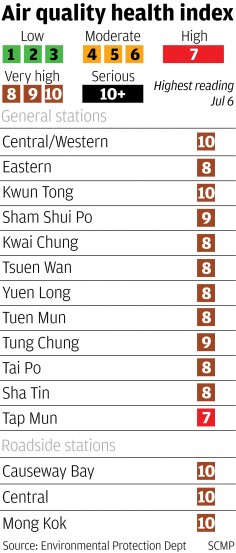
Hong Kong was shrouded in higher-than-normal pollution yesterday as “very high” levels were recorded across some of the busiest areas of the city.

Areas such as Central and Western District, Causeway Bay, Mong Kok and Kwun Tong recorded “very high” levels of 10 at intervals throughout the day.

The Environment Protection Department warned some districts could reach “serious” levels above 10, as a continental airstream closes in on the area, affecting the coastal areas of Guangdong.

air-quality-health-indexOut of the 15 monitoring stations across the city, 11 reached the “very high” level at 6pm, according to the department’s website. These stations recorded an index between 7 and 10.

However, the environment watchdog stopped short of confirming whether the choking condition was likely to continue today, as a spokesperson said the index was only reflective of a short timeframe.

The index, introduced in 2013, is an indicator of the short-term health impact pollutants have on people.

The watchdog warned the “very high” level meant children, the elderly and people with existing heart or respiratory illnesses were advised to reduce outdoor activities to a minimum or even avoid them.

Others, the department warned, were advised to stay out of areas with heavy traffic.

When the serious level is reached, those who are particularly vulnerable are advised to avoid all outdoor exposure, especially in areas with heavy traffic.

Despite uncertainties on the index levels, the weather conditions forecast over the next couple of days are expected to be more conducive to a continued high pollution level.

Chan Yan-chun, scientific officer of the Hong Kong Observatory said the city would be influenced by a dry continental airstream. “It will bring us hot, cloudy weather with haze and isolated showers,” he said.

The environmental watchdog said the airstream was likely to enhance the formation of ozone, while a light wind would facilitate the trapping of pollutants.

Meanwhile, tropical storm Linfa is gradually approaching the southern part of Taiwan and Chan said the Observatory would keep an eye on its movement in case it affected the region.

via Health warning issued as Hong Kong air pollution expected to hit ‘serious’ levels | South China Morning Post.

Posted in Air Quality, Asia, China | Tagged , , | Leave a comment

Transport fares discounted to reduce ozone pollution

The current heat wave has resulted in peak levels of ozone pollution. Certain Swiss cantons have announced discounted fares on public transport to encourage people to avoid using cars and thus reduce pollution.

In Geneva, all regional public transport services are discounted, and will remain so until the ozone level returns to an acceptable level, authorities revealed on Friday. For example, a second class day pass on the Geneva public transport system that costs CHF10 ($10.6) has now been reduced to CHF7.30. Similar measures have also been adopted by the neighbouring cantons of Vaud and Valais.

In recent days, the ozone levels have increased up to 260 micrograms per cubic metre compared to an acceptable level of 120 micrograms.

While ozone forms a protective layer in the upper atmosphere shielding us from harmful ultraviolet radiation, ground level ozone is a major pollutant and is responsible for respiratory illnesses. This “bad ozone” is formed when volatile organic compounds and nitrogen oxides from sources like vehicle emissions interact in the presence of heat and sunlight.

via Transport fares discounted to reduce ozone pollution – SWI swissinfo.ch.

Posted in Air Quality, Europe | Tagged , , , , | Leave a comment

London faces ‘secret pollution’ from refrigerated vans taking food to smaller stores

London’s residential neighbourhoods are being choked by “secret pollution” emitted by trucks delivering chilled food to the new generation of local supermarket convenience stores, according to a report.

Many of the hundreds of daily deliveries of fresh fruit, vegetables, meat and fish to the supermarkets are made by small lorries using diesel-powered transport refrigeration units (TRUs).

However, the largely unregulated motors that power them are belching out huge quantities of dangerous particulates and nitrogen dioxide gases, according to the study by London technology company Dearman.

Its research has found that TRUs give out 164 times more particulates — the microscopic sooty flakes that are a by-product of burning diesel —than a diesel car.

There are estimated to be 84,000 TRUs in Britain, many used by the big supermarkets and chains such as coffee shops that sell chilled food. Many home deliveries by the likes of Ocado and Tesco.com use vans with TRUs but these are usually run off the vehicle’s engine rather than a separate unit.

Dr Tim Fox, former head of energy and environment at the Institution of Mechanical Engineers, and a global ambassador to Dearman, said: “TRUs are hidden polluters that are coming into these residential areas and pumping out significant amounts of NOX and particulates.

Their use has increased as a result of the increased demand for chilled and frozen products and the increased interest in artisan and fresh food available locally. A lack of regulation has been a feature of this area of technology, they sweep in under the radar.”

Dearman, which has bases in Covent Garden and Croydon, is working on an alternative “clean” system using liquid nitrogen to chill food. It estimates that converting all TRUs to the zero-emission technology would take the equivalent of 5.5 million diesel cars and 500,000 trucks off the road.

via London faces ‘secret pollution’ from refrigerated vans taking food to smaller stores – London – News – London Evening Standard.

Posted in Air Quality, Europe, London, UK | Tagged , , , , , , | Leave a comment

Metro Vancouver issues air quality advisory due to smoke from wildfires

Metro Vancouver has issued an air quality advisory due to the fine particulates in smoke from wildfires that have invaded the region.

People with chronic medical conditions are being warned to avoid strenuous exercise or to stay inside.

Health officials say exposure is a particular concern for infants, the elderly and those who have lung or heart disease or diabetes.

Roger Quan, Metro Vancouver’s director of air quality said the region didn’t feel it was necessary to issue an advisory Sunday morning because the smoke was being held aloft.

But as the day progressed he said air turbulence picked up and there was more “vertical mixing.”

Similar concentrations of smoke were also being reported over Vancouver Island.

Those wishing to monitor changes in the air quality, can find real time readings at http://www.airmap.ca and http://www.bcairquality.ca.

What is fine particulate matter?

Fine particulate matter refers to airborne solid or liquid droplets with a diameter of 2.5 micrometres (μm) or less.

It is also known as PM2.5. PM2.5 concentrations tend to be highest around busy roads, industrial operations, major ports as well as areas with residential wood burning.

PM2.5 can easily penetrate indoors because of its small size.

Tips to reduce your personal health risk.

  • Avoid roads with heavy vehicle traffic and areas with wood smoke.
  • Stay cool and drink plenty of water.
  • Continue to manage medical conditions such as asthma, chronic respiratory disease and heart failure. If symptoms continue to be bothersome, seek medical attention
  • Stay in a cool, air-conditioned environment and reduce indoor sources of pollution such as smoking and vacuuming.
  • Run an air cleaner. Some room air cleaners, such as HEPA filters, can help reduce indoor particulate levels
  • Take shelter in air-conditioned buildings which have large indoor volumes and limited entry of outdoor air.

via Metro Vancouver issues air quality advisory due to smoke from wildfires – British Columbia – CBC News.

Posted in Air Quality, USA & Canada | Tagged , , , , | Leave a comment

Air quality here still ‘moderate’

The air quality has worsened slightly in Singapore and parts of Malaysia.

In Singapore, the three-hour Pollutant Standards Index (PSI) hit 79 at 12pm yesterday, up from 64 at 6am. As of 7pm, it was 67.

The 24-hour PSI reading – which the Government has said is a better indicator of whether people should worry about their health – also rose yesterday. At 7pm, it was 66-72 for the whole of Singapore, up from 58-62 at 12am.

A reading from 51 to 100 is in the moderate range, while a reading of 101 to 200 is considered unhealthy.

In Malaysia, the country’s Natural Resources and Environment Minister, G. Palanivel, said that places like the Klang Valley and Nilai had moderate air quality, due to small fires at local levels amid the hot and dry weather.

As of 11am yesterday, the Air Pollution Index for 15 areas recorded good air quality while another 31 areas had moderate air quality, he said in a statement.

“None of the areas recorded unhealthy air quality,” he said.

The Malaysian Meteorological Department said the hazy conditions in Malaysia might worsen in the next two months, if the dry season continues.

Recent observations also showed that Malaysia might encounter moderate transboundary haze if the heatwave continues.

Transboundary haze is the movement of haze from one country to another, explained Hisham Mohd Anip, a senior meteorologist from the department’s National Weather Centre.

He said there might be an increase in haze in Malaysia and neighbouring countries, even as far as north Australia, if the dry season progresses.

via Air quality here still ‘moderate’ , AsiaOne Singapore News.

Posted in Air Quality, Asia, Singapore | Tagged , , , | 1 Comment