US supreme court strikes down Obama’s EPA limits on mercury pollution

The US supreme court struck down new rules for America’s biggest air polluters on Monday, dealing a blow to the Obama administration’s efforts to set limits on the amount of mercury, arsenic and other toxins coal-fired power plants can spew into the air, lakes and rivers.

The 5-4 decision was a major setback to the Environmental Protection Agency (EPA), and could leave the agency more vulnerable to legal challenges to its other new carbon pollution rules, from industries and Republican-led states.

The justices embraced the arguments from the industry and 21 Republican-led states that the EPA rules were prohibitively expensive and amounted to government overreach.
But the EPA pointed out that most plants had already either complied or made plans to comply with the ruling.

“EPA is disappointed that the court did not uphold the rule, but this rule was issued more than three years ago, investments have been made and most plants are already well on their way to compliance,” the agency said in a statement obtained by Reuters.

According to data compiled by SNL Energy, many generators in the US complied with the mercury and toxics compliance, despite the possibility that the court would strike down the rule.

The data showed that 200 plants, or roughly 20% of the US generating capacity, were given up to an extra year to comply with the standards, mostly in order to finish installing mercury controls.

Plants moved ahead with compliance plans due to the long lead time for environmental control projects, SNL said. The compliance deadline fell in April of this year.

The EPA “remains committed to ensuring that appropriate standards are in place to protect the public from the significant amount of toxic emissions from coal and oil-fired electric utilities and continue reducing the toxic pollution from these facilities,” the agency added.

Monday’s decision, written by Justice Antonin Scalia, ruled that the EPA did not reasonably consider the cost factor when drafting the toxic air-pollution regulations.
The Clean Air Act had directed the EPA to create rules to regulate power plants for mercury and other toxic pollutants that were “appropriate and necessary”.

The agency had previously said it did not need to consider costs during that stage of the regulatory process. The agency estimated that the cost of its regulation to power plants would be $9.6bn a year, but it said that its analysis “played no role” in whether regulations were deemed “necessary and appropriate”.

The EPA also estimated that the rule would produce up to $37bn-$90bn in benefits and would prevent up to 11,000 premature deaths and 130,000 asthma cases each year.
The EPA rule took effect for some plants in April and was due to go into full effect by next year. In the meantime, the rule remains in effect, lawyers working on the case told Reuters. The ruling only concerns the cost consideration, so the EPA may try to write the rule again with cost in mind.
Scalia was joined in overturning the rule by the more conservative members of the bench, Chief Justice John Roberts, Clarence Thomas, Samuel Alito and Anthony Kennedy . The dissent, written by Elena Kagan, was supported by Ruth Bader Ginsburg, Stephen Breyer and Sonia Sotomayor.
In his majority opinion, Scalia called the EPA’s counterarguments “unpersuasive”.
In her dissent, Kagan said that the majority decision was “micromanaging” EPA’s rule-making, “based on little more than the word “appropriate”.
Kagan also said that the court’s invalidation of the EPA’s rule because the agency had not considered cost at the initial stage of the regulatory process was a “blinkered” assessment, considering the “subsequent times and ways EPA considered costs in deciding what any regulation would look like like”.

The landmark decision is the latest chapter in a two-decade-long effort to force stricter emissions standards for coal-fired power plants.

The regulation, adopted in 2012, would have affected about 600 coal-fired power plants across the country – many of which are concentrated in the midwest and the south.

It was already going into effect across the country. But Republican governors and power companies challenged the EPA’s authority, saying the agency had mishandled estimates of the cost of the new rules.

Monday’s decision was also a blow to years of local efforts to clean up dangerous air pollution.

The supreme court has now sent the case back to the Washington DC circuit court of appeals, which will ask the EPA to reconsider its rule-making. Activists are now urging the EPA to act definitively and quickly to issue revised regulation.

“The supreme court’s decision does not change the importance of EPA’s role in protecting our families and communities from toxic air pollution,” said Lisa Garcia of non-profit litigation group Earthjustice in a statement. “The court gave EPA the ability to finalize these critical public health protections once and for all. Now, EPA must act quickly. Thousands of lives are at stake.”

Political reaction was divided along party lines, in a week that has seen supreme court victories for liberals – on gay marriage – and conservatives – on the death penalty.

“Today’s supreme court decision represents a cutting rebuke to the administration’s callous attitude,” said Republican Senate majority leader Mitch McConnell. “The ruling serves as a critical reminder to every governor contemplating the administration’s demands to impose more regressive – and likely illegal – regulations that promise even more middle-class pain.”
Republican presidential candidate and Texas governor Rick Perry said Monday’s ruling “ends the false narrative that environmental protection can only be achieved through one-size-fits-all federal mandates and at the expense of economic growth.”
By contrast, Democratic senator Patrick Leahy, a ranking member of the Senate judiciary committee, said that there was nothing more “necessary and appropriate” than “curbing poisonous pollutants that the EPA estimates are responsible for thousands of early deaths, and tens of thousands more illnesses each year” and condemned the court for “letting corporate profits trump the public’s health”.
Democratic presidential candidate and former Maryland governor Martin O’Malley called the failure to limit poisonous toxins produced by power plants “a moral failure”. He said the court’s decision should reinforce “the need to transition to clean energy.”

The EPA and campaigners have argued that the public health costs posed by the toxic air pollutants outweighed those to utility companies forced to fit new control equipment.

Anna Aurilio, the Washington director of Environment America, said in a statement that the court’s decision “to let polluters off the hook is a huge setback for our kids’ health”.

Earthjustice said that the rules now invalidated by the court’s decision would have saved “between 4,000 and 11,000 lives each year by substantially reducing pollution from the dirtiest plants”.

In a statement, the group highlighted the fact that the court did not reject the key conclusions from the EPA, namely that power plants are “far and away the worst industrial polluters,” and controlling toxic emissions is “both technologically and economically feasible”.
Joseph O Minnott, chief counsel of the Clean Air Council, said his organization was “disappointed” by the court’s decision not to uphold the EPA rules, “which would bring many of the country’s oldest and dirtiest power plants in line with modern standards, and allow citizens to breath cleaner safer air”.
He added: “It is clear that the benefits to public health and the environment this rule would provide dwarf the costs of implementing it, no matter when in the determination those costs are considered.”

Michigan v EPA was the third recent test for the Obama administration’s environmental policies at the supreme court. In April 2014, the court endorsed the EPA’s efforts to deal with air pollution blowing across state lines in an important victory for Obama. In June 2014, the court largely upheld Obama’s plans to cut carbon pollution from power plants.

via US supreme court strikes down Obama’s EPA limits on mercury pollution | Environment | The Guardian.

Posted in Air Quality, USA & Canada | Tagged , , , | Leave a comment

The Terrifying Truth About Air Pollution and Dementia

“WE SHOULD GET out of here,” says air pollution chemist Eben Cross. At 7 a.m. on this cold November day the wind blows steadily through the Massachusetts Institute of Technology’s Cambridge campus, cutting through our thin jackets. But Cross isn’t afraid of the cold. He worries about the air we’re breathing—especially considering the six fire trucks directly ahead, idling in the dim morning light.

“We’re getting hammered right now,” Cross says, shouting over the hum of the engines. He’s taken his gloves off to manipulate the display panel on his pollution monitor. The acrid smell of diesel is unmistakable. “Anytime you can smell it, you are in a regime that is very polluted,” he says. “In many ways your nose is a better mass spectrometer than any device on the market.”

Cross’ monitor measures the presence of microscopic particles suspended in the air. Earlier, in his home, the device reported average concentrations of between 10,000 and 100,000 airborne particles per cubic centimeter of air (the latter after he burned some toast). Now it detects millions. The massive size of the fire trucks’ engines, combined with their inefficient combustion in cold weather, means that the air reaching us is replete with fine and ultrafine particles—specks of waste at least 36 times finer than a grain of sand, often riddled with toxic combinations of sulfate, nitrate and ammonium ions, hydrocarbons, and heavy metals. Though we have long known that these tiny particles cause and exacerbate respiratory problems—like asthma and infections and cancers of the lungs—they are also suspected to contribute to a diverse range of disorders, from heart disease to obesity. And now cutting-edge research suggests that these particles play a role in some of humanity’s most terrifying and mysterious illnesses: degenerative brain diseases.

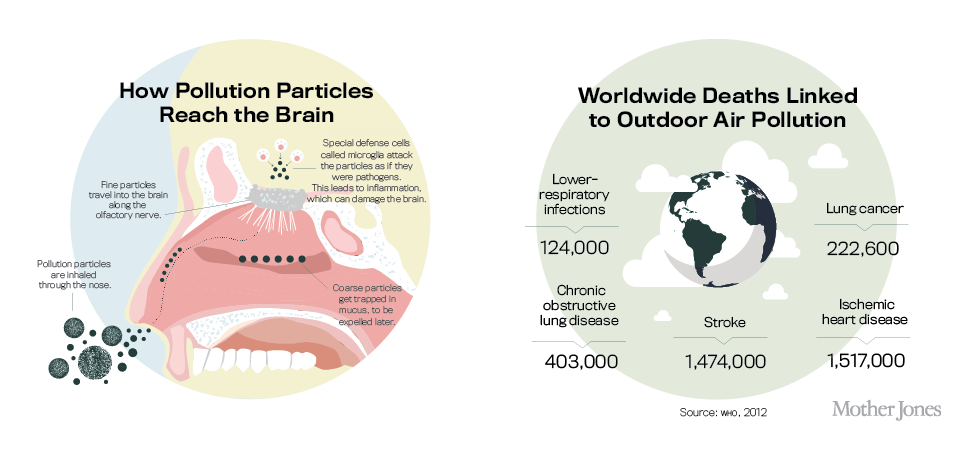
While coarse pollution particles seldom make it past our upper lungs, fine and ultrafine particles can travel from our nostrils along neural pathways directly into our brains. Once there, they can wreak a special havoc that appears to kick off or accelerate the downward spiral of degenerative diseases like Alzheimer’s and Parkinson’s. While much of the research is still preliminary, the findings so far are compelling. Autopsies of the brains of people who lived in highly contaminated areas have turned up traces of pollution and corresponding brain trauma. And among those still living, epidemiologists have recorded elevated rates of brain disease and accelerated mental decline.

All of this is especially scary when you consider how many people are at risk. Alzheimer’s and Parkinson’s already afflict 50 million people worldwide and about 6 million in the United States. In 2015, nearly 1 in 5 Medicare dollarswill be spent on Alzheimer’s; this disease and other types of dementia will cost the United States $226 billion. By 2050, experts predict, that cost will rise to $1.1 trillion—the baby boomers are only now entering the phase of life when degenerative diseases usually emerge. Because boomers were born before the improvements of the Clean Air Act, passed in 1970, they likely have had a greater lifetime exposure to air pollution than any other generation before or after them.

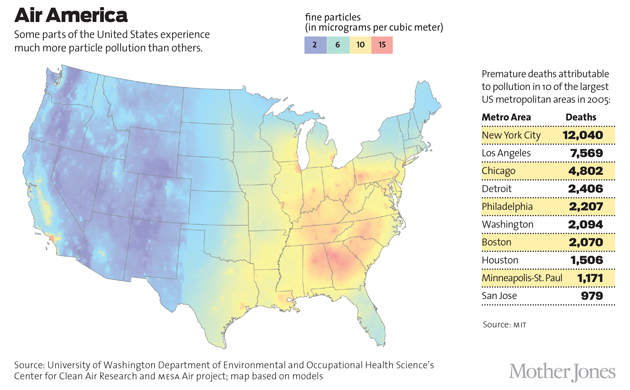
But although American air today is the cleanest it has been in four decades, pollution is still a major public health problem. According to estimates from the American Lung Association, more than 46 million Americans—about 15 percent of the US population—are chronically exposed to levels of particle pollution that exceed Environmental Protection Agency (EPA) standards, with a further 44.1 million plagued by periodic unhealthy exposures on bad air days or, as in parts of California, seasonal air pollution spikes. Meanwhile, in some Chinese and Indian cities, air pollution levels are routinely three to six times higher than World Health Organization standards. A recent study in the peer-reviewed journal Environmental Health and Technology estimated that we could avoid two million deaths globally by cleaning up the world’s air.
Air America

Researchers have struggled for decades to pinpoint the risk factors that, in addition to genetics, can contribute to a person’s likelihood of developing Alzheimer’s and Parkinson’s diseases; theories have ranged from viral infection to aluminum exposure to high-fat diets, but none of these has withstood scientific scrutiny. The research implicating air pollution is in its early stages, and many questions remain unanswered—for example, it’s unclear whether particle pollution initiates degenerative disease or merely accelerates it. Still, the evidence so far suggests that pollution could be the most pervasive potential cause of brain disease that scientists have ever discovered. We’re not “beyond a doubt,” says Michelle Block, a neurobiologist at the Indiana University School of Medicine, but “everything we do says this is probably happening.”

IN A SMALL ROOM on the third floor of a lab at the University of Southern California’s gerontology department, graduate student Nick Woodward shows me one front line in the global effort to understand the link between air pollution and brain disease: nine black mice in clear plastic cages. They are breathing highway exhaust, piped in by Woodward, that was gathered from the busy 110 freeway. Because of the heavy truck traffic on that road, the exhaust is especially rich in ultrafine particles laced with metals and hydrocarbons, in hundreds of combinations. To simulate life in a nearby neighborhood, Woodward explains, the mice will be exposed to exhaust for five hours a day, three days a week, until they are finally sacrificed and their organs examined for the presence of particles and disease.

This study and similar ones have their roots in Mexican research from the 1990s, when the United Nations had just deemed Mexico City one of the most polluted metropolitan areas on the planet. Even modern Beijing sees relatively clear skies 20 percent of the year—but in 1992, Mexico City air quality monitors recorded only eight smog-free days. By the early 2000s, researchers in Mexico City studying the effects of urban pollution on dogs, which live longer than mice and can be raised outdoors to approximate human exposures, began to discover unusual symptoms.

Dr. Lilian Calderón-Garcidueñas, lead investigator of the studies, noted that some dogs exposed to Mexico City air began to exhibit “decrements of attention and activity.” Caretakers of other dogs “were aware of alterations of sleep patterns and barking,” she wrote. Some “reported transient episodes during which the dogs failed to recognize [them].” Inside their brains, Calderón-Garcidueñas found dramatic tissue damage—the cells in the dogs’ olfactory-processing center were dying, with the scars of disease traceable out to the nose itself—that was strangely reminiscent of the damage that sometimes appears in an entirely different study population: Alzheimer’s and Parkinson’s patients.

Domesticated dogs have an exquisite sense of smell; they possess as many as 220 million olfactory neurons, while humans are thought to have between 5 million and 12 million. Dogs are also one of only a handful of animal species known to naturally develop Alzheimer’s-type dementia. What Calderón-Garcidueñas discovered more than a decade ago may prove to be the missing element in a long-standing theory of neurodegenerative disease origin. For reasons poorly understood, degenerative diseases like Alzheimer’s and Parkinson’s often reveal themselves in humans through early breakdowns in the olfactory system. Degenerative disease sufferers lose some of their sense of smell so predictably, and so long before more overt symptoms manifest, that doctors sometimes use smell tests as a diagnostic tool. As a result, many neurologists have long suspected that these disorders might be caused by foreign substances that we inhale through our noses. The most recent studies have looked at the most common of these substances: particle pollution.

In order to understand how exactly a particle travels from the nose to the brain, you’ll need a quick lesson in human respiratory anatomy. When you breathe in polluted air, particles enter your body through both your nose and your mouth. Large, coarse particles, like bits of windblown dust, are caught there and in your upper lungs and are eventually removed by coughing, sneezing, and nose running. Smaller particles can bypass these natural defense lines to reach your body’s more sensitive tissue. In the lungs, scientists have long known, they can embed and foster infection and cancer or pass directly into the bloodstream, where they create a host of dangerous byproducts that can circulate with the blood and cause damage to organs and bodily systems.

But particles that make it past your nose may be even more damaging. The lining of the human nasal cavity contains millions of specialized nerve cells that wave tens of millions of tiny hairs in a gel of mucus. These hairs detect inhaled chemicals and transmit information about them to the smell center of your brain, called the olfactory bulb. This is the process that allows you to tell, say, whether a carton of milk is spoiled. Your nasal nerve, whose hairs are exposed to the outside air in your nose, reaches all the way into your brain. This direct line allows your nose to communicate very quickly with your mind, an advantage in hunting, gathering, and predator avoidance. But it also makes us susceptible to pollution—particles entering your nose can actually travel along the olfactory neuron pathways from the nasal hairs right into the brain. In other words, as with cocaine, what you inhale through your nose can go straight to your brain.
pollution_graphics_960x230-02

Once in the brain, pollutant particles can directly kill or damage neurons if toxic metals or compounds are attached to them. But scientists now know that they can also cause more widespread damage by disrupting microglia, the brain’s unique army of immune cells. Microglia are the sentinels, bodyguards, and trash collectors of the brain. Among other things, they identify threats to brain health, from dead neurons to pathogens, and work collectively to neutralize and remove the offenders. When microglia encounter a pollution particle, they mistake it for a germ—with disastrous results.

Microglia in the presence of a particle produce a variety of chemical compounds meant to kill the interloper. The chemicals then accumulate and begin to damage or even kill surrounding cells. And the toxins attached to particles can corrupt the microglia, leaving them permanently in attack mode or otherwise unable to perform other important functions, like removing waste from the brain.

Researchers believe that chronic inflammation—the long-term overactivation of the body’s immune response—is harmful, even at very low levels. Studies have connected it to a broad range of illnesses; in the skeletal system, for example, it can cause the pain associated with arthritis, while in the gut it can lead to metabolic disorders such as diabetes. In the brain, chronic inflammation has been consistently implicated in neurological degeneration. This is, relatively speaking, old and established science. In scans and autopsies of patients with Alzheimer’s and Parkinson’s, highly active microglia are found in the regions of the brain that have lost the most neurons. And, in mice, scientists have actually observed the microglia killing neurons.

With air pollution, “there is indication that we are creating inflammatory responses that are in the direction of Alzheimer’s disease,” says Caleb Finch, a gerontologist who runs the lab that is studying pollution and mice at USC. If that assessment sounds overly cautious, it’s meant to: Researchers in the Alzheimer’s field are extremely wary of overstating the evidence. Still fresh are the memories of an aluminum scare in the mid-1980s, when preliminary studies linking aluminum in the brain to Alzheimer’s disease fed provocative news headlines and initiated needless hand-wringing over antiperspirants and cooking pans. Also, scientists now increasingly believe that it’s likely that no one environmental factor or trigger causes the disease; rather, “it’s probably a multiple hit,” says Indiana University’s Block. “It’s an assault across your entire lifetime that’s going to culminate with disease in age.”

Even so, of all the potential environmental drivers of degenerative disease, air pollution has by far the most promising scientific evidence behind it. “The longer I’ve been doing this research, the more I’m convinced that, most likely, urban air pollution is the most readily available source of microglial activation,” Block says. Jennifer Ailshire, a social demographer at USC, also sees growing evidence along these lines. It “just hardly ever happens,” she says, that human studies and animal models are in such strong agreement.

In epidemiology, one of the best ways to figure out what leads to a disease is the prospective study, in which scientists track patients over decades, monitoring their diet, lifestyle, exposures to toxins, and health outcomes. Several prospective studies on pollution’s effect on neurodegenerative diseases are underway, but we won’t know their results for decades. What we do have so far are retrospective epidemiological studies, which are kind of the opposite: Scientists study groups of older people with and without a given disease, comparing their life experiences, genetic factors, and environmental exposures. The problem with retrospective studies is that they rely heavily on subjects’ self-reporting, which is notoriously fallible; subjects probably wouldn’t be able to accurately recall, for example, how much time they’ve spent near an idling school bus. Another problem is inconsistent data. For example: Fine-particle levels in the United States have been regularly recorded for only the last 15 years, so epidemiologists often use proxy measures to estimate exposures from the distant past.

Pollution2_960

Still, evidence from retrospective studies is sobering. Controlling for things like ethnicity, gender, income, education, and other possible environmental exposures (including cigarette smoke), elderly individuals living in areas with polluted air appear to lose their mental abilities faster, show more predementia symptoms (also known as mild cognitive impairment), and develop Alzheimer’s disease at greater rates. Six years ago, researchers in Germany assessed the cognitive abilities of 399 elderly women who lived in the same place for more than 20 years. Regardless of her socioeconomic status, the closer a woman lived to a busy road, the authors reported, the greater the chance that she would have mild cognitive impairment.

Four years ago, researchers from Harvard linked estimates of higher daily exposure to black carbon, a solid type of fine particulate matter, to lower cognitive ability in older men in Boston. In a larger, national study tracking the mental status of more than 19,000 retired nurses over several years, researchers connected the rate of mental decline in women 70 and older to their exposure to coarse- and fine-particle pollution and found that those exposed to more particles lost their mental abilities at a faster rate. In a group of 95,690 elderly Taiwanese, researchers this year found that a slight increase in fine-particle exposure over 10 years led to a 138 percent increased risk of developing Alzheimer’s disease. A smaller, more recent study published in theAnnals of Neurology followed 1,403 elderly women without dementia. Scientists found that exposure to air pollution over time to led to a major decrease in the subjects’ white matter, a part of the brain essential for cognition.

So how much pollution might the brain be able to withstand? Unfortunately, that’s not yet clear. In the study from Taiwan, an increase in annual pollution exposure of four micrograms of particles per cubic meter of air—the additional amount you might experience within a block or two from a busy road—was sufficient to dramatically alter Alzheimer’s risk. But that was in addition to already high levels of pollution exposure, which were greater than anything you would routinely experience in America. In the nationwide study of retired US nurses, exposure to an additional 10 micrograms of fine particles per cubic meter of air per year over several years seemed to speed up damage to mental abilities “as if your brain were aged an extra two years,” says Rush University’sJennifer Weuve, the study’s lead author. That’s about the same increase in pollution you would experience if you moved from Beverly Hills to South Central Los Angeles.

And there is growing evidence that particle pollution’s assault on the mind is not limited to elderly brains. Researchers in Mexico City, which still has some of the worst urban air on the planet, have found signs of advanced brain damage in children as young as six and seven years old: overactive immune cells, degraded white matter, and damaged vasculature typically seen only in older brains. In one autopsy study comparing children raised in Mexico City with their counterparts in less polluted parts of the country, half the Mexico City children had notable aggregations of a protein called amyloid beta—which is strongly associated with Alzheimer’s—grouped in clumps across their brains. In the children from less polluted areas, there were none.

IN AMERICA, AS in most of the world, the burden of pollution does not fall evenly. Fine particles can travel thousands of miles through the air, but ultrafine particles drop out much sooner, typically after only a few thousand feet. This means that unless you live within a few miles of a coal-fired power plant or metal smelter, most of the ultrafine particles you breathe are probably from vehicles, particularly old diesel engines.

In our pass through Cambridge and then Boston, which has average air pollution levels for an American city, Cross detects numerous and dramatic ultrafine-particle pollution hot spots: bike lanes near highways where diesel clouds plague commuters for miles; schoolyards full of emissions from idling buses; apartments downwind of trucking routes. The worst places tend to be near busy roads; one EPA study found the concentration of ultrafine particles in Los Angeles to be 25 times greater near freeways than in the rest of the city.

Because pollution falls hardest near road traffic and crowded urban areas, people who are more likely to live there—the poor, the elderly, people of color—are disproportionately exposed to airborne neurotoxins. In 2014, researchers from the University of Minnesota found that minorities in the United States are exposed on average to 38 percent higher levels of air pollution than white people. (Though they looked at nitrogen dioxide, a nonparticle pollutant, their findings are indicative of traffic-related exposures.) In 2012, researchers from Yale matched census tracts to particle pollution data for areas around the continental United States. They found that “non-Hispanic blacks, the least educated, the unemployed, and those in poverty” suffered the highest pollution burden.

The good news is that air pollution is one of the United States’ greatest environmental success stories. Particle emissions have been dropping steadily since the 1970s, along with other pollutants governed by laws like the Clean Air Act. The EPA regulates levels of coarse- and fine-particle pollution, and two years ago it strengthened the national standards for fine particles. But there is still no regulation for ultrafine-particle pollution, here or in any other country. While the EPA did consider the new science implicating ultrafine particles in brain disease during its last review, an agency representative told me by email that there was “insufficient evidence to draw conclusions.” The agency has said that it will consider the new science on ultrafine particles in its current review, which is ongoing.

The quickest way to rid our cities of particle pollution would be by cleaning up diesel engines. That may be in the works; the Obama administration recentlyproposed much tougher emissions standards for trucks. Since 2007, the EPA has required new diesel buses and trucks to utilize cleaner-burning engines, but because diesel engines last 20 or 30 years, millions of the older ones are still on the roads. Beginning around 2000, California started requiring owners of old diesel vehicles—from Greyhounds to big rigs and school buses—to begin replacing their engines. But a significant number of old, dirty engines are still on the road—and in many parts of the United States, engine upgrades are not yet mandatory.

Another option to reduce exposure is to move away from hot spots. But as Columbia University epidemiologist Shakira Suglia points out, because the risk tends to be highest in poorer neighborhoods, the people with the worst exposures “simply don’t have the resources to move. The less you have, the harder it is to control what it is you are being exposed to.” Some public health advocates’ suggestions for people who can’t move—like telling them to stay indoors on the worst pollution days—can seem impractical, even cruel. Broader efforts, like limiting vehicle traffic through neighborhoods and building schools and nursing homes far from busy roads, could offer a measure of relief, as could the installation of expensive air filters. (A California law requires new schools to be built away from freeways or equipped with filters, but there are major loopholes. Meaningful improvement may be decades away even in places like Los Angeles—not to mention developing megacities like Beijing and New Delhi.)

Meanwhile, it’s worth noting that those who study brain disease and air pollution are taking matters into their own hands. Every time she moves to a new place, Weuve says she aims to live “at least 50 meters away from an interstate expressway, state highway, or truck route.” When USC’s Finch moved to Los Angeles, he “chose to live at as high an altitude as possible” in order to escape the pollution that clusters around the city’s low-lying highways. Last year, before their daughter was born, MIT’s Cross and his wife began looking for a new home for their young family. “Minimizing her exposure to roadside emissions is something that played into our decisions,” Cross says. For any potential home, proximity to a busy road “was a deal-breaker.”

via The Terrifying Truth About Air Pollution and Dementia | Mother Jones.

Posted in Air Quality, Health Effects of Air Pollution, Medical Studies | Tagged , , , , , , , , , , , , , | Leave a comment

Meet the conductor: London set to trial first all-electric doubledecker bus

The first fully electric London doubledecker bus will enter service in October, as transport authorities try to reduce the capital’s air pollution levels.

Transport for London said the Chinese-built bus would be the the world’s first purpose-built electric doubledecker.

Until now the battery technology has rendered electric doubledeckers too heavy and expensive, but TfL believes the latest development will be transformational for emissions and air quality.

Peter Hendy, London’s transport commissioner, said of the move to an electric fleet: “It’s essential because the air in your city isn’t clean enough. But it’s only going to be possible if the prices are affordable and the operating costs bearable.”

The buses will run on route 16, which operates between Cricklewood, north-west London, and Victoria station.

On Monday the capital joined dozens of cities around the world in committing to green vehicles, to give bus manufacturers confidence to develop and mass-produce the technology to make electric buses affordable.

At a global clean bus summit at City Hall in London, 24 cities pledged to roll out 40,000 low-emission buses by the end of the decade.

TfL promised that all new buses in London would comply with the ultra-low emission zone that comes into effect from 2020 – a tacit admission that the first hybrid Routemasters commissioned by the mayor, Boris Johnson, will breach the zone’s limits, and are more polluting than the vehicles that have now become available.

More singledecker electric buses will join the eight trialled in south London since 2013.

Johnson said London was a fitting place for the trials of electric doubledeckers, as electric buses had run on its streets more than a century ago, before the London Electrobus company collapsed in 1909.

As a cyclist, he said, he would welcome following an electric bus rather than “the throbbing, belching machines that emit their fumes like wounded war-elephants”.

Oxford Street, the main shopping thoroughfare which is a major bus artery through central London, was found by air quality experts at Kings College London to have some of the highest concentrations of nitrogen dioxide pollution in the world.

While TfL was claiming a world first, York has been running a converted electric doubledecker sightseeing bus on a battery since 2014.

via Meet the conductor: London set to trial first all-electric doubledecker bus | UK news | The Guardian.

Posted in Air Quality, Europe, London, UK | Tagged , , , , , , | Leave a comment

World pollutionwatch: Slow progress on the exhaust front

Travel the world and you will see many of the same types of lorries, buses and cars on the roads but what comes from their exhaust can be very different.

The US, Japan and Europe were the first to set limits on health-harmful exhaust. European limits began in 1992 and got progressively tighter; allowing technology to be developed and perfected. Much of the world is following Europe but Russia lags by around eight years and others such as India, China, Mexico and Australia have no plans to adopt the latest European standards. India has no regulations beyond 15-year-old European standards and China has no national schemes beyond Europe’s 2005 standards for buses and lorries.

European standards have not been a complete success; air pollution in European cities has hardly improved in the last decade and many cities are wrestling with nitrogen dioxide that is two to three times World Health Organisation guidelines. Much of this is due to vehicles passing “treadmill” laboratory tests and then emitting more pollution in real-world use, however, there are signs that the latest European standards might be more successful.

The International Council on Clean Transport argue that the rest of the world should leap straight to the latest EU standards, rather than wasting time with the steps that were less effective, saving an estimated 200,000 premature deaths per year by 2030, mostly in India and China. Avoiding growth of diesel-powered passenger cars is another lesson to be learnt from Europe. India is increasing diesel taxes for this very reason.

via World pollutionwatch: Slow progress on the exhaust front | Environment | The Guardian.

Posted in Air Quality, Asia, Australia & Oceania, China, Europe, India, Japan, Latin America, Mexico, USA & Canada, World News | Tagged , , , , , , , , , , , | Leave a comment

WHO Air Pollution Guidelines Could Save Millions Of Lives Every Year AnonHQ

According to a new paper, published in the journal Environmental Science & Technology, improving the air quality, in both heavily polluted and relatively clean areas, could save millions of lives every year.

The study’s aim was to determine how changes in outdoor air pollution levels would affect pollution related deaths, including heart attack, stroke, lung disease, lung cancer and respiratory infections. The World Health Organization (WHO) reported that “in 2012 around 7 million people died – one in eight of total global deaths – as a result of air pollution exposure.” For the study, a team of environmental engineering and public health researchers designed a model to measure the correlation of the airs pollution levels and related deaths.

“We’re a bit surprised at how much it matters to clean up air pollution, even in comparatively clean places like the U.S.,” lead author Joshua S. Apte of the Cockrell School of Engineering at The University of Texas, Austin, told weather.com. “The moral from the work that’s quite interesting is how large the health benefits of cleaning up air pollution are.”

It should also be noted that even if the quality of air was improved in just China and India alone, the percentage of worldwide air pollution related deaths would significantly reduce.

“A huge fraction of the global burden of disease for outdoor air pollution is from India and China alone,” he said. “If those two countries alone met the [World Health Organization] targets for outdoor air quality … worldwide [deaths] would be reduced by 70 percent.”

Deaths attributable to AAP in 2012, by disease

According to WHO, ambient air pollution alone caused 3.7 million deaths in 2012. In the past, Apte has examined air pollution in the developing world and its effects on our health. Yet, the new data has suggested that if developed countries followed the WHO suggested guideline of 10 mg per cubic meter, their populations could also reap the significant health benefits associated with cleaner air.

Today, the Environmental Protection Agency mandates a standard of 12 mg per cubic meter; however, evidence has shown that even air pollution at much lower levels than this standard still harms the health of the population.

We need to know what the health effects are at truly clean levels,” he said.

Although the results don’t have a practical application as of yet, they have confirmed that if we are to improve the health of the population, and the planet as a whole, the quality of the air must be significantly improved.

The other thing we need to take into account are what are the strategies that are economically feasible to achieve cleaner air,” Apte said. “What’s the least-cost, fastest way to get toward better and better outdoor air quality?


via WHO Air Pollution Guidelines Could Save Millions Of Lives Every Year AnonHQ.

Posted in Air Quality, Health Effects of Air Pollution | Tagged , , , , | Leave a comment

Brussels restricts cars, but ‘not enough’

Boulevard Anspach runs through the Brussels’ city centre. Its broad lanes are filled with snarling traffic. It is noisy and dirty. It feels like cars and people are in competition. Pedestrian crossings exist but drivers give the impression that stopping is an optional extra.

The scene will become an anachronism on Monday (29 June) in some parts of the city, when new rules come into force which will reduce the places downtown where cars will be allowed.

In the week before, banners could be seen near the city’s stock exchange that said the “pedestrian [is] king”.

The area where cars are banned in the EU capital will increase from 28 to 50 hectares, making what the municipal government said is the largest pedestrian zone in Europe.

“The main reason is to make the centre more attractive”, Marc Daniels, a spokesperson for the municipality’s transport alderwoman, told this website.

“We found that much of the traffic going through the centre was north-south transit traffic, which led to traffic jams and pollution”, he added.

Daniels noted that the city government expects more people to switch to public transport, bikes, or walking.

However, not everyone is convinced of the success of the new “circulation plan”, which will be evaluated after an eight-month test phase.

“We’ll see after the summer”, said Reynold Leclercq, co-founder of the comic book shop Bruesel. A large part of the Boulevard Anspach in front of his shop will be closed to traffic.

“We’re not in Barcelona. Half of the year it’s cold and raining”, he added, on Brussels’ pedestrianisation hopes.

Leclercq fears for people’s personal safety on the city centre’s large, empty streets. He also thinks he’ll lose customers.

The plan has also been criticised, but for other reasons, by the Brussels-based European Cyclists’ Federation (ECF).

“It will do something to improve air quality, but not enough because the plan does not reduce car traffic around the pedestrian area”, ECF’s urban mobility officer Benedicte Swennen told this website.

According to a recent ECF report, the impact on air pollution of introducing car-free streets is limited if not complemented by other measures.

“As for those measures directed at reducing the demand for car use, the most relevant were congestion-charging schemes, low-emission zones, parking rationing and increasing vehicle costs”, its report noted.

Since 2005, Brussels has not been able to lower the amount of particulate matter – which causes major health problems – in the air to meet levels required by EU limits.

On 18 June, the EU commission referred Belgium, as well as Bulgaria, to the European Union’s Court of Justice for its failure to meet the targets.

Although the local government wants to make Brussels “more breathable for its inhabitants”, Daniels stressed that it alone cannot solve the air pollution problem.

“Let’s be realistic, all of Western Europe suffers from particulate matter”, the spokesperson said.

One reason why the car is such a popular means of transport in Brussels, and the entire country, is that the government gives tax breaks for companies that want to give employees cars as part of their salary.

Last year, OECD economist Michelle Harding found that among its 34 member countries, Belgium gives the highest fiscal incentives for employers on company cars.

The average subsidy per company car is €1,600 per year, but it’s €2,763 in Belgium.

But that, Daniels said, is not something the local government of Brussels can do anything about.

via Brussels restricts cars, but ‘not enough’.

Posted in Air Quality, Europe | Tagged , , | Leave a comment

Poland: Europe’s most polluted country in trouble with the EU but still won’t clean up coal

After ten years of extreme pollution that shows no sign of abating, the European Commission has told Poland to clean up its air or else it’ll be taken to the EU Court of Justice.

Poland’s air pollution causes around 43,000 premature deaths a year, but the government – beholden to fossil fuel interests – refuses to curb coal-fired emissions.

The proposal designed to satisfy the Commission overlooks coal pollution, focusing instead on tackling transport and household emissions, Energydesk has learned.

Admittedly, cars and home furnaces produce the bulk of the country’s very visible PM10 pollution, but industry and energy are also significant contributors and even moreso of the toxic particulate PM2.5.

Pollution from coal-fired power plants kills 5,300 people a year in Poland —  way more than in any other country in Europe.

Speaking to Energydesk, the Commission said it is vital that Poland both reduces its high-stack emissions (those that come from coal plants) and makes its smog-drive legally binding  — which we’re pretty sure it doesn’t plan on doing.

Screen Shot 2015-06-26 at 14.09.53Breached annual EU air pollution limits in March

It took just three months for Warsaw, Krakow and a crop of other large Polish cities to exceed the EU’s air pollution allowance for the entire year.

By the end of March, these six cities had each recorded more than 50 micrograms of fine dust particles (PM10) per square metre on at least 35 different days.

Inhalation of PM10 particles can cause respiratory and cardiovascular health problems.

Poland, home to 6 of the 10 most polluted cities in Europe, was warned in February over its continued failure to address its pollution problem — and given two months to formulate a plan.

In its statement, the Commission said the maximum daily air pollution limits were being exceeded in 36 zones, and yearly limits breached in 12.

“The Commission believes that Poland has failed to take appropriate measures that should have been in place since 2005 to protect citizens’ health, and is asking for forward-looking, speedy and effective action.”

It’s now been three months, and so Energydesk spoke to the Commission about the stage of infringement proceedings, and whether Poland’s proposal is enough to avoid taking the matter to the EU Court of Justice.

A spokesperson for the Commission said proceedings remain at the point of “additional reasoned opinion” and that “the case may yet go to Court” — not all the zones have implemented the measures.

The Commission wouldn’t divulge details of Poland’s plans, but said the EU requires that it both be legally binding and that, in addition to fumes from transport and households, high-stack emissions are tackled.

Energydesk, however, understands that the Polish government has no plans to curb the high-stack, and that its proposal will simply empower local and regional authorities to crackdown on low-stack — basically, it would not be legally binding.

Environment Minister Maciej Grabowski earlier this year said: “This program has no legal force by definition. It is not a magic wand by which in a short time – a year or two – we will breathe clean air.”

A Commission spokesperson recently told the Gazeta Wyborcza: “There are constant infringements and Poland isn’t doing anything about it”.

Screen-Shot-2015-06-24-at-20.02.46

Prime Minister Ewa Kopacz has catchily called 2015 ‘the year of improving air quality,’ and so it appears only now are Polish politicians cottoning on to just how much damage the country’s extreme air pollution is doing.

But household emissions and pollution from vehicles are the only targets in this would-be clean air campaign.

And it’s true that Poland has shocking levels of low-stack, with residents burning cheap and poor-quality coal in similarly cheap and poor quality furnaces. Of the country’s primary pollution, 42% comes from households, and 19% comes from vehicles.

But industry and energy production together account for 24% of primary pollution, and are likely to be behind even more secondary pollution (though there’s just not enough data to say for certain).

And high-stack sectors contribute more PM2.5 than they do PM10, which – because it’s smaller and can more easily get into the lungs – is even more dangerous.

Polish politics is pretty much controlled by coal interests, since it produces 90% of the country’s energy and employs so many of its people, so the government would prefer not to enforce higher standards, or appear to be criticising the sector at all.

Weak targets hide the extent of Poland’s pollution

In its statement, the Commission said it would also be investigating reports that Poland has been exceeding limits on nitrogen oxide.

It’s possible that nothing will turn up; the EEA just a weeks ago gave Poland a perfect score on NOx and several other emissions all the while scolding Germany, Austria and handful of other countries.

And it doesn’t look bad at first glance, with Germany failing to meet its NOx target, which roughly the same as Poland’s. But the graph below shows absolute emissions, not per capita. Germany is more than twice the size of Poland so naturally it needs more energy, and burns more coal.

Also look at the trends. As Germany has cut its NOx emissions in half since 1990, Poland has cut its by less than 50%.

Screen-Shot-2015-06-24-at-19.06.14

Poland is trying hard to make sure it doesn’t need to improve its power sector emissions, with its BREF delegation – half comprised of people paid by industry – pushing hard to water down future EU pollution regulations.

The leading political opposition party – Law & Justice – this week said it would fight to get an opt-out of EU climate targets.

So on coal pollution, it appears as though both sides of the Polish parliament are on the same page.

via Poland: Europe’s most polluted country in trouble with the EU but still won’t clean up coal – Energydesk.

Posted in Air Quality, Europe, Germany, Poland | Tagged , , , , , , , | Leave a comment

European air pollution exceeds legal limits

The human toll for poor air quality is worse than for road traffic accidents, with air pollution responsible for more than 400,000 premature deaths in the EU each year. (Source: European Environment Agency – EEA). Read on to find out what France is doing about it.

Europeans do enjoy cleaner water and air and less waste is sent to landfill sights but, according to the latest EEA’s five-yearly report ‘The European Environment – state and outlook 2015 (SOER 2015),  Europe remains a long way from achieving the objective of ‘living well within the limits of the planet’ by 2050, as set out in the 7th Environment Action Programme.

Each Member State of the EU has individual air pollutant emission limits or ‘ceilings’, which they are not supposed to exceed or break. The limits are set for the most common and harmful chemicals – to humans and the environment – including sulphur dioxide (SO2), nitrogen oxides (NOx), ammonia (NH3) and non-methane volatile organic compounds (NMVOC).

However, ten Member States did exceed at least one limit, according to the latest data collected in 2013 by the EEA, and Germany exceeded three of the four limits – the only country to do so.

Austria, Belgium, France, Germany, Ireland and Luxembourg – exceeded their NOx emission ceilings in all years from 2010-2013.

In 2013, Germany and France reported the highest excess of NOx limits with 218 kilotonnes and 180 kilotonnes, respectively. In percentage terms, Luxembourg (41%) and Austria (32%) exceeded their NOx emission ceilings by the greatest amount in 2013.

Ammonia (NH3) levels were also breached by Austria, Denmark, Finland, Germany, Netherlands and Spain for four years running (2010-2013). Sulphur ceilings were not exceeded by any Member States.

What’s producing so much nitrogen oxide?

Emissions from road transport is the biggest reason for the increasing NOx levels. The increase in the number of diesel-engine cars is partly to blame (diesel engines produce more NOx than petrol engines) but also because actual engines produce more emissions than the laboratory simulators used to create the controls.

Reducing air pollution in France

In an effort to control car emissions, the French government will be introducing a new car control scheme in 2016. Every car will carry a colour-coded sticker numbered 1 to 6, classifying the car according to age of the car and emissions of polluting gases and particles.

The colour coding will be part of a scheme called Crit’Air. The idea is to reward owners of cars that do not pollute rather than penalise those with cars that do pollute.

Owners of low or non-polluting cars will:

  • Have access to favourable parking arrangement
  • Be given privileged driving conditions
  • Will be allowed to drive in restricted traffic zones

CritAirElectric vehicles, will carry a blue sticker and will not have a number as they do not emit pollutants and therefore will not be controlled.

The certificate and sticker will go into operation on 1 January, 2016. It will be available online and will be free for the first six months (after that there will be a €5 fee). More details will be made available towards the end of 2015.

A similar scheme to the Crit’Air sticker scheme is already in operation in Germany, Denmark, Sweden, Italy, Austria and the Czech Republic.

via European air pollution exceeds legal limits | AngloINFO World: Expat Life.

Posted in Air Quality, Europe, France, Germany | Tagged , , , , , , , , , , , , , , , , , , , | Leave a comment