Respro® Masks FAQ: Can I Wash The Filter?

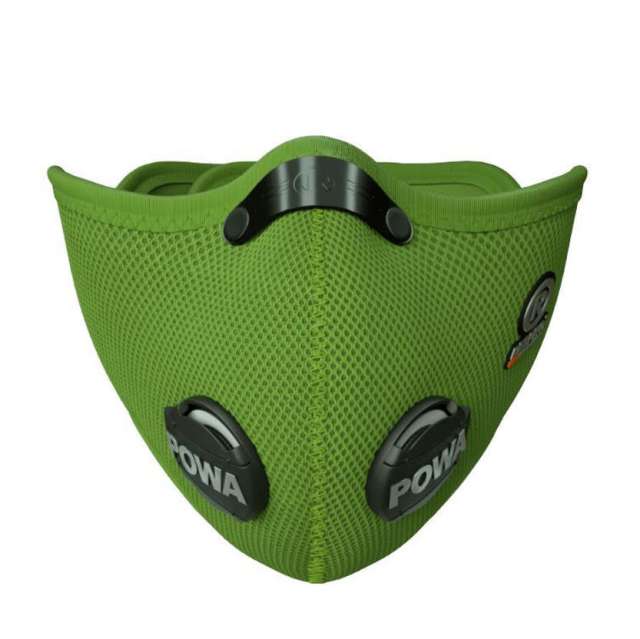
FILTER IN MASKThe filter material may be washed, but ordinarily we recommend ‘hand washing’. Machine washing can be somewhat vigorous which can abraid the material by being washed with other garments. Some washing powders also contain fragrance additives which the filter will certainly pick up.

The best procedure now would be to follow our washing guide and hopefully your filter will still be useable.

WASHING INSTRUCTIONS:

To ensure good hygiene/care measures we suggest that you place the filter and valves in a pan of freshly boiled water (remove pan from heat source before putting filter in) and let it cool down. Remove the filter unit from the water and allow to stand dry.
This procedure will remove facial oils that may build up over a period of continuous use and will also remove some of the particulates and organic vapour that will be present within the Charcoal structure of the filter or tissue salt build in the valves.

If the mask cover requires washing this should be done by carefully removing the filter assembly and then washing the outer casing in warm soapy water and then left to dry naturally (not forced by means of heaters and driers).

For more Frequently Asked Questions go to respro.com

Posted in Air Quality | Tagged | Leave a comment

Many European countries’ air pollutant emissions above legal limits

Air pollutant emissions in the EU continue to exceed legal limits, according to a report from the European Environment Agency (EEA) published today. Preliminary data for 2013 shows that ten EU Member States exceeded one or more of their emission ceilings for key pollutants.

Under the National Emission Ceilings (NEC) Directive, EU Member States have individual air pollutant emission limits, or ‘ceilings’, for sulphur dioxide (SO2), nitrogen oxides (NOx), ammonia (NH3) and non-methane volatile organic compounds (NMVOC). As of 2010, Member States should not have exceeded their emission ceilings, but the EEA report ‘NEC Directive status report 2014’, which includes preliminary data for 2013 and summarises data for 2010-12, confirms that a number of countries did so for these years.

The four pollutants addressed in the directive harm human health and the environment, causing respiratory illnesses, acidifying soil and surface waters, and damaging vegetation.

Key findings

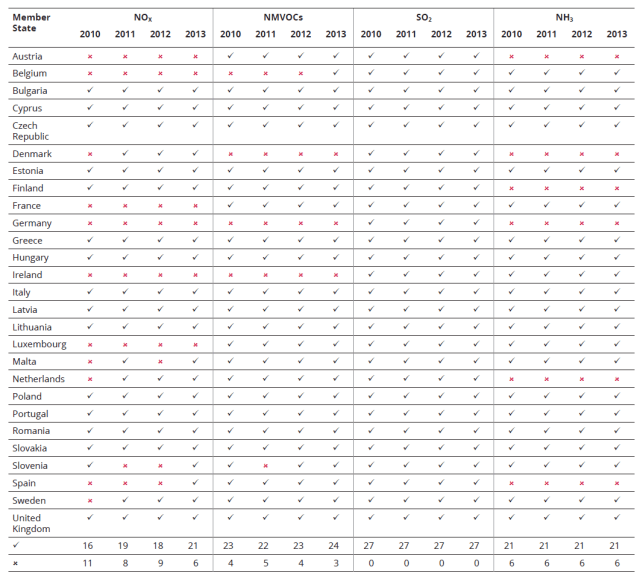
Ten Member States exceeded at least one ceiling in 2013. Germany was the only country that exceeded three of the four emission ceilings (NOx, NMVOCs and NH3), while Austria (NOx and NH3), Denmark (NMVOCs and NH3) and Ireland (NOx and NMVOCs) exceeded two ceilings in 2013.

The following six Member States – Austria, Belgium, France, Germany, Ireland and Luxembourg – exceeded their NOx emission ceilings in all years from 2010-2013. In 2013, Germany and France reported the highest exceedances of NOx limits with 218 kilotonnes and 180 kilotonnes, respectively. In percentage terms, Luxembourg (41%) and Austria (32%) exceeded their NOx emission ceilings by the greatest amount in 2013.

Emissions from road transport is one of the main reasons for the large number of NOx exceedances. NOx reductions from the road transport sector have been lower than originally anticipated over the last two decades, partly because transport has grown more than expected, and partly owing to the increased number of diesel vehicles producing higher NOx emissions than petrol-fuelled vehicles.

Six Member States also have persistent problems meeting their national emission limits for NH3. Austria, Denmark, Finland, Germany, Netherlands and Spain all breached the ceilings for four years running (2010-13).

Almost 95% of NH3 emissions stem from agriculture, mainly from the use of fertilisers and the handling of animal manure. NH3 emissions have decreased since 1990, but not to the same extent as the other pollutants covered by the NEC Directive.

The ceilings for sulphur dioxide (SO2) emissions were not exceeded by any Member State between 2010 and 2013.

NEC directive executive summary

‘v’ indicates that the emission ceiling has been attained; ‘x’ indicates the ceiling has not been attained.
Years 2010, 2011 and 2012: final data; year 2013: provisional data.
Under the Gothenburg Protocol, inventory adjustment applications for emissions from Germany (for NOX) and Denmark (for NH3) were accepted by the EMEP Steering Body in 2014. However, emission data reported under the NECD used in this report are unadjusted.

via Many European countries’ air pollutant emissions above legal limits — European Environment Agency (EEA).

Posted in Air Quality, Europe, France, Germany, Spain, UK | Tagged , , , , , , , , , , , , , , , , | Leave a comment

South Korea reports seventh death from MERS virus

South Korea’s health ministry said on Tuesday a patient infected with the Middle East Respiratory Syndrome (MERS) virus has died, becoming the seventh fatality in an outbreak that began in May.

The ministry said there were eight new cases of MERS, bringing the total to 95 but falling from 23 daily new cases reported on Monday.

South Korean President Park Geun-hye said the progress of MERS, which has been spreading in South Korea since last month when a businessman brought it home from a Middle East trip, had to be halted, a day after authorities began using mobile phones to trace people who violate quarantine.

Most of the disease’s approximately 445 fatalities have been in the Middle East but memories are fresh in Asia of Severe Acute Respiratory Syndrome (SARS), which emerged in 2002-2003 and killed about 800 people worldwide.

MERS is caused by a coronavirus from the same family as the one that caused SARS.

The World Health Organisation (WHO) has not recommended travel restrictions and its director-general, Margaret Chan, said she believed South Korea would be able to control the spread. But alarm is growing and about 25,000 people cancelled trips to South Korea between Jun 5 and Jun 7, the Korean Tourism Organisation said.

MERS

Hong Kong raised its response level to “serious”, from “alert” on its three-level system. The third is “emergency”. The “serious” level means tighter controls at points of entry to Hong Kong, greater coordination between authorities and swifter test results for suspected cases.

“The Department of Health advises the public to avoid unnecessary travel to Korea, in particular, those with chronic illnesses,” Hong Kong’s Centre for Health Protection said. “Travellers in Korea and the Middle-East should avoid unnecessary visit to healthcare facilities.”

All known South Korean infections have taken place in health facilities, where it is common for family and friends to make lengthy visits, sometimes staying around the clock to care for a sick relative.

CUTTING LINKS

Malaysia has advised its nationals to avoid South Korea while Singapore has postponed or cancelled school trips.

In China, airports stepped up monitoring and authorities have asked airlines to report any passengers with high temperatures. Vietnam and Cambodia ordered heightened screening of arrivals from South Korea.

South Korea has closed nearly 2,000 schools and put about 2,500 people, who may have had contact with MERS patients, under quarantine, some in hospitals but most at home.

“The focus of our effort is to completely verify the route of infection and completely cut off the links and to stop all additional contacts,” Park said at the health ministry.

The outbreak is adding pressure for an interest rate cut in South Korea, possibly as soon as the central bank’s next policy meeting this week.

“The effect from MERS on private consumption cannot be overlooked as spending and tourism are quickly shrinking,” Park said during a visit to the MERS response headquarters. “Minimising the economic impact of the disease and overcoming it has to be part of eradicating the MERS outbreak.”

The outbreak could inflict a US$2 billion hit on South Korea, according to Barclays, or 0.14 per cent of its forecast for 2015 output, with hotels and restaurants among sectors most affected.

Despite the new cases, the Health Ministry said the first big wave of infections traced to a hospital in the city of Pyeongtaek, which has been shut, seemed to have run its course, with no new infections among the latest batch.

A team of WHO experts is due to evaluate the response to the outbreak and advise on further measures.

via South Korea reports seventh death from MERS virus – Channel NewsAsia.

Posted in Air Quality, Asia, China, Singapore, South Korea, Vietnam | Tagged , , , , , , , , , | Leave a comment

Mers South Korea: WHO says more cases anticipated

South Korea’s outbreak of Middle East Respiratory Syndrome is “large and complex” and more cases are expected, World Health Organization experts say.

But while it was premature to declare the outbreak over, the WHO said it had “found no evidence” of the Mers virus spreading wider in the community.

About 140 people have been infected since the start of the outbreak last month. Fourteen are known to have died.

Experts also urged the South Korean government to stay vigilant.

Middle East Respiratory Syndrome (Mers)

Mers is caused by a new type of coronavirus, a type of virus which includes the common cold and Sars (severe acute respiratory syndrome).
First cases emerged in the Middle East in 2012, and the first death in Saudi Arabia in June that year.
It is not known for certain how it is transmitted. It is possible the virus is spread in droplets when an infected person coughs or sneezes.
Patients have a fever, cough and breathing difficulties, but Mers can also cause pneumonia and kidney failure.
Approximately 36% of reported patients with Mers have died – there is no vaccine or specific treatment.

Speaking in Seoul after a week-long investigation, the WHO’s Keiji Fukuda said: “Because the outbreak has been large and is complex, more cases should be anticipated.”

He added: “At present the mission has found no evidence that there is ongoing transmission within the community.”

All of South Korea’s cases have been linked to health facilities, but the WHO urged the government to continue to maintain strong control measures, thoroughly tracing infected people’s contacts and preventing suspected patients from travelling.

A number of factors may have contributed to the spread of the disease in South Korea so far, the WHO said, including:

Overcrowded emergency rooms and hospital wards
The habit of “doctor shopping” – visiting several facilities for the same complaint
Doctors unfamiliar with the disease
About 2,900 schools were closed and 3,680 people were isolated as of Friday after possible contacts with those infected.

Earlier this week, South Korea’s central bank cut interest rates to a record low in a move seen as an attempt to stem the economic fallout from the outbreak in Asia’s fourth largest economy, which was first reported last last month.

The outbreak is the largest outside Saudi Arabia, where the disease was first identified in humans in 2012.

via Mers South Korea: WHO says more cases anticipated – BBC News.

Posted in Air Quality, Asia, South Korea | Tagged , , , | Leave a comment

Unhealthy air quality forecast Thursday and Friday

Air pollution is forecast Thursday to reach unhealthy levels for sensitive groups, including children, the elderly, and people with asthma, heart disease or lung disease.

The Maryland Department of the Environment has issued a “Code Orange” alert across the Baltimore and Washington, D.C., regions. Ozone, a pollutant created by reactions between chemicals emitted by cars and industrial facilities, is the chief concern.

Meanwhile, smoke from wildfires in Canada has been drifting across the region, adding to the pollution.

The heat and sunshine coupled with calm winds tend to make air pollution worse. Partly cloudy skies and highs in the lower 90s are forecast Thursday. Some afternoon storms are possible, and could improve air quality.

More poor air quality is possible Friday, according to MDE. Clean Air Partners, a nonprofit air quality advocacy group, is forecasting another “Code Orange” day Friday.

Ozone is a natural compound present in upper levels of the atmosphere and consisting of three oxygen atoms. But when it is created near the ground, by chemicals interacting in the presence of sunlight, it can contribute to smog and reduce lung function and irritate lung tissue, according to the Environmental Protection Agency.

via Unhealthy air quality forecast Thursday and Friday – Baltimore Sun.

Posted in Air Quality, USA & Canada | Tagged , , , | Leave a comment

Chile’s Copa América: Pollution worries hang in the air

As South America’s football heroes jet into Chile for the Copa América, a dark cloud is hanging over two host cities where air pollution alerts are worrying organizers and fans.

With just days to go to the continental championship which kicks off Thursday, an “environmental emergency” was declared in host city Temuco and a “pre-emergency” in the capital Santiago, where the hosts will face Ecuador in the opening match. (See the full schedule here.)

Both cities have some of the worst air pollution in Latin America.

Santiago, a city of six million people, sits in an enclosed valley with limited wind and little rain to wash away the contamination generated by its vehicles and its bustling industrial sector.

Temuco, a city of 250,000 people some 700 kilometers (400 miles) to the south, relies heavily on wood-burning stoves for heat during the Southern Hemisphere winter, often leaving a smoky layer of particles hanging in the air.

Both are alarming Copa organizers, who have scheduled eight matches in Santiago, including the July 4 final, and three in Temuco.

Last week authorities in Santiago ordered a day of extraordinary anti-smog measures for Friday, keeping more than 300,000 vehicles off the roads and nearly 800 factories closed.

Under the so-called “pre-emergency,” city officials also suspended physical education classes at schools and recommended citizens refrain from outdoor athletic activities because of concerns over the effects of breathing the contaminated air while exercising.

Temuco declared an emergency two weeks ago because of air pollution — its second this year. Santiago has declared 10 environmental alerts since the beginning of the year.

But Santiago governor Claudio Orrego vowed the Copa América schedule will not be disrupted.

“We’ve spoken with the authorities and if there’s one thing we can’t do it’s suspend a match,” he told AFP.

Performance concerns 

Chile introduced tighter restrictions on air pollution levels this year, meaning even more alerts and emergencies will likely be declared.

The aim is to reduce the health impact on adults and especially children. A government study in 2014 found that 4,000 people a year die prematurely of cardiopulmonary diseases linked to air pollution.

Other studies have shown significant increases in respiratory diseases such as chronic bronchitis, pneumonia and asthma linked to air pollution in Santiago.

For football fans, the more immediate concern is that stars like Lionel Messi of Argentina and James Rodríguez of Colombia will not be in top form if they play under a blanket of smog, especially coming off a long and tiring club season.

For footballers competing at the highest level, exposure to high levels of air pollution can affect performance, researchers say.

“Smog and contamination don’t just affect health, they affect athletic performance,” said sports medicine specialist Luis Maya.

Maya, who trains popular Chilean club Colo-Colo, said practice sessions are an even bigger concern than matches because they generally take place during the day and last longer, exposing players to more pollution.

“There’s no doubt that there is a small decrease in physical performance caused by contamination,” he said. “It could have an effect. Not a big one, but in the details.”

via Chile’s Copa América: Pollution worries hang in the air -The Tico Times.

Posted in Air Quality, Chile, Latin America | Tagged , , , , | Leave a comment

Czech air pollution among worst in EU

The quality of air in the Czech Republic lags behind the average of the EU mainly due to the emissions of greenhouse gases which are the fifth worst in the EU, daily Lidove noviny (LN) writes yesterday.

“An improvement in international comparison is a long-distance race,” Environment Minister Richard Brabec (ANO) has said in a discussion staged in the Czech Senate, LN writes.

Hans Bruyninckx, Executive Director of the European Environment Agency, unveiled the results of the latest report on the environment in the Senate, it adds.

Eurostat data reveal that the Czech Republic is the fifth worst source of greenhouse gases pollution in the EU, LN writes.

The overall average total greenhouse gases emissions are about nine tonnes of carbon dioxide per inhabitant, but the figure stands at almost 13 tonnes in the Czech Republic.

With regard to water quality, the situation is almost the same as the content of nitrates in Czech waters is one of the highest in the EU, LN writes.

Czechs should also improve their position in the proportion of energy generated from sustainable sources and the recycling rate, it adds.

Although progress has been achieved in both spheres in recent years, the Czech Republic is still lagging behind some Western countries of the EU, LN writes.

Roughly one-third of municipal refuse is recycled, while the proportion is all but double in Germany, Austria and Belgium, it adds.

On the other hand, the Czech Republic has the fifth lowest production of waste, LN writes.

“After the 1989 overthrow of the Communist regime, the state of the environment was disastrous. Since then, we have seen a remarkable improvement,” Brabec said.

However, low air quality is a surviving problem plaguing most the Czech Republic, LN writes.

“There has been a long-standing fall in the emissions, but the quality of air is not improving,” Brabec said.

The Moravia-Silesia Region and large towns are most hit by air pollution, LN writes.

In 2013, emission limit values were exceeded in more than one-third of the Czech Republic’s area, it adds.

This was largely due to transport, industry and emissions from local fireplaces, LN writes.

Exposure to dust particles in particular strongly affects the health, it adds.

According to the estimates by the National Institute of Public Health, it may have caused up to 5,500 premature deaths in 2012 alone, LN writes.

However, a Eurobarometer poll conducted in 2012 has revealed that environmental protection is no priority for most Czechs, it adds.

A mere 17 percent of Czechs consider it important, as against the European average of 21 percent, LN writes.

via Poll: Czech air pollution among worst in EU | Prague Monitor.

Posted in Air Quality, Europe | Tagged , , , | Leave a comment

Far away forest fires make skies hazy over Winnipeg

The hazy sky over Winnipeg Monday is courtesy dozens of forest fires burning hundreds of kilometers away.

There are at least two “hot spots” in Northern Manitoba, with another 20-plus forest fires burning in Saskatchewan.

The Air Quality Health Index put the air quality at 5 Monday afternoon, which means the health risk is moderate. Those with pre-existing health conditions such as asthma or chronic obstructive pulmonary disease are advised to cancel strenuous activities.

Manitoba Conservation collects air samples at several locations in Winnipeg and Brandon and then analyze them for pollutants like ground-level ozone, particulate matter and nitrogen dioxide. Forest fires and wind can increase the levels of particulate matter.

Brian Asher, an air quality analyst with Manitoba Conservation, particulate matter, is often present in smoke from forest fires.

“It gets really deep in your lungs, and when it gets deep in your lungs, it can have more of an impact on your health,” said Asher, who takes the data collected and passes it on to Environment Canada.

The weather agency put out an air quality statement about the haze shortly after noon Monday.

“Air quality may decrease at times, especially in areas closer to the Saskatchewan border, which may see locally poor visibility and air quality readings today into this evening,” the statement said.

The smoke is expected to disperse overnight but may redevelop Tuesday afternoon and into the evening as northwest winds redevelop, Environment Canada said.

Communities affected by the statement as of noon are:

  • Winnipeg
  • Portage la Prairie, Headingley, Brunkild, Carman
  • Steinbach, St. Adolphe, Dominion City, Vita, Richer
  • Morden, Winkler, Altona, Emerson, Morris
  • Selkirk, Gimli, Stonewall, Woodlands, Eriksdale
  • Dugald, Beausejour, Grand Beach
  • Bissett, Nopiming Provincial Park, Pine Falls
  • Whiteshell, Lac du Bonnet, Pinawa
  • Sprague, Northwest Angle Provincial Forest
  • Grand Rapids
  • Arborg, Hecla, Fisher River, Gypsumville, Ashern
  • Dauphin, Roblin, Winnipegosis
  • Minnedosa, Neepawa, Russell, Riding Mountain National Park
  • Ste. Rose, McCreary, Alonsa, Gladstone
  • The Pas, Wanless, Westray, Clearwater Lake Provincial Park
  • Swan River, Duck Mountain, Porcupine Provincial Forest
  • Flin Flon, Cranberry Portage, Snow Lake
  • Berens River, Little Grand Rapids, Bloodvein, Atikaki
  • Norway House, Cross Lake, Wabowden
  • Poplar River

via Far away forest fires make skies hazy over Winnipeg – Winnipeg | Globalnews.ca.

Posted in Air Quality, USA & Canada | Tagged , , , , | Leave a comment