A No Brainer: Strengthen Air Quality Standards Now

Does your kid have learning problems? Does he have problems concentrating and he is easily distracted? Is he doing poorly in school?

There can be a host of reasons for these problems. But a recent study is confirming the notion that pollution coming from fossil fuels, such as gasoline and coal, can inflict lasting damage on the human brain development, especially in fetuses, babies and toddlers, and that we Latinos are disproportionally affected by it.

The report –published by JAMA Psychiatry and originated by Columbia University– concludes that exposure to polycyclic aromatic hydrocarbons (PAH), a residue of fossil fuel combustion, is correlated to the reduction of white matter in the brain.

“Those disturbances in brain growth are in turn proportionately associated with cognitive slowing and a host of behavioral disturbances,” says Dr. Bradley Peterson, the study’s lead scientist and director of the Institute for the Developing Mind at Children’s Hospital in Los Angeles.

These include attention deficit disorder and hyperactivity, typical symptoms of impulsive children and children with learning problems.

Latino and African-American families, two social groups disproportionally impacted by air pollution, participated in the study from 1997 to 2006. Researchers observed a key finding in children: the greater the exposure to PAHs in the womb was, the greater the reduction in white matter and the worse their behavioral and developmental problems later in life.

“It is logical to hypothesize that these disturbances contribute to poor academic and high school dropouts, but that hypothesis would need to be addressed specifically in a larger study that explicitly assessed academic performance and school dropout, which we did not do in our study,” says Dr. Peterson. “But I do agree that something serious must be done to tackle the problem of the effects that air pollution has on the developing brain.”

The study also revealed that the brain disturbances not only take place during the fetal period, but also that exposure to PAHs can aggravate the reduction of white matter in the early childhood.

Dr. Peterson is not optimistic about reversing the damage caused by fossil fuel pollution on the brain.

“At the present time we know of no interventions that can prevent or reverse the brain and behavioral effects of exposure to air pollution during fetal development and early childhood,” he says. “The only recommendation that can be made at this time is either to find ways of reducing exposure in pregnant women and young children to levels of air pollution that already exist or to reducing extant levels of air pollution.”

But that reduction, for us Latinos, is not materializing. In its recent 2015 State of the Air report, the American Lung Association again underscored that the vast majority of the country’s cities with the worst air quality are found in Southern and Central California, where tens of millions of Latinos live. In places like Los Angeles, Long Beach, Bakersfield and the San Joaquin Valley all too often breathing is dangerous to your health.

The EPA is currently considering improving the federal smog pollution standard from its current 75 parts per billion (ppb) to perhaps 65 ppb. But health experts insist that in order to truly protect public health, the standard should be no higher than 60 ppb.

Asked whether his study reinforces the notion that clean air standards must be stronger, Dr. Peterson is categorical: “Yes, our findings do reinforce that notion. And they reinforce it for the most vulnerable members of our society, young children.”

Clearly, this is a no brainer: the EPA has the moral obligation to truly strengthen the nation’s air quality standards.

via A No Brainer: Strengthen Air Quality Standards Now | Javier Sierra.

Posted in Air Quality, Health Effects of Air Pollution | Tagged , , | Leave a comment

Pollutionwatch: A deadline missed, with deadly consequences

April’s Supreme Court ruling on air quality means that the government must make new plans to meet European Limits for nitrogen dioxide. These limits were set in 1998 to be achieved by 2010, giving us 12 years. Not only have we missed the deadline but some of our biggest cities are still over 15 years away from attainment.

So how did this happen?

Scientists first warned that policies were not on track in 2003 when nitrogen dioxide alongside London’s Marylebone Road stopped going down and instead increased by 25%. Increases were then found alongside other roads. Instead of devising new policies government continued to rely on the promise of future technological improvements to diesel exhausts that have still not delivered in real-world driving conditions. This is in stark contrast to the successful clean up of exhausts from petrol cars.

Over the last 15 years a huge growth in the proportion of diesel vehicles on our roads has compounded the problem. Today, the locations with greatest nitrogen dioxide are close to major roads in urban centres, especially in locations that are dominated by diesel traffic, including the buses, taxis and delivery vehicles that make our cities work. Unlike rural motorways these roads teem with people and are lined with homes, shops and schools. The solutions will not be easy, but attaining the limits is not just a legal exercise. During the last five years researchers have shown stronger links between nitrogen dioxide and respiratory health.

Whatever the solutions put forward, one clear lesson is that feedbacks are essential to make sure that our future plans remain on track.

via Pollutionwatch: A deadline missed, with deadly consequences | Environment | The Guardian.

Posted in Air Quality, Europe, London, UK | Tagged , , , , | Leave a comment

8 air pollutants destroying the atmosphere

Back in school, you’ll have learned that the air in our atmosphere is composed primarily of nitrogen, at 78%, and oxygen, at 21%, with a number of other trace gases.

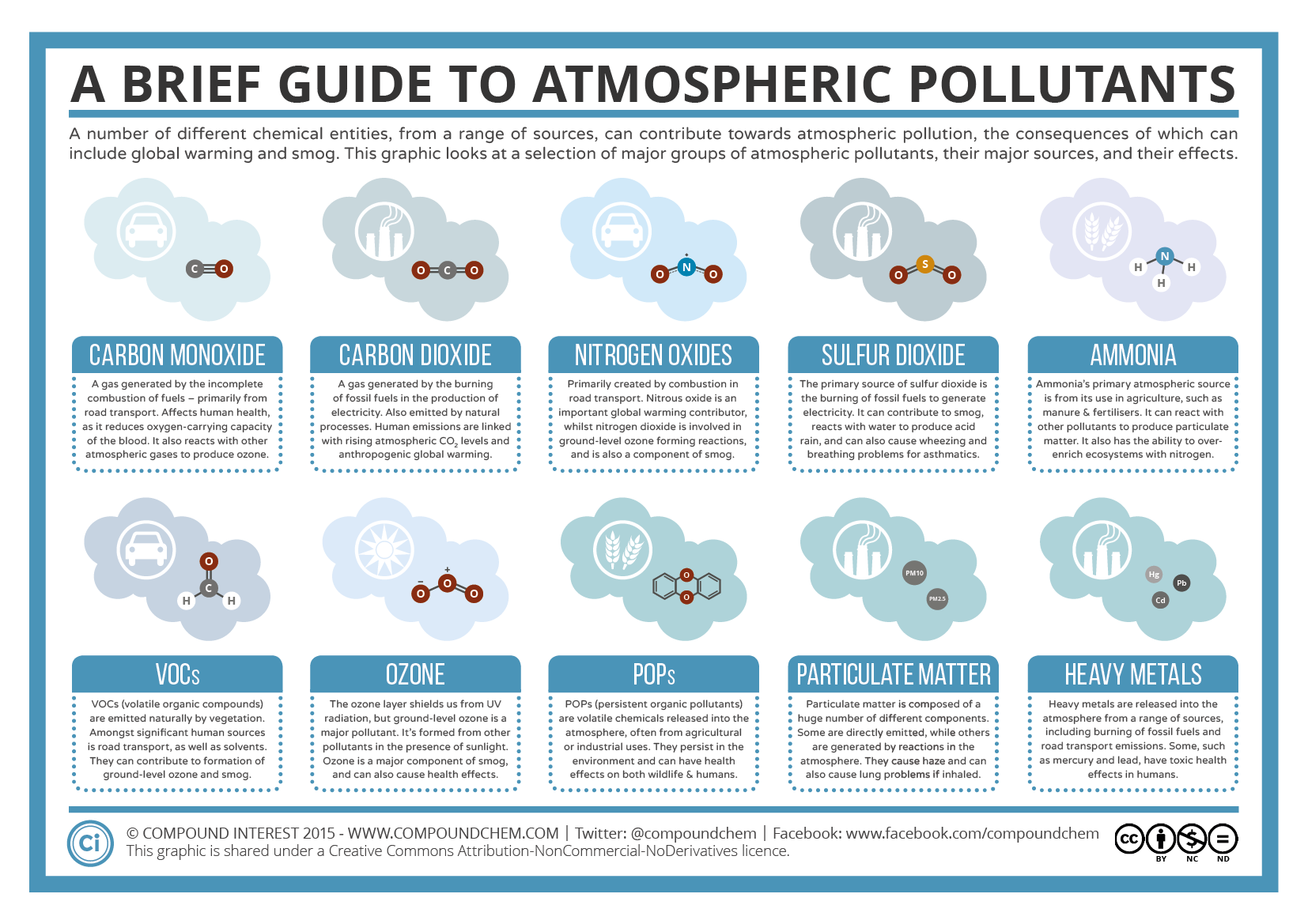
It’s to these trace gases we’re looking today – more specifically, at how human activity can result in the release of air pollution in to the atmosphere. Here, we examine a number of different chemical compounds that contribute to atmospheric pollution, their specific sources, and their effects.

It’ll come as no surprise to learn that one of the primary sources of atmospheric pollutants is our continued reliance on the burning of fossil fuels for a large proportion of our electrical energy.

Carbon dioxide, also produced by natural processes, is the obvious gas produced in this case, produced as a combustion product. However, other pollutants are also produced. Sulfur dioxide is formed as a result of the sulfur impurities in coal and oil, whilst particulate matter and heavy metals can also be released.

Another obvious source of pollutant release is that of vehicle emissions. Pollutants from road transport again include carbon dioxide, but also include carbon monoxide, as well as nitrogen oxides, formed by direct combination of nitrogen and oxygen in combustion engines.

The purpose of catalytic converters in cars is to try and remove nitrogen oxides, and carbon monoxide, converting the majority of them into less harmful gases. Cars have also previously been a large contributor to heavy metal pollution, as a consequence of the use of leaded petrol, though this is no longer used in many countries.

The agricultural industry is another that contributes pollutants to the atmosphere. Some of this is a consequence of the use of manure and fertilisers, which can release ammonia, whilst some chemicals used as pesticides can also wind up in the atmosphere – these are known as persistent organic pollutants (POPs). POPs can also be generated in industrial processes; for example, waste incineration can lead to the production of dioxins.

The effects of these different pollutants are varied. Carbon dioxide’s effects have already been extensively documented elsewhere, of course – there’s an excellent NASA site detailing the evidence linking it to anthropogenic global warming here – so we’ll instead focus on the other pollutants detailed.

Carbon monoxide’s effects are also well known – it’s a gas that, in sufficient quantity, can cause toxic effects and death in humans. If we breathe it in, it binds strongly to the haemoglobin in our red blood cells, diminishing the oxygen-carrying capacity of our blood. From the perspective of atmospheric pollution, it’s one of the handful of gases that can react with other atmospheric chemicals to help form ground-level ozone.

Ozone might not immediately spring to mind as a pollutant. After all, it’s present in the higher levels of our atmosphere, and this ozone layer helps shield us from harmful UV radiation. However, ground-level ozone is an entirely different prospect. It is a major component of the smog that occasionally plagues areas of the globe, and can also cause health effects such as irritation, coughing, and chest pains.

Ground-level ozone isn’t directly generated by human activities. However, it can be produced as a result of the reactions of different human pollutants in the atmosphere. Primarily, the reactions of nitrogen oxides with volatile organic compounds, in the presence of sunlight, can produce ozone. These volatile organic compounds (VOCs) can have a range of human sources, but are also produced naturally by vegetation, and other natural processes. VOCs can additionally undergo other reactions with nitrogen oxides to form peroxyacyl nitrates, respiratory and eye irritants present in smog.

Particulate matter in the atmosphere can also be a factor in smog. This matter can be composed of a huge number of chemical entities, and is generally split into three categories: coarse particles, with a diameter between 10 and 2.5 micrometres; fine particles, smaller than 2.5 micrometres; and ultra-fine particles, smaller than 0.1 micrometres.

As well as contributing to smog, some of these particles have been linked with human health effects, as the smallest can be breathed deep into the lungs.

Some particulate matter is directly emitted, for example as a result of fossil fuel combustion. Others are generated in the atmosphere from reactions between different atmospheric species.

One other atmospheric pollutant that can contribute to the formation of particulate matter is ammonia. Released from manure and fertilisers in agricultural settings, ammonia can react with other pollutants, producing these tiny particles. Ammonia can also have other effects, such as eutrophication. This is when soil or water becomes over-enriched with nitrogen, causing over-promotion of growth, a particular issue in aquatic environments.

A final environmental effect that pollutants can have is the production of acid rain. This is primarily a consequence of sulfur dioxide emissions, though nitrogen oxides can also contribute. They can react with water in the atmosphere, in the case of sulfur dioxide producing sulfurous acid as an intermediate, which can then react further with oxygen to form sulfuric acid. This can cause acidification of aquatic environments, as well as corrosion of some building materials.

It’s clear then, that there are a wide range of atmospheric pollutants – so what are we doing to combat them?

A number of environmental agencies worldwide have identified six ‘criteria pollutants’, which are regulated, and measures of which can be used to gauge air quality. These are carbon monoxide, lead, nitrogen dioxide, lead, particulate matter, and sulfur dioxide. There are broad regulations and limits in place to try and reduce the release of these pollutants; however, some countries have failed to meet these emission limits. Just last week, the UK was criticised for failing to meet nitrogen dioxide emissions below required levels.

With that said, progress is certainly being made in some cases. Emissions of lead have been significantly reduced by the removal of tetraethyl lead from petrol, and sulfur dioxide emissions have also been reduced by stricter controls on the sulfur content of fuels. Innovations such as the introduction of catalytic converters into cars have also reduced emissions of nitrogen oxides – however, this has been offset to an extent by increasing numbers of vehicles on the roads.

There are still plenty of challenges to reduce levels of atmospheric pollutants, but hopefully, with greater awareness, we can continue to work on reducing their levels and preventing the associated effects on the environment and our health.
brief-guide-to-atmospheric-pollutants

via 8 air pollutants destroying the atmosphere – Business Insider.

Posted in Air Quality | Tagged , , , , , , , , , , | Leave a comment

Town Hall must act quickly to combat ‘illegal’ air pollution, say cycle campaigners

CYCLING campaigners have called on the Town Hall to take immediate steps to reduce motor traffic in a bid to combat “illegal” levels of air pollution.

Islington Cyclists’ Action Group (ICAG), which carried out research with the activist lawyer group ClientEarth in November of last year, has found that more than half of roads surveyed in the south of the borough had levels of nitrogen dioxide (NO2) concentration far higher than considered safe. NO2, a constituent of exhaust emissions, is widely linked to respiratory and heart problems.

ICAG installed diffusion tubes on 30 lampposts across the south of the borough. The tubes were analysed by scientists at University College London who found that pollution is at its worse in the south of the borough, especially in busy roads such as Clerkenwell Road and Old Street.

The campaigners say that filtering motoring traffic at key places would improve air quality and road safety.

Andrea Casalotti, of ICAG, said: “We found that pollution is highest on arterial roads, around 60 per cent above the legal limit, and around 40 per cent higher in quieter roads that are used as rat-runs. If those are closed to motor traffic, the quality of life for people living in and walking and travelling through these roads would improve.”

Examples of the “rat run” roads Mr Casalotti suggested should be closed to cars and lorries include the southern end of St John Street and Lloyd Baker Street in Clerkenwell.

He added: “It is reckless that the council seeks to promote cycling on roads with illegal levels of air pollution.”

Green Party campaigner Ben Hickey told the Tribune: “I live on Clerkenwell Road, which has been measured to have NO2 concentration levels 50 per cent over the legal ­limit. I breathe that air in when I’m at home.

“The council, the Mayor and city planners must act now to reduce the traffic on these main roads. Surely it’s simpler and cheaper to prevent pollution-related illness through better traffic planning than to treat it?”

The cyclists’ call comes after the Supreme Court, the country’s highest legislative body, declared the UK’s levels of nitrogen-dioxide pollution a “danger to public health” last week.

The council, which last year secured £2million from Transport for London to improve cycling routes, said it is committed to improving air quality in Islington. A spokeswoman pointed to initiatives to cut emissions, including the introduction of a diesel surcharge to encourage a move to less-polluting vehicles, and said the authority is lobbying TfL to upgrade all buses that run through Islington to hybrid or zero-emission vehicles.

She added: “Closing roads limits the routes for resident drivers and other motorists and can increase traffic on other residential streets, but we are supporting other environmental improvements to major roads in the borough.”

via Town Hall must act quickly to combat ‘illegal’ air pollution, say cycle campaigners | Islington Tribune.

Posted in Air Quality, Europe, London, UK | Tagged , , , , | Leave a comment

Respro® Masks FAQ: What filters do I need for the X-treme™ masks?

What filters do I need for the X-treme™ masks?

Essentially the filters in the X-treme™ function in the same way as the City™ and Sportsta™ filters do. The X-treme™ mask for sports utilises the particulate filtration ability of the Sportsta™ and the X-treme™ mask for urban use, uses activated carbon as its filtration medium.

For more Frequently Asked Questions,  go to Respro® Mask FAQ

Posted in Air Quality | Tagged | Leave a comment

Air pollution: Not breathing easy

BRITISH air is much clearer than it once was: in 1952 one “pea souper” smog in London (see photo) caused the deaths of around 4,000 people in a week. But it is not as clean as it could be. On April 29th the Supreme Court ordered the next government to come up with a plan by the end of the year to reduce the amount of nitrogen dioxide (NO{-2}), a noxious gas produced by diesel engines, in the atmosphere. The judgment could have big implications for several large infrastructure projects. It also suggests how, after years of campaigning by greener types, dirty air is finally becoming a political issue.

Britain has long been exceeding limits set by the European Union on air pollution. In 2014 the Department for Environment, Food and Rural Affairs reported that, in the previous year, annual mean limits for NO{-2} had been breached in 38 out of 43 sites. Certain roads in London, such as Oxford Street, a busy shopping thoroughfare, have seen some of the highest recorded measures of NO{-2} in Europe.

The health effects of NO{-2} have not yet been calculated for Britain, but are thought to be as potentially damaging as fine man-made particulate matter, says Gary Fuller of King’s College London. A report from a government advisory group in 2010 estimated that, if all fine particulate matter (which is mostly caused by car fumes and the wear and tear of tyres on the road) were removed from the atmosphere, it would increase the average life expectancy of those born in 2008 by six months—and for those born in London by nine months.

Despite the mounting evidence of the harmful effects of dirty air, there has been little political desire to get it sorted. Responsibility for cleaning up air pollution falls over several different government departments, and may require unpopular decisions to be made about raising taxes or increasing environmental burdens on car companies. And around a third of the dirty air in Britain is swept across from Europe. Politicians could often skirt the issue by pointing out that it was a Europe-wide problem. But the ruling by the Supreme Court “takes political will out of the equation,” says Alan Andrews of ClientEarth, the group of environmental lawyers who brought the case to the Supreme Court. The government will have to clear up the air within the next decade or so, regardless of costs.

However, in the next few months Sir Howard Davies, the leader of an independent Airports Commission, is expected to issue a recommendation on where to expand airport capacity in the south-east. The court ruling adds a “potential black mark” to the case for expanding either Heathrow or Gatwick, Sir Howard’s two potential options, says Matthew Farrow, the executive director of the Environmental Industries Commission, an industry group. Levels of NO{-2} are already above recommended levels around Heathrow, which is next to a busy motorway, and are expected to rise at Gatwick even without another runway. It could also delay plans for a new bridge in East London.

This means the next government will have to make some swift decisions about clearing up Britain’s dirty air, by introducing several “low-emission zones” to reduce the number of diesel cars and the like. Measures to cut air pollution have been taken before. In 1956, after the smog in London, the government pushed through a Clean Air Act, banning coal fires in people’s homes. That decision was prompted by a crisis. The reasons for pushing through this reform may appear to be less dramatic, but they are no less important.

via Air pollution: Not breathing easy | The Economist.

Posted in Air Quality, Europe, London, UK | Tagged , , , , , , , , , | Leave a comment

What’s in Your Air?

Take a deep breath. Hold it. Now, release. Breathing is an amazing bodily function, one that is fundamental to life and an act that we do both automatically and conscientiously. Though we are acutely aware of changes in our breathing—too fast, too shallow, too loud—most people give little thought to what is in the air we breathe.

With an estimated 3.4 million deaths annually attributed to outdoor air pollution, this lack of awareness is concerning. To better understand the linkages between air quality and human heath, a group of the world’s leading scientists convened by the Environmental Performance Index at Yale University came together to review the latest science on air pollution and explore how the next generation of air quality indicators can be made more useful for policy purposes.

Linking scientific data to policies to improve air quality is hard to do. One reason is that it is difficult to attribute ambient air pollution to specific sources of pollution. For example, forecasting for ozone requires complex scientific modeling, making it difficult to attribute to regional or global sources. Measuring how pollutants change over space and time is also tricky, especially when it comes to understanding how air pollution moves across cities and within neighborhoods. Depending upon where you live, air quality data may not be available in real time (if they’re available at all, see this interactive map we put together showing availability of reported air quality data to the World Health Organization). More often than not, especially in developing countries, data are reported in yearly smoothed-out averages and can obscure daily spikes from human activity (rush hour, for example) that most impact health.

To better understand these linkages, the scientists focused on some of the most deadly air pollutants, including ozone and particulate matter (PM), which cause respiratory illness, and persistent organic pollutants (POPs) and mercury, which affect human health through food chains and degrade ecosystems. These pollutants are caused by urbanization and industrialization, and are, for the most part, naked to the human eye. Most of these pollutants are not regularly monitored in most of the world, particularly in areas that are urbanizing and developing the fastest. Not enough attention is given to advocating for stricter monitoring and clean-up of these pollutants.

Although there is a plethora of ongoing research on air pollution, these data are not collected and communicated in a meaningful way for policy-makers to take much needed action. For example, air quality indices that are used to communicate health exposures to PM or ozone do not tell a city mayor what sources are largely responsible for the pollution. Should the mayor tackle emissions arising from motor vehicles, or should environmental ministries mandate better scrubbers on power plants? The available indicators generated from ground-based monitoring stations do not link to the sources of pollution, making action challenging.

Another common problem we found across each indicator is the need for more and better data. However, many countries lack the capacity or financial resources to install and maintain costly ground-based monitoring stations or networks. Here’s where the data revolution, low-cost environmental sensors, and improved mobile technology can allow for crowd-sourced data to help fill in some of the data gaps, especially in developing countries that are in “information-poor.”

At the same time, we must make sure that people are aware of air pollution issues that affect their everyday lives, which is why we developed the interactive data visualization above to raise awareness about air pollution and the need for new indicators to measure air quality. The aim of these interactive data visualizations, produced by a team of student designers and programmers, is to help educate people about the air we breathe by answering key questions: Where do air pollutants come from? What are the risks and impacts? How do we measure these factors? And, what do we do to address data gaps?

Ultimately, the goal is to help policy-makers make better decisions about air quality as it relates to important drivers such as agriculture, land use change, urban form, and economic growth. Check out the interactive to learn more about what is in the air, how it affects your health, and what can be done to achieve the ‘next generation’ indicators for policy action.

To view the interactive on the website of Yale’s Environmental Performance Index click here.

via What’s in Your Air? [Interactive] | Guest Blog, Scientific American Blog Network.

Posted in Air Quality | Tagged , , , , | Leave a comment

Respro® Masks FAQ: Why is the Cinqro™ mask more expensive than the other masks?

RESPRO® CINQRO™ MASK

The Cinqro™ package incorporates a complete mask fitted with a Hepa-Type particle filter for filtering submicron particles like diesel smoke. A spare DACC chemical/particle filter is also supplied as part of the package allowing filter interchangeability.

For improved air flow and comfortability, two Powa Elite™ valves are included with the Cinqro™ mask. They improve air flow characteristics when breathing out at elevated breathing patterns. This equates to less back pressure, less dampness in the filter, improved filtration, lower inhalation resistance all of which result in improved comfort and performance.

A graphics rebuild for the look of the mask fits it squarely in the sports arena rather than the ‘scare the hell out of everyone’ arena.

Cinqro™ = mask + 2 filters + Powa Elite™ valves + graphics = value for money

For more FAQ visit Respro® masks FAQ

Posted in Air Quality | Tagged | Leave a comment