Respro® Masks FAQ: Can the mask be washed?

Can the mask be washed?

It is recommended that you wash the neoprene shell of the mask every month under normal use. To do this it is necessary to remove the filter and the valve first. Although spare valves and filters are available from your retailer, please be careful not to misplace any of the components during maintenance.

Place the filter and valves in a pan of freshly boiled water (remove pan from heat source before putting filter in) and let it cool down. Remove filter unit and allow to stand dry.

This will remove facial oils that may build up over a period of continuous use and ensure that it is hygienically clean. This procedure will also remove some of the particulates and organic vapour that will be present within the Charcoal structure of the filter or tissue salt build in the valves.

If the mask cover (shell) requires washing this should be done by carefully removing the filter assembly and then washing it in warm soapy water and then left to dry naturally.

For more FAQ,  see Respro® Mask FAQ or visit our YouTube channel youtube.com/ResproMasks

All Respro® products are available from our website respro.com

Respro® will ship your order to anywhere on the planet free of charge.

Posted in Air Quality | Tagged | Leave a comment

Documentary on Air Pollution Grips China

Millions of Chinese, riveted and outraged, watched a 104-minute documentary video over the weekend that begins with a slight woman in jeans and a white blouse walking on to a stage dimly lit in blue. As an audience looks on somberly, the woman, Chai Jing, displays a graph of brown-red peaks with occasional troughs.

“This was the PM 2.5 curve for Beijing in January 2013, when there were 25 days of smog in that one month,” explains Ms. Chai, a former Chinese television reporter, referring to a widely used gauge of air pollution. Back then, she says, she paid little attention to the smog engulfing much of China and affecting 600 million people, even as her work took her to places where the air was acrid with fumes and dust.

“But,” Ms. Chai says with a pause, “when I returned to Beijing, I learned that I was pregnant.”

She has said her concerns about what the filthy air would mean for her infant daughter’s health prompted her to produce the documentary, “Under the Dome.” It was published online Saturday, and swiftly inspired an unusually passionate eruption of public and mass media discussion. The newly appointed minister of environmental protection even likened the documentary to “Silent Spring,” Rachel Carson’s landmark exposé of chemical pollution.

“I’d never felt afraid of pollution before, and never wore a mask no matter where,” Ms. Chai, 39, says in the video. “But when you carry a life in you, what she breathes, eats and drinks are all your responsibility, and then you feel the fear.”

By early Monday morning, “Under the Dome” had been played more than 20 million times on Youku, a popular video-sharing site, and it was also being viewed widely on other sites.

Tens of thousands of viewers posted comments about the video, many of them parents who identified with Ms. Chai’s concern for her daughter. Some praised her for forthrightly condemning the industrial interests, energy conglomerates and bureaucratic hurdles that she says have obstructed stronger action against pollution. Others lamented that she was able to do so only after leaving her job with the state-run China Central Television.

“Support Chai Jing or those like her who stand up like this to speak the truth,” said one of the comments — which exceeded 25,000 by Sunday afternoon — on Youku. “In this messed-up country that’s devoid of law, cold-hearted, numb and arrogant, they’re like an eye-grabbing sign that shocks the soul.”

The documentary is part science lecture, part investigative exposé and part memoir, and Ms. Chai’s own story has become a focus of praise and criticism. Ms. Chai and her husband were wealthy and privileged enough for her to have given birth in the United States, according to a flurry of news reports last year, and some comments accused her of hypocrisy. Her daughter was born with a benign tumor that required surgery; newspapers have quoted scientists who have challenged Ms. Chai’s suggestion in the video that smog was to blame.

But most of the reaction welcomed her initiative in producing and posting the documentary with her own money. Indeed, some have wondered how Ms. Chai got away with it.

China has been tightening restrictions on the Internet, and the documentary is somewhat critical of the government. Access to the video was not blocked, but by Sunday evening popular Chinese websites had removed prominent headlines and links about “Under the Dome” from their front pages, possibly at the behest of nervous propaganda officials.

Some officials, however, may even welcome it as an opportunity to build support for anti-smog measures. The website of People’s Daily, the main Communist Party newspaper, was one of the first to post “Under the Dome.” And the new minister of environmental protection, Chen Jining, praised the video.

Mr. Chen said at a news conference for Chinese reporters in Beijing on Sunday that the documentary reminded him of Ms. Carson’s “Silent Spring,” which on publication in 1962 inspired a public uproar about excessive use of pesticides, The Beijing Times reported, citing the Xinhua news agency.

“I think this work has an important role in promoting public awareness of environmental health issues,” Mr. Chen said, “so I’m particularly pleased about this event.”

Ms. Chai, 39, was born in Shanxi Province, a part of China abundant in coal, and bathed in noxious pollution. She told the website of People’s Daily that she decided to set aside worries about making her daughter the subject of a video.

“If I had not had this kind of emotional impetus,” she told the website, “I would have found it very difficult to spend such a long time completing this.”

via Documentary on Air Pollution Grips China – NYTimes.com.

Posted in Air Quality, Asia, China | Tagged , | 1 Comment

MPs’ plan to cut air pollution near schools rejected by Government

A generation of children will grow up with their lives blighted by illegally high levels of air pollution after the Government rejected proposals to protect schools in the worst affected areas, MPs claim.

With air pollution thought to be killing up to 60,000 people a year, a committee of MPs came up with a plan last December to tackle the problem. But in its response published today, the Government rejected most of their main recommendations.

Joan Walley, the Labour MP who chairs the Environmental Audit Committee, said: “This was an opportunity for the Government to pledge decisive action to cut the air pollution, thought to be killing nearly as many people in the UK as smoking.

“But ministers have once again failed to face up to the problem and instead passed the buck to the next government. We have been warning that urgent action is needed for the past five years. While this Government accepted that there is a problem, it has repeatedly failed to take the decisions necessary to sort it out.”

The committee had asked the Government to “make it impossible to build new schools, care homes or health clinics near existing air pollution hot spots” by changing planning laws.

But in their response, ministers said there was no need for additional planning rules. They pointed out that filters can be fitted to schools’ ventilation systems to “provide cleaner air”.

The committee’s calls for taxes on diesel vehicles designed to reduce air pollution were also rejected, but the Government said it would consider setting up a network of low-emission zones to improve air quality.

via MPs’ plan to cut air pollution near schools rejected by Government – UK Politics – UK – The Independent.

Posted in Air Quality, Europe, UK | Tagged , , | Leave a comment

Cold facts of air pollution

The difference between a breath of cold air and a breath of warm air isn’t just the temperature. It’s also the pollutants they might contain.

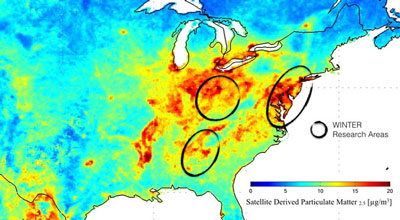
Until now, wintertime air pollution hasn’t been studied in much detail. Scientists have focused more on warm air, partly because summertime’s stagnant atmospheric conditions and intense sunshine tend to worsen ozone pollution. But that’s about to change as researchers turn their attention to winter air quality in the eastern United States.

This month, a major air quality project known as WINTER (Wintertime Investigation of Transport, Emissions, and Reactivity) takes to the air to examine pollutants across the Northeast urban corridor, Ohio River Valley, and Southeast Mid-Atlantic. Scientists will home in on wintertime emissions from urban areas, power plants, and farmland, and seek to better understand the chemical processes that take place as pollutants move through an atmosphere that is not only colder but also darker than in summer.

The field campaign, which runs from February 1 to March 15, is being led by scientists at the University of Washington, NOAA’s Earth System Research Laboratory, University of California Berkeley, Georgia Institute of Technology, University of Colorado Boulder, and the University of New Hampshire. The research team will use the NSF/NCAR C-130, a flying laboratory equipped with more than 20 instruments to measure gases and particles.

The aircraft is owned by the National Science Foundation and operated by NCAR. NCAR is also managing the project, including coordinating research flights and providing data services. Flight operations will be based at the NASA Langley Research Center in Hampton, Virginia.

“Aircraft missions will occur at different times during the campaign so that the pollutant gases and reactions can be observed during the day, at night, from night into day, and day into night,” said NCAR project manager Cory Wolff.

WINTER’S REGIONAL DIFFERENCES

A number of factors affect wintertime air: colder temperatures, snow cover, lower absolute humidity, and fewer hours of sunlight. Plants tend to emit fewer chemicals, while people may emit more as they burn heating oil and other fuels to heat their homes. In addition, pollutants may travel farther because chemical reactions take place more slowly in cold air.

By flying over several regions, the WINTER research team will better understand the atmospheric impacts created by different types of emissions from major cities in the Northeast and coal-fired power plants in the Ohio River Valley. The scientists will compare those emissions with data they gather in the Southeast, where winters are milder, plants have a more pronounced influence on the atmosphere, and emissions come from agricultural burning.

The project’s findings will be used to provide more detailed information to decision makers and improve computer models of the atmosphere.

“Wintertime pollution has not been the focus of many campaigns—most are during the spring and summer months when the Sun has maximum impact,” said Wolff. “By sampling the air in the cold and darkness of winter, the science team can get a better sense of the atmospheric chemistry of the eastern United States and compare that to other times of year. ”

via Cold facts of air pollution | UCAR – University Corporation for Atmospheric Research.

Posted in Air Quality, USA & Canada | Tagged , , , , , | Leave a comment

State and federal governments agree to crack down on air pollution

Tougher standards on emissions and a national clean air agreement could help reduce healthcare costs by billions of dollars

The federal and state governments have agreed to work together to improve air quality standards and help Australia adapt to the effects of climate change.

After a meeting on Thursday, environment ministers released a discussion paper for a national clean air agreement proposing stronger air quality standards for sulphur dioxide, nitrogen dioxide and ozone, tackling the release of mercury into the environment and curbing shipping emissions.

While the paper stressed that Australia’s air quality is “very good” compared with the rest of the world, the health costs of air pollution cost the country up to $24.3bn a year. Around 2.2% of hospital emissions for children aged under 14 with respiratory problems are due to PM10, a type of particulate released by burning fuels.

There will also be a review of fuel quality standards and measures to control emissions from wood heaters and non-road spark ignition engines. The exact level of these standards has yet to be thrashed out by the governments.

A climate change adaption working group has been established, to be chaired by Lisa Neville, Victoria’s environment minister. The group, which will involve all the states, will work on issues such as water management and renewable energy opportunities.

The inclusion of sulphur dioxide (SO2) in the review has been welcomed by some residents in the Victorian town of Anglesea, who have fought a lengthy campaign against the Alcoa coal mine and power plant, which sits just 1km from a primary school.

Surf Coast Air Action, a community environment group, claims that residents are at risk from the 39,000 tonnes of SO2 pumped out by the plant, citing evidence that it worsens asthma and contributes to heart and lung diseases.

“It’s good news that slowly but surely it’s being recognised that current standards do not protect human health,” said Dr Jacinta Morahan, of the air action group. Morahan removed her own children from the school that sits next to the mine.

“ I think [federal environment minister] Greg Hunt is to be commended for including SO2. It’s a real risk to people and there is community concern here about its impact, as well as the coal dust. At the moment, Alcoa can just say they are meeting the standards so nothing changes.”

Federal Liberal MP Sarah Henderson, whose electorate includes Anglesea, told Guardian Australia she had lobbied Hunt to include the review of SO2.

“My job is to be a strong advocate for the communities I represent and there’s no doubt there’s strong concern about Alcoa’s power plant,” said Henderson, who describes herself as a “strong environmentalist.”

“I’ve been very disappointed that Alcoa haven’t invested in sulphur dioxide scrubbers.

“If we had our time again, the Anglesea coal fired power station would not be built where it is. Developing a coal mine in a pristine part of the world is not a decision governments would make these days.”

Neville said there was “room for improvement” in air quality measures but that there needed to be a national agreement rather than the states going it alone.

“We need a nationally consistent approach to provide certainty to everyone,” she told Guardian Australia.

Neville said while many of the states disagreed with the federal government on its climate change policies, the election of a new Labor government in Queensland provides “whole new options on what we can be doing together to tackle climate change.”

Other matters discussed include the phasing out of microplastics that harm the marine environment and also the banning of non-biodegradable plastic bags.

New South Wales has already committed to reducing microplastics use as well as to establish a deposit scheme by July 2017 for the recycling of beer bottles and other containers.

“The banning of only lightweight bags may not be effective in reducing the total volume of plastic bags washing into our oceans, rivers and waterways,” said NSW environment minister Rob Stokes.

“An effective approach must also be to reduce heavy plastic bags. It must not drive up consumption of so-called degradable bags, that instead break down into small pieces and become micro-plastics in the food chain rather than completely degrading.”

Hunt said there had been “remarkable cooperation” between the federal government and the states and territories to implement the national clean air agreement by July 2016.

“Australian cities have very good air quality by world standards but it could be better, and over the coming decades as population grows, we need to make sure that our air quality improves, that we reduce particulates, reduce sulphur dioxide,” he said.

via State and federal governments agree to crack down on air pollution | Australia news | The Guardian.

Posted in Air Quality, Australia & Oceania | Tagged , | Leave a comment

Air pollution monitoring stations get boost in #Budget2015

The environmental affairs department wants citizens to inhale clean air, according to the 2015/16 budget tabled in Parliament on Wednesday.

It plans to increase the number of air quality monitoring stations to 105 by 2017/18, from 65 in 2013/14.

The finalisation of desired emission reduction goals for various sectors would provide a regulatory framework for improving ambient air quality, according to the 2015 Estimates of National Expenditure document.

The SA Weather Service would receive transfers to the value of R570 million over the medium-term which would, among other things, ensure air pollution emissions were constantly monitored.

The department had a R5.9 billion budget for the 2015/16 financial year, most of which would be spent on environmental programmes.

Fighting wildlife crimes, particularly rhino poaching in the Kruger National Park, remained a top priority.

To combat this, an additional allocation of R140m would be allocated to deploy more rangers in the park.

via Air pollution monitoring stations get boost in #Budget2015 – Times LIVE.

Posted in Africa, Air Quality | Tagged , | Leave a comment

Respro® Masks FAQ: I feel my breathing is restricted, is this normal?

Respro® Skins™ pollution mask - PETAL Mixed #matchyourstyleI feel my breathing is restricted, is this normal?

I think that from the start that you have to understand that any mask will have some level of restriction especially at fast breathing rates for example; when cycling fast.

All of our masks are compatible with aerobic exercise. If you body starts working in an anaerobic capacity then no mask is compatible and you will feel like you need to stop or slow down.,

The best masks will use exhalation valves that ‘dump’ heat, water vapours and Co2; the quicker the better. The removal of these components are the key to comfort. You need to get them out of the mask. The Powa and Powa Elite valve is key at elevated breathing rates.

For more frequently asked questions, go to Respro® Mask FAQ

All Respro® products are available from our website respro.com

Respro® will ship your order to anywhere on the planet free of charge.

Posted in Air Quality | Tagged | Leave a comment

Singapore Air Pollution Poses Foreign Policy Dilemma

If lawyer Jaya Gurunathan wakes up with a sore throat, he often knows the cause right away: the “haze.”  Singapore blames the hazy air pollution that sometimes blankets the city on fires in the less regulated countries that surround it.

Gurunathan said that when air quality is especially bad, his eyes turn red and watery and he exhales black particles.

“I have sinus issues, so this makes it worse,” he said. “Sometimes it makes it hard to work.”

The pollution from fires in nearby Indonesia and Malaysia raise a foreign policy dilemma for the government: What rights does a nation have when other sovereign countries make decisions that harm it?

Blaming Indonesia, Malaysia

Singapore usually points the finger at Indonesia, where the sometimes illegal practice of slash-and-burn land to clear it for farming sends smoke across the ocean to both Malaysia and Singapore.

But this month, the black clouds have been coming from a bushfire in Malaysia. Singapore’s National Environment Agency said in Feb. 15 online post that some residents noticed odour and pollution days after the fire broke out.

“The Malaysian authorities have highlighted that activities are underway to put out the fire in the areas and cap burnt areas with soil to prevent fires from recurring,” the agency said.

Singapore, of course, can’t control the policies of its neighbours. But it is testing the limits on what a government can do to exert influence beyond its borders.

The Ministry of the Environment and Water Resources told Voice of America that it wants to support Indonesia’s “fire-fighting capabilities.”

“Singapore has consistently offered assistance packages to Indonesia over the past years to help combat possible land and forest fires,” a ministry spokesperson said.

Catching criminals

Some progress was made in September, when Indonesia became the last member of the Association of Southeast Asian Nations to pass the Agreement on Transboundary Haze Pollution. Environmentalists hope the pact will make it easier to catch criminals setting fires illegally, create early warning systems, and tighten control of land rights permits.

The Ministry of the Environment and Water Resources also said it had a “successful collaboration” with Indonesia to work on a master plan against illegal fires in Jambi province.

Social justice

Any solution to the haze would have to consider the socioeconomic forces behind the fires.

“There’s a lot of poverty, for example,” said Mariska Pagey, an Indonesian who lived in New Zealand and now works in Singapore. “What are we going to do about that?”

The Indonesians who light the fires to clear land often do so out of financial necessity, trying to make money by extracting resources such as palm oil.

“They don’t have any options, that’s where they live,” said Pagey, a procurement officer for a mining company. “If they want to make money, that’s what they have to do.”

Those social issues have to be balanced with public health. The haze has become such a problem of everyday life in Singapore that the government started a website solely devoted to pollution, http://www.haze.gov.sg. During severe periods, Singaporeans go online daily to check the PSI, or Pollutant Standards Index.

via Singapore Air Pollution Poses Foreign Policy Dilemma.

Posted in Air Quality, Asia, Singapore | Tagged , , , , , , | Leave a comment