Clearing up Europe’s air pollution hotspots

Paris

Current air quality legislation in Europe will lead to significant improvements in particulate matter pollution, but without further emission control efforts, many areas of Europe will continue to see air pollution levels above the limits of the EU and the World Health Organization. Strict control of vehicle emissions alone will not be sufficient to achieve the limit values.

Under current legislation, air pollution hotspots will remain in Eastern Europe, Southern Poland and major European cities such as Warsaw, Paris, and Milan, according to a new study published in the journal Atmospheric Chemistry and Physics by researchers at the International Institute for Applied Systems Analysis (IIASA) and colleagues around Europe.

“This is the first time that we have analyzed particulate matter at individual monitoring stations across Europe, from regional background to urban streets, exactly where it’s important to know if air quality limits will be met. We show the potential and the need for further emission controls to achieve safe levels of air quality – current legislation will not do the job,” says IIASA researcher Gregor Kiesewetter, who led the study.

Air pollution has a major impact on human health, contributing to lung and heart disease. Exposure to particulate matter was linked to as many as 400,000 premature deaths in 2011 in Europe, according to the European Environment Agency.

EU legislation sets limit values on ambient concentrations for particulate matter of less than 10 microns in diameter (PM10). While new policies in Europe have contributed to significant decreases in air pollution over the past several decades, an estimated 80% of Europe’s population is still exposed to PM levels above WHO air quality guidelines, and a significant proportion of the region still exceeds the air quality limit values set by EU law.

Such pollution comes from a number of sources, including power plants, agriculture, domestic heating, and city traffic. IIASA’s GAINS model has been used for years to provide estimates of emissions and air pollution levels to support policymakers in Europe and around the world. In particular, the model has been employed in the ongoing revision of the EU air quality legislation.

PM10 Europe

The new study also uses the GAINS model, and improves the estimation of ground-level PM levels by adding in air quality data collected on the ground at monitoring stations across Europe. “We are now able to explicitly identify the different sources contributing to ambient pollution levels. Some cities clearly have a local problem that may be tackled by local measures. In many others, like Vienna, the majority of measured concentrations comes from sources outside the city or even outside the country”, explains Kiesewetter. He adds, “Approaching the WHO guideline value will require emission reductions from various sources, two of which were often overlooked in the past. Especially in Eastern Europe, emissions from solid fuels used for home heating are dominating. In many European regions we also see an important contribution of secondary inorganic aerosols, which are steered by agricultural ammonia emissions.”
Using the improved model, the researchers explored two scenarios for how air pollution levels could develop across Europe by 2030. Assuming that current legislation is successfully implemented, average air pollution levels would decrease substantially. However, the study shows that a substantial proportion of the European population would still be exposed to PM10 concentrations exceeding EU standards in 2030, in particular in southern Poland, the Czech Republic, Slovakia, northern Italy, and Bulgaria, as well as in a number of major cities.

In a second scenario, the researchers examined what would happen if the most efficient air pollution control technologies that are currently available were implemented across Europe. In this case, they found that by 2030, 99% of monitoring stations would see air pollution levels reduced below EU limits.

“A mix of EU-wide and local measures will be needed to bring PM concentrations below limit values. We show that coordinated EU-wide action could eliminate a large part of the problem,” explains Kiesewetter.

Indeed, even in the second scenario the researchers say that challenges will remain in Eastern Europe. Switching to cleaner heating fuels and local traffic management are additional measures that could make a difference.

via Clearing up Europe’s air pollution hotspots.

Posted in Air Quality, Europe, France, Italy | Tagged , , , , , , , , , , , | Leave a comment

This Man’s Running Mask Speaks The Horrifying Truth About Delhi’s Air Quality

Nirvan Mehra is a 28-year-old asthmatic patient and a runner. He took to running because he wanted to build lung capacity and fulfil his dream of climbing Stok Kangri in Ladakh.

“Running became the means to an end—from one kilometer, I now run 30-40 kilometres a week,” says Mehra, who had to relocate from Doon School to Delhi because of his asthma, but now runs half marathons regularly.

But Delhi’s declining air quality took a toll on his running. Subsequently, an expatriate runner friend introduced him to a mask with changeable filters and it made a dramatic difference. “After just a day of wearing the mask, I found that not only had I shaved several minutes off my running time, I didn’t need to take my inhaler along,” he says. “If I did run without the mask, I had to stop almost immediately because I felt like I was choking.”

But when Mehra took out his mask’s filter a month of usage recently, he was shocked. The UK-based manufacturer recommends that the filter can be used for three months. But with Delhi’s air, the mask had become choked and unusable within a month. This is the picture Mehra posted on Facebook.

This is its state after one month’s worth of running on Delhi roads:dirty filter

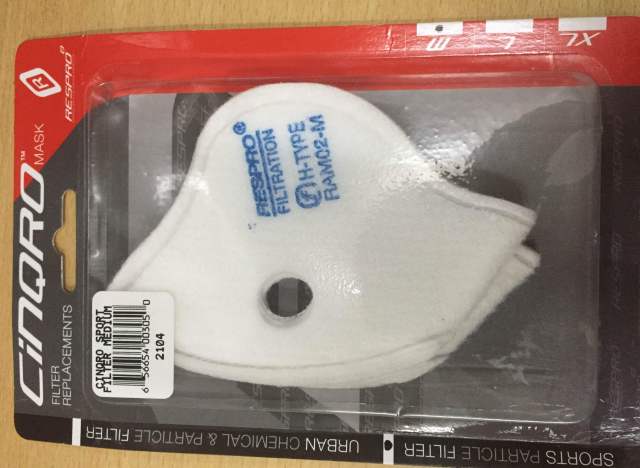
This is what the new filter looked like:

filter pack

“It was shocking to think that this is what would have gone and embedded itself deep inside my lungs,” he says.

The shockingly poor quality of Delhi’s air is now manifesting in people’s lives as worsening Asthma attacks and rising instances of respiratory ailments.

The World Health Organization said last year that Delhi has the most toxic air in the world.

Nobody really woke up then and air pollution was not an issue for any of the parties in the recently concluded Delhi elections.

In a survey last week, environmental organization Greenpeace said Delhi’s air quality readings were on average worse than Beijing’s, widely considered to be burdened with the planet’s worst air pollution. The levels of particulate matter of 2.5 microns or less was found to be 9 times higher than prescribed safe limits by Indian authorities, which are themselves way higher than the levels prescribed by the World Health Organization. This kind of particulate matter, called PM2.5, gets deep into lungs and the blood stream and can cause severe respiratory and cardiac ailments.

A recent New York Times story took stock of the air quality challenges facing Delhi.

Delhi’s new chief minister, Arvind Kejriwal, is in many ways the perfect man to begin tackling the problem. He has bronchial issues and developed asthma last year. And persistent cough intercepts his speeches often. He has not assumed any portfolios yet. Perhaps he can make the corruption of Delhi’s air his main portfolio and principal concern.

via This Man’s Running Mask Speaks The Horrifying Truth About Delhi’s Air Quality.

Posted in Air Quality | Tagged | Leave a comment

The big smog: Cities plagued by air pollution

Smog hangs over Ulan Bator – like every winter. This air pollution and intense cold is damaging the lungs of 19-year-old Tsegi. But it’s not only Mongolia’s capital: Here’s a look at some of the worst cities for bad air.

Ulan Bator is not only one of the coldest capitals on earth, it’s also a city with massive air pollution. During the winter months, yurts like Tsegi’s are heated with coal and wood which contributes up to 70 percent of the smog in the city. Air pollution in Ulan Bator is seven times higher than what is considered safe by the WHO.

via The big smog: Cities plagued by air pollution | Home | Life Links | DW.DE | 18.02.2015.

Posted in Air Quality, Asia, Mongolia | Tagged , , , | Leave a comment

U.S. to Monitor Air Quality in India and Other Countries

The United States says it will expand air-quality monitoring at some overseas diplomatic missions, following several years of reporting pollution data in China.

The goal is to increase awareness of the health risks of outdoor air pollution, which easily spreads across borders, Secretary of State John Kerry said in announcing the program on Wednesday.

The program is intended to help United States citizens abroad reduce their exposure to pollution and to help other countries develop their own air-quality monitoring through training and exchanges with American experts, he said.

“We’re hoping that this tool can also expand international cooperation when it comes to curbing air pollution,” Mr. Kerry said.

The program, run in conjunction with the Environmental Protection Agency, will begin to operate in India in a few months. New Delhi has some of the world’s worst air pollution, and residents there are becoming increasingly concerned about the dangers.

American diplomatic missions will also monitor air quality in Vietnam, Mongolia and elsewhere, Mr. Kerry said.

In 2008, the United States Embassy in Beijing began monitoring levels of PM 2.5 — fine airborne particles that are particularly dangerous for human health — and posting hourly readings on Twitter.

The move angered the Chinese government, which said the information could threaten social stability. But the step also helped pressure Chinese environmental officials to expand their monitoring of air pollution and begin publishing their own air-quality reports.

via U.S. to Monitor Air Quality in India and Other Countries – NYTimes.com.

Posted in Air Quality, Asia, China, India | Tagged , , , , , | Leave a comment

Pollution is Silent Killer in Uganda

Pollution is said to be the biggest killer in developing countries.  Contaminated air, water and soil claim millions of lives every year.  And with rapid urbanization and economic growth come fears that these numbers will only rise in years to come.  In Uganda, the effects of pollution on people are becoming more visible.

The World Health Organization says more than 8 million people die around the world each year as a result of living in a polluted environment. In Kampala, Dr. Kiggundu Tamale said the effects of air pollution are becoming more and more noticeable.

“Air pollution has become one of the biggest challenges faced in Uganda, especially in urban centers… In Uganda, the main cause of air pollution is transport, especially rapid motorization that is being experienced in urban areas.  But then there are other causes, like mining for example.  Like open waste burning,” said Dr. Tamale.

Doctors say it’s often difficult to tie someone’s health problems specifically to air pollution. In recent years, though, doctors in Uganda have seen an increase in the number of patients with lung problems.

Dr. William Worodria said air pollution has multiple effects.

“And particularly the lungs, the heart and other body systems.  In the lungs you may have chronic lung disease, like bronchial asthma, chronic obstructed lung diseases.  Even lung cancer has been reported associated with air pollution,” said Dr. Worodria.

Worldwide, the WHO says pollution kills more people than malaria, HIV/AIDS and tuberculosis combined. Yet, pollution often remains under the radar of policy makers.

Studies by Ugandan scientists suggest about 14 percent of children between the ages of 8 and 14 living in Kampala have bronchial asthma. Dr. Worodria said researchers found similar results in one of Uganda’s rural districts.

“They looked at other forms of pollution, which include indoor pollution from smoke and other things and again about 14 percent of inhabitants of that rural district had some form of chronic obstructed lung diseases,” he said.

Scientists and health officials say one reason air pollution is not a higher priority is that it’s less visible than other problems..

“For example, if you have a poor road infrastructure, this is visible enough.  If you don’t have electricity, this is visible.  So our politicians tend to focus more on problems that are visible by people.  But air pollution is less visible and therefor our decision makers or policy makers do not see it as a priority,” said Dr. Tamale.

Recently, however, Ugandan health officials and the government, have started a campaign to raise awareness about lung disease caused by air pollution.

One suggested approach includes trying to get people out of their cars and walking — before Uganda becomes congested not only by cars but by their exhaust fumes.

via Pollution is Silent Killer in Uganda.

Posted in Africa, Air Quality | Tagged , , , | 1 Comment

Air quality concern in Truro

Air quality is Truro has declined to such an extent that Cornwall Council is considering special measures to improve it.

The initiative would require officials to monitor levels of air pollution and draw up an action plan.

Air Quality Management Areas (AQMAs) are already in force in Camborne, Pool, Redruth, and Tideford.

New AQMAs were declared for Gunnislake and St Austell in March 2014. Cornwall Council is now consulting with the public about declaring another AQMA in Truro.

via Air quality concern in Truro | West Briton.

Posted in Air Quality, Europe, UK | Tagged , , , , , , , , , , | Leave a comment

Poland air pollution most severe in EU

Poland has the highest air pollution levels among all European Union (EU) countries.

According to Polish newspaper Gazeta Wyborcza, the European Commission (EC) has sent a reminder to the Polish government that the country might face a fine of up to 1 billion Euro ($1.13 billion) if the levels continue to remain high, Xinhua reported Tuesday.

Several Polish cities did not meet EU air purity standards.

In many towns, the concentration of harmful particles in the air exceeded the standards several times.

The EC has given Poland two months to improve the situation.

Apart from Poland, 15 other EU countries are being subjected to EC proceedings for their air pollution levels.

via Poland air pollution most severe in EU.

Posted in Air Quality, Europe, Poland | Tagged , , | Leave a comment

Iran MPs wear medical face masks to protest air pollution

Iranian lawmakers wore medical face masks in parliament on Sunday in a show of solidarity with residents of their areas battling pollution from strong sandstorms.

Sixteen MPs from the western provinces of Khuzestan, Ilam and Kermanshah donned the masks to draw awareness to the plight of their constituents, said official news agency IRNA.

Media reports said many Khuzestan residents have been hospitalised suffering respiratory problems, while schools have been closed for the past week.

https://twitter.com/Behrouz_Bahmani/status/567130938631417856

Iran is among the worst polluted countries in the world, and a 2011 report by the World Health Organisation listed Khuzestan city of Ahvaz as the most polluted in the world.

Tehran is also known for its poor air quality, because of an altitude ranging from 1,100-1,700 metres (3,600-5,600 feet) above sea level in a basin surrounded by mountains and also due to exhaust fumes from more than four million cars plying the roads of the city.

On Sunday, authorities urged children and the elderly not to venture outdoors as pollution levels peaked in Tehran.

The latest peaks come as sandstorms have lashed the region over the past week.

In 2012, pollution contributed to the premature deaths of 4,500 people in Tehran and about 80,000 across Iran, according to the health ministry.

via Iran MPs wear medical face masks to protest air pollution | Environment | The Guardian.

Posted in Air Quality, Iran, Middle East | Tagged , , , , , , | Leave a comment