Qatar’s air pollution unacceptably high 44 percent of the year

Amid ongoing concern about air pollution in Qatar, a new environmental report shows harmful airborne particles exceeded recommended levels for 159 days of the year in 2012.

The Environment Statistics Annual Report 2013, recently issued by the Ministry of Development, Planning and Statistics, breaks down Qatar’s air quality levels from 2008 until its latest figures in 2012.

It follows data released by the World Health Organization earlier this year, which suggested Doha’s air is among the most polluted in the world.

Pollution

The WHO’s ambient (outdoor) air pollution in cities database 2014 examined air pollution levels in 1,600 cities in 91 countries.

It measures particulate matter, which are small and large droplets in the air. It concluded that Doha had the 12th highest average levels of small and fine particles, known as PM2.5, which can penetrate the respiratory tract and increase the risk of respiratory infections, lung cancer, heart disease and stroke.

According to the US Environment Protection Agency, these particles – which often cannot be seen with the naked eye – are made up of heavy metals and toxic organic compounds, and originate from vehicle exhaust, smelting plants and the burning of organic materials.

Larger particles – PM10 – are mostly caused by dust and smoke. In this category, Doha ranked just outside the top 30.

Standards

While the ministry’s recent report didn’t benchmark Qatar against other countries, it showed that local air pollution levels frequently exceed the WHO’s recommendations as well as Qatar’s own targets, which are more lax than the international standards.

For example, Qatar’s national air quality standards for PM10 are 150 ug/m3 for 24 hours average concentration and 50 ug/m3 for the annual average concentration.

By comparison, the WHO’s standards for PM10 are 50 ug/m3 for the 24-hour average – one third of Qatar’s target – and 20 ug/m3 for the annual average concentration, which is less than half of the national figure.

The MDPS report uses statistics from the Ministry of Environment, which measures air quality at three monitoring stations in Doha – at Qatar University, Aspire Zone and the Mövenpick Hotel on the Corniche.

Levels highest at QU

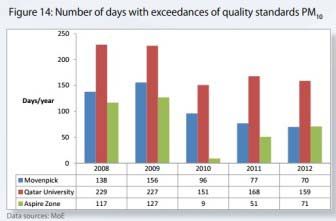
All three monitoring stations recorded pollution levels above the recommended national and global levels. However, concentration levels of the larger particulates (PM10) were highest at QU station in the north of Doha. That location also recorded the most days when air quality levels did not meet international standards.

Air Quality study - fig14In 2012, the national quality standards were breached on 159 days, or 44 percent of the year.
This is still an improvement from 2008, when the national standard of 150 µg/m3 for 24-hours average concentration was exceeded on 229 days – nearly two-thirds of the year.

The QU station also recorded the highest 24-hour average concentration of PM10 in March 2012, which was 2,214 µg/m3 – far above both the national and WHO recommended levels.

Air Quality study - fig 12

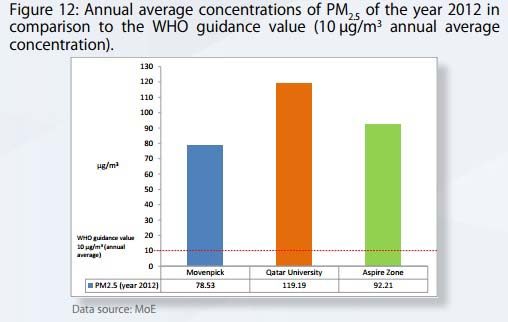
For the smaller and more harmful particles, figures recorded at the QU station show the annual average concentration was 119.19 µg/m3 – nearly 12 times the level recommended by the WHO.

The figures may be at least partly explained by Qatar University’s proximity to Lusail, where construction crews are undertaking massive infrastructure and development projects in preparation for the 2022 World Cup.

Previous government reports have said sand and dust generated by Qatar’s booming construction industry, as well as transportation emissions, are the primary causes of air pollution in Doha.

To tackle the issue, it recommended the development of strict guidelines “to manage discharge of greenhouses gases and air pollution, where all sects of the society should participate, including the private sector.”

via Report: Qatar’s air pollution unacceptably high 44 percent of the year – Doha News.

Posted in Air Quality, Middle East | Tagged , , | 1 Comment

Respro® Masks FAQ: What is Air Pollution?

What is Air Pollution?

Air pollution is made up of two distinct categories:

1. Gases and Vapours

2. Particulates

Most types of pollution can be put into one or other category.

Gases & Vapours:

Nitrogen oxides

Sulphur Dioxide

Carbon Monoxide

Low level Ozone

Hydrocarbon Chemicals

These all require an activated carbon filter media to adsorb these pollutants.

(Techno™, City™, Bandit™, Cinqro™, Xtreme™ urban)

Particulates:

Asbestos dust from brake linings

Pollen

Road dust

Black smoke from diesel emissions

Any other material which is solid in nature

These all require a submicron Hepa-Type filter media to trap these pollutants.

(Techno™, Sportsta™, Cinqro™, Respro® Allergy Mask, Xtreme™ Sports)

Particulate Types:

Inhalable and Respirable.

Inhalable particulates: are the particles big enough to be trapped within the nasal hairs and the mucous membranes at the back of the throat. (Larger in size than 2.5 microns)

Respirable particulates: are the particles that pass beyond the nasal hairs and the mucous membranes of the throat and pass into the lung sacs and subsequent blood barrier.

These particulates can carry carcinogenic chemicals used in petrol (benzene, pyrene, etc) to the blood barrier. (Smaller in size than 2.5 microns)

Posted in Air Quality | Tagged , | Leave a comment

Study shows way in which air-polluting traffic increases risk of cardiovascular disease

Pollution from vehicles — and not only from factories — triggers the development of cardiovascular diseases, according to new research conducted at Haifa’s Rambam Medical Center that will soon be published in the journal Toxicology and Industrial Health.

Urban living and personal transport is popular, but they come at a price, says Prof. Michael Aviram, head of the lipid research lab at Rambam and the Technion-Israel Institute of Technology’s Rappaport Medical Faculty, along with Technion environmental engineering faculty lecturer, Dr. Lorraine Patrick.

It has been published in recent years that Haifa and its environs have the highest cancer rate in the country. Although no studies have pointed to the influence of pollution from the petroleum refineries and other factories, the connection is widely believed. Bur gasoline-powered vehicles are all over the country, and they have no less an effect on health, the researchers implied.

The new study demonstrates “for the first time” the way that air pollution from vehicles can become a trigger for the development of cardiac and vascular diseases. Carbon monoxide (CO) is a central factor in air pollution from vehicles. The researchers checked the effects of CO on the accumulation of fatty plaques on the endothelial tissue inside the arteries, leading to heart attack and strokes.

The exposure of microphages (which are small white cells that gobble up harmful materials and represent cells inside the blood vessels) to CO raised the level of triglyceride fats in the cells by 60 percent and reduced by 30% the ability of “good cholesterol” (high-density lipoprotein) to remove excess cholesterol from the microphages.

Aviram said the innovative research “stress the need to reduce the amount of air pollution to minimize morbidity and mortality from cardiovascular diseases.”

via Study shows way in which air-polluting traffic increases risk of cardiovascular disease.

Posted in Air Quality, Health Effects of Air Pollution | Tagged , , , | Leave a comment

Georgia establishes new system to measure air pollution

To protect and maintain fresh air in the country, Georgia’s Ministry of Environment and Natural Resources Protection has installed a special automatic monitoring system to measure pollution levels in the country.

Specifically, the new monitoring system measured radioactive aerosols in the air. Stations have been installed in Tbilisi, Akhaltsikhe and Kobuleti.

The system automatically monitored the air and checked the pollution levels in the samples.

Special equipment allowed the stations to determine the volume of iodine, xenon, krypton and other pollutants in the air.

Minister of Environment Elguja Khokrishvili said the new monitoring system will improve the quality of radiation control mechanisms and contribute to the radiation hazard risk mitigation process.

Khokrishvili and head of National Environment Agency Vladimer Lazarishvili attended a special ceremony marking the new system installation.

via The Messenger – Georgia establishes new system to measure air pollution.

Posted in Air Quality | Tagged , , , , | Leave a comment

EPA ramps up Latrobe Valley air quality monitoring

The Environment Protection Authority EPA has improved its air quality monitoring capabilities in Victoria’s Latrobe Valley.

The EPA was widely criticised during the Hazelwood mine fire this year for taking too long to make air pollution data available.

It now has monitoring stations for fine particles and carbon monoxide at Morwell South, Morwell East and Traralgon and it is installing stations at Moe and Churchill.

The EPA’s principal air quality expert, Dr Paul Torre, said the air in the Latrobe Valley was being more closely monitored.

“I think we learnt quite a lot in terms of how we can respond to areas of a lot of smoke,” he said.

“There’s quite a lot of work in the background trying to look at cheaper smart sensors that can give us alerts of smoke … there’s also quite a bit of research now being done through the CRC [cooperative research centre] for emerging incidents, where they’re looking at trying to better model some of these smoke impacts to provide adequate time for alerts.”

via EPA ramps up Latrobe Valley air quality monitoring – ABC News Australian Broadcasting Corporation.

Posted in Air Quality, Australia & Oceania | Tagged , , | Leave a comment

Warning over exercise as air pollution from fireworks night ‘very high’

The government is urging people to reduce their physical activities, particularly outdoors, after pollution levels across much of England and Wales peaked because of a combination of fireworks night and unusually still weather.

Pollution levels across the north and south-west of England, the Midlands, and south Wales are now “very high” meaning that the official health advice now urges people with lung problems, heart problems, and older people, to avoid strenuous physical activity, while people with asthma are told they may need to use their reliever inhaler more often.

According to the advice the general population should: “Reduce physical exertion, particularly outdoors, especially if you experience symptoms such as cough or sore throat.”

Readings from the government’s monitoring network show pollution at 10 out of 10 on the Daily Air Quality Index rankings, across the country. During the Sahara dust smog episode in April, pollution was at similar levels across the south-east and London.

Pollution levels peak annually after particulate pollution from bonfires and fireworks and often fall rapidly as they are dispersed by the wind.

Fog and still weather has led to this morning’s warnings, but the environment department’s UK Air unit said the very high pollution would clear and return to low throughout the day.

Data from 9am shows very high levels for the whole of England and Wales except for the south-east where levels are moderate, and East Anglia and north Wales, where they are low. Scotland had relatively low levels of pollution on Thursday morning.

A Met Office spokeswoman said an area of low pressure was moving from west to east, which will bring wet and windy weather and sweep a lot of the pollution away later today.

via Warning over exercise as air pollution from fireworks night ‘very high’ | Environment | theguardian.com.

Posted in Air Quality, Europe, UK | Tagged , , , | Leave a comment

Prenatal Air Pollution Levels Linked to ADHD in Kids

Kids who are exposed to the highest levels of air pollution before birth have a greater risk of attention deficit hyperactivity disorder (ADHD) symptoms than their less exposed peers, according to new research.

In the study, researchers looked at levels of compounds called polycyclic aromatic hydrocarbons (PAH), which are a component of air pollution.

“Those children born to moms who were exposed to high levels of PAH during pregnancy had five times the odds of having an increased number of symptoms” of ADHD, said Frederica Perera, a professor at Columbia University’s Mailman School of Public Health in New York City and the first author of the new study. “Those symptoms were specifically of the inattentive type,” she said (as opposed to being the symptoms of hyperactivity). [7 Ways Pregnant Women Affect Babies]

These compounds are the products of incomplete fossil fuel combustion, and are known to damage the developing nervous system. Traffic exhaust and residential fuel oil use are the main sources of PAH in cities.

To gauge kids’ prenatal exposure to PAHs, the researchers measured levels of fragments of the mothers’ DNA bonded to PAH molecules, also known as DNA adducts, in umbilical cord blood. “That gives us a kind of fingerprint of individual exposure,” Perera said. “It shows how much was actually activated into an immediate toxic form that could damage DNA.”

In previous studies in the same cohort of children, Perera and her team found associations between higher levels of prenatal PAH exposure and the risk of developmental delays at age 3, lower IQ scores at age 5, and a greater likelihood of anxiety, depression and attention problems at ages 6 and 7.

The new study, published today (Nov. 5) in the journal PLoS One, looked at the children when they were 9 years old. The researchers took the children’s postnatal PAH exposure into account, as well as any exposure to secondhand smoke, so they could focus on the prenatal effects of pollution.

They looked at the kids’ ADHD symptoms using the Child Behavior Checklist and the Conners’ Parent Rating Scale—Revised, which are two screening tests that use parents’ reporting of their child’s behavior to determine if the child should receive more detailed evaluation for ADHD.

Just over one-third of the 250 children in the new study had high prenatal PAH exposure. These kids were five times more likely to have “moderately to markedly atypical” scores on a test of children’s ability to pay attention, and had triple the risk of a high score on a test of all ADHD symptoms.

The study is the first to link prenatal PAH exposure to ADHD symptoms, Perera said. “If replicated, then these findings could lead to new ways or stronger ways, better ways, to prevent ADHD,” she said. “By nature, environmental exposures are preventable … this we consider one possible contributor to ADHD and one that’s preventable, and the findings should be followed up so that necessary preventive strategies could be taken.”

New York City has already reduced levels of PAH pollution by enacting anti-idling regulations for trucks and buses, and requiring new city buses to use cleaner fuels, Perera said. “We do see that policies can make a difference, and air pollution is the responsibility of policymakers.”

Pregnant women who are concerned about the risks of pollution exposure should be sure to eat plenty of fresh produce, according to Perera. “Good nutrition is very important, and helps to offset the effects of pollutants,” she said.

via Prenatal Air Pollution Levels Linked to ADHD in Kids – Yahoo News UK.

Posted in Air Quality, Health Effects of Air Pollution | Tagged , , | Leave a comment

An ultra low emission zone won’t clean London’s air alone

Boris Johnson’s plan to improve the capital’s air quality by making central London an ultra low emission zone (ULEZ) has now gone out to consultation. It will require all motor vehicles driven within the zone to spew little if any bad stuff from their exhausts by 2020, four years after Johnson’s ultra low achievement mayoralty (ULAM) is due to end. Toxic tailpipe fumes are by far the biggest cause of people-killing air pollution in London, so will the ULEZ provide the ULAM with a posthumous upgrade?

The mayor says the ULEZ, which will cover the same area as the congestion charge zone, will be the first in the world and is essential for safeguarding Londoners’ well-being. He’s seemed less keen to mention the need to at last bring London into line with European Union limits on airborne pollution that harms human health and so avoid the UK government being hit with a fat fine. Thanks to London, the threat of this has been hanging over the nation for five years.

Private vehicles whose emissions don’t meet the Euro standard the ULEZ requires will be punished with a daily charge. Transport for London (TfL) is proposing that non-compliant lorries and coaches would have to pay £100 and cars, vans, minibuses and motorcycles, £12.50. This would be on top of the congestion charge, meaning below-scratch HGVs could have to shell out over £120 a day to drive in central London and cars £24 (and more if the congestion charge is increased before the ULEZ comes into effect). Public transport and private hire vehicles too will be required to come up to the ULEZ mark, with London’s famous black cabs already told they must be capable of producing zero emissions from January 2018 if they’re to be allowed to operate in the centre and other bad air areas.

Any complaints? The basic principle is sound. The ULEZ is a targetted intensification of the often-forgotten low emission zone (LEZ), which has spanned most of Greater London since Ken Livingstone introduced it to regulate dirty HGVs in February 2008, three months before Johnson removed him from City Hall. Johnson quarreled with Livingstone’s anti-congestion policies but not with the LEZ, describing its “polluter pays” model as “fair”. However, he slowed the wider implementation of the LEZ, postponing its application to vans until January 2012 on the grounds that it would hurt recession-hit small businesses.

Johnson’s air quality policies have sometimes had a characteristically improvised feel. He came to power promising to liberate London cabbies from Red Ken tape in the form of twice yearly MoTs, only to U-turn two years after honouring the pledge. Derision met the failure of attempts to “glue” tiny soot particles to the ground. The Clean Air in London campaign thinks Johnson tends to talk the problem down.

In July, the mayor’s environment adviser Matthew Pencharz defended Johnson’s record against some of his wilder critics, pointing out that elderly buses have been retired and greener ones introduced, that the age of black cabs is to be further capped at ten years and that overall harmful emissions have been falling. Indeed, London currently passes the EU particulates test. The ULEZ, it is hoped, will bring it into line on nitrogen dioxide too. Cleaner engine technologies are on the rise. But could and should the mayor be doing more?

The London Assembly Greens, unsurprisingly, think the ULEZ is too little, too late. Jenny Jones has called for boroughs outside the congestion charge zone to be allowed to opt in to the scheme. Her party’s City Hall office adds that owners of non-compliant vehicles who live inside the congestion charge zone will have a three year “sunset period” after the ULEZ is introduced, giving them nearly a decade before they have to get their motors into line. And the Greens have doubts about the accuracy of emissions measurement, pointing out that the hybrid New Routemaster bus is proving less clean in service than it did as a prototype. For the Lib Dems, Stephen Knight wants an outright ban on ULEZ infringers, which seems to imply that financial deterence should be replaced by an enforcement ring of steel.

There is a further dimension to all this. As TfL gears up to provide new Thames crossings for motorists to the east of Tower Bridge – an ambition that potential future Labour mayors seem unlikely to oppose – I’m told its air quality projections are to be reviewed to take account of the extra vehicles these are expected to bring on to London’s roads. The ULEZ has its virtues, but the capital’s halting progress on bad air could yet shift into reverse.

via An ultra low emission zone won’t clean London’s air alone | UK news | theguardian.com.

Posted in Air Quality, Europe, London, UK | Tagged , , , , , | Leave a comment