AIIMS study links air pollution, arthritis

Are autoimmune diseases such as rheumatoid arthritis, where the body’s immune system reacts against itself, linked to air pollution?

A preliminary analysis of an ongoing study at AIIMS since April 2013 on 300 rheumatoid arthritis patients has found their symptoms worsen when suspended particulate matter (SPM) 2.5 increases in the atmosphere.

Particulate matter are essentially pollutants in the air, microscopic solid or liquid particles suspended in the atmosphere. Depending on their size, the pollutants are classified into many subtypes, one of them being SPM 2.5. It includes particulate matter less than 2.5 micrometres in diameter.

“These are preliminary findings, where we have found a definite co-relation between increase in one category of pollutants, that is PM 2.5, and the symptoms in diagnosed rheumatoid arthritis patients. Patients showed worsening of symptoms like joint pain and swelling when the air pollutants increased,” Dr Uma Kumar, head of Clinical Immunology and Rheumatology department and principal investigator of the study, said.

The study, funded by the Department of Science and Technology as part of a project on climate change, is being jointly conducted by the Rheumatology department at AIIMS and the Indian Meteorological Department (IMD). The study is expected to take two more years.

Studies in the US and Sweden have found a minor link between rheumatoid arthritis and vehicular pollutants like nitrogen dioxide and home-heating pollutants like sulphur dioxide, but no association between the disease and suspended particulate matter in the atmosphere.

Researchers from McGill University Health Centre in Canada have found that “short-term variations in air pollution may influence disease activity” in patients of Lupus disease, another autoimmune disorder.

Dr Kumar too said there could be a “potential link” between air pollutants and other autoimmune disorders, which warranted studying.

Dr Kumar said, “Till now, we have analysed the condition of the patients through last year with data taken retrospectively on air pollutant levels from IMD. Now, a prospective study will be done on the same patients, collecting current data and comparing their symptoms.”

“We will start by collecting current data from IMD from Diwali when air pollutant levels shoot up and analyse the condition of patients. We will analyse pollutant levels in four categories and see the corresponding symptoms till 2016 in our identified patients,” Dr Kumar said.

This, she said, would provide a more accurate and detailed analysis on the connection.

Researchers are in the process of analysing co-relations between the symptoms and other category of pollutants, including SPM 10, sulphur dioxide

via AIIMS study links air pollution, arthritis – Financial Express.

Posted in Air Quality, Health Effects of Air Pollution | Tagged , , | Leave a comment

New ICCT study shows real-world exhaust emissions from modern diesel cars seven times higher than EU, US regulatory limits

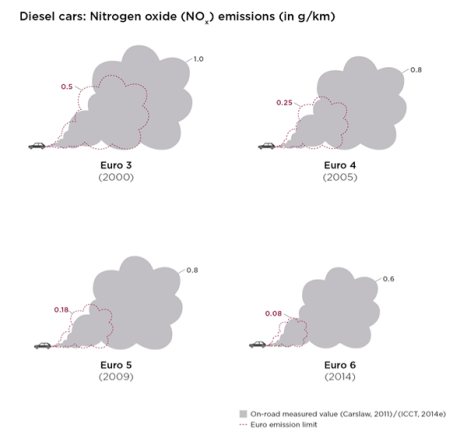
On-road nitrogen oxides emission levels of modern diesel cars are on average about seven times higher than the limit set by the Euro 6 emission standard, which went into effect in September 2014. This is the key finding from a new report published today in Berlin by the International Council on Clean Transportation (ICCT), an independent research organization.

The study, which is the most comprehensive report on the real-world behavior of the latest generation of diesel cars published to date, found remarkable differences among individual vehicle models, indicating that technologies for real-world clean diesels already exist but are not being employed consistently by different vehicle manufacturers. The findings come at a time when the European Commission is preparing to propose an improved car emissions testing procedure, including on-road measurement, that could take effect in 2017.

The study is based on on-road tests of 15 vehicles using Portable Emissions Measurement Systems (PEMS). It covers more than 140 hours and 6,400 kilometers of driving, and provides the largest collection of public data on Euro 6 equivalent diesel cars currently available. Diesel vehicles make up about 50 per cent of all new cars in the EU. From September 2014 on, the Euro 6 standard applies to all new passenger car types.

“On average, we found that real-world nitrogen oxides emissions for modern diesel cars were about seven times higher than required by the Euro 6 standard”, says Dr. Peter Mock, Managing Director of ICCT Europe. The ICCT researchers demonstrate that the majority of exceedances found could not be attributed to extreme or untypical driving. Instead, they were due to driving situations that are part of the normal operation of diesel cars, such as mild uphill driving and regeneration events of the diesel exhaust aftertreatment system.

The ICCT experts also found significant differences among the performance of all the vehicles tested, with a few vehicles performing substantially better than the others. “This supports the notion that the technologies for real-world clean diesels already exist”, says Dr. Vicente Franco, researcher at the ICCT and lead author of the study. “Policies are needed to ensure that manufacturers will use these technologies and calibrate them to effectively control emissions over the large majority of in-use operating conditions, not just those covered by the current test cycle”.

The European Commission is currently preparing to require on-road testing as part of the passenger car type-approval process in the EU. According to these plans, vehicle manufacturers from 2017 would have to test new vehicles not only under laboratory conditions but also on the road, using PEMS equipment. Technical experts from the EU Member States will meet in Brussels on October 15 to discuss further steps and whether the new regulation can be approved at the end of 2014, as originally planned.

Nitrogen oxides emissions can have serious adverse health effects, causing major respiratory problems and leading to premature death. Diesel vehicles are the single largest contributor to total nitrogen oxide emissions in the EU. Especial in urban areas of Europe, measured nitrogen oxide emission levels are often higher than the legal limits, and some EU Member States are already facing legal actions for persistent air pollution problems.

via [Press release] New ICCT study shows real-world exhaust emissions from modern diesel cars seven times higher than EU, US regulatory limits | International Council on Clean Transportation.

Posted in Air Quality, Europe | Tagged , , | Leave a comment

Hudhud cyclone to hit Delhi’s air quality

The Hudhud cyclone that’s likely to hit the Coromandel coast on Sunday will have a serious effect on Delhi’s air quality. The models prepared by System of Air Quality Weather Forecasting and Research (SAFAR) at Indian Institute of Tropical Meteorology show levels of carbon monoxide, ozone and particulate matter rising steeply Friday evening onwards. Meteorologists at SAFAR say Delhites should brace up for very poor air quality, especially if there is no rainfall in Delhi.

Scientists at Delhi Pollution Control Committee air quality lab also confirmed that levels of certain pollutants are set to rise. According to SAFAR’s model, CO levels will rise from the current 1.2 parts per million to about 3 PPM over the weekend. The threshold for CO is 1.7 PPM, according to SAFAR. Ground level ozone is associated with serious health problems such as breathing difficulty and reduced lung function. Ozone levels are likely to increase from the present level of 40 parts per billion (PPB) to 63 PPB. The threshold for ground-level ozone is 50 PPB.

The particulate matter (PM 2.5 and PM 10) concentration is likely to increase by 60% to 70%. PM2.5 (fine respirable particles) levels may reach about 180-200 micrograms per cubic metre when the standard is only 60 micrograms per cubic metre. PM10 (coarse particles) levels are likely to be about 260 to 270 micrograms per cubic metre.

“The air from the coastal region will sweep out the air rich in pollutants and dump it on the Indo-Gangetic plains which will affect Delhi, too. The effect from this will also dissipate quickly. But for two days air quality will be very poor. If it rains then PM levels may get better but CO and ozone levels will be high,” said Gufran Beig, chief project scientist, SAFAR. The Indian Meteorological Department forecasts a clear sky on Saturday but for Sunday there are chances of thunderstorm and gusty winds.

The worst air quality is likely to be faced by other parts of Indo-Gangetic plains like Uttar Pradesh and Punjab. DPCC is also gearing up for an awareness drive up to keep air pollution in check during Diwali.

via Hudhud cyclone to hit Delhi’s air quality – The Times of India.

Posted in Air Quality, Asia, India | Tagged , , , , , , | Leave a comment

Days of heavy air pollution blight northern China

Days of heavy smog shrouding swathes of northern China pushed pollution to more than 20 times safe levels on Friday (Oct 10), despite government promises to tackle environmental blight.

Visibility dropped dramatically as measures of small pollutant particles known as PM2.5, which can embed themselves deep in the lungs, reached more than 500 micrograms per cubic metre in parts of Hebei, a province bordering Beijing. The World Health Organization’s guideline for maximum healthy exposure is 25.

In the capital buildings were obscured by a thick haze, with PM2.5 levels in the city staying above 300 micrograms per cubic metre since Wednesday afternoon and authorities issuing an “orange” alert. “It’s very worrying, the main worry is my health,” said a 28-year-old marketing worker surnamed Hu, carrying an anti-smog mask decorated with a pink pig’s nose as she walked in central Beijing.

China has for years been hit by heavy air pollution, caused by enormous use of coal to generate electricity to power a booming economy, and more vehicles on the roads. But public discontent about the environment has grown, leading the government to declare a “war on pollution” and vow to cut coal use in some areas.

Nonetheless poor air quality has persisted with officials continuing to focus on economic growth, and lax enforcement of environmental regulations remains rife. In a sign of growing environmental activism, Greenpeace East Asia projected the message “Blue Sky Now!” onto a facade of the Drum Tower, a historic building north of the Forbidden City.

The pollution – which also hit areas hundreds of kilometres from Beijing – comes as the city hosts a high-profile cycling tournament, the Tour of Beijing, and a Brazil-Argentina football friendly.

Global heads of state from the US, Russia and Asia are set to gather in the capital for a key summit next month. City authorities said Thursday that they would place tighter restrictions on vehicle use during the APEC Economic Leaders’ Meeting in November, while requesting neighbouring areas to shut down polluting facilities.

But most locals were not wearing protection on Friday, and several people said they believed Beijing was being hit by natural haze, rather than pollution. Even so, sitting in a Beijing park 82-year-old Liu Shuying said: “There are too many cars. I don’t wear a mask because I’m not afraid of death.”

Days of heavy air pollution blight northern China – Channel NewsAsia.

Posted in Air Quality, Asia, China | Tagged , , , , , | Leave a comment

Beijing Raises Smog Alert as Pollution Envelops North China

Beijing raised its air pollution alert to orange, the second-highest level, triggering limits on some industrial production as smog enveloped northern China for a second day.

The concentration of PM2.5, fine particulates that pose the greatest risk to human health, was 359 micrograms per cubic meter at 11 a.m. nearTiananmen Square in Beijing, the Beijing Municipal Environmental Monitoring Center saidon its website. The WHO recommends 24-hour exposure to PM2.5 at concentrations no higher than 25.

Under the orange alert, people are advised to cut down on outdoor activity, while the elderly and people with heart and lung ailments should stay inside. It was an upgrade from yesterday’s yellowalert, which called for measures such as increased road cleaning and spraying of water at construction sites, according to the Beijing Meteorological Bureau.

Reduced visibility led traffic authorities to close several highways out of Beijing, the official Xinhua News Agency said. The smog is partly the result of farmers burning stalks on their land after the autumn harvest, Xinhua said, citing the environmental protection bureau of Henan province.

Beijing is planning to impose pollution-control measures next month, similar to those enacted ahead of the 2008 Olympics, when leaders of the Asia-Pacific Economic Cooperation forum gather in the city for an annual summit. In August, the city ordered vehicles off the road to ensure clear skies for an APEC preparation meeting.

The city last month said it has fined hundreds of companies more than $2 million in the first six months of its stepped-up anti-air–pollution campaign.

Beijing’s monitoring center forecasts the pollution will remain heavy until Saturday. Seven cities out of 11 monitored by Hebei province, which surrounds the capital, saw severe pollution today, data from the provincial monitoring center showed.

via Beijing Raises Smog Alert as Pollution Envelops North China – Bloomberg.

Posted in Air Quality, Asia, China | Tagged , , , | Leave a comment

PSI slips into ‘unhealthy’ range

The Republic’s air quality worsened on Wednesday Oct 8 evening, as the three-hour Pollutants Standard Index PSI hit the ‘unhealthy’ range at 6pm with a 3-hour PSI reading of 102. The 3-hour PSI reading rose to 105 as of 7pm and stayed at 107 as of 9pm, The 24-hour PSI reading remained in the ‘moderate’ range at 79 to 90.

The National Environment Agency NEA noted that it was “slightly hazy” in the afternoon, and attributed this to smoke haze blown in from southern Sumatra by prevailing southerly winds. Singapore’s met agency detected 110 hotspots on the Indonesian island of Sumatra on Wednesday, up from about 100 the day before.

“The hazy conditions are expected to persist tonight,” NEA stated on its website.For Thursday, NEA forecast thundery showers in the afternoon, but said hazy conditions can be expected, as prevailing winds are expected to come from a southeasterly and southwesterly direction.

“The overall air quality for the next 24 hours is expected to be mainly in the high-end of ‘moderate’ range and low-end of the ‘unhealthy’ range,” NEA said.

via PSI slips into ‘unhealthy’ range – Channel NewsAsia.

Posted in Air Quality, Asia, Singapore | Tagged , , , , , | Leave a comment

Respro® Masks on Channel 4 Gadget Man

Respro® Skins™ Masks were recently featured on Channel 4 Gadget Man

The Respro® ‘Skin’ is the Neoprene outer-shell of the mask. When the Skin is combined with a filter and valve assembly, you have the full Respro® mask ready to use.

The ‘Match Your Style’ Skins™ range allows you to feel ‘part’ rather than ‘apart’ from everyone else.

#matchyourstyle

Posted in Air Quality | Tagged , | Leave a comment

Air pollution slows growth of children’s lungs, says UK study

Medical experts are urging the government to take more effective action to clear the city’s air after a new study found that air pollution restricts the growth of children’s lungs.

The preliminary analysis of a six-year study done in Britain indicates that children exposed to nitrogen dioxide and particulate matter have slower lung growth.

Professor Frank Kelly, an environmental health expert at King’s College, London, said a child could lose as much as 165ml of lung volume under high-level exposure to nitrogen dioxide.

The professor said the impact of a smaller lung was lifelong and could “contribute to the development of chronic lung diseases such as asthma”.

Studies in Hong Kong have found similar results. Dr Alfred Tam Yat-cheung of the Hong Kong Society of Paediatric Respirology said that children living in polluted districts suffered from restricted lung growth, while girls had a more significant decline in lung volume than boys.

A weaker and smaller lung means children might have more difficulty doing exercise and a lower resistance to respiratory diseases, said Tam.

But the specifics of how pollutants restrict the development of lungs is still being studied. “Perhaps children have smaller lungs than adults, and therefore they inhale more air pollutants. However, this is still just speculation,” Kelly said.

Ruby Tse, 24, a long-term rhinitis patient, started to suffer from asthma three years ago when she was studying in the UK. The problem persisted when she returned to Hong Kong in 2012.

She says her health improves when she avoids crowded areas such as Mong Kok or Causeway Bay on heavily polluted days. She also exercises indoors to strengthen her respiratory system and has reduced her reliance on an asthma inhaler from six times to twice a day.

To improve lung function and build defences against pollution, medical experts recommended a diet rich in antioxidants, Vitamin C and E, and urged the government to take more action to improve air quality.

Undersecretary for the Environment Christine Loh Kung-wai said major steps were being taken, including the replacement of catalytic converters in minibuses and taxis, and the replacement of more than 80,000 diesel vehicles by 2019.

Posted in Air Quality, Health Effects of Air Pollution | Tagged , , , , , | Leave a comment