Islington to fine idling drivers to boost air quality

Drivers caught running their engines unnecessarily while stationary will from today (August 1) be issued with on-the-spot fines by council officers

Islington council will from today (August 1) begin issuing on-the-spot fines to idling motorists in the London borough in a bid to boost air quality.

In what the borough council believes is the ‘first campaign of its type’ in UK, drivers in the borough will be educated on the air quality impacts of running their engine while the vehicle is stationary.

And, drivers who fail to turn off their engine after being asked to do so by an authorised council officer will also be issued with on-the-spot fines under the Road Traffic (Vehicle Emissions) (Fixed Penalty) (England) Regulations 2002.

The law covers all vehicles on public roads including buses, taxis and private cars. However it does not apply to vehicles moving slowly due to road works or congestion; vehicles stopped at traffic lights; vehicles under test or repair; or defrosting a windscreen.

According to the council, an idling engine can release as much pollution into the air as a moving vehicle, so turning off the engine when stationary reduces the amount of harmful pollutants being released while also saving on fuel costs.

Islington has also been working with Transport for London (TfL) to encourage high-polluting buses to switch off their engines when idling at bus stops at driver switch-over points and bus stops at the end of routes.

The council’s campaign comes as the Mayor of London Boris Johnson this week announced his air quality manifesto for the capital, which includes proposals to charge diesel drivers an additional £10 to drive in the planned ultra low emission zone (ULEZ) from 2020 (see airqualitynews.com story).

London

However, Islington council believes Mr Johnson should be doing more to tackle air pollution and protect the health of residents in the borough.

Islington councillor Claudia Webbe, executive member for the environment, said: “We are committed to improving air quality in Islington which is why we are clamping down on idling buses, lorries and diesel cars, as part of our air quality strategy.

“We are taking action to tackle the problem of air pollution in Islington but we need Boris Johnson to do his share: by introducing a low-polluting bus fleet, and addressing the high number of polluting lorries that travel through our streets on a daily basis affecting residents’ health.”

The campaign is the latest part of the council’s commitment to reducing air pollution and increasing air quality, and follows the launch of Islington’s air quality strategy, the introduction of 20mph speed limits and the Air Text service for residents.

More information on the borough’s idling campaign is available on the council website.

via Islington to fine idling drivers to boost air quality | AirQualityNews.
Posted in Air Quality, Europe, London, UK | Tagged , , , , | 1 Comment

Diesel car drivers ‘betrayed’ as EU cracks down on Britain over air pollution

More than 10 million motorists who were “betrayed and misled” into buying diesel cars have been warned that they face higher costs as the European Union puts pressure on Britain to cut air pollution levels.

It comes as Boris Johnson, the Mayor of London, announced plans to charge diesel drivers an extra £10 to drive in the capital – a measure that could be copied by as many as 18 other cities.

For more than a decade, motorists buying diesel cars have enjoyed tax breaks because the cars produce lower levels of carbon dioxide and are more fuel efficient.

Now, Britain is being sued by the European Commission for breaching air pollution limits, because emissions from diesel vehicles are contributing to tens of thousands of premature deaths each year.

Senior Conservatives are understood to be lobbying the Government to increase road taxes on diesel vehicles to bring them into line with petrol, although ministers have ruled out such a move in this parliament.

Motoring groups warned that new levies would hit drivers already struggling to cope with high prices at the pumps and lower the resale value of diesel vehicles.

Edmund King, the president of the AA, said: “Some drivers will feel betrayed and misled because they were encouraged to go for the dash for diesel.

“In the 1990s there was a near hysteria about carbon dioxide, and yet nobody looked at the bigger picture.

“The drivers thought they were doing the right thing, but now they are being told that it has serious health implications. They are being made to feel guilty for something that they were encouraged to do.

“There is no doubt that other cities, encouraged by EU legislation, will look to introduce similar restrictions on diesel cars.

“I think it’s highly likely that the Treasury might slap an extra penalties on diesel vehicles.”

In 2001, Gordon Brown, the then chancellor, overhauled vehicle excise duty so that cars that emitted a higher level of carbon dioxide faced a higher level of vehicle excise duty.

Labour introduced the new regime despite official warnings that diesel vehicles emit “10 times the fine particles and up to twice the nitrogen dioxide”.

The move prompted a “profound” shift towards diesel cars, which produce lower levels of carbon dioxide because they are about 20 per cent more efficient than petrol engines.

Over the past decade, the number of diesel cars on Britain’s roads has risen from 1.6 million to more than 11 million and accounts for a third of vehicles.

However, diesel vehicles produce high levels of nitrogen dioxide, which can lead to respiratory disease and has been linked to 7,000 deaths a year.

Frank Kelly, the chairman of the Department of Health’s committee on air pollution, said the public were still being misled about the benefits of diesel cars.

He said: “I have full sympathy with the public who have not been provided balanced information on this issue.

“Even today if you go to buy a new car you are provided with lots of information about its CO2 emissions and nothing in respect to the pollutants it emits.

“The whole scenario is a very good example of why government policy needs to founded on best science available – not just one aspect, as it was in this case.”

Prof Stephen Glaister, the director of the RAC Foundation, said: “Buying a car is one of the biggest purchases people make.

“Drivers do not want to go to the garage one morning only to find what was previously worth a lot of money has plummeted in value overnight because politicians have suddenly moved the goalposts. People with the oldest, dirtiest diesels will feel the financial squeeze most. They face paying more to use their cars and getting less for them when they try to sell.”

According to official figures, some 18 cities across Britain will fail to meet EU clean air targets for nitrogen dioxide emissions by the end of the decade.

Bristol, Birmingham and Leicester are all considering introducing levies for diesel cars to cut emissions, while Labour is considering plans for a national network of low emission zones in cities that would limit access for diesel vehicles.

There are growing fears that the charges could affect vehicles including school buses and hearses.

In London, only diesel vehicles that meet the Euro 6 emissions standard will be exempted from the charge.

Matthew Pencharz, the Mayor of London’s environment adviser, suggested that successive governments are to blame for a “generation of dirty diesels”.

He added: “These measures can help us to meet EU emission limits ten years ahead of government projections and will deliver significant health benefits to all Londoners.”

The latest government statistics show that in 2011, the nation’s 28.5 million cars emitted 150,000 tons of nitrogen oxides, but a further 97,000 tons were given off by just 400,000 HGVs.

Government sources said rates of vehicle excise duty are unlikely to change for diesel vehicles.

via Diesel car drivers ‘betrayed’ as EU cracks down on Britain over air pollution – Telegraph.

Posted in Air Quality, Europe, London, UK | Tagged , , , , , , , , , , | 1 Comment

Sheffield area ‘above pollution limits’ for months

Air quality in Nether Edge has met EU standards only once in six months of monitoring, it has been revealed.

Levels of pollution in the Sheaf Valley, which includes Nether Edge, Sharrow and Abbeydale Road, have been above maximum European Union regulation levels constantly since January, revealed Nether Edge councillor Nikki Bond.

She is leading the Sheaf Valley Clean Air Campaign to raise awareness of polluted air and its links to poor health in a bid to cut car use.

She said: “Abbeydale Road is an arterial road for Sheffield, and Nether Edge is in a bit of a valley, which can exacerbate the problem.

“Last year we agreed a funding application from the East End Quality Of Life Initiative to install monitoring tubes in the area.

“Measurement started in January. There is only one occasion, in February on Chippinghouse Road, where it was within legal limits. It was above it for the rest of the area the rest of the time.

“The limit is 40mg per metre squared of nitrogen dioxide, but levels in the area have been at about 50mg for the duration of the monitoring.

“Air pollution causes cancer, according to research by the World Health Organisation.

“Poor air quality can also have an impact on children’s lung development.”

But Coun Bond was keen to stress air pollution is a problem across Sheffield, not just in Nether Edge.

A report by The Star in June revealed air pollution is causing 500 premature deaths a year in the city at a cost of £160 million to health services annually.

The council published an Air Quality Action Plan last year setting out a range of initiatives to tackle the issue.

The plan includes proposals such as controlling industrial emissions, mitigating the impact of the M1 by pushing for a speed limit reduction and looking into the possibility of introducing a city centre ‘Low Emission Zone’.

Coun Bond said the Sheaf Valley campaign is about raising awareness, including talks at Nether Edge Primary School about air quality, adding: “The purpose is to bring people in the community and the council together to work on raising awareness of poor air quality, in partnership with schools.

“You can’t see or taste air so it’s encouraging people to think about it and consider their car use carefully.”

via Sheffield area ‘above pollution limits’ for months – Sheffield Telegraph.

Posted in Air Quality, Europe, UK | Tagged , , | Leave a comment

Nightmare days in summer

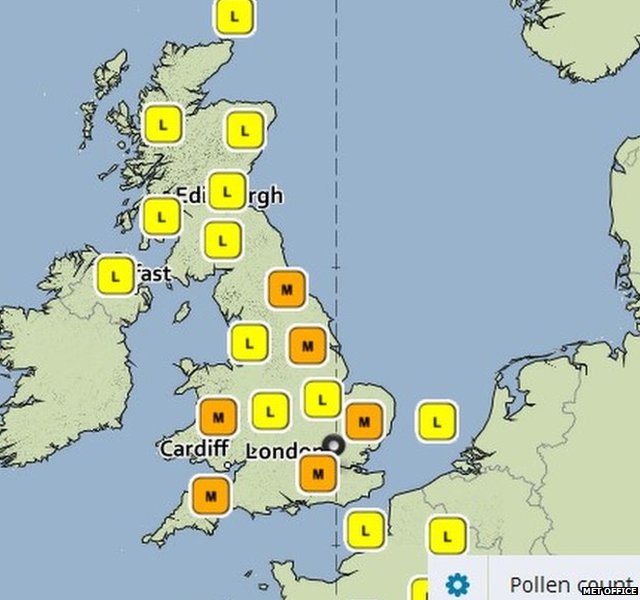
While many people hanker for some proper summer weather with long dry and sunny days, for others those warm days can turn into a nightmare – those who suffer from hayfever.

Hayfever is an allergic reaction to pollen released by plants during the spring and summer months and this year has been an unusually severe season due to the weather conditions.

Perfect conditions for pollen production starts with a warm and wet spring, followed by a dry, warm summer, high humidity and just a gentle breeze.

The day-to-day weather impacts on pollen levels for any given day, levels usually peaking mid-to-late morning after the pollen is released early, and again in the evening.

The pollen type also varies through the season, with tree pollen the main variety from March to mid-May, mainly birch and oak, followed by grass pollen from mid-May to late July, then finally weed pollen from mid-to-late July through to September.

But have you ever wondered how pollen counts are measured and forecast?

Pollen levels are measured in what is called a Burkhard volumetric spore trap, a standardised method of collection which is a garden chair-sized contraption, about waist high, that is placed about two storeys above ground level.

This is the same for all the traps across the UK, and in Northern Ireland the trap is located on a rooftop at Queen’s University Belfast.

Yolanda Clewlow is the UK pollen network manager at the Met Office which is now responsible for the UK pollen monitoring network and forecasts.

She said the readings were taken at all sites at the same time, daily at 09:00, by a very dedicated team of observers – mostly for the love of it!

Inside the Burkhard trap is a rotating drum with a wax-coated sticky tape. An aperture on the trap sucks in air at a regulated speed, depositing anything in the air onto the drum.

Observers remove the tape and mount it on a slide using a pollen stain called fuscin, which identifies only pollen spores and stains them pink.

They can then count the pollen grains and extrapolate to give pollen grains per cubic metre over the next 24 hours.

The information is then sent to the Met Office from all the UK sites and is used along with the weather forecast to give the pollen forecast for the next five days.

So what constitutes whether the levels are high?

Levels are based on a numerical range that varies according to the pollen species, and the grass pollen has been exceptionally high this year due to the weather conditions.

Anything over 150 grains per cubic metre is considered very high, and here in Northern Ireland the highest count has been up to 212 this summer.

So, if you are allergic to grass pollen and have been suffering from sneezing, an itchy nose or watery eyes, that is the reason.

However, levels have been highest across parts of England with York University having the highest count, up to a very eye-watering 801 grains per cubic metre.

The pollen microscope slides are retained indefinitely because we can never be sure what additional use may be made of them in the future.

Over the past three years they have also been used to identify volcanic ash from Iceland to ascertain how far it had spread across the UK, and also the DNA of ash die-back disease, to establish whether the disease had spread to the UK from the continent as it was previously thought unable to be carried by the wind.

The pollen data collected is also used extensively in research, especially around climate change and health.

via BBC News – Nightmare days in summer.

Posted in Air Quality, Allergies, Hayfever, Health Effects of Air Pollution | Tagged , , | Leave a comment

Boris Johnson defends London’s record on air pollution

The Mayor of London’s office has strenuously defended the city’s record on air pollution, insisting that it is far from the worst polluted city, despite data showing that nitrogen dioxide (NO2) levels have been higher than anywhere else yet recorded.

Boris Johnson’s top air quality officials told the Guardian that it was “ludicrous” to put London in the same category as capitals such as Mexico City, Delhi and Beijing, and other cities.

“It’s not even comparing apples with pears, it is comparing apples with cucumbers,” said Matthew Pencharz, the mayor’s adviser on environment and energy.

Pencharz claimed other cities frequently site their air quality monitoring stations far from the sources of the worst pollution, for instance in parks, quiet roads or suburbs, but that London’s monitoring stations are “more reliable” because they are sited near busy roads.

Levels of NO2 on Oxford Street in 2013 were at an annual mean of 135 μg m-3, according to samples taken by the London Air Quality Network.

Other data analysed by the European Environment Agency also showed London topping Europe’s cities for air pollution, though at lower levels than the Oxford Street samples, which were not submitted for the agency’s consideration.

Under the EEA’s analysis, Marylebone Road, a busy London road where pollution levels frequently exceed the EU’s legal maximum, was found to be the worst in Europe in 2012, with 94 μg m-3, compared to a maximum of 40 μg m-3 which is considered by the EU to be the upper safe limit for human health. The next worst European cities were Stuttgart, with 91 μg m-3 at one site and 90 μg m-3 at another, and Paris with 90 μg m-3 at one site.

EU cities with highest annual mean NO2 levels (μg/m3)

40 μg/m3 is the level considered safe for human health by the EU

EU Cities NO2

But Pencharz said that the data cited was not representative, because other cities have fewer monitoring stations and submit less data. London had more monitoring stations than Paris or Rome, for instance, with 157 sites compared to 32 in Paris, 13 in Rome, 17 in Berlin and 19 in Amsterdam, in 2011. He also said other cities frequently sited their monitoring stations away from some of their main polluting sites, and therefore were not as reliable as the UK.

The mayor’s office said: “More monitoring stations means we can do the responsible thing and place our monitoring stations directly in the most polluted roads. Some cities place their monitoring stations in vast green parks or traffic-free courtyards, hence the lower figures they report. That’s why Oxford Street records comparatively high levels of pollution than for many other cities – but to say it is the worst of any place on Earth is misleading.”

Martin Adams of the European Environment Agency confirmed that member states could pick the data they wanted to submit on air quality, provided that it met certain criteria and a minimum number of sampling stations were included. “That is the flexibility that member states have,” he told the Guardian. “That is the responsibility of member states – to choose the monitoring stations [from which they submit data].”

Pencharz also said London was leading the world’s cities in improving air quality. He has said that emissions of NOx have fallen on average by a fifth since Johnson was elected, and the number of Londoners living in areas that break EU limits for the gas had been halved.

NO2 can contribute to breathing difficulties, and is a particular problem for young children, older people and susceptible adults, such as those with existing respiratory conditions. Diesel-fuelled vehicles are a major source of the pollutant, and London is facing hefty fines from the European Union for flouting NO2 limits.

Johnson unveiled plans on Tuesday to double the current congestion charge for drivers of diesel-powered vehicles. He said that diesel was worse for air pollution than alternatives including petrol, electric vehicles and other transport. The new plans – which must be put out to consultation before they can be adopted – would not come into force until 2020.

via Boris Johnson defends London’s record on air pollution | Environment | theguardian.com.

Posted in Air Quality, Europe, London, UK | Tagged , , , , , , , , , | Leave a comment

Increase diesel taxes to fight pollution, say Boris Johnson and green groups

Green campaigners, pollution experts and the mayor of London have called on government to increase taxes on diesel fuel to tackle dirty air in UK cities.

They say a change is needed to the system of taxation because it currently favours diesel vehicles despite their having a much more severe air pollution impact than petrol cars.

Boris Johnson laid out plans on Tuesday for an effective doubling of the congestion charge for diesel cars within certain areas of London, to around £20, and said he was lobbying central government for a change in taxation. Fuel taxes on petrol and diesel are the same despite the latter giving higher miles per gallon, meaning diesel works out cheaper in taxation per mile travelled.

But diesel results in far higher air pollution than petrol, because the method of combustion means bigger sooty particles are emitted. The particles – some so big they can be visible to the naked eye – cause respiratory problems, and are especially harmful to young children, older people and susceptible adults, such as those with respiratory problems.

Environmental campaigners including Clean Air in London, Friends of the Earth, Greenpeace, Client Earth, as well as the the Green Party, Labour and the thinktank IPPR have all called for a reconsideration of fuel taxes given the health problems associated with the lower-taxed fuel.

Simon Birkett, founder and director of Clean Air in London, told the Guardian the problem was now acute and must be dealt with: “Successive governments have incentivised the use of diesel vehicles, especially through company car taxation, even though they have known for over ten years that doing so was killing people. We need action now to ban carcinogenic diesel exhaust from the most polluted places by 2020 with an intermediate step by 2018 and an inquiry to discover how this public health catastrophe happened in the first place.”

Client Earth, another environmental pressure group, said that higher taxes on diesel relative to petrol should be considered urgently, together with reform of vehicle excise duty and company car tax. “It needs to happen as part of a comprehensive plan to tackle diesel pollution in the shortest time possible,” a spokesman said.

The IPPR thinktank said: “[Current] taxes do not reflect where a car is driven, or at what time of day. There are undoubtedly significant problems. Diesel vehicles are the most polluting.”

Frank Kelly, a professor at King’s College London, told the Guardian: “Diesel cars have to date been regarded as the ‘green’ option because they appear to offer better fuel consumption and hence CO2 emissions than petrol cars. This image of diesel cars however is wrong as they emit more harmful air pollutants, such as nitrogen dioxide and particulate matter. Given the shortcoming of diesel vehicles a sensible option would be discourage their use through a higher fuel taxation.”

Under Johnson’s plans, from 2020, all drivers of diesel vehicles, and petrol cars registered before 2006, will have to pay an extra £10 to drive into central London on top of the existing congestion charge, as part of his ‘air quality manifesto’, launched on Tuesday night. Only those diesel vehicles that meet the EURO6 emissions standard will be exempt from the charge.

Caroline Russell, spokeswoman on local transport for the Green Party, said: “Policy has… failed to keep up with a growing body of evidence that shows that the reality of diesel performance in the stop-start city-driving situation is nothing like that achieved on a test track and increasing awareness of the damaging impact of diesel particulates on air quality and human health.

“Government and local authorities must act fast to protect our health from the effects of diesel pollution and use all measures at their disposal – this should include working towards a diesel ban and removing fuel duty incentives.”

RAC Foundation director Professor Stephen Glaister said: “This isn’t quite a miss-selling scandal, but for years ministers took their eye off the ball and encouraged drivers to buy diesels to help fight climate change. That has come at a cost: local air pollution. Today 10 million cars in Britain are powered by diesel engines – a third of the total.

“Part of the problem is regulation. In laboratory conditions diesel cars have met strict test criteria. Unfortunately that performance hasn’t been matched on the road and now we have a significant health issue because of the dash for diesel.”

Other motoring industry representatives and car companies did not respond to requests for comment.

A spokeswoman for the Department for Food, Rural Affairs and the Environment did not comment on whether diesel taxation should be reviewed but said: “Local authorities also have powers to introduce low emission zones and other access control schemes to reduce emissions on the most polluted roads. This could include an age restriction on certain diesel vehicles – the government is not considering a blanket ban on the production and sale of diesel vehicles.”

The Treasury did not comment, but has previously told the Guardian that the taxation rates of diesel and petrol-driven vehicles are equal and there are no plans to change them.

via Increase diesel taxes to fight pollution, say Boris Johnson and green groups | Environment | theguardian.com.

Posted in Air Quality, Europe, London, UK | Tagged , , , , | Leave a comment

Respro® Masks FAQ: These bendy nose things, how far should I bend them?

These bendy nose things, how far should I bend them?

The malleable nose clip deforms easily so that a good fit can be formed around the bridge of the nose. Continuous or exaggerated deformation will eventually cause failure in the metal – it will snap. Once a good fit has been found, it is best to maintain the shape, rather than folding it flat when storing it or when not in use.

For more FAQs,  go to Respro® Mask FAQ

Posted in Air Quality | Tagged | Leave a comment

Air quality ‘unhealthy’ as haze obscures skies

Air quality around Kuala Lumpur and on Borneo island was ‘unhealthy’ yesterday, with one town reaching ‘very unhealthy’ levels as haze – mostly from forest fires in Indonesia – obscured skies.

Kuala Lumpur residents wore face masks as protection from the choking smog, while visibility was low.

Nine out of some 50 measuring stations recorded air pollutant index readings above 100, which signify ‘unhealthy’ air quality.

Readings in Sibu, Sarawak breached 200 – designated as “very unhealthy” – on Monday, but recovered slightly yesterday.

A reading of above 300 signifies ‘hazardous’ air.

In Indonesia, the National Disaster Management Agency deployed a chopper to conduct water bombing to West Kalimantan on Borneo to tame 268 so-called hotspots detected in the province as haze also shrouded skies there and on Sumatra island.

In Riau on Sumatra, hundreds of military and police personnel as well as firefighters used water cannons to put out fires that stretched over more than 850 hectares of land.

“Ninety-nine percent of this fire is man-made,” said National Disaster Management Agency spokesman Sutopo Purwo Nugroho.

“Hundreds of fire-fighters and volunteers are trying to put out the fire, but the fire, set alight by individuals and groups, are more intensified still.”

Haze is an annual problem during drier summer months when monsoon winds blow smoke from fires mostly on the huge Indonesian island of Sumatra, which lies across the Malacca Strait from Malaysia and Singapore.

The fires have been largely blamed on palm oil firms using the illegal but cheap method of burning vast tracts of rainforest and peatland to clear them for planting.

Indonesian authorities had warned last month that Malaysia and Singapore could be hit by haze again after a huge jump in forest fires in Riau province, which was at the centre of an air pollution crisis last year. — AFP

Both Malaysia and Singapore were effected, with readings hitting 750 in one town in southern Malaysia in June last year.

This was the highest seen in the Southeast Asian country for 16 years, causing a declaration of emergency in several districts, school closures and a regional diplomatic row.

Malaysia – usually known for its tropical heavy downpours – this year has also been plagued by drought, leading to water rationing, particularly in Selangor, the country’s economic hub, which surrounds the capital.

via Air quality ‘unhealthy’ as haze obscures skies – BorneoPost Online | Borneo , Malaysia, Sarawak Daily News | Largest English Daily In Borneo.

Posted in Air Quality, Asia, Singapore | Tagged , , , , | Leave a comment