Air Pollution Linked to Autism, Schizophrenia, Study Finds

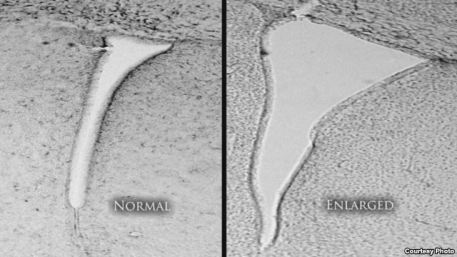
A mouse brain that was exposed to polluted air shows an enlarged lateral ventricle (right) compared with a mouse whose air was clean and filtered. Enlarged lateral ventricles are associated in humans with autism and schizophrenia. (University of Rochester Medical Center)

There’s new evidence of a link between air pollution and some mental disorders, including autism and schizophrenia, say researchers who exposed mice to pollutants and found telltale changes in their brains.

Scientists from the University of Rochester medical school in New York state outlined their findings in the journal Environmental Health Perspectives, published online Thursday.

In initial studies, the researchers exposed certain mice to air pollution and then gave them behavioral tests.

Mice that breathed polluted air did worse on tests of mental functioning than mice that breathed clean air, said research leader Deborah Cory-Slechta, Ph.D. The ones exposed to pollution did worse in a learning test.  And the results were the same when they were tested for memory.

“You could see again there were deficits in that short-term memory,” Cory-Slechta said. “And those we also saw in both males and females.”

The research team decided to see if the pollution was having any physical effect on the laboratory animals’ brains. So they launched a new study.

When they examined the brains of the pollution-breathing mice, they found the lateral ventricles – part of the brain’s cerebrospinal fluid circulatory system – were two to three times the normal size.

In humans, this enlargement is associated with autism, schizophrenia and more, Cory-Slechta said. “It is an indicator of poor development.  It is a prognosis for poor development of children with behavioral, IQ, cognitive, and other kinds of deficits that will persist.”

In addition, structures that communicate between left and right halves of the brain were not fully developed in the pollution-breathing mice.

The laboratory animals were exposed to polluted air just days after birth, and their brains were tested soon after. But the same impairment was found when the brains of several months-old mice were examined, indicating the damage does not go away.

The polluted air in this experiment was made up of ultra-fine particles, which are believed to be more dangerous because they are small enough to get deep into the lungs and into the bloodstream.

Cory-Slechta said her research may help explain why a number of other studies have shown a statistical link between air pollution and autism: “Our data basically, we think, provide a biological plausibility for that kind of association.”

via Air Pollution Linked to Autism, Schizophrenia, Study Finds.

Posted in Air Quality, Health Effects of Air Pollution | Tagged , , | Leave a comment

World Environment Day 2014: Top Five Most Polluted Countries

To celebrate the World Environment Day on 5 June, a day designated by the UN to raise awareness of environmental issues, IBTimes UK looks at some of the countries with the highest rates of pollution.

According to World Health Organisation WHO air pollution – both indoor and outdoor – is the leading cause of death worldwide.

The main causes of pollution are: uncontrolled emissions from motor vehicles, dust, industrial waste, garbage, brick kilns, cooking stoves, burning of wood, coal and bio-mass.

WHO examined the concentration of fine particulates – tiny pieces of solid or liquid matter suspended in the atmosphere – of 2.5 micrometres or less in diameter PM2.5.

These particulates are small enough  to pass into the bloodstream and cause diseases such as emphysema and cancer.

PM 2.5 is the best indicator of assessing health impacts from air pollution.

The concentration of air pollution is measured in micrograms per cubic metre of air ug/m3.

India

The levels of air pollution in Delhi were measured at 163 ug/m3 – the worst air conditions in the world.

This concentration of air pollution is far greater than what is usually considered safe.”Too many urban [centres] today are so enveloped in dirty air that their skylines are invisible,” Flavia Bustreo, WHO Assistant Director-General for Family, Children and Women’s Health, said.

Half of the top 20 cities in the world with the highest levels of PM2.5 are in India, according to WHO.

Bangladesh

The Bangladeshi city with the highest air pollution rate was Narayonganj with a rate of 89 ug/m3, followed by Gazipur 87 ug/m3 and Dhaka 86 ug/m3.

An estimated 15,000 premature deaths, as well as several million cases of pulmonary, respiratory and neurological illness are attributed to poor air quality in Dhaka, according to the Air Quality Management Project AQMP, funded by the government and the World Bank.

Pakistan

The Pakistani city with the highest pollution levels was Karachi, which is the fifth city with the worst level of air pollution 117 ug/m3. Peshawar 111 ug/m3 and Rawalpindi 107 ug/m3 came in at 6th and 7th respectively.

“Pakistan has one of the highest childhood death burdens in the world, and pneumonia is the main single cause of death. As a contributor to the pneumonia burden, the country has a significant indoor air pollution IAP problem,” WHO said.

Iran

Iran city with highest level of air pollution was Khoramabad with a PM2.5 average of 102 ug/m3. It was ranked 8th in a list of cities with high air pollution.

According to city officials, some 270 people die each day from blood cancer, heart and respiratory diseases, and other pollution-related illnesses.

Qatar

The air in the country’s capital, Doha, was ranked 12th most polluted, with a PM2.5 of 93 ug/m3. Al Wakrah came was 25th with 85 ug/m3.According to a 2013 research by Qatar University, the level of fine particles in the air in Qatar is almost six times above the permissible limit.

via World Environment Day 2014: Top Five Most Polluted Countries.

Posted in Air Quality, Asia, India, Iran, Middle East, World News | Tagged , , , , , , , , , , , , , , , , , , | Leave a comment

Genes determine extent of inflammatory response of air pollutants

Scientists at the Helmholtz Zentrum Munchen announced Thursday that people with certain gene variants react with a stronger inflammatory response than those who do not carry this genetic predisposition.

The genetic predisposition is an important factor how people react to air pollutants, said Helmholtz Zentrum Munchen, German Research Center for Environmental Health in the study that is published in the journal International Environment.

According to Helmholtz Zentrum Munchen, air pollutants can cause oxidative stress in the body, which leads to an inflammatory reaction that affects the whole body.

The scientists analyzed inflammatory parameters in a total of 1,765 blood samples that were collected from different groups of patients over a period of 21 months.

At control stations, hourly air measurements were carried out and consequently the pollution levels were calculated.

It was found that patients who had a gene variant for glutathione S-transferase M1 GSTM1 and genetic alterations for the C-reactive protein CRP or fibrinogen, showed clearly increased concentrations of inflammatory mediators in the blood, especially when there are increased levels of air pollution.”

Our results confirm the assumption that air pollutants cause inflammatory reactions, especially in the genetically predisposed persons,” said lead author of the study Dr. Regina Pickford, “Such inflammatory processes precede widespread diseases, such as cardiovascular or metabolic diseases.”

Environmental and lifestyle factors contribute significantly to the emergence of widespread diseases in Germany, such as cardiovascular diseases and diabetes mellitus, said the study.

The aim of the Helmholtz Zentrum Munchen is to develop new approaches for diagnosis, treatment and prevention of common diseases.

via Genes determine extent of inflammatory response of air pollutants | GlobalPost.

Posted in Air Quality, Health Effects of Air Pollution | Tagged , , | Leave a comment

Pollution link to irregular heartbeat and lung clotting

Air pollution is linked to increased risk of developing an irregular heartbeat and blood clots in the lung, research suggests.The impact of air pollution on the risk of heart attack and stroke is less clear, say UK experts.

Analysis of data from England and Wales shows air pollution is particularly harmful in the elderly.Further research is needed on pollution and cardiovascular health, says the British Heart Foundation.

A team at the London School of Hygiene & Tropical Medicine analysed data collected in England and Wales between 2003 and 2009 on links between cardiovascular problems and short-term air pollution.

They found short-term air pollution was linked to arrhythmia abnormal heart rhythm and blood clots in the lung.

The strongest link was in the over-75s and in women, lead researcher Dr Ai Milojevic told BBC News.

“Our main message is that we didn’t have clear evidence for air pollution impact on stroke or heart attack, which ultimately represent general blood clotting processes,” she said.

Commenting on the study, published in the journal, Heart, the British Heart Foundation said previous studies had shown air pollution could make existing heart and circulatory conditions, including heart attacks, worse in vulnerable people.

“This research adds weight to what we already know, but goes further to suggest a link between air pollution and an increased risk of blood clots in the lungs and heart rhythm atrial fibrillation,” said Julie Ward, senior cardiac nurse.

“But, as with many studies, we do need to look at the bigger picture and, although this is a large comprehensive study, it did have its limitations.

“We do, therefore, recognise that further research into exactly how air pollution particles affect the cardiovascular system needs to be carried out.”

Seven million people died as a result of air pollution in 2012, according to World Health Organization estimates.

Its findings suggest a link between air pollution and heart disease, respiratory problems and cancer.

via BBC News – Pollution link to irregular heartbeat and lung clotting.

Posted in Air Quality, Health Effects of Air Pollution | Tagged , , | Leave a comment

Respro® Masks FAQ: What filters do I need for the X-treme™ masks?

What filters do I need for the X-treme™ masks?

Essentially the filters in the X-treme™ function in the same way as the City™ and Sportsta™ filters do. The X-treme™ mask for sports utilises the particulate filtration ability of the Sportsta™ and the X-treme™ mask for urban use, uses activated carbon as its filtration medium.

For more Frequently Asked Questions,  go to Respro® Mask FAQ

Posted in Air Quality | Tagged | Leave a comment

Air Pollution Has Gone Up In Delhi, Mumbai: Survey

The quality of air has gone down in eight cities, including Delhi and Mumbai among others, according to a survey conducted by The Energy and Resources Institute TERI.

More than 80% participants feel that average temperatures have risen while 63% say rainfall levels have decreased gradually.

The survey was conducted in Delhi, Mumbai, Coimbatore, Guwahati, Indore, Jamshedpur, Kanpur and Pune to ‘gauge the perception, awareness, opinion and behaviour of people towards environment.’

The survey focused on the environment, water and waste-related issues.

“Overall, the majority felt that air quality had worsened and the number of bird species in their cities declined. However, most people felt that the availability and quality of drinking water, as well as waste management facilities in their cities had improved,” the survey said.

“A vast majority of respondents 90% felt that climate change was a reality,” it added.

In Delhi, more than 90% people stated that climate changes are occurring and 95% felt that temperature is rising. Over 50% favoured prioritising environment over development.

via Air Pollution Has Gone Up In Delhi, Mumbai: Survey | Business Insider India.

Posted in Air Quality, Asia, India | Tagged , , , , , , , , | Leave a comment

Congestion increasing Sheffield air pollution threat

There are claims that worsening air pollution in Sheffield caused by increasing traffic congestion is posing a serious health threat.

A new survey today says the city has seen the biggest increase in traffic congestion of any major city in the UK. And it follows a government report which showed that Sheffield recorded SIX days last year when the air was potentially harmful to healthy people.

Environmental campaigners say air pollution is becoming so bad that urgent action is needed to drastically cut emissions.

via Congestion increasing Sheffield air pollution threat | Calendar – ITV News.

Posted in Air Quality, Europe, UK | Tagged , , | Leave a comment

Morwell mine fire: air monitoring was lacking as pollution hit hazardous levels

Air pollution was 10 times acceptable levels during the peak of the Morwell coalmine fire in Victoria, but scientists were unable to measure it accurately at the time, an inquiry has heard.

Staff from the state’s Environment Protection Authority EPA who were sent to measure air quality near the Hazelwood mine fire were using a tool that was not calibrated for coal fires when the smoke levels peaked on 15 and 16 February, the inquiry into the blaze was told.

The EPA’s assessments and predictions expert, Paul Torre, said indicative data was passed on to the Health Department on the weekend of 15 February but more accurate data wasn’t able to be generated until several weeks later.

“Some of the data of the 15th and 16th was actually estimated several weeks later or a month later,” Torre told the inquiry on Tuesday. “We weren’t able at that time to provide that information.

“We were just providing air quality forecasts.”

A report produced after the fire showed that over 45 days of air-quality monitoring, from 14 February to 31 March, the level of particles known as PM 2.5 in the air exceeded the acceptable standard on 21 days.

On seven days levels were hazardous and on four days levels were extreme.

On the weekend of 15 February the concentration of smoke particles was greater than 250 micrograms per cubic metre, 10 times the acceptable standard, the inquiry heard.

Torre agreed the indicative data was “accurate enough” to inform the response by emergency personnel during the blaze but said the experience highlighted the need for the EPA to have a rapid response capacity.

“We’re not really geared up for our role in this emergency response space,” Torre said.

The inquiry heard on the weekend of 15 February, EPA scientists were using a piece of equipment known as DustTrak that had to be hired from Tasmania.

“The calibrations the Tasmanians had done was with wood smoke. We wanted to do a bit more calibration,” Torre said. It had been deployed as quickly as possible, he said.

The six-week mine fire that ignited on 9 February shrouded Morwell in smoke and ash, forcing some residents to evacuate.

The DustTrak equipment was monitoring air in Morwell south in addition to EPA equipment at east Morwell.

via Morwell mine fire: air monitoring was lacking as pollution hit hazardous levels | World news | theguardian.com.

Posted in Air Quality, Australia & Oceania | Tagged , , , , , | Leave a comment