London smog leaves babies in buggies ‘vulnerable’ to pollution, minister warns

Toddlers being pushed in buggies down London high streets are “vulnerable” to pollution blamed for thousands of premature deaths a year, a Cabinet minister warned today.

Climate Change and Energy Secretary Ed Davey stressed parents had raised with him fears that when wheeling their young children along busy roads in pushchairs, they are close to the level of exhaust pipes belching out harmful diesel soot.

In an interview with The Standard, the senior Liberal Democrat called on Boris Johnson to step up the battle against dirty air with a quicker switch to electric vehicles.

He also suggested the Mayor put out “smog alerts” on the Transport for London website, at bus stops, possibly on buses and other places where this could be done cheaply.

Accusing Mr Johnson of “flim-flamming about” on improving London’s air, Mr Davey stressed children were particularly at risk from traffic pollution.

“If you had electric vehicles, they would not be exposed. If you had low emission vehicles, they would not be exposed. But at the moment they are vulnerable if they are being pushed down congested high streets. In a buggy they are at near exhaust pipe level,” he said.

“It’s vital for the health of our children that we take this issue far more seriously.”

He accused the Mayor of “not delivering” on a pledge to put London at the forefront of the electric car revolution.

“London needs to go electric and we need to start with the buses,” he added.

“Boris’ record on electric buses is hopeless.”

But Mr Johnson’s allies hit back at Mr Davey’s attack just days before the local elections.

“This is the same Climate Change Secretary who has repeatedly ignored Boris’ entreaties to help us improve air quality,” said one.

The Mayor’s senior environmental adviser Matthew Pencharz insisted Mr Johnson was delivering the most ambitious set of measures in the world to tackle air pollution, including an ultra low emission zone.

“He is pulling every lever that he can – it’s not unreasonable to ask the Government to do its bit too,” he added.

“Since being elected, he has driven down emissions across London, leading to a halving of the number of people living in areas with poor air quality.”

Mr Davey defended his record on making Britain’s energy system greener and accused Mr Johnson of a “cop out” by highlighting that central Government needed to do more on air quality.

The MP for Kingston and Surbiton added: “He has been lackadaisical.

“If there is a smog problem in London, he should be looking every single way possible to get that message over to people.

“If they have got asthma, they can take mitigating effects. If they want to help out, they can change their transport plans – so maybe they would say ‘alright I’ll work at home’.”

He praised Mr Johnson for the Boris Bike scheme and supported his call for changes to car tax – vehicle excise duty system – to tackle local air pollution as well as climate change.
via London smog leaves babies in buggies ‘vulnerable’ to pollution, minister warns – London – News – London Evening Standard.

Posted in Air Quality, Europe, London, UK | Tagged , , , | Leave a comment

Scooters pollute more than lorries

Scooters produce more pollution than larger vehicles such as lorries, scientists have discovered.

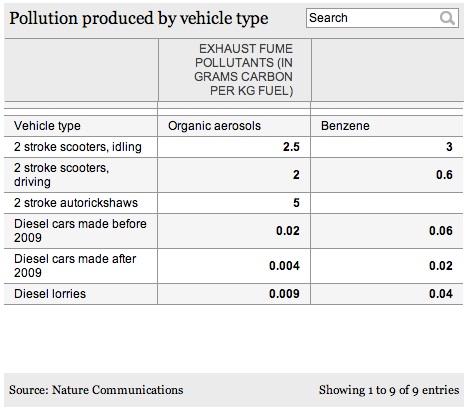
An idling scooter can give off thousands of times more smog-causing “organic aerosols” than larger vehicles, according to a study.

It means that even though the number of scooters on the roads are relatively small when compared to cars and lorries, they contribute relatively more to pollution in cities.

The scientists, including some from the University of Cambridge, also found high levels of cancer-causing benzene and a family of toxic chemicals known as “reactive oxygen species” in the emissions.

They warn that even waiting behind a scooter at a junction “may be highly deleterious to health”.

Markus Kalberer, one of the scientists involved in the study from the centre for atmospheric science at the University of Cambridge, said: “We showed that, in contrast to the general belief, scooters can be a dominant source of air pollution, including soot and organic particles, in urban areas.

“We showed that the particles transformed the atmosphere from these scooter emissions are especially toxic.”

Scooters typically use two-stroke engines, which are far less efficient at burning the fuel they use.

The exhaust systems are also less effective at removing pollutants than catalytic converters found in most modern cars.

This means that exhaust fumes from scooters contain higher levels of the chemicals found in the fuel and oil they use.

The scientists measured the emissions produced by range of different vehicles and found that two stroke engined scooters emit significantly more primary organic aerosols and volatile organic compounds from incomplete burning of the fuel.

They also produced significant secondary organic aerosols as gases released from the exhaust reacted with the air and microscopic particles of soot, which are known to increase the risk of heart and lung disease.

They also found that older two stroke vehicles produced reactive oxygen molecules that are known to be potentially harmful lung health.

As well as testing different scooters in the laboratory, the scientists assessed the air pollution in cities in Europe, the US and Asia.

Pollution by vehicle typeThey claim that reducing the number of two-stroke scooters would improve urban air quality significantly and cost-effectively, even though less than 1 per cent of fuel in the European Union is currently used in scooters.

Several Chinese cities have banned scooters and report markedly reduced air pollution, even when other traffic has increased.

In a paper published in the journal Nature Communications, the authors said that in some cities scooters may contribute up to two thirds of the roadside air pollution.

They said: “Using average two stroke scooter emission factors… suggests that two stroke scooters contribute to around 60% of roadside POA in Bangkok, where they account for 10% of fuel consumption.

“Our data suggest that two stroke scooters are a significant, and in many cities, the largest source of vehicular particular matter and toxic secondary organic aerosols and aromatic hydrocarbons, despite being a relatively small fraction of the total fleet.

“Therefore, given the alternative technologies available, restrictions on two stroke scooters, already implemented in China, could improve air quality in many cities around the globe.”

Stephen Platt, the lead author of the paper from the Paul Scherrer Institute in Switzerland, added: “Cars and trucks, particularly diesel vehicles, are thought to be the main vehicular pollution sources.

“This needs re-thinking, as we show that elevated particulate matter levels can be a consequence of ‘asymmetric pollution’ from two-stroke scooters, vehicles that constitute a small fraction of the fleet, but can dominate urban vehicular pollution through organic aerosol and aromatic emission factors up to thousands of times higher than from other vehicle classes.”

via Scooters pollute more than lorries – Telegraph.

Posted in Air Quality, World News | Tagged , | Leave a comment

Air pollution levels spike following Lag Ba’omer

Following two days of Lag Ba’omer bonfires, most air pollution monitoring stations throughout the country recorded markedly increased concentrations of respirable particles, the Environmental Protection Ministry reported on Monday.

Respirable particle concentrations achieved peak levels between 9 p.m. on Sunday and 3 a.m. on Monday, the ministry said.

Particularly striking was the sharp rise in the presence of PM2.5, fine respirable particles with a diameter of 2.5 microns or less, the ministry added.

While the Council of the Chief Rabbinate formally moved Lag Ba’omer bonfires and festivities from Saturday night to Sunday night, in order to prevent Shabbat violations, many fires were still kindled on Saturday night as well.

A comparison of the data between the two nights shows increases in pollution levels at some stations and decreases at others, due to various methods of fire kindling as well as changes in meteorological conditions, the ministry said.

Among the monitoring stations with the greatest concentrations of PM10 – respirable particles with a diameter of 10 microns or less – were those at Beersheba, Givatayim and South Tel Aviv’s Hatikva neighborhood.

Beersheba showed 146 micrograms per cubic meter, 2.4 times the city’s normal values, while Givatayim and Tel Aviv had 145 micrograms per cubic meter, also 2.4 times the typical daily values for these cities.

Not far behind were Rehovot and Yad Rambam, with 123 micrograms per cubic meter and 121 micrograms per cubic meter respectively, and 2.1 times the normal daily values for both places, the ministry data said.

As far as PM2.5 concentrations were concerned, Nir Yisrael, a moshav near Ashkelon, stood out with the worst levels, with 242 micrograms per cubic meter, and 8.1 times the typical values for the area.

Ashdod was a close second with 226 micrograms per cubic meter – 7.5 times the normal daily values – followed by Rishon Lezion and Gadera, with 168 and 158 micrograms per cubic meter, and 5.6 and 5.3 times their normal daily values respectively.

The Lag Ba’omer data comes a week after a World Health Organization global air pollution report, in which Israel tied for 22nd worst place in the world, in terms of PM10 concentrations, and tied for 40th worst in terms of PM2.5 concentrations.

The WHO study recorded Israel’s average PM10 levels in 2010 as 64 micrograms per cubic meter – more than three times the accepted WHO standard – and PM2.5 levels of 23 micrograms per cubic meter – more than two times the accepted standard.

The Environmental Protection Ministry said that current average concentrations for PM10 and PM2.5 are about 60 and 30 micrograms per cubic meter respectively.

This year, monitoring stations in Gush Dan and Jerusalem saw relatively low particle concentrations, due to the reduction of open spaces available for bonfires within the cities, the Environment Ministry said.

Field studies showed, however, that there was an increase in the frequency in visits to emergency rooms near bonfire hubs due to worsening air quality on Lag Ba’omer, the ministry added.

via Air pollution levels spike following Lag Ba’omer | JPost | Israel News.

Posted in Air Quality, Middle East | Tagged , , , , , , | Leave a comment

La Linea tops Spanish air pollution blacklist

IT’S a finding that won’t surprise anyone living in Gibraltar.

A recent World Health Organisation (WHO) report has found La Linea to have the worst air pollution in Spain. The Algeciras Bay is home to one of the country’s largest petrochemical refineries.

Four other Andalucian towns were also included in the worst ten polluted list.

WHO’s urban air quality database covered 1600 cities across 91 countries showing more cities worldwide are monitoring outdoor air quality alongside growing recognition of air pollution’s health risks.

The shocking report highlighted the fact that half of the urban population is exposed to air pollution that is at least 2.5 times higher than the levels WHO recommends – putting those people at additional risk of serious, long-term health problems.

The WHO has called for greater awareness of health risks caused by air pollution, implementation of effective air pollution mitigation policies and close monitoring worldwide.

“Too many urban centres today are so enveloped in dirty air that their skylines are invisible,” said Dr Flavia Bustreo, WHO Assistant Director-General for Family, Children and Women’s Health.

“Not surprisingly, this air is dangerous to breathe. So a growing number of cities and communities worldwide are striving to better meet the needs of their residents – in particular children and the elderly.”

The report wasn’t all gloom and doom for Andalucia, however. Marbella was rated by the WHO as the third-best city in Spain for air quality.

Ten most polluted Spanish cities

1. La Línea de la Concepción, Cádiz (18 microgramos/m3)

2. Toledo (17 microgramos/m3)

3. Málaga (17 microgramos/m3)

4. Barcelona (16 microgramos/m3)

5. Granada (16 microgramos/m3)

6. Jaén (16 microgramos/m3)

7. Logroño (16 microgramos/m3)

8. Sevilla (16 microgramos/m3)

9. Valencia (14 microgramos/m3)

10. Pamplona (14 microgramos/m3)

via La Linea tops Spanish air pollution blacklist.

Posted in Air Quality, Europe, Spain | Tagged , , , , , , , , , , , , , | Leave a comment

Finland swept by fine particle pollution

Air pollution experts report that Finland is on the receiving end of more than the usual amount of air pollution from eastern Europe. Air currents originating from the southeast are carrying particles of pollution from Poland, Ukraine, Belarus and Russia, says air pollution control specialist Anu Kousa from Helsinki region environmental services. Air quality control officials say the pollution is emanating from traffic, energy production and possibly even from forest fires in the east.

“Fine particles and street dust have caused a deterioration of the air quality in the Helsinki region so that the air quality is now satisfactory or poor, when it’s usually satisfactory or even good,” Kousa added.

The air quality in cities such as Oulu and Tampere was also poor Monday morning and satisfactory in areas such as Jyväskylä, Kuopio and Lappeenranta. However concentrations of pollution are still at a reasonable level, and although they are expected to increase over the next few days, air quality control specialists don’t expect that air quality will worsen.

A regular spring occurence

“We see this happening every spring,” Kousa noted.

Usually Finland is swept by Atlantic currents, which tend to be cleaner. However even Atlantic currents can first make their way through eastern Europe, picking up fine particles along the way.

“There is however less pollution in central Europe than in eastern Europe. The air is cleanest when it comes from up North, for example from Sweden or Norway,” she added.

Fine air particles can pose a health risk as they can aggravate symptoms related to respiratory and heart diseases. Adding to the discomfort of these groups and allergy sufferers is high quantities of birch pollen in the air. Children and the elderly are particularly sensitive to these health issues.

According to Kousa people should aim to protect themselves from particle pollution and local street dust by avoiding physical exertion such as running near busy streets. However Helsinki Environmental Services is not advising anyone against going outdoors because currently the concentration of particles in the air is not dangerously high.

via Finland swept by fine particle pollution | Yle Uutiset | yle.fi.

Posted in Air Quality, Europe | Tagged , , , , | Leave a comment

Wildfire Smoke Affecting San Diego’s Air Quality

Smoke from the multiple wildfires in San Diego County is negatively affecting the air above parts of San Bernardino County was warned by the air quality officials on Saturday.

The Santa Ana winds out of the northeast caused the flames to spread rapidly and pushed smoke over the Pacific Ocean when the wildfires first erupted Tuesday and Wednesday. Thereafter, the wind shifted and the blowing wildfire smoke northeast from San Diego County to Orange, Riverside and San Bernardino counties later in the week.

The unhealthy air existed in the central San Bernardino Mountains, the Perris valley and near Lake Elsinore according to update from the South Coast Air Quality Management District at 3 p.m. on Saturday. The AQMD have classified the surrounding areas of the regions like the central and east San Bernardino Valley, the east San Bernardino Mountains and areas near Hemet, Temecula and the Coachella Valley to be unhealthy air for sensitive people – such as infants, elders and those with respiratory illnesses.

A news release on Saturday was issued by the air quality district advising people in areas who are directly affected by the smoke to refrain from vigorous outdoor activities and recommended closing of doors and windows.

“All individuals are urged to exercise caution and avoid unnecessary outdoor activities in any area directly impacted by smoke,” the news release explained. “This includes areas where residents can see or smell smoke.”

The agency says on its website that the South Coast AQMD is the air pollution control agency for the urban portions of San Bernardino, Riverside and Los Angeles counties and all of Orange County.

via Wildfire Smoke Affecting San Diego’s Air Quality | American News.

Posted in Air Quality, USA & Canada | Tagged , , , , | Leave a comment

Respro® Masks FAQ: How do the Sportsta™ and City™ mask differ?

How do the Sportsta™ and City™ mask differ?


Aside from the differences in filtration (explained below), the Sportsta™ mask offers the wearer increased comfort over the City™ mask for the following two reasons:


1. The Powa valves incorporated in the Sportsta™ have a larger bore size than the Standard valves allowing heat, water vapour and Carbon dioxide to be exhaled more efficiently through the valve system and not through the filter material. The larger bore size also allows a sports person to compete at peak physical exertion without experiencing breathing resistance when exhaling.


2. The sides of the Sportsta™ mask have mesh side panels to assist ventilation of the face, keeping the user cool.


For more FAQ,  see Respro® Mask FAQ

All Respro® products are available from our website respro.com


Posted in Air Quality | Tagged | Leave a comment

Paris pollution levels dropped during March’s car ban

EMERGENCY measures to fight March’s spike in pollution in Paris had a small but measurable effect, air-quality monitors in the capital have said.

In a report published yesterday Airparif, the NGO that monitors air quality, revealed that the registration plate-based ban on vehicles reduced fine particle pollution in the city by 6%.

Airparif described the ban as having a “quantifiable and visible impact”, but it warned that it would take “sustainable large-scale action” to reduce chronic pollution levels in Paris.

During the restrictions, air quality especially improved in areas closest to the usually busy Peripherique, where speed limits were cut to 70kph in January speed limits were cut to 70kph in January in a bid to cut pollution levels.

The restriction on cars based on their licence plate numbers was criticised by commuters who were unable to use their vehicles, but the report showed that levels of PM10 pollutants were down 15%, with a 20% drop in nitrogen dioxide emissions during the 18-hour ban.

Travel on public transport was free during the crisis in Paris and other French cities.

Now, Paris’s newly elected mayor Anne Hidalgo recently elected mayor is to propose rapid-response traffic restrictions in an anti-pollution plan she will present to the city council on Monday.

It proposes making residential parking free and will impose a ban on buying diesel vehicles for the municipal fleet.

Ms Hidalgo plans to keep the alternating traffic scheme and wants it implemented as soon as pollution rises to dangerous levels in the capital.

Airparif’s report also noted that, despite the general decrease in air pollutants in 2013, Paris’s air still does not meet European standards.

via Paris pollution levels dropped during March’s car ban – The Connexion.

Posted in Air Quality, Europe, France | Tagged , , | Leave a comment