Smog over Britain: Air pollution ‘will get worse’ as more drivers choose diesel powered cars

The smog-like conditions which brought a haze to swathes of Britain will become even more frequent as diesel car ownership soars, a leading pollution expert has warned.

Diesel engine emissions pose the single greatest public health challenge for UK cities in the years to come, claims Timothy Baker of King’s College London.

Asthma, chronic bronchitis and emphysema sufferers complained of breathing problems, with air pollution reaching “high” levels in rural areas of the South-east and East Anglia. The pollution, which is forecast to remain until Friday, is a mix of traffic and power station emissions and dust from the Sahara.

Some schoolchildren in London were kept indoors at lunchtime to avoid them having asthma attacks and potentially life-long lung damage.

Professor Frank Kelly, a Government adviser, urged other schools in affected areas to do the same. “As a general response this is a good approach as children tend to run around outside and therefore breathe deeper,” he said.

Dr Keith Prowse, the honorary medical adviser to the British Lung Foundation, warned those who suffer from asthma to stay indoors and said going running would be “sheer stupidity” while pollution levels remained high. He added that the effects of the Saharan dust storm, which exacerbated the pollution, are likely to persist for days.

Mr Baker, deputy manager of MRC-PHE Centre for Environment and Health, warned that the growing popularity of diesel cars will push air pollution levels even higher. To make matters worse, diesel fumes have been found to have a role in causing cancer.

“The way things are going, pollution levels are likely to rise in the coming months and years. Traffic emissions are a big and growing problem in the UK because of the dramatic increase in diesel cars in the last few years,” Mr Baker told The Independent.

“This is one of the big challenges in the years to come for public health and, within the urban environment, it’s probably the biggest challenge.”

UK

Sales of diesel cars recently overtook petrol engines, accounting for 51 per cent of new cars bought, compared to just 14 per cent in 2000. Drivers seek these vehicles because they are cheaper to run and emit less carbon dioxide, but the fine particles created by the engines pose huge health risks, he said. Pollution levels hit the highest ranking of 10 on the Department for Environment, Food and Rural Affair’s index in Norfolk and much of East Anglia. When pollution hits this level people are advised to “reduce physical exertion, particularly outdoors, especially if you experience symptoms such as sore eyes, cough or sore throat”.

Paula Browne, a Norfolk-based NHS respiratory nurse adviser, said people with breathing conditions had reported difficulties earlier in the week before pollution levels made headline news.

“We had quite a few people saying that they hadn’t felt that good but they couldn’t put their finger on why because the weather had been nice. But they said it made sense when they woke up to see the high pollution levels,” she said.

Ms Browne said people suffering from chronic obstructive pulmonary diseases such as emphysema and bronchitis were the worst affected. They typically feel short of breath when the weather is very hot, windy, damp or wet – none of which was the case earlier this week.

“I don’t know if the full effects of the pollution will be felt for several days yet. I wouldn’t be surprised if people were more affected at the weekend because the inflammation can take time,” she added.

A spokesman for the environment department said that the pollution level today is likely to remain “high to moderate” across much of the South-east, Midlands and East Anglia but should ebb away by Friday.

Sahara dust: The causes of this week’s smog

This week’s pollution is caused by a combination of dust blown in from the Sahara, as well as harmful emissions, largely from car exhausts and power plants, from the UK and Europe. Light winds have allowed this cocktail of natural and manmade pollutants to linger in the skies above the country.

The haze contains pollutants such as carbon monoxide, nitrogen dioxide and ozone. It can cause runny eyes and noses, as well as coughs and sore throats, but the effects can be more serious among the very young, the elderly and those with heart or lung problems. It can also be carcinogenic. The pollution has left a layer of orange dust on cars as the rain clears it from the upper atmosphere and brings it down to lower levels.

The Defra Daily Air Quality Index, which hit the top level of 10 yesterday in parts of East Anglia and the South-east, is calculated by measuring pollutants – ozone, nitrogen dioxide, sulphur dioxide and tiny particulate matter, known as PM10 and PM2.5.

Each pollutant is measured in a different way. For example, ozone is measured by shining UV light through air. The ozone will reduce the amount of UV light getting through, which tells us how much ozone is in the air.
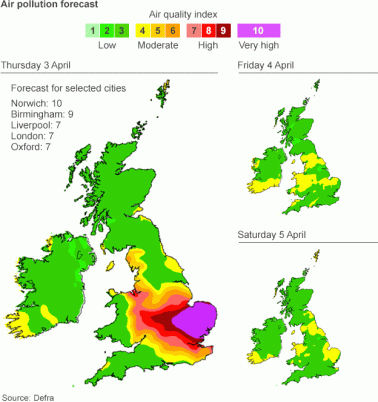
via Smog over Britain: Air pollution ‘will get worse’ as more drivers choose diesel powered cars – Climate Change – Environment – The Independent.

Posted in Air Quality, London, UK | Tagged , , , , | Leave a comment

Air pollution: High levels continue to affect UK

High levels of air pollution are continuing to affect parts of the UK on Thursday, according to experts.

Data from environment department Defra shows London has reached the maximum level 10 – meaning very high.

Levels in eastern England have reached nine – meaning high – with the South East and north-west England, the Midlands and north Wales also affected.

Health warnings have been issued for people with lung and heart conditions, as well as for those with asthma.

The prime minister admitted the atmosphere in the capital was “unpleasant”.

The smog-like conditions, which are expected to clear on Friday, are caused by a mixture of local and continental pollution, and dust from the Sahara.

‘Risk of attack’

Defra (the Department for Environment, Food & Rural Affairs) has a 10-point scale for measuring air quality – with level one implying a “low” risk of air pollution and 10 for “very high” levels.

Levels in eastern England had reached level nine – meaning high – by Thursday morning.

UK

“Moderate” levels are expected in parts of Northern Ireland and “many other parts of England and Wales” on Thursday, Defra added.

On Wednesday, levels were recorded at eight in parts of south-east England and East Anglia, with level seven in Greater London.

Levels are determined by the concentration of five pollutants in the air – ozone, sulphur dioxide (SO2), nitrogen dioxide (NO2) and two types of particulate matter.

High levels of air pollution are usually reached about five times a year.

BBC weather presenter Tomasz Schafernaker said: “We have to wait until the end of week before we see Atlantic winds coming in which will help to improve the quality of the air across the UK.”

David Cameron described the pollution as “extraordinary” and urged people to seek advice from the Met Office and Public Health England.

He said: “I didn’t go for my morning run this morning, I chose to do some work instead but you can feel it.”

In Wales, health officials have warned air pollution is predicted to be very high.

Parts of the north east of the country are expected to reach level eight – meaning high – around the Dee estuary.

People with lung and heart problems are advised to avoid strenuous activity outdoors, while those suffering symptoms of pollution – including sore eyes, coughs and sore throats – should cut down the amount they do outside, Defra said.

And Kay Boycott, chief executive of Asthma UK, said “the two-thirds of people with asthma who find that air pollution makes their asthma worse will be at an increased risk of an attack”.

“Asthma UK warns the 3.6 million people at increased risk to be sure they always have a working blue reliever inhaler on them and take their preventer inhalers as prescribed,” she said.

In February, the European Commission launched legal proceedings against the UK for failing to reduce levels of NO2 air pollution.

via BBC News – Air pollution: High levels continue to affect UK.

Posted in Air Quality, London, UK | Tagged , , , , | Leave a comment

UK smog alert: how bad is it?

c4 graph

The east of England and Midlands are the worst-affected areas but large swathes of England and Wales will see high levels of pollution on Thursday, the Department for Environment, Food and Rural Affairs (Defra) said.

The elevated pollution levels have been caused by a combination of light south-easterly winds, the continental air flow and dust which has blown up from the Sahara desert, a spokeswoman said.

On Wednesday north-west Norfolk should experience the highest level of air pollution. According to Defra’s pollution forecast, the people in the region can expect “very high” levels of pollution.

Other parts of East Anglia will experience “high” levels and parts of south-east England and the Humber region will experience “moderate” pollution.

But it could be worse, as Channel 4 News has found out.

Beijing

Chinese Premier Li Keqiang “declared war” on pollution in a major policy address in March, but China has long struggled to strike a balance between protecting the environment and keeping up economic growth.

Rapid urbanisation brought dust from new housing and road building, while more traffic increased emissions. Slower wind speeds than usual in northern China were an additional contributing factor last year.

Beijing’s mayor promised in January to spend $2.4bn on improving air quality this year as part of an “all-out effort” to tackle pollution, though similar pledges in the past have brought little improvement.

Mexico City

Mexico City’s air pollution sent more than one million people to hospitals in 1999. Despite planting ten million trees and introducing alternative fuels for government vehicles, air pollution remains one of the most daunting environmental issues facing Mexico City.

More than three million vehicles on the road each day are mostly to blame, but so are industries and small factories, deforestation, and fires.

Ulaanbaatar

Ulaanbaatar in Mongolia is the coldest capital in the world. It has a population just over a twentieth of Beijing, yet according to the World Health Organization, it is considered the second most polluted city in the world – behind Ahvaz, Iran.

Its temperatures plunge when winter sets in and people begin to seek heat by firing up old, coal-powered stoves. Millions of stoves ignited around the same time produce a smog so thick, it hangs like a yellow cloud you can see from any hilltop.

Pollution is believed to be responsible for one in ten deaths and a 45 per cent rise in the number of patients with respiratory illnesses between 2004 and 2008.

Ahvaz

Ahvaz in south Iran is one of the world’s most polluted cities, according to a recent air quality survey by the World Health Organization. The city, with a population of about 1.2m people, had the highest count of small airborne particles out of 1,100 urban areas around the world.

The hub of Iran’s oil production, Ahwaz is marked by thick orange smog that often saturates the city. Iranian officials blame its high levels of air pollution on the presence of US forces during the Iran-Iraq war, but other researchers point to the city’s heavy oil, metal and petrochemical industries.

Santiago

Santiago in Chile deals with substantial amounts of smog each year. This blanket of pollution is caused by a plant powering one of the largest copper mines in the world.

Atmospheric and geographic conditions worsen the problem. With Santiago nearly surrounded by mountains, covered by a layer of warm air, and with little rain or wind, smog gets trapped. The result is a brown cloud of pollution permanently hanging over the city.

New Delhi

In Delhi, India the pollution, created by vehicles and industrial plants, is particularly severe in winter, when low temperatures keep emissions close to the ground.

Thick blankets of smog covered the capital through most of March, leading to bleak days, hundreds of cancelled flights and a cacophony of coughs on the city’s streets.

The previous Delhi government had put together a plan to tackle air pollution, involving better monitoring mechanisms, cutting the number of vehicles on the roads, and stricter parking policies. But the plan remains unimplemented.

London smog (Getty)

Other famous smogs from the past

A dense fog covered London between the 5 and 8 December 1952. Trying to keep warm, Londoners piled extra coal into their fireplaces, sending plumes of black, sooty smoke into the air that mixed with clouds of exhaust from factories and coal-burning power plants.

Over the next five days a thick haze hovered over the streets, penetrating homes and offices. The great smog led to several changes in practices and regulations, including the Clean Air Act 1956. London Plane Trees were also introduced to help clean the air after the great smog.

The 1948 Donora smog in Pennsylvania, US, killed 20 people and sickened 7,000 people – half the town’s population.

The smog was caused by a decrease in temperature combined with hydrogen fluoride and sulphur dioxide emissions from steel plants. The Town of Donora’s business district is today empty, and full of crumbling and decayed buildings.

via UK smog alert: how bad is it? – Channel 4 News.

Posted in Air Quality, London, UK | Tagged , , , | Leave a comment

UK smog alert: vulnerable people advised to stay indoors

map

“Periods of very high pollution in London arise usually because the city’s normal pollution emissions are increased further by polluted air arriving on light winds from neighbouring areas such as northern Europe,” he said.

“However, whether home-produced or arriving from the continent, the tiny particles we take into our bodies with each breath cause immediate problems for some individuals such as those with asthma and contribute to longer-term problems for most of us in the form of heart disease and stroke.

Forecasters warned that one of the year’s worst smogs would worsen as Wednesday progressed, with air pollution reaching the maximum “very high” level in many parts of southern Britain.

The unusually high levels of air pollution are a result of inland smog and powerful dust storms swept in from the Sahara by strong gales.

“We usually see this happen several times a year when big dust storms in the Sahara coincide with southerly winds to bring that dust here,” said Paul Hutcheon at the Met Office. “More dust rain is possible during showers expected later this week.”

The Department for Environment, Food and Rural Affairs (Defra) said air pollution levels on Wednesday were expected to reach eight or nine on a 10-point scale in much of southern England, the Midlands and southern Wales.

The southern coast – which was battered by torrential rain and storm winds earlier this year – is forecast to see pollution hit the maximum level 10.

Adults and children with lung problems, heart defects and older people are being urged to avoid any strenuous activity and asthma-sufferers have been told to use their inhaler more often.

Advice on the Defra website for the general population facing “very high” pollution levels states: “Reduce physical exertion, particularly outdoors, especially if you experience symptoms such as cough or sore throat.”

Defra forecasters issued the fresh warning after air pollution levels reached 10 in north-west Norfolk on Tuesday.

“For England and Wales, moderate to high air pollution levels are forecast for central and south-east England, to the south and east of a line from around the Wash to Cheshire to east Devon, with local very high levels expected in parts of East Anglia and the East Midlands,” said a Defra forecaster.

“This is due to light easterly winds continuing to bring in pollutants and allow local pollutants to remain close to source. There may also be some component due to Saharan dust.”

Conditions are expected to worsen on Wednesday evening and into Thursday as the smog extends north.

High levels of pollution are forecast to stretch across East Anglia, the Midlands, Lincolnshire, through the Wirral to north and east Wales, then further norther over much of England’s north-west coast, south-west Scotland and the north-east of Northern Ireland.

Cleaner air from the Atlantic should bring some respite for south-west wales and England’s southern-most counties on Thursday, forecasters said, although many other parts of England and Wales will experience higher levels of smog than usual.

Keith Taylor, the Green party’s member of European parliament for south-east England, said the high level of pollution showed the need for stronger government action.

“Episodes like this often have a number of contributing factors,” he said. “What seems clear is that towns and cities across south-east England need to reduce the level of air pollution in their streets by cutting the amount of traffic. But on top of that it’s clear that our government must play a role in pushing for stronger air pollution laws from the European Union, rather than trying to water down the rules we already have.”

The UK faces fines of up to £300m a year and embarrassing court appearances after the European commission launched legal proceedings against it for failing to reduce “excessive” levels of nitrogen dioxide (NO2) air pollution from traffic, despite 15 years of warnings and several extensions and postponements granted to the government.

According to the World Health Organisation, air pollution has become the world’s single biggest environmental health risk, linked to around 7 million deaths a year – or nearly one in eight deaths in 2012.

via UK smog alert: vulnerable people advised to stay indoors | Environment | theguardian.com.

Posted in Air Quality, London, UK | Tagged , , , , | Leave a comment

Respro® Masks FAQ: Can the mask be washed?

Can the mask be washed?

It is recommended that you wash the neoprene shell of the mask every month under normal use. To do this it is necessary to remove the filter and the valve first. Although spare valves and filters are available from your retailer, please be careful not to misplace any of the components during maintenance.

For more FAQ,  see Respro® Mask FAQ or visit our YouTube channel youtube.com/ResproMasks

All Respro® products are available from our website respro.com

Respro® will ship your order to anywhere on the planet free of charge.

Posted in Air Quality | Tagged | Leave a comment

Air pollution: High levels ‘to spread across England and Wales’

High levels of air pollution which have been affecting parts of England are set to get worse and spread, experts say.

Environment department Defra says “high” or “very high” levels have been recorded in the past 24 hours mainly in the East of England and the Midlands.

It expects the pollution – linked to sandstorms in the Sahara – to spread across England and Wales on Wednesday.

Defra says air pollution can cause respiratory problems and people with heart or lung disease are most at risk.

Rain particles

Andrew Sibley, specialist forecaster for the Met Office, said: “Conditions are going to get worse again as we go through Wednesday and the rest of the week.”

He said that a south-easterly wind would bring with it yet more pollution from Europe, and further compound the situation in the UK.

Mr Sibley said that dust and sand particles from the Saharan desert could easily get swept up by high winds and carried thousands of miles across the globe.

“The dust gets caught by rain particles and that’s how it ends up being visible on the ground,” he said.

A Defra spokeswoman said: “The high level of air pollution this week is due to a combination of local emissions, light winds, pollution from the continent and dust blown over from the Sahara.

“We want to keep improving air quality and have introduced a new five-day forecast service in addition to investing heavily in local and transport initiatives to tackle this issue head-on.”

It is warning of “high” or “very high” air pollution levels across much of England and Wales.

And the high levels of pollution are expected to continue across East Anglia and the Midlands on Thursday.

But the pollution is expected to ebb away by Friday.

via BBC News – Air pollution: High levels ‘to spread across England and Wales’.

Posted in Air Quality, London, UK | Tagged , , , , , , | Leave a comment

Saharan dust prompts ‘very high’ air pollution threatening sick and elderly

Saharan dust is contributing to unusually high levels of air pollution, threatening the health of elderly and vulnerable people in the UK.

Parts of eastern England, the Midlands and Wales over the next few days will experience the highest levels of air pollution on the government’s official scale, and those with heart and lung problems have been warned by environmental experts to avoid “strenuous activity”.

The Department for Environment, Food and Rural Affairs (Defra) said certain areas would reach 10 out of 10 – or “very high” – on its air cleanliness chart on Tuesday and Wednesday.

When levels reach 7 to 9 on Defra’s chart, adults and children with lung problems and adults with heart problems are advised to reduce exertion.

Those with asthma are told they may find they need to use their inhaler more often and older people are also advised to reduce physical exertion.

When pollution levels reach 10, the general population is told to “reduce physical exertion, particularly outdoors, especially if you experience symptoms such as sore eyes, cough or sore throat”.

Defra said the elevated pollution levels have been caused by a combination of light south-easterly winds, the continental air flow and dust which has blown up from the Sahara desert.

North-west Norfolk should experience the highest level of air pollution on Tuesday, while East Anglia will experience “high” levels and parts of south-east England and the Humber region will experience “moderate” pollution.

Experts are anticipating “high” or “very high” air pollution levels across much of England and Wales on Wednesday.

The high levels of pollution are expected to continue across East Anglia and the Midlands on Thursday, but the air pollution is expected to ebb away by Friday.

Last weekend, some people found their cars to be covered in a light coating of red dust. The Met Office said that a large amount of sand and dust was swept up by storm winds in the Sahara Desert.

Experts said that the airborne particles of dust were blown north to the UK where they combined with our warm air and were deposited during showers.

via Saharan dust prompts ‘very high’ air pollution threatening sick and elderly – Telegraph.

Posted in Air Quality, London, UK | Tagged , | Leave a comment

Met Office Warns London and South About Saharan Dust Storm

UK residents especially those living in London are being warned that dust from a Saharan storm could be a contributing factor to one of the worst smogs of the year, expected later this week.

Southerly winds from north Africa already blanketed cars with sand in the South West last weekend, mostly affecting Devon and Cornwall, and there is more dust to come, the Met Office has warned.

A Met Office spokesman said: “A lot will depend on how big the storm is and how much sand it will pick up on the way. But it is likely it will affect the south of the country.”

Paul Hutcheon, deputy chief forecaster, said: “We usually see this happen several times a year, particularly in summer when you get these big dust storms in the western Sahara and the southerly winds to bring that dust here.”

The Department for Environment, Food and Rural Affairs (Defra) is predicting the high levels of air pollution in England and Wales tomorrow and Wednesday.

In light of the “very high level” of pollution expected this week Defra warned that adults and children with lung and heart problems, including older people, should avoid strenuous physical activity, adding that “people with asthma may find they need to use their reliever inhaler more often”.

London Assembly Green Party Member Jenny Jones said: “More and more Londoners are getting more and more concerned about the dangerous levels of air pollution in our capital.

“Rather than solving the problem the Mayor seems intent on making the problems worse, backing new road building schemes and increased airport capacity. We need firm action to deliver cleaner vehicles as well as reduce the overall level of traffic on our roads.”

Defra’s Recommended Actions and Health Advice

Air Pollution Banding Value Accompanying health messages for at-risk individuals* Accompanying health messages for the general population

Low 1-3 Enjoy your usual outdoor activities. Enjoy your usual outdoor activities.

Moderate 4-6 Adults and children with lung problems, and adults with heart problems, who experience symptoms, should consider reducing strenuous physical activity, particularly outdoors. Enjoy your usual outdoor activities.

High 7-9 Adults and children with lung problems, and adults with heart problems, should reduce strenuous physical exertion, particularly outdoors, and particularly if they experience symptoms. People with asthma may find they need to use their reliever inhaler more often. Older people should also reduce physical exertion. Anyone experiencing discomfort such as sore eyes, cough or sore throat should consider reducing activity, particularly outdoors.

Very High 10 Adults and children with lung problems, adults with heart problems, and older people, should avoid strenuous physical activity. People with asthma may find they need to use their reliever inhaler more often. Reduce physical exertion, particularly outdoors, especially if you experience symptoms such as cough or sore throat.

via Met Office Warns London and South About Saharan Dust Storm.

Posted in Air Quality, London, UK | Tagged , , , , | Leave a comment