Turkey’s 13 cities had ‘high air pollution’ in 2020

The aptly titled “Dark Report” from the non-profit Right to Clean Air Platform (THHP) based in Turkey paints a gloomy picture of air pollution in Turkey. The report, based on data from pollution measurement stations, says 13 provinces out of 81 in the country suffered from high levels of air pollution in 2020 – a year when contributions to pollution peaked due to disruptions to daily life caused by the COVID-19 pandemic.

Average annual particulate matter values (PM10) recorded at 97.7% of the 175 measurement stations, exceeded guideline values set by the World Health Organization (WHO), the report says.

Guideline values set a limit on tolerance of air pollutants before it poses a public health risk. Particulate matter is the most comprehensive indicator for air pollution and includes sulfate, nitrates, ammonia, sodium chloride, black carbon, mineral dust and water. Particles smaller than 10 microns in diameter can penetrate the lungs, endangering human health.

According to the report, air pollution in 45 provinces surpassed national limits in pollutants. Fifteen stations in the provinces of Muş, Iğdır, Malatya and Ağrı in the east, Istanbul, Edirne and Denizli in the west, the capital Ankara, the northern provinces Tokat, Düzce, Sinop and Karabük and the central province of Kayseri indicate they all suffer from high pollution, while only Bitlis and Hakkari, two small provinces in the east, had PM10 below WHO guideline values. The report singles out Muş as having the most polluted air, which “the population has to breathe for 306 days in a year.”

Istanbul, as the country’s most crowded city, prominently figured in the Dark Report, although it boasted a lower PM10 average compared to previous years. Still, the 2020 levels were two times higher than WHO guideline values. Four districts and neighborhoods of the city had levels three times higher level than the WHO limit. These were Mecidiyeköy on the European side of the city, a busy hub of transportation and businesses, the developing suburb Sultangazi, Esenyurt, which has seen a population boom in recent years, and Alibeyköy. In the capital Ankara, air pollution levels recorded by a station in Siteler, an industrial neighborhood dotted with furniture factories, were four times higher than the WHO limits.

In Izmir, the country’s third-largest province, Aliağa fared the worst, with levels more than twice the WHO values. The main pollutants in the industrial hub of Aliağa include a coal-powered plant, factories processing junk metal and petrochemical facilities.

THHP says the increasing number of heat waves Turkey has faced in the last decade has made forest fires more prevalent among the causes of pollution. It gives an example of a fire in Hatay that emitted massive levels of black carbon into the air. Another finding of the report is that coronavirus cases are higher in locations with higher air pollution.

Air pollution weakens the lungs, the main target of COVID-19, which in turn aggravates the cases. THHP Coordinator Buket Atlı says that Turkey must commit to reducing early deaths stemming from air pollution by 55% by 2030 and it needs to declare a strategy against nationwide air pollution, “a great public health problem.”

Turkey’s 13 cities had ‘high air pollution’ in 2020 | Daily Sabah
Posted in Air Quality, Europe | Tagged , , , , , , , | Leave a comment

Swiss air pollution exceeds new WHO guidelines

On 22 September 2021, the World Health Organisation (WHO) adjusted its healthy guidelines for key air pollutants. Switzerland now regularly exceeds maximum guidelines for several pollutants.

According to WHO, exposure to air pollution is estimated to cause 7 million premature deaths a year globally and result in the loss of millions more healthy years of life. The damage includes reduced lung growth and function, respiratory infections and aggravated asthma in children. In adults it mainly causes ischaemic heart disease and strokes. Evidence is also emerging of other effects such as diabetes and neurodegenerative conditions. The burden of disease attributable to air pollution is on par with unhealthy diet and tobacco smoking, said the health agency.

The WHO said that there was a marked increase in evidence that shows how air pollution affects different aspects of health. After a systematic review of the evidence the body decided to adjust almost all of its air quality guideline levels downwards.

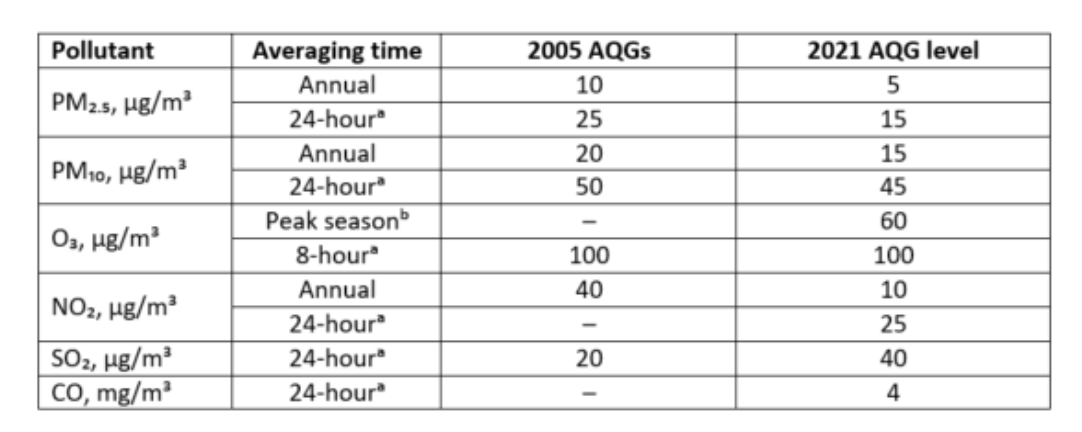
The guidelines set out new healthy guideline levels for six pollutants, which include particulate matter (PM2.5 and PM10), ozone (O₃), nitrogen dioxide (NO₂) sulfur dioxide (SO₂) and carbon monoxide (CO).

The annual guideline for PM2.5 was halved from 10µg/m3 to 5µg/m3 – PM2.5 particulate matter penetrates into lungs with the potential to pass through the lungs into other organs. The same annual rates for PM10 were cut from 20µg to 15µg and for NO2 they were cut from 40µg to 10µg.

Much of Switzerland regularly exceeds these new guidelines. In 2019, Bern came in with a PM2.5 reading of 10.9 μg/m³, well in excess of the new guideline of 5µg/m3.

Air pollution in Switzerland is seasonal. In 2019, air quality in Bern declined in November from around 8 μg/m³ of PM2.5 to 11.6μg/m³. This then climbed to 14.7 μg/m³ in January, and then to a yearly high of around 18 μg/m³ in February, the most polluted month.

In winter, burning wood, gas and heating oil add to Switzerland’s pollution. In addition, between 2-3% of the electricity generated in Switzerland is from fossil fuels.

During September 2021, Bern managed PM2.5 levels under 5µg for only 3 out of 30 days, according to IQAir. On the worst day air concentration of PM2.5 rose as high as 14.8µg/m3, close to three times the annual guideline limit. September air in Bern scored better on PM10 concentrations. The new annual WHO guideline is 15µg/m3. Bern had PM10 concentrations above this level for only 17 out of 30 days (57%).

Much of Switzerland’s pollution comes from vehicles and factories. Cars and trucks generate large amounts of NO2 and SO2 in addition to rubber particles from their tyres, which continue to accumulate. 200 tonnes of these particulates have been spread around Switzerland over the last 20 years alone.

Those most at risk from poor air quality are people living near factories and areas of dense traffic. Road commuters are also exposed to road pollution.

Swiss air pollution exceeds new WHO guidelines

Posted in Air Quality, Europe | Tagged , , , | Leave a comment

Europe’s industrial air pollution costing hundreds of billions: EEA

Air pollution from industries in Europe causes health and environmental damage estimated at up to €430 billion for a single year, the European Environment Agency (EEA) said Wednesday (29 September).

In 2017, industrial air pollution cost society between €277 billion and €433 billion, according to a new report from the agency.

“This is equivalent to about two to 3% of EU GDP, and is higher than many individual Member States’ total economic output that year,” the EEA said in a statement.

While European industry has made “significant progress” in reducing its environmental and climate impact, “societal costs or ‘externalities’ caused by air pollution from the sector remain high.”

The effects of the pollution include illness and premature death as well as the deterioration of ecosystems, habitats and crops. These have all been given an estimated monetary value in the report.

Of the 11,000-plus sites reporting pollutant emissions, 211 are responsible for half of the total costs, according to the report. These are mainly located in Germany, the UK, Poland, Spain and Italy.

Air pollution from thermal power plants – mostly run on coal – is the most dangerous to health and the environment, followed by emissions from heavy industry, fuel production and processing, according to the EU agency.

These are followed by lighter industries, waste management, livestock farming and wastewater treatment.

Among the 30 most polluting facilities on the continent, 24 are thermal power plants, 15 of which are in Western Europe including seven in Germany, according to the study.

The single most polluting plant is in Poland but the next four are in Germany.

Despite slight improvements, “air pollution is still a major health risk for Europeans,” the agency warned last week, as the levels of fine particulate matter, ozone and nitrogen oxides are often above air quality standards.

Europe’s industrial air pollution costing hundreds of billions: EEA – EURACTIV.com

Posted in Air Quality, Europe, Germany, Italy, Poland, Spain, UK | Tagged , , , , , , , , , | Leave a comment

Air pollution linked to nearly 6 million premature births in 2019, study finds

A new study released Tuesday from the University of California, San Francisco and the University of Washington found air pollution likely caused millions of babies to be born prematurely and under a healthy weight in 2019. Babies who are born with low birth weights or born prematurely have significant health disadvantages, including higher rates of major illnesses throughout their lives. 

The World Health Organization has estimated that approximately 90% of the global population lives with outdoor air pollution, and 50% of the global populations also lives with indoor air pollution from wood, coal and dung-fueled fires inside the home.

The study looked at how air pollution affected multiple parts of pregnancy, including length of pregnancy, birth weight, preterm birth and weight loss after birth. It’s the first study to include indoor air pollution, which accounted for two thirds of the documented effects. 

In 2019, air pollution resulted in nearly 6 million premature births and 3 million underweight babies worldwide, according to the study. And in the United States, ambient air pollution contributed to an estimated 12,000 premature births.

Meanwhile, in Southeast Asia and sub-Saharan Africa, premature births and low birth weights could be reduced by 78% if air pollution was reduced, the study found. The two geographic areas have both common indoor air pollution, due to indoor cook-fires, and some of the highest premature birth rates in the world. 

“The air pollution-attributable burden is enormous, yet with sufficient effort, it could be largely mitigated,” said lead author Rakesh Ghosh in a press release. Ghosh is a a prevention and public health specialist at the Institute for Global Health Sciences at UCSF.

In a previous study, the same team found that air pollution directly contributed to the deaths of 500,000 newborns in 2019. 

“With this new, global and more rigorously generated evidence, air pollution should now be considered a major driver of infant morbidity and mortality, not just of chronic adult diseases,” Ghosh said. “Our study suggests that taking measures to mitigate climate change and reduce air pollution levels will have significant health co-benefit for newborns.”   

Air pollution linked to nearly 6 million premature births in 2019, study finds – CBS News

Posted in Africa, Air Quality, Asia, Health Effects of Air Pollution, Medical Studies, USA, USA & Canada, World News | Tagged , , , | 1 Comment

Air pollution is number one public health risk in Ghana, affecting infants and elderly

Air pollution, from both outdoor and indoor activities are dangerous to the environment and human health, but infants and the elderly in Ghana are at greater risk as they make the majority who fall ill from the pollution, a World Bank study has found out.

In a presentation at a one-day workshop on air pollution, September 24, 2021 in Accra, George Amoasah, the World Bank Environmental Specialist outlined the natural sources of emissions which include smoke from bush or forest fires, windblown dust, pollen and mold spores, volcanic activity, sea spray, and so on.

“The anthropogenic sources include fuel combustion from motor vehicles, electricity and heat generation, industrial and mining activities, solid waste landfills and waste incineration, household sources of air pollution,” he said.

He indicated that household air pollution is mainly from anthropogenic activities such as incomplete combustion of solid biomass fuels (e.g., wood, charcoal, crop waste, dung), coal and kerosene, for cooking, heating, and lighting needs.

Citing a World Bank report on air pollution said an estimated 20.5 million Ghanaians – over 70 per cent of the population – burn solid fuels e.g., fuelwood, charcoal, dung and so on, in their homes for cooking and heating.

“Air pollution’s disease burden is disproportionately borne by infants and the elderly,” he said.

The report finds that 100 per cent of Ghana’s population is exposed to air pollution levels exceeding WHO’s guidelines, and 16,000 people die prematurely from it.

Approximately 66 per cent of air pollution related deaths in rural areas are due to Household Air Pollution, the report found.

“Air pollution is deadly, causing or contributing to heart attacks, strokes, lung cancer, and respiratory diseases. It is Ghana’s number one environmental risk to public health and its sixth-ranked overall risk for death,” said Pierre Laporte, World Bank Country Director of Ghana at the opening of the dissemination workshop.

“Ghana’s air pollution is responsible for eight per cent of total mortality with approximately 16,000 Ghanaians dying prematurely each year. More than half of these deaths are in our cities with nearly as many occurring in rural areas,” he added.

The World Bank study also found that in 2017, air pollution in Ghana had an estimated average cost of $2.5 billion or an equivalent of 4.2 per cent of GDP.

The study estimates the cost of Ghana’s greenhouse gas emissions to the global community is, on average $2.3 billion each year (though the estimated range is $1.5 to $3.2 billion), equivalent to just under 4 per cent of Ghana’s GDP.

Air pollution is number one public health risk in Ghana, affecting infants and elderly – World Bank – Ghana Business News
Posted in Africa, Air Quality, World News | Tagged , , | 1 Comment

Air Quality Alerts Issued in California Due to Wildfires

Officials are advising those in the Bay Area and the San Joaquin Valley to limit their time outside as wildfire smoke and ash fills the air.

Air quality remains a concern in California thanks to severe active wildfires and health experts are warning people to limit their time outside.

Wildfires are also threatening California’s historic sequoia trees. Officials evacuated communities near Sequoia National Park as the Windy and KNP Complex fires got closer.

On Wednesday, officials showed reporters how Sequoia National Park’s famous Giant Forest has been protected from the KNP Complex fire by years of using carefully set and controlled fires to burn away vegetation that can serve as wildfire fuel.

The bases of some of the most famous giant sequoias were also wrapped in fire-resistant materials. Giant Forest has 2,000 sequoias and includes the General Sherman Tree, the largest tree in the world by volume.

Historic drought tied to climate change is making wildfires harder to fight. It has killed millions of trees in California alone. Scientists say climate change has made the West much warmer and drier in the past 30 years and will continue to make weather more extreme and wildfires more frequent and destructive.

Statewide, more than 9,000 firefighters remained assigned to 10 large, active wildfires, according to the California Department of Forestry and Fire Protection.

California fires have burned 3,671 square miles this year, destroying more than 3,200 homes, commercial properties and other structures.

Air Quality Alerts Issued in California Due to Wildfires (VIDEO)
Posted in Air Quality, USA, USA & Canada | Tagged , , , , , , | Leave a comment

WHO slashes guideline limits on air pollution from fossil fuels

Level for the most damaging tiny particles is halved, reflecting new evidence of deadly harm

The World Health Organization has cut its recommended limits for air pollution and urged nations to tackle dirty air and save millions of lives.

In the first update for 16 years, the guideline limit for the most damaging pollution – tiny particles from burning fossil fuels – has been halved. The new limit for nitrogen dioxide (NO2), mainly produced by diesel engines, is now 75% lower.

The stringent new limits reflect the large body of evidence produced in recent years of the deadly harm caused to people by much lower levels of pollution than previously thought. Air pollution kills at least 7 million people a year, the WHO said, while a recent study estimated 8.7 million early deaths a year from coal, oil and gas burning – 20% of all deaths.

Pollution cuts an average of two years from the lives of the global population, and up to six years in highly polluted nations such as India, making it a bigger killer than smoking, car crashes or HIV/Aids.

Scientists stressed that even the new limits should not be considered safe, as there appears to be no level at which pollutants stop causing damage. They said reducing pollution would boost health even in nations with relatively clean air. A 2019 review concluded that air pollution may be damaging every organ in the body, causing heart and lung disease, diabetes and dementia and reducing intelligence.

Air pollution is the biggest environmental threat to human health and is a public health emergency, according to the WHO, costing trillions of dollars a year. More than 90% of the global population already breathes levels of pollution above the WHO’s 2005 guideline for tiny particles. Cutting air pollution brings huge and cost-effective health benefits and reduces the carbon emissions driving the climate crisis.

“Air pollution is a threat to health in all countries,” said Tedros Adhanom Ghebreyesus, the WHO director general. The guidelines are not legally binding but can be used by countries to plan their action. “I urge all countries to put them to use to reduce suffering and save lives,” he said. The WHO said dirty air often affected the most vulnerable people and that clean air should be a “fundamental human right”.

The campaigner Rosamund Adoo-Kissi-Debrah, whose daughter Ella became the first person to have air pollution cited as an official cause of death, said: “Air pollution stunts children’s health and future. There is no safe level but at least following the WHO’s new guidelines will set us on the path to achieving clean air for all.”

Lwando Maki, a doctor at the Public Health Association of South Africa, said: “I saw the impacts of toxic air pollution every single day in Johannesburg. Updates to air quality standards were long overdue.”

Renewable energy is often cheaper than fossil fuels even without taking the economic burden of air pollution into account, said Avinash Chanchal, of Greenpeace India. “We have all the tools we need to solve the air pollution crisis. At this point, addressing air pollution is a question of political will, not technology.”

Every one of the 100 most populous cities in the world exceeded the new WHO guideline for tiny particle pollution in 2020, according to Greenpeace analysis. This includes Tokyo, Shanghai, New York, Lagos, London and Delhi, with the latter exceeding the limit by 17 times.

Dorota Jarosińska, the WHO’s technical lead for the new guidelines, said: “These are very ambitious public health recommendations and achieving the guideline levels would be the ultimate goal, but all the steps towards it are critical.

“The interim targets [the WHO has also set] are milestones on this continuous march towards getting air quality that is most protective to health. Every step you make towards improving air quality brings health benefits.”

The new guidelines are the product of five years of systematic review by dozens of scientists, considering more than 500 studies and including several rounds of peer review. The guidelines represent the level at which there is already strong evidence for harm to health.

“We feel confident that these are really robust,” said Jarosińska. “But these levels absolutely do not mean we are confident that there is no harm [at even lower levels].”

One of the most harmful pollutants is tiny particulate matter, smaller than 2.5 microns in size (PM2.5), which can pass through the lungs into the bloodstream and affect other organs. The WHO has reduced the guideline for annual average exposure to PM2.5 from 10 to 5 micrograms per cubic metre (µg/m3). The WHO classified these particles as cancer-causing in 2013. For NO2, the WHO has cut the annual average limit from 40 to 10 µg/m3.

Almost 80% of the millions of deaths related to PM2.5 could be avoided if today’s pollution levels were reduced to those in the new guidelines, according to the WHO, compared with a 48% reduction under the 2005 limit. The WHO also said: “Air pollution is most likely a contributing factor to the health burden caused by Covid-19.”

In the UK, the environmental lawyers ClientEarth said legal pollution limits for PM2.5 and NO2 were now four times the WHO guidelines, meaning people are exposed to levels far above that known to be acceptable. NO2 levels are already above UK limits in 75% of urban areas.

“These new guidelines reflect the best available science and the conclusion is irrefutable: air pollution, even at lower levels, seriously endangers people’s health,” said Andrea Lee, of ClientEarth. “This must serve as a wake-up call for the UK government – ministers should be scrambling to act.”

A spokesperson for the UK’s environment ministry said: “We will set ambitious targets on air quality through our environment bill. We will consider the updated WHO guidelines on PM2.5 to inform the development of air quality targets, but we must not underestimate the challenges these would bring, particularly in large cities and for people’s daily lives.” A consultation on the proposed targets is expected in early 2022.

via WHO slashes guideline limits on air pollution from fossil fuels | Air pollution | The Guardian

Posted in Air Quality, Health Effects of Air Pollution | Tagged , , , , | 1 Comment

Air pollution still too high in most EU Member States

Concentrations of key air pollutants remain too high in most European countries. According to the European Environment Agency’s official data, published today, most European Union (EU) Member States exceed at least one or more of the EU’s legal limits for pollutants in ambient air in 2019.

The EEA briefing ‘Europe’s air quality status 2021’ presents the latest official data for 2019, as well as provisional data for 2020, on concentrations of key air pollutants measured at over 4,500 monitoring stations across 40 European countries.

The EEA data show that air pollution is still a major health risk for Europeans. In central and eastern Europe, the burning of solid fuels for domestic heating and industry results in high concentrations of both fine and coarse particulate matter, as well as benzo[a]pyrene, a known carcinogen. Exposure to fine particulate matter causes cardiovascular disease, lung cancer and other diseases that lead to premature deaths. In bigger cities, high concentrations of nitrogen dioxide persist due to road traffic, with nitrogen dioxide linked to asthma and breathing problems. And, especially in southern Europe, pollutants emitted from human activities react in heat and sunlight to produce high concentrations of ground-level ozone, linked to cardiovascular disease and irritation of the eyes, nose and throat.

Key results:

Particulate matter (PM10): 21 countries (of which 16 were EU Member States[1]) registered concentrations above the EU daily limit value in 2019, while 31 countries registered concentrations above the stricter World Health Organization (WHO) guideline from 2005.

Fine particulate matter (PM2.5): 7 countries (of which 4 were EU Member States) registered concentrations above the EU annual limit value in 2019, while 28 countries registered concentrations above the 2005 WHO guideline.

Ground-level ozone (O3): 24 countries (of which 19 were EU Member States) registered concentrations above the EU annual limit value in 2019, while all countries registered concentrations above the 2005 WHO guideline.

Nitrogen dioxide (NO2): 22 countries (of which 18 were EU Member States) registered concentrations above the EU annual limit value in 2019, which is the same as the 2005 WHO guideline.

The EEA’s data show that air quality in Europe improved in 2020, as lockdown measures to control the spread of COVID-19 led to a fall in transport emissions, combined with favorable weather patterns. An EEA analysis of the impacts of COVID-19 lockdowns on air quality in 2020 is presented in a separate briefing and more extensively in the Air Quality in Europe – 2020 report.

Background

The WHO has established air quality guidelines to protect human health from the impacts of air pollutants. These guidelines are from 2005 and based on the best scientific evidence available at that time. WHO is expected to publish new air quality guidelines on 22 September 2021.

The EU´s Ambient Air Quality Directives set maximum values for a total of 13 air pollutants. Although these values take into account relevant WHO guidelines, they also reflect the technical and economic feasibility of their attainment across EU Member States. For most air pollutants, the EU air quality standards are less strict than the WHO 2005 air quality guidelines.

Other key resources:

European Air Quality Index shows near real-time air quality data for Europe, allowing users to check local air quality where they live or travel.

European city air quality viewer compares average levels of fine particulate matter in 323 European cities, over the past two calendar years.

National air pollutant emissions data viewer gives access to the latest air pollutant emission data, reported by EU Member States under the National Emission reduction Commitments (NEC) Directive.

Air quality data center gives access to all relevant EEA data on air quality in Europe

Air pollution: how it affects our health shows how exposure to fine particulate matter contributes to disease and premature death in Europe and how this burden is distributed across European society

[1] The EEA’s assessment of the state of air quality in 2019 and 2020 includes data from the United Kingdom, in agreement with the terms of the Withdrawal Agreement, which entered into force on 1 February 2020.

Air pollution still too high in most EU Member States — European Environment Agency
Posted in Air Quality, Europe | Tagged , , , , , , , , , | Leave a comment