Air pollution reductions may prevent 1M premature deaths over a decade, study says

A new study suggests aerosol emissions be included in climate targets in reducing harmful gasses — potentially saving about one million lives per year — researchers said on Tuesday.

Aerosol emissions were not addressed in the document setting emissions targets for some 194 countries across the world with the aim of slowing global warming.

But researchers say, in a study published in the journal Earth’s Future, that reducing aerosols could be as good for human life as it is for the planet itself.

“While all greenhouse gas emissions might be thought of as unambiguously harmful, aerosols are more complicated,” study first author Pascal Polonik said in a press release.

“All aerosols are harmful to human health but they also often help counteract global warming by cooling the Earth’s surface,” said Polonik, a doctoral student at Scripps Oceanography.

Researchers estimate that emissions of aerosols from burning fossil fuels like coal and diesel create aerosol emissions that are linked to nine million premature deaths across the globe.

Researchers said warming can be limited by reducing commercial and waste sectors.

“There are real benefits to being thoughtful about how aerosols factor into climate policy outcomes. There may be big benefits to cutting emissions from certain sectors first,” co-author Kate Ricke, assistant professor with Scripps Oceanography and the School of Global Policy and Strategy, said in the press release.

Under the Paris Agreement on Global Warming, each country is required to submit a Nationally Determined Contribution on the steps to be taken to achieve a common goal.

While the goal is to reduce population mortality, each country decides for itself how and where to implement the various processes.

The researchers emphasized that, in terms of climate policy, different countries have different priorities in reducing warming and protecting public health due to varying industrial footprints.

The news comes after the World Meteorological Organization last week said temperature averages continue to increase despite goals set by the international coalition.

Air pollution reductions may prevent 1M premature deaths over a decade, study says – UPI.com
Posted in Air Quality, Health Effects of Air Pollution, Medical Studies, USA, USA & Canada | Tagged , , , | Leave a comment

Pollution nearly doubles the risk of losing your sense of smell

New research digs into how air pollution can cause anosmia, the loss of smell.

The loss of smell, a condition known as anosmia, can severely affect a person’s quality of life, making it extremely difficult to taste foods, detect airborne hazards in the environment, and carry out other functions dependent on the sense.

Those with anosmia may experience weight concerns, decreased social interaction, depression, and general anxiety. In some cases, loss of smell has been linked to death in older adults.

“We included participants from a variety of areas in our study; however, most lived in urban areas where pollution levels are highest,” says lead author Murugappan “Murray” Ramanathan, rhinologist and associate professor of otolaryngology–head and neck surgery at Johns Hopkins University School of Medicine.

“We wanted to assess how their exposure to PM2.5 air pollution—inhalable, particulate matter less than 2.5 micrometers in size or about 30 times smaller than the diameter of a human hair—might cause them to lose their sense of smell.”

According to the US Environmental Protection Agency (EPA), PM2.5 (the PM stands for “particulate matter”) is the term for a mixture of solid particles and liquid droplets found in the air. Depending on location, PM2.5 can consist of many materials, including dust, dirt, soot, smoke, organic compounds, and metals. It has been linked to cardiovascular disease, lung cancer, decline in cognitive thinking ability, chronic obstructive pulmonary disease, asthma, and premature death.

Previous research has associated PM2.5 as a likely culprit in loss of smell—a connection that Ramanathan and his team decided to explore in greater detail.

In their study, the researchers looked at 2,690 people, age 18 and older, who otolaryngologists evaluated between January 2013 and December 2016. Of these, 538 were diagnosed with anosmia, with an average age of 54 and with men making up the majority (339 or 63%).

Air pollution data for the study came from the EPA’s Air Quality System. The researchers fed the data into a complex computer model—incorporating meteorological and satellite-based environmental measurements, land-use information, and simulations of airborne chemical movement—to estimate the PM2.5 pollution levels within the participants’ residential ZIP codes. The model was created by Zhenyu Zhang, an otolaryngology postdoctoral fellow.

The researchers found long-term airborne exposure to PM2.5 increases the risk of losing one’s smell by nearly twice (a 1.6- to 1.7-fold increase). They believe this may occur because the location of the olfactory nerve—which contains the sensory nerve fibers relating to the sense of smell—places it directly in the path of inhaled PM2.5 materials.

“Based on this result, we feel that long-term exposure to high levels of PM2.5 represents a common risk factor for the loss of sense of smell, especially in vulnerable populations such as older people—but also one that is potentially modifiable if sources of PM2.5 components can be better controlled,” says Ramanathan.

Next, the researchers plan to study socioeconomic factors among patients with anosmia to determine if they impact the chances of exposure to PM2.5 air pollution. They also hope to evaluate other air pollution components that may contribute to loss of smell, such as ozone.

The findings appear in JAMA Network Open.

Source: Johns Hopkins University Original Study DOI: 10.1001/jamanetworkopen.2021.11606

Pollution nearly doubles the risk of losing your sense of smell – Futurity
Posted in Air Quality, Health Effects of Air Pollution, Medical Studies | Tagged , , , , , | Leave a comment

The murky issue of air pollution in North Macedonia

In winter, Skopje, the Capital of North Macedonia, is one of the most polluted cities in Europe.

According to estimates from the World Bank Study, over 1000 people die each year as a result of air pollution in North Macedonia and its population is only 2 million.

The South Eastern Europe Health Network is a regional organisation located in Skopje. It encourages health and wellbeing among member states and is working actively in the area because of the alarming situation.

Mira Jovanovski Dashic, the Director of the South Eastern Europe Health Network says a report that was made by experts from its member states shows that “it was clear that the damage of air pollution to health is extremely big, and the consequences can be seen on heart disease, allergies and cancers”.

Several investigations have shown that some large-scale energy consumers use fuel forbidden for use by European regulations. But as North Macedonia seeks to become a member of the EU, it has adapted a large part of its legislation to fit EU norms. So now the public and its representatives want to know how this harmonisation of legislation will truly affect them.

Naser Nuredini is the Environment Minister in North Macedonia, he tells us that the country has to implement its laws. “We can’t just harmonise them”, he explains. “We need to work on different fronts. This is why we need to have better inter-sectorial collaboration”. He says that the Ministry of the Environment proposed new laws in North Macedonia, but to him, it is not enough to just pass them in parliament. He thinks they need to work together with inspectors, other ministries and agencies to implement them.

The conversion of the letter of the law into reality is one of the biggest systemic weaknesses of transition countries, like North Macedonia. The European Commission notes this chronic weakness in all its progress reports.

For now, citizens are still waiting for the government to implement EC recommendations which will likely give residents in Skopje a breath of fresh air.

The murky issue of air pollution in North Macedonia | Euronews
Posted in Air Quality, Europe | Tagged , , | Leave a comment

Balkan countries are source of most of SO2 emissions in Europe

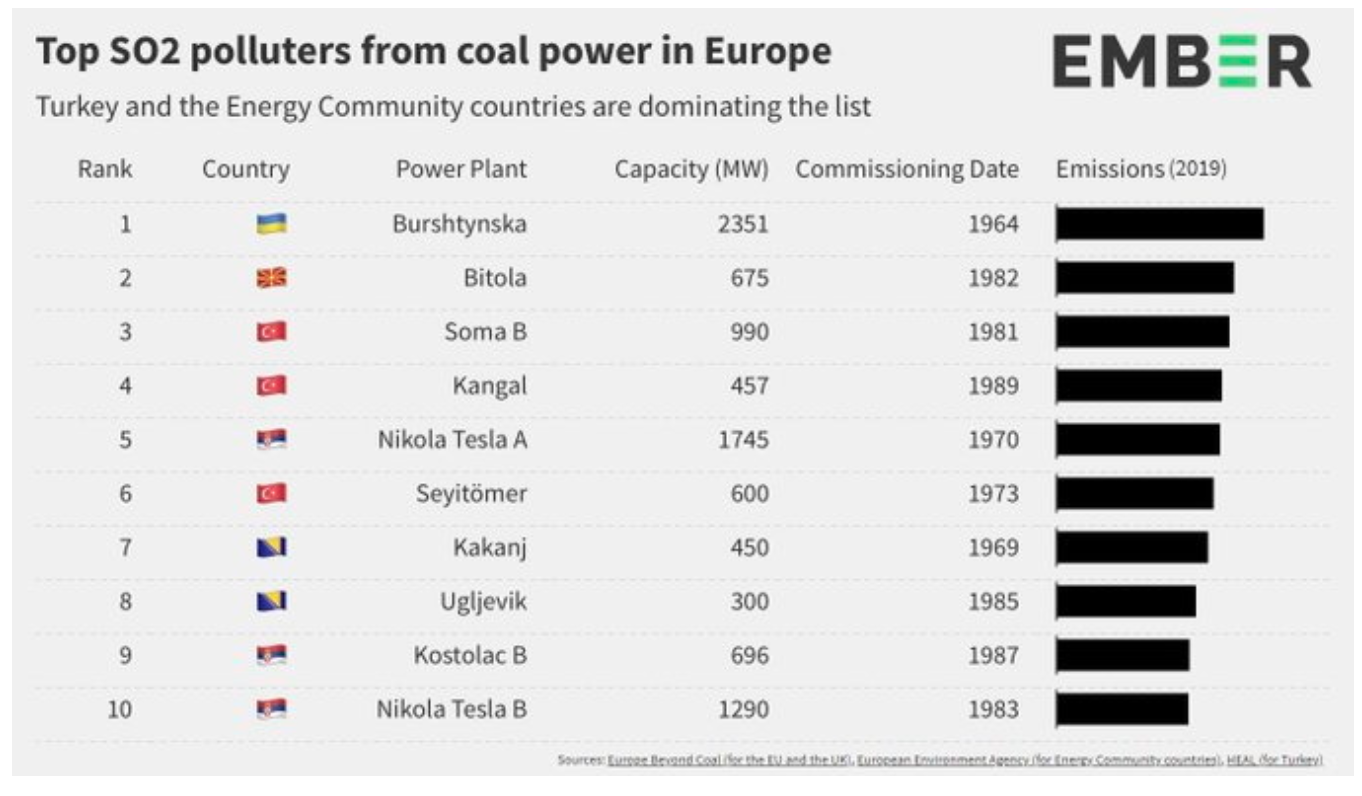
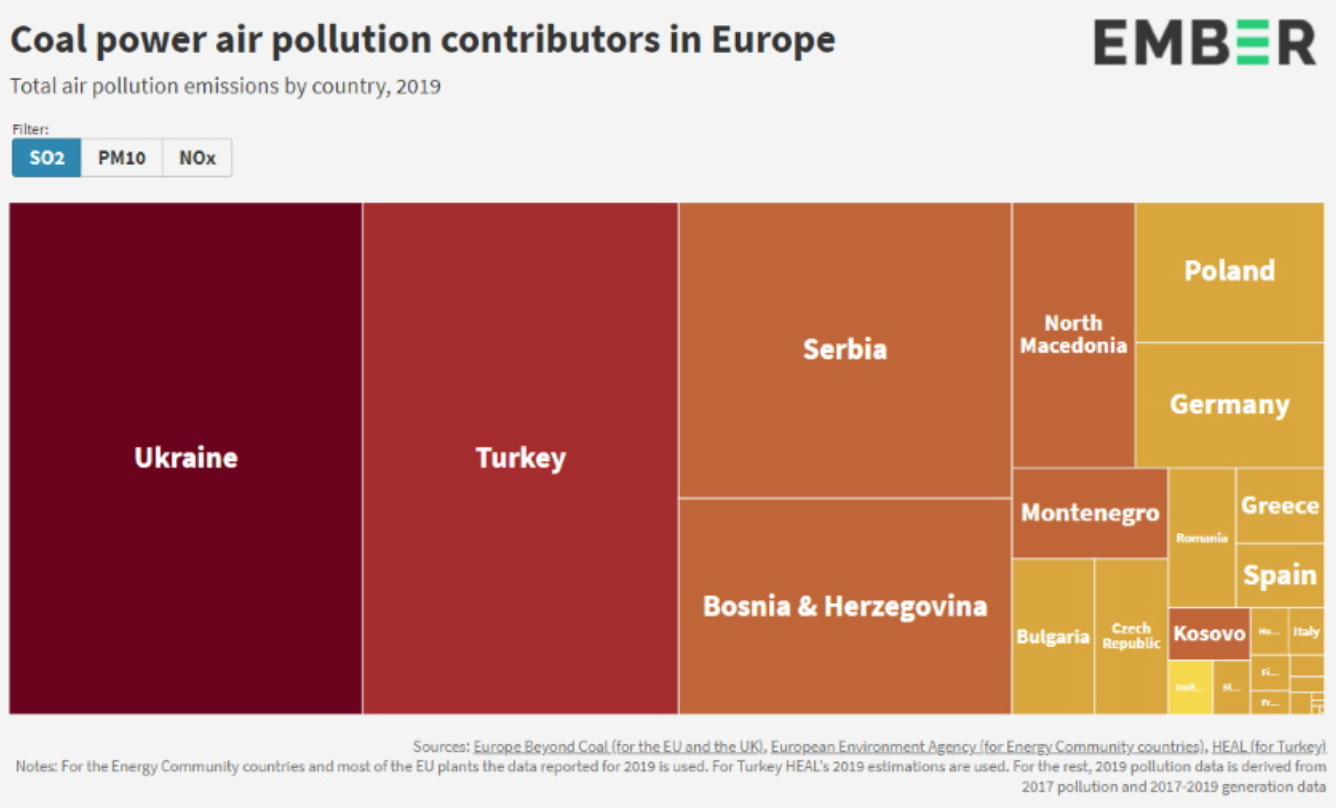
Ukraine, Turkey and the Western Balkans topped the European charts in 2019 across all types of air pollutants from coal-fired thermal power plants, Ember found. Furthermore, over half of entire SO2 emissions originated in Southeastern Europe.

Coal power air pollution statistics highlight contributions from a small number of countries in Europe, energy think tank Ember said. Turkey and Ukraine rank within the top three polluting countries and Western Balkan countries are next in the list despite their relatively small sizes. According to data for 2019 presented in the research, 61.3% of industrial sulfur dioxide (SO2) emissions came from Southeastern Europe.

When coal is burned for generating electricity, pollutants are released into the air, which poses a threat to human health. They are responsible for high numbers of premature deaths.

With pollutants sometimes traveling thousands of kilometers, air pollution from coal power affects the whole of Europe no matter the source.

Bitola thermal power plant is biggest emitter of SO2 in Balkans

As for SO2 emissions, the top ten coal plants were responsible for 44% of the total. Burshtynska, located in Ukraine, is the biggest polluter in the category, followed by North Macedonia’s Bitola.

The remaining eight thermal power plants are all from the region tracked by Balkan Green Energy News: Soma B and Kangal (Turkey), Nikola Tesla A (Serbia), Seyitömer (Turkey), Kakanj and Ugljevik (Bosnia and Herzegovina) and Kostolac B and Nikola Tesla B (Serbia), in that order.

Ukraine’s coal plants lead in PM10 pollution

The majority of PM10 pollution from coal power generation originates from plants in Ukraine, which has eight plants in the top ten and all the top five. Turkey’s Seyitömer and Tunçbilek are also in tier one. EU countries like Germany and Poland are also among the worst for NOx pollution.

Poland’s Elektrownia Bełchatów, the largest coal-fired thermal power station in Europe, also emits most nitrogen oxides, usually marked as NOx. Next is Ukraine’s Zaporizka, which didn’t appear in the top ten in the two other categories. Yatağan, located in Turkey, is in third place.

Germany is represented with four plants. Nikola Tesla A and B are ranked sixth and ninth, respectively, and Kosovo B is tenth.

All the coal-fired thermal power plants in the three lists were commissioned more than 30 years ago.

Balkan countries are source of most of SO2 emissions in Europe

Posted in Air Quality, Europe | Tagged , , , , , , , , , , , | Leave a comment

Stronger air pollution standards in U.S. would have significant public health benefits

Reducing certain air pollutants in the U.S. by small amounts would prevent thousands of early deaths each year among elders, according to new research led by Harvard T.H. Chan School of Public Health.

The study, which focused on fine particulate matter (PM2.5), nitrogen dioxide (NO2), and ozone (O3), also found that even when levels of these pollutants met or fell below the Environmental Protection Agency’s (EPA) current National Ambient Air Quality Standards, they were still associated with significant mortality in elders. The authors said the findings raise serious concerns that the country’s current air quality standards do not sufficiently protect public health.

“Clearly the current national air pollution standards are entirely outdated and the progress in reducing air pollution is stalled,” said Joel Schwartz, professor of environmental epidemiology and senior author of the study. “The findings of this study signal a very clear message to policy makers: More rigorous PM2.5 and NO2 standards and a long-term O3 standard are absolutely necessary to protect public health, especially the health of elders.”

The study was published in Environmental Health on May 6, 2021.

To analyze the issue, the team used national Medicare data collected between 2000 and 2016 and predicted ZIP code–level estimates of ambient air pollution levels based on ground monitoring data, satellite data, meteorological conditions and several other factors. They focused specifically on establishing what is known as the “causal dose-response” relationship between the air pollutants and mortality among the Medicare population. A dose-response relationship can show how exposures to a certain amount of a substance—in this case, individual air pollutants—changes physiological function and health condition. The model created for this study also enabled the researchers to predict what would happen at the population level if exposures to these air pollutants changed.

In addition to determining that PM2.5, O3, and NO2 are all linked with significant harmful effects on human health, even at low levels, the researchers also found that substantial health gains can be achieved through small reductions in exposures. For instance, the study showed that lowering PM2.5 concentration by less than 1 microgram per cubic meter and lowering concentrations of O3 by less than 2 parts per billion and NO2 by approximately 3 parts per billion would prevent 65,935 early deaths per year among elders.

Moreover, according to Schwartz, the study highlighted the urgent need for the EPA to better regulate levels of O3, a gas that occurs naturally in the stratosphere but can also form at the ground level as a result of pollution from diesel engines and other sources undergoing chemical reactions in the presence of sunlight. At the ground level, O3 is associated with numerous health risks, especially for children, the elderly, and people who have asthma and similar conditions. There is currently no long-term exposure standard for O3, just a daily one.

“For O3, the EPA has focused on bringing down the number of peak days in the summer while producing little change in the long-term average exposure between spring and fall,” Schwartz said. “Our study shows that this is a mistake, and people are dying from it.”

Corresponding author Yaguang Wei, a doctoral candidate in the Department of Environmental Health, said that causal modeling can help provide precises predictions of how changes to air quality standards will affect public health. “We think this study can be used to help EPA, the World Health Organization, and others set their air quality standards and estimate the health benefits of specific policies, such as replacing diesel vehicles with cleaner alternatives,” Wei said.

Stronger air pollution standards in U.S. would have significant public health benefits | News | Harvard T.H. Chan School of Public Health
Posted in Air Quality, Health Effects of Air Pollution, Medical Studies, USA, USA & Canada | Tagged , , , , , , , , , | Leave a comment

Air pollution helps wildfires create their own lightning

Most people know lightning can spark wildfires. But wildfires can also spark lightning—a phenomenon that has puzzled scientists for decades. Now, researchers have revealed a key cause of this phenomenon: air pollution. Dirtier air means more lightning above wildfires—and more rain, too.

The finding “demonstrates that we should be thinking about the impact air pollution has on weather systems, including the impact on storms,” says Joel Thornton, an atmospheric scientist at the University of Washington, Seattle, who was not involved in the research.

Many factors are believed to cause lightning during a wildfire. Scientists have blamed everything from air currents to urbanization. These elements have been hard to disentangle in the air above land because the rough topography, changing land use, and varying heat create a complex set of variables that are hard to tease out.

Enter Australia’s devastating 2019–20 fire season. Known as “Black Summer,” massive blazes charred more than 186,000 square kilometers of land, and large amounts of smoke billowed southeast over the Tasman Sea. But the vast, flat, cool surface of the sea provided an opportunity to study the fires over a relatively blank canvas.

Yakun Liu, a meteorologist at the Massachusetts Institute of Technology (MIT), and his colleagues used satellite data and land-based lightning detection systems to track the movement of the aerosols—tiny airborne particles—generated by Black Summer wildfires and measure lightning activity in the region. During the fires, the air above a broad swath of the ocean became exceptionally polluted; it would probably take a volcanic eruption to do worse, Liu says.

Amid this seafaring air pollution, lightning activity increased by as much as 270% (from about 12 strokes up to 43 strokes, or lightning flash segments, per square kilometer per year) compared with the same time period the year before, the researchers report this month in Geophysical Research Letters. “That is much higher than I would have expected,” says Graciela Raga, an atmospheric scientist at the National Autonomous University of Mexico, Mexico City, who was not involved in the study.

In thunderclouds, upward-lofting ice crystals collide with descending bits of hail, and these collisions produce an electrical charge that gives rise to lightning. Liu and his colleagues detected higher concentrations of smaller ice crystals in aerosol-polluted clouds over the Tasman Sea. They believe the large influx of aerosols into the skies above the sea provided more surfaces around which cloud ice crystals could form.

The researchers also found that air pollution did more than enhance lightning; wildfire smoke more than tripled the intensity of thundershowers. Over the Tasman Sea, rainfall in lightning storms increased by 240% (from 12.2 to 41.8 millimeters per day).

There are two competing feedback loops, says Earle Williams, a meteorologist at MIT and co-author on the study. Lightning sparks fires and fires enhance lightning, he explains, whereas enhanced rainfall cleanses the atmosphere and helps fight fires.

This is a story that goes beyond wildfires, however,  Thornton says. The work is another example of how human beings—through our cities, traffic, and industrial activities—can change the weather, he says. “When you think about the size of the particles and the scale of the impacts they’re having on the nature of storms, it’s remarkable.”

Air pollution helps wildfires create their own lightning | Science | AAAS
Posted in Air Quality, World News | Tagged , , | Leave a comment

Korean Study Adds to Indications That Air Pollution is Tied to Parkinson’s

Nitrogen dioxide (NO2) is associated significantly with a higher risk for developing Parkinson’s disease, according to a recent study from Korea. The finding reinforces previous research showing a potential link between air pollution and Parkinson’s.

The results also prompted researchers to suggest that better air pollution regulations might lower incidence of the neurodegenerative disorder.

The study, “Association of NO2 and Other Air Pollution Exposures With the Risk of Parkinson Disease,” was published recently in JAMA Neurology.

Recent research has linked long-term exposure to ingested and inhaled environmental pollutants with the occurrence of neurodegenerative disorders such as Parkinson’s. How this might happen remains unclear, however.

One hypothesis states that the toxic clumps of alpha-synuclein that characterize Parkinson’s on a molecular level first form in the brain’s olfactory bulb and in the gut, before spreading throughout the nervous system. This involvement supports the environmental exposure connection by being directly linked to what we inhale and consume, respectively.

Epidemiological studies seeking to confirm the relationship between pollution and Parkinson’s have delivered inconsistent results, however. Some studies have found associations between the disorder and various airborne molecules, including ozone (O3), small particulate matter (PM2.5), and NO2.

A team of researchers from the University of Ulsan College of Medicine, in Seoul, South Korea, pointed out that most past studies have been carried out in North America and Europe, leaving little Asian data from which to draw.

To attempt to fill this gap, the group used Korea’s National Health Insurance Service (NHIS) records to look for associations between Parkinson’s occurrence and six common ambient air pollutants: PM2.5, PM10 (slightly larger small particulate matter), NO2, O3, sulfur dioxide (SO2), and carbon monoxide (CO).

NHIS records include approximately 97% of Korean residents.

The investigators compared health records to those of air pollution, which are tracked by the Seoul Research Institute of Public Health and Environment.

They identified 78,830 adults older than 40 (mean age 54.4, 52.1% female), without Parkinson’s, and who lived in Seoul from January 2002 to December 2006. They then followed this group’s records annually from January 2007 to December 2015.

A total of 338 individuals developed Parkinson’s over the study period, and from among the analyzed pollutants, only exposure to high amounts of NO2 were linked to a statistically significant increase in Parkinson’s risk.

The association between NO2 and Parkinson’s remained strong, even after adjusting for age, sex, type of insurance, and other medical conditions.

The researchers observed that NO2 exposure often is related to traffic emissions and that some studies have suggested that it exerts toxic effects on the brain. These include worsening the buildup of amyloid-beta, which can trigger the formation of alpha-synuclein clumps, causing nerve signaling difficulties and increasing markers of inflammation.

“In conclusion,” the scientists wrote, “we identified a statistically significant association between the risk of [Parkinson’s] and exposure to NO2 for the previous 5 years, especially at high exposure levels. We found no evidence for the association between the risk of PD and exposure to PM2.5, PM10, O3, SO2, or CO.”

“These findings,” they added, “suggest that regulation of air pollutants might reduce the incidence of [Parkinson’s].”

Korean Study Adds to Indications That Air Pollution is Tied to Parkinson’s
Posted in Air Quality, Asia, Health Effects of Air Pollution, Medical Studies, South Korea | Tagged , , , , , , , , , , | Leave a comment

Air at two Dhaka slums 5 times thicker than usual

Air density at two of Dhaka’s most marginalised low-income slums is four to five times higher than the permissible limit in Bangladesh for a 24-hour period.

As a result, residents suffer from air pollution-induced diseases like laryngeal problems, asthma and bronchial illnesses.

A study report published yesterday titled “Urban Localised Pollution in the Context of Climate Change” revealed this information at a virtual launching event.

According to the report, the major sources of indoor air pollution in both marginalised areas are earthen stoves for cooking and using biomass as fuel. Women are the most severely affected by air pollution, as they are exposed to smoke for long stretches of time during cooking.

The study was carried out in two large slums of Dhaka South City Corporation (DSCC) — Citypolli slum in Dholpur and Dhaka Match Colony in Shyampur. It focused on four issues — water supply, sanitation, indoor air pollution, and solid waste management.

These low-income settlements are surrounded by different air polluting industries like steel mills, plastic factory, melamine factory, brick kiln, etc.

The research was conducted between December 2020 and January 2021 under Featuring Green Earth Project, jointly implemented by Plan International Bangladesh, Bangladesh Youth Environmental Initiative (BYEI) and Population Services and Training Center (PSTC).

The project initiated the research in collaboration with the Department of Urban and Regional Planning (URP), Buet and International Centre for Climate Change and Development (ICCCAD).

Buet Professor Afsana Haque and ICCCAD Coordinator Sarder Shafiqul Alam shared the research findings in the event.

Under this research, Center for Atmospheric Pollution Studies (CAPS), Stamford University Bangladesh tested the water and air of the research areas.

The air quality report of the CAPS team reveals that Particulate Matter (PM) 2.5 and PM10 are found four to five times higher above the permissible limit under Bangladesh standards in a 24-hour period.

The water sample tested by CAPS was contaminated with foreign particles exceeding standard limits in both the study areas. They found E. Coli and ‘uncountable colonies of total coliform’ in the water. The Biological Oxygen Demand (BOD5) and chlorine concentration have been reported excessive as well.

Residents of the two slums said water is often inaccessible, scarce and polluted. Supply is often interrupted and women have to wait hours in queues to collect water.

On average, the households pay Tk 400-500 per month for water services.

Speaking as chief guest, Local Government, Rural Development & Cooperatives Minister Tazul Islam said, “Awareness is key at every stage of society. Community-led initiatives should be encouraged. Government, NGOs and the private sector must collaborate to address challenges related to waste management, water supply, water and air pollution.”

Plan International Bangladesh Director (Programme Management and Implementation) Afroz Mahal said that people migrated to Dhaka often end up in marginalised low-income areas with inadequate basic services and the problem will exacerbate due to impending climate change impacts.

Buet Vice Chancellor Professor Satya Prasad Majumder Vice, PSTC Executive Director Dr Noor Mohammad and ICCCAD Director Professor Saleemul Huq were also present at the event.

Air at two Dhaka slums 5 times thicker than usual | The Daily Star
Posted in Air Quality, Asia | Tagged , , | Leave a comment