Bangkok’s ranks world’s third worst air quality. Forecast to be bad for the rest of the week

Bangkok ended up recording the world’s third worst air quality on Air Visual, the air quality monitoring app, yesterday. Not a chart you want to be on top of. Meanwhile, the Bangkok Metropolitan Authority remains on high alert for a predicted rise in PM2.5 levels for the rest of the week. High temperatures and light winds are compounding the problem (forecast below).

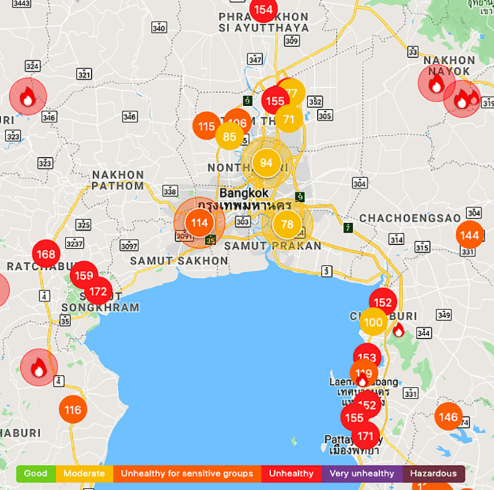
The industrial areas of Bangkok are also heavily polluted as well as the air quality at the seaside resort of Pattaya, southeast of Bangkok. Today’s Air Quality map here…

Screen Shot 2020-01-10 at 08.51.40.png

Fine dust pollution exceeded the safe threshold in 45 of the 48 areas of greater Bangkok this morning with the worst in Bangkok’s Bung Kum district, according to the Pollution Control Department.

Meanwhile the Bangkok Metropolitan Administration is putting its health officials on high alert following a rise of the hazardous ultra-fine dust, aka. PM2.5, in 38 of 50 areas in the capital, suburbs and adjacent provinces.

According to the Pollution Control Department the levels of fine particulate matter in the 38 areas ranged from 40 to 71µg/m³. The World Health Authority sets ’50’ as its upper safety limit for 2.5 micron air pollution levels.

The director of the BMA’s Health Department, Chawin Sirinak, says the Communicable Diseases Control Division is closely monitoring guidelines drawn up to help authorities effectively respond to air pollution around the city.

He says officials at mobile units led by 68 health offices have been instructed to step up awareness campaigns among city residents, with a focus on the most vulnerable groups – the elderly, children, pregnant women and people with heart and respiratory complaints.

The Thai Interior Minister, Anupong Paojinda, is ordering police to strictly monitor emissions from vehicles and factories and enforce the ban on open-air burning to help relieve the situation.
via Bangkok’s ranks world’s third worst air quality. Forecast to be bad for the rest of the week. | The Thaiger

Posted in Air Quality, Asia, Thailand | Tagged , , , | Leave a comment

Brake dust air pollution may have same harmful effects on immune cells as diesel exhaust

Metal particles from the abrasion of brake pads – up to a fifth of fine particulate matter (PM2.5) air pollution at roadsides – may cause inflammation and reduce the ability of immune cells to kill bacteria a new study has found, similarly to particles derived from diesel exhaust.

The scientists, primarily funded by the Medical Research Council (MRC), part of UK Research and Innovation, say this suggests that particulate pollution from brake wear could be contributing to increased susceptibility to airway infections and other negative effects on respiratory health.

It is estimated that only 7% of PM2.5 pollution from traffic comes from tail pipe exhaust fumes at roadside sites – the rest comes from sources such as tyre, clutch and brake wear, as well as the resuspension of road dust. Brake dust is the source of approximately 20% of total PM2.5 traffic pollution.

These are particles small enough to be inhaled into the deepest regions of the lung – PM2.5 means the particles are less than 2.5 micrometres in diameter.

Much of the research into the effects of traffic air pollution has focused on the effects of particulates derived from the tailpipe of diesel vehicles, but this new study has investigated if the particulate matter in brake dust has similar effects.

Dr Ian Mudway, who led the research at the MRC Centre for Environment and Health at King’s College London, said: “At this time the focus on diesel exhaust emissions is completely justified by the scientific literature, but we should not forget, or discount, the importance of other components, such as metals from mechanical abrasion, especially from brakes. There is no such thing as a zero-emission vehicle, and as regulations to reduced exhaust emissions kick in, the contribution from these sources are likely to become more significant.”

Dust from brake friction is rich in metals, which can catalyse the production of reactive oxygen species (ROS) – chemicals which can cause damage to cells on entering the lungs.

Past research into the increased rates of pneumonia seen in welders and foundry workers have shown that tiny particles rich in metal components can reduce the immune system’s ability to tackle bacterial infections. Since brake dust also contains a lot of metal particles, the researchers wanted to test if the types of metal particles found in brake dust can have a similar effect.

In this study, published in the journal Metallomics, the researchers obtained dust from a brake pad testing factory. The factory tests a broad range of drum brakes from a mixture of buses and trucks currently used in Europe under conditions representative of urban driving and high-speed braking.

To test its effect on immune cells, they grew macrophages in the lab, which are a type of immune cell that is on the front line of our defences in the lungs and kills bacteria by engulfing and digesting them.

When they exposed the macrophages to particulates from diesel exhaust and brake dust respectively, both reduced the ability of the macrophages to take up and destroy bacteria. They were tested with Staphylococcus aureus, a common infection in the lungs.

Adding metal chelators – chemicals that can bind to metal ions, stopping them from reacting and causing damage – prevented the negative effects on immune cells. This suggested that the metal content of the particulate dust was causing the ill effects.

The particulates from both sources also caused the macrophages to produce immune signalling molecules which drive inflammation.

The scientists were surprised to find that the metals in both brake dust and diesel exhaust had similar effects on the immune cells, as the diesel exhaust lacked the iron and copper common in brake dust, which are known to generate ROS in the body.

There were many other metal particles they had in common (such as arsenic, tin and antimony), but the researchers concluded the biggest culprit was most likely to be vanadium, as it was the only metal that was taken up by the cells increasingly as the dose of brake dust and diesel exhaust particulate matter increased.

Dr Liza Selley, who conducted the research at the MRC Centre for Environment and Health at King’s College London and Imperial College London, said: “Diesel fumes and brake dust appear to be as bad as each other in terms of toxicity in macrophages. Macrophages protect the lung from microbes and infections and regulate inflammation, but we found that when they’re exposed to brake dust they can no longer take up bacteria.”

“Worryingly, this means that brake dust could be contributing to what I call ‘London throat’ – the constant froggy feeling and string of coughs and colds that city dwellers endure – and more serious infections like pneumonia or bronchitis which we already know to be influenced by diesel exhaust exposure.”

This research was conducted in cells in the lab and further research is needed to fully understand how brake dust particles could contribute to ill health in humans.

Dr Selley added: “We included some experiments that gave the cells a rest from the pollution, and were pleased to see that these rested cells quickly regained their ability to take up bacteria once the brake dust had been removed. Our research was conducted in cells in the lab, so further study is required to see whether the metal particulate traffic pollution influences susceptibility to infection in the lungs of real people.”

Dr Megan Dowie, head of molecular and cellular medicine at the MRC, commented: “The impact of poor air quality is an important environmental risk to health in the UK. As changes in regulations surrounding internal combustion engines take effect, the relative contribution of brake dust to traffic pollution is predicted to rise. Studies like this investigating potential health effects could have important policy implications.”

via Brake dust air pollution may have same harmful effects on immune cells as diesel exhaust | EurekAlert! Science News

Posted in Air Quality, Europe, Health Effects of Air Pollution, World News | Tagged , , , , , , , | Leave a comment

Study links air pollution to osteoporosis

Air pollution has long been associated with health problems such as respiratory diseases, and has more recently even been linked to psychotic experiences. New research now reinforces the theory that it may also cause osteoporosis.

For the recent study, scientists from Spain’s Barcelona Institute for Global Health (ISGlobal) assessed the outdoor air quality of 28 villages near the Indian city of Hyberabad. They were particularly interested in levels of suspended fine particulate matter and black carbon.

The researchers additionally analyzed the bone health of 3,717 residents of those villages. A technology known as dual-energy x-ray absorptiometry was used, to measure bone mass at the lumbar spine and the left hip.

The data was gathered over a four-year period, from 2009 to 2012. During that time, residents also completed questionnaires regarding the type of indoor cooking fuel they used.

It was ultimately found that the villagers’ average annual exposure to airborne particles (measuring 2.5 micrometers or less) sat at 32.8 micrograms per cubic meter. This is far above the World Health Organisation’s maximum recommended level of 10 micrograms.

Importantly, it was also noted that the higher a village’s levels of outdoor air pollution, the lower its residents’ bone mineral content and mineral density tended to be. There was no correlation, however, between bone mass and the use of biomass such as wood for cooking fuel.

“This study contributes to the limited and inconclusive literature on air pollution and bone health,” says ISGlobal’s Dr. Otavio T. Ranzani, first author of a paper on the research. “Inhalation of polluting particles could lead to bone mass loss through the oxidative stress and inflammation caused by air pollution.”

The paper was recently published in the journal Jama Network Open.

via Study links air pollution to osteoporosis

Posted in Air Quality, Health Effects of Air Pollution, Medical Studies, Spain | Tagged , , , , , , | Leave a comment

Australian bush fires cause air pollution spike across Wellington region

Wellington’s air pollution levels are spiking as some of the worst bush fires in history rage across the Tasman.

Air currents are carrying smoke and pollutants from Australia, up the west coast of the South Island, and then across the middle of the country, putting one centre above the national standard.

Air pollution is measured in micrograms per cubic metre of air (ug/cm3). A PM10 particle is less than 10 microns in diameter, or one-fifth of the diameter of human hair, and are easily inhaled and absorbed into the lungs.

The national standard – the level of pollution deemed safe in New Zealand – is 50 micrograms per cubic metre.

The hourly average spiked to 52 at the Birch Lane station in the Hutt Valley around 3am on Friday morning – above the national standard for human safety – but dropped below again by 5am.

It reached 39.4ug/cm3 at the Willis St monitoring station at 8am on Friday, and levels reached 46.3ug/cm3 at the Wainuiomata bowling club station.

At high levels the particles can cause significant health effects, especially in the elderly, infants, those with asthma and other respiratory diseases, and people with other chronic diseases such as heart disease.

Senior lecturer in applied environmental chemistry at Massey University, Nick Kim, said air quality in Wellington was generally pretty good, mostly due to the high winds moving things along.

Kim said the main concern was the particle matter, as gases like CO2 or SO2 being swept across from Australia posed a low risk from that distance.

He would be surprised if this event exceeded the national standard of 50ug, but the bush fires would likely continue to create a “secondary imprint” on New Zealand’s levels.

While the increased particle matter meant most people had no cause for alarm, it held the potential to harm people already suffering from respiratory illness, Kim said.

“We are absolutely going to see many more of these events.”

The levels didn’t pose a high enough risk to warrant action at this point, but constant monitoring was necessary.

via Australian bush fires cause air pollution spike across Wellington region | Stuff.co.nz

Posted in Air Quality, Australia & Oceania | Tagged , , , , , , | 3 Comments

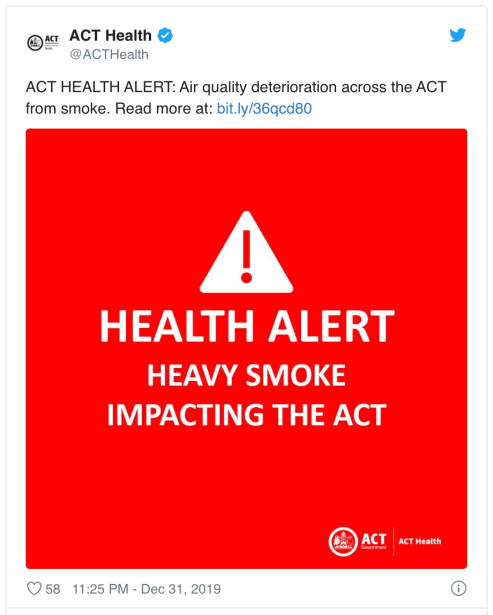
Canberra experiences worst air quality on record as bushfire smoke from south coast sets in

Canberra experiences worst air quality on record as bushfire smoke from south coast sets in
Residents of Australia’s capital are told to stay indoors and brace for more smog in the coming days

Canberra has experienced its worst air quality on record, as bushfire smoke became trapped by atmospheric conditions and residents were told to stay indoors and brace for more smog in the coming days.

The ACT’s acting chief health officer, Dr Paul Dugdale, said the smoke was the worst since the 2003 bushfires and was “certainly the worst” since air quality monitoring started in the city 15 years ago.

Air quality index readings in Canberra city were at 3,463 on Wednesday afternoon, according to the ACT Health website. Ratings of more than 200 are considered hazardous. The suburb of Monash showed levels at 4,650 and Florey was at 3,508.

An ACT health spokesperson said the AQI reading for fine particles peaked at 7700 at 1am on Wednesday at the Monash monitoring site.

The Canberra-based University of NSW climate scientist Dr Sophie Lewis was out in the city with her two-year-old daughter and said the conditions were “like nothing I have experienced before”. She was planning to leave the city.

“It’s permeating everything. It is the fine particulates that get through everything. This is the worst it has been,” she said.

“Last night it started to blow in and you do start to feel quite anxious and stressed. Smoke just makes us all panic.”

Families and children visiting Questacon, the National Science and Technology Centre, had a look of shock, said Lewis, with many people wearing masks and checking phone apps for air quality and fire updates.

Screen Shot 2020-01-02 at 10.01.33.png

She said a pattern in recent weeks had been for the smoke from bushfires burning to the east to arrive on cooler sea breezes in the evening.

On Tuesday night and Wednesday, a phenomenon known as a “temperature inversion” had caused warmer air above to trap the smoke, making conditions especially bad.

On Wednesday morning Dugdale said 12 people had gone to Canberra hospital with smoke-related illnesses in the previous 24 hours.

Dugdale said it was not the time for people to start any new year fitness resolutions and they should stay indoors instead.

“This is an exceptional time for Canberra – usually our air quality is among the best in the world,” he said.

The ACT’s health directorate also issued fresh advice on Wednesday, saying all Canberrans should “avoid physical activity outside”.

Screen Shot 2020-01-02 at 10.02.19.png

The public was advised to stay indoors with windows and doors closed and to turn evaporative air conditioners off.

The “extremely thick” smog was forecast to linger for several days, with conditions expected to remain poor, and temperatures on Saturday forecast to climb to 42C.

A statement said: “We also strongly advise people who are sensitive to smoke, especially those with pre-existing heart and lung conditions, to take extra care during these conditions.

“People who are sensitive to smoke and air pollution can be more vulnerable to heat-related illness as well, so staying hydrated and cool is important.

“People who are able to do so, are also encouraged to check on others who they think might need extra help, to see that they are okay.”

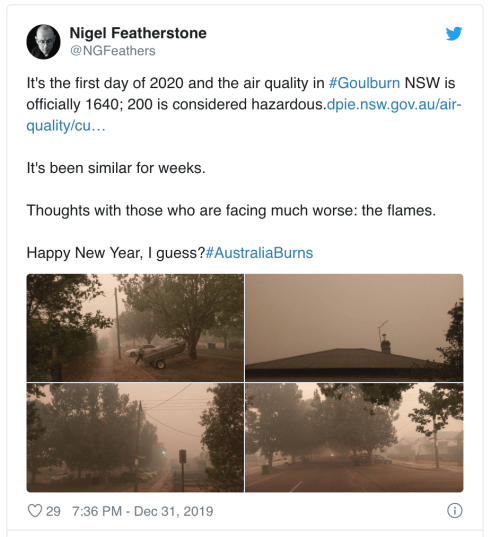
In NSW on Wednesday, the air quality index was at very high hazardous levels of 2,300 around Goulburn, caused by smoke from nearby bushfires.

Hazardous conditions were also detected in regions of Sydney’s south-west (352), and in the central tablelands (394) and southwest slopes (360).

Screen Shot 2020-01-02 at 10.03.31.png

via Canberra experiences worst air quality on record as bushfire smoke from south coast sets in | Environment | The Guardian

Posted in Air Quality, Australia & Oceania | Tagged , , , | Leave a comment

How Afghan officials are tackling Kabul’s ‘hazardous’ pollution

Afghan officials have begun cracking down on local businesses thought to be the main contributors to air pollution in the capital to battle a crisis that has reached “hazardous” levels.

The owners of wedding halls, public baths, and property management offices were also warned to stop burning scrap tyres and plastics – commonly done to provide heating in places of business, Leila Samani, a spokeswoman for Afghanistan’s National Environmental Protection Agency told the dpa news agency on Monday.

She also called on residents to reduce the use of coal – used to warm homes – and repair their old cars.

Three wedding halls and two property management offices were shut down as a senior delegation from the police, municipality and environmental agency started operating on Sunday evening.

Another 28 businesses have been identified for closure this week, according to Samani.

Many residents cite poverty and lack of electricity as the primary cause of pollution, which will be impossible to solve without cheaper gas and electricity.

Kabul is ranked as one of the worst-polluted cities in the world.

Seasonal air pollution is a major cause of disease in Kabul, and environmental activists have launched a campaign in which they distribute face masks.

Many people, especially children, suffer from respiratory infections caused by breathing polluted air.

“Kabul air is not breathable,” tweeted Shaharzad Akbar, the chairperson of Afghanistan’s Human Rights Commission.

“I feel constantly exhausted and low in energy, my son coughs at night and we don’t dare to go out for a walk.”

via How Afghan officials are tackling Kabul’s ‘hazardous’ pollution | Afghanistan News | Al Jazeera

Posted in Air Quality, Middle East | Tagged , , | Leave a comment

Revealed: microplastic pollution is raining down on city dwellers

Exclusive: London has highest level yet recorded but health impacts of breathing particles are unknown

Microplastic pollution is raining down on city dwellers, with research revealing that London has the highest levels yet recorded.

The health impacts of breathing or consuming the tiny plastic particles are unknown, and experts say urgent research is needed to assess the risks.

Only four cities have been assessed to date but all had microplastic pollution in the air. Scientists believe every city will be contaminated, as sources of microplastic such as clothing and packaging are found everywhere.

Recent research shows the whole planet appears to be contaminated with microplastic pollution. Scientists have found the particles everywhere they look, from Arctic snow and mountain soils, to many rivers and the deepest oceans. Other work indicates particles can be blown across the world.

The level of microplastic discovered in the London air surprised scientists. “We found a high abundance of microplastics, much higher than what has previously been reported,” said Stephanie Wrightfrom Kings College London, who led the research. “But any city around the world is going to be somewhat similar.”

“I find it of concern – that is why I am working on it,” she said. “The biggest concern is we don’t really know much at all. I want to find out if it is safe or not.”

About 335m tonnes of new plastic is produced each year and much leaks into the environment. The research, published in the journal Environment International, collected the microplastics falling onto the roof of a nine-storey building in central London. This ensured that only microplastic from the atmosphere was collected.

They were found in all eight samples, with deposition rates ranging from 575 to 1,008 pieces per sq metre per day, and 15 different plastics were identified. Most microplastics were fibres made of acrylic, most likely from clothing. Just 8% of the microplastics were particles, and these were mostly polystyrene and polyethylene, both commonly used in food packaging.

The rate of microplastic deposition measured in London is 20 times higher than in Dongguan, China, seven times higher than in Paris, France and nearly three times higher than Hamburg, Germany. The researchers do not know the reason for the variation, but differences in experimental methods are likely to be partly responsible.

The microplastic particles in London were between 0.02mm and 0.5mm. These are large enough to be deposited on to the airways when inhaled and would be swallowed in saliva. Smaller particles that can get into the lungs and bloodstream represent the greatest potential health hazard. These were seen in the samples but their composition could not be identified with current technology.

The serious health damage caused by the pollution particles emitted by traffic and industry are well known. A comprehensive global review earlier in 2019 concluded that air pollution may be damaging every organ and virtually every cell in the human body.

But the potential health impacts of inhaling plastic particles from the air, or consuming them via food and water, are unknown. People eat at least 50,000 microplastic particles per year, according to one study.

Plastics can carry toxic chemicals and harbour harmful microbes, and the limited research done to date has shown harm to some marine creatures. The only assessment of microplastic in human lungs, published in 1998, found inhaled fibres were present in cancerous lung specimens.

“These studies showing just how much plastic is in the air are a wake-up call,” said Steve Allen, at the EcoLab research institute near Toulouse, France, and whose own work has shown microplastic air pollution in remote mountain areas. “The [London research] is a very well done study showing incredibly high numbers of airborne microplastics.

“Currently we have very little knowledge on what effect this airborne pollution will have on humans,” he said. “But with what we do know it is pretty scary to think we are breathing it in. We need urgent research.”

Johnny Gasperi, at the Université Paris-Est, said the research shows a widespread contamination of the air by microplastics. He said the London study showed that microplastic deposition did not depend on the strength or direction of the wind, suggesting the city itself was the most likely source.

Melanie Bergmann, at the Alfred Wegener Institute for Polar and Marine Research in Germany, said more research on the potential health effects of microplastic pollution was very important. “We do not currently know what proportion of inhaled microplastics actually penetrates the deep lung,” she said.

The European commission’s chief scientific advisers said in a report in April: “The evidence [on the environmental and health risks of microplastics] provides grounds for genuine concern and for precaution to be exercised.”

Microplastics are also found in drinking water and in August an assessment by the World Health Organization found no evidence to date of harm but said more research was needed.

Cutting microplastic pollution requires changing how plastic is used and disposed of, said Wright: “You can’t clean it up, so it is about stopping it at source.” Allen said: “This is not a problem that is going to go away anytime soon.”

via Revealed: microplastic pollution is raining down on city dwellers | Environment | The Guardian

Posted in Air Quality, Europe, London, Research on Air Pollution in the UK, UK | Tagged , , , , | Leave a comment

Tehran air pollution forces week-long school closure

Schools in Iran’s Tehran province have been ordered shut until Friday due to severe air pollution, authorities announced, extending their closure to a full week.

Tehran city was cloaked by thick toxic smog for a third successive day on Monday that blanketed out landmarks like Milad Tower and the snow-capped Alborz mountains.

“All of Tehran province’s schools… except Firuzkuh and Damavand counties are closed for the week due to increasing air pollution,” governor Mohsen Bandpey told reporters.

He added that forecasts indicated stable weather and “increasing pollutant density” across urban areas.

Average airborne concentration of the finest and most hazardous particles (PM2.5) was at 147 microgrammes per cubic metre in the 24 hours to midday Monday, according to government website air.tehran.ir.

That is close to six times the World Health Organization’s recommended maximum of 25 microgrammes per square metre.

Pollution worsens in Tehran during winter, when cold air and a lack of wind traps hazardous smog over the capital for days on end, a phenomenon known as thermal inversion.

Schools in northern Alborz province were also closed for the week, state news agency IRNA quoted the deputy governor as saying.

The measure aims to stop pollution-belching buses from traversing the city while also keeping vulnerable youngsters indoors.

Iranian media and officials have however slammed the school closures as a limited measure to address the problem.

Shutting schools on Saturday and Sunday had evidently “not helped to improve Tehran’s air quality”, Donya-e Eqtesad daily wrote, calling it the “minimum necessary measure” the authorities could take.

Iran’s judiciary chief Ebrahim Raisi said the “roots” of the problem must be addressed.

Tehran’s mayor Pirouz Hanachi called for industries using the fuel oil mazout and gasoline to be targeted.

The sprawling capital is one of the world’s most polluted cities.

According to a World Bank report last year, most of the pollution in the city of eight million is caused by heavy duty vehicles, motorbikes, refineries and power plants.

via Tehran air pollution forces week-long school closure – France 24

Posted in Air Quality, Iran, Middle East | Tagged , , | Leave a comment