Madrid pollution levels soar within just one day of scrapping traffic restriction scheme

Just a day after traffic restrictions were scrapped by the new mayor, air pollution returned to levels recorded in the days before Madrid Central was introduced.
Environmentalists warned that pollution levels had risen above the legal limit of 40 micrograms per cubic meter on Monday and soared to 70 – a level not reached since Madrid introduced its traffic restrictions last November.

On Monday morning, July 1st,  Madrid’s new mayor, José Luis Martínez-Almeida, from the right-wing Popular Party fulfilled his promise to ditch fines for driving in the capital’s low-emissions zones and scrap Madrid Central, an initiative that was introduced to improve air quality.

Martínez-Almeida described the reversal as a temporary measure put in place while he and his team decides what to do about Madrid Central. He said they were working to “fight for sustainable mobility and against pollution, while guaranteeing citizen mobility and avoid, as much as possible, the losses suffered by retailers.”

The new mayor’s decision to suspend fines came despite the action of several ecological groups over the past weeks, including a march of 60 thousand people on Saturday.

But the mayor, who has failed to answer the activists’ requests for a meeting to discuss the issue, poked fun at protestors, saying he envies “how much free time they have to carry out these sorts of actions”.

In spite of this, ecologists continue to deliver hard evidence on the environmental benefits of the city’s low-emission zones, with Juan Bárcena, spokesperson of the group Ecologistas en Acción, pointing out that levels of pollution have reached their legal limit – 40 micrograms per cubic meter – which is something that hasn’t happened in the last quarter.

via Madrid pollution levels soar within just one day of scrapping traffic restriction scheme – The Local

Posted in Air Quality, Europe, Spain | Tagged , , | Leave a comment

Air pollution means pregnant women can’t breathe easy

Pregnant women receive a lot of instructions to ensure the healthiest possible baby: what to eat and drink, what to avoid, which vitamins to take, which activities to avoid and more.

But what about breathing?

Researchers have long been concerned about air pollution’s effects on pregnancy, with possible consequences ranging from premature births and low birth weight to elevated blood pressure later in the child’s life.

“We have just scratched the surface on this research,” said Dr. Beate Ritz, professor of epidemiology at the UCLA Fielding School of Public Health.

Ritz, who is president of the International Society of Environmental Epidemiology, has conducted studies since the 1990s linking air pollution levels in Southern California to mothers delivering babies before full term at below-average birth weight.

“When we started, some people said the fetus doesn’t breathe air, so how would it be affected?” she said. “It has become clear that whatever is happening to the mother is happening to the baby, and what happens in pregnancy can affect the rest of its life.”

Recent studies in the United States and elsewhere have shown correlations between particulate matter in the air and high blood pressure in mothers and babies, gestational diabetes (an increase in blood sugar that affects pregnant women), and high blood pressure in children who were exposed to pollution in the womb.

The possible dangers for babies who develop in a polluted environment extend to an increased risk of autism, asthma and the ultimate risk: miscarriage.

“It’s very hard to measure, because some women might lose the fetus so early they didn’t even know they were pregnant,” Ritz said. “But once you damage a fetus enough, it doesn’t survive.”

Pollution “seems to particularly affect vulnerable populations, such as those who are elderly or predisposed to disease,” said Dr. Sanjay Rajagopalan, chief of cardiology at the Herrington Heart and Vascular Institute of University Hospital in Cleveland. “And pregnancy is a vulnerable state. The fetus is in an environment where it is growing and vulnerable.”

However, Rajagopalan, who co-authored an American Heart Association scientific statement about air pollution and cardiovascular disease, said most studies so far have established only correlations between polluted air and disease rather than a direct cause-and-effect.

One obstacle, Rajagopalan said, is “it’s difficult to persuade pregnant women to partake in research. But this is becoming widely recognized as a field to explore. It’s just a matter of time.”

Meanwhile, pregnant women shouldn’t breathe easy. For expectant mothers and everyone else, Ritz said, the dangers of pollution should fuel campaigns for better air quality everywhere in the world.

But that’s unlikely to change much in nine months, bringing simple precautions and common sense to the forefront.

Indoor air purifiers are a good idea, Ritz said, as is keeping windows closed that face roadways and heeding health warnings on high-pollution days.

Rajagopalan stresses all the healthy behaviors for pregnancy – eating well, physical activity, prenatal care, avoiding alcohol and tobacco, monitoring blood pressure and other health indicators – as well as reducing exposure to bad air.

“Try to visit green spaces and areas that will probably have low levels of air pollution,” he said. “And if you don’t have to make that crazy car ride to downtown Los Angeles in your convertible, don’t do it.”

via Air pollution means pregnant women can’t breathe easy

Posted in Air Quality, Health Effects of Air Pollution, Medical Studies | Tagged , , | Leave a comment

Paris bans old diesels to tackle pollution

Paris on Monday banned all diesel vehicles aged 13 years or over from the city centre, the latest move in a campaign to tackle pollution on the city’s streets.

Diesel vehicles over 18 years old and petrol vehicles over 21 years old are already banned in Paris — a measure that was extended Monday to a new “low-emissions” belt surrounding the city.

Central Paris meanwhile went further by also banning diesel cars, trucks and motorbikes aged 13 years and over — a move aimed at cleaning up the air in a city that is regularly shrouded in smog.

Motorists who flout the traffic restrictions in central Paris, which were trialled during last week’s heatwave, face a 68-euro ($77) fine, rising to 135 euros for trucks and buses.

A Greenpeace report listed Paris as the worst western European capital for small particle air pollution in 2018, with levels higher than cities such as the Philippines capital Manila or the Colombian capital Bogota.

Beyond the city’s boundaries, the authorities are also clamping down on polluters in the 47 districts that ring the central Paris region, which are home to around 5.5 million people.

Unlike in central Paris, however, offenders in the suburbs, where car dependency is greater, face no punishment for the first two years of the ban.

The government agreed to a two-year punishment-free “learning period” after resistance from some mayors who feared that the ban could rekindle the “yellow vest” protests, which erupted late last year among motorists furious over fuel price hikes.

The protests quickly escalated into an anti-government revolt, marked by weekly demonstrations in cities around France that have regularly turned violent.

Reflecting on the lessons learnt, a senior official for the greater Paris area, Patrick Ollier, told reporters last week: “We don’t want to force the environment on people, but rather that it be accepted as the outcome of dialogue.”

The subject of air quality has become a burning issue for governments across the EU, where green parties made strong gains in May’s elections to the European Parliament.

In November, Madrid followed a handful of other European cities that have restricted traffic in their centres.

But whereas London, Stockholm and Milan have sought to dissuade motorists by driving into the city centre by hitting them with congestion taxes Madrid went further, banning many vehicles from accessing the centre altogether and fining them if they did.

In France, air pollution causes 48,000 extra deaths a year, according to the health service, making it the country’s second-biggest killer after smoking, ahead of alcohol.

Paris Mayor Anne Hidalgo has restricted car access and promoted walking and cycling in central Paris in a bid to banish the smog that periodically shrouds the capital.

The city aims to phase out the use of diesel cars by the time it hosts the Summer Olympics in 2024.

via Paris bans old diesels to tackle pollution

Posted in Air Quality, Europe, France | Tagged , , , | Leave a comment

Jakarta residents to sue government over severe air pollution

Tired of breathing in some of the world’s filthiest air, a group of activists and environmentalists in Jakarta has decided to sue the Indonesian government to take action.

Air quality in the south-east Asian metropolis has plunged dramatically in the past month and recorded worse conditions than notoriously polluted cities such as Delhi and Beijing.

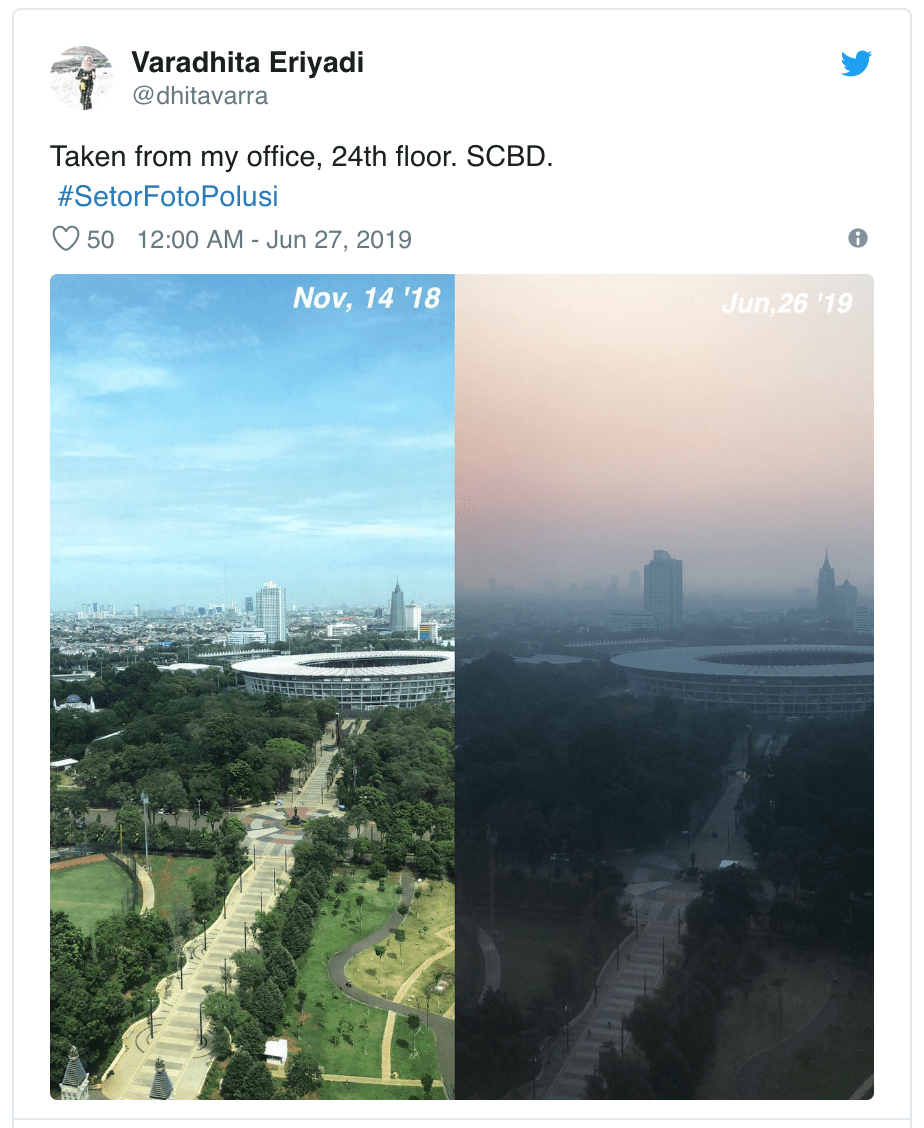
Social media users have uploaded photographs of the Indonesian capital blanketed in smog under the hashtag, #SetorFotoPolusi.

Screen Shot 2019-07-02 at 08.15.13.png

On 25 June, the capital registered an air quality index (AQI) of 240 according to the dynamic IQAirVisual index. For comparison, London’s current index reading is 12 while San Francisco is on 26.

The Jakarta smog has now prompted more than 30 plaintiffs, including activists, environmentalists, civil servants, artists, and businesspeople to band together and work on submitting a civil lawsuit against the government this month.

The case will be filed against the Indonesian president, as well as the ministries of health, home affairs and environment, and the governors of Jakarta, Banten and West Java.

“We hope that through this lawsuit the government can improve existing policies and take effective steps to overcome air pollution because current policies are not working,” explained Ayu Eza Tiara, a lawyer from the Jakarta Legal Institute, which is handling the case.

“In the last week of June, based on our data, the air pollution index is often really bad,” said Ayu, “It is often high in the red zone, which is classified as very unhealthy.”

According to the dynamic IQAirVisual index, Jakarta topped the charts for the world’s most polluted city at least half a dozen times this June.

The AQI reading is based on measurements of particulate matter, including PM 2.5, small particles less than 2.5 micrometers in diameter that can be inhaled and cause serious health problems.

Last year Jakarta was ranked the most polluted city in south-east Asia, based on a study by Greenpeace and AirVisual, published this March.

In addition to Jakarta’s notoriously bad traffic, Greenpeace believes the city’s industries, legal and illegal smelters, open-waste burning and coal-fired power plants are also to blame.

But the Indonesian government appears reluctant to acknowledge the problem.

The acting head of the Jakarta environmental agency recently dismissed the poor June readings, saying the government “doesn’t really respond to real-time data” and in general the air quality had been “moderate” this year.

Jakarta governor Anies Baswedan has put the problem down to the high number of vehicles on the road, but Greenpeace energy campaigner Bondan Andriyani argues that is only part of the picture.

“In 2018 the data showed that traffic in Jakarta was improving, but the air quality, declined. It’s a contradiction,” said Bondan, “The PM 2.5 data showed that number of unhealthy days almost doubled in 2018 from the year earlier.”

via Jakarta residents to sue government over severe air pollution | World news | The Guardian

Posted in Air Quality, Asia | Tagged , | Leave a comment

Air pollution ‘may affect number of eggs ovaries can produce’

Results suggest environmental factors could play a role in female reproductive health

Air pollution has been linked to a drop in activity of a woman’s ovaries, researchers have revealed.

Experts say the findings suggest the female reproductive system is affected by environmental factors, although the study does not look specifically at the impact of air pollution on fertility.

However, they added that if such an effect were permanent, it might mean that women might have a shorter period of their life in which to reproduce and an earlier menopause.

“Environmental aspects of our lives matter so we should take care about indoor environments as well as external,” said the study’s lead researcher, Antonio La Marca, of the University of Modena and Reggio Emilia, in Italy.

The findings, presented at the annual meeting of the European Society of Human Reproduction and Embryology, are based on a study of levels of a hormone called AMH. This is released by cells in the ovaries and gives an indication of a woman’s ovarian reserve – the number of viable eggs the ovaries can produce. This level differs between women and is affected by a number of factors, including genetics, age and smoking. Its link to fertility is debatable: a low ovarian reserve does not necessarily mean natural conception will be difficult.

However, La Marca said previous studies had suggested there could be a link between higher air pollution and reduced fertility in women, and animal models have inferred air pollution could affect levels of AMH.

To explore the issue further, La Marca and colleagues looked at AMH levels in about 1,300 women, the samples being collected in Modena between early 2007 and autumn 2017. From the participants’ home addresses, the team estimated daily levels of small particulates known as PM2.5s and PM10s, as well as levels of nitrogen dioxide.

For women over the age of 25, levels of AMH in the blood fell with age. After taking age into account, though, the team found AMH levels were lower among women who lived in areas with higher levels of air pollutants.

More specifically, when the team split the air pollution levels into four bands, they found women living amid the worst pollution were two to three times more likely than those in the other bands to have AMH levels below 1ng/ml – a level the team say signifies a severely low ovarian reserve. La Marca said previous research had shown only about 10% of healthy women under the age of 30 had such low levels of AMH.

La Marca said while the link between AMH levels and the chances of becoming pregnant naturally in the short term remained unclear, the results suggested environmental factors could play a role in female reproductive health.

“Having a high AMH is in some way a reproductive advantage because women with a higher AMH are going to have a longer reproductive lifespan,” he said, adding it was also significant to those undergoing IVF. “If you have a high AMH you will have a higher number of eggs after ovulatory stimulation which turn into a higher number of embryos,” he said.

The study has limitations, not least that the team was unable to take into account other factors, such as poverty and poorer health, that tend to be more prevalent in areas of high pollution and might also affect AMH levels. What’s more, AMH and pollution levels were not tracked over time.

Richard Anderson, a professor of clinical reproductive science at the University of Edinburgh, said while the impact of environmental factors on sperm count and quality was a topic of much research, there had been far less work on possible impacts on the female reproductive system.

“This does show a reduction in the activity of the ovaries in women [living in areas of high air pollution],” he said, although he pointed out the levels of air pollution women were directly exposed to was not measured.

Anderson said questions remained. “There is uncertainty in whether this is a permanent effect, which might indicate perhaps a reduced reproductive lifespan and an earlier menopause, or whether this is a temporary effect that women could recover from if they are no longer exposed to those chemicals,” he said.

via Air pollution ‘may affect number of eggs ovaries can produce’ | Environment | The Guardian

Posted in Air Quality, Health Effects of Air Pollution, Medical Studies | Tagged , , , , , | Leave a comment

In legal first, court faults France over air pollution

A court on Tuesday (25 June) found the French state had failed to take sufficient steps to limit air pollution around Paris, a legal first in the country hailed by environmental campaigners as a victory for victims of dirty air.

The case at the administrative court in Montreuil outside Paris was brought by a mother and daughter who argued their health had been harmed by the air in a notoriously congested area of the city.

But the court also said it did not find any direct link between the pair’s health problems and failures of the state, throwing out their demand for damages.

Backed by NGOs, the complaint was the first brought by individuals against the French state over health problems caused by air pollution.

“The state committed a fault by taking insufficient measures concerning the quality of air,” the court said in a statement.

It said that between 2012 and 2016, the state had failed to take sufficient measures to bring concentrations of certain polluting gases below allowed limits.

“For victims of pollution, this is a first,” the plaintiffs’ lawyer Francois Lafforgue told AFP. “From now, the state will have to take effective measures in the fight against pollution and the victims can hope to have what they suffered recognised.”

Nadir Saifi, of Ecologie sans Frontière, a French NGO which backed the case, said the decision was “historic”.

“I am very moved. We have been waiting for this for 20 years,” said the activist.

More cases to come

However the court rejected the pair’s demand for €160,000 in damages, saying it could not find a direct link between their health problems and the state’s failings.

The mother Farida, 52, and daughter said the authorities did not take effective steps against atmospheric pollution, in particular during a pollution high in December 2016.

They argued that this affected their health, especially as they were living at the time in the northern Paris suburb of Saint-Ouen, just outside the clogged périphérique ring road. They have now moved to the Loire city of Orleans.

The périphérique – opened in 1973 – takes 1.1 million drivers a day but is also a nightmare for the 100,000 people living around it.

The ruling said, however, that the Paris authorities had not been at fault during the 2016 pollution crisis and had introduced measures such as restricting the number of cars on the road.

Some 50 people across France are taking similar actions against the French state, according to activists.

The court’s ruling comes as concerns grow over pollution in Paris as the capital and other parts of France swelter in a heatwave.

Paris authorities have banned older models of diesel and petrol cars from Paris on Wednesday because of a build up of pollution.

In France, air pollution is responsible for 48,000 premature deaths every year, according to the Public Health France agency.

As pollution climbs up the political agenda ahead of 2020 municipal elections, Paris Mayor Anne Hidalgo is looking at proposals to limit pollution on the périphérique, including cutting the speed limit to 50 kilometres per hour.

In May 2018, the European Commission took France and five other countries to the European Court of Justice for failing to apply long-sought steps to improve air quality.

In France’s case the move came after 12 years of warnings over fine particles as well as nitrogen dioxide levels, which in some cities were more than double EU limits.

via In legal first, court faults France over air pollution – EURACTIV.com

Posted in Air Quality, Europe, France | Tagged , | Leave a comment

Air pollution responsible for over 4,000 deaths annually in Tehran

There are numerous vehicular trips per day in Tehran, which are the leading cause of air pollution in the capital, so that the air in Tehran is amongst the most polluted in the world, Tehran City Council member, Arash Milani, said.

According to a report by World Bank published in April 2018, Tehran is ranked 12th among 26 megacities in terms of ambient PM10 levels. After Cairo, Tehran is the most polluted non-Asian megacity. In 2016, the annual ambient level of PM10 was estimated at 77 micrograms per cubic meter. This is almost four times the WHO’s recommended threshold of 20 micrograms per cubic meter.

In the metropolis of Tehran alone over 4,000 people die of respiratory problems caused by air pollution annually, Milani lamented, Fars reported on Sunday.

However, the average concentration of major pollutants in Tehran has declined since the last 10 years, he added.

“Of course, this year, clean and healthy air quality stayed in the capital compared to the recent years. This means that any changes in transportation system, can have a significant impact on air pollution hitting Tehran,” he concluded.

According to the Air Quality Control Company, 25 days of excellent and 62 days of healthy air quality have been reported in the capital since the beginning of the current Iranian calendar year (March 21), while unhealthy air quality for sensitive group hit the capital for 7 days.

Last year in the same period only 8 days of clean air were reported, but 15 days were lightly polluted or unhealthy for sensitive groups.

via Air pollution responsible for over 4,000 deaths annually in Tehran – Tehran Times

Posted in Air Quality, Iran, Middle East | Tagged , , | Leave a comment

Air pollution of toxic substances (namely nitrogen dioxide) in the central part of Kyiv is 6 times higher than the allowable rate

The causes of such level of pollution are the heat, the high atmospheric pressure, low wind speed and night surface inversions

Air pollution of toxic substances (namely nitrogen dioxide) in the central part of Kyiv is six times higher than the allowable rate. The press office of the State Emergency Service reported this.

According to the Hydrometeorological Center, the causes of the level of pollution the heat, the high atmospheric pressure, low wind speed and night surface inversions – will be observed in Kyiv until Monday, June 24.

Rescuers also said that the current level of air pollution was also caused by the lack of precipitation.

“Starting from June 10, there was a gradual accumulation of pollutants, especially nitrogen dioxide NO2 and formaldehyde. The highest concentration of pollutants is observed at the end of the week (Friday), over the weekend the concentration decreases slightly, and starting from Monday it gradually increases again, which indicates the predominant influence of motor transport”, said in the message.

We recall that similar meteorological conditions in the weather center have been observed since June 8. On June 11, in Kyiv, weather forecasters recorded the warmest night since 1881 – the heat did not drop below +20.2 degrees. Last week, weather forecasters warned about excessive fire risks of 4 and 5 levels.

via Air pollution of toxic substances (namely nitrogen dioxide) in the central part of Kyiv is 6 times higher than the allowable rate – Air pollution in center of Kyiv six times higher than normal – 112.international

Posted in Air Quality | Tagged , , , | Leave a comment


