A tale of two cities: Is air pollution improving in Paris and London?

For the first time, a joint air pollution study across two mega-cities — London and Paris — measures the impact of policies designed to reduce air pollution from urban traffic over the last 12 years.

In a paper, published today in the journal Environmental Pollution, researchers from King’s College London and Airparif found that despite efforts, both cities do not meet legal limits for nitrogen dioxide and airborne particle pollution set by the World Health Organisation.

Many polices are in place to combat air pollution at European-wide, city-wide and local scales. This study found that since 2010, these have led to improvements in nitrogen dioxide and particle concentrations across both cities.

However, the rate of change has not been enough to achieve compliance with legal limits. They note that nitrogen dioxide from traffic in London has deteriorated alongside some roads.

Looking at two time periods, 2005-2009 and 2010-2016, they also found that:

As the legal compliance approached in 2010, nitrogen dioxide in both cities was getting worse and not better. Despite passing ever tighter laboratory tests, new diesel cars failed to achieve anticipated reductions when driven on the roads. This suggests that if feedback between air pollution surveillance and policy makers was better, it could have allowed for a more agile response, as conditions changed from the expected trajectory.
From 2010 to the end of 2016, the large decline in particle pollution in London and Paris can be explained by the implementation of the Euro 5 standards on diesel cars and vans.
There is some evidence that the introduction of newer diesel lorries and buses manufactured after 2009 lead to decreased nitrogen dioxide.
In London, schemes to update bus fleets lead to rapid improvements alongside some roads. However, an increase in motorcycles in London since 2010 may have offset some of the improvements from other vehicle types. This highlights the less stringent exhaust standards applied to motorbikes compared with other vehicles.
Dr Gary Fuller, air pollution scientist at King’s College London said, “The diesel emissions scandal had a serious impact on air pollution in Europe’s two mega-cities. Even though new cars passed ever tighter exhaust tests, many emitted much more pollution when driven on our roads. This has led to chronic and widespread problems with limits for nitrogen dioxide.

“A clear lesson here the need for better feedback to make sure that our air pollution polices remain on track. There have been some successes in London and especially with the bus fleet. Although we are now heading in the right direction; we need stronger policies, such as London’s forthcoming ultra-low emission zone, to improve air pollution quickly for everyone in our cities, and we need to check that they work.”

Story Source:

Materials provided by King’s College London. Note: Content may be edited for style and length.

via A tale of two cities: Is air pollution improving in Paris and London? — ScienceDaily
Posted in Air Quality, Europe, France, London, UK | Tagged , , , , , , , , , | Leave a comment

Air pollution may impact fetal cardiovascular system, Rutgers study says

Exposure to ultrafine particulates, the smallest particles in air pollution, restricts blood flow and nutrients to the uterus

Microscopic particles in air pollution inhaled by pregnant women may damage fetal cardiovascular development, according to a study by Rutgers researchers.

The study, published in the journal Cardiovascular Toxicology, found that early in the first trimester and late in the third trimester were critical windows during which pollutants most affect the mother’s and fetus’ cardiovascular systems.

“These findings suggest that pregnant women, women of child-bearing years who may be pregnant and those undergoing fertility treatments should avoid areas known for high air pollution or stay inside on high-smog days to reduce their exposure,” said Phoebe Stapleton, assistant professor at Rutgers Ernest Mario School of Pharmacy and a faculty member at Rutgers Environmental and Occupational Health Sciences Institute. “Pregnant women should also consider monitoring their indoor air quality.”

What a mother inhales affects her circulatory system, which is constantly adapting to supply adequate blood flow to the fetus as it grows. Exposure to these pollutants can constrict blood vessels, restricting blood flow to the uterus and depriving the fetus of oxygen and nutrients, which can result in delayed growth and development. It can also lead to common pregnancy complications, such as intrauterine growth restriction.

The study looked at how the circulatory systems of pregnant rats and their fetuses were affected by a single exposure to nanosized titanium dioxide aerosols — a surrogate for particles found in typical air pollution — during their first, second and third trimesters. The results were compared to pregnant rats that were exposed only to high-efficiency filtered air.

The researchers found that exposures to pollutants early in gestation significantly impact a fetus’s circulatory system, specifically the main artery and the umbilical vein. Later exposure had the most impact on fetal size since the restricted blood flow from the mother deprives the fetus of nutrients in this final stage.

In non-pregnant animals, even a single exposure to these nanoparticles has been linked to impaired function of the arteries in the uterus. The study found that one exposure late in pregnancy can restrict maternal and fetal blood flow, which can continue to affect the child into adulthood.

“Although nanotechnology has led to achievements in areas such as vehicle fuel efficiency and renewable energy, not much is known about how these particles affect people at all stages of development,” said Stapleton.

By 2025, the annual global production of nanosize titanium dioxide particles is projected to reach 2.5 million metric tons. Besides representing the very small particles found in air pollution, titanium dioxide also is commonly used in many personal care products including sunscreens and face powders.

via Air pollution may impact fetal cardiovascular system, Rutgers study says | EurekAlert! Science News

Posted in Air Quality, Health Effects of Air Pollution, Medical Studies | Tagged , , | Leave a comment

Jakarta has most polluted air in Southeast Asia: Study

Jakarta ranks first as city with the worst air quality in Southeast Asia last year, a recent study has shown.

The study by Greenpeace and AirVisual IQ published on March 5, monitored air quality in hundreds of cities across the globe. Jakarta was ranked first, followed by Hanoi, for the worst air quality, the head of Greenpeace Indonesia, Leonard Simanjuntak, said.

Across the globe, Leonard added, Jakarta was ranked 161st for cities with the worst air quality. New Delhi was in first place.

“Four- and two-wheeled vehicles exceed Jakarta’s capacity. There is almost no control over them. It’s easier for people to use private vehicles in Jakarta,” he said as quoted by kompas.com on Thursday.

Another factor, according to Greenpeace, was coal-fired steam power plants (PLTU) located around Jakarta. The PLTUs contributed 33 to 36 percent to air pollution in Jakarta.

“There are PLTUs around Jakarta that are situated within a 100-meter radius of each other. It also contributes seriously to the level of air pollution in Jakarta,” Leonard said.

He explained that the daily air quality average in Jakarta, according to the PM 2.5 indicator, last year was 45.3 micrograms pollutant particles per cubic meter.

“The daily average air quality in Jakarta is 4.5 times worse than the limit set by the World Health Organization [WHO]. That number also increased compared to 2017, when the average daily air quality in Jakarta was 29.7,” Leonard said.

The WHO has set an average air quality guideline of 25 micrograms per cubic meter daily.

via Jakarta has most polluted air in Southeast Asia: Study – City – The Jakarta Post

Posted in Air Quality, Asia | Tagged , , , , | Leave a comment

Moon proposes artificial rain with China to clear Seoul air

With the South Korean capital’s air quality deteriorating to a never-before-seen level, President Moon Jae-in on Wednesday instructed ministries to draw up countermeasures such as artificial rain, in coordination with China, which is seen as a primary culprit.

The atmospheric concentration of PM2.5 — particulate matter smaller than 2.5 microns in diameter, which can lodge deep in the lungs — reached an average 135 micrograms per cubic meter Tuesday in Seoul, the Ministry of Environment said. The level exceeds the earlier record of 129 micrograms per cubic meter from January, and is nearly four times the South Korean standard for air quality.

Moon cited artificial rain over the Yellow Sea as an example of a countermeasure, even though an experiment failed in January. But it is still unclear whether that would deliver the desired effect. Environment Minister Cho Myung-rae said restrictions of car traffic and economic activities should be considered.

On early Wednesday morning, Seoul had the world’s worst air quality in a ranking compiled by air-quality information provider AirVisual — worse than New Delhi and Shanghai. Hazy visibility from even a few hundred meters away has not been uncommon here since last year. Stagnation of air flow due to a high-pressure system around the Korean Peninsula on Tuesday seems to have led to the high PM2.5 concentration.

Media outlets are reporting on air pollution as one of the top issues daily, showing pictures of people wearing respirators.

PM2.5, which the environment ministry calls carcinogenic, has become a source of serious concern for residents. Much of the pollutant is thought to come from China, as factory emissions and yellow dust from deserts travel to South Korea on the prevailing belt of winds known as the westerlies.

The Chinese side has given a mixed response. “I don’t know if there is sufficient evidence in Korea that the smog in South Korea comes from China,” Foreign Ministry spokesperson Lu Kang said in his regular press conference Wednesday, adding that the cause of the pollution and how to effectively manage it must be investigated “in a scientific manner.” But he also said cooperation among parties “is of course good.”

Tackling air pollution was one of Moon’s campaign promises in the 2017 election. Nearly two years into his tenure, his approval rating could take a hit if he fails to address the worsening problem.

via Moon proposes artificial rain with China to clear Seoul air – Nikkei Asian Review

Posted in Air Quality, Asia, South Korea | Tagged , , , , | Leave a comment

22 of world’s 30 most polluted cities are in India, Greenpeace says

Analysis of air pollution data finds that 64% of cities globally exceed WHO guidelines

Twenty-two of the world’s 30 worst cities for air pollution are in India, according to a new report, with Delhi again ranked the world’s most polluted capital.

The Greenpeace and AirVisual analysis of air pollution readings from 3,000 cities around the world found that 64% exceed the World Health Organization’s annual exposure guideline for PM2.5 fine particulate matter – tiny airborne particles, about a 40th of the width of a human hair, that are linked to a wide range of health problems.

Every single measured city in the Middle East and Africa exceeds the WHO guidelines, as well as 99% of cities in south Asia and 89% in east Asia. Since many cities, particularly in Africa, do not have up-to-date public air quality information, the actual number of cities exceeding PM2.5 thresholds is expected to be much higher, the report authors said.

The report is based on 2018 air quality data from public monitoring sources, such as government monitoring networks, supplemented with validated data from outdoor IQAir AirVisual monitors operated by private individuals and organisations.

Screen Shot 2019-03-06 at 08.29.23

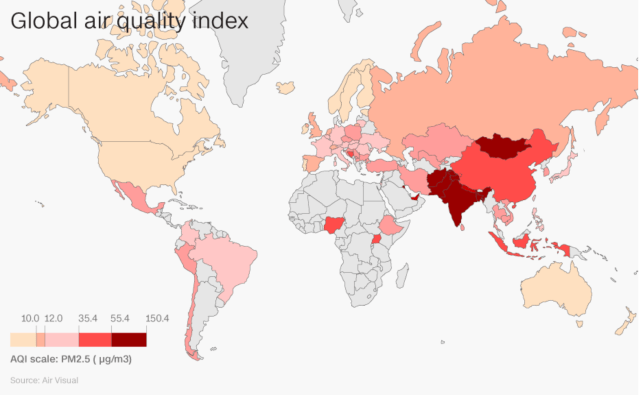
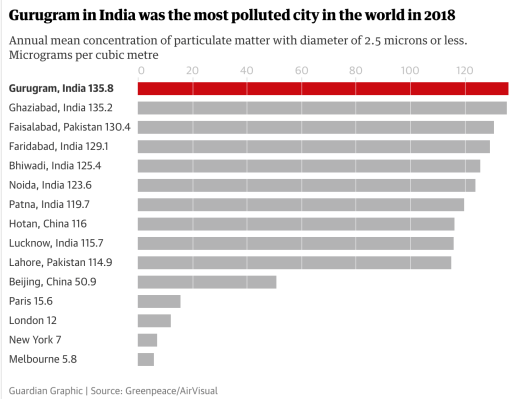
India dominates the top of the list. The tech hub of Gurugram, a city just to the south-west of Delhi which was previously known as Gurgaon, and where international firms including Uber and TripAdvisor have headquarters, ranked the most polluted in the world with an average of more than 135 micrograms of PM2.5 per cubic metre (µg/m3) throughout the year. Delhi is ranked 11th.

Faisalabad in Pakistan is ranked third with 130 (µg/m3), with Lahore 10th. Dhaka in Bangladesh is ranked 17th. The only other country to feature in the top 30 is China, which appears five times, including Hotan in the western Xinjiang province (eighth) and the ancient Silk Road city of Kashgar (19th).

The highest-ranking capital cities are Delhi, Dhaka and Kabul in Afghanistan (52nd). The Bosnian capital, Sarajevo, is the most polluted European city with an annual average of 38.4 µg/m3. London is the 48th most polluted capital with 12.0 µg/m3 and Washington DC 56th with 9.2 µg/m3.

“Air pollution steals our livelihoods and our futures, but we can change that,” said Yeb Saño, executive director of Greenpeace Southeast Asia. “We want this report to make people think about the air we breathe, because when we understand the impacts of air quality on our lives, we will act to protect what’s most important.”

The WHO estimates that 7 million people a year die prematurely from exposure to air pollution globally, with the World Bank calculating the cost to the world economy in lost labour as $225bn.

via 22 of world’s 30 most polluted cities are in India, Greenpeace says | Cities | The Guardian

Posted in Africa, Air Quality, Asia, India, Middle East | Tagged , , , , , | Leave a comment

22 of the top 30 most polluted cities in the world are in India

India accounts for seven of the world’s 10 cities with the worst air pollution, according to a new report, but previously smogbound Chinese cities have seen a marked improvement.

Gurugram, a suburb of the Indian capital New Delhi, is the world’s most polluted city, according to Greenpeace and AirVisual, which found it had an average air quality index of 135.8 in 2018 — almost three times the level which the US Environmental Protection Agency regards as healthy.
In two months of last year, the AQI in Gurugram — as measured by levels of fine particulate matter known as PM 2.5 — was above 200. The EPA regards this as “very unhealthy” and warns that “everyone may experience more serious health effects” if exposed.
According to the report, air pollution will cause around 7 million premature deaths globally next year and have a major economic impact.
“Air pollution steals our livelihoods and our futures,” said Yeb Sano, executive director of Greenpeace Southeast Asia. “In addition to human lives lost, there’s an estimated global cost of 225 billion dollars in lost labor, and trillions in medical costs. This has enormous impacts, on our health and on our wallets.”

Screen Shot 2019-03-05 at 10.38.29

The problem is particularly pronounced in South Asia. Eighteen of the world’s top 20 most polluted cities are in India, Pakistan or Bangladesh, including the major population centers of Lahore, Delhi and Dhaka, which placed 10th, 11th and 17th respectively last year.

Climate change “is making the effects of air pollution worse by changing atmospheric conditions and amplifying forest fires,” the report said, while noting that the key driver of global warming, burning fossil fuels, is also a major cause of dirty air.

“What is clear is that the common culprit across the globe is the burning of fossil fuels — coal, oil and gas — worsened by the cutting down of our forests,” Sano said.

“What we need to see is our leaders thinking seriously about our health and the climate by looking at a fair transition out of fossil fuels while telling us clearly the level of our air quality, so that steps can be taken to tackle this health and climate crisis.”

While South Asian countries, along with China, are the worst affected, air pollution is a global issue.

Of the 3,000 cities measured in the report, 64% exceeded the World Health Organization’s annual exposure guidelines for PM2.5.

PM2.5 includes pollutants such as sulfate, nitrates and black carbon, which can sneak deep into the lungs and cardiovascular system. Exposure to such particles has been linked to lung and heart disorders, and can impair cognitive and immune functions.

Every single city included in the report in the Middle East and Africa exceeded WHO guidelines for PM2.5, as did 99% of cities in South Asia, 95% in Southeast Asia, and 89% in East Asia.

“As many areas lack up-to-date public air quality information and are for this reason not represented in this report, the total number of cities exceeding the WHO PM2.5 threshold is expected to be far higher,” the report warned.

One bright spot was China, once the world’s poster child for urban air pollution. The report found that average concentrations of pollutants fell in Chinese cities by 12% from 2017 to 2018, while the capital Beijing has fallen out of the top 100 most polluted cities following concerted efforts to get air pollution under control.

China’s most polluted city in 2018, according to the Greenpeace/AirVisual report, was Hotan in the far west. Baoding, which once ranked among the worst in the country, is now at number 33. When CNN visited in 2015, residents said they often couldn’t see neighboring buildings because the air was so smoggy.

While China saw improvement, however, many neighboring countries suffered major increases in pollution, including in Indonesia, South Korea, Vietnam and Thailand.

In January, authorities in Bangkok deployed planes with special rainmaking capabilities — a technique known as cloud seeding — to relieve persistent pollution in the Thai capital. In the same month, cities across South Korea, China and India reported major spikes in air pollution, as winter fuel burning contributed to the smog blanketing the region.

via 22 of the top 30 most polluted cities in the world are in India – CNN

Posted in Air Quality, Asia, India | Tagged , , , , , , , , , , | 2 Comments

Air Pollution: Scarves do not help in fighting city’s air pollution: Experts

Masks are better, research organisation plans to analyse options

The scarves worn by many two-wheeler riders in the city or even pieces of cloth wrapped around the nose are ineffective in fighting air pollution around us. A Pune based institute, the Chest Research Foundation, revealed the startling fact and added that it would soon commission a study on the masks that could be used to check the health hazard and determine its efficiency.

“The air quality we breathe in the state, including that of the city, is unhealthy as the number of pollutants and particulates are beyond the standards mentioned by the World Health Organisation (WHO),” said Sundeep Salvi, the director of the foundation.
Salvi said that India has the second highest number of cases of chronic obstructive pulmonary disease (COPD) in the world. “The ambient air pollution caused by construction work, dust and other weather conditions scores over vehicular pollution, household pollution and the pollution caused by smoking tobacco,” he added.

The director said hence it becomes very important to take steps like preventive measures and treatment to address the air pollution concerns that are increasing daily.

Salvi revealed that a study would start soon to understand which masks work best for particular air quality and conditions. He said that a normal mask is about 40 per cent more efficient than scarves/cloth used to cover the face.

“Masks offer much better protection against bad air quality. However, there are a number of models and companies producing them. It can become a difficult task to select the right mask for an individual,” he said.

Salvi said that study would include understanding different components of these masks including the filters, the layers that go in filtering the different layers of pollution and the comfortable aspect of it.

The research would also include details on the capacity of each mask to filter the amount of particulate matter in the air. “Some masks have many filters but this may make it difficult to breathe when the air is heavy. Whereas some masks are able to filter between 95 per cent to 99 per cent of particulate matter,” he said.

Salvi told Mirrorthat in such cases, the cost factor plays a determining role in how much one wants to spend and effectiveness needed or health concerns that need to be addressed.

“Hence the study becomes important. Moreover, air filters and purifiers installed indoors and polluted junctions in various parts of India are a reality. Treating then also becomes a point of concern,” he added.

“People should learn to own the fact that they are equally responsible to the bad air quality they breathe as others surrounding them. Measures like massive plantation, devising innovative technologies that absorb pollutants in the air and reducing the emissions should be taken by the people,” he said.

Gufran Beig, senior scientist at Indian Institute of Tropical Meteorology (IITM), said, “The air quality of Pune is much better compared to Mumbai or New Delhi. However, there are preventive measures that need to be taken.”

Beig said that the measures will have to be taken especially when the particulate matter (PM) levels go beyond 60-3. The PM10 levels in Pune were 61on Sunday and expected to reach 74 in the next three days.

via Air Pollution: Scarves do not help in fighting city’s air pollution: Experts

Posted in Air Quality, Asia, India | Tagged , , , , , , , | Leave a comment

Italy’s polluted Po Valley gasps for fresh air

It is only the end of February, but air pollution in Milan has already exceeded the legal limit for 2019, and the Po Valley swims in a soupy smog.

“I can really feel when there’s smog, I suffer all winter long,” 45-year old Milan local Fabio Cigognini told AFP, describing the asthma-like symptoms which plague him during the cold months.

“We breathe in poison, but no-one tells us anything,” he said.

Set against the mountains, far from the ocean and cleansing sea breezes, Italy’s major northern city and the Po Valley have always been at a disadvantage, climate wise.

But with air pollution at “alarming” rates – among the highest in Europe – local authorities have turned to a combination of tactics to help the city and the valley breath again.

“The Po Valley is very unhappily situated for atmospheric pollution in terms of climate and geography,” says Damiano Disimine, head scientist in the Lombardy for Italy’s environmentalist lobby Legambiente.

“Wind is rare and there are frequent and prolonged episodes of climatic inversion. This means that the air is colder in the plains than in the mountains, and is still,” he said.

“On a European scale, the air pollution level is comparable only to southern Poland, where there is a coal industry and frightening sources of pollution”.

– Action plan –

In Lombardy, coal-fired power stations are closed and the use of heavy fuel oil for heating has been banned for 20 years.

In the vast plain, which runs from the Apennines to the Alps, “a quarter of the pollution is caused by road traffic, 45 percent by domestic heating and the rest by industrial and agricultural emissions,” says Lombardy environment councillor Raffaele Cattaneo.

The region produces vast amounts of animal waste, a big contributor to pollution. It delivers more than 40 percent of Italy’s milk production, for example, while over half of the Italian pig production is located in the Po Valley.

Lombardy’s action plan — drawn up in coordination with three other regions in the valley — is based on those three factors.

The circulation of dirty vehicles is limited in certain areas, especially when the level of coarse dust particles (PM10) exceeds the threshold for four consecutive days.

The same goes for heating in homes and offices. And those who buy greener heating systems or upgrade their home insulation can get financial assistance.

There are also measures for agriculture — as a chemical reaction between the ammonia in fertiliser and the nitrous oxide from diesel vehicles accounts for up to three quarters of particles, Cattaneo said.

Air pollution has decreased significantly in recent years as a result.

From 2005 to 2018, the average PM10 concentration in Lombardy dropped from 46 to 29 mg/m3, and the number of days in which the 50 mg/m3 limit was breached in the region dropped from 119 to 40.

– Situation ‘alarming’ –

Still, pollution levels exceed a 35-day limit however, breaking EU law. And the dry, sunny winter on the plain does not bode well for 2019’s air quality.

The climatic and geographic “handicap” should be an incentive to “do better, and more than others”, Disimine said.

Things are improving — particularly in grey-skied Milan, which charges vehicles to enter the city centre and has just imposed a ban on the worst offenders during the day on weekdays.

But Disimine says the situation still “alarming”, especially as regards the nitrogen oxide level, for which traffic is to blame.

There are some 65 cars per 100 inhabitants in Italy — and 51.8 in Milan — compared to 36 for example in Paris, London and Berlin.

The answers lie in “public transport, car sharing, cycling” and improving bus and train networks beyond the regional capital.

“In the last ten years, the number of citizens using the train has doubled in Lombardy,” says Cattaneo, who favours a carrot rather than stick approach, preferring to offer financial incentives than enforce bans.

The region has set itself the goal of coming in at, or under, the European Union 35-day limit by 2025.

via Italy’s polluted Po Valley gasps for fresh air

Posted in Air Quality, Europe, Italy | Tagged , , , , , | Leave a comment