7 districts in Taichung, Taiwan exposed to 8 cancerous air pollutants

7 districts of Taichung, Taiwan exposed to high concentrations of 8 carcinogens in air

A study of air pollution in Taichung City has found that seven districts contain unacceptable levels of PM2.5 and eight first-level airborne carcinogens, reported SETN.

On Saturday, a public hearing on the results of the first and second phases of a survey on air pollution was held by the Taichung Environmental Protection Bureau at Chung Shan Medical University. Liaw Yung- po (廖勇柏), a professor at the university, said that although the city of Taichung did not exceed standards for PM2.5 and carcinogens, there are seven districts which were found to have concentrations of eight carcinogens so high, that just inhaling the air would put residents at a higher risk.

The issue of air pollution in Taichung has attracted much attention in recent years. In addition to the dismantling of intermediate load power plants, citizens have been curious about how Taichung Mayor Lu Shiow-yen (盧秀燕) would improve the air quality in the city.

However, the results of the latest survey have caused panic among residents of the seven Taichung districts. The study focuses on the exposure to air pollution by residents around the Taichung Power Plant, Dragon Steel Co., Ltd., and Central Taiwan Science Park.

Although the study found that much of Taichung City did not exceed PM2.5 and carcinogen standards, the following seven districts had high concentrations of carcinogens: Longjing, Situn, Dadu, Daya, Cingshuei, Houli, and Wuci.

At the hearing, Liaw then explained that the eight first-level airborne carcinogens included arsenic, cadmium, nickel, and dioxin. Liaw said that those who inhale these pollutants may face higher health risks, regardless of the dose, particularly pregnant women, children, the elderly, and sensitive groups.

Liaw, who conducted the research, said that air pollution, PM2.5, and carcinogens inflict great harm on the human body. Liaw said this was not only a local problem but also a “national security issue.”

He said that he hoped the government’s many ministries should pay more attention to this matter, regardless of blue or green affiliations.

Liaw also suggested that continuous monitoring be carried out. The third phase of the survey will be conducted from the end of this year into next year.

In response to the results of the report, Lu said that it is conceivable that the seven districts could be seriously affected by air pollution, and the health of the city’s citizens is threatened. Lu said that now that the report has been published, the city government will begin to deal with it.

Lu emphasized that the solution to the problem of air pollution is to thoroughly eradicate its source. Therefore, the Taichung City Government will continue to advocate that some old intermediate load power plants be decommissioned and repurposed much like plans for Fourth Nuclear Power Plant (核四).

via 7 districts in Taichung, Taiwan exposed to 8 … | Taiwan News

Posted in Air Quality, Asia, Taiwan | Tagged , , , , | Leave a comment

Week kicks off with more choking haze and cancelled flights in the north

From Nan to Mae Hong Son, Phrae, Chiang Mai and Chiang Rai, choking smog continues to be a persistent problem and part of daily life in the North, where more than 400 brushfire hotspots have now been identified.

Most of the fires are in Mae Hong Son, on the far north-west border with Myanmar, which counted 100.

Bangkok Airways has already cancelled its morning flights between Chiang Mai and Mae Hong Son until at least next Sunday, extending the deadline from this weekend, saying there had been no improvement in visibility so the situation was too risky for flights.

Yesterday morning visibility at Mae Hong Son was just 1,600 metres, whereas Bangkok Airways requires 6,000 metres. At this stage other flights are continuing their schedule.

Screen-Shot-2019-03-18-at-07.51.40.jpg

The Pollution Control Department reported the level of PM2.5 – particulate matter 2.5 micrometres or less in diameter – in Mae Hong Son more than twice the safe limit of 50 micrograms per cubic metre.

Authorities say that deliberately set brushfires and plantation burn-offs are the main cause of the air pollution. With Mae Hong Son topping the list, Chiang Mai had 83 hotspots on Sunday, Phayao 54, Tak 49, Nan 38, Chiang Rai 37, Lampang 31, Phrae 24 and Lamphum 20.

Authorities in several provinces have declared total bans on outdoor burning, but farmers often risk the threatened fines because they have no other viable way to clear their land.

Several outdoor activities have been cancelled in Nan, such as sports tournaments, as a result of the danger to health.

via Week kicks off with more choking haze and cancelled flights in the north | The Thaiger

Posted in Air Quality, Asia, Thailand | Tagged , , , , , , , , | Leave a comment

Brazilian city’s pollution spreads to untouched Amazon rainforest

  • Pollution from Manaus is affecting pristine areas of the Amazon rainforest
  • Particles interfere with cloud formation causing changes in rainfall patterns in the region
  • The same could be happening in areas of Africa and South-East Asia

The pollution plume produced in the city of Manaus, northwest Brazil, tends to drift towards pristine areas of the Amazon rainforest, elevating up to 50 times the concentration of tiny, harmful particles in parts of the forest with near pre-industrial atmospheric conditions.

This is one of the key findings of a team of researchers from the United States, Brazil and Germany studying how humans have affected the Amazon’s atmosphere.

They analysed how pollution pumped out in Manaus alters the life cycle of aerosols and clouds and how these elements interact in the atmosphere, affecting rainfall in the Amazon forest.
“The main question is how increased human activities will affect Earth’s climate, forest’s atmosphere, clouds, rainfall and human health in the future, especially in developing regions like the Amazon.”
ManishKumar Shrivastava, Pacific Northwest National Laboratory
By doing so, they also found that pollution is increasing the formation of particles that can cause severe cardiopulmonary diseases.

Manaus is the capital of the state of Amazonas, with nearly two million residents and surrounded by jungle on all sides. It also has a strong industrial base and a fleet of 700,000 vehicles on its roads.

Yet, a few hundred kilometres away, large tropical forest areas remain untouched, with conditions close to those seen before human activities started influencing Earth’s atmosphere.

It makes the Amazon one of the few places on Earth where scientists can study atmospheric chemistry in both past and present conditions.

Researchers analysed measurements taken from aircraft and ground-based radar in 2014 and 2015.

Some readings were taken in eastern areas, ahead of prevailing winds over Manaus, where the atmosphere is not yet contaminated by the city’s pollution. Others were taken in Manaus itself and downwind of the city.

The data was processed with an advanced computer model that simulated how chemical reactions form particles in the atmosphere

The findings suggest that pollution from Manaus may increase the concentration of nitrogen oxides from between 10 and 50 times in untouched areas of the Amazon.

Researchers say this would also increase the formation of oxidants such as ozone and hydroxyl radicals, which in turn convert much of the forest’s volatile organic emissions into an air pollutant called secondary organic aerosols, increasing the volume of aerosols in the atmosphere.

“The pollution plume from Manaus increases the formation of secondary organic aerosols by up to 400 per cent in pristine forests,” says ManishKumar Shrivastava, a modelling Earth scientist at the Pacific Northwest National Laboratory, in the United States, and lead author of the study published in Nature Communications.

“The high concentration of these aerosols in the Amazon’s atmosphere could interfere in plants’ photosynthetic processes and cloud formation, affecting rainfall patterns in that region,” says Paulo Artaxo, a physicist at the University of Sao Paulo’s Institute of Physics and co-author of the study.

Artaxo adds that many other big cities in the Amazon region, such as Santarém and Belém, may be pumping out their pollution directly into the rainforest, affecting it in a similar way.

Researchers also point out that the same effect observed in the Amazon region may be happening in other places where there are cities near forests, such as in parts of Africa and South-East Asia.

“Secondary organic aerosols may also penetrate deep into human lungs causing cardiopulmonary diseases,” says Shrivastava, who is one of many scientists worldwide creating complex computer models to explain the atmosphere and climate behaviour.

The study was carried out under the auspices of the Green Ocean Amazon (GOAmazon) program, launched in 2014 with support from the US Department of Energy, FAPESP, the Amazonas Research Foundation (FAPEAM), and the National Science Foundation (NSF).

via Brazilian city’s pollution spreads to untouched Amazon rainforest – SciDev.Net

Posted in Air Quality, Latin America | Tagged , , , | Leave a comment

Air pollution raises diabetes risk in China: study

Long-term exposure to harmful smog particles increases the risk of diabetes, a new study in China has shown, providing evidence for a link between the country’s air pollution and the disease.

China is facing the largest diabetes problem in the world with around 11 percent of its population suffering from the metabolic illness, according to a United States study published in 2017.

Increased prosperity has brought changing diets and lifestyles, along with an air pollution crisis that the World Health Organization estimates causes over a million premature deaths every year.

The risk of diabetes rose by about 16 percent for an increase of 10 microgrammes per cubic metre in long-term PM2.5 particle exposure, researchers from Fuwai Hospital in Beijing and Emory University in the US found in a study published online by Environment International last week.

“Sustained improvement of air quality will help decrease the diabetes epidemic in China,” Lu Xiangfeng, one of the study’s authors, told AFP in an email.

Researchers collected data from over 88,000 subjects across 15 provinces, estimating their exposure to PM2.5 based on satellite data from 2004 to 2015.

PM2.5 includes toxins like sulfate and black carbon, which can penetrate deep into the lungs or cardiovascular system, and have been linked to higher rates of lung cancer, chronic bronchitis and heart disease.

While similar studies in North America, Europe, Hong Kong and Taiwan have linked air pollution with diabetes, researchers say this is the largest study of its kind in mainland China.

“Due to high levels of PM2.5, different exposure pattern and population susceptibility, results from developed countries with low PM2.5 levels were not applicable in China,” Lu said.

His team adjusted for factors such as age, body mass index, smoking status, family history of diabetes and work-related physical activity levels, but did not directly factor in dietary habits and other types of pollutants.

Ho Kin-fai, a professor at the Chinese University in Hong Kong who studies air pollutants and is not involved in the study, told AFP the study shows air pollution is a factor in the diabetes epidemic “that we cannot ignore”.

But scientists still need to find evidence showing how PM2.5 particles work in the human body to increase risk of the disease,” Ho said.

Ho said the study excludes “some other factors in the environment that maybe we haven’t considered … so that’s why we need to have more evidence from the biological mechanism to prove it’s true.”

Diabetes is a growing public health problem throughout the world, killing an estimated 1.6 million people in 2016, according to the WHO, which says the problem is increasing more rapidly in low and middle-income countries.

via Air pollution raises diabetes risk in China: study

Posted in Air Quality, Asia, China, Health Effects of Air Pollution, Medical Studies | Tagged , , , , , | Leave a comment

Air pollution deaths are double previous estimates, finds research

Researchers say dirty air is killing 800,000 people a year in Europe, and urge the phasing out of fossil fuel burning

The number of early deaths caused by air pollution is double previous estimates, according to research, meaning toxic air is killing more people than tobacco smoking.

The scientists used new data to estimate that nearly 800,000 people die prematurely each year in Europe because of dirty air, and that each life is cut short by an average of more than two years. The health damage caused by air pollution in Europe is higher than the global average. Its dense population and poor air results in exposure that is among the highest in the world.

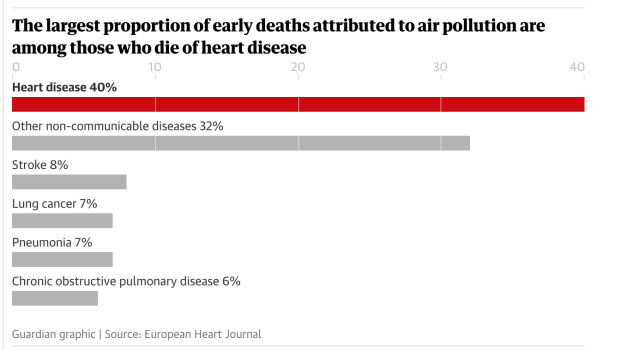
The new research, published in the European Heart Journal, indicates that while air pollution hits the lungs first, its impact via the bloodstream on heart disease and strokes is responsible for twice as many deaths as respiratory diseases.

Screen Shot 2019-03-13 at 08.09.17

The analysis builds on research published in September and confirms that calculation of 8.8m early deaths a year from outdoor air pollution around the world, double previous estimates.

“To put this into perspective, this means that air pollution causes more extra deaths a year than tobacco smoking,” said Prof Thomas Münzel at the University Medical Centre Mainz in Germany and one of the scientists behind the new study. “Smoking is avoidable but air pollution is not.”

Prof Jos Lelieveld of the Max-Plank Institute for Chemistry in Mainz and also part of the team, said: “Since most air pollutants come from the burning of fossil fuels, we need to switch to other sources of energy urgently. When we use clean, renewable energy, we are not just fulfilling the Paris agreement to mitigate the effects of climate change, we could also reduce air pollution-related death rates by up to 55%.”

The new research combined three sets of data: air pollution exposure, population density and age, and the health impacts of toxic air. It calculated a much higher number of premature deaths because better data on the wide impacts of air pollution is now available.

There was previously little data about the effect of high levels of air pollution and results from second-hand smoking studies were used instead, leading to an underestimate of deaths. There are now more than 40 large studies, including important research from China. Research also now covers a wider range of health impacts, including diabetes and high blood pressure, which also increases the estimated number of deaths.

The estimates of early deaths varied significantly between countries. In Germany, there were 154 early deaths per 100,000 people, with an average reduction of 2.4 years in life expectancy. In the UK, there were 98 deaths per 100,000 and a cut in lifespan of 1.5 years. Lelieveld said the UK’s lower number may be because Atlantic winds help to disperse pollution.

Münzel said small particles, less than 2.5 microns in size (PM2.5), are not paid sufficient attention when tackling cardiovascular disease. “The prevention guidelines for CVD must adopt air pollution as an important risk factor,” he said. The EU’s PM2.5 limit is more than double the World HealthOrganization (WHO) guideline used by Canada and Australia.

“The EU is lagging a long way behind,” Münzel said.“We as doctors and patients cannot alter the limits for air pollution, so the politicians have to stand up and give us an environment that keeps us safe.”

Prof Metin Avkiran of the British Heart Foundation said: “Air pollution is clearly a huge problem across Europe. We need to see WHO guidelines in UK law in order to drive decisive action to protect the nation’s health.”

Penny Woods, the chief executive of the British Lung Foundation, said: “Toxic air doesn’t just cut lives short. It also seriously affects the health and quality of life of millions of people.”

The scientists acknowledge there are large uncertainties in their early death estimates for Europe, which range from 645,000 to 934,000. Some deaths could have been misattributed to air pollution, but it is as likely that the true number of deaths could be even higher, they said.

The effects of air pollution on infant deaths was not included, because the evidence is not yet as strong. The new work also only considered PM2.5 and ozone, and not other particles, nitrogen dioxide or other pollutants.

via Air pollution deaths are double previous estimates, finds research | Environment | The Guardian

Posted in Air Quality, Europe, Health Effects of Air Pollution, London, Medical Studies, UK | Tagged , , , , , , | Leave a comment

A tale of two cities: Is air pollution improving in Paris and London?

For the first time, a joint air pollution study across two mega-cities — London and Paris — measures the impact of policies designed to reduce air pollution from urban traffic over the last 12 years.

In a paper, published today in the journal Environmental Pollution, researchers from King’s College London and Airparif found that despite efforts, both cities do not meet legal limits for nitrogen dioxide and airborne particle pollution set by the World Health Organisation.

Many polices are in place to combat air pollution at European-wide, city-wide and local scales. This study found that since 2010, these have led to improvements in nitrogen dioxide and particle concentrations across both cities.

However, the rate of change has not been enough to achieve compliance with legal limits. They note that nitrogen dioxide from traffic in London has deteriorated alongside some roads.

Looking at two time periods, 2005-2009 and 2010-2016, they also found that:

As the legal compliance approached in 2010, nitrogen dioxide in both cities was getting worse and not better. Despite passing ever tighter laboratory tests, new diesel cars failed to achieve anticipated reductions when driven on the roads. This suggests that if feedback between air pollution surveillance and policy makers was better, it could have allowed for a more agile response, as conditions changed from the expected trajectory.
From 2010 to the end of 2016, the large decline in particle pollution in London and Paris can be explained by the implementation of the Euro 5 standards on diesel cars and vans.
There is some evidence that the introduction of newer diesel lorries and buses manufactured after 2009 lead to decreased nitrogen dioxide.
In London, schemes to update bus fleets lead to rapid improvements alongside some roads. However, an increase in motorcycles in London since 2010 may have offset some of the improvements from other vehicle types. This highlights the less stringent exhaust standards applied to motorbikes compared with other vehicles.
Dr Gary Fuller, air pollution scientist at King’s College London said, “The diesel emissions scandal had a serious impact on air pollution in Europe’s two mega-cities. Even though new cars passed ever tighter exhaust tests, many emitted much more pollution when driven on our roads. This has led to chronic and widespread problems with limits for nitrogen dioxide.

“A clear lesson here the need for better feedback to make sure that our air pollution polices remain on track. There have been some successes in London and especially with the bus fleet. Although we are now heading in the right direction; we need stronger policies, such as London’s forthcoming ultra-low emission zone, to improve air pollution quickly for everyone in our cities, and we need to check that they work.”

Story Source:

Materials provided by King’s College London. Note: Content may be edited for style and length.

via A tale of two cities: Is air pollution improving in Paris and London? — ScienceDaily

Posted in Air Quality, Europe, France, London, UK | Tagged , , , , , , , , , | Leave a comment

Air pollution may impact fetal cardiovascular system, Rutgers study says

Exposure to ultrafine particulates, the smallest particles in air pollution, restricts blood flow and nutrients to the uterus

Microscopic particles in air pollution inhaled by pregnant women may damage fetal cardiovascular development, according to a study by Rutgers researchers.

The study, published in the journal Cardiovascular Toxicology, found that early in the first trimester and late in the third trimester were critical windows during which pollutants most affect the mother’s and fetus’ cardiovascular systems.

“These findings suggest that pregnant women, women of child-bearing years who may be pregnant and those undergoing fertility treatments should avoid areas known for high air pollution or stay inside on high-smog days to reduce their exposure,” said Phoebe Stapleton, assistant professor at Rutgers Ernest Mario School of Pharmacy and a faculty member at Rutgers Environmental and Occupational Health Sciences Institute. “Pregnant women should also consider monitoring their indoor air quality.”

What a mother inhales affects her circulatory system, which is constantly adapting to supply adequate blood flow to the fetus as it grows. Exposure to these pollutants can constrict blood vessels, restricting blood flow to the uterus and depriving the fetus of oxygen and nutrients, which can result in delayed growth and development. It can also lead to common pregnancy complications, such as intrauterine growth restriction.

The study looked at how the circulatory systems of pregnant rats and their fetuses were affected by a single exposure to nanosized titanium dioxide aerosols — a surrogate for particles found in typical air pollution — during their first, second and third trimesters. The results were compared to pregnant rats that were exposed only to high-efficiency filtered air.

The researchers found that exposures to pollutants early in gestation significantly impact a fetus’s circulatory system, specifically the main artery and the umbilical vein. Later exposure had the most impact on fetal size since the restricted blood flow from the mother deprives the fetus of nutrients in this final stage.

In non-pregnant animals, even a single exposure to these nanoparticles has been linked to impaired function of the arteries in the uterus. The study found that one exposure late in pregnancy can restrict maternal and fetal blood flow, which can continue to affect the child into adulthood.

“Although nanotechnology has led to achievements in areas such as vehicle fuel efficiency and renewable energy, not much is known about how these particles affect people at all stages of development,” said Stapleton.

By 2025, the annual global production of nanosize titanium dioxide particles is projected to reach 2.5 million metric tons. Besides representing the very small particles found in air pollution, titanium dioxide also is commonly used in many personal care products including sunscreens and face powders.

via Air pollution may impact fetal cardiovascular system, Rutgers study says | EurekAlert! Science News

Posted in Air Quality, Health Effects of Air Pollution, Medical Studies | Tagged , , | Leave a comment

Jakarta has most polluted air in Southeast Asia: Study

Jakarta ranks first as city with the worst air quality in Southeast Asia last year, a recent study has shown.

The study by Greenpeace and AirVisual IQ published on March 5, monitored air quality in hundreds of cities across the globe. Jakarta was ranked first, followed by Hanoi, for the worst air quality, the head of Greenpeace Indonesia, Leonard Simanjuntak, said.

Across the globe, Leonard added, Jakarta was ranked 161st for cities with the worst air quality. New Delhi was in first place.

“Four- and two-wheeled vehicles exceed Jakarta’s capacity. There is almost no control over them. It’s easier for people to use private vehicles in Jakarta,” he said as quoted by kompas.com on Thursday.

Another factor, according to Greenpeace, was coal-fired steam power plants (PLTU) located around Jakarta. The PLTUs contributed 33 to 36 percent to air pollution in Jakarta.

“There are PLTUs around Jakarta that are situated within a 100-meter radius of each other. It also contributes seriously to the level of air pollution in Jakarta,” Leonard said.

He explained that the daily air quality average in Jakarta, according to the PM 2.5 indicator, last year was 45.3 micrograms pollutant particles per cubic meter.

“The daily average air quality in Jakarta is 4.5 times worse than the limit set by the World Health Organization [WHO]. That number also increased compared to 2017, when the average daily air quality in Jakarta was 29.7,” Leonard said.

The WHO has set an average air quality guideline of 25 micrograms per cubic meter daily.

via Jakarta has most polluted air in Southeast Asia: Study – City – The Jakarta Post

Posted in Air Quality, Asia | Tagged , , , , | Leave a comment