California air pollution due to wildfires exceeded world health standards by 60 times

The level of air pollution in California exceeded world “safe” levels by about 60 times last week after a series of deadly wildfires.

Particulates in the air in some areas of the state reached levels as high as 1,500 micrograms per cubic meter, according to Bloomberg. The World Health Organization-set healthy standard for such particulates is 25.

Rebecca Buchholz, from the National Center for Atmospheric Research, described the high levels as “just insane.”

“It is quite amazing how high these fine-particulate levels are,” Buchholz said to Bloomberg.

More than 70 people have died in the Camp Fire. The Northern California blaze is now the state’s deadliest wildfire and has destroyed vast swaths of land. There is also a wildfire doing severe damage in Southern California.

Buchholz warned that while the pollution levels have since lowered in many areas, it may linger long after the fires are extinguished, especially due to expected rain and the potential for smoldering, which keeps smoke in the air.

High levels of air particulates can lead to long-term respiratory issues, as well as irritation of lungs and eyes, according to Buchholz.

President Trump visited the damaged areas over the weekend, after initially blaming California’s forest management for the fires and threatening to withhold federal funding to the state.

The president signed a declaration to give funding to California but has continued to criticize state officials about forest management.

via California air pollution due to wildfires exceeded world health standards by 60 times | TheHill

Posted in Air Quality, USA, USA & Canada | Tagged , , , , , | Leave a comment

Deadly air pollution shortens lives by nearly two years: researchers

Air pollution, caused largely by burning fossil fuels, is cutting global life expectancy by an average of 1.8 years per person, making it the world’s top killer, researchers said on Monday.

The tiny particles ingested from polluted air shorten life more than first-hand cigarette smoke, which can reduce it by 1.6 years, and are more dangerous than other public health threats such as war and HIV/AIDS, they said.

The University of Chicago’s Air Quality Life Index (AQLI) shows people in parts of India, the world’s second-largest country by population, could live 11 years less due to high levels of air pollution.

Life expectancy averages slightly below 69 in the South Asian nation of 1.3 billion, according to the World Bank.

The researchers launched a website that tells users how many years of life air pollution could cost them according to which region of a country they live in.

The index seeks to transform hard-to-comprehend data into “perhaps the most important metric that exists – life”, Michael Greenstone, director of the Energy Policy Institute at the University of Chicago (EPIC), said in a statement.

Particulate pollution is normally measured in micrograms per cubic meter.

“The fact that this AQLI tool quantifies the number of years I and you have lost to air pollution makes me worried,” Kalikesh Singh Deo, an Indian member of parliament, said in a statement shared by EPIC.

China and Indonesia are also among the countries where microscopic particles floating in the air hit residents the hardest, cutting their life expectancy by as much as seven years and five and a half years respectively, the website shows.

Other studies have previously looked into the number of people who may die prematurely because of air pollution.

But the EPIC scientists hope the website – the first of its kind, according to the institute – will make the consequences of policies that promote dirty energy more tangible, and encourage reforms that promote better air quality.

Only a handful of India’s 100 most polluted cities have drawn up plans to combat air pollution despite being asked to do so three years ago, a report from the World Health Organization said earlier this year.

via Deadly air pollution shortens lives by nearly two years: researchers | Reuters

Posted in Air Quality, Health Effects of Air Pollution, Medical Studies | Tagged , , | Leave a comment

Air Pollution in cities damaging insects and ecosystems

High levels of pollution found in many of the world’s major cities are having negative effects on plants and insects, according to new research from the University of Sheffield.

The study, published in Nature Communications, reveals that plants exposed to high levels of nitrogen dioxide (NO2) — similar to levels recorded in major urban centres — are able to better defend themselves against herbivorous insects.

Led by Dr Stuart Campbell from the University’s Department of Animal and Plant Sciences, the research has discovered that plants exposed to increased levels of pollution produce more defensive chemicals in their leaves.

Results from the study show that insects feeding on these leaves grew poorly, which suggests high levels of air pollution may be having cascading negative effects on communities of herbivorous creatures.

Dr Campbell, who is also part of the P3 Centre — a centre of excellence for translational plant science at the University of Sheffield, said: “Nitrogen dioxide is a pollutant that causes severe health problems in humans, but our research has found that it may also be having a significant impact on plants and insects.

“Insects are a crucial part of nature and the world we live in. Insects are critical to the healthy functioning of ecosystems.

“Many people may be aware that insect pollinators, such as the thousands of species of bees, along with flies, moths and butterflies, are crucial for food production — but they also ensure the long-term survival of wildflowers, shrubs and trees.”

Dr Campbell added: “Insects that feed on plants (herbivorous insects) help return plant nutrients to the soil, and are themselves food for wild birds, reptiles, mammals, and yet more insects. Insects are also immensely important for decomposing decaying organic matter and maintaining healthy soils. Scientists are warning about massive declines in insect numbers, which should be incredibly alarming to anyone who values the natural world and our sources of food.

“Nitrogen dioxide is a major component of smog and is an example of pollution caused from human activity, particularly our reliance on fossil fuels. Levels of this pollutant in the atmosphere remain particularly high in cities, and especially in the UK. Our research shows another example of the dangers of pollution to our environments and the reasons why we need to make a united effort to tackle it.”

The international team of scientists, which includes a researcher now based at the US Environmental Protection Agency, also looked at whether insects have an effect on the ability of plants to absorb NO2 from the environment.

Plants that had been fed on by insects absorbed much less NO2, according to the study. The authors believe this indicates that insects could be influencing the amount of pollution removed from the air by urban green spaces. Urban trees can absorb gaseous pollutants like NO2, but the effects appear to vary between species and locations, and this may be due in part to the actions of leaf-feeding insects. Dr Campbell emphasised, however, that the primary concern would be for the insects themselves, and that further research is needed: “Research suggests that urban vegetation plays a modest role in taking up NO2. More work is needed, because many factors may influence the effect of urban plants on air quality, including herbivory. Plant feeding insects, however, face a number of different human threats, potentially including air pollution.”

The study, Plant defences mediate interactions between herbivory and the direct foliar uptake of atmospheric reactive nitrogen, is published in the journal Nature Communications.

The University of Sheffield’s Department of Animal and Plant Sciences is a leading department for whole organism biology, with the UK’s highest concentration of animal and plant researchers.

It is among the top five animal and plant research centres in the country for research excellence, according to the last Research Excellence Framework in 2014.

Animal and plant scientists at Sheffield study in locations from the Polar Regions to the tropics, at scales from within cells up to entire ecosystems. Their research aims both to understand the fundamental processes that drive biological systems and to solve pressing environmental problems.

via Pollution in cities damaging insects and ecosystems — ScienceDaily

Posted in Air Quality | Tagged , , | Leave a comment

12 stations flash red pollution alerts in central, southern Taiwan

taiwan

AirVisual earth map of AQI levels in China and Taiwan

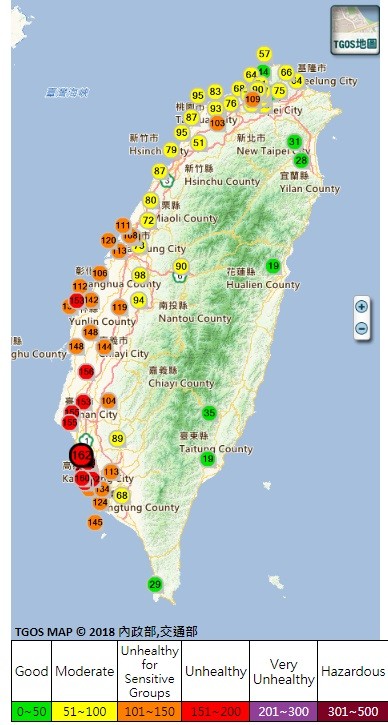
Due to poor diffusion conditions and an accumulation of pollutants, the air quality in central and southern Taiwan is still poor with harmful levels of pollution reported in 30 air quality monitoring stations, 12 of which are flashing red alerts.

As of 9 a.m. this morning, Taiwan’s Air Quality Monitoring Network is reporting harmful levels of pollution across much of western Taiwan, with more than half of the air quality monitoring stations flashing orange and red alerts for high levels of PM 2.5 concentration.

The 12 stations which have flashed a red alert are  Mailiao, Chiayi, Xinying, Annan, Tainan, Qiaotou, Fengshan, Renwu, Zuoying, Qianjin, Shanhua, and Qianzhen.

The Environmental Protection Agency said that the lack of wind in the early morning has led to an accumulations of pollutants. In the afternoon northeastern winds are expected to increase, possibly bringing in more pollution from neighboring countries.

Northern Taiwan may see orange alerts within a short period of time. As diffusion conditions remain poor, southern and central Taiwan will likely continue to see red alerts throughout the day. The EPA predicts that red alerts will continue to be seen in Yunlin, Chiayi and Tainan counties, while orange alerts will be seen in central Taiwan, Kaohsiung, Pingtung, Matsu, Kinmen, and Penghu. Other parts of Taiwan should see moderate to good air.

In response to the poor air quality in Yunlin, Chiayi, and Tainan, Taiwan Power Co. (Taipower) has instructed the coal-fired Taichung power plant to reduce power generation from 7 a.m. to 4 p.m.

taiwan1

via 12 stations flash red pollution alerts i… | Taiwan News

Posted in Air Quality, Asia, Taiwan | Tagged , | Leave a comment

Small-particle air pollution may raise glaucoma risk in some

In people who already have a genetic vulnerability, small-particle air pollution known as black carbon may raise the risk of developing glaucoma, a new study suggests.

Researchers found that in older men with genetic variations that made them especially susceptible to oxidative stress, long-term exposure to black carbon, a pollutant linked to vehicle emissions and other products of combustion, was associated with higher pressures in the eye, according to the study published in JAMA Ophthalmology.

“Oftentimes, when we think about glaucoma we think about risk factors like age and genetic predisposition and we don’t think about the environment,” said the study’s lead author, Jamaji Nwanaji-Enwerem, an MD/PhD candidate at the Harvard Medical School in Boston. “But one thing we’re starting to appreciate more is how the environment impacts health outcomes.”

One area in which there hasn’t been a lot of research is the impact of the environment on eye disease, Nwanaji-Enwerem said. So, he and his colleagues decided to look at the effect of the tiny particles of black carbon, which are smaller than 2.5 microns in diameter and can penetrate deep into the lungs, and from there, into the bloodstream.

The researchers analyzed data from 419 older men from the Boston area who had been participating since the 1960s in a larger U.S. Department of Veterans Affairs aging study. They came in for health exams every three to five years after joining the study and as part of those exams intraocular pressure was measured.

Glaucoma, which can eventually result in blindness if not treated, is most often caused by high intraocular pressure, or high fluid pressure within the eye.

“When eye pressure is too high, it causes damage to the optic nerve, the cable that connects our eyes to the brain and visual pathways,” explained Dr. Christopher Starr, an ophthalmologist at NewYork-Presbyterian/Weill Cornell Medicine in New York City, who was not involved in the new research. “If you lose cells in that nerve, you lose vision. It usually starts with peripheral vision loss and as time goes on you lose more and more.”

For the study, Nwanaji-Enwerem’s team determined the men’s pollution exposure using a modeling program that included black carbon levels gleaned from 83 monitoring sites and weather data.

The researchers then analyzed the pollution results along with each man’s eye pressure readings and a host of other health and lifestyle factors, including BMI, smoking status, heart disease, blood pressure and diabetes.

Overall, they found no link between pollution and eye pressure. But when they looked just at men who had certain gene versions that made them vulnerable to oxidative stress, the researchers found an association between higher pollution levels and a slight increase in eye pressure.

While interesting, the new study’s findings will need to be duplicated, Starr noted, adding that even if proven, the effects seen in this study are small. “They may not even be clinically significant in the context of glaucoma,” he said.

The differences in intraocular pressure might have been more striking if the men in the study had lived in a place that had high levels of black carbon pollution, Starr said.

While it’s clear that family history can raise your risk for glaucoma, studies of other possible variables have been mixed, said Dr. Julia Polat, an assistant professor of ophthalmology at the University of Pittsburgh Medical Center in Pennsylvania, who was not involved in the new research.

“When patients ask, ‘what can I do to modify my risk?’ unfortunately I don’t have a lot of definitive information to give them,” Polat said. “I tell them to eat healthy, exercise and stop smoking, not necessarily because it will help with glaucoma, but because these changes can make them healthier overall.”

Glaucoma is especially insidious because it generally develops with no symptoms, Starr said. That’s why people should be getting their pressures checked on a regular basis, he added.

“One of the ironic things, if you look at global surveys in almost all societies and cultures vision is by far what people cherish and value most,” Starr said. “And yet, people see their GP for yearly checkups, but don’t see an eye doctor regularly.”

SOURCE: https://bit.ly/2JNqelK and https://bit.ly/2FlnQnE JAMA Ophthalmology, online November 8, 2018.

via Small-particle air pollution may raise glaucoma risk in some – Business Insider

Posted in Air Quality, Health Effects of Air Pollution, Medical Studies | Tagged , , , | Leave a comment

Pollutionwatch: fireworks increase UK air pollution for several days

Guy Fawkes events caused five days of particle pollution problems, reaching maximum levels in several locations

This year, Guy Fawkes events caused five days of particle pollution problems. Fireworks caused increased air pollution on Friday and Saturday evening across the eastern half of England, including London, Southampton and Hull. On Sunday firework smoke was measured across northern England, Coventry and Chesterfield, and in Derry in Northern Ireland. On Bonfire Night itself particle pollution reached the maximum level of 10 on the UK air pollution scale in Chesterfield, Leeds, Sheffield, Stockton-on-Tees and York, and lingered overnight to cause further problems the next day.

In India, Diwali fireworks have been implicated in the severe smogs that affect the Delhi region each year. In 2016, the Indian capital was enveloped in a severe smog for more than a week after Diwali, leading to a ban on firework sales that has split public opinion. This year the courts have relaxed the rules to allow the sale of less polluting “green” fireworks that produce less smoke and do not contain metals such as lead and mercury. This may help, but it will not cure Delhi’s chronic post-monsoon smogs, which are mainly caused by burning of rice stubble in the surrounding region. So, in addition to firework restrictions, there is a clear need for alternative ways to clear crops to improve the air quality breathed by more than 63 million people in the area.

via Pollutionwatch: fireworks increase UK air pollution for several days | Environment | The Guardian

Posted in Air Quality, Europe, London, UK | Tagged , , , , , , , , , , , , , , | Leave a comment

Air pollution skyrockets to hazardous levels in India

Toxic clouds descended upon New Delhi on Thursday, forcing residents indoors and posing significant health concerns. The lethal smog came just hours after celebrations to mark Diwali, the Hindu “festival of the lights.”

Commemorating the triumph of good over evil, the holiday happens every fall — but this year the atmosphere threw a wrench in the plan. The city of more than 18 million awoke Thursday morning to a shroud of hazardous haze, spurred by construction activity and vehicle emissions and exacerbated by fireworks detonated the night before.

The air pollution soared to 20 times safe levels.

For the second year in a row, India’s 31-member Supreme Court banned the sale of most fireworks leading up to the festivities. Only “green” fireworks were to be sold, a prohibition that extended to online merchants — including Amazon. The court also set a fixed time, from 8 to 10 p.m., for them to be set off.

Despite the strict regulations, poor enforcement may have been inevitable in a city so large. Residents continued to ignite fireworks after midnight while donning face masks and coughing up ashen soot. Last year, New Delhi’s chief minister likened the debacle to a “gas chamber,” according to The Guardian.

The Air Quality Index (AQI) is based on the concentrations of five air pollutants: ground-level ozone, carbon monoxide, sulfur dioxide, nitrogen dioxide and particulate matter. The latter describes fine particles in the air between 2.5 and 10 microns across, roughly 1/28th the diameter of a strand of human hair.

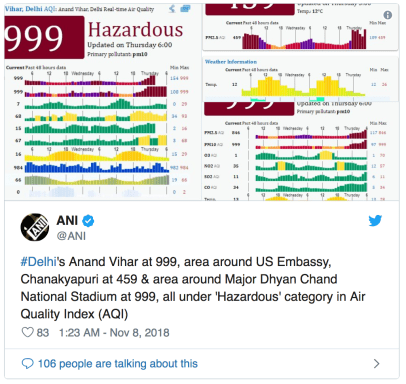
AQI values lower than 50 are considered good. When they exceed 100, they are considered to be “unhealthy for sensitive groups.” Big concerns come around 150-200. Anything over 300 is deemed “hazardous.” New Delhi’s AQI hit about 1,000 in the early morning hours Thursday, the worst conditions found just south of Safdarjung Airport.

Screen Shot 2018-11-09 at 08.49.50

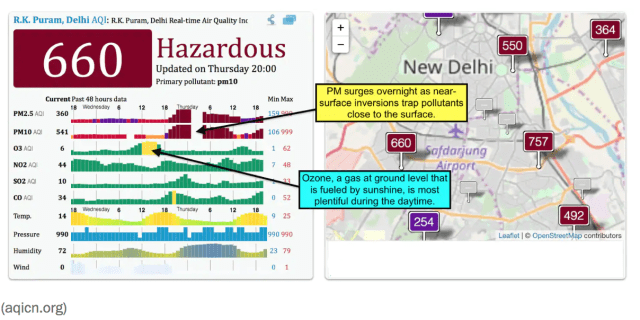
A weather balloon launched from the hub at 6:30 p.m. Wednesday night shows a strong inversion present just a thousand feet above the surface. This layer of warm air acted as a “ceiling” to the atmosphere, trapping all pollutants below. The smoke can’t rise, so it becomes penned. It’s like leaving a vehicle idling with your garage door shut. The consequences can be deadly.

EMH6G4UX3ZGOJPK5P5MIEZCJIU

Temperature change with altitude in New Delhi, India, indicative of pollutant-trapping inversion. (University of Wyoming adapted by Matthew Cappucci)

Particulate matter can come from natural sources — like dust storms in the Sahara — but is a more common byproduct of vehicle emissions, construction and “dirty combustion.” Its concentrations proved to be less during the daytime as the inversion lifted and allowed the air to mix out. Other gases — like ozone — feed off sunlight and reach their highest levels in the early afternoon.

Screen Shot 2018-11-09 at 08.51.25.png

This is the third year consecutive data has been collected to show an alarming spike following Diwali. Pollution levels have historically tripled or quadrupled overnight, making Diwali peak date of the year for pollution.

India is infamous for its pollution, rivaling China as the greatest polluter of greenhouse gases and particulate matter by gross domestic product. A 2015 study warned that nearly half of all New Delhi schoolchildren would develop irreversible lung damage before reaching adulthood.

This latest pollution episode comes 10 days after the World Health Organization released a report concluding that 93 percent of children worldwide breath toxic air daily. The chilling findings link the toxic gases we release to “lower cognitive test outcomes,” compromised “mental and motor development” and issues with “neurodevelopment.”

via Air pollution skyrockets to hazardous levels in India – The Washington Post

Posted in Air Quality, Asia, India | Tagged , , , , , , | Leave a comment

World’s Worst Air Pollution Spikes as Indians Go Firecracker Crazy

Air pollution levels skyrocketed in New Delhi and left India’s capital shrouded in toxic smog as millions of Indians set off firecrackers on Wednesday evening for Diwali, the Hindu festival of lights.

The air quality index, or AQI, hit 980 at 4:30 a.m. Thursday, according to website AirVisual, which monitors air pollution around the world. The levels surged as people violated an order of the Supreme Court and burst firecrackers before and after a two-hour window set for the purpose. Readings below 50 are considered safe, while anything above 300 is considered hazardous.

The air quality is just about as bad as it was in 2017 a day after Diwali, when levels exceeded 1,000, roughly ten times worse than the air pollution in Beijing. The levels on Thursday came down from their peak, with the gauge reading 622 as of 6:30 a.m. The smog last year led the capital’s chief minister to declare his city had become a “gas chamber.”

Toxic air is estimated to kill more than 1 million Indians each year, according to the nonprofit Health Effects Institute.

New Delhi was ranked the most polluted city in the world on Thursday, according to AirVisual’s global rankings. Lahore in Pakistan was at second place with AQI at 273 as of 8 a.m. local time. By comparison, New York had readings of just 29 as of 10 p.m. on Wednesday local time.

With different air quality monitors showing varied readings across the capital, it was still clear that New Delhi’s air was the worst in the world. Levels of dangerous PM 2.5 — the fine, inhalable particles that lodge deep in the lungs, where they can enter the bloodstream — were pushing close to 1,400 in some parts of the Indian capital early on Thursday morning, according to a website run by the Delhi Pollution Control Committee, a government agency.

Burning Crops

Delhi’s air pollution is a toxic mix of vehicular exhaust, smoke from burning crops in the nearby states of Punjab and Haryana, road dust and billowing sand from thousands of construction sites. The pollution is intensified by winter weather patterns and hemmed in by the towering Himalayas to the north.

Severe air pollution — which has been linked to serious ailments including lung cancer and heart disease — affects dozens of cities across South Asia.

Nearby Lahore, over the border in the Pakistani province of Punjab, has been one of the worst affected in recent weeks as agricultural crop burning intensified. Afghanistan’s Kabul and Nepal’s Kathmandu have also been near the top of the pollution rankings.

India alone, according to the World Health Organization’s 2016 rankings, accounted for the world’s 10 most-polluted cities as measured by PM 2.5.

The Lancet estimates that 6.5 million people die annually around the world because of air pollution, mostly in India and China.

via World’s Worst Air Pollution Spikes as Indians Go Firecracker Crazy – Bloomberg

Posted in Air Quality, Asia, India | Tagged , , , , , | Leave a comment