A 24-hour no-burn alert will take effect at midnight

Due to poor air quality, residents in much of Southern California will be prohibited from lighting wood-burning fires for 24 hours, starting at midnight Monday.

The mandatory no-burn alert was issued by the South Coast Air Quality Management District. On Sunday afternoon, the air quality index in downtown Los Angeles was 119, or “unhealthy for sensitive groups,” according to the air quality district’s website.

From Nov. 1 through the end of February, the air district issues no-burn alerts when fine particulate pollution rises to an unhealthy level, defined as more than 30 micrograms per cubic meter. The alert applies to wood-burning devices such as residential fireplaces, backyard fire pits and wood stoves.

The district oversees air quality in the Orange County and the urban portions of Los Angeles, Riverside and San Bernardino counties, which are among the smoggiest regions in the country.

The no-burn alert does not apply to the Riverside County desert or to properties above 3,000 feet in elevation. Low-income households are exempt, as are households where wood-burning is the sole source of heat.

High levels of air pollution can cause eye, nose and throat irritation, lung inflammation and breathing difficulties, as well as increase the risk of bronchitis, asthma attacks and heart attacks, according to the air district.

via A 24-hour no-burn alert will take effect at midnight – LA Times
Posted in Air Quality, USA & Canada | Tagged , , , | Leave a comment

air pollution in Delhi: Delhi-NCR air quality still very poor as stubble burning reaches Delhi

The air quality in Delhi and NCR sees no scope of improvement, as despite orders and monitoring, the practice of stubble burning was reported from Delhi itself on Thursday.

Track the pollution level in your city

As stubble burning increases and spreads across districts of Punjab, Haryana and Uttar Pradesh, satellite images showed cases of crop-residue burning in north Delhi towards Haryana border where farming community resides.

While the incidents of residue burning escaped the monitoring of the Delhi Pollution Control Committee (DPCC), which is responsible to check such cases within Delhi, officials say that appropriate action will be taken.

“We have not noticed any such cases and it should not be there… however we will check the incidents… If satellite images are showing this, then there is possibility of some garbage burning,” an official of DPCC told IANS.

As the Supreme Court-appointed Environment Pollution Control Authority (EPCA) expects the air quality to deteriorate further due to fog formation, weather analysts react predict change in the wind direction and type, from dry to moist, towards November 28 to further worsen the situation here.

According to the Central Pollution Control Board (CPCB) on Thursday, the average concentration of major pollutant PM2.5 or particles with diameter less than 2.5 micrometer at 7 p.m. in Delhi-NCR combined was 167, while in Delhi it was 172 as against a safe limit of 25 microgramme per cubic meters as per international standards and 60 units as per national standards.


The average air quality recorded by 25 active monitoring stations of Delhi, Uttar Pradesh, Rajasthan and the CPCB was “very poor”, except in Rajasthan’s Alwar, where the air quality was “moderate to poor”.


Meanwhile, with PM2.5 values over 250 units, Ghaziabad, Bhiwadi and Delhi Technical University in north Delhi recorded “severe plus” or “emergency” Air Quality Index (AQI).


According to the wether analyst, a western disturbance is likely around November 27 over Rajasthan and Haryana. However, this cyclonic circulation will only worsen the situation unlike the case of last week when the drizzling in Delhi-NCR due to the western disturbance bought the pollution levels down.


“The present dry and cold North-westerly winds coming from Punjab and Haryana have moderate speed today, which are suppose to change into moist south-westerly winds which will be of very low speed. Due to this the additional emissions collecting in Delhi will not dissipate while the mist and haze formation would further drop the air-quality,” said Mahesh Palawat, director of private weather forecasting agency Skymet.

via air pollution in Delhi: Delhi-NCR air quality still very poor as stubble burning reaches Delhi | Delhi News – Times of India

Posted in Air Quality, Asia, India | Tagged , , | Leave a comment

Carburetor motorcycles cause 19% of air pollution in Tehran: official

There are around 2 million motorcycles in Tehran and the carburetor ones are causing a great deal of pollution relatively speaking, Tasnim quoted Masoud Zandi as saying.

While only 30 days are reported as polluted or mildly polluted on average over the first 8 months of the year (starting on March 21), over the last four months of the year (falling on the last month of autumn and winter) the air quality index indicate high level of pollution as the number of the polluted days jump threefold or more in some years, Zandi regretted.

Although as per a law approved by the cabinet carburetor motorcycles are not being domestically produced since last September still they account for high amounts of pollutants, stated.

Moreover, Zandi said, while the sole purpose of adopting the aforesaid law was shifting to electric motorcycles, “lack of necessary infrastructure is what is holding us back.”

Elsewhere in his remarks, Zandi said that some 9 percent of the passenger cars in Tehran are clunkers and highly pollutant which also play a significant role in intensifying air pollution.

“Another challenge we are facing are clunker buses and diesel engine heavy vehicles that are highly responsible for the discharging hazardous pollutant,” he added.

Once it comes to air pollution many believe that vehicles are causing 80% of the air pollution that we breathe. In order to eliminate this major sources of air pollution the government has come up with various plans.

Scrapping some 500,000 clunkers annually, importing and manufacturing high standard vehicles and switching to greener alternatives in general are of the plans which are being partially implemented or are hoped to be fully implemented in the country.

via Carburetor motorcycles cause 19% of air pollution in Tehran: official – Tehran Times

Posted in Air Quality, Iran, Middle East | Tagged , , | Leave a comment

Air pollution linked to poorer quality sperm

Air pollution, particularly levels of fine particulate matter (PM2.5), is associated with poorer quality sperm, suggests research published online in Occupational & Environmental Medicine.

Although the size of the effect is relatively small in clinical terms, given how widespread air pollution is, this might spell infertility for a “significant number of couples,” say the researchers.

Environmental exposure to chemicals is thought to be a potential factor in worsening sperm quality, but the jury is still out on whether air pollution might also have a role.

To explore this possibility further, the international team of researchers looked at the impact on health of short and long term exposure to fine particulate matter (PM2.5) among nearly 6500 15 to 49 year old men in Taiwan.

The men were all taking part in a standard medical examination programme between 2001 and 2014, during which their sperm quality was assessed (total numbers, shape/size, movement) as set out by World Health Organization guidelines.

PM2.5 levels were estimated for each man’s home address for a period of three months, as that is how long it takes for sperm to be generated, and for an average of 2 years, using a new mathematical approach combined with NASA satellite data.

A strong association between PM2.5 exposure and abnormal sperm shape was found. Every 5 ug/m3 increase in fine particulate matter across the 2 year average was associated with a significant drop in normal sperm shape/size of 1.29 per cent.

And it was associated with a 26 per cent heightened risk of being in the bottom 10 per cent of normal sperm size and shape, after taking account of potentially influential factors, such as smoking and drinking, age or overweight.

However, it was also associated with a significant increase in sperm numbers, possibly as a compensatory mechanism to combat the detrimental effects on shape and size, suggest the researchers.

Similar findings were evident after three months of exposure to PM2.5.

This is an observational study so no firm conclusions can be drawn about cause and effect, and the researchers were not privy to information on any previous fertility problems.

And exactly how air pollution could impair sperm development is not clear. But many of the components of fine particulate matter, such as heavy metals and polycyclic aromatic hydrocarbons, have been linked to sperm damage in experimental studies, the researchers point out.

Free radical damage, brought on by exposure to air pollutants, might have a possible role, as this can damage DNA and alter cellular processes in the body, they suggest.

“Although the effect estimates are small and the significance might be negligible in a clinical setting, this is an important public health challenge,” emphasise the researchers.

“Given the ubiquity of exposure to air pollution, a small effect size of PM2.5 on sperm normal morphology may result in a significant number of couples with infertility,” they warn, calling for global strategies to minimise the impact of air pollution on reproductive health.

via Air pollution linked to poorer quality sperm | EurekAlert! Science News

Posted in Health Effects of Air Pollution | Tagged , , , , | Leave a comment

SMOKESCREEN: 13 Spanish cities accused of cover-up over ‘dangerous’ air pollution

AN ENVIRONMENTAL group in Spain has claimed that 16 cities “regularly surpass” harmful levels of air pollution but only three have told their residents.

Ecologistas en Accion claim that A Coruña, Aviles, Bailen, Barcelona, Granada, Huelva, Lleida, Madrid, Murcia, Puertollano, Santander, Sevilla, Talavera de la Reina, Valencia, Valladolid and Zaragoza all surpass the toxic PM10 emission limits of 50 micrograms per cubic metre.

The group said “only Madrid and Valladolid have warned their citizens” and have implemented traffic restrictions to combat the pollution in a press release yesterday (Monday). Since then Barcelona has also introduced traffic restrictions in its city centre.

A further six cities – Barcelona, Getafe, Guadalajara, Salamanca, Sevilla and Zaragoza – have also reached dangerous levels of CO2 and have “not adopted any measure to protect the health of their citizens” according to Ecologistas en Accion.

They slammed the cities for “lacking both short-term and long-term solutions,” and demand immediate plans to address the situation.

According to the World Health Organisation, harmful air pollutants are responsible for an estimated 30,000 premature deaths every year in Spain.

via SMOKESCREEN: 13 Spanish cities accused of cover-up over ‘dangerous’ air pollution

Posted in Air Quality, Europe, Spain | Tagged , , , , , , , , , , , , , , , , , , | Leave a comment

Delhi Air Pollution: ‘Dust’ Screen Hiding Bigger Killers

Dust may be the most visible marker of Delhi’s air pollution, but its sheer abundance may actually be masking the bigger killers- emissions from vehicles, thermal power plants and industries.

Studies and research reports have underlined that it’s the chemical composition of ultrafine particulates PM2.5 or PM10, and not their volume, which is more crucial in determining the toxicity of air.

The Environment Pollution (Prevention and Control) Authority (EPCA), a Supreme Court-appointed pollution watchdog, made a similar point in a report to the top court, that particles from coal and diesel are more harmful than wind-blown dust, as they can lead to an increase in heart disease-related deaths.

“Similarly, particles from diesel combustion are very toxic and have been classified by the World Health Organisation as a class I carcinogen for strong links with lung cancer, putting them in the same bracket as tobacco smoking and asbestos.

“This suggests that we must prioritise the more harmful particulates for action. Combustion sources- vehicles, power plants and industry- need more stringent and priority action,” the report says.

The EPCA mentioned it separately under a section addressing number versus toxicity.

An Indian Institute of Technology-Kanpur report, which assessed the chemical composition of pollution from various sources in the city, also concluded that combustion- vehicular and industrial alike- was responsible for the formation of PM2.5 in greater quantity.

Among PM2.5 and PM10, the most dominant pollutants in Delhi’s air, PM2.5 is deadlier owing to its tinier size, up to 30 times smaller than the width of a human hair, aiding it in lodging deep in the lungs and subsequently entering the bloodstream.

The IIT report found that PM2.5 Nitrate particles formed from nitrogen oxides and sulphate particles formed from sulphur dioxides can be 25 per cent of the total PM2.5 load in the city.

Both nitrates and sulphates are classified as ‘secondary particles’, which are formed due to the reaction of gases such as sulphur dioxide (SO2) and oxides of nitrogen (NOx) emitted from vehicles, thermal power plants and industries.

“In a broad sense, fractions of secondary particles of both PM 10 and PM2.5 in two seasons were consistent and need to be controlled for better air quality in Delhi and the National Capital Region,” the report pointed out.

It estimates that of around 312 tons of NOx produced per day in the city, nearly 52 per cent come from industrial point sources such as power plants and 36 per cent from vehicular emissions, “probably making it the most important emission”.

via Delhi Air Pollution: ‘Dust’ Screen Hiding Bigger Killers

Posted in Air Quality, Asia, India | Tagged , , , , , , , | Leave a comment

European Air Quality Index: current air quality information at your finger tips

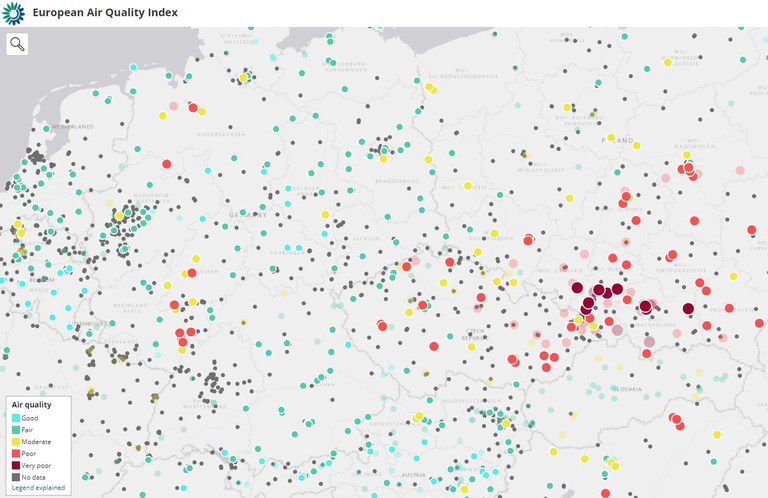
A new European Air Quality Index, launched today by the European Environment Agency (EEA) and the European Commission, allows users to check the current air quality across Europe’s cities and regions. The Index is accompanied by new country fact sheets that provide updated air quality information for EEA member countries.


The EEA and the European Commission’s new online service, the European Air Quality Index, provides information on the current air quality situation based on measurements from more than 2 000 air quality monitoring stations across Europe.

The Index consists of an interactive map that shows the local air quality situation at station level, based on five key pollutants that harm people’s health and the environment: particulate matter (PM2.5 and PM10), ground-level ozone (O3), nitrogen dioxide (NO2) and sulphur dioxide (SO2).

Users can zoom in or search for any town or region in Europe to check the overall air quality and measurements per key pollutant. The Index shows an overall rating for each monitoring station, marked by a coloured dot on the map, corresponding to the worst rating for any of the five pollutants.

“The new European Air Quality Index gives citizens an easy way to access information on their local air quality, which can have a direct impact on their health. This information, accessible to everyone, is an important basis for a dialogue and decisions that are needed to safeguard people’s health, especially in cities,” said Hans Bruyninckx, EEA Executive Director, presenting the Index today at the Clean Air Forum, organised by the European Commission, in Paris.

Karmenu Vella, EU Commissioner for the Environment, Maritime Affairs and Fisheries, also welcomed the Index, saying: “Air pollution is an invisible killer, so the Air Quality Index is needed to inform European citizens on the state of the air they breathe in their own neighbourhood. We are working with cities, regions, countries and industry to tackle the sources of that pollution, which is a cocktail coming from factories, homes and fields, not only from transport. We must all work together to improve air quality.”

The EEA has also published updated country fact sheets that provide an annual summary of air pollution and its impacts in EEA member countries. Providing more detailed, country-level information on both air pollutant emissions and air quality, the fact sheets complement the EEA’s annual Air Quality in Europe – 2017 report, published in October.

The EEA’s latest annual air quality report shows that most people living in Europe’s cities are still exposed to levels of air pollution deemed harmful by the World Health Organization. The most harmful pollutant, fine particulate matter (PM2.5), caused the premature death of an estimated 400 000 Europeans in 2014. According to the report, air pollution has also significant economic impacts, increasing medical costs, reducing employees’ productivity, and damaging soil, crops, forests, lakes and rivers. Road transport, agriculture, power plants, industry and households are the biggest emitters of air pollutants in Europe.


via European Air Quality Index: current air quality information at your finger tips — European Environment Agency

Posted in Air Quality, Europe | Tagged , , , , , , | Leave a comment

Air pollution linked to osteoporosis-related bone fractures

Exposure to air pollution increases the risk of bone loss and fractures.

Beyond the risks of cardiovascular disease, respiratory disease and even cancer, living in a highly polluted zone for a significant time could increase the risk of osteoporosis-related bone fracture, especially in older people.

This is according to two new American studies published in the journal The Lancet Planetary Health.

Exposure to high levels of fine particulate matter (PM2.5) in the atmosphere could accelerate bone density loss and increase the risk of fracture, say researchers at Columbia University’s Mailman School of Public Health, New York.

Like the toxic substances in cigarette smoke, air pollution could cause inflammation and oxidative stress, leading to bone loss.

The researchers came to this conclusion by means of two parallel studies. In the first, they studied hospital admissions between 2003 and 2010 for osteoporosis-related fractures in patients over 65 years old. The results indicated that even small increases in fine particle concentrations could lead to an increase in bone fractures in older adults.

In the second study, the scientists followed 692 men from low-income backgrounds in the region of Boston over the same period. Participants’ average age was 47. They found that adults living in areas with high levels of fine particles and black carbon, a pollutant from automotive emissions, had lower levels of parathyroid hormone, a key calcium and bone-related hormone.

The researchers also found that participants in the study had greater decreases in bone density than men exposed to lower levels of these pollutants.

In April, the same team of experts published research reporting that B vitamins (50 milligrams of B6, 2.5 milligrams of B9, 1 milligram of B12) could diminish the toxic effects of air pollution on the immune and cardiovascular systems. However, scientists are currently unsure whether the benefits of B vitamins extend to bone loss.

The researchers report that there are an estimated two million osteoporosis-related bone fractures in the United States each year.

The researchers conclude that, like smoking and lack of physical exercise, air pollution is a risk factor for bone fractures.

via Air pollution linked to osteoporosis-related bone fractures | The Citizen

Posted in Air Quality, Health Effects of Air Pollution, Medical Studies | Tagged , , | Leave a comment


