EU auditors to assess anti-pollution efforts by testing Brussels air 

The European Court of Auditors is to embark on a comprehensive review of the European Union’s efforts to curb air pollution, the main environmental cause of premature deaths in the EU, the court said on Thursday (21 September).

The Luxembourg-based Court will look into the effectiveness of current EU policies on tackling air pollution. Air quality in six European cities will be tested as part of the audit, including in Brussels, the heart of the EU. The audit is scheduled to take place over the next few months and the Court hopes to publish its findings in mid-2018.

In a preparatory statement on the forthcoming investigation, the auditors revealed that investigations will be carried out in urban areas most affected by air pollution. They will take place in Brussels, Sofia, Ostrava (Czech Republic), Stuttgart, Milan and Krakow.

The chosen test venues include the often-congested capital of the EU; an urban area in one of the newest states; a city at the heart of the German car industry; and Krakow, where smog levels are so bad that living there is equivalent to smoking 4,000 cigarettes a year, according to a recent study.

ClientEarth lawyer Anna Heslop welcomed the forthcoming report and called on the Commission to be “stronger in holding member states accountable”, adding that “this issue affects countries across Europe beyond the six countries being assessed”.

In its audit brief, the Auditors pointed out that research shows that fine particulate matter was responsible for 436,000 premature deaths in the EU in 2013, while nitrogen oxide and ground-level ozone claimed the lives of 68,000 and 16,000 citizens, respectively.

Air pollution has become a topic of grave public concern as scientific research continues to show the huge toll bad air quality has on citizens’ health. One study recently showed that air pollution can be as bad for unborn babies as when expecting mothers smoke.

European Environment Bureau policy officer Margherita Tolotto insisted that we “shouldn’t need another report to persuade national governments to act”.

“We know the solutions: cut wasted energy by improving efficiency, stop burning fossil fuels – especially coal, close the most polluting power plants and take old diesel cars off of the road,” she said.

Pollution in its many forms will form the basis of the United Nations Environment Assembly’s end-of-year summit in Nairobi under the title of ‘Towards a pollution-free planet’.

It aims to produce a political declaration linked to the Sustainable Development Goals and kick-start global action on curbing pollution, along the lines of its successful work on limiting mercury pollution under the Minamata Convention.

The Court’s mandate is to investigate how the EU spends its money. Significant sums of taxpayer money are invested in air quality improvement measures, including co-financing of projects through the European Structural and Investment Fund (EFSI), research programmes and the LIFE programme.

Under the Ambient Air Quality Directive, common measurement techniques have been established, as well as EU-wide criteria for assessing air quality and limits on air pollutant concentration.

Its report will serve as a basis for a wider European report on air quality that is currently ongoing within the scope of the European Organisation of Supreme Audit Institutions, which is also scheduled for publishing mid next year.

Source: EU auditors to assess anti-pollution efforts by testing Brussels air – EURACTIV.com

Posted in Air Quality, Europe, Germany, Italy, Poland | Tagged , , , , , , , , , , , , | Leave a comment

Air pollution may have damaging effects on the kidneys

Highlight

  • In a study of US veterans, researchers found a linear relationship between air pollution levels and risk of experiencing kidney function decline and of developing kidney disease or kidney failure.
  • Air quality remains suboptimal in many parts of the United States and in multiple regions around the world.

Studies have shown that air pollution can have negative effects on cardiovascular health and life expectancy. Now new research indicates that it is also harmful to the kidneys. The study, which appears in an upcoming issue of the Journal of the American Society of Nephrology (JASN), reveals that the effects on the kidneys are seen at low levels of particulate matter and increase linearly with rising levels of pollution.

Information on the relationship between air pollution and kidney disease is very scarce. To investigate, a team led by Ziyad Al-Aly, MD (Director of Clinical Epidemiology at the VA Saint Louis Health Care System) linked the Environmental Protection Agency (EPA) and the Department of Veterans Affairs databases to examine information on 2,482,737 US veterans who were followed for a median of 8.5 years. Air pollution levels were also assessed using space-borne sensors from NASA satellites.

The researchers found a linear relationship between air pollution levels and risk of experiencing kidney function decline and of developing kidney disease or kidney failure. The results suggest that each year in the United States, 44,793 new cases of CKD and 2438 new cases of kidney failure are attributed to particulate matter air pollution exceeding the EPA’s recommended limit of 12 μg/m3.

“Even levels below the limit set by the EPA were harmful to the kidneys,” noted Dr. Al-Aly. “This suggests that there is no safe level of air pollution.” He noted that the burden is not evenly distributed geographically: the highest toll seems to be in southern California and in large swaths of the Midwest, the Northeast, and the South. Of course the findings have implications outside the United States and may help explain the substantial variation in the burden of kidney disease observed around the world.

Source: Air pollution may have damaging effects on the kidneys | EurekAlert! Science News

Posted in Air Quality, Health Effects of Air Pollution, Medical Studies | Tagged , , , , | Leave a comment

More Than 16 Mln Russians Are Breathing Polluted Air

More than 16 million residents of Russia’s largest cities are breathing polluted air, an annual Natural Resources and Environment Ministry report cited by the Kommersant daily on Thursday suggests.

Russia’s fledgling post-Soviet environmental protection movement has been hampered in recent years by corruption, lax enforcement of laws and a crackdown on advocacy groups. Russia ranked 32 out of 180 countries in the 2016 environmental performance index compiled by Yale University.

The Environment Ministry’s report estimates that 16.4 million people, or 15 percent of Russia’s urban population, are exposed to air pollution.

More than three-quarters of city dwellers in the Siberian regions of Buryatia, Khabarovsk and Taimyr are vulnerable to high levels of air pollution, according to the report.

Pollutants in the industrial cities of Krasnoyarsk and Magnitogorsk were found to exceed maximum permissible levels by 30 times, according to the report cited by Kommersant.

Other major contaminated cities include the mining and smelting center Norilsk, which was recently ranked among the 10 most polluted places on earth.

Overall emissions in Russia totaled 31.6 million metric tons last year, representing 1.1-percent growth compared to 2015. Industrial emissions accounted for more than half of that figure, followed by air pollution from vehicles.

The Moscow region leads the country in vehicle emissions, accounting for one-eighth of all pollutants released by vehicles. Kommersant reported in January that vehicles cause up to 80 percent of air pollution in major Russian cities.

The ministry report names the North Caucasus cities of Ingushetia and Kabardino-Balkaria, as well as Sevastopol in Crimea, as Russia’s cleanest cities, but noted growing pollution in all three cities in 2016.

Source: More Than 16 Mln Russians Are Breathing Polluted Air

Posted in Air Quality, Asia, Europe | Tagged , , , , , , , , | Leave a comment

Timaru to clear the air: Council brings in burner ban 

A plan to tackle air pollution in Canterbury has been approved by the regional council, but councillors say it will not be fining people straight away.

It includes a ban on log burners more than 15 years old in Timaru.

The council’s Canterbury Air Plan said some areas suffer from poor air quality, partly because of the burning of wood and coal. In 2016 the World Health Organisation found that Timaru had the worst air pollution in Oceania.

About 100 Timaru residents met Environment Minister Nick Smith earlier this week to voice their concerns about the ban, with many saying their log burners are not responsible for poor air quality.

But councillor Peter Scott said the council would not be immediately fining people who do not replace their old burners.

“We’re not going to chase people, we’re not going to come down hard on people.

“We know that it is an issue, it’s an issue in terms of the people in Timaru – how soon they can put those burners into those houses – and we know that is taking a long time.

“There’s a lot of burners to be replaced down there, between 2000 and 3000 possibly.”

Councillor Peter Skelton told today’s meeting the plan has been worked on for several years, and has gone through a substantial review process.

The plan, and the log burner ban, comes into effect at the end of next month.

Source: Timaru to clear the air: Council brings in burner ban | Radio New Zealand News

Posted in Air Quality, Australia & Oceania | Tagged , , | Leave a comment

Air pollution: A threat to your heart and longevity? 

New research links “safe” levels of air pollution to premature death.

Every day, you inhale thousands of gallons of air — mostly nitrogen, oxygen, and a smattering of other gases. But that air also contains tiny particles spewed from power plants, industrial factories, and vehicles. These pollutants can trigger heart attacks, strokes, and irregular heart rhythms, especially in people who already have or who are at risk for heart disease.

And even though the air we breathe is much cleaner today than it was in the 1970s, there’s still room for improvement. In fact, a major Harvard study recently found that air pollution kills thousands of people in the United States each year, even at pollution levels currently allowed by the Environmental Protection Agency (see “Something in the air: Regulating pollution”).

“If we cleaned up the air even more, we could prolong people’s lives,” says Dr. Jeffrey Drazen, editor-in-chief of The New England Journal of Medicine, where the study (and an editorial he co-authored) was published on June 29, 2017.

Something in the air: Regulating pollution

In 1970, the Clean Air Act was amended to institute National Ambient Air Quality Standards (NAAQS), which set exposure limits for six major air pollutants. Most comes from car and truck exhaust, power plants, refineries, and other industrial factories. Wildfires and wood-burning stoves also contribute to air pollution.

From a health standpoint, the most worrisome pollutants are tiny soot particles that are so small that 100 could sit side-by-side across the period at the end of this sentence and still have room for more. They are called particulate matter less than 2.5 micrometers, or PM2.5 for short. Ground-level ozone, which forms when gas pollutants react with heat and sunlight, is also a concern.

The current NAAQS for particle pollutants, last updated in 2012, set the yearly average level of PM2.5 at 12 micrograms per cubic meter. In 2015, the ozone standard was set at 70 parts per billion (ppb), but the study described in the main text used a cutoff of 50 ppb.

Air pollution’s deadly toll

The study included data from nearly all of the nation’s Medicare recipients — some 60 million people, all ages 65 or older. Using information from federal air monitoring stations and satellites, researchers compiled a detailed picture of air pollution levels, pinpointing areas down to individual ZIP codes. They then analyzed the impact of very low levels of air pollution on death rates.

The results suggest that lowering the levels of tiny particulate matter (known as PM2.5) nationwide by just one microgram per cubic meter of air below current standards could save as many as 12,000 lives each year, the researchers concluded. Similarly, lowering ozone levels by just one part per billion nationwide could save an estimated 1,900 lives each year.

While the researchers didn’t report the causes of death, cardiovascular disease accounts for one of every three deaths in this country. And there’s a clear, established biological link between air pollution and heart disease, notes Dr. Drazen. Fine particles pass through the lungs into the circulation, activating immune cells called macrophages. These cells are intimately involved in the creation of artery-clogging plaque, which interferes with blood flow, potentially triggering a heart attack or stroke, says Dr. Drazen, who is also a professor of environmental health at the Harvard T.H. Chan School of Public Health. The evidence is strong enough that the American Heart Association has advocated for measures that lower Americans’ exposure to air pollution and for more research on the impact of air pollution on public health.

Steps toward solutions

To limit your exposure to air pollution, avoid exercising outdoors near busy roads or industrial areas. Older people and those with asthma or other lung conditions may want to keep tabs on the local air quality index, a color-coded scale for pollution levels that’s often reported by local news outlets; you can also find it at http://www.epa.gov/airnow.

In addition, you can take steps to reduce pollution by bicycling or walking instead of driving when possible, and by purchasing a hybrid or electric car, says Dr. Drazen. Another suggestion: choose nonpolluting renewable energy from your local electricity supplier — an option that’s available many places in the United States. “If we all work together to support legislation that helps clean up the air, that will be in everyone’s best interest,” says Dr. Drazen.

Invisible but audible: Noise pollution hazards

Trains, planes, and automobiles generate not only air pollution, but also a lot of noise. A number of studies suggest that chronic exposure to environmental noise — such as traffic and aircraft noise — may raise blood pressure and the risk of cardiovascular events. A 2015 report in Environmental Research that pooled findings from 10 studies suggested that every 10-decibel (dB) increase in noise above that of an average conversation noise level (50 dB) might slightly raise a person’s risk of heart disease. The cumulative effect of excess noise may increase stress hormones and may also disrupt sleep, both of which can contribute to heart disease, experts say.

Source: Air pollution: A threat to your heart and longevity? – Harvard Health

Posted in Air Quality, Health Effects of Air Pollution, Medical Studies, USA & Canada | Tagged , , , , , , | 2 Comments

Korea has worst air of advanced economies, report shows

Korea has the worst air quality of any advanced country, with its fine dust level soaring over the past 17 years, according to an Organization for Economic Cooperation and Development (OECD) report released Sunday.

The report shows Korea had the worst level 12 times over the period with a fine dust level of 32 micrograms per cubic meter in 2015, compared with a 13.7 micrograms average for the OECD countries.

The fine dust exposure level refers to ultrafine particles or particle matter in one cubic meter of air.

Poland was second worst, with 23.4 micrometers, which is 8.6 micrometers lower than Korea.

At the other end of the scale, Iceland and Norway recorded 2.9 and 4.4 micrometers respectively as clean countries, the report said. The countries recorded low level of ultrafine particles, reflecting a significantly high level of reliance on renewable energy.

Iceland is 88.5 percent reliant on renewable energy and Norway is 44.6 percent. Korea figure is just 1.5 percent.

President Moon Jae-in pledged in August to expand the development and use of clean energy technologies, replacing aging coal and nuclear power plants by 2030.

The ministry will no longer give licenses to build or operate coal plants.

Source: Korea has worst air of advanced economies, report shows

Posted in Air Quality, Asia, South Korea | Tagged , | Leave a comment

5,000 deaths annually from dieselgate in Europe 

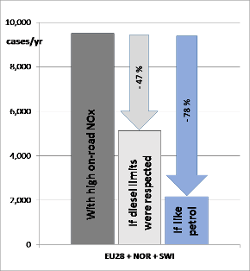
Excess emissions from diesel cars cause about 5,000 premature deaths annually across Europe, a new study shows.

Since the late 1990s the share of diesel cars in the EU has risen to around 50% in the fleet, with important variations between countries. There are now more than 100 million diesel cars running in Europe, twice as many as in the rest of the world together. Their NOx emissions are however 4 to 7 times higher on the road than in official certification tests. Modern engine controls have been optimized by manufacturers for the specific laboratory testing but underperform in real-driving. In this new study, researchers at IIASA and the Norwegian Meteorological Institute have calculated the premature deaths from these excess NOx emissions for the population in all European countries.

Health effect estimates           
About 425,000 premature deaths annually are associated with the current levels of air pollution in EU28, Norway and Switzerland. More than 90% of these premature deaths are caused by respiratory and cardiovascular diseases related to exposure to fine particulate matter. NOx is a key precursor to this fine particulate matter. This new study estimates that roughly 10,000 premature deaths annually can be attributed to NOx emissions from diesel cars, vans and light commercial vehicles. About half–around 5,000 premature deaths annually–are due to NOx emissions being much higher than limit values in real-world driving. Petrol cars have much lower emissions.

“If diesel car emissions were as low as petrol car emissions, three quarters or about 7,500 premature deaths could have been avoided” says IIASA researcher Jens Borken-Kleefeld.

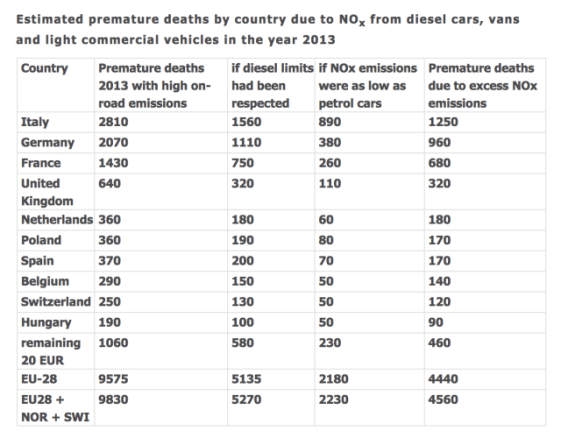
The countries with the highest number of premature deaths attributable to fine particles from diesel cars, vans and light commercial vehicles are Italy, Germany and France. That is because of both their large populations and a high share of diesel cars. However, the risk per capita is almost twice as high in Italy as in France.

Number of premature deaths due to excess NOx emissions from diesel cars, vans and light commercial vehicles in Europe (left column). Almost 50% could be have been avoided if diesel emission limits had been respected on the road (center column). Almost 80% could have been avoided had diesel cars emitted no more NOx than petrol cars (right column).

“This reflects the very adverse pollution situation, particularly in highly populated Northern Italy”, says research leader Jan Eiof Jonson from the Norwegian Meteorological Institute. The lowest risks are in Norway, Finland and Cyprus where risks are at least fourteen times lower than the EU28+ average.

The researchers note that is not the very first calculation of health impacts for Europe. Notably the Nature paper came up with about 7,000 premature deaths due to excess NOx from LDDV. Their results were discussed and reported widely, but there was less focus on results in Europe, which are presented in detail in the new study. 

The study was conducted by the Norwegian Meteorological Institute in cooperation with the International Institute for Applied Systems Analysis (IIASA) in Austria, and the Dept. Space, Earth & Environment at Chalmers University of Technology in Sweden. In this study the Norwegian Meteorological Institute has calculated the pollutant concentrations and depositions based on NOx emissions from LDDVs from different countries and model years provided by IIASA. IIASA has also made the health effect calculations.

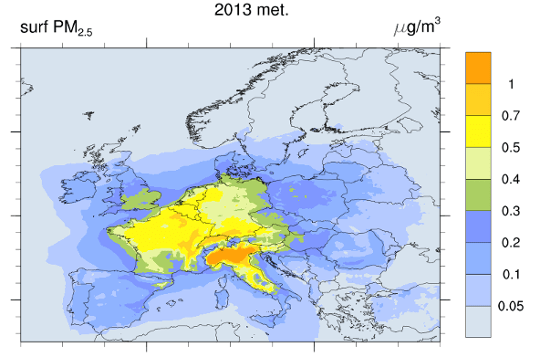
This map shows the concentration of fine particulate matter due to excess NOx emissions from diesel cars, vans and light commercial vehicles across Europe. Blue colours indicate low concentrations, orange and red indicates high extra pollution. Unit: microgram PM2.5 per cubic metre, annual average 2013. © Jonson et al 2017

Source: 5,000 deaths annually from dieselgate in Europe – 2017 – IIASA

Posted in Air Quality, Europe, France, Germany, Health Effects of Air Pollution, Italy, Medical Studies | Tagged , , , , , , , | Leave a comment

North China moves to fight winter air pollution 

Beijing, Tianjin and Hebei have rolled out measures to fight air pollution as the most heavily polluted season, winter, is coming.

The port city of Tianjin will restrict production in heavily polluting industries, including steel, casting, construction materials and coking, according to a local government action plan to curb air pollution during the four-month central heating season that usually starts on November 15.

Steel output will be slashed by half, it said.

Data showed that pollutants from the burning of coal increase by 30 percent during winter, said Yang Yong, an official with Tianjin Environmental Protection Bureau.

Without output limits, one of the most effective ways to reducing pollution, the amount of pollutants would exceed the environmental capacity, said Yang.

Most of the industries affected are suffering from overcapacity and the limits would not lead to a marked shortage of supply, he said.

Hebei, home to several of cities in China’s top 10 most polluted, has issued similar measures for heavily polluting industries.

The province is also ordering its rural regions near Beijing to use electricity and natural gas to replace burning coal, a major cause of smog in winter.

In Beijing, developers will even be banned from land auctions if three or more of their projects are found to be failing to control dust.

The Beijing-Tianjin-Hebei region sits at the heart of the North China Plain where air pollution, particularly winter smog, often occurs as a result of the high concentration of industrial and vehicle emissions, limited air circulation and the burning of coal.

Local governments are taking harsher measures to fight air pollution with more residents increasingly worried about the health impacts, particularly of PM2.5, airborne particles smaller than 2.5 microns in diameter.

China has set a target to reduce the level of PM 2.5 pollution by at least 15 percent in the cities around the Beijing-Tianjin-Hebei region between October 2017 and March 2018.

Source: North China moves to fight winter air pollution – Xinhua | English.news.cn

Posted in Air Quality, Asia, China | Tagged , , , , | Leave a comment