In utero exposure to diesel exhaust could be linked to adult heart failure: Toxic effects of air pollution can cross generations through unanticipated effects on DNA in the heart of the developing embryo, new study reveals

Gestational exposure to airborne particles derived from diesel exhaust can modify DNA in utero and alter the expression of genes that potentially increase susceptibility to adult heart failure, suggests a study in mice.

According to a study published online in The FASEB Journal, involving mice, gestational exposure to airborne particles derived from diesel exhaust can modify DNA in utero and alter the expression of genes that potentially increase susceptibility to adult heart failure. Although an association between gestational exposure to diesel exhaust and heart failure susceptibility had previously been reported, this is the first study that identifies specific DNA methylation (a chemical modification of DNA that changes its action) and gene expression effects in the heart that result from gestational exposure.

“Our study adds to the large body of evidence that air pollution exposure has significant harmful effects on the cardiovascular system, and extends these findings to show the effects of this exposure on the developing heart — effects that can last for decades,” said Michael T. Chin, M.D., Ph.D., associate professor of medicine at the University of Washington School of Medicine’s Center for Cardiovascular Biology in Seattle. “By demonstrating this potential public and global health problem, we hope that our study prompts leaders to develop thoughtful environmental regulatory policies that promote the health and well-being of future generations.”

Chin and colleagues used four groups of mice. The first group was exposed gestationally to filtered air and then underwent sham surgery. The second group was exposed gestationally to diesel exhaust particles and then underwent sham surgery. The third group was exposed gestationally to filtered air and then underwent transverse aortic constriction (TAC) surgery. The fourth group was exposed gestationally to diesel exhaust particles and then underwent TAC surgery. The researchers compared heart gene expression in all four groups and identified three candidate genes that were expressed differently in the diesel-exposed TAC surgery group, which developed the worst heart failure. These target genes in the heart are the first to be identified that likely play an important role in mediating adult sensitivity to heart failure. The researchers subsequently investigated whether these genes become chemically modified after diesel particulate exposure and found that one of them (miR133a-2) was methylated differently.

“From just an experience vantage we all assume diesel and other petroleum combustion products are bad for us. Here is evidence of possibly how bad. ” said Thoru Pederson, Ph.D., Editor-in-Chief of The FASEB Journal.

Source: In utero exposure to diesel exhaust could be linked to adult heart failure: Toxic effects of air pollution can cross generations through unanticipated effects on DNA in the heart of the developing embryo, new study reveals — ScienceDaily

Posted in Air Quality, Health Effects of Air Pollution, Medical Studies | Tagged , , , | Leave a comment

New California law gives air quality officials the power to quickly shut down polluters 

Local air quality officials are gaining new powers to quickly stop polluters when they endanger people’s health under legislation signed by Gov. Jerry Brown on Monday.

The law, which goes into effect Jan. 1, follows years of frustration in communities such as Paramount, Boyle Heights and Maywood — where regulators have struggled to stop highly polluting operations after discovering hot spots of Chromium-6, lead and other dangerous pollutants.

Currently, air regulators seeking orders to curtail operations that violate rules and threaten public health must go through an administrative hearing board. The process can take months, while the pollution continues unabated.

As a result, residents “were being told: ‘You are in grave danger, but we can’t do anything about it,’ ” said Assemblywoman Cristina Garcia (D-Bell Gardens), who wrote the legislation.

“What we’re saying today is that when we have imminent health threats, that trumps the right to do business,” Garcia said.

The new law will give pollution control officers the power to issue immediate orders to stop polluting operations when violations pose an “imminent and substantial” danger. The orders are temporary, pending a hearing before an administrative board.

South Coast Air Quality Management District Executive Officer Wayne Nastri welcomed the legislation as “an important new tool to protect public health.”

The district, which sponsored the legislation, has pointed to five recent cases where inadequate enforcement authority prevented it from taking swift action to stop a facility’s harmful emissions.

At Anaplex Corp., a metal-finishing facility in Paramount, it took the South Coast air district months to secure an administrative order to curtail operations after the carcinogen Chromium-6 was detected last fall at levels up to 350 times normal. The district has said it would have used the new authority to stop dangerous levels of lead from the now-shuttered battery recycler Exide Technologies in Vernon and Chromium-6 from Hixson Metal Finishing in Newport Beach, among other cases.

Some industry groups opposed the legislation, while cities backed it as giving air districts the tools they need to protect residents.

Nastri said the law “provides additional protection for the breathing public and also ensures due process for any affected businesses.”

The new powers come as state lawmakers are imposing requirements that local air districts do more to monitor and reduce toxic pollutants. Brown last month signed legislation aimed at improving neighborhood-level air quality as part of a deal to extend the state’s cap-and-trade program to fight climate change.

Stronger enforcement authority also is key to a $47-million air toxics plan that the South Coast district announced earlier this year to find and reduce emissions from the worst-polluting facilities over the next seven years. The initiative targets an estimated 1,100 metal-processing facilities that may be releasing toxic pollutants such as Chromium-6, lead, arsenic, cadmium and nickel.

Source: New California law gives air quality officials the power to quickly shut down polluters – LA Times

Posted in Air Quality, USA & Canada | Tagged , , | Leave a comment

Forest fires hit Indonesia, as scientists warn blazes are ‘new normal’

Forest fires are once again sweeping across Indonesia, with academics warning that the blazes, which have become an annual event since the mid-1990s, have become the “new normal”.

So far five Indonesian provinces have declared emergencies as result of forest fires, according to officials.

Satellite images collected by Indonesia’s National Disaster Management Authority showed 170 hotspots in the country at the end of July, with the regions of East Nusa Tenggara, West Kalimantan and the province of Aceh in northern Sumatra the worst affected.

Local media reports suggest that dozens of people have been hospitalised due to smoke inhalation in Aceh.

According to experts, it is unlikely that this year’s fires will have the same impact as 2015, when unusual weather caused by El Nino led to much of southeast Asia being enveloped by a thick yellow haze – leading to transport chaos and school and hospital closures.

The World Bank estimates that the crisis two years ago caused $16.1 billion of losses for the Indonesian economy.

The situation is however being monitored, with fires likely to continue until the dry season ends in September.

Sue Page, a professor of physical geography at the University of Leicester told Energydesk:

“Although 2015 was exceptional, every year now we’re seeing fires. This is the new normal. Trying to control fires in landscapes which are now incredibly fire prone is a really big challenge.”

Global problem

Devastating forest fires have become an annual event in Indonesia in the last 20 years, a period that has seen extensive deforestation and agricultural development, related in part to the booming palm oil industry in the country.

Fire has long been used by smallholders to clear land in southeast Asia, but large-scale farming has made this practice more dangerous.

Industrial agriculture in the region has disturbed ancient peat swamps, draining them of water and making them more susceptible to burning.

Burning peatlands could release tonnes of carbon into the atmosphere, meaning that the fight to contain forest fires in Indonesia has been linked to the battle to prevent climate change.

Back in 2015, Greenpeace warned that the amount of CO2 released by the Indonesian forest fires was equivalent to the annual emissions of the UK.

Data collected by the Copernicus Atmosphere Monitoring Service (CAMS) and its global fire assimilation system shows that carbon emissions from forest fires this year have so far been less than the average daily figures from 2003-16, but that number is rising daily.
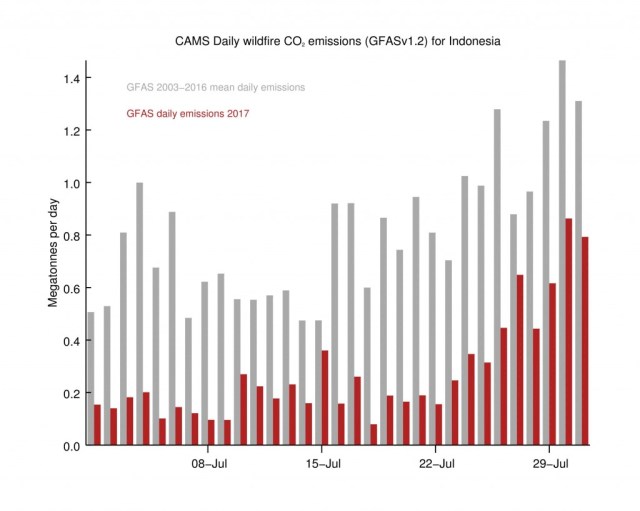
CO2 emissions from 2017’s fires are yet to reach previous years but have been increasing daily.

Source: CAMS

“If you go back to before the peat swamps were being extensively disturbed, they were more or less fire free,” explained Page.

“Fire has always been used in Indonesia and across other parts of southeast Asia to clear land and there have been other fires in the past, but we never saw this as an annual event and that’s now what it has become.”

Health risk

As well as posing a risk to the environment, the fires also threaten human health.

Last year, a study by scientists at Harvard university estimated that pollution caused by the 2015 fires had led to more than 100,000 premature deaths in southeast Asia.

Another study, focusing on the short term impact of the fires, suggested that 12,000 people had died, with 69 million exposed to poor air quality. 

The Indonesian government disputed both studies, pointing to official statistics showing that only 19 people were killed by fires that year.

To date, the impact of the fires on surrounding countries has been limited. Official data from Singapore’s environment agency, which badly affected by haze in 2015, shows that air quality remains normal in the area, at the time of writing.

Dominick Spracklen, a professor of biosphere-atmosphere interactions at Leeds University, who worked on the latter research explained that while the numbers in the two studies differed the studies “were relatively consistent. At least, in showing that the fires had a very significant effect on human health.”

In recent months, the Indonesian government, led by President Joko Wikodo, has made international headlines for efforts aimed at tackling the blazes.

Source: CAMS

In December 2016, the President announced a move to ban industrial activity on the country’s peatlands.

At the same time, new initiatives like the peatland restoration agency have been established.

Nazir Foead, head of the agency, told reporters last year there would be no repeat of the 2015 haze.

“With the preparation the government is making, the re-wetting activities, I would say there should be no more haze going to the [neighbouring countries].”

But despite these efforts, moves to increase air quality monitoring have been lacking.

According to Spracklen, even after the haze, monitoring remains patchy, even though the Indonesian authorities, have invested in new systems in recent years.

“Very few stations report and even fewer report all the time. At the moment, a lot of the ones in southern Sarawak where it looks like there might be some haze are not reporting. Another station in Kalimantan is showing numbers that are way off.

“The monitoring has definitely improved in the last few years. Until recently, there weren’t any air monitoring stations in Indonesia. Now there are quite a few, but the data availability is quite sporadic.”

Source: Forest fires hit Indonesia, as scientists warn blazes are ‘new normal’

Posted in Air Quality, Asia | Tagged , , , , , , , | Leave a comment

Portland air quality remains unhealthy, but some relief may come Friday 

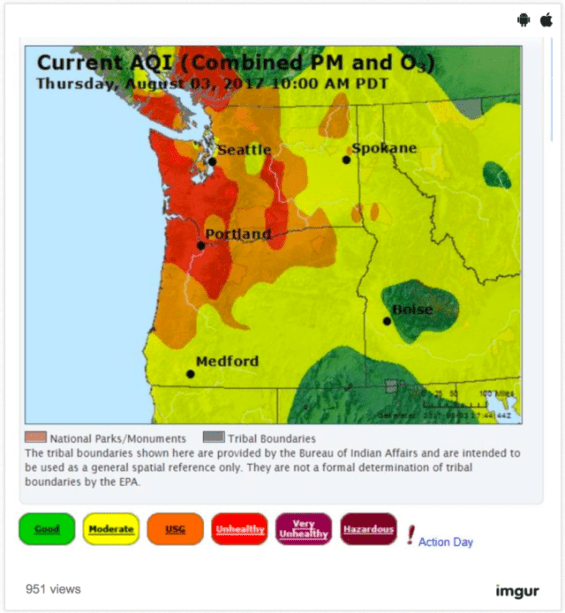
Portland’s air quality rating remains unhealthy on Friday, although some relief may come later in the day.

The thick haze from wildfires in British Columbia has blanketed the Portland area this week amid record heat.

KGW chief meteorologist Matt Zaffino says westerly winds will not only mean a slight drop in temperature but also the possible clearing of smoke.

“The wildfire smoke responsible for our hazy sky and bad air quality may ease a bit Friday, when the winds aloft become more westerly,” he said.

Earlier this week the Oregon Department of Environment Quality said the air was considered unhealthy for sensitive populations, such as seniors, kids and people with respiratory problems. But they downgraded that rating to unhealthy for everyone on Thursday and it remained that way Friday morning.

Thousands of people in British Columbia have been evacuated as more than 100 wildfires throughout western Canada threaten homes. Winds pushed the wildfire smoke south into the northwestern U.S. on Tuesday.

The smoke moved farther into the Portland area throughout the day Wednesday. By Thursday morning, the sky was filled with hazy smoke.

“Air quality monitors in southwest Washington and Portland/Vancouver metro area have shown lowering air quality since Tuesday afternoon,” the National Weather Service said.

The DEQ issued an air pollution advisory for Portland, Vancouver, Salem, Eugene and Medford Wednesday. The advisory is expected to last through August 8.

Smog, exacerbated by a record-breaking heat wave, added to air quality issues.

“A number of active wildfires conducive to increasing ozone and particulate matter levels are expected to linger through next week,” the DEQ said in a press release.

A fire is also burning in the Mt. Jefferson wilderness.

After morning swim lessons Thursday, Portland Parks and Recreation closed the city’s outdoor pools and pulled camps indoors due to the unhealthy air quality and the excessive heat warning. Outdoor pools will remain closed all day Friday.

Indoor pools are open and on regular schedules.

Health officials warned people in the Portland metro area to avoid heavy or prolonged exercise outside, especially people who have underlying health conditions.

“These small particles are so small they can get down into the lungs and get into the blood stream,” said Dr. Richard Lehman, a public health physician with Oregon Health Authority. “When that happens that can lead to inflammation or irritation and if you’ve got underlying heart disease that can even trigger a heart attack.”

“Kids have small airways,” Lehman added. “And if they get swelling in their airways it makes it tougher for them to breathe.”

The Oregon Health Authority cautioned sensitive groups to stay inside and keep windows and doors closed, if possible, depending on heat. Keep the air quality clean by not frying or boiling food, which can add particles to indoor air. If you have to drive, run the air conditioner on “re-circulate” mode to keep smoky air from the car interior.

The smoke also impacted air quality in Clark County, Wash., officials said Wednesday afternoon. A pollution advisory has been issued for Southwest Washington and will likely continue through next week.

The air remained unhealthy south of Portland to Salem. The southern and eastern parts of the state have slightly better air quality.

The wildfires have caused air quality around Seattle to deteriorate to “among the worst in the country,” state officials told KGW’s sister station KING5.

Source: Portland air quality remains unhealthy, but some relief may come Friday | KGW.com

Posted in Air Quality, USA & Canada | Tagged , , , , | Leave a comment

Pierce County burn ban for smoky air includes barbecues, campfires 

Diminished air quality prompted the Puget Sound Clean Air Agency to ban all outdoor burning in the region Wednesday.

The state 1 burn ban went into effect at 4 p.m. for Pierce, King, Snohomish and Kitsap counties because smoke from British Columbia wildfires has brought unhealthy levels of air pollution.

All of the state Department of Ecology air quality monitoring sites in Pierce County were reporting unhealthy levels of air pollution Wednesday afternoon.

The wind pattern is expected to continue through at least Friday, the agency says.

“The purpose of the burn ban is to reduce any additional harm to sensitive populations from excess air pollution and is in addition to existing fire safety burn bans,” the agency wrote in a statement.

The ban includes charcoal barbecues, firepits and campfires, as well as field-burning and Native American ceremonial fires outside of tribal lands.

Not that anyone is going to be doing this during this week’s stretch of record-breaking heat, but fires in fireplaces and woodstoves are also prohibited.

Anyone sensitive to air pollution should stay inside, the agency says, especially when exercising.


Source: Pierce County burn ban for smoky air includes barbecues, campfires | The News Tribune

Posted in Air Quality, USA & Canada | Tagged , , , , | Leave a comment

B.C. wildfires cause light orange haze over Vancouver in wake of air quality advisory

Vancouver residents are experiencing a small taste of what others in the B.C. Interior have been enduring for nearly a month.

This morning, a light orange haze has descended over Vancouver. The misty skies are the result of smoke being blown from wildfires from Harrison Lake to the B.C. Interior.

An air quality advisory went into effect today for Metro Vancouver and the Fraser Valley because of high concentrations of particulate matter.

Metro Vancouver said in a news release that exposure to these particulates is of greatest concern for infants, the elderly, and those with diabetes or lung or heart disease.

“Fine particulate matter, also known as PM2.5, refers to airborne solid or liquid droplets with a diameter of 2.5 micrometres (μm) or less. PM2.5 can easily penetrate indoors because of their small size,” Metro Vancouver said in the news release.

Indoor spaces with air conditioning, such as libraries and community centres, can offer a respite from the heat and air pollution.

Air quality remains a serious public health issue across the country.

According to an essay by UBC researchers Michael Brauer and Chris Carlsten in a new book called Reflections of Canada, nearly 8,000 Canadians die every year as a result of this problem.

“Air pollution causes more death than motor vehicle collisions, suicide, and HIV combined,” Brauer and Carlsten wrote in the book, which was published by the Peter Wall Institute for Advanced Studies.

Source: B.C. wildfires cause light orange haze over Vancouver in wake of air quality advisory | Georgia Straight Vancouver’s News & Entertainment Weekly

Posted in Air Quality, USA & Canada | Tagged , , , , | Leave a comment

Air pollution deaths expected to rise because of climate change

If things don’t change, researchers say air pollution worsened by climate change could cost tens of thousands of lives a year

New research predicts that air pollution worsened by climate change will cost tens of thousands of lives if changes are not made.

The study, published in the journal Nature Climate Change, estimates that if current trends continue, climate change will be responsible for another 60,000 air pollution-related deaths globally in the year 2030. By 2100, that number could jump to 260,000.

Previous research has found that some 5.5 million people worldwide already die prematurely due to air pollution.

The authors say this is the most comprehensive study to date on how climate change will affect health as a result of exacerbating air pollution. The research incorporates results from several of the world’s top climate change modeling groups in the United States, United Kingdom, France, Japan and New Zealand.

Hotter temperatures “can speed up the reaction rate of air pollutants that form in the atmosphere,” lead study author Jason West, an associate professor of environmental sciences and engineering in the University of North Carolina, Chapel Hill, told CBS News. “Places that by and large get drier from climate change would be expected to increase air pollution concentrations.”

The study estimates that climate change is expected to increase air pollution-related deaths globally and in all regions except for Africa.

“Air pollution affects things like heart attacksstroke, cardiopulmonary disease, and lung cancer,” he said. “So because air pollution affects those causes it has a big effect on health.”

The researchers emphasize that a concerted effort to slow down climate change could make a big difference for our future. The U.S. commitment to such efforts was thrown into question when President Trump withdrew from the Paris climate accord in June. That agreement, signed by more than 190 other countries, aims to reduce carbon emissions, which scientists say have been fueling global warming.

“Reducing greenhouse gas emissions has a really big benefit for air pollution and therefore for human health,” West said.

In addition to increasing air pollution deaths, climate change is also expected to have a growing impact on health through rising rates of heat stress, the wider spread of infectious diseases, and reduced access to clean water and food.

Source: Air pollution deaths expected to rise because of climate change – CBS News

Posted in Air Quality, Health Effects of Air Pollution | Tagged , , | Leave a comment

German court orders diesel ban in bid tackle air pollution

Judge demands ban placed on most polluting diesels entering German city of Stuttgart from January 2018, ruling previous plans from city government not ambitious enough

A judge in the German city of Stuttgart has ordered the most polluting diesel cars be banned from entering the city from January 2018 in a bid to curb illegal levels of air pollution.

The judge ruled on Friday that the government of Stuttgart must re-write its Air Quality Plan to include a ban on the most polluting diesels in the city from next year, after he deemed the current plan inadequate for bringing air pollution back within legal limits.

Stuttgart has some of the worst air pollution in Germany, with levels of nitrogen dioxide and particulate matter regularly breaching legal limits.

In response to the issue the Stuttgart government drew up a draft Air Quality Plan, but environmental lawyers ClientEarth took the government to court arguing that although it contained some positive measures it did not go far enough to restrict pollution.

The judge agreed, adding that restricting access to the city from the most polluting cars was unavoidable if the area was to meaningfully cut pollution in as short a time as possible.

The move follows similar rulings in Dusseldorf and Munich, and represents the latest in a series of victories for clean air campaigners across Europe.

“The judge has clarified that a diesel ban is unavoidable,” ClientEarth lawyer Ugo Taddei said in a statement. “Stuttgart’s authorities must now find rapid and effective ways to solve the region’s air quality issues. This should include a more structured approach that acknowledges the emissions issues with diesel vehicles – it must also not put undue confidence in what retrofitting can achieve.”

However, a wider court case later this year will determine whether cities have the power to ban diesels from their streets, or whether it must be up to the federal government to decide whether such restrictions can be enforced.

The move came just days after the UK government unveiled a new air quality plan, pledging to ban the sale of internal combustion engine cars by 2040 and instruct local authorities to take fresh steps to improve air pollution in urban areas.

The plan raises the prospect of local authorities charging some diesel vehicles if they enter polluted areas, but stressed that alternative measures need to be attempted first.

The move was widely criticised by green groups, including ClientEarth, who argued the government should act more urgently to tackle current air pollution and bring forward wider plans for charging zones.

Source: German court orders diesel ban in bid tackle air pollution

Posted in Air Quality, Europe, Germany | Tagged , , , | Leave a comment