Portland air quality remains unhealthy, but some relief may come Friday 

Portland’s air quality rating remains unhealthy on Friday, although some relief may come later in the day.

The thick haze from wildfires in British Columbia has blanketed the Portland area this week amid record heat.

KGW chief meteorologist Matt Zaffino says westerly winds will not only mean a slight drop in temperature but also the possible clearing of smoke.

“The wildfire smoke responsible for our hazy sky and bad air quality may ease a bit Friday, when the winds aloft become more westerly,” he said.

Earlier this week the Oregon Department of Environment Quality said the air was considered unhealthy for sensitive populations, such as seniors, kids and people with respiratory problems. But they downgraded that rating to unhealthy for everyone on Thursday and it remained that way Friday morning.

Thousands of people in British Columbia have been evacuated as more than 100 wildfires throughout western Canada threaten homes. Winds pushed the wildfire smoke south into the northwestern U.S. on Tuesday.

The smoke moved farther into the Portland area throughout the day Wednesday. By Thursday morning, the sky was filled with hazy smoke.

“Air quality monitors in southwest Washington and Portland/Vancouver metro area have shown lowering air quality since Tuesday afternoon,” the National Weather Service said.

The DEQ issued an air pollution advisory for Portland, Vancouver, Salem, Eugene and Medford Wednesday. The advisory is expected to last through August 8.

Smog, exacerbated by a record-breaking heat wave, added to air quality issues.

“A number of active wildfires conducive to increasing ozone and particulate matter levels are expected to linger through next week,” the DEQ said in a press release.

A fire is also burning in the Mt. Jefferson wilderness.

After morning swim lessons Thursday, Portland Parks and Recreation closed the city’s outdoor pools and pulled camps indoors due to the unhealthy air quality and the excessive heat warning. Outdoor pools will remain closed all day Friday.

Indoor pools are open and on regular schedules.

Health officials warned people in the Portland metro area to avoid heavy or prolonged exercise outside, especially people who have underlying health conditions.

“These small particles are so small they can get down into the lungs and get into the blood stream,” said Dr. Richard Lehman, a public health physician with Oregon Health Authority. “When that happens that can lead to inflammation or irritation and if you’ve got underlying heart disease that can even trigger a heart attack.”

“Kids have small airways,” Lehman added. “And if they get swelling in their airways it makes it tougher for them to breathe.”

The Oregon Health Authority cautioned sensitive groups to stay inside and keep windows and doors closed, if possible, depending on heat. Keep the air quality clean by not frying or boiling food, which can add particles to indoor air. If you have to drive, run the air conditioner on “re-circulate” mode to keep smoky air from the car interior.

The smoke also impacted air quality in Clark County, Wash., officials said Wednesday afternoon. A pollution advisory has been issued for Southwest Washington and will likely continue through next week.

The air remained unhealthy south of Portland to Salem. The southern and eastern parts of the state have slightly better air quality.
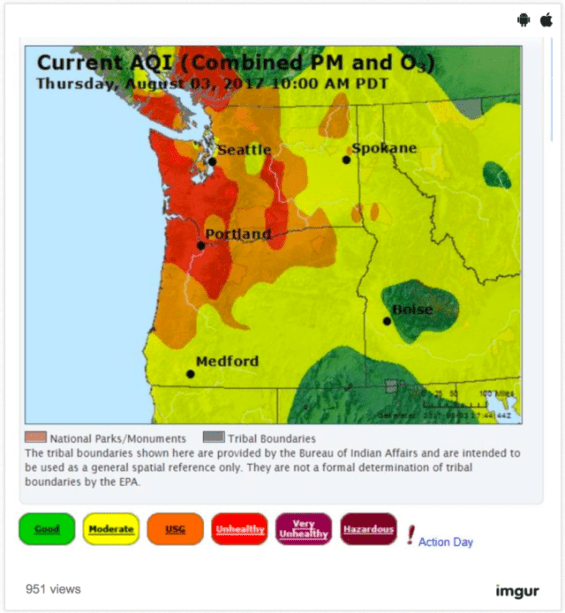
The wildfires have caused air quality around Seattle to deteriorate to “among the worst in the country,” state officials told KGW’s sister station KING5.

Source: Portland air quality remains unhealthy, but some relief may come Friday | KGW.com

Posted in Air Quality, USA & Canada | Tagged , , , , | Leave a comment

Pierce County burn ban for smoky air includes barbecues, campfires 

Diminished air quality prompted the Puget Sound Clean Air Agency to ban all outdoor burning in the region Wednesday.

The state 1 burn ban went into effect at 4 p.m. for Pierce, King, Snohomish and Kitsap counties because smoke from British Columbia wildfires has brought unhealthy levels of air pollution.

All of the state Department of Ecology air quality monitoring sites in Pierce County were reporting unhealthy levels of air pollution Wednesday afternoon.

The wind pattern is expected to continue through at least Friday, the agency says.

“The purpose of the burn ban is to reduce any additional harm to sensitive populations from excess air pollution and is in addition to existing fire safety burn bans,” the agency wrote in a statement.

The ban includes charcoal barbecues, firepits and campfires, as well as field-burning and Native American ceremonial fires outside of tribal lands.

Not that anyone is going to be doing this during this week’s stretch of record-breaking heat, but fires in fireplaces and woodstoves are also prohibited.

Anyone sensitive to air pollution should stay inside, the agency says, especially when exercising.


Source: Pierce County burn ban for smoky air includes barbecues, campfires | The News Tribune

Posted in Air Quality, USA & Canada | Tagged , , , , | Leave a comment

B.C. wildfires cause light orange haze over Vancouver in wake of air quality advisory

Vancouver residents are experiencing a small taste of what others in the B.C. Interior have been enduring for nearly a month.

This morning, a light orange haze has descended over Vancouver. The misty skies are the result of smoke being blown from wildfires from Harrison Lake to the B.C. Interior.

An air quality advisory went into effect today for Metro Vancouver and the Fraser Valley because of high concentrations of particulate matter.

Metro Vancouver said in a news release that exposure to these particulates is of greatest concern for infants, the elderly, and those with diabetes or lung or heart disease.

“Fine particulate matter, also known as PM2.5, refers to airborne solid or liquid droplets with a diameter of 2.5 micrometres (μm) or less. PM2.5 can easily penetrate indoors because of their small size,” Metro Vancouver said in the news release.

Indoor spaces with air conditioning, such as libraries and community centres, can offer a respite from the heat and air pollution.

Air quality remains a serious public health issue across the country.

According to an essay by UBC researchers Michael Brauer and Chris Carlsten in a new book called Reflections of Canada, nearly 8,000 Canadians die every year as a result of this problem.

“Air pollution causes more death than motor vehicle collisions, suicide, and HIV combined,” Brauer and Carlsten wrote in the book, which was published by the Peter Wall Institute for Advanced Studies.

Source: B.C. wildfires cause light orange haze over Vancouver in wake of air quality advisory | Georgia Straight Vancouver’s News & Entertainment Weekly

Posted in Air Quality, USA & Canada | Tagged , , , , | Leave a comment

Air pollution deaths expected to rise because of climate change

If things don’t change, researchers say air pollution worsened by climate change could cost tens of thousands of lives a year

New research predicts that air pollution worsened by climate change will cost tens of thousands of lives if changes are not made.

The study, published in the journal Nature Climate Change, estimates that if current trends continue, climate change will be responsible for another 60,000 air pollution-related deaths globally in the year 2030. By 2100, that number could jump to 260,000.

Previous research has found that some 5.5 million people worldwide already die prematurely due to air pollution.

The authors say this is the most comprehensive study to date on how climate change will affect health as a result of exacerbating air pollution. The research incorporates results from several of the world’s top climate change modeling groups in the United States, United Kingdom, France, Japan and New Zealand.

Hotter temperatures “can speed up the reaction rate of air pollutants that form in the atmosphere,” lead study author Jason West, an associate professor of environmental sciences and engineering in the University of North Carolina, Chapel Hill, told CBS News. “Places that by and large get drier from climate change would be expected to increase air pollution concentrations.”

The study estimates that climate change is expected to increase air pollution-related deaths globally and in all regions except for Africa.

“Air pollution affects things like heart attacks, stroke, cardiopulmonary disease, and lung cancer,” he said. “So because air pollution affects those causes it has a big effect on health.”

The researchers emphasize that a concerted effort to slow down climate change could make a big difference for our future. The U.S. commitment to such efforts was thrown into question when President Trump withdrew from the Paris climate accord in June. That agreement, signed by more than 190 other countries, aims to reduce carbon emissions, which scientists say have been fueling global warming.

“Reducing greenhouse gas emissions has a really big benefit for air pollution and therefore for human health,” West said.

In addition to increasing air pollution deaths, climate change is also expected to have a growing impact on health through rising rates of heat stress, the wider spread of infectious diseases, and reduced access to clean water and food.

Source: Air pollution deaths expected to rise because of climate change – CBS News

Posted in Air Quality, Health Effects of Air Pollution | Tagged , , | Leave a comment

German court orders diesel ban in bid tackle air pollution

Judge demands ban placed on most polluting diesels entering German city of Stuttgart from January 2018, ruling previous plans from city government not ambitious enough

A judge in the German city of Stuttgart has ordered the most polluting diesel cars be banned from entering the city from January 2018 in a bid to curb illegal levels of air pollution.

The judge ruled on Friday that the government of Stuttgart must re-write its Air Quality Plan to include a ban on the most polluting diesels in the city from next year, after he deemed the current plan inadequate for bringing air pollution back within legal limits.

Stuttgart has some of the worst air pollution in Germany, with levels of nitrogen dioxide and particulate matter regularly breaching legal limits.

In response to the issue the Stuttgart government drew up a draft Air Quality Plan, but environmental lawyers ClientEarth took the government to court arguing that although it contained some positive measures it did not go far enough to restrict pollution.

The judge agreed, adding that restricting access to the city from the most polluting cars was unavoidable if the area was to meaningfully cut pollution in as short a time as possible.

The move follows similar rulings in Dusseldorf and Munich, and represents the latest in a series of victories for clean air campaigners across Europe.

“The judge has clarified that a diesel ban is unavoidable,” ClientEarth lawyer Ugo Taddei said in a statement. “Stuttgart’s authorities must now find rapid and effective ways to solve the region’s air quality issues. This should include a more structured approach that acknowledges the emissions issues with diesel vehicles – it must also not put undue confidence in what retrofitting can achieve.”

However, a wider court case later this year will determine whether cities have the power to ban diesels from their streets, or whether it must be up to the federal government to decide whether such restrictions can be enforced.

The move came just days after the UK government unveiled a new air quality plan, pledging to ban the sale of internal combustion engine cars by 2040 and instruct local authorities to take fresh steps to improve air pollution in urban areas.

The plan raises the prospect of local authorities charging some diesel vehicles if they enter polluted areas, but stressed that alternative measures need to be attempted first.

The move was widely criticised by green groups, including ClientEarth, who argued the government should act more urgently to tackle current air pollution and bring forward wider plans for charging zones.

Source: German court orders diesel ban in bid tackle air pollution

Posted in Air Quality, Europe, Germany | Tagged , , , | Leave a comment

Maternal exposure to air pollution early in pregnancy linked to preterm, low birth weight babies

Exposure to air pollution early in a pregnancy could increase risk for preterm birth and low birth weight, according to a study led by researchers at NYU School of Medicine, and published on July 27 in Environmental Health Perspectives.

The study, conducted in mice, found that exposure to air pollution during the equivalent of the first or second trimester in humans was linked to more negative birth outcomes than exposure later in pregnancy.

Researchers studied the effects of fine particulate air pollution, which is made up of particles less than one ten-thousandth of an inch in diameter, or PM2.5. Inhalable and almost invisible to the eye, this type pollution comes from car exhaust, coal-fired power plants, and other industrial processes. PM2.5exposure has previously been linked to risk for asthma and heart disease.

According to the US Centers for Disease Control and Prevention, preterm birth and low birth weight increase risk for vision and hearing problems, learning problems and even death.

Using PM2.5 levels comparable to those found in highly-polluted urban environments, researchers examined obstetric outcomes based on exposures during different stages of pregnancy in mice. The findings, according to the study’s authors, could have both implications for physicians as they advise women during pregnancy, as well as for air pollution policy.

“This first study of this problem in mice adds to the growing body of evidence that inhalation of particulate matter from implantation through the second trimester of pregnancy is potentially dangerous,” says lead author and investigator Jason Blum, PhD, MS, assistant professor in the Department of Environmental Medicine at NYU School of Medicine.

Implications for Clinical Care and Policy

Past studies had linked high levels particulate matter exposure to low birth weight, but impact of the timing of maternal exposure on birth weight had been debated. The new findings suggest that exposure during the first two trimesters has the greatest affect, say the study authors.

In the study, pregnant mice were randomly assigned to one of two groups– one exposed to filtered air and a second to concentrated PM2.5. The mice exposed to particles were also randomly assigned for exposure during one of four gestational periods designed to mirror the stages of human pregnancy: period 1(0.5-5.5 days); period 2(6.5-14.5 days); period 3(14.5-16.5 days); or period 4(0.5-16.5 days).

Researchers measured both the duration of pregnancy and birth weight of the offspring to identify the effects of concentrated PM2.5 over the time periods. Their results show that exposure to air pollution during period one resulted in preterm birth for about 83 percent of exposed mouse litters. Similarly, exposure to PM2.5 from conception to the end of the second trimester–periods one, two and three–resulted in an 11.4 percent decrease in birth weight for 50 percent of the litters.

Exposure during the first and second trimester also came with decreased body length, decreased placental weight, and decreased anogenital distance, which can reflect abnormal hormone levels, says Blum.

“These findings could lead physicians to advise women to avoid high pollution areas or use air filtration systems during the early stages of pregnancy,” says senior study author Judith Zelikoff, PhD, a professor in the Department of Environmental Medicine at NYU School of Medicine. “With preterm birth and low birth weight having such serious health consequences, the need for further research in this area is greater than ever.”

Source: Maternal exposure to air pollution early in pregnancy linked to preterm, low birth weight babies

Posted in Air Quality, Health Effects of Air Pollution, Medical Studies | Tagged , , , | Leave a comment

Scottish Government accused of showing “remarkable disregard for public health” on air pollution 

Environmental groups accuse UK Government of “kicking urgently needed action into the long grass” with plan to ban the sale of petrol and diesel cars and vans by 2040

Environmental groups have accused the UK Government of “kicking urgently needed action into the long grass” with its plan to ban the sale of petrol and diesel cars and vans by 2040.

Plans to tackle air pollution in Scotland also came under fire, with Friends of the Earth Scotland saying the strategy unveiled by Scottish ministers showed “a remarkable disregard for public health”.

Environment Secretary Michael Gove yesterday announced plans to ban the sale of polluting vehicles by 2040 as part of the UK’s clean air plan.

Transport Secretary Chris Grayling said the move, which aims to reduce the health damage caused by air pollution while also helping to mitigate climate change caused by transport emissions, showed the Government was “determined to deliver a green revolution”.

But the scale of ambition came under fire from campaigners, with FoE Scotland describing air pollution as a “public health crisis which is killing thousands of people early every year” and branding the announcement “simply not good enough”.

Meanwhile WWF Scotland called for a more ambitious plan, saying “the clean-up needs to happen much faster”.

Both groups called on the Scottish Government to phase out the sale of polluting cars and vans by 2030.

The Federation of Small Businesses also raised questions over the announcement, pointing out that businesses had bought diesel cars based on government advice and warning the UK announcement is “light on the detail and still leaves many small businesses in the dark”.

The UK Government has been involved in a long-running legal battle with environmental group Client Earth over dangerously high levels of air pollution, with the High Court recently ordering ministers to publish their draft clean air strategy.

The Scottish Government published its own Cleaner Air for Scotland strategy to outline its role in meeting UK-wide targets.

There are 38 Pollution Zones in Scotland, with emissions thought to cause over 2,500 early deaths each year.

But an update on the Scottish plans, published today, also faced strong criticism from environmentalists, with FoE Scotland accusing the Scottish Government of showing “a remarkable disregard for public health by its highly unambitious plans”.

Emilia Hanna, air pollution campaigner for FoE Scotland said: “In spite of a court ruling last year which demanded improved plans, Ministers are serving up practically the same old proposals, which simply don’t go far enough. This continued foot-dragging and time wasting will cost thousands of lives.

“In the updated plans the Scottish Government has reaffirmed its commitment to introduce only one Low Emission Zone next year, but failed to detail how the Zone will be funded and where it will be. One Low Emission Zone is simply not enough, because there are 14 Councils with unsafe levels of toxic air.  For the many people whose lives are impacted by dirty air on a daily basis this lack of ambition is unacceptable.”

Gina Hanrahan, acting head of policy at WWF Scotland said: “This is welcome news from the UK Government, but the clean-up needs to happen much faster. That’s why we’re calling on the Scottish Government to include the phase out of new diesel and petrol cars by 2030, ten years earlier than proposed by Westminster, in the forthcoming Climate Change Bill.  Ending the dominance of fossil fuel vehicles will reduce emissions, clean up our polluted air and tackle a public health crisis.”

Source: Scottish Government accused of showing “remarkable disregard for public health” on air pollution | Holyrood Magazine

Posted in Air Quality, Europe, UK | Tagged , , , , | Leave a comment

New diesel and petrol vehicles to be banned from 2040 in UK 

Ministers will also unveil a £255m fund to help councils introduce steps to deal with vehicle pollution.

New diesel and petrol cars and vans will be banned in the UK from 2040 in a bid to tackle air pollution, the government is set to announce.

Ministers will also unveil a £255m fund to help councils tackle emissions from diesel vehicles, as part of a £3bn package of spending on air quality.

The government will later publish its clean air strategy, favouring electric cars, before a High Court deadline.

Campaigners said the measures were promising, but more detail was needed.

They had wanted government-funded and mandated clean air zones, with charges for the most-polluting vehicles to enter areas with high pollution, included in the plans.

After a protracted legal battle, the government was ordered by the courts to produce new plans to tackle illegal levels of harmful pollutant nitrogen dioxide.

Judges agreed with environmental campaigners that previous plans were insufficient to meet EU pollution limits.

Ministers had to set out their draft clean air strategy plans in May, with the final measures due by 31 July.

Local measures could include altering buses and other transport to make them cleaner, changing road layouts, altering features such as speed humps, and re-programming traffic lights to make vehicle-flow smoother.

It is thought ministers will consult on a scrappage scheme later this year, but there is no firm commitment.

Ministers have been wary of being seen to “punish” drivers of diesel cars, who, they argue, bought the vehicles after being encouraged to by the last Labour government because they produced lower carbon emissions.

The UK announcement comes amid signs of an accelerating shift towards electric cars instead of petrol and diesel ones, both at home and abroad:

  • Earlier this month, President Emmanuel Macron announced similar plans to phase out diesel and petrol cars in France, also from 2040.
  • BMW announced on Tuesday that a fully electric version of the Mini will be built at the Cowley plant in Oxford from 2019.
  • Swedish carmaker Volvo has said all new models will have an electric motor from the same year.

Source: New diesel and petrol vehicles to be banned from 2040 in UK – BBC News

Posted in Air Quality, Europe, UK | Tagged , , , | Leave a comment