Air quality at ‘unhealthy’ level in Portland due to wildfires 

A smoky haze from wildfires across the state has settled into the Portland metro area and other parts of the Willamette Valley.

Tuesday’s air quality is the worst it has been in weeks, categorized as “unhealthy” most of the afternoon by the Oregon Department of Environmental Quality.

The best thing to do when the air quality reaches unhealthy levels is to limit your time outside and refrain from vigorous activities like running or playing sports.

Young children, pregnant women and those usually sensitive to air pollution should limit their time outside as well.

FOX 12 talked to hiker Andy Ranalli on Tuesday near Council Crest. He said that he planned to take it easy on his hike and take more breaks because of all of the smoke.

“Visually, it’s almost night and day,” Ranalli said. “It’s like we’re in an October fog here because you can’t see more than 100 feet out with real visibility. I think it sucks. It’s not the Portland we know.”

Here are a few more tips from the Oregon Health Authority:

  • Make sure to keep your indoor air as clean as possible by changing your filters if they are due.
  • Avoid smoking inside.
  • Hold off on vacuuming, which can stir up dust.
  • Drink lots of water. That can help ease symptoms like a scratchy throat or coughing.

There is some good news. The winds should blow out at least some of this smoke Tuesday evening and push it east. By Wednesday, everyone should notice a big improvement in air quality in the metro area.

Source: Air quality at ‘unhealthy’ level in Portland due to wildfires – KPTV – FOX 12

Posted in Air Quality, USA & Canada | Tagged , , , , | Leave a comment

Air pollution ‘nearly as bad’ for baby as smoking during pregnancy

AIR pollution can lead to babies being born with shorter bodies and smaller heads, according to Scottish research which found that high exposure to toxic fumes during pregnancy is nearly as harmful as smoking.

A study by Edinburgh and Aberdeen universities found that Scottish babies exposed to toxic gases and particulates breathed in by their mother, such as traffic fumes, were born with smaller heads and shorter bodies.

A similar outcome was observed in babies whose mothers smoked during pregnancy but were exposed to less pollution.

The findings are particularly worrying because the study — the largest of its kind so far conducted — only examined the effects of pollution in the northeast of Scotland, where air quality is relatively good compared with congested areas such as Glasgow, Edinburgh and London.

It comes just weeks after another study at Edinburgh University showed that nano-sized particles found in traffic fumes can damage the immune system’s ability to kill viruses and bacteria. The emissions are also known to aggravate lung conditions, and have even been linked to an increased risk of dementia.

Dr Tom Clemens, who led the latest study, has called on the World Health Organisation (WHO) and the EU to urgently review their definition of “acceptable” emissions levels amid concern they are still too high.

He added: “Our findings suggest that there may not be a truly ‘safe’ level of exposure during pregnancy.

“A foetus with a non-smoking mother exposed to high pollution levels is only slightly better off than one with a smoking mother exposed to low levels of pollution. This implies that the effect of exposure to the highest They detected average concentrations of 7.2 micrograms per metre cubed — well below the annual average of 10 micrograms per metre cubed that is deemed acceptable by WHO.”

Data on foetal growth was gathered from ultrasound scans and maternity records for almost 14,000 pregnancies in northeast Scotland between 2002 and 2011. Lifestyle factors, such as smoking, were considered. Air quality at postcode level was determined using dispersion models based on UK government data.

Unlike previous air pollution studies, the investigation by Clemens and his team looked at the effect on developing foetuses of microscopic specks of dust and soot that can enter the lungs and bloodstream.

Chris Dibben, a co-author of the study, added: “Although most parents will be aware that their smoking may be harming their unborn child, we wonder whether there is an equal awareness that air pollution can have a similar level of impact on the growth of the child in the womb, even in a relatively unpolluted region like northeast Scotland.”

The study is published in the scientific journal, Environment International.

In February, the European Commission admitted that air quality laws had been flouted in more than 130 cities across 23 of the 28 EU member states, including the UK. It is estimated to cut average life expectancy in Scotland by three to four months and causes 2,500 premature deaths.

The UK Government has pledged to ban the sale of new diesel and petrol cars by 2040 as part of efforts to reduce air pollution from traffic.

It has been estimated that 59 per cent of the British population are living in towns and cities where nitrogen dioxide pollution breaches the lawful level of 40 microgrammes per cubic metre of air.

In January, Hope Street in Glasgow was named the most polluted street in Scotland with average nitrogen dioxide levels which were more than 60 per cent above the legal limit.

Source: Air pollution ‘nearly as bad’ for baby as smoking during pregnancy (From HeraldScotland)

Posted in Air Quality, Europe, Health Effects of Air Pollution, Medical Studies, UK | Tagged , , , | Leave a comment

Smoky haze, and heat, return to the Seattle area — but pollution isn’t from B.C. this time 

The smoke, originating in our own state, is not nearly as bad as earlier this month, but you can expect to see the haze until the winds change and push it out, maybe as soon as this afternoon.

The smoke is back over the Puget Sound region — but this time it’s our own Washington state wildfires to blame, according to the National Weather Service.

At the beginning of this month, haze from wildfires raging in Canada contributed to health concerns during a record-breaking heat wave for the region.

This haze, however, is due to an easterly wind blowing from the interior of the state toward the coast and pulling smoke from a few wildfires near Cle Elum with it, Weather Service meteorologist Kirby Cook said. The wind is expected to change direction and “flip to the Southeast” soon, which will help clear out the skies locally, Cook said.

Air quality ranged from good to moderate throughout the region Monday morning.

Monday’s high temperatures  reached the upper-80s in Seattle and low-90s in Olympia, the Weather Service said. Temperatures could cool down to the upper 70s and 80s on Tuesday and Wednesday but could begin to creep up again into the 80s to 90s through the end of the week and into the holiday weekend.

Nighttime temperatures, however, are expected to cool down into the 50s all week, which will likely make the heat easier to endure for the majority of Seattle-area residents who do not have central air conditioning.

In addition to having some of the hottest days on record, this stretch of summer will also go down as the driest on record, with only 2/100th of an inch of precipitation in July and August this year, Cook said.

That means the danger of wildfires will continue to grow into Labor Day weekend.

“We’re still right in the middle of fire season and people need to be extremely careful with fires,” he said.

Source: Smoky haze, and heat, return to the Seattle area — but pollution isn’t from B.C. this time | The Seattle Times

Posted in Air Quality, USA & Canada | Tagged , , , | Leave a comment

Scientist finds children at risk from surprising source of air pollution

We think of schools as safe places for children, but there’s an invisible hazard lurking right outside the front door. A recent study by Matthew Adams, assistant professor with U of T Mississauga’s Department of Geography, found that school kiss-and-ride drop-off zones are exposing children to increased levels of air pollution.

With every breath, urban dwellers inhale a toxic cocktail of air pollutants like carbon monoxide, sulphur dioxide, nitrogen oxides and ozone. Our general exposure is typically predicted by government air quality data related to the postal code of an individual’s home. But, Adams notes, many of us spend the majority of our day away from home, at work, school or other locations with different air quality. “The amount of pollution an individual is actually exposed to can change according to proximity to busy roads and major highways, workplace exposure, physical exertion or even weather conditions,” he says.

Adams uses GIS—geographic information systems—to predict individual exposure to air pollution on a hyper-local scale, studying locations in Hamilton, Mississauga and other urban areas in the greater Toronto area. His research could help us better understand and predict our own exposure to air pollution, and maybe take steps to avoid it.

“We wanted to know what happens when cars idle outside of schools, and we found that it creates some significant air pollution issues,” Adams says. “Under certain conditions, particularly in the winter when the air is not moving and dispersing that air pollution, cars can generate very high air pollution concentrations right where students are being dropped off.” He notes that kindergarten play yards are often located next to drop-off zones, subjecting the youngest students to concentrated exposure to auto exhaust, which can lead to a variety of negative effects like respiratory health issues, poor school performance, and poor well-being later in life.

“Students spend a long time at school. They don’t really have a choice in where they’re going to school, and schools are built to last for a long time,” he says. “Understanding what’s going on in these very local sources of air pollution is important because that’s really where the exposure occurs.”

In his research, Adams collects air pollution data from mobile monitors, satellite imaging and fixed monitoring stations, and hopes to combine that information with location and heart rate data from cell phones and wearable fitness devices. “As we get better air pollution models that can estimate [pollutions levels for] an entire city by block, by street or even household location, we can integrate that information into the activity patterns of how people move through the environment and start to understand what local exposure means.”

“It’s very difficult to control sources of pollution,” Adams says. “But it’s particularly important information for those who are at risk, such as the elderly, youth or people with existing cardio-respiratory diseases.” Better information about local exposure could help individuals choose different activities or locations during periods of high pollution. “We want to inform people that a specific location might not be a good place to go for a run today, or that there’s a better location elsewhere where there’s lower exposure to air pollution,” he says. “We want to provide the public with a way to manage their own risk.”

“Simple changes can help to minimize health effects on students,” Adams says. The study recommends locating play structures and play yards away from drop-off zones, encouraging students to walk and bike to school and convincing auto-oriented parents to turn off their engines in the drop-off location.

Source: Scientist finds children at risk from surprising source of air pollution

Posted in Air Quality, Health Effects of Air Pollution | Tagged , , , , , , | Leave a comment

Firms face fines after new monitors detect pollutants 

Following the installation of 100 small air-quality monitors in Taoyuan’s Kuanyin Industrial Park (觀音工業區), two factories are being prosecuted for violating air pollution and waste disposal regulations, Environmental Protection Administration officials said yesterday.

The action is part of the agency’s four-year, NT$200 million (US$6.6 million) plan to install 10,200 small air-quality monitors nationwide, Department of Environmental Monitoring and Information Management Director-General Chang Shuenn-chin (張順欽) told a news conference in Taipei yesterday.

The first 100 monitors, installed on lighting poles in the park, are quick testers for PM2.5 pollutants, volatile organic compounds, temperature and humidity, Chang said.

They can submit data to the agency’s database every three minutes, he said.

While stationary stations indicate the general air quality of a region, the micro monitors’ instant data can narrow down the suspected contamination area, Bureau of Environmental Inspection Northern Branch Director Chuang Hsun-cheng (莊訓城) said.

Inspectors would examine all sources of pollution in the suspected spot, Chuang said, adding that the monitors were installed at the request of residents.

Hua-chen Precision Co and Tai-yi Dyeing Co officials face prison terms of one to five years and fines of NT$200,000 to NT$15 million if found in violation of the Waste Disposal Act (廢棄物清理法) and the Air Pollution Control Act (空氣污染防制法), he said.

Hua-chen had allegedly illegally disposed other companies’ sludge even though it had been asked to stop operations by the Taoyuan Department of Environmental Protection in 2015 and lacked any waste-disposal permits, he said.

Tai-yi, asked to stop operations by the department last year due to its polluting emissions, also secretly resumed its business, he said, adding that the two cases have been forwarded to Taoyuan District Prosecutors’ Office.

Two other companies, Tung-hsin Industry Co and Super Max Engineering Co, face fines of NT$20,000 to NT$200,000 for violating the Air Pollution Control Act, he said.

Source: Firms face fines after new monitors detect pollutants – Taipei Times

Posted in Air Quality, Asia, Taiwan | Tagged , | Leave a comment

In utero exposure to diesel exhaust could be linked to adult heart failure: Toxic effects of air pollution can cross generations through unanticipated effects on DNA in the heart of the developing embryo, new study reveals

Gestational exposure to airborne particles derived from diesel exhaust can modify DNA in utero and alter the expression of genes that potentially increase susceptibility to adult heart failure, suggests a study in mice.

According to a study published online in The FASEB Journal, involving mice, gestational exposure to airborne particles derived from diesel exhaust can modify DNA in utero and alter the expression of genes that potentially increase susceptibility to adult heart failure. Although an association between gestational exposure to diesel exhaust and heart failure susceptibility had previously been reported, this is the first study that identifies specific DNA methylation (a chemical modification of DNA that changes its action) and gene expression effects in the heart that result from gestational exposure.

“Our study adds to the large body of evidence that air pollution exposure has significant harmful effects on the cardiovascular system, and extends these findings to show the effects of this exposure on the developing heart — effects that can last for decades,” said Michael T. Chin, M.D., Ph.D., associate professor of medicine at the University of Washington School of Medicine’s Center for Cardiovascular Biology in Seattle. “By demonstrating this potential public and global health problem, we hope that our study prompts leaders to develop thoughtful environmental regulatory policies that promote the health and well-being of future generations.”

Chin and colleagues used four groups of mice. The first group was exposed gestationally to filtered air and then underwent sham surgery. The second group was exposed gestationally to diesel exhaust particles and then underwent sham surgery. The third group was exposed gestationally to filtered air and then underwent transverse aortic constriction (TAC) surgery. The fourth group was exposed gestationally to diesel exhaust particles and then underwent TAC surgery. The researchers compared heart gene expression in all four groups and identified three candidate genes that were expressed differently in the diesel-exposed TAC surgery group, which developed the worst heart failure. These target genes in the heart are the first to be identified that likely play an important role in mediating adult sensitivity to heart failure. The researchers subsequently investigated whether these genes become chemically modified after diesel particulate exposure and found that one of them (miR133a-2) was methylated differently.

“From just an experience vantage we all assume diesel and other petroleum combustion products are bad for us. Here is evidence of possibly how bad. ” said Thoru Pederson, Ph.D., Editor-in-Chief of The FASEB Journal.

Source: In utero exposure to diesel exhaust could be linked to adult heart failure: Toxic effects of air pollution can cross generations through unanticipated effects on DNA in the heart of the developing embryo, new study reveals — ScienceDaily

Posted in Air Quality, Health Effects of Air Pollution, Medical Studies | Tagged , , , | Leave a comment

New California law gives air quality officials the power to quickly shut down polluters 

Local air quality officials are gaining new powers to quickly stop polluters when they endanger people’s health under legislation signed by Gov. Jerry Brown on Monday.

The law, which goes into effect Jan. 1, follows years of frustration in communities such as Paramount, Boyle Heights and Maywood — where regulators have struggled to stop highly polluting operations after discovering hot spots of Chromium-6, lead and other dangerous pollutants.

Currently, air regulators seeking orders to curtail operations that violate rules and threaten public health must go through an administrative hearing board. The process can take months, while the pollution continues unabated.

As a result, residents “were being told: ‘You are in grave danger, but we can’t do anything about it,’ ” said Assemblywoman Cristina Garcia (D-Bell Gardens), who wrote the legislation.

“What we’re saying today is that when we have imminent health threats, that trumps the right to do business,” Garcia said.

The new law will give pollution control officers the power to issue immediate orders to stop polluting operations when violations pose an “imminent and substantial” danger. The orders are temporary, pending a hearing before an administrative board.

South Coast Air Quality Management District Executive Officer Wayne Nastri welcomed the legislation as “an important new tool to protect public health.”

The district, which sponsored the legislation, has pointed to five recent cases where inadequate enforcement authority prevented it from taking swift action to stop a facility’s harmful emissions.

At Anaplex Corp., a metal-finishing facility in Paramount, it took the South Coast air district months to secure an administrative order to curtail operations after the carcinogen Chromium-6 was detected last fall at levels up to 350 times normal. The district has said it would have used the new authority to stop dangerous levels of lead from the now-shuttered battery recycler Exide Technologies in Vernon and Chromium-6 from Hixson Metal Finishing in Newport Beach, among other cases.

Some industry groups opposed the legislation, while cities backed it as giving air districts the tools they need to protect residents.

Nastri said the law “provides additional protection for the breathing public and also ensures due process for any affected businesses.”

The new powers come as state lawmakers are imposing requirements that local air districts do more to monitor and reduce toxic pollutants. Brown last month signed legislation aimed at improving neighborhood-level air quality as part of a deal to extend the state’s cap-and-trade program to fight climate change.

Stronger enforcement authority also is key to a $47-million air toxics plan that the South Coast district announced earlier this year to find and reduce emissions from the worst-polluting facilities over the next seven years. The initiative targets an estimated 1,100 metal-processing facilities that may be releasing toxic pollutants such as Chromium-6, lead, arsenic, cadmium and nickel.

Source: New California law gives air quality officials the power to quickly shut down polluters – LA Times

Posted in Air Quality, USA & Canada | Tagged , , | Leave a comment

Forest fires hit Indonesia, as scientists warn blazes are ‘new normal’

Forest fires are once again sweeping across Indonesia, with academics warning that the blazes, which have become an annual event since the mid-1990s, have become the “new normal”.

So far five Indonesian provinces have declared emergencies as result of forest fires, according to officials.

Satellite images collected by Indonesia’s National Disaster Management Authority showed 170 hotspots in the country at the end of July, with the regions of East Nusa Tenggara, West Kalimantan and the province of Aceh in northern Sumatra the worst affected.

Local media reports suggest that dozens of people have been hospitalised due to smoke inhalation in Aceh.

According to experts, it is unlikely that this year’s fires will have the same impact as 2015, when unusual weather caused by El Nino led to much of southeast Asia being enveloped by a thick yellow haze – leading to transport chaos and school and hospital closures.

The World Bank estimates that the crisis two years ago caused $16.1 billion of losses for the Indonesian economy.

The situation is however being monitored, with fires likely to continue until the dry season ends in September.

Sue Page, a professor of physical geography at the University of Leicester told Energydesk:

“Although 2015 was exceptional, every year now we’re seeing fires. This is the new normal. Trying to control fires in landscapes which are now incredibly fire prone is a really big challenge.”

Global problem

Devastating forest fires have become an annual event in Indonesia in the last 20 years, a period that has seen extensive deforestation and agricultural development, related in part to the booming palm oil industry in the country.

Fire has long been used by smallholders to clear land in southeast Asia, but large-scale farming has made this practice more dangerous.

Industrial agriculture in the region has disturbed ancient peat swamps, draining them of water and making them more susceptible to burning.

Burning peatlands could release tonnes of carbon into the atmosphere, meaning that the fight to contain forest fires in Indonesia has been linked to the battle to prevent climate change.

Back in 2015, Greenpeace warned that the amount of CO2 released by the Indonesian forest fires was equivalent to the annual emissions of the UK.

Data collected by the Copernicus Atmosphere Monitoring Service (CAMS) and its global fire assimilation system shows that carbon emissions from forest fires this year have so far been less than the average daily figures from 2003-16, but that number is rising daily.
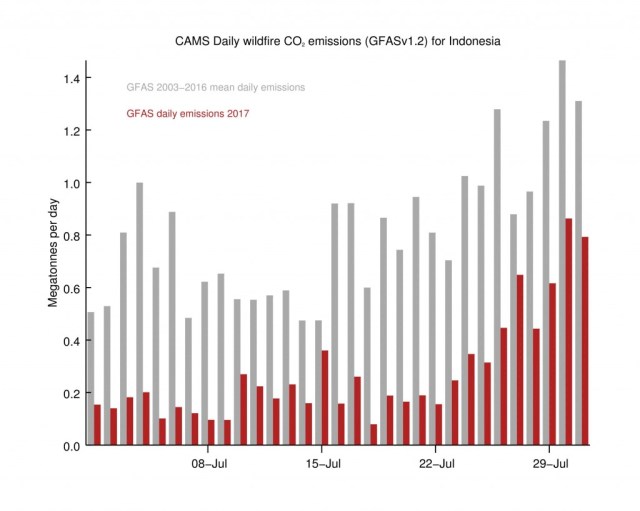
CO2 emissions from 2017’s fires are yet to reach previous years but have been increasing daily.

Source: CAMS

“If you go back to before the peat swamps were being extensively disturbed, they were more or less fire free,” explained Page.

“Fire has always been used in Indonesia and across other parts of southeast Asia to clear land and there have been other fires in the past, but we never saw this as an annual event and that’s now what it has become.”

Health risk

As well as posing a risk to the environment, the fires also threaten human health.

Last year, a study by scientists at Harvard university estimated that pollution caused by the 2015 fires had led to more than 100,000 premature deaths in southeast Asia.

Another study, focusing on the short term impact of the fires, suggested that 12,000 people had died, with 69 million exposed to poor air quality. 

The Indonesian government disputed both studies, pointing to official statistics showing that only 19 people were killed by fires that year.

To date, the impact of the fires on surrounding countries has been limited. Official data from Singapore’s environment agency, which badly affected by haze in 2015, shows that air quality remains normal in the area, at the time of writing.

Dominick Spracklen, a professor of biosphere-atmosphere interactions at Leeds University, who worked on the latter research explained that while the numbers in the two studies differed the studies “were relatively consistent. At least, in showing that the fires had a very significant effect on human health.”

In recent months, the Indonesian government, led by President Joko Wikodo, has made international headlines for efforts aimed at tackling the blazes.

Source: CAMS

In December 2016, the President announced a move to ban industrial activity on the country’s peatlands.

At the same time, new initiatives like the peatland restoration agency have been established.

Nazir Foead, head of the agency, told reporters last year there would be no repeat of the 2015 haze.

“With the preparation the government is making, the re-wetting activities, I would say there should be no more haze going to the [neighbouring countries].”

But despite these efforts, moves to increase air quality monitoring have been lacking.

According to Spracklen, even after the haze, monitoring remains patchy, even though the Indonesian authorities, have invested in new systems in recent years.

“Very few stations report and even fewer report all the time. At the moment, a lot of the ones in southern Sarawak where it looks like there might be some haze are not reporting. Another station in Kalimantan is showing numbers that are way off.

“The monitoring has definitely improved in the last few years. Until recently, there weren’t any air monitoring stations in Indonesia. Now there are quite a few, but the data availability is quite sporadic.”

Source: Forest fires hit Indonesia, as scientists warn blazes are ‘new normal’

Posted in Air Quality, Asia | Tagged , , , , , , , | Leave a comment


