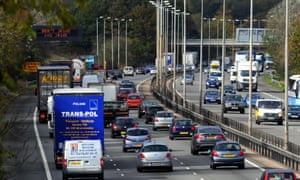
Pollution warning as London air quality alerts are issued 

Air quality alerts have been issued by Mayor of London Sadiq Khan, with moderate pollution expected until the weekend across 17 London boroughs.

The problem is expected to peak on Thursday in Westminster, City of London, Hammersmith, Kensington and Chelsea, Kingston and Wandsworth.

Pollution warnings will be displayed at bus stops, Tube stations and roadsides.

Mr Khan first announced the introduction of the alerts in August 2016.

Mr Khan has described London’s dirty air as a “public health emergency” and has said his office will continue to closely monitor pollution levels over the coming days.

The elderly and those with heart or lung problems should reduce strenuous activity, particularly outdoors, according to the official advice.

London breached its legal limits for toxic air for the entire year in the first five days of 2017.

The environmental law group Client Earth, which has successfully sued the UK government twice over poor air quality, said it was a “shameful reminder of the severity of London’s air pollution” and “shows why the mayor has rightly made tackling it a top priority”.

Source: Pollution warning as London air quality alerts are issued – BBC News

Posted in Air Quality, Europe, London, UK | Tagged , , , , | Leave a comment

What does inversion mean for you health? 

It happens in Utah every year in the winter – inversion.

Even though it only affects Utah a few months every year, what does this mean for your health?

The Utah Physicians for a Healthy Environment said it’s estimated that Utah’s winter inversion is actually stealing 2 years of your life away, and enough is enough.

“Even brief episodes of pollution can have significant consequences and they can be irreversible consequences and lifelong,” explained Dr. Brian Moench, president of Utah Physicians for a Healthy Environment.

In Utah, the mountains create a bowl effect, trapping in cold air and pollution in the valleys – PM2.5, which is made up of soot, dust and vehicle emissions.

Last year alone, dozens of new studies show the air pollution isn’t just affecting your lungs. Utah Physicians for a Healthy Environment released a report highlighting dozens of new studies from 2016 that show alarming consequences from air pollution.

One of the major concerns — the impact of inversion during pregnancy.

“The end result can be pregnancy complications, but it can also be fetal development problems that set up a person for a lifelong increased vulnerability to chronic diseases,” Dr. Moench explained.

Even more alarming, recent research suggests that the inversion pollution can actually impact a developing baby before the mother is even pregnant. Dr. Moench explains that studies show air pollution can impact as far as back 3 months prior to conception.

Other studies have also focused on the impact air pollution has on your brain too. One such study researched the autopsies of patients ranging from 3 to 92-years-old, and found alarming results.

“The brains of all these patients have these tiny magnitude particles that are found in air pollution,” Dr. Moench said. “We know that those particles are associated with neurodegenerative diseases and…early onset dementia, Alzheimer’s.”

Dr. Moench says on bad air days, you can stay indoors, but that the pollution still creeps inside.

An air filter can help make the difference, but long term he says, Utah needs to change its ways.

“If we could… get rid of all wood burning in homes and in restaurants, that would probably make the biggest different in overall air pollution,” Dr. Moench said.

These Utah doctors hope lawmakers in the upcoming 2017 Legislative Session, will enact new laws to ultimately save lives.

“The air pollution that we all experience along the Wasatch Front, shortens the average person’s life span by 2 years. What’s 2 years of your life worth to you?” Dr. Moench said.

Utah Physicians for a Healthy Environment are organizing a Clean Air Rally on January 21 at 1 p.m. at the Utah State Capitol.

Source: What does inversion mean for you health? | KUTV

Posted in Air Quality, USA & Canada | Tagged , , , , , | Leave a comment

Hanoi, Ho Chi Minh City’s pollution readings alarming: expert

Alarming pollution readings have been recorded in both of Vietnam’s largest cities Hanoi and Ho Chi Minh City during 2016, raising health concerns amongst locals.

Hanoi’s 2016 Air Quality Index (AQI) value, calculated based on the PM2.5 annual mean concentration, was twice as high as the safe limit set out by the World Health Organization (WHO), experts said at a seminar on pollution and public health in Hanoi on Tuesday.

PM, or Particulate Matter, is the term for a mixture of solid particles and liquid droplets found in the air. PM2.5 particulates are fine particles with diameters 2.5 micrometers or less.

PM2.5 readings are converted into an AQI value, which reveals the level of pollution the monitored air has on a scale from 0 to 500, with 500 being the most polluted.

PM2.5 particulates are as thin as 1/30 the width of a human hair, and therefore can easily pass through lung tissues and be absorbed into the bloodstream, causing adverse health effects, according to Nguy Thuy Khanh, CEO of Green ID, a Hanoi-based sustainability advocate organization which co-organized Tuesday’s seminar.

According to a Green ID survey conducted in 2016, the PM2.5 annual mean concentration in Hanoi was 50.5 micrograms per cubic meter of air.

Hanoi suffered 123 days of excessive PM2.5 levels in 2016 according to Vietnamese standards, and 282 days according to WHO’s air quality guidelines.

These readings were higher than those recorded in China’s Guangzhou City the same year, the group noted.

The PM2.5 annual mean concentration in Ho Chi Minh City was lower, at 28.3 micrograms per cubic meter, while its citizens went through 14 and 175 days of unsafe PM2.5 levels according to national and WHO standards, respectively.

Heavy industrial zones located to the east of Hanoi and thermal power plants outside the city contributed greatly to air pollution in the capital, based on satellite data collected by Green ID.

Traffic vehicles, construction sites, garbage incineration as well as household cooking were also named as causes of Hanoi’s worsening air pollution.

A late 2016 survey of over 1,400 Hanoi residents, more than 86 percent of which are under 40, found that over 70 percent of respondents claimed to have noticed respiratory problems in themselves and their family members.

Source: Hanoi, Ho Chi Minh City’s pollution readings alarming: expert

Posted in Air Quality, Asia, Vietnam | Tagged , , , , , , | Leave a comment

Most Indian cities fail to meet air quality standards: report 

Greenpeace study estimates air pollution kills more than 1 million Indians each year

Not a single city in northern India meets international air quality standards, according to a Greenpeace report that estimates air pollution kills more than 1 million Indians each year.

The report released last week also shows that levels of the most dangerous airborne pollutants grew by 13 per cent in India between 2010 and 2015 but fell at least 15 per cent over the same period in China, the U.S. and Europe.

It adds to a growing body of research showing the problem of toxic air is not limited only to the Indian capital, Delhi, but afflicts almost all the country’s large cities, particularly in the north.

Air quality data gathered for 2015 from state pollution control boards and under freedom of information laws showed “there are virtually no places in India complying with World Health Organisation and national ambient air quality (NAAQ) standards, and most cities are critically polluted”, the report said.

“Except for a few places in southern India which complied with NAAQ standards, the entire country is experiencing a public health crisis due to high air pollution levels.”

In all of the 20 cities monitored in the state of Uttar Pradesh, the level of PM10 – airborne pollutants such as dust, mould and chemical droplets less than 10 micrometers in diameter – exceeded international limits by at least 100 per cent.

Ghaziabad, an Uttar Pradesh city that borders Delhi, exceeded the limits by more than 400 per cent, the report showed.

But the PM10 limits also exceeded in cities where the problem is less publicised, such as Hyderabad, Pune and Thane, where pollution density was about twice the safe level.

Cities in the south-western state of Karnataka generally enjoyed good air quality, with 12 of the 21 places with monitoring stations, including Mangalore and Mysore, recording PM10 levels well below the safe annual average limit of 60 micrograms.

Delhi’s average level of PM2.5, the smallest and most harmful pollutants, was 128 micrograms in 2015 compared with 81 micrograms in Beijing that year.

Last week, Delhi’s high court directed administrators in Punjab, an agricultural northern state where crop burning each October sends torrents of smog billowing across north India, to cease the practice from this year.

India’s supreme court has also banned fireworks from Delhi after last year’s Diwali festival caused levels of some pollutants to reach 42 times the safe limit and forced the closure of schools, construction sites and a coal-fired power station.(c) Guardian News & Media Ltd, 2017

Except for a few places in southern India which complied with NAAQ standards, the entire country is experiencing a public health crisis due to high air pollution levels


Good, bad and ugly

  • The PM10 limits also exceeded in cities where the problem is less publicised, such as Hyderabad, Pune and Thane, where pollution density was about twice the safe level.
  • Ghaziabadexceeded the limits by more than 400 per cent, the report showed.
  • Cities in the south-western state of Karnataka generally enjoyed good air quality, with 12 of the 21 places with monitoring stations, including Mangalore and Mysore, recording PM10 levels well below the safe annual average limit of 60 micrograms.
  • Poor air quality is the result of several factors including road dust, open fires, vehicle exhaust fumes, industrial emissions and the burning of crop residue.

The Lancet’s global burden of disease study shows about 3,283 Indians die each day due to exposure to outdoor air pollution.

Source: Most Indian cities fail to meet air quality standards: report – IN SCHOOL – The Hindu

Posted in Air Quality, Asia, India | Tagged , , , , | Leave a comment

How European cities are trying to cut deadly air pollution 

As Paris steps up its crackdown on the city’s worst-polluting vehicles (in French), Euronews looks at what other European cities are doing to tackle the deadly problem.

From today (Monday, January 16), the French capital will begin enforcing a scheme to restrict what vehicles can enter the city’s limits.

The European Environment Agency (EEA) said 85 percent of those living in urban areas in the EU were exposed to levels of particulate matter (PM 2.5) considered harmful by the World Health Organisation.

The EEA says in Europe PM 2.5 was responsible for 467,000 premature deaths and nitrogen oxides 71,000 in 2013, the latest year for which data was available.

Transport, in particular diesel vehicles, is one of the biggest contributors to nitrogen oxide emissions, whereas PM 2.5 comes from several different areas, including household heating, coal-fired power plants, vehicles and agriculture.

One of the most popular ways (see below) of controlling air pollution, is to only allow vehicles with certain emission standards to drive in city centres.

But environmental groups say the standards – which have come under scrutiny after Volkswagen admitted cheating emission tests in the US – have failed to cut air pollution levels.

“Euro standards have failed to successfully reduce real-world NOx emissions from diesel vehicles,” said Udo Taddei, a lawyer at ClientEarth. “Diesel vehicles emit on the road on average five or six times the legal limit.”

London

– London’s congestion charge, which sees drivers pay to enter the city centre, was the first such scheme in a major European city when it was introduced in 2003.

– Lorries, buses and coaches over a certain weight – and large vans – have had to meet certain emissions standards to be allowed into the city, since 2012. This will be extended to all other vehicles by 2020.

– One of the city’s main shopping areas, Oxford Street, has recorded some of the highest nitrogen dioxide levels in the world. Putney High Street, in south-west London, broke its annual emission limits just eight days into 2016.

– The UK government’s Department for Environment was ordered to come up with a better set of proposals to tackle air pollution by July 2017, by the High Court.

Oslo

– The city is planning to ban private vehicles from the city centre by 2019 and has reportedly already begun removing parking spaces as it begins making the shift.

– There is already a charge for entering the city centre, which costs around 3.40 euros, 6h-18h, Monday to Friday.

– During periods of high pollution, the city can either temporarily ban the use of diesel vehicles that do not meet certain pollution standards, or, like Paris, allow vehicles with odd-numbered registration plates to circulate one day, but not the next, alternating with even-numbered vehicles.

– A zone that only allows vehicles that meet certain emissions standards to enter, is planned for spring 2017.

– Zero-emission cars made up 17.1 percent of new car registrations in Norway in 2015, the highest market share for clean vehicles in the world.

Milan

– There is a charge for entering the city centre, five euros, or two euros if you are a Milan resident.

– From February 13, 2017, stricter limits will be imposed on vehicles allowed into central Milan, although some less environmentally-friendly vehicles will have 40 free tickets to enter the city’s low emissions zone up until October 2017.

– There is also a low emissions zone covering the province of Milan.

screen-shot-2017-01-17-at-11-59-41

This shows nitrogen oxide levels recorded in European cities, set against premature deaths linked to the pollutant in the wider country. The annual EU limit for nitrogen oxide is 40 µg/m3. Source: European Environment Agency.

Paris

– All vehicles, from Monday, January 16, have to display a sticker attesting to how polluting they are, with some cars, such as those put on the roads before 1997, banned altogether. A similar scheme will be introduced in Grenoble from April 2017.

– A ban on lorries and heavy goods vehicles entering the city at certain times, such as Monday mornings or Friday afternoons.

– During past pollution peaks, the city has bid to tackle the problem by only allowing vehicles with even-numbered registration plates one day, and odd the next. The city also makes public transport free during these periods to encourage people to leave their vehicles at home.

– From July 2017, diesel vehicles will have to meet certain emission standards (Euro 3) to be allowed on Paris’ streets.

– The regular closure of some of the worst-polluted streets. For example the Champs Elysées is shut on the first Sunday of each month.

– Paris is one of four cities worldwide to commit to banning diesel vehicles altogether by 2025.

Munich

– Munich, like scores of other German cities, has restrictions on what vehicles can drive on the city’s streets. Vehicles have to meet certain standards (Euro 4, 5 and 6 for diesel vehicles in Munich) to be allowed to circulate. All vehicles have to put a sticker in the windscreen to indicate how polluting it is considered.

– A ban on trucks weighing more than 3.5 tonnes passing through the city centre.

– There has long been debate about whether to introduce blue badges for vehicles, aimed at tackling nitrogen oxide levels. Their introduction was rejected at a meeting of federal transport ministers in Stuttgart in October 2016, because it would ban older diesel cars from the roads. Ecologist Winfried Hermann, transport minister for the Baden-Württemberg region, said the idea was still on the political agenda, however.

– In July 2016 the Bavarian Administrative Court ordered the state, which includes the city of Munich, to bring nitrogen oxide levels down within a year, or face a fine.

– Meanwhile in Stuttgart there is a pollution alert system in place, which is triggered when weather conditions are expected to be conducive to allowing fine dust to collect in the atmosphere around the city. When the alert is sounded, city residents are called on to leave their cars at home and not to light fires unless they are an essential part of heating the house.

Source: How European cities are trying to cut deadly air pollution | Euronews

Posted in Air Quality, Europe, France, Germany, Italy, Spain, UK | Tagged , , , , , , , , , , , , , , , | 1 Comment

Air pollution on Scots streets ‘causing public health crisis’ 

Air pollution is causing a public health crisis in Scotland, environmental campaigners have said with five new “pollutions zones” declared over the last year.

Friends of the Earth Scotland analysed data which it said looked at the country’s dirtiest streets.

Official figures for two toxic pollutants reveal air quality safety standards are regularly broken, the campaign group said.

In 2016 new official pollution zones were declared in Linlithgow and Newton in West Lothian, Johnstone and Renfrew in Renfrewshire, and with Edinburgh’s Salamander Street coming into force later this month, taking the number up to 38 across the country.

Friends of the Earth Scotland looked at figures for two key pollutants, nitrogen dioxide (NO2) and “particulate matter”.

The most polluted streets with nitrogen dioxide last year were Glasgow’s Hope Street with 65 microgrammes per cubic metre, St John’s Road in Edinburgh on 49, Wellington Road in Aberdeen with 46, Dundee’s Seagate on 46 and Cambuslang Main Street with 45.

Other streets breaking the European directive of 40 microgrammes per cubic metre were Union Street in Aberdeen, Queensferry Road in Edinburgh, Glasgow’s Dumbarton Road and Atholl Street in Perth.

Streets breaking the Scottish air quality objective of 18 microgrammes per cubic metre of particulate matter were Atholl Street, Queensferry Road, Salamander Street, Aberdeen’s King Street, Crieff High Street, Falkirk’s West Bridge Street and Glasgow Road in Edinburgh.

Friends of the Earth Scotland said the Scottish Government needs to take the issue more seriously.

Air pollution campaigner Emilia Hanna said: “Air pollution from traffic is a public health crisis, claiming thousands of lives each year and particularly harmful for small children, pregnant women and people living in poverty.

“For people living in an official pollution zone or near traffic-choked streets, breathing in toxic air is an inescapable fact of life. It should not be this way, we have the right to breathe clean air just as we have the right to drink clean water.

“The Scottish Government and local authorities are not tackling this public health crisis with the seriousness and urgency required.

“We now have a staggering 38 official pollution zones across Scotland, up from 33 last year. This means that many more people are living with illegal levels of air pollution than previously recognised.

“The Scottish Government has promised a ‘plan’ for Low Emission Zones by 2018 but needs to make a public commitment that it will provide significant funding, so that local councils can get on with making serious plans to clean up the air in their area.”

Jean Nelson, 59, from Glasgow, believes pollution has contributed to her chronic obstructive pulmonary disease.

She said: “I live at a junction where the traffic is nose to tail almost every minute of the day, and I feel like I’m choking on fumes on a daily basis.

“Air pollution makes it hard for me to breathe and on bad days, I can barely walk. I do not own a car and often have to take the bus from Hope Street. I can see black smoke coming out of the buses and sometimes am forced to take a taxi just to escape the fumes.

“We need less traffic on our roads if air pollution is going to improve. There are thousands more cars on the roads every year and the problem is only getting worse.”

Source: Air pollution on Scots streets ‘causing public health crisis’ – The Scotsman

Posted in Air Quality, Europe, UK | Tagged , , , , , , , | Leave a comment

Air quality over Delhi continues to remain ‘very poor’, says city’s traffic police

New Delhi [India]: Delhi and the National Capital Region’s air quality continue to remain ‘very poor’, as the level of prominent pollutants PM 2.5 and PM 10 is above normal at many places, the Delhi Traffic Police reported on Thursday.

In Anand Vihar, the Air Quality Index (AQI) was pegged at 585, in R K Puram at 382, in Mandir Marg at 326 and in Gurugram at 316 (AQICN).

Delhi leads the list of most polluted cities in the country followed by several in Uttar Pradesh, Jharkhand, Haryana and Bihar, a report by Greenpeace India has revealed.

The report is based on information obtained through online reports and Right to Information applications from state pollution control boards across India, and assessments of air quality performed in 168 cities across 24 states and union territories. It claims that none of the 168 cities assessed complies with air quality standards prescribed by the World Health Organization (WHO).

Delhi Environment Minister Imran Hussain recently reviewed the ambient air quality position with scientists and engineers of the Delhi Pollution Control Committee and senior officials of the Department of Environment.

He also reviewed implementation of the directions issued by different agencies and courts in recent past to curb air pollution.

Source: Air quality over Delhi continues to remain ‘very poor’, says city’s traffic police | The Siasat Daily

Posted in Air Quality, Asia, India | Tagged , , , , , , | Leave a comment

Mongolian air pollution kills 120 children annually 

A new report by the Mongolian National University of Medical Sciences has revealed some disturbing figures about the impact of Ulaanbaatar’s killer smog, reports news.mn.

The writers state that 120 children and 1200-1300 people in Mongolia are dying every year due to illnesses and disease caused by or exacerbated by air pollution.

MNUMS researched air pollution effects on health in cooperation with the University of California and Seoul National University. The report shows that children under the age of five are at greater risk than adults; air pollution can severely damage the development of a child’s body.

Based on the WHO studies in 2009, over seven thousand deaths occur annually in Mongolia; 10% of them are associated with air pollution. However, the number of deaths increased to 20% in 2014.

Currently the coldest winter in a decade has led to the increase in the burning of cheap fuel in the capital’s ‘ger district’ shanty towns, which has resulted in more intense pollution.

Source: Mongolian air pollution kills 120 children annually – report – AKIpress News Agency

Posted in Air Quality, Asia, Mongolia | Tagged , , , , | Leave a comment