Why Madrid Is Going Car-Free This Holiday Season 

The city center will be nearly car-free for nine days.

Madrid just gave its citizens a present for the holidays. The city closed the entire city center to most cars, turning the urban core into a de facto pedestrian zone.

Starting last Friday at 5 p.m. and continuing for nine days, vehicles belonging to non-residents are banned from entering a zone covering Madrid’s historic core as well as Gran Via, the blaring, multi-lane avenue that serves as the Spanish capital’s main drag and as a major through-route for crosstown traffic.

Buses, cabs and residents’ cars will still be crawling the streets, although restricted to a specially lowered 30 kmh (18 mph) speed limit. The otherwise blanket ban in the throbbing, vehicle-packed heart of a major metropolis is one of the boldest anti-car plans seen in Europe so far. To get a loose idea of the scale in American terms, imagine banning all cars in Manhattan from driving south of 14th Street.

The restrictions, which end Sunday at 10 p.m., couldn’t come at a better time. It’s not just that the holiday shopping season is in full swing in Spain’s busiest commercial district, making the place a whole lot more manageable for shoppers on foot. Spain also has two national holidays this week: Tuesday’s Constitution Day and Thursday’s Immaculate Conception Day. These make early December a classic choice for Spaniards who want to take a week off without squandering too much of their paid vacation allowance. As you’d expect, crowds in the streets are thicker than usual, while the area’s arterial roads tend to get more than a little snarled up. The temporary ban is likely to make the whole area… well, just nicer.

Winter is also a period when Madrid’s air quality needs all the help it can get. Thanks to a seasonal inversion effect, Madrid’s plateau location helps trap fumes into a noxious greige-colored cap known locally as La Boina (“the beret”). Discouraging cars from central Madrid won’t just make the streets a lot more attractive to pedestrians. By keeping keys out of car ignitions, it could also ensure that city residents get to breathe a little more freely for a week.

That should make this week far more pleasant for Madrid residents, who will benefit from increased metro services to get them into town during the shutdown. But like a puppy given as a gift, the plan will have a long life beyond Christmas. The car-free week is a harbinger of further reductions to come. Madrid is planning to cut the number of car lanes along Gran Via, expanding sidewalks to take their place so that the roaring car canyon becomes a pleasant place to stroll. This makeover is due to arrive in summer 2017.

Meanwhile, new car parks are due to be constructed around the edge of the current semi-car-free zone, so it becomes easier for drivers to ditch their vehicles and switch to public transit as they descend on the dense, frequently knotty streets at Madrid’s heart.

The city plans to have a fleet of 2,000 clean electric buses on its roads by 2020 to absorb some of the escapees from private cars. And finally, there are further plans in the works to divert traffic away from central Madrid entirely, though these early-stage proposals still have a few more hoops to jump through before they’re made public. All this comes on the back of past temporary driving bans during winter pollution peaks, designed to soften the worst excesses of air pollution when La Boina is hanging especially heavily over the city. Slowly but surely, the city is getting people used to the idea of not driving into downtown, while also letting them see how much more pleasant and healthy the area is without cars when they actually get there.

By taking the softly, softly approach to cutting car use, Madrid may well be emulating Paris. The French capital’s total ban on cars on the Seine’s right bank was wisely preceded by closing the area in question to host a temporary summer beach. As locals got used to this seasonal closure, extending it into the autumn and thereafter became a far-narrower psychological chasm to jump across, even if reaction from authorities in the greater Paris region has been pretty combative. Madrid has a similar split to Paris’, between a left-leaning city government and a right-leaning one in the region immediately surrounding the city limits, so a similar stand-off between city and exurbs is not unthinkable.

Madrid has already successfully banished most cars from its center in the past—it began doing so for two days of its Mobility Week in September 2015. Moves like this aren’t entirely contested, of course. But by slowly introducing a less car-dependent city—as a seasonal treat rather than a gray bureaucratic edict—Madrid isn’t just pushing toward a cleaner future. It’s steadily building the consensus necessary to make sure that future is what most people in the city actually want.

Source: Why Madrid Is Going Car-Free This Holiday Season – CityLab

Posted in Air Quality, Europe, Spain | Tagged , , | Leave a comment

Get your masks out! Delhi’s air quality ‘severe’, to get worse this week 

Air quality in the Capital worsened on Wednesday as pollution levels in various parts of the city reached “severe” proportions.

Air quality in the Capital worsened on Wednesday as pollution levels in various parts of the city reached “severe” proportions.

Although the overall Air Quality Index read 379, which is “very poor”, Pusa Road had the AQI at 404, Dhirpur 441, Delhi University 458, IGI Airport 438 and Pitampura 431. These are all in the severe category. The monitoring station at Lodhi Road recorded a maximum AQI of 500.

Air pollution level is classified as severe if the AQI is between 401 and 500. China declares a “red alert” at this level.

Severe AQI for three consecutive days is met with desperate measures such as shutting down of schools and offices, closing down industries and power plants and rationing of vehicles on the roads.

SAFAR has advised people to avoid all outdoor physical activity. People with heart or lung diseases, senior citizens, and children should remain indoors and keep activity levels low when air quality turns “severe”, it said.

People with existing heart or lung diseases such as asthma, congestive heart disease, or ischemic heart disease should avoid heavy exertion when the air quality is “very poor”.

In the morning, the 24-hour rolling average of PM10 and PM2.5 touched poor and very poor limits, respectively, according to System of Air Quality Weather Forecasting and Research (SAFAR) data, reading 346 and 174 microgram per cubic metre respectively. These, too, became fouler as the day progressed clocking 408 and 222 microgram per cubic metre.

PM2.5 and PM10 are ultrafine particles that are the dominant pollutants in Delhi. The 24-hour acceptable levels of PM 2.5 and PM10 are 60 and 100 microgram per cubic metre, respectively.

According to forecasts, the air-quality may get fouler over the next couple of days.

“Cold winds from the Indo-Gangetic plains are bringing in pollution to the Delhi region and as a result air is getting fouler. The air quality will keep getting worse till Thursday when PM2.5 is expected to touch 200g/m³,” Gufran Beig, programme director of SAFAR, which comes under the earth sciences ministry, told HT.

With patterns and directions changing, dense fog has returned to Delhi. Officials predict dense to very dense fog on Thursday morning.

The change in weather, in terms of dense fog, comes with the return of easterly winds. “There is also a cyclonic movement of air over the Bay of Bengal. The factors raise moisture in the air, which in cold climates can lead to fog,” a scientist said.

The minimum temperature on Wednesday was recorded at 11.2°C, which is two notches above average for this time of the year, a MeT official said. The maximum was recorded at 24.3°C, which is normal. On Thursday, the maximum and minimum temperature will be around 25°C and 12°C, respectively.

Source: Get your masks out! Delhi’s air quality ‘severe’, to get worse this week | delhi | Hindustan Times

Posted in Air Quality, Asia, India | Tagged , , , , , | Leave a comment

Paris bans cars for second day running as pollution chokes city 

Vehicles with odd-number plates were banned on Tuesday and, on Wednesday, it was the even numbers’ turn

Paris authorities restricted traffic in the city for a second day after a “lid of pollution” sealed the capital, causing concern over public health.

Photographs showed a grey veil of dirty air trapped over the city, masking the horizon and, at times, landmarks such as the Eiffel Tower. Experts said it was the longest most intense spike in pollution for at least 10 years and was expected to continue for at least another day if not longer.

Following a ban on vehicles with odd-number licence plates on Tuesday, it was the turn of those with even numbers to be told to leave the car at home on Wednesday. To encourage them, public transport in the city and suburbs was free.

The alternate-day vehicle bans have only been introduced four times in the last two decades, and never before for two consecutive days.

“Without it the air would be even more polluted. It’s an emergency solution to an urgent problem,” Charlotte Songeur of Airparif, which measures air quality in the French capital, said.

She added: “Even before this, 1.6 million French people were breathing in a level of nitrogen dioxide over European recommended levels.”

High levels of pollutant gases and fine lead particles can cause asthma, allergies, breathing difficulties and heart diseases.

The Paris prefect, Michel Cadot, said the ban would be extended to a third day if air quality did not improve.

The spike in pollution was blamed on anticyclonic weather conditions, little wind combined with the cold snap keeping the pollution from escaping, and people turning up their gas heating or lighting fires.

“As long as the meteorological situation remains the same and emissions remain the same, we will not see the end of the pollution spike,” said Cadot.

The level of PM10 lead particles in Paris was higher than the recommended 80 micrograms per cubic metre several days last week.

However, because the alternating traffic rule is only introduced after four consecutive days of continuous high pollution – and the traffic level dropped at the weekend – it was not introduced on Monday, causing criticism of the authorities when the levels shot back up again. Air quality controllers also noted a jump in nitrogen dioxide levels from last Thursday.

The air quality was said to be bad in other French cities, including Grenoble and Lyon.

Sébastien Vray, president of the group Respire (Breathe), said there were 48,000 premature deaths in France each year due to air pollution. “It’s the third biggest cause of death, but politicians only react under the pressure of public opinion,” Vray told France TV Info.

“It’s now 40 years that we’ve had health problems linked to air pollution. Organisations measuring air quality give the same reports each year … what are we waiting for to bring in technological change? Our carmakers have known for the last 40 years they can improve their engines with increasingly efficient technology and the state must better inform the public to help them change.”

Motorists who ignored the ban aimed at cutting traffic were fined €22 (£19).

The mayor of Paris, Anne Hidalgo, who has made tackling pollution a priority, tweeted a photograph taken from an aircraft over the capital showing the city covered in a grey blanket, with only the top of the Eiffel Tower visible. “Proof of the necessity to reduce the place of the car in city centres,” she wrote.

screen-shot-2016-12-07-at-17-50-44

Source: Paris bans cars for second day running as pollution chokes city | World news | The Guardian

Posted in Air Quality, Europe, France | Tagged , , , | Leave a comment

Londoners urged to leave cars at home as polluted air drifts in from Europe 

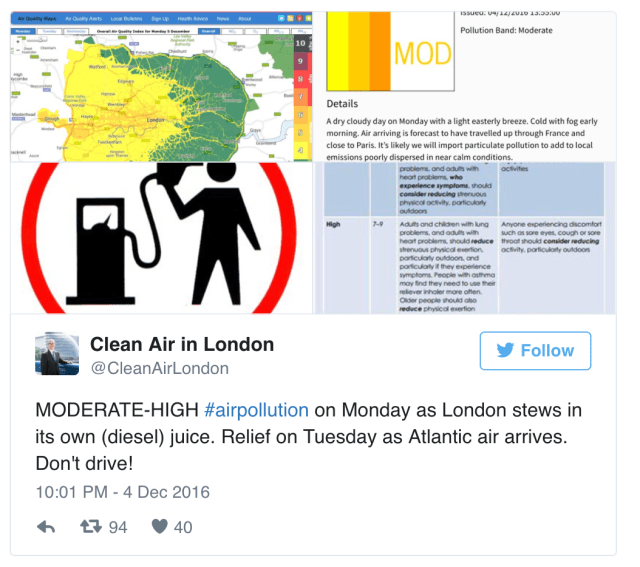
Motorists in London were to leave their cars at home on Monday as air pollution drifted in from Europe. Westminster and the City were among the worst-affected areas, along with other busy roads, while the rest of London was issued with “moderate” warnings.  Experts at King’s College’s pollution monitoring centre, London Air, said levels of toxic fumes were thought to be particularly bad in the capital as polluted air flows across the channel from France.

Motorists in London were to leave their cars at home on Monday as air pollution drifted in from Europe.

Westminster and the City were among the worst-affected areas, along with other busy roads, while the rest of London was issued with “moderate” warnings.

Experts at King’s College’s pollution monitoring centre, London Air, said levels of toxic fumes were thought to be particularly bad in the capital as polluted air flows across the channel from France.

Green Party Assembly Member Caroline Russell said car-free days were no replacement for decisive action on the capital’s traffic problem.

“It’s great the Mayor has issued air pollution warnings but these don’t go far enough, you need to tackle pollution at its source not just tell people that it’s happening,” she told The Independent. 

“I have supported the Mayor’s idea for Paris-style ‘car free’ days but car free days are no substitute for decisive action on air pollution and traffic reduction.”

screen-shot-2016-12-06-at-11-00-56

Green Party peer Jenny Jones suggested Mayor of London Sadiq Khan should urge motorists not to drive during the air pollution spike.

screen-shot-2016-12-06-at-11-00-10

Public Health England advice for moderate air pollution cautions adults and children with lung or heart problems, who experience symptoms, to consider reducing strenuous physical activity, particularly outdoors.

Pollution is considered by the size of its particulate matter, with PM2.5 thought to be particularly dangerous for its ability to enter the lungs and seep into the bloodstream.

Diesel emissions are also known to produce high amounts of nitrogen dioxide pollution, thought to be significantly more harmful than emissions from petrol vehicles.

Mr Khan recently announced plans to spend £770 million on cycling schemes over the next five years to make cycling a “safe and obvious choice for Londoners”.

Ms Russell, who launched the plan Prioritising People in November to encourage the mayor to do more to deliver healthy streets, said extra investment was the only way to reduce pollution in the capital.

“Obviously the best way to bring pollution down is to make driving a bit less convenient and walking, cycling and public transport much more convenient, pleasant and affordable,” she told The Independent.

“Those vulnerable to dirty air risk their health just stepping outside their front doors. How much more are Londoners expected to take?”

According to City Hall, nearly 10,000 people die each year as a result of London’s poor air quality.

The Mayor has already pledged to pedestrianise Oxford Street and introduce low emissions zones in the capital to tackle the problem.

Last week, he introduced “anti-idling” pollution alerts at 2,500 bus stops and river piers, the entrances of all 270 Tube stations and on 140 signs next to the busiest main roads into London, with instructions to switch engines off when stationary to reduce emissions.

A spokesperson for Mayor of London Sadiq Khan said: “The Mayor is delivering hard-hitting measures to rid London of the dirtiest diesel long before 2025.

“His immediate plans include charges for the most polluting diesel cars in central from 2017 and bringing forward and extending the Ultra-Low Emission Zone which removes all but the newest Euro 6 diesel vehicles from as early as 2019.

“Across London all heavy vehicles will have to meet the same Euro 6 standard which removes the oldest models.

“The Mayor is transforming London’s buses into one of the greenest fleets in the world and last week announced no more pure diesel buses will be procured from 2018. The Mayor is doing everything in his power to tackle London’s toxic air and get rid of the most polluting vehicles, but he cannot do this alone and is calling on the Government to face its responsibility and implement a national diesel scrappage scheme now.”

Source: Londoners urged to leave cars at home as polluted air drifts in from Europe | The Independent

Posted in Air Quality, Europe, London, UK | Tagged , , , , , , | Leave a comment

REVIEW: RESPRO® TECHNO, LA MASCHERA PER CAMBIARE ARIA

techno

Lasciarsi condurre da profumi e colori, pedalando gioiosamente con la consapevolezza di fare del bene a se stessi e alla terra. Dovrebbe essere lapalissiano e non un ossimoro. E invece i nostri polmoni rubano le parole da “Il male minore” di Niccolò Fabi e urlano “Non riesco a respirare. Come mai? “

Respro® è un’azienda inglese che lavora per il benessere di noi irriducibili ciclisti urbani ed extraurbani. Alla base della sua ventennale attività vi sono infatti la consapevolezza del galoppante aumento dell’inquinamento atmosferico e l’impegno nel trovare una soluzione agli effetti negativi che questo può avere sulla nostra salute.

La Respro® ci consente di scegliere tra una vasta gamma di maschere, ognuna di esse con caratteristiche specifiche per l’uso che se ne intende fare.

techno mask

Tra le maschere suggerite per chi utilizza giornalmente la bicicletta negli spostamenti in ambito cittadino, la Techno è quella su cui concentreremo la nostra attenzione.

La maschera Techno è dotata sia di filtro Hepa™, che agisce contro le polveri sottili, che di tecnologia Dynamic ACC (Activated Charcoal Cloth), adatta ad assorbire gli odori irritanti.  Questa mescolanza di attributi la rende, rispetto a tante altre, molto efficace su larga scala.

Differentemente da altre maschere, il filtro integrato nella Techno consente una facile respirazione grazie alla bassa resistenza all’inalazione, anche durante un’attività aerobica intensa. E questo è fondamentalmente dovuto al carico di fibre catturate elettrostaticamente e ai micro particolati trattenuti.

La maschera Techno è realizzata in neoprene, è adatta anche alle basse temperature, è lavabile, disponibile in tre misure e nei colori rosso, blu o nero.

Con in dosso una delle Respro® Masks potremmo ricordare vagamente Hannibal Lecter, ma con intenzioni decisamente meno inquietanti e nella testa un sogno di aria pura.

Per maggiori informazioni e per vedere tutta la gamma Respro®, collegatevi al sito internet dell’azienda.

via BiciMagazine


Posted in Air Quality | Leave a comment

Four of world’s biggest cities to ban diesel cars from their centres 

Paris, Madrid, Athens and Mexico City will ban the most polluting cars and vans by 2025 to tackle air pollution

Four of the world’s biggest cities are to ban diesel vehicles from their centres within the next decade, as a means of tackling air pollution, with campaigners urging other city leaders to follow suit.

The mayors of Paris, Madrid, Athens and Mexico City announced plans on Friday to take diesel cars and vans off their roads by 2025.

Anne Hidalgo, mayor of Paris, led the initiative at the C40 conference of mayorson climate change, taking place in Mexico this week. She said: “Mayors have already stood up to say that climate change is one of the greatest challenges we face. Today, we also stand up to say we no longer tolerate air pollution and the health problems and deaths it causes, particularly for our most vulnerable citizens.”

“Soot from diesel vehicles is among the big contributors to ill health and global warming,” added Helena Molin Valdés, head of the United Nations’ climate and clean air coalition, noting that more than nine out of 10 people around the globe live where air pollution exceeds World Health Organisation safety limits.

Miguel Ángel Mancera, mayor of Mexico City, said increasing investments in public transport would also help clean the city’s air, and reduce greenhouse gas emissions. Giorgos Kaminis, mayor of Athens, said his goal was to remove all cars from the city centre. The city authorities will also work with national governments and manufacturers, and promote electric vehicles and cleaner transport.

Recent research has uncovered the scale of the problem, with 3 million premature deaths a year attributed to dirty air, as well as millions of other illnesses, particularly in children.

Green campaigners welcomed the announcement, saying it showed that it was possible to clean up big cities.

Alan Andrews, lawyer at the NGO ClientEarth, whose legal victory has forced a UK government re-think of air pollution plans, said: “This shows political leaders across the world are waking up to the damage diesel is doing to our health. But 2025 is a long time away when you consider the 467,000 premature deaths caused by air pollution in Europe [alone] every year.”

He called on other leaders to “go further and faster [with] bold new measures”.

Jenny Bates, of Friends of the Earth, added: “This bold move to get rid of diesels, the most polluting vehicles, is exactly what is needed. We need cleaner vehicles and fewer of them. Getting rid of diesel is essential and we must also give people genuine alternatives to driving.”

She also called on London’s mayor, Sadiq Khan, to phase out diesel vehicles from the city by 2025, and for new clean air zones in all of the UK’s cities and major towns, with funding taken away from roads to promote sustainable alternative transport.

Diesel fuel use is a key cause of air pollution in cities, as the engines produce nitrogen dioxide, a harmful gas, and tiny particulates that can lodge in the lungs. These forms of pollution can also interact with other substances to create, in some conditions, a toxic soup.

Yet diesel use has been rising in many countries, partly for economic reasons and partly as a consequence of measures to combat climate change – diesel vehicles burn fuel more efficiently than conventional petrol engines, reducing carbon dioxide emissions.

It is not clear whether diesel vehicles in the four cities will be subject to a total ban, or what areas of the cities will be covered. Some cities already have measures in place intended to reduce congestion and clean up the air, such as low-emission zones that involve traffic restrictions.

Last year, the Volkswagen Group was engulfed by scandal when it was discovered that some of its diesel cars contained technology to disguise the true level of their harmful emissions.

Source: Four of world’s biggest cities to ban diesel cars from their centres | Environment | The Guardian

Posted in Air Quality, Europe, France, Latin America, Mexico | Tagged , , , , , , , , , , , | Leave a comment

‘Shocking’ photo shows London covered in thick black layer of smog as pollution hits twice normal level 

This “shocking” photo shows London covered in a filthy layer of black smog as unusually high levels of air pollution hit the capital.

The picture, taken by IT worker Pete Buckney at the top of Horniman Hill in south London, shows a stark contrast between the darkness blanketing the city and the blue sky above.

Air pollution was more than double the usual level for the capital on Thursday, according to the London Air Quality Network.

It came as temperatures plummeted below freezing amid clear skies and low wind levels.

Dr Gary Fuller, of King’s College London’s Environmental Research Group, explained: “On cold days you get a cold layer of air that sits close to the ground and all of our air pollution is put into that layer, therefore the concentration goes up.

“Yesterday was one of those rare moments where air pollution was actually visible; you can’t normally see it like that.”

screen-shot-2016-12-02-at-09-29-14He added that normal air pollution levels for London are between one and three but “yesterday we had numbers which were breaking the 7, 8, 9, 10 mark.”

The figures come from the London Air Network’s ‘nowcast’ 1-10 scale, which measures levels of four toxic pollutants at locations across the city.

“Air pollution can seem intangible but there are a few moments when it is made visible and you can see it co clearly,” Dr Fuller said.

Mr Buckney, who cycles up Horniman Hill every day to drop his children at school, said it is on the clearest, brightest days that air pollution looks most severe.

The 48-year-old told the Standard: “On clear days you can really see the state of things, and yesterday it was shocking.

“I cycle up this hill every day and I love the view of London, but it is very concerning to see how bad the pollution is.

“When I can see the air pollution I avoid cycling into town and try to take the quickest routes possible, so that I don’t exert myself too much.”

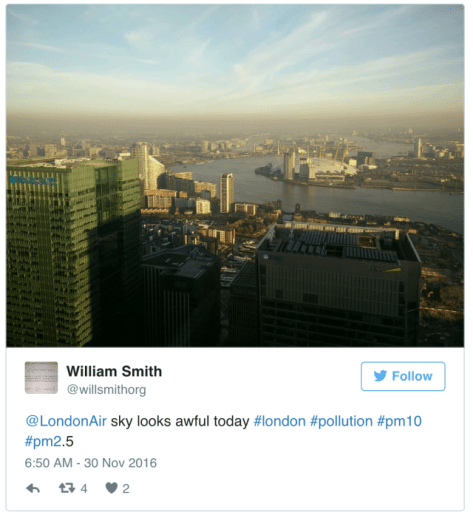
Another picture posted on Twitter by quantative analyst William Smith shows a similar layer of pollution visible looking out across the O2 arena to east London.

Winds from the Atlantic were expected to ease pollution later on Friday but the Environment Department is still forecasting moderate to high pollution following yesterday’s very high peak.

Parents have also been advised to “take care” when taking their baby outside by the pioneering Plume Labs company after it recorded toxic levels of air pollution.

The firm put the level of air pollution in London as “high” based on World Health Organisation limits, which are stricter for some pollutants than EU rules used by the Government and other experts.

A spokesman for London mayor Sadiq Khan said: “Sadiq has proposed the toughest crackdown on polluting vehicles by any major city in the world.

“He is also consulting on a new emissions surcharge and introducing an expanded Ultra Low Emission Zone a year earlier than the previous Mayor planned.”

“[This week] he revealed that no more pure diesel double-deck buses will be added to the capital’s fleet from 2018 and that all new single-decks for central London will be zero-emission.

“The Mayor cannot tackle air quality on his own and he is also calling for the Government to rise up to the challenge and pass new legislation fit for the 21st century.”

Source: ‘Shocking’ photo shows London covered in thick black layer of smog as pollution hits twice normal level | London Evening Standard

Posted in Air Quality, Europe, London, UK | Tagged , , , , , | Leave a comment

Parents warned over taking babies outside in London as air pollution levels soar 

londonsmog0706aParents in London were today advised to “take care” when taking their baby outside because of toxic air pollution levels.

The warning came from the pioneering Plume Labs company whose aim is “making the air more transparent”.

The firm put the level of air pollution in London as “high” this morning based on World Health Organisation limits, which are stricter for some pollutants than EU rules used by the Government and other experts.

Following hour-by-hour “high” readings, Plume Labs’ advice was for parents to “take care” when they “bring baby out” and when doing outdoor sports, and to “take it easy” when cycling or eating outside.

The firm’s chief executive Romain Lacombe said: “We are not saying that you should not go out with your baby. We are advising to avoid major roads and high traffic areas.”

Experts at King’s College London, using the EU limits, put air pollution at “high” in Brent mid-morning and “moderate” in Sutton, Westminster, the City, Lambeth, Croydon and Ealing.

Advice from Public Health England for moderate air pollution is: “Adults and children with lung problems, and adults with heart problems who experience symptoms, should consider reducing strenuous physical activity, particularly outdoors.”

Other people should “enjoy your usual outdoor activities”.

Only when dirty air levels become “high” should the general population consider reducing activity if experiencing discomfort.

Simon Birkett, of Clean Air in London, said: “It’s fair to say that any vulnerable people, young or old, should consider reducing activity today if they feel symptoms such as difficulty breathing or tightness in the chest. But please check the official Government advice.”

Professor Frank Kelly, air quality expert at King’s College, added: “If we really want to do more to improve public health we would follow the WHO guidelines.”

Shirley Rodrigues, deputy mayor for environment and energy, said children’s lungs were particularly vulnerable to “London’s illegal and filthy polluted air” and urged the Government to do more to tackle “this diabolical situation”.

The Environment Department is forecasting moderate to high pollution in urban areas in southern England, after a very high peak in London yesterday. Winds from the Atlantic were expected to ease pollution later today.

Meanwhile, Transport Secretary Chris Grayling signalled that ministers will not “water down” air quality rules after Brexit to allow a third runway to be built at Heathrow.

The Cabinet minister insisted the west London airport can be allowed to expand within limits on nitrogen dioxide which are currently being widely breached in the capital.

Environmentalists and campaigners dispute this and there are concerns that when the UK quits the EU, the Government could abandon the EU pollution limits. But Mr Grayling told the Commons environmental audit committee: “I cannot conceive of this Government or a successor government wanting to water down air quality standards.

“We all now recognise that there is a very real issue.”

Source: Parents warned over taking babies outside in London as air pollution levels soar | London Evening Standard

Posted in Air Quality, Europe, London, UK | Tagged , , , , | Leave a comment