UK has second-highest number of deaths from NO2 pollution in Europe

Only Italy has more annual deaths from nitrogen dioxide, according to a report by the European Environment Agency

The UK is second only to Italy in Europe for the highest number of annual deaths from a major air pollutant, a report has found just days after a court gave UK ministers a deadline for drawing up a stronger air quality plan.

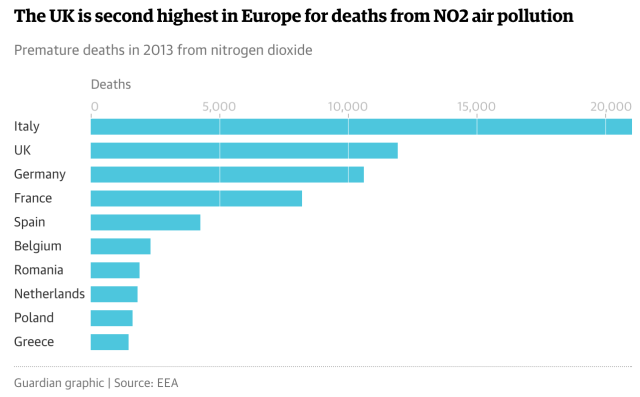
The European Environment Agency said the UK had 11,940 premature deaths in 2013 from nitrogen dioxide (NO2), a toxic gas mostly caused by diesel vehicles and linked to lung problems. The number is down from 14,100 in 2012, but still the second worst in Europe.

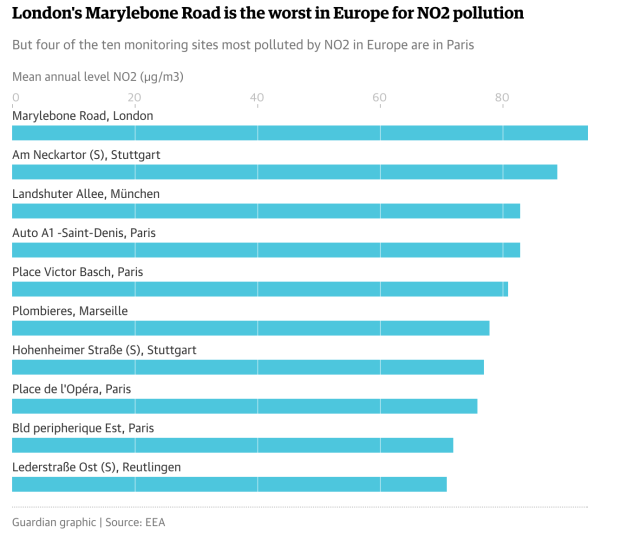
The agency also revealed that the UK is home to the worst NO2 hotspot in Europe. Marylebone Road in London recorded the highest annual mean levels of the pollutant, more than double than double the legal EU limit.

screen-shot-2016-11-24-at-09-51-40

Campaigners said the data was a reminder that the UK, which has been in breach of EU limits on NO2 since 2010, needed to take tougher action.

James Thornton, the CEO of law firm ClientEarth, which brought the court case, said: “Today’s EEA report puts the UK in an unwanted position near the top of the table when it comes to premature deaths from exposure to NO2 pollution. The UK government should be ashamed of these figures and must act now to protect the health of people in this country.”

Italy and UK both a similar proportion of diesel cars, but the NO2 problem in Italy is also compounded by industrial sources of the pollutant in urban and suburban areas, experts at the EEA said.

Across Europe, the EEA estimated that 71,000 people died prematurely in 2013 because of NO2 pollution. While the pollutant has been on a downward trend since the turn of the century because of stricter diesel car standards, more than one in 10 monitoring stations in Europe still breach NO2 limits, the agency found.

screen-shot-2016-11-24-at-09-52-39

Hans Bruyninckx, the EEA’s executive director, said: “Emission reductions have led to improvements in air quality in Europe, but not enough to avoid unacceptable damage to human health and the environment.”

The report comes as MEPs in the European parliament on Wednesday arpproved caps for five air pollutants, including NO2, to come into force in 2030. The new national emissions ceilings rules are expected to halve the number of deaths from air pollution.

Catherine Bearder, a Liberal Democrat MEP, said: “If I had become a doctor instead of a politician I would be prescribing a serious health warning to the UK government today. The UK government have approved a third runway at Heathrow airport even though they know that air pollution around the airport is already dangerously above legal levels of nitrogen dioxide.”

The Guardian reported earlier this year that the plan had been diluted after lobbying by the UK government.

Source: UK has second-highest number of deaths from NO2 pollution in Europe | Environment | The Guardian

Posted in Air Quality, Europe, UK | Tagged , , , , , | Leave a comment

Air pollution ’causes 467,000 premature deaths a year in Europe’

Air pollution is causing around 467,000 premature deaths in Europe every year, the European Environment Agency (EEA) has warned.

People in urban areas are especially at risk, with around 85% exposed to fine particulate matter (PM2.5) at levels deemed harmful by the World Health Organization (WHO).

These particles are too small to see or smell, but have a devastating impact.

PM2.5 can cause or aggravate heart disease, asthma and lung cancer.

How big is the problem?

It’s pretty bad. Within the European Union (EU), more than 430,000 people died prematurely due to PM2.5 in 2013, the most recent year with figures available.

According to the EEA’s Air quality in Europe – 2016 report, the toxic gas nitrogen dioxide (NO2) – released by vehicles and central heating boilers – has an impact equivalent to 71,000 premature deaths a year.

Ground-level ozone (O3) is also killing people – an estimated 17,000 annually in the EU.

Unlike the protective ozone layer in the stratosphere, ground-level ozone is harmful, formed when emissions like NO2 react with other pollutants and “cook” in heat or sunlight.

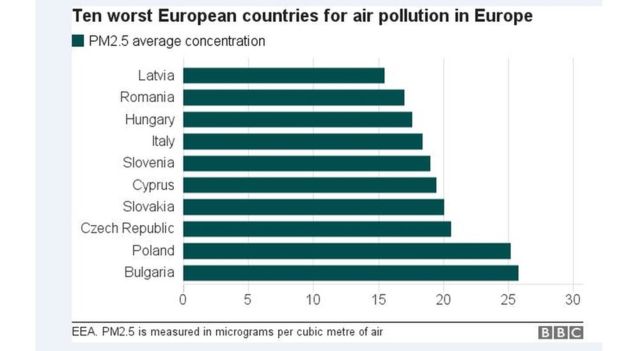
The European countries with the worst levels of PM2.5 are Bulgaria, Poland and the Czech Republic.

Nations like Poland where coal is a major source of electricity production tend to rank at the bottom of air quality measures, according to the EEA.

In 2013, Bulgaria provided four of the five worst European cities for high particulate matter. Costs to ill-health from coal power plants in the country are estimated to be up to €4.6bn ($4.8bn; £3.9bn) per year.

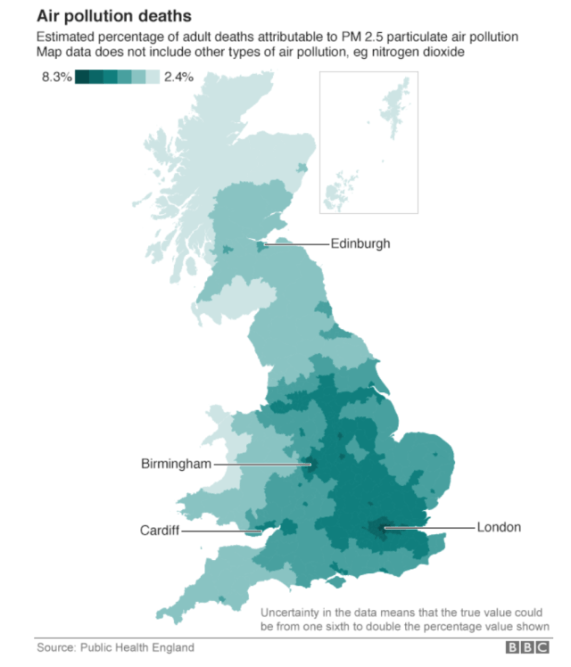
In the UK, air pollution overall costs the economy more than £20bn per year – just under 16% of the NHS’s annual £116bn budget.

screen-shot-2016-11-24-at-07-51-28

Technically, European air quality actually improved between 2000 and 2014. Levels of PM10 – another tiny pollutant particle – fell in 75% of the EEA’s monitored locations.

PM2.5 concentrations also dropped on average between 2006 and 2014.

But EEA executive director Hans Bruyninckx says “unacceptable damage to human health and the environment” is still rife.

Outdoor air pollution contributes to about 40,000 early deaths a year in the UK, according to the Royal Colleges of Physicians and of Paediatrics and Child Health.

Source: Air pollution ’causes 467,000 premature deaths a year in Europe’ – BBC News

Posted in Air Quality, Europe, Health Effects of Air Pollution | Tagged , , , , , , , , , | Leave a comment

Smog gets in your eyes 

Lahore has experienced smog for the past five years: in 2014, it ranked amongst the top 10 worst cities for smog according to a Deutsche Welle report.

This November, its intensity exposed the lack of effective planning by the city management and local administration.

Heavy smog brought a disastrous impact on daily life with traffic coming to a halt on motorways in the early office hours and after sunset due to dangerously low visibility. People complained of eye-irritation, coughing and asthma.

Lahore is a semi-industrial city comprising small and large-scale industrial units. Heavy traffic and on-going mega projects such as the Orange Line together produce significant pollution throughout the year.

In the surrounding cities of Kasur, Sheikhupura and Pindi Bhattian, around November, farmers burn their agricultural leftover sending a lot of smoke into the atmosphere. Crop residue can be disposed of in a sustainable way, but the cost is too high for the farming community.

The combined smoke from industries, traffic and crop-burning is normally washed away when it rains in winter, but this year, due to an early winter and no rain, this pollution and smoke has converted into smog causing low visibility and health issues for the residents.

According to Dr Qamar-uz-Zaman Chaudhry, former director general of the Pakistan Meteorological Department, “Climate change has affected the climate cycle creating an extended dry cycle, which causes smog.”

However, Dr Adil Najam, Dean of the Pardee School of Global Studies at Boston University believes that climate change is not the only factor.

“This is much more a case of pollution. We have had a double whammy because pollution, especially from vehicles, has gone up while trees and vegetation have steadily gone down. What we are seeing is the combined effect of these two dynamics coupled with the weather pattern,” he points out.

What is smog made up of and how will it affect you?

Lahore experiences a photochemical smog which is a mixture of primary and secondary pollutants.

Primary pollutants are released into the atmosphere because of human activity while secondary pollutants are produced when primary pollutants react with each other or with the air in the presence of sunlight.

The primary air pollutants of smog are mainly composed of anthropogenic gases (gases resulting from human activity) including nitrogen oxides, sulphur dioxide, carbon monoxide, hydrocarbons and particulate matter (extremely small particles combined with water droplets which can cause serious health problems when inhaled).

When these pollutants interact with damp air in cold weather a layer of thick smoke is formed near the earth’s surface. The thicker the smoke is, the higher the concentration of toxic gases and particles.

Pakistan has no real-time air quality monitoring system for on-site monitoring of its polluted cities.

However, some measurements taken during smoggy days show a concentration of pollutants much higher than those recommended by the National Environmental Quality Standards.

Exposure to smog for long hours can cause serious health issues — it can cause chest congestion, irritation in our respiratory system, reduce lung function and aggravate asthma. It also affects the immune system of animals to fight against harmful bacteria in the respiratory tract.

According to Dr Kashif Raza Khan, ophthalmologist at King Edward Medical University, exposure to smog can cause short-term eye-burning which can be treated by washing the eyes with water. Using a mask is recommended especially for motorcyclists.

What caused the current smog?

While the current smog over Lahore is being attributed primarily to crop burning, there are multiple sources of smog production.

A World Bank study revealed that from November 2005 to January 2006, several contributing factors were responsible for the high particulate matter in the air such as diesel emissions (28 per cent), biomass burning (15pc), coal combustion (13pc), secondary particulate matter (30pc), exhaust from two-stroke vehicles (8pc), and industrial sources (6pc).

The biggest culprits were diesel and emissions from motorcycles and rickshaws which accounted for 36pc of the high particulate matter.

Although a large component of the carbonaceous aerosols in Lahore originated from fossil fuel combustion, a significant fraction was derived from biomass burning.

What the government needs to do

Tackling pollution caused by vehicles will be the biggest headache for authorities. The number of vehicles in Pakistan has jumped from approximately two million to 10.6mn over the last 20 years, an average annual growth rate in excess of 8.5pc.

From 1991 to 2012, the number of motorcycles and scooters grew more than 450pc, and motor cars close to 650pc.

Industrial sites and factories such as brick kilns and steel mills located within city limits are also a contributing factor.

The government can turn to the courts for a solution

Pakistan’s judiciary has often dealt with environmental conservation, such as the establishment of Lahore Clean Air Commission by the Lahore High Court (LHC) which was assigned to prepare and submit a report to measure, control and improve vehicular air pollution in the city.

There are also reports of open-field burning of rice straw across the border in the Indian Punjab region which has aggravated smog in Lahore as reported by Nasa.

According to environmental lawyer, Ahmed Rafay Alam, Pakistan can hold India liable for the current smog but only if the government can prove its neighbouring country is responsible.

“If we can prove that crop burning in India has exacerbated smog on the Pakistani side, then under International Environmental Law, India can be made liable to prevent this from happening again. But without adequate testing equipment, we can’t be sure and no policy can be set.”

What Lahore can learn from other cities

For solutions to the current smog, the Lahore administration need not look further than it’s neighbouring country. In the past week and a half, New Delhi has faced poor air quality — the Air Quality Index value reached 999 on the index (a value above 300+ is considered ‘hazardous’) due to unchecked crop burning and the use of firecrackers during Diwali.

The local administration in New Delhi took immediate measures such as closures of schools to prevent children from being exposed to toxic air, the shutting down of the coal-fired Badarpur Thermal Power plant, banning of all construction and demolition work and a ban on burning trash at landfill sites.

For traffic control, an odd/even numbering system is being considered. Vacuum cleaning is also being done on highways to clean the air while artificial rain is also under consideration. The steps being taken by the New Delhi administration could be followed by Lahore’s.

Other long-term solutions include real-time air quality monitoring devices at various locations in the city, shifting heavily polluting industries outside the city, planting trees, sufficient public transport and sustainable management of agricultural waste residue can provide long-term solutions to smog.

If the authorities don’t take action soon, Lahore might go the way of London.

The Great Smog of 1952 — also known as The Big Smoke — when the city suffered from five days of smog which led to the deaths of 4,000 people (updated figures reveal the number of fatalities could have been as great as 12,000) and the hospitalisation of another 100,000.

The Great Smog eventually led to the enactment of the Clean Air Act 1956. If we fail to learn, the time is not far when the rivers will go dry, all trees will be chopped down and the air will be impossible to breathe. Only then we will realise, we can’t eat money!

Source: Smog gets in your eyes – Magazine – DAWN.COM

Posted in Air Quality, Asia | Tagged , , | Leave a comment

Antimicrobial resistant bacteria detected in air pollution

Areas subject to air pollution contain a growing concentration of bacteria that are resistant to antimicrobials, according to a new study. Consequently, air movement may provide a new ways for their transmission.

The study, highlighting a growth in airborne or air-carried antimicrobial resistant bacteria, has come from China, with a focus on the Beijing. The extent of antimicrobial resistance has been assessed at the genetic level, with the detection of DNA from genes that make bacteria resistant.

The study has been led by Professor Joakim Larsson, of the Sahlgrenska Academy and the University of Gothenburg. Professor Larsson is especially concerned about air as a potential vector for spreading antimicrobial resistant pathogens.

Antimicrobial resistance (including resistance to antibiotics) is the biggest risk faced by human societies. The implications are that life expectancy could fall due to people dying from diseases that are readily treatable today.

With the new research, Professor Larsson’s team tested air samples for genes that make bacteria resistant to antibiotics. From a total of 864 samples, DNA was tested and related back to its source. One area of concern was the detection of a series of genes that provide resistance to carbapenems. These are a group of ‘last resort antibiotics’ and they are administered for infections caused by bacteria that the most resistant to antimicrobials. Carbapenems are members of the beta lactam class of antibiotics, which kill bacteria by binding to penicillin-binding proteins and inhibiting cell wall synthesis.

Importantly, the findings cannot indicate if the bacteria are alive in the air. This narrows the risk somewhat; however, the potential for genetic transfer with viable bacteria, upon contact, remains.

The study is, however, only a starting point. The researchers plan to assess whether antimicrobial resistance can indeed spread through air. Here the focus will move to a study of the air within the vicinity of European sewage treatment plants. Sewage plants are regularly called out as potential sites for the spread of antimicrobial resistance. This is because, with so many different types of bacteria coming together in sewage plants, this provided optimal conditions for organisms to swap genes that confer resistance. This also means antibiotic-resistant bacteria could evolve much faster than they would in isolation.

Data will be cross-checked in relation to the air and to the sewage. Additional samples will be taken from people who live in close proximity to sewage plants.

The research findings are published in the journal Microbiome and the research paper is titled “The structure and diversity of human, animal and environmental resistomes.”

Source: Antimicrobial resistant bacteria detected in air pollution

Posted in Air Quality, Health Effects of Air Pollution | Tagged , , | Leave a comment

Beijing updates air pollution alert system 

A red alert, the most serious level, will be issued for air pollution in Beijing if the city’s Air Quality Index (AQI) reaches 500, local authorities said on Monday.

The information office of the municipal government released an updated emergency response plan for severe air pollution, aiming to better address air pollution with minimal disturbance to people’s lives.

According to the new plan, which will become effective on Dec. 15, more gas-burning vehicles will be pulled off the streets when an alert is issued.

Li Kunsheng from the city environmental protection department said Beijing had about 5.7 million registered vehicles, which emit 500,000 tonnes of pollutants every year, contributing over 30 percent of the hazardous PM2.5 accumulated locally.

Schools and factories will be suspended or closed based on more detailed and flexible standards.

Besides, as part of the Beijing-Tianjin-Hebei integration effort, the air pollution alert system in the three adjacent municipalities and province will be synchronized as per the new version.

China has a four-tier warning system for severe weather, with red being the most serious, followed by orange, yellow and blue.

Beijing issued its first air pollution alert plan in 2012. The plan has played an effective role in alleviating pollution accumulation and protecting the public’s health, said Fang Li, deputy director of the environmental protection department.

Source: Beijing updates air pollution alert system – Global Times

Posted in Air Quality, Asia, China | Tagged , , , | Leave a comment

Air pollution is a risk factor for diabetes, says study

Exposure to air pollution at the place of residence increases the risk of developing insulin resistance as a pre-diabetic state of type 2 diabetes.

Scientists of Helmholtz Zentrum München, in collaboration with colleagues of the German Center for Diabetes Research (DZD), reported these results in the journal Diabetes.

“Whether the disease becomes manifest and when this occurs is not only due to lifestyle or genetic factors, but also due to traffic-related air pollution,” said Professor Annette Peters, head of the research area of epidemiology of the DZD.

For the current study, she and her colleagues analyzed the data of nearly 3,000 participants of the KORA study who live in the city of Augsburg and two adjacent rural counties.

All individuals were interviewed and physically examined. Furthermore, the researchers took fasting blood samples, in which they determined various markers for insulin resistance and inflammation.

In addition, leptin was examined as adipokine which has been suggested to be associated with insulin resistance.

Non-diabetic individuals underwent an oral glucose tolerance test to detect whether their glucose metabolism was impaired.

The researchers compared these data with the concentrations of air pollutants at the place of residence of the participants.

They estimated air pollution using predictive models based on repeated measurements at 20 sites (for particle measurements) and at 40 sites (for nitrogen dioxide measurements) in the city and in the rural counties.

“The results revealed that people who already have an impaired glucose metabolism, so-called pre-diabetic individuals, are particularly vulnerable to the effects of air pollution,” said Dr. Kathrin Wolf, lead author of the study.

“In these individuals, the association between increases in their blood marker levels and increases in air pollutant concentrations is particularly significant!”

“Thus, over the long term — especially for people with impaired glucose metabolism — air pollution is a risk factor for type 2 diabetes.”

Next, the scientists want to investigate the influence of ultrafine particles.

“Diabetes will be a main focus of our research, also in this context. A precise knowledge of the risk factors is crucial for counteracting the increasing incidence of diabetes,” said Peters, looking to the future.

Source: Air pollution is a risk factor for diabetes, says study | Knowridge Science Report

Posted in Air Quality, Health Effects of Air Pollution | Tagged , , , | Leave a comment

Indonesian fires exposed 69 million to ‘killer haze’ 

Wildfires in Indonesia and Borneo exposed 69 million people to unhealthy air pollution and are responsible for thousands of premature deaths, new research has shown.

The study, published today in Scientific Reports, gives the most accurate picture yet of the impact on human health of the wildfires which ripped through forest and peatland in Equatorial Asia during the autumn of 2015.

The study used detailed observations of the haze from Singapore and Indonesia. Analysing hourly air quality data from a model at a resolution of 10km — where all previous studies have looked at daily levels at a much lower resolution — the team was able to show that a quarter of the population of Malaysia, Singapore and Indonesia was exposed to unhealthy air quality conditions between September and October 2015.

Estimating between 6,150 and 17,270 premature deaths occurred as a direct result of the polluted haze, the research team — involving academics from the UK, US, Singapore and Malaysia — said the study confirmed the extent of this public health crisis.

Lead author Dr Paola Crippa, from Newcastle University, UK, said:

“Our study showed that 69 million people living in Malaysia, Singapore and Indonesia were exposed to unhealthy air quality conditions during the time of the fires — that’s more than a quarter of the local population.

“The wildfires of 2015 were the worst we’ve seen for almost two decades as a result of global climate change, land use changes and deforestation. The extremely dry conditions in that region mean that these are likely to become more common events in the future, unless concerted action is taken to prevent fires.

“Our study estimated that between 6,150 and 17,270 premature deaths occurred due to breathing in the polluted air over that short two month period. To put this into perspective, we estimate that around 1 in 6,000 people exposed to the polluted haze from these fires died as a result. The uncertainty in these estimates is mostly due to the lack of medical studies on exposure from extreme air pollution in the area.”

Ten times the recommended limit of PM2.5

Performing numerical simulations on the Indiana University high performance computing resources, the team analysed the levels of particulate matter in the air — PM2.5 — during the two months of the fires.

WHO air quality guidelines state that levels of PM2.5 should not exceed 25 μg/m³ in a 24 hour period.

Dr Christine Wiedinmyer, from the National Center for Atmospheric Research in Colorado, said:

“Exposure to particulate pollution was substantially greater in autumn 2015 than in other recent years. This is due to the large particulate matter emissions from fires in this region in 2015.”

During the two month period, levels of PM2.5 — the most dangerous of these tiny toxic particles — were on average above 70 μg/m³ with peaks reaching 300 μg/m³ in densely populated areas such as Singapore.

Professor Dominick Spracklen, a co-author of the study based at the University of Leeds, explained:

“In most of the UK, levels of PM2.5 are usually below 10 μg/m³ and we would consider a serious pollution episode to be where concentrations rose to above 30 μg/m³. During these fires, Singapore experienced levels of pollution 10 times higher. It is hard for us in the UK to imagine air pollution as bad as that experienced across much of Indonesia and Singapore last autumn.

“If large fires occurred every year, repeatedly exposing the local population to polluted air, the number of deaths would rise substantially — to as many as 75,000. Our findings are consistent with a recent estimate of the number of deaths that occurred due to long-term exposure to air pollution from these fires.”

The team say it is imperative that action is taken to prevent forest fires and killer haze events in the future. Deforestation and drainage of peatlands makes for very susceptible conditions for fire and new efforts are needed to re-wet peatlands and reduce further deforestation in this region.

Source: Indonesian fires exposed 69 million to ‘killer haze’ — ScienceDaily

Posted in Air Quality, Asia, Indonesia, Malaysia, Singapore | Tagged , , , , , , , , , , | Leave a comment

Iran: Unprecedented Death Toll, Due to Air Pollution in the Capital City

Tehran is currently engulfed in thick, yellow smog, resulting in the deaths of hundreds of people.

The noxious cloud has surrounded the city for almost a week now; due to the public health risk, officials ordered the schools closed last Wednesday and recommended that citizens stay indoors.

This is not an option for many Iranians though; they have no choice but to go out and work.

Authorities have reported 412 deaths from respiratory illnesses in the past 23 days, linked to the high pollution levels. It is believed that these level stems from Iran having to refine gasoline within its own borders due to previous sanctions leveled against it.

Despite the lifting of these sanctions in January, Tehran has continued down this path and now the government can’t decide how to solve the problem; instead, putting the onus on the people.

Iran’s Supreme Leader, Ayatollah Ali Khamenei, issued a religious edict on Monday, which forbade the use of cars during this time without a good reason. Meanwhile, an official from the Ministry of Health, Khosrow Sadeghniyat, recommended that Iranian shield themselves from pollution by staying indoors, drinking milk and eating fresh vegetables.

It is not clear, however, how the cows or the vegetables have been affected by this smog.

A particle which is particularly threatening to respiratory health, PM2.5, has now reached a concentration level of more than 150 in Tehran. It is linked to heart disease and lung cancer.

Dariush Mehrjui, a filmmaker, told the Iranian news agency, ISNA: “I can’t breathe in Tehran, simple as that. Everyone is fleeing Tehran … everyone is choking, look at cancer rates. Who can live [in Tehran] under these circumstances?”

The World Health Organisation (WHO) listed the city of Zabol in Iran as the most polluted in the world according to those PM2.5 levels.

The head of Tehran’s Environment Agency has stated that air pollution contributes to the deaths of around 45,000 Iranians per year.

Source: Iran: Unprecedented Death Toll, Due to Air Pollution in the Capital City

Posted in Air Quality, Iran, Middle East | Tagged , , | Leave a comment