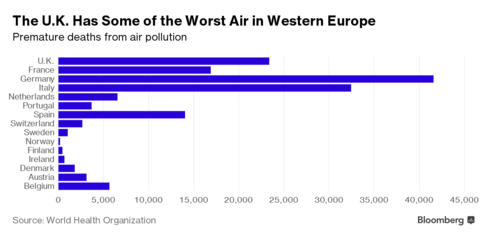
Brexit May Turn London’s Fog to Smog If U.K. Ditches EU Rules

Londoners may find it harder to catch their breath if the U.K.’s decision to leave the European Union weakens air-quality standards, according to S&P Global Inc.

Inside the 28-nation bloc, the U.K. is legally bound to keep air pollution below regulatory thresholds. Once the country formally makes its exit, there’s no guarantee those EU limits will still be observed.

“This is a very serious issue for the U.K.,” said Michael Wilkins, managing director of infrastructure ratings at S&P, in a report on Wednesday. “Post-Brexit, it could be more difficult to hold the government accountable for air quality standards.”

London has repeatedly broken EU air-quality rules. It took the city just eight days in 2016 to breach the annual cap on nitrogen dioxide concentrations. Almost all the pollution is emitted by cars and trucks, according to the International Energy Agency. The World Heath Organization estimates air pollution annually costs the U.K. 62 billion pounds ($83 billion).

Government officials are divided on this issue. The Department for Environment, Food & Rural Affairs previously sought to slow the pace of implementing EU pollution limits, saying it was unable to meet 2010 rules until at least 2025. London mayor Sadiq Khan, elected in May, has said he will fight to keep pollution on the capital city’s agenda.

The EU regulations will still apply until the U.K. formally leaves the union, which will take at least two years. Even if the U.K. strikes a deal to remain in the European Economic Area free-trade zone, enforcing the standards could become more difficult.

“Leaving the EU would mean that the U.K. government would no longer face fines from the European Court of Justice,” said Alan Andrews, a lawyer at ClientEarth, a legal group that successfully sued the U.K. government in 2011 over its failure to cut pollution. “The future is obviously uncertain and depends what the deal is with our exit from the EU.”

Source: Brexit May Turn London’s Fog to Smog If U.K. Ditches EU Rules – Bloomberg

Posted in Air Quality, Europe, London, UK | Tagged , , , , , | Leave a comment

Seoul to limit old diesel vehicles to fight air pollution 

South Korea’s capital of Seoul will limit the number of old diesel vehicles on the roads starting next year, as the country tackles rising air pollution.

Asia’s fourth-biggest economy in June announced a string of measures to address growing concerns about air quality following fine dust particle warnings and Volkswagen’s emissions-test cheating scandal. Seoul aims to bring its air quality to the levels of European peers like London and Paris within a decade.

South Korea’s environment ministry said on Thursday that Seoul will introduce the restriction in 2017 on diesel vehicles registered before 2006, followed by the nearby city of Incheon and then 17 cities in Gyeonggi Province in 2018.

About 1.04 million vehicles will be subject to the regulations.

Older diesel vehicle weighing 2.5 tonnes or more will not be allowed into the so-called “low emission zones” if it is not equipped with an emission-reducing device or a low-pollution engine. A car which does not undergo a regular emission check, or fails to pass the test will be also banned from entering the city.

Whenever a camera spots a non-compliant vehicle being driven in the region, a penalty charge of 200,000 won ($179) will be issued.

The government also plans to implement a diesel car scrappage program in which an automaker offers a discount of up to 1.2 million won to those who trade old diesel cars in for new ones.

Major European cities are also fighting air pollution. Paris last month started to bar old vehicles from the city’s streets from 8 a.m. to 8 p.m. on Mondays to Fridays, while London could introduce an extra charge on the most polluting vehicles entering the center of town.

Source: Seoul to limit old diesel vehicles to fight air pollution | Reuters

Posted in Air Quality, Asia, South Korea | Tagged , , , | 1 Comment

Diesel vehicle purchases banned by City of London Corporation

London’s struggling attempt to battle rising air pollution was given a welcome boost on Monday (1 August), after the City of London Corporation announced a ban on the purchase of diesel vehicles for its business fleets.

With a fleet of more than 300 vehicles, the City Corporation arrived at an agreement to ban the purchase of diesel vehicles and will instead explore the benefits of hybrid vehicles.

Head of Procurement at the City of London Corporation Chris Bell said: “This agreement is a major step forward in our drive to protect the millions of London tourists, workers and residents from air pollution.

“The City Corporation takes air quality extremely seriously. We are taking responsibility for the cleanliness of our fleet and encouraging the use of low and zero emission vehicles with our partners.

“It complements the work that we are doing to support many City businesses who are also cutting back on vehicle deliveries and using more hybrid vehicles.”

With diesel being the main source of nitrogen dioxide (NOx) emissions and particulate matter (PM10), the City Corporation is continuing to clamp down on its usage of diesel vehicles. It has already seen a 40% reduction of NOx and 50% of PM10 since 2009. This is due to a reduction of fleet sizes and purchasing low-emission vehicles. However, some diesel vehicles such as tractors will still be procured due to the lack of a non-diesel alternative.

The City of London Corporation has also created the ‘City Air’ app, which offers low-pollution travel routes around the capital. It joins the growing trend of mobile apps geared towards tackling air pollution, which includes the CleanSpace app that visualises pollution levels.

Additionally, the Corporation has also introduced a city wide 20mph zone and a city wide cutback on engine idling and tighter restrictions on bulldozers and generators.

Death of diesel

The announcement comes just a week after the approval of the London City Airports expansion, a move criticised by green groups as a ‘reckless and irresponsible’ decision. Also, with London having breached its annual air pollution limits within a single week earlier this year, eyes are on the city to crackdown on its environmental impact.

However, there is a series of business-orientated changes that aim to tackle the serious air pollution problem in London. With such a large number of fleets active in the UK, steps have already been introduced to mitigate the potential environmental impact.

In April this year, a Department for Transport (DfT) investigation revealed that some vehicles in the UK are still producing up to 12 times the EU maximum limit for road-tested emissions, tarnishing the Government’s claims that it “leading the push” for greater emissions testing in diesel cars.

London was also absent from the list of 20 European cities calling for more stringent regulations to be put in place across the continent to tackle the deadly levels of air pollution caused by diesel vehicles.

However, London’s dormant approach to tackling diesel emissions could be rejuvenated by new Mayor of London Sadiq Khan, who has vowed to introduce Clean Bus Corridors and a diesel vehicle scrappage scheme.

Source: Diesel vehicle purchases banned by City of London Corporation

Posted in Air Quality, Europe, London, UK | Tagged , , , , , , | Leave a comment

Dutch activists sue government over air pollution

Dutch environmentalists said Tuesday they are suing the government over poor air quality, saying people’s “fundamental” rights to good health were being infringed.

In a lawsuit filed on Monday, the Milieudefensie group alleged “the Netherlands exceeds the legal standards for air quality and is violating fundamental human rights by doing too little to combat air pollution.”

“This pollution causes thousands of deaths every year, and leaves tens of thousands of people seriously ill. That is unacceptable,” added the group’s campaign manager, Anne Knol, in a statement.

The suit launched in The Hague is the first step in a lengthy process which could lead to a trial. The first hearing is due to be held on August 17.

Environmental activists say under the constitution “the state has a duty to protect citizens from unhealthy air.”

The group alleges that, in tests carried out at 58 sites across the country last year, the levels of nitrogen dioxide exceeded European norms in 11 places.

The indictment has been signed by 57 Dutch citizens, and the lawsuit has been launched after a crowd-funding campaign raised some 30,000 euros ($33,593) to cover the costs.

This latest action comes after another Dutch environmental rights group, Urgenda, last year won a landmark ruling ordering the government to slash greenhouse gases by a quarter by 2020.

Climate experts hailed the June 2015 ruling as “a milestone” in a case brought by 900 Dutch citizens seeking to force a national reduction of the emissions blamed for global warming. The government is appealing.

Source: Dutch activists sue government over air pollution

Posted in Air Quality, Europe | Tagged , , | Leave a comment

Murderer Hazy Air Pollution is again over Chinese Capital 

Schools in the Chinese capital kept students indoors and parents brought their kids to hospitals with breathing ailments Tuesday as Beijing grappled with extremely severe air pollution.Residents of Beijing and other parts of northern China were literally breathing a sigh of relief Wednesday, after a cold front and strong winds blew away choking smog that had enveloped the region for about five days. But a haze of recrimination remained.

The pollution that reached over 30 times the World Health Organization’s safe levels Monday

The heavy smog erased the capital’s skylines with a monotonous gray and left buildings just a block or two away hardly discernable. Neon signs barely punctured the gloom, and many Beijingers wore masks of various kinds while walking the streets.

More than 23 cities in northern China had readings of PM2.5 fine particles over 200 — categorized as “seriously polluted” in recent days — with readings in Beijing hitting what state media called an “astonishing” level of 900 Monday, and more than 700 Tuesday, in the latest example of the Chinese capital’s periodic winter “airpocalypse.” (The WHO says any reading over 25 is unhealthy, though China’s official standard is set higher.) Pollution over 500 is officially classified as off the top end of the scale on some monitoring devices.

By Wednesday morning the reading was down to 10 in some parts of Beijing, and one resident posted on social media: “I’ve never been happier to hear sound of winter wind,” while many posted pictures of blue skies and pollution index readings.

But with many recent surveys showing that air pollution is one of the issues the Chinese public is most concerned about, debate about the causes of the smog, and the official response, continued. Officials blamed meteorological conditions — including high humidity, temperature inversion and low winds — for the problem, as well as pollutants including gases released by burning coal to produce energy and heat as cold winter descended on the region in recent weeks.

The Beijing government responded by issuing first a yellow and then an orange pollution alert — the third and second highest levels respectively — which meant closing thousands of factories, halting construction and banning heavy trucks from roads. It also said inspection teams had been dispatched to check coal discharge, “outdoor barbecues” and stubble burning in areas around Beijing and other cities.

However many citizens criticized the authorities for not issuing a red smog alert — the highest level — which they can do after 72 hours of “hazardously” high levels of pollution (over the 300 mark). Beijing environmental officials said however that a red alert “would affect people’s daily life too much,” since it would not only involve closing schools, but halving the number of private cars on roads — and reducing the number of government vehicles by two-thirds.

However environmental groups criticized the decision not to close schools

Children had to be kept inside at break times though some Beijing schools have installed giant inflatable domes with purified air to allow pupils to continue to play sports at times of heavy pollution. Environmental group Greenpeace East Asia, which described the pollution as “shocking,” said Beijing’s “insufficient” warning system had exacerbated what it called “serious danger” to citizens’ health.

There was also a dispute in Chinese media after many Internet users criticized China’s Ministry of Housing and Urban Rural Development, which controls the centralized heating systems for many residential areas in northern China that are fuelled largely by coal-fired furnaces. The ministry denied that it was the prime culprit for the pollution. It said car emissions were the main cause, and turning on the heating — which takes places in the second half of November every year — was “only the last straw.” However Beijing’s municipal Environmental Monitoring Center insisted that coal burning was the main cause of the smog.

The official Global Times newspaper quoted environmental experts as saying that this “buck passing” showed a “lack of pollution source analysis and coordinated efforts to effectively combat pollution.” And though China has pledged vast sums to tackle pollution — the ministry of commerce said this week that China would invest $2.6 trillion in energy conservation and environment in next five years — experts said there was still a lack of government funding for research into sources of pollution.

Shanghai-based news website The Paper quoted an official from China’s Ministry of Environmental Protection as saying that local governments had not taken sufficiently effective action in the face of the smog crisis. The official said local implementation of policies was not as strong as it should be, due to a lack of coordination between different government departments, poor management skills and a lack of staff.

The areas around Beijing were still burning “a large quantity of coal” this week

Quoted one local nonprofit as saying that more than 10 companies were still emitting excessive quantities of pollutants Tuesday. It’s a reminder that even after a decade of increasingly serious air pollution, many in China still lack a thorough understanding of the causes of pollution, according to some experts. This was again highlighted this week, when reports from researchers at China’s Ministry of Environmental Protection that fine particles in smog could cause respiratory diseases, cancer or sometimes death, were given headline status in Chinese media, even though these conclusions did not appear to be particularly new. And an online film explaining the causes of pollution attracted 100 million viewers on the Internet in China earlier this year.

The authorities in Beijing say they are taking long-term action. They had previously claimed that the city had seen improving air quality this year, and have pledged to clean up Beijing’s environment in time for the 2022 Winter Olympics, which will be held in the city and surrounding areas. They have begun to move polluting factories out of the city, and have said all vehicles in Beijing will have to meet Euro VI emissions standards, the world’s strictest, in two years’ time.

Nevertheless coal is still a source of some 80 percent of China’s energy. And an op-ed in the Global Times on Wednesday said the government should realize how imperative it was to “control pollution [ and] seek a balance between the development of Chinese society and environmental protection.”

The article also called on citizens, whose rising living standards have contributed to greater energy consumption and rising pollution, to take responsibility too, and adjust their lifestyles: “We all want to live in a bustling metropolis, in a big house with warm temperatures in winter, while everyone has a car to drive. Yet in the meantime, we all want blue sky. Such a contradiction is hard to resolve,” it said.

However, some people’s response to this week’s smog is likely only to increase electricity consumption and resultant emissions.

Source: Murderer Hazy Air Pollution is again over Chinese Capital – Boston Technology Time

Posted in Air Quality, Asia, China | Tagged , , | Leave a comment

Rio 2016 Olympics will have the worst polluted air after the Beijing 2008 Olympics

Athletes competing in the 2016 Rio Olympics might be able to avoid swallowing Guanabara Bay’s fetid water, as they have been advised. But there’s no getting around the city’s dirty air.

An air analysis by Reuters and Brazilian researchers from the University of São Paulo found high levels of fine particulate matter—PM2.5. The highest levels of this dangerous pollution were recorded at the Olympic stadium, which hit a peak of 65 PM2.5 micrograms per cubic meter of air volume during an hour-long test. (The WHO’s recommended limit, based on a 24-hour mean, is 25 micrograms per cubic meter.)

That’s going to take a toll on athletes’ performance. A study by University of Massachusetts Amherst professor Jamie Mullins found that increases in particulate matter hurt outcomes in a significant way, both statistically and competitively.

Rio’s environmental agency has downplayed the results of the independent test, telling Reuters that pollution can’t be measured in PMs alone. It also declined to share data on levels of larger particulate matter for the past couple of years. But published numbers for previous years showed that, despite promises to clean up ahead of the Olympics, Brazilian officials improved little years after winning its 2009 bid to host the games.

From 2010 to 2014, Rio averaged an annual level of 52 micrograms of coarser particulate matter (PM10) per cubic meter of air, reports Reuters. That’s more than twice the WHO’s recommended limit of 20 micrograms/cubic meter. (The organization notes that it has not identified any threshold low enough to not damage health.)

If those pollutions remain the same today, they would put Rio in second place for worst pollution ever by an Olympics host city. Beijing, which held the summer Olympics in 2008, gets the top honor, according to a 2009 study published in the journal Environmental Science and Technology.

In Rio, some 5,400 people died from air pollution in 2014, exceeding the city’s 3,117 murder victims last year, University of Sao Paulo pathologist Paulo Saldiva told Reuters.

Source: Rio 2016 Olympics will have the worst polluted air after the Beijing 2008 Olympics — Quartz

Posted in Air Quality, Latin America | Tagged , , , , | Leave a comment

Breathtaking 

Air-quality indices make pollution seem less bad than it is

SMOKING a whole packet of cigarettes in a day once or twice a year would certainly make someone feel ill, but probably would not kill him. Smoking even one cigarette every day for decades, though, might do so. That is the difference between acute and chronic exposure, and it is a difference most people understand. What they may not understand is that the same thing applies to air pollution.

On a day-to-day basis, the forecasts most cities offer turn red only when pollution levels rise to a point where they will cause immediate discomfort. That makes sense, for it lets people such as asthmatics take appropriate action. But it might also lead the unwary to assume, if most days in the place he inhabits are green, that the air he is breathing is basically safe. This may well not be the case. In London, for example, a study published last year by researchers at King’s College suggested air pollution shortens the city’s inhabitants’ lives by nine to 16 months.

To investigate the matter, The Economist crunched a year’s worth of data collected from May 2015 onwards in 15 big cities. They were gathered by Plume Labs, a firm based in Paris, which uses them to produce a commercial air-quality app. The three pollutants of most concern in rich countries are nitrogen dioxide (NO2, a brownish gas emitted by car exhausts, and particularly by diesels), ozone (a triatomic form of oxygen that irritates lungs) and soot-particles smaller than 2.5 microns across (which makes them tiny enough to get deep into the lungs). These pollutants can cause a variety of medical difficulties, including asthma, heart disease, lung cancer and stunted lung growth in children.

As the chart shows, levels of NO2 in London and Paris are routinely higher than World Health Organisation (WHO) guidelines about what constitutes a long-term hazard, known as the annual average limit—and that goes, too, for particulate matter. In London, during daytime, the concentration of NO2 exceeded the WHO’s limit by 41%, on average, over the 12 months examined. In Paris, where the national index said air quality was “good” or “very good” four days out of five, our analysis found that at least one of the three main pollutants exceeded the WHO’s limit at some point almost every day.

A further problem is that setting day-to-day limits is a local matter. So, not only do they rarely take long-term risk into account, they also vary from place to place. In Britain’s index a concentration of NO2 up to five times the WHO’s annual average limit counts as “low”. America is more conservative. It draws the line at two-and-a-half times the WHO limit. Worse, in some cases there is no pretence of objectivity. The website of Belgium’s BelATMO index, for example, warns that this is “a qualitative representation” of air quality that “has little scientific meaning”.

Cities also vary in the way they present pollution data. Most do so on a scale of ten or 100, which is then segmented into four to six bands labelled low, moderate and so on. Some places draw the line between “low” and “moderate” at the level at which pollution starts to cause immediate health effects, reserving the red band for smog that severely affects most people. Others divide the scale into equal chunks, each representing the same additional daily risk of dying or being admitted to hospital because of pollution.

Official indices also fail to capture patterns of variation within a day. These can be important—and people might be able to modify their behaviour if they understood them. Our analysis suggests, for example, that Parisians who head out for work at 9am and return at 6pm could reduce their average daily commuting intake of NO2 by 16% by travelling both ways an hour earlier. Going two hours earlier would cut the intake by 28%.

Weekly cycles also exist. Parents in Brussels and Paris might be wise to schedule their children’s indoor activities, such as swimming lessons, on Saturdays and outdoor stuff like football practice on Sundays. That is because, during daytime hours, the concentration of NO2 in those cities was, on average, about 20% lower on Sundays. In Amsterdam it was 16% lower. In all three places, fine-particle pollution also fell on Sundays, as did ozone in the summer months.

The best pollution advice of all to people in these cities, though, is: move to America. In New York, levels of NO2 were 20% below the WHO limit, and that is pretty typical of places in the United States, where diesels are less common than in Europe. As the inscription under the Statue of Liberty has it, “Give me your…huddled masses, yearning to breathe free.”

Source: Breathtaking | The Economist

Posted in Air Quality, Health Effects of Air Pollution | Tagged , , , | Leave a comment

Major Study Links Air Pollution to Increased Mental Illness in Children

A ground-breaking new study from Sweden has highlighted a link between poor air quality and increased levels of mental illness in children. Though scientists have uncovered a growing body of evidence which had pointed to the link in the past, this study is the first to establish it outright.

Even more concerning, the study proves that mental illnesses are more likely to develop among young ones even in areas which suffer from fairly low but prolonged levels of air pollution.

What the study says

The study, first published in the science and health journal BMJ Open, is based upon the findings of a monitoring operation which kept track of pollution levels in areas affecting over half a million young Swedes aged 18 years or younger. This data was then cross-referenced with an analysis of the amount of medicines prescribed to the youngsters, including all types of medication from anti-psychotic drugs to sedatives.

What’s remarkable is that Sweden itself enjoys a good reputation when it comes to air quality, meaning that cities and countries with higher levels of pollution are likely at a higher risk of young ones developing mental health issues.

“The results can mean that a lower concentration of air pollution, first and foremost from traffic, may reduce psychiatric disorders in children and adolescents,” explained Anna Oudin, lead researcher on the study. “I would be worried myself if I lived in an area with high air pollution. In all the air pollution studies I have been involved in, the effects seem to be linear.”

A growing body of evidence

The Swedish paper might be the first to establish clear parallels between heightened pollution levels and an increase in mental illness, but it’s only the latest in a long line of research pointing to the harmful effects of poor air quality – especially with regard to children.

A Spanish study carried out last year monitored 2,715 children for one year to test how their cognitive and memory capabilities were affected over the course of 12 months. Those who lived in areas with higher air quality displayed greater percentages of improvement in both areas, drawing a parallel between pollution and intelligence.

Meanwhile, another year-long study was launched at approximately the same time, with the children from 1,200 families across Europe – and everything they came into contact during that time – monitored to determine how their exposure to pollution affected their development and health.

Bad news for the UK

The fact that the Swedish study uncovered these results even in areas with low air pollution levels which showed concentrations of nitrogen dioxide (NO2) below 15 micrograms per cubic metre (mcg/m3) means that young ones in Britain are almost definitely more at risk.

For reference, the recommended maximum level of NO2 (as advised by both the EU and the World Health Organisation) is 40mcg/m3. In certain parts of London, those levels can be many times higher, while earlier this year the Guardian reported that 433 schools in the capital were based in areas which exceeded legal limits for NO2.

With a concrete link between mental impairment and pollution now firmly established, it’s vital that the government and big business waste no time in improving air quality and transport-related pollution. The wellbeing of future generations depends upon it.

Source: Major Study Links Air Pollution to Increased Mental Illness in Children – Jul 27 2016 08:00 AM – Breaking News – Pollution Solutions Online

Posted in Air Quality, Health Effects of Air Pollution, Medical Studies | Tagged , , , , | Leave a comment