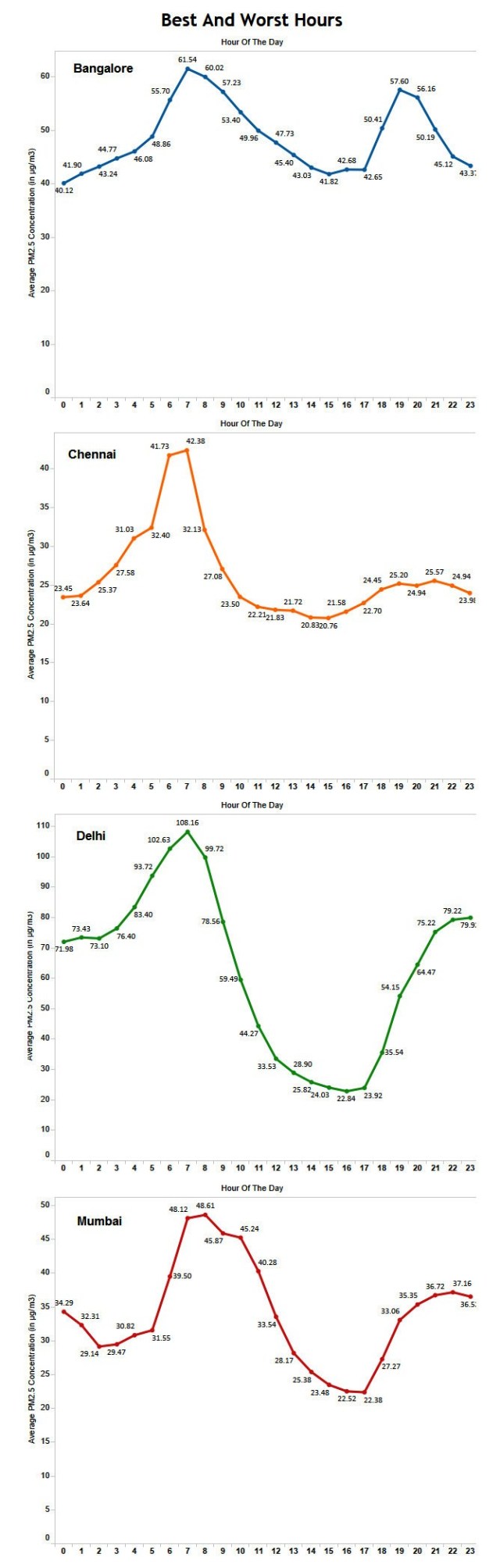
If you think mornings are the best time for outdoor exercise, you’re wrong. Mornings experience the worst air pollution in four Indian cities, according to an analysis of particulate matter 2.5 data from IndiaSpend’s #Breathe air quality sensors, analysed from Bengaluru, Chennai, Delhi and Mumbai between March 15 and April 15.
Bengaluru: Best air quality – midnight
The worst air quality was at 7 am, as PM 2.5 concentrations peaked at 61.54 micrograms per cubic metre of air (μg/m3). The air quality improved as the day wore on, worsening by evening at about 5 pm, reaching a late evening high at 7 pm (57.60 μg/m3). The best air quality was registered around midnight, when PM 2.5 levels fell as low to 40.12 μg/m3.
Chennai: Best air quality – 3 pm
The worst air was at 7 am, when PM 2.5 levels (61.54 μg/m3) reached their peak. Levels began to peak over the night and slide during the day, after 7 am. The best air quality was recorded in the afternoon, at 3 pm, with PM 2.5 levels reaching as low as 20.76 μg/m3.
Delhi: Best air quality – 4 pm
Mornings were the worst time, with PM 2.5 levels reaching as high as 108.16 μg/m3 at 7 am. Air quality gradually improved as the day wore on, registering the cleanest air at 4 pm (22.84 μg/m3). Pollution levels then picked up through the night.
Delhi topped the list of the world’s most polluted cities, according to the World Health Organization.
Mumbai: Best air quality – 5 pm
The worst hour for a Mumbaikar is 8 am, with PM 2.5 levels reaching 48.61 μg/m3; the air started to worsen after 5 am. The best air quality was registered at 5 pm, when PM 2.5 levels were 22.38 μg/m3.
Outdoor air pollution causes 670,000 deaths annually in India, according to this 2014 research paper from the Indian Institute of Management-Ahmedabad.
Air pollution has become a global concern with rising air pollution levels, as outdoor air pollution in cities and rural areas across the world estimated to cause 3.7 million premature deaths in 2012, according to the World Health Organization.
Particulate matter, or PM, is the term for particles found in the air, including dust, dirt, soot, smoke, and liquid droplets. These are classified according to their diameter. Particles less than 2.5 µm (micrometres) are called PM 2.5. They are approximately 1/30th the average width of a human hair. Particles between 2.5 to 10 µm in diameter are called PM 10.
PM 10 and PM 2.5 include inhalable particles that are small enough to penetrate the thoracic region of the respiratory system. The health effects of inhalable PM are well documented, caused by exposure over both the short-term (hours, days) and long-term (months, years). They include: Respiratory and cardiovascular morbidity such as aggravation of asthma, respiratory symptoms, and an increase in hospital admissions; and mortality from cardiovascular and respiratory diseases and from lung cancer.
There is good evidence of the effects of short-term exposure to PM 10 on respiratory health, but for mortality, and especially as a consequence of long-term exposure, PM 2.5 is a stronger risk factor than the coarse part of PM 10.
There is a close relationship between exposure to high concentrations of small particulates (PM 10 and PM 2.5) and increased mortality and morbidity from cardiovascular/respiratory diseases and cancer, both daily and over time, according to the WHO.
UK inquiry after Volkswagen scandal finds much higher nitrogen oxide levels than when vehicles are tested in laboratory
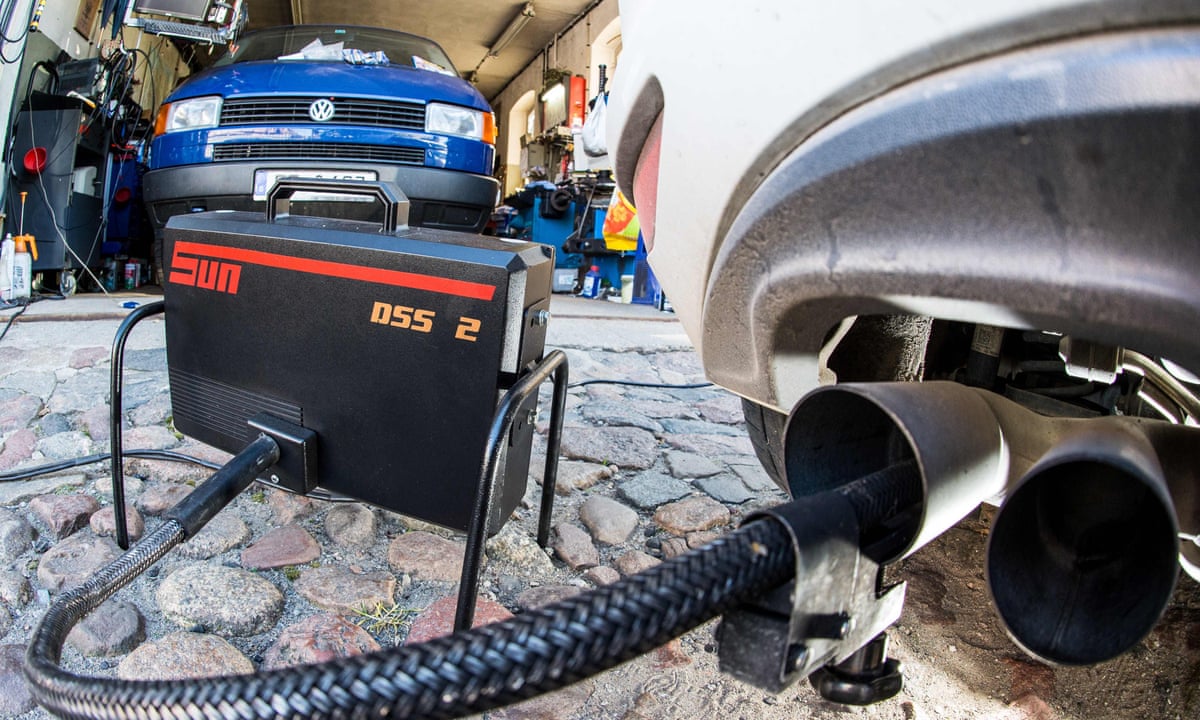
Diesel cars are producing many times more health-damaging pollutants than claimed by laboratory tests, with some emitting up to 12 times the EU maximum when tested on the road, according to a government investigation undertaken following the Volkswagen scandal.
A Department for Transport (DfT) study of cars made by manufacturers such as Ford, Renault and Vauxhall found there was a vast difference in nitrogen oxide emissions measured in the laboratory and under normal driving conditions.
Not a single car among 37 models tested against the two most recent nitrogen oxide emissions standards met the EU lab limit in real-world testing, with the average emissions being more than five times as high.
However, the DfT said it had found no vehicles outside the VW group with systems in place to deliberately rig emissions figures. Robert Goodwill, the junior transport minister, said: “Unlike the Volkswagen situation, there have been no laws broken. This has been done within the rules.”
The minister denied that the findings meant the current emissions testing regime was a farce. “But certainly I am disappointed that the cars that we are driving on our roads are not as clean as we thought they might be. It’s up to manufacturers now to rise to the real-world tests and the tough standards we’re introducing,” he said.
The DfT exercise was ordered after it emerged that Volkswagen had allegedly used technology to cheat emissions tests. It measured Nox, or nitrogen oxide emissions. Nitrogen oxide helps to form ozone smog that can badly affect people with chest conditions such as asthma.
The tests were carried out by a team led by Ricardo Martinez-Botas, professor of mechanical engineering at Imperial College London. Among the vehicles tested were 19 models that meet the latest Euro 6 limit of 80mg/km NOx emissions in laboratory tests. Euro 6 was introduced for all new cars sold after September last year.
When driven in a real-world simulation of urban, rural and motorway travel, the average was nearer to 500mg/km, with some cars getting close to 1,100mg/km.
Among the new models tested that are meant to comply with the Euro 6 standard were the Ford Focus, which had a real-world emission about eight times above the EU limit, the Renault Megane, whose emissions were more than 10 times higher, and the Vauxhall Insignia, almost 10 times higher.
Officials stressed that comparisons directly between models was unfair as they were all tested on different days, with varying temperatures and road conditions.
The study also revealed that none of the 37 top-selling vehicles that were claimed to have met the previous Euro 5 limit of 180 mg/km, in place from 2009 until last year, stayed within that legal level when driven in the road.
The models tested represented 50% of all diesel cars on the roads sold from 2010 to 2015, the report said.
The results do not mean any of the manufacturers other than Volkswagen have potentially broken any laws, because the only legal standard currently is to meet the lab requirement.
In the US it emerged that the of nearly 600,000 Volkswagen vehicles rigged to cheat on diesel emissions tests will have the option to have their cars fixed or bought back by Volkswagen, a federal judge said on Thursday.
VW may have to spend more than $10bn to comply with the agreement it has struck with the US Justice Department, according to analysts and sources briefed on the deal. The German carmaker admitted in September using sophisticated secret software to cheat exhaust emissions tests.
Industry experts said the car industry faced a crisis similar to recent banking scandals. David Bailey, professor of industry at Aston University, said the government, manufacturers and regulators needed to act on the results of the study.
“I liken this to the Libor crisis in banking. There is a fundamental question of confidence in the industry,
” Bailey said. “Clearly the testing regime needs to more accurately reflect the real world. That is not happening at the moment, not just in terms of nitrogen oxide but fuel efficiency. There is also an issue of accountability and openness for manufacturers in terms of what they put into public domain.”
In the wake of the tests, the government has promised to introduce new “real driving emissions tests” from next year. Initially, manufacturers will be able to sell cars that produce slightly over double the 80mg/km limit on the roads, but from 2020 this will fall to the actual limit.
The report found big variations depending on outside temperatures, with engines producing more emissions when it was cold.
Manufacturers told the DfT that devices to reduce emissions, called exhaust gas recirculation, tended to switch off when it was cold to protect the engine. This partly explained the lower lab emission readings, as these were taken at temperatures of about 20C.
The transport secretary, Patrick McLoughlin, said car manufacturers needed to take action. “Following the Volkswagen emissions scandal, the whole of the automotive industry must work hard to restore public trust by being transparent about the systems they employ and advancing plans for introducing cleaner engine technology.”
He added: “I’m disappointed the results are as bad as they are. We expected them to be different by a factor of maybe 0.5 or two on the road compared to the lab, but the levels are disappointingly high – industry needs to raise its game.”
The Society of Motor Manufacturers and Traders (SMMT), which represents the auto industry, said it backed the new real-world tests. A spokesman said: “The differences between the results from official laboratory tests and those performed in the real world are well known, and industry acknowledges the need for fundamental reform of the current official test regime, which does it no favours.
“SMMT and industry support the introduction of the proposed new and more onerous test, which will help to reflect better real-world driving.”
Friends of the Earth said properly stringent standards would take too long to come into force, with tens of thousands of people a year dying early because of poor air quality. “This confirms what experts have been saying for years: deadly emissions are far higher in the real world than in controlled tests in the lab,” said Oliver Hayes, from the group.
Jaguar Land Rover said its customers should be confident that its cars were “fully compliant with all current emissions legislations”. It added: “The results demonstrate that Jaguar Land Rover does not use any cheat devices or software. Jaguar Land Rover recognises that there is a difference between lab and real-world test results. We fully support the move towards real-world testing and the greater clarity this will bring for our customer.”
Mercedes said its vehicles had been “certified and licensed in accordance with the applicable legal requirements”. Vauxhall said it “welcomes the clarity provided by the report from the UK government”.
A Vauxhall spokesman added:
“Vauxhall is actively engaged in the discussion on RDE (real driving emissions). We strongly believe that the industry has to regain trust by increasing the transparency with customers and authorities, and we have taken definitive steps in this direction.”
Volkswagen will offer “substantial compensation” and car buy-back deals in the US as part of a settlement of the the diesel emissions scandal.
Final details of the packages offered will be announced in June, but a court had given VW and regulators until Thursday to reach a deal in principle.
Last year, US regulators discovered that VW cars were fitted with software that could distort emissions tests.
The German giant subsequently said 11 million cars worldwide were affected.
‘Substantial’ compensation
Details of the preliminary agreement were announced in a California court. US district court Judge Charles Breyer said the settlement would include a buyback offer for nearly 500,000 2.0-litre vehicles.
He did not give details of how much car owners would offered in compensation, but said the deal between Volkswagen, the US government and private lawyers would be “substantial”.
Judge Breyer said VW would also pay into an environmental fund and commit other money to promote green car technology.
Volkswagen told its shareholders last year it had set aside $7.3bn to help defray the potential costs of a recall or regulatory penalties, but that figure could rise. The company faces as much as $20bn in fines for Clean Air Act violations alone.
Analyst Marc-Rene Tonn, at Warburg Research, estimated the direct financial impact on Volkswagen from the emissions scandal worldwide was $32.3bn.
The US settlement could influence what happens in Europe and in other countries, Mr Tonn said. “Very generous payments to US customers may add to some greediness here, too.”
Emissions cheating
Volkswagen installed software in the diesel engines to detect when they were being tested and cheat the results. Some models could have been pumping out up to 40 times the legal limit of the pollutant, nitrogen oxide, regulators disclosed.
“Volkswagen is committed to winning back the trust of its customers, its dealers, its regulators and all of America,” said VW lawyer Robert Giuffra. The agreements are “an important step forward on the road to making things right,” he added.
The firm said in a statement that it “intends to compensate its customers fully and to remediate any impact on the environment from excess diesel emissions”.
It said a deal in principle had been reached with the Justice Department, the Environmental Protection Agency and the California Air Resources Board.
It added that it had “reached an agreement on the basic features of a settlement with the class action plaintiffs in the lawsuit in San Francisco. This agreement will be incorporated into a comprehensive settlement in the coming weeks”.
The deal announced on Thursday covers mostly 2-litre vehicles. Judge Breyer said he expects an agreement between VW and regulators covering about 90,000 larger vehicles and SUVs to be addressed “expeditiously”.
American Lung Association’s ‘state of the air’ report finds 166 million Americans are living in unhealthy ozone or particle pollution with serious health risks
More than half of the US population lives amid potentially dangerous air pollution, with national efforts to improve air quality at risk of being reversed, a new report has warned.
A total of 166 million Americans live in areas that have unhealthy levels of either ozone or particle pollution, according to the American Lung Association, raising their risk of lung cancer, asthma attacks, heart disease, reproductive problems and other ailments.
The association’s 17th annual “state of the air” report found that there has been a gradual improvement in air quality in recent years but warned progress has been too slow and could even be reversed by efforts in Congress to water down the Clean Air Act.
Climate change is also a looming air pollution challenge, with the report charting an increase in short-term spikes in particle pollution. Many of these day-long jumps in soot and smoke have come from a worsening wildfire situation across the US, especially in areas experiencing prolonged dry conditions.
Six of the 10 worst US cities for short-term pollution are in California, which has been in the grip of an historic drought. Bakersfield, California, was named the most polluted city for both short-term and year-round particle pollution, while Los Angeles-Long Beach was the worst for ozone pollution.
Small particles that escape from the burning of coal and from vehicle tail pipes can bury themselves deep in people’s lungs, causing various health problems. Ozone and other harmful gases can also be expelled from these sources, triggering asthma attacks and even premature death.
People at Risk In 25 US Cities Most Polluted by Year-Round Particle Pollution
SOURCE: American Lung Association, State of the Air 2016
It isn’t all bad news – the total number of unhealthy air days has fallen and year-round particle pollution has dropped as old diesel engines are retired and coal-fired power plants are cleaned up. The federal Clean Air Act, established in 1970, is credited with cleaning up many US cities that were previously blighted by harmful smog. According to the Environmental Protection Agency, the legislation will have saved around 4.2 million lives by 2020.
But environmental groups have warned that some members of Congress are actively attempting to weaken the Clean Air Act. A bill backed by the Republican presidential candidate Ted Cruz would prevent the federal government from regulating various toxins under the Clean Air Act. Republicans have also objected to the act being used to reduce greenhouse gas emissions, prompting a US supreme court challenge to the Clean Power Plan.
“There are wide-ranging extreme measures to undermine the Clean Air Act,” said Paul Billings, senior vice-president for advocacy at the American Lung Association. “If we roll back and weaken these protections, the health consequences will be dire.
“We’ve certainly seen dramatic improvements in air quality but far too many cities and counties exceed levels where adverse effects occur. Progress should be faster. Americans deserve to breathe clean air and there’s still a lot of work to be done.”
Billings said more needed to be done to prevent pollution from wood stoves and from oil and gas extraction.
Piles of leaf and garbage are burnt with impunity in Delhi’s parks and landfills, filling the air with foul smoke containing dangerous levels of carcinogens and carbon dioxide that is blamed for stoking weather extremes.
The fumes of burning rubbish, a major source of pollution that goes unchecked, undermine the Arvind Kejriwal government’s odd-even road rationing formula to reduce air toxicity.
Penalties to offenders in the past year — north and south municipal corporations’ 26 challans and their east counterpart’s 191 — show how much importance is given to the green watchdog in New Delhi that the World Health Organization (WHO) ranks as the world’s worst city for air pollution.
The National Green Tribunal had banned in April 2015 the practice of burning leaves and trash in the city — a ritual followed almost religiously in the absence of a robust garbage disposal system and a strict monitoring system.
Delhi’s never-ending stream of traffic contributes 8% to air pollution in summer, which is just 1% higher than the burning of garbage, an IIT-Kanpur study found.
Smoke from leaf and trash burning releases PM10, a coarse particle that can embed deep in the lungs. Studies have shown PM10 leads to respiratory and heart problems, especially in children.
“We regularly monitor leaf burning to curb the practice,” North Delhi municipal commissioner PK Gupta said.
A civic official defended the relatively low compliance, saying garbage is burnt mostly before dawn or after sunset.
Another official said wood and leaf piles were burnt by poor people to keep warm in winter. “These people can’t pay the lowest fine amount, which is Rs 5,000.”
But at the root of such man-made emissions is the lack of an effective waste management system.
Errant municipal employees find it easy to burn garbage, mostly of biological origin — from horticulture waste to food — than taking the rubbish to dumping sites.
“Sanitation workers, especially those on contract, indulge in this practice on the sly. It becomes hard for enforcement officials to catch them because they escape after lighting the waste,” said an official.
Green activist demanded more accountability, saying burning does not make the waste disappear but transforms it into a formidable pollution problem.
“It requires vigilance to catch offenders. Communities should be involved to ensure the burning doesn’t happen in their neighbourhood … the municipal agencies must work to provide a solution to the problem of waste disposal,” said Anumita Roy Chowdhury, executive director of the Centre for Science and Environment (CSE).
Often residents were clueless about a garbage fire until smoke enters their homes.
“In such a scenario, the sanitation staff, local officials and even residents must be held responsible to ensure accountability,” said Bharti Chaturvedi of Chintan, an NGO.
As Greenpeace stages protests in London, we reveal the 16 regions around the UK where lives lost to pollution are on the increase
Greenpeace protesters scaled 17 of London’s most famous statues yesterday to raise public awareness of the dangers posed by air pollution .
By fitting face masks to Nelson, Queen Victoria and Oliver Cromwell, the environmental campaign group hoped to make the point that London’s atmosphere is toxic and breaches limits on air pollution set by the World Health Organisation , killing 10,000 people every year.
Greenpeace campaigner Areeba Hamid said: “At schools across London, children are being forced to breathe illegal, dangerous air.
“The next mayor should begin a consultation on a Clean Air Zone immediately after the election.”
The protest comes soon after news that environmental law firm Client Earth are set to take the government to court for the second time because the UK’s air pollution breaks EU law.
Experts say that air pollution will kill 200,000 over the next five years.
Last year, a report published by the Royal College of Physicians showed that, across the UK, 40,000 deaths a year can be attributed to air pollution.
And while air quality across the country as a whole is improving, figures analysed by The New Day’s data unit show that in 16 regions, the number of deaths caused by pollution went up between 2010 and 2013, the latest statistics available.
In Lincolnshire, the increase between 2010 and 2013 was 8.3%.
The other areas affected were Norfolk (7.2%), East Riding of Yorkshire (6.5%), Wakefield (4.9%), Barnsley (3.5%), Suffolk (3%), North Lincolnshire (2.5%), Rutland (2.5%), Doncaster (2%), Herefordshire (2%), Nottinghamshire (1.8%), Somerset (1.8%), North Yorkshire (1.4%), Cambridgeshire (0.7%) and Shropshire (0.2%).
According to the Royal College of Physicians, air pollution has an “adverse effect on the development of the fetus” and is linked to “asthma, diabetes, dementia, obesity and cancer”.
The report also noted “compelling new evidence that air pollution is associated with new onset asthma in children and adults”.
Dr Samantha Walker is Director of Research and Policy at Asthma UK. She said: “We’ve heard anecdotally from people with asthma who find air pollution makes their asthma worse – particularly in London.”
Because the UK is in breach of EU directives on air quality, last year environmental law firm Client Earth were able to take the government to the UK Supreme Court .
In April 2015, judges ruled: “The government should be left in no doubt as to the need for immediate action to address this issue.”
Previously, government policy had aimed to bring levels of pollution in British cities to legal levels by 2030 – a delay which could have killed 600,000 people.
In response to the ruling, the government has instigated a Clean Air Zones policy in Birmingham, Leeds, Nottingham, Derby and Southampton, due to be introduced by 2020.
In London, where air quality is the responsibility of the Mayor, Boris Johnson has announced the implementation of a “ultra-low emission zone” to bring air quality within legal limits by 2025.
However Client Earth argues that the UK should not have to wait another five or 10 years for air improvement.
Their lead clean air lawyer Alan Andrews told The New Day : “The government was ordered to produce plans that would get air pollution down to legal limits as soon as possible.
“The plans it produced were an insult to the tens of thousands of people being made sick and dying from toxic air. It didn’t consider the strong measures needed to get the worst polluting diesel vehicles out of our town and city centres.
“As the government still can’t be trusted to deal with air pollution, we are taking them back to court to get the urgent action that’s needed.”
A Defra spokesperson said: “Between 2005 and 2013 emissions of nitrogen oxides have fallen by 38% and particulate matter has reduced by more than 16%.
“Tackling air pollution is a priority for this Government and we have set out how we will improve the UK’s air quality through a new programme of Clean Air Zones, which alongside national action and continued investment in clean technologies will create cleaner, healthier air for all.”
‘World Health Orgamisation and EU limits do not represent safe levels’
Dr. Matthew Loxham is a toxicologist and research fellow at Southampton University
“UK air quality is improving at a very slow pace, and is still above WHO and EU limits. Even then, we know that these limits do not represent safe levels.
“At the same time, better scientific research and detection methods have shown that air pollution is a much bigger problem that we had hitherto realised.
“A decade ago, scientists estimated that one million people worldwide die annually due to air pollution. Now that figure is three million.
“In the UK, we have a particular problem with the particulates (polluting particles) and nitrogen oxides (aka NOx) emitted by diesel vehicles including buses, HGVs, taxis and private cars.
“We were encouraged to buy diesel cars because they were supposed to be more environmentally friendly. The number of diesel cars went up from 10% to 40%, but actually the benefits for climate change are negligible.
“To save lives, we need urgently to reduce diesel usage, try to separate people from traffic and encourage policies like park and ride.
“The Met Office now provide air quality forecasts, and give advice to the public about what to do when it is particularly bad in their region.”
Government urged to crack down on rogue practice of garages removing compulsory diesel particulate filters from vehicles
More than a thousand diesel cars have been caught without an essential pollution filter that traps deadly particles, according to government figures. But experts warn the rogue practice of removing the filters, which contributes to air pollution-related deaths, could be far more widespread.
Almost 29,000 people die prematurely each year in the UK owing to particle pollution, causing £15bn in health costs. Since 2009 diesel particulate filters (DPFs) have been compulsory in new diesel cars. But, particularly for cars driven in cities, the DPFs can become clogged and cause breakdowns.
Replacing DPFs usually costs more than a £1,000 and, as a result, many garages across the country offer to remove the filter completely for a few hundred pounds. Removing the filter is not illegal, but driving a car without a DPF is an offence and particle emissions from the exhaust pipe are likely to soar fivefold as a result.
In 2014, ministers said the “unacceptable” practice was “clearly detrimental to people’s health” and introduced a visual check into the MOT. This has caught 1,188 vehicles so far, according to figures given to the Guardian by the Department for Transport (DfT).
However, many garages offer to circumvent the visual check by, for example, by “discreetly cutting a small window in the top of the chamber, removing the internal filter before rewelding the window and refitting to the vehicle. This way the vehicle still appears to have a DPF fitted and … will have no affect on your MOT.” Garages also claim removing the DPF will increase power and fuel efficiency, with one promising “your engine will breathe again”.
Simon Birkett, director of Clean Air in London (CAL), said: “The thought of raw and carcinogenic diesel exhaust being spewed on to our high streets is terrifying. The diesel catastrophe, worsened by DPF removal, will affect the health of everyone in the UK.”
He added: “CAL estimates that tens of thousands and more likely hundreds of thousands of diesel vehicles have been tampered with in this way. As more and more vehicles come out of warranty and parts wear out, this problem will grow.”
Dave Garratt, chief executive at the Garage Equipment Association, said: “[DPF removal] has been going on for a long time and it is probably getting progressively worse. The biggest hole in the MOT is that they don’t really check it. [Visual inspection] does not actually tell you if there is a core in the canister. I’d guess there are a lot more out there.”
One garage owner, who has now stopped removing DPFs and did not want to be named, said: “We were inundated with vehicles with DPF problems. Removal was the quick fix.”
The roads minister, Andrew Jones, said: “We are fully committed to improving air quality and the new figures are proof that our common-sense changes to the MOT test are helping get hundreds of polluting vehicles off the road. We continue to tackle harmful vehicle emissions and are investigating ways to use the latest technology to further improve detection methods.”
The DfT has commissioned research on how existing or new technology can be used to detect DPF removal by measuring exhaust fumes. One possibility is adapting the use of the equipment that performs the current MOT smoke test to make it more sensitive. The findings may be implemented as part of changes to the Roadworthiness Directive, which sets the framework for MOT testing, and is scheduled to be introduced in the UK in 2017-18.
However, ministers face calls for more urgent action. “It is such a clear cut issue,” said Patrick Streeter, an elected councillor in the City of London Corporation, who has taken up the issue with the police. “They have to get out there and arrest these people. They need to raid the garages to collect the registration numbers [of the cars that have had DPF removed]. The pollution is absolutely terrible.”
Cleaning the DPF is possible and usually costs less than replacement but more than removal. Ceramex is one company offering the service and its managing director, Rob Rule, said DPF removal was undercutting action by politicians and car makers to improve the UK’s poor air quality.
“It drives me absolutely bonkers,” he said. “Not only is it immoral and illegal, you are undermining so much cost and effort that is going into cleaning up the environment. It is antisocial.”
Rule backed calls for a further crackdown on DPF removal, saying: “If there is one thing that could improve air quality in [cities], it would be to send the police to garages to tell them they are committing a criminal act, then go back if they don’t change their act.”
In October, police in Spain raided a string of garages which were allegedly performing DPF removal, while in the US in 2013, a company agreed to pay a $500,000 (£350,000) fine for DPF-related violations.
Birkett said: “The UK government must outlaw the removal of DPFs, modernise and mandate the testing of exhaust emissions during the MOT and introduce random on-road testing.” Spot checks used to take place in the UK but were stopped in 2011, with the government saying they had unearthed only two problems in a decade and that anti-pollution funding was better spent elsewhere.
DPF removal services are widely advertised across the UK. The Guardian contacted five garages offering the service on their websites. Two claimed their websites were out of date but did not subsequently update them. Two said managers would call back, but they did not. One said the service was offered only to off-road vehicles, though the website made no mention of this caveat.
Experts said DPF removal could invalidate car insurance if not declared and that the vehicle inspections offered by motoring organisations to prospective car buyers were visual checks only.
The notice issued to MOT testers in 2014 said: “The DPF plays an essential environmental role in enabling reductions in emissions, reducing air pollution and thereby improving health quality.”
A University of Toronto researcher says the city should take air pollution into account when planning cycling infrastructure.
It turns out cars are harmful to cyclists in more ways than one.
Four cyclists were killed last year in crashes with cars on Toronto streets. But, University of Toronto researcher Marianne Hatzopoulou says cars’ tailpipes are nearly as dangerous as their fenders.
Her work shows cyclists are particularly vulnerable to the risks posed by air pollution — higher levels of breast and prostate cancer being among them.
Cyclists, she said, “tend to have higher breathing rates than other pedestrians, so whatever they’re inhaling is going deeper into their lungs.”
It’s a reminder that encouraging healthy urban environments means more than adding cycle tracks and bike lanes, said Hatzopoulou, a civil engineering professor.
“We’re encouraging densification and also encouraging all modes of active transportation, but we’ve done nothing to reduce the number of cars on the road,” she said. “So all we’re doing is putting cyclists and pedestrians closer to the pollution.”
While in Montreal, Hatzopoulou outfitted cyclists with air quality monitors and sent them pedalling across 600 kilometres of bike paths. She discovered popular cycling routes were among the “most polluted” roads in the city.
Hatzopoulou has compiled similar data in Toronto and created an app that lets cyclists plan cleaner commutes. She’s also launched a survey to understand whether cyclists would change their behaviour if they knew just how polluted the air along their favourite route is.
Tracking air pollution in a city like Toronto can be tricky, but Hatzopoulou said particulate matter tends to gather in the corridors between tall buildings.
For example, the intersection of Bay and Bloor streets is, despite having more traffic, less polluted than Bay and King.
Pollution Masks since 1993 - The 'Original' and still the best - Made in the UK - respro.com
THE AIR WE BREATHE
The Respro® Bulletin Board is designed to keep you up to date with current views and issues relating to Air Pollution and its health implications in our daily lives.














 Respro® Masks are reusable