Scientists develop diesel that emits far less CO2

Researchers have discovered a new approach to the production of fuels. Their new method can be used to produce much cleaner diesel. It can quickly be scaled up for industrial use. In five to 10 years, we may see the first cars driven by this new clean diesel.

Researchers from KU Leuven and Utrecht University have discovered a new approach to the production of fuels. Their new method can be used to produce much cleaner diesel. It can quickly be scaled up for industrial use. In 5 to 10 years, we may see the first cars driven by this new clean diesel.

The production of fuel involves the use of catalysts. These substances trigger the chemical reactions that convert raw material into fuel. In the case of diesel, small catalyst granules are added to the raw material to sufficiently change the molecules of the raw material to produce usable fuel.

Catalysts can have one or more chemical functions. The catalyst that was used for this particular study has two functions, represented by two different materials: a metal (platinum) and a solid-state acid. During the production process for diesel, the molecules bounce to and fro between the metal and the acid. Each time a molecule comes into contact with one of the materials, it changes a little bit. At the end of the process, the molecules are ready to be used for diesel fuel.

The assumption has always been that the metal and the solid-state acid in the catalyst should be as close together as possible. That would speed up the production process by helping the molecules bounce to and fro more quickly. Professor Johan Martens (KU Leuven) and Professor Krijn de Jong (Utrecht University) have now discovered that this assumption is incorrect. If the functions within a catalyst are nanometers apart, the process yields better molecules for cleaner fuel.

“Our results are the exact opposite of what we had expected. At first, we thought that the samples had been switched or that something was wrong with our analysis,” says Professor Martens. “We repeated the experiments three times, only to arrive at the same conclusion: the current theory is wrong. There has to be a minimum distance between the functions within a catalyst. This goes against what the industry has been doing for the past 50 years.”

The new method can optimize quite a few molecules in diesel. Cars that are driven by this clean diesel would emit far fewer particulates and CO2. The researchers believe that their method can be scaled up for industrial use with relative ease, so the new diesel could be used in cars in 5 to 10 years.

The new technique can be applied to petroleum-based fuels, but also to renewable carbon from biomass.


Story Source:

The above post is reprinted from materials provided by KU Leuven. Note: Materials may be edited for content and length.

Source: Scientists develop diesel that emits far less CO2 — ScienceDaily

Posted in Air Quality, Europe | Tagged , , | Leave a comment

Pollution hotspots get ‘clean bus’ cash 

Eighteen “pollution hotspots” in England have been awarded funds to cut bus emissions, as part of efforts to meet EU targets on nitrogen dioxide.

The government has been taken to court over its failure to meet NO2 limits and has spent £20m since 2011 trying to make old polluting buses more green.

The 2015 award will split £7m between 18 areas, to upgrade 439 buses with technology to reduce exhaust emissions.

Funding was prioritised for the most polluted towns and cities.

The 18 councils and transport authorities that will share the Clean Bus Technology Fund 2015 are in Birmingham, London, Leicester, Liverpool, Sheffield, Leeds and West Yorkshire, Bristol, Brighton, Gateshead, Sunderland, Manchester, Lancashire, Norfolk, York, Harrogate, Broxbourne and Rossendale.

Fifty buses will be upgraded in London, 38 in Rossendale, 35 in Bristol and Brighton and 32 in Leeds.

The UK is failing to meet EU targets on NO2 and the government says targeting buses – which have high mileage and long “operational lives” – can help.

Among the pollution hotspots is Bristol – European Green Capital 2015 – whose mayor said the city had a “huge responsibility” to build on the momentum of UN climate talks in Paris.

He said the money would “clean up our dirtiest buses on the busiest routes”.

The buses will be fitted with “selective catalytic reduction” technology to treat exhaust gas. The government has already spent £20m on retrofit schemes since 2011, having struggled to meet EU targets on NO2 emissions, of which diesel vehicles are a key source.

In April, the Supreme Court ruled the government must put together new air quality plans by December 31 2015, after a case brought by environmental lawyers.

It revealed plans for new “clean air zones” in five cities by 2020 – which would see older polluting buses charged to enter them.

Source: Pollution hotspots get ‘clean bus’ cash – BBC News

Posted in Air Quality, Europe, London, UK | Tagged , , , , , , , , , , , , , , , , , , , , | Leave a comment

Delhi embraces car restrictions on key working day 

New restrictions on private cars, which are being enforced to tackle hazardous pollution levels in Delhi, faced their first serious test on Monday as residents headed back to work following the New Year weekend.

The scheme was launched on Friday and authorities in the Indian capital said that most drivers had complied with the rules, which require private cars with even- and odd-number plates to take to the roads on alternate days until 15 January.

There were fears many would flout the rules on the scheme’s first full working day.

But the city’s usually clogged roads saw less traffic than normal, police said, suggesting motorists with odd-number plates had sought alternative ways of getting around.

“There were doubts about what would happen when all the offices opened,” said Delhi Transport Minister Gopal Rai. “We are glad that people are following the rules.”

One way of getting people on board was through a full-page advertisement in Monday’s newspapers which compared the lungs of a 52-year-old Delhi citizen with those of a resident of a similar age from Himachal Pradesh, a mountainous state in northern India.

“DELHI HAS NOW DECLARED A WAR ON AIR POLLUTION. ON WHICH SIDE ARE YOU?” it asked readers.

Bad air

The car limiting plan is in place between 08:00 and 20:00 daily except on Sundays and the city government has put an additional 3,000 buses into service to handle an increased load.

The city’s Metro has also had to deal with a rise in passengers but on Monday, Mangu Singh, the managing director of Delhi Metro Rail Corporation, said the network was operating smoothly.

Taxi operators, which like motorcycles and women drivers, are exempt from the scheme, appeared to witness increased business.

“It’s encouraging that people have worked with the government on this. This is most important because it affects our health and our children,” said retired engineer RC Taneja, who owns both an odd- and even-plated car but chose to take the Metro for an appointment on Monday morning.

Some residents have even called for the scheme to be made permanent.

Those caught violating the rules face a fine of 2,000 rupees ($30), although many were let off with a verbal warning on Friday and Saturday.

The Press Trust of India said 1,231 people had been fined on Monday.

But what impact has it had on the city’s air quality, which the World Health Organization (WHO) says is the world’s dirtiest and a Delhi-based environmental group says is responsible for up to 30,000 deaths each year?

A visible layer of smog hovered over the city on Monday and overall pollution levels continued to be deemed “hazardous” on the US embassy’s air quality index. It advised the elderly and children to stay indoors and for everyone to avoid physical activity outdoors.

Meanwhile, PM 2.5, the small particles in the air considered dangerous for lungs and the heart, stood at 403.6 micrograms per cubic metre in the Indian capital as of 14:00 – while the safe limit defined by the WHO in 25.

What are PM 2.5 particles?

  • Particulate matter, or PM, 2.5 is a type of pollution involving fine particles less than 2.5 microns (0.0025mm) in diameter
  • A second type, PM 10, is of coarser particles with a diameter of up to 10 microns
  • Some occur naturally – e.g. from dust storms and forest fires, others from human industrial processes
  • They often consist of fragments that are small enough to reach the lungs or, in the smallest cases, to cross into the bloodstream as well
  • A build-up of PM2.5 in the lungs has been associated with causing respiratory illnesses and lung damage

As well as vehicles, experts say the burning of crops and dust from construction also heavily affect Delhi’s toxic air.

In an editorial on Monday, the Business Standard newspaper applauded the Delhi government, led by Chief Minister Arvind Kejriwal, who carpooled to work on Monday with colleagues, for “making a sincere effort in curbing vehicular pollution”.

But it added that more needed to be done, including encouraging people to buy and use battery-operated motorcycles given that “over a third of Delhi’s pollution is caused by emissions from two-wheelers”.

It also called for expanding public transport networks and upgrading them so “that people can use them with comfort in preference to their private vehicles”.

Some residents agreed.

Abheyraj Singh, 25, a smart-phone app designer, said buses “move super slow, making travelling a pain” and that “my nearest Metro station is 3-4km away, making it really hard for me to use”. He added: “I really want to use public transport and I feel everyone should, but only if it were more connected.”

Source: Delhi embraces car restrictions on key working day – BBC News

Posted in Asia, India | Tagged , , , , , | Leave a comment

Beijing air quality improved in 2015 despite pollution alerts, authorities say 

Environmental authorities in Beijing say the Chinese capital’s air quality in 2015 was better than the year before despite the city’s first two red alerts for pollution late in the year.

China has been setting national and local targets to reduce its notorious air pollution as citizens have become increasingly aware of the health dangers. Beijing’s municipal government has been replacing coal-fired boilers with natural gas-powered facilities, forcing older, more polluting vehicles off the road, and closing or moving factories that are heavy polluters.

The city’s average concentration of PM2.5 — small, inhalable particles that can penetrate deep into the lungs and are considered a reliable gauge of air quality — was 81 micrograms per cubic metre in 2015. That was a drop of 6% from 2014, and 10% lower than 2013, when Beijing started publishing data on PM2.5.

The “number of days of most serious PM2.5 pollution is falling each year,” Beijing’s municipal environmental protection bureau said Monday.

It was, however, still more than twice China’s own standard of 35 micrograms per cubic metre, and seven times higher than an annual mean of ten that the World Health Organisation gives as its guideline for safe air.

Other pollutants also fell, including sulfur dioxide by 38% and nitrogen dioxide by 12%. The environmental protection bureau attributed the lowering of sulfur dioxide to the phasing out of coal-fired heating systems.

Beijing’s air gets especially bad in the winter, when the burning of coal in northern China increases and weather patterns add to the smog.

Beijing issued its first two red alerts in December under a four-tier warning system that has been in place for two years. The city had earlier experienced more hazardous levels of pollution and come in for criticism for not issuing a red alert sooner, but authorities said at least three consecutive days of smog at particular levels on the city’s air quality index must be forecast before issuing the highest alert.

The red alerts meant half the city’s vehicles were ordered off the roads on a given day, factory production was restricted and schools were closed.

Beijing sits in one of China’s most heavily polluted regions. Its main sources of pollution are vehicles, coal-burning, industry and dust from construction sites.

The capital aims to eliminate coal use in its six downtown districts and close all coal-fired boilers throughout the city by 2020.

Source: Beijing air quality improved in 2015 despite pollution alerts, authorities say | Environment | The Guardian

Posted in Air Quality, Asia, China | Tagged , , , | Leave a comment

Hundreds of buses to be fitted with green technology to cut air pollution 

The government has announced new funding for councils to cut emissions in 439 buses around the country as part of a £7million scheme

A million greener bus journeys will take place across the UK next year after ministers announced £7million to fund new technology.

Hundreds of buses will be fitted with devices to cut harmful nitrogen oxide emissions in areas where pollution is high, reducing toxins by 90 per cent according to government research.

Fifty London buses will go green and Bristol and Brighton will both see 35 vehicles fitted with the technology.

Other areas including Leeds, York, Sunderland and Norfolk will get government funding to convert their buses in eighteen hotspots in total.

Andrew Jones, the transport minister, said: “Greener buses mean cleaner town and city centres and a healthier environment for everyone.

“The upgraded buses that will soon hit the roads in England continue our commitment to better air quality by investing in greener transport.

“By targeting pollution hotspots and backing the low-emission technology of the future, we are making the right long-term decisions to improve people’s lives.”

The new round of funding takes the total spent by Ministers on upgrading old buses to £27million since 2011.

Councils have been awarded up to £500,000 to refit old vehicles under the scheme, which aims to reduce air pollution in urban areas.

Last summer a court ruled the government must urgently cut emissions after repeatedly missing EU air quality targets.

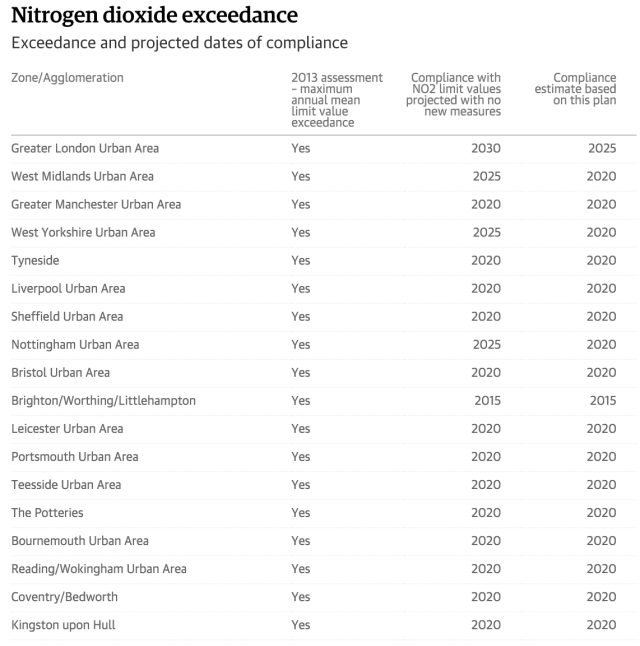
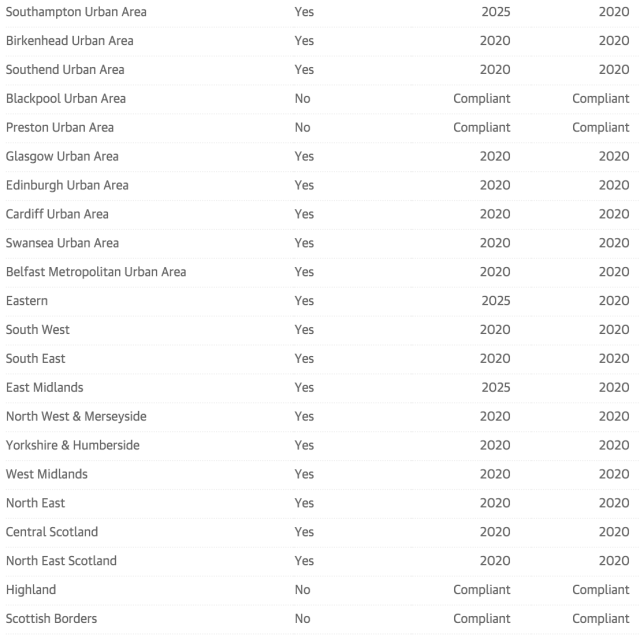
Ministers vowed to make changes to bring the UK in line with rules set by Europe amid warnings that some parts of the country won’t meet targets until 2030.

Nitrogen oxides are estimated to be responsible for thousands of deaths in the UK every year.

Source: Hundreds of buses to be fitted with green technology to cut air pollution – Telegraph

Posted in Air Quality, Europe, London, UK | Tagged , , , , , , , , , | Leave a comment

How will Delhi’s ‘odd-even’ car rationing work?

In a desperate bid to curb the alarming levels of pollution in the Indian capital, Delhi, authorities have announced that private cars with even and odd numbers plates would be allowed only on alternate days from Friday.

The “odd-even” car rationing experiment will run for an initial two-week trial period after which the government will take a call on extending – or, junking – it.

The city – the most polluted in the world, according to the World Health Organisation – has been experiencing hazardous levels of pollution this winter – and the government believes that draconian measures are needed to help improve the air quality.

The BBC’s Geeta Pandey in Delhi explains how this formula will work.

How would the “odd-even” plan work?

For the first 15 days in the New Year, number plates ending with odd numbers – one, three, five, seven and nine – will be allowed on odd dates while number plates ending with even numbers – zero, two, four, six and eight – will be allowed on even dates.

The restrictions will be in place from 8am to 8pm from Monday to Saturday.

The rule has to be followed by everyone, except for those who have been granted exemption.

Delhi is known for its wide avenues, but with more than 8.5 million vehicles in the city, the roads are choked with endless traffic snarls.

And reports say with 1,400 new cars being added to the city roads every day, the situation is going to get only worse.

Authorities say car emissions are a major contributor to pollution and curtailing their use will help clean the city air.

They want to encourage more people to start using public transport like the Metro and the bus or take to cycling.

The odd-even formula is among several measures aimed at reducing smog levels – the plan is also to shut some coal-fired power plants in the vicinity of the city and vacuum roads to reduce dust.

Who is exempted?

The list of exemptions is long:

  • Anyone who is a VIP [Very Important Person] which is the president, the vice-president, the prime minister, all government ministers, several senior politicians, judges and foreign diplomats
  • Women drivers – alone or when they are driving with women passengers. Male children up to 12 years are allowed, but no adult men can travel in the car
  • Two-wheelers which include motorbikes and scooters
  • Non-polluting vehicles – those that run on clean fuel like CNG [compressed natural gas] or electricity
  • Emergency vehicles – ambulance, fire engines, hospital and prison vehicles, hearse, enforcement vehicles or those belonging to paramilitary forces
  • Physically challenged drivers
  • Those on way to the hospital for emergency treatment – they will be allowed to go if they can “prove the emergency” to the traffic policemen

This long list of exemptions has caused much heartburn – the Delhi police chief has said enforcing the scheme will be difficult and the Delhi high court has asked the government to explain the rationale behind exempting women and two-wheelers.

How will the scheme be enforced?

Delhi Chief Minister Arvind Kerjiwal has said the idea is to encourage people to use public transport more and to cope with the increased numbers, the government will be running 3,000 additional buses.

Schools have been ordered to remain shut until 15 January so that their buses could be used as public transport.

Car-pooling is being encouraged and web-based taxi service Uber and radio-taxi service Meru have also launched pooling facilities.

Thousands of traffic policemen will be deployed to catch the violators and the offenders will have to pay a fine of 2,000 rupees ($30; £20) – rather steep by Indian standards where traffic offenders generally get away with a fine of 100 rupees to 400 rupees.

In addition, Mr Kejriwal’s Aam Aadmi Party (AAP) has roped in more than 7,500 volunteers – they will man nearly 200 traffic signals, carrying placards to encourage people to follow the scheme. They will tell the offenders “politely that they should follow the law and give them a flower and ask them to go home”.

What has been the public reaction?


Mixed.

The chief justice of India and the US embassy – though on the list of exemptions – have said they would carpool and follow the odd-even formula.

Many residents, sick of breathing the toxic air, have expressed their support and said they would join in to make the scheme a success.

Many others, however, are complaining about the inconvenience they would face getting to work – they point out the inadequate public transport infrastructure and poor last-mile connectivity.

Metro and buses are already bursting at the seams and with millions more taking to the public transport, overcrowding would get worse, they say.

Will it help clean the Delhi air?


A few months ago, Delhi introduced a “car-free day” on the 22nd of every month – on that day, cars are banned from one city district for a few hours and authorities say the air quality monitoring has shown a plunge in pollution levels in the area after the exercise.

They say they are confident that the odd-even formula, along with the other measures, will make a difference.

Critics, however, say it’s too little because of the long list of exemptions.

Environmental group Centre for Science and Environment (CSE) has welcomed the “emergency action to reduce vehicle numbers on the road” but questioned the absurdity of exempting two-wheelers which account for more than 30% of air pollutants generated by the transport sector in Delhi and women drivers.

Also, Delhi’ites are notorious for not following traffic regulations and there is talk already of how people will get around the ban with forged “sliding number plates” to fit the odd-even formula, how men might start dressing in drag to evade detection, how many may pretend to be sick and how many would rush to buy a second car.

Where did the idea come from?


Car rationing has been tried in many countries around the world.

In 1989, Mexico’s capital city introduced “hoy no circula” – roughly translating as “today, (your car) does not circulate”.

Since then, similar restrictions have been tried in the Colombian capital Bogota, Chilean capital Santiago, Brazil’s largest city Sao Paulo, French capital Paris and Chinese capital Beijing.

Beijing’s odd-even formula imposed ahead of the 2008 Olympics produced its best air quality in a decade – with a Chinese government study claiming that vehicle emissions reduced by 40%.

Indian authorities say they are hopeful of similar results.

In recent years though, Beijing’s pollution levels have worsened again – a warning to authorities in Delhi that the measures will have to be sustained in the long run.

Will it be extended?

The Delhi chief minister has said if the policy causes too much inconvenience to the city residents, they will scrap it.

For the next fortnight though, all eyes will be on Delhi – the WHO survey of global cities last year said that besides Delhi, 13 of the most polluted 20 cities in the world were in India.

If the experiment succeeds in cleaning up Delhi’s air, other cities may also be willing to try out the odd-even formula.

Source: How will Delhi’s ‘odd-even’ car rationing work? – BBC News

Posted in Air Quality, Asia, India | Tagged , , , , | Leave a comment

Air quality: Breathe in the bad news too 

The first three days of the New Year is expected to see the worst air quality, especially in the areas of Shivajinagar to Mhasoba Gate, where there will be enough traffic jams. This was the reading given by System of Air Quality and Weather Forecasting and Research (SAFAR), which issues the air quality at various places in the city.

With the fall in temperature, increase in moisture and overall increase of traffic in certain areas, air quality is deteriorating and will slowly deteriorate further in the next three days, according to SAFAR.

“The overall air quality of Pune city on the first day of 2016 is predicted to be ‘moderate’ range with a lead pollutant PM2.5 (86microgram/m3 ), which is deadliest among all criteria pollutants, this time. The threshold level of PM2.5 is 60 µg/m3. The first 3 days of 2016 will witness the worst spell of the winter season when the level will be at the edge of poor category (85 to 93µg/m3). The poor category starts from 90,’’ states lead scientist of SAFAR Dr Gufran Beig.

Even as these areas will see moderate range, air quality in quite a few locations within Pune are likely to deteriorate further with increased air pollution. The area stretching from Shivajinagar to Mhasoba gate will have the worst air quality with135 microgram/m3, making it in the very poor range. The other two areas among the 10 SAFAR locations with poor air quality are Katraj and Hadapsar, where emissions from suspended dust and traffic are dominant. Rest of the areas have moderate air quality.

While Pune may not have good grades in pollution, there is good news for PCMC region. According to their reading, the cleanest area where level of PM2.5 is below the threshold level in “good” range is Bhosari and Nigdi (40-50 microgram/m3).

The health advisory for Shivajinagar, Katraj and Hadapsar is in the range of “poor to very poor”, while for the rest of Pune city SAFAR has issued “moderate” alert.

Source: Air quality: Breathe in the bad news too | The Indian Express

Posted in Air Quality, Asia, India | Tagged , , , | Leave a comment

Air Pollution Is Causing Iran to Cancel Soccer Games and Keep Kids Home From School 

The air in the Iranian capital of Tehran has gotten so hazardous, the government is now canceling school, banning outdoor sports, and urging all who can to stay inside.

Tehran’s air quality index hovered around 159 on Wednesday — which is more than three times the World Health Organization’s advised maximum of between 0 and 50. Iranian media reported that in an area in northeastern Tehran, the index rose as high as 238. With pollution that bad, WHO advises that people in Tehran avoid breathing outside air unless they absolutely have to.

The crisis is nothing new. For the past 18 days pollution levels in Iran’s capital city have been dangerously high, forcing many to wear masks or avoid going outdoors. And for the past six years, the air quality in Iran has gotten worse. This is largely because US sanctions against Iran have limited its supply of refined fuel, forcing the country to burn low-quality diesel. Tehran authorities reported last year that 270 people die daily of respiratory disease, heart trouble, and other pollution-related sicknesses.

The crisis is not limited to the capital city. The semi-official Iranian Student News Agency reported on Wednesday that state meteorologists are now predicting that pollution could cause acid rain in Isfahan, Iran’s third largest city.

Earlier this year, VICE News spoke to Sepideh, a nurse the southwestern city of Ahwaz, who reported dangerously high pollution levels there as well. According to WHO, Ahwaz is the most polluted city on earth.

“During the winter we deal with thousands of elderly patients with heart and respiratory problems from the pollution, and asthma cases in children are also rising,” Sepideh said last January. “The situation has become much worse since Iran started producing so much domestic gasoline. You can even smell it is different than before.”

Emissions from vehicles contribute roughly 80 percent of the air pollution in Iran. A combination of overcrowded roads, low fuel quality, and poor emission standards has created perfect storm, plunging Tehran into a toxic cloud of exhaust and fumes.

David Michel, a non-resident fellow at the Stimson Center, singles out lax vehicle requirements as a major cause for the crisis.

“The roadways in Tehran have the capacity for less than a million cars, but there are more are 3.5 to four million cars in the city now,” he explained. “The stock of cars is older and doesn’t have the emission control technologies that you’ll find in the US or other Western countries.”

Though an official up-to-date tally of the cost of pollution is hard to come by, in 2012 Iran’s Health Ministry estimated that poor air quality contributed to the premature deaths of 4,500 people in Tehran and about 80,000 across the nation.

On Wednesday, President Hassan Rouhani emerged from a cabinet meeting pledging to do something about the crisis. His cabinet had made “urgent and short-term decisions” to address dangerous air pollution, Rouhani told the Iranian media after meeting with his top advisors, though he did to elaborate on any specific policies adopted.

Just last month, Ayatollah Ali Khamenei, Iran’s supreme leader, issued a 15-point list of policy suggestions on how the government should confront what’s become an environmental crisis. He directed Rouhani to develop policies that would criminalize pollution and promote green energy industries.

As the pollution crisis intensifies, members of the country’s political class are pointing fingers at each other, with different branches of government blaming others for the filthy air.

A clean air bill is currently being considered by Iran’s parliament, the Majlis, but it has been stalled for nearly two years. Over 100 parliamentarians penned a letter to Rouhani on Monday urging him to take action. The head of Iran’s environmental protection organization, the well-known reform politician Massoumeh Ebtekar, then fired back at parliament on Wednesday, telling state news agencies that conservative Majlis speaker Ali Larijani should speed up parliamentary review of clean air laws.

“I called on the speaker to put the clean air bill on the Majlis’ agenda as a priority,” she said. “Unfortunately, it has yet to be reviewed.”

Mohammad Bagher Ghalibaf, the conservative mayor of Tehran, criticized others for “politicizing” the issue.

“We understand the issue of air pollution,” he told reporters on Wednesday. “There is no lack of laws to resolve it; our problem is the implementation of the laws.”

That view seemed to contradict Ebtekar, who blamed the pollution on a lack of specific emissions standards.

“One factor that intensifies air pollution is that the first emission test of newly-manufactured cars is carried out only five years after the purchase of the car,” she said on Wednesday. “This interval is too long.”

As the politicians bickered, daily life in Tehran ground to a halt. Iran’s premier soccer league postponed two games over the weekend, and certain parts of the city were closed to cars. Vehicles with plates ending in an odd number are not allowed to drive on Saturday, Monday, and Wednesday; cars with even-numbered plates are banned on Sunday, Tuesday, and Thursday.

City officials also ordered most schools to shut their doors.

“Our preference was to close all schools,” said Mohammad Heydarzadeh, secretary of Tehran’s emergency air pollution committee. “But the education ministry insisted on keeping high schools open because of final term exams.”

Source: Air Pollution Is Causing Iran to Cancel Soccer Games and Keep Kids Home From School | VICE News

Posted in Air Quality, Iran, Middle East | Tagged , , , | Leave a comment