Air pollution hits major Italian cities

Rome, Milan, Florence, Bologna and other Italian cities are trying to face the high levels of air pollution with car bans

Air pollution hit two of the largest Italian cities, Milan and Rome, and local authorities were forced to impose car bans to deal with the life-threatening air pollution.

Milan is banning cars, motorcycles and scooters for six hours a day over the next three days. Moreover, authorities in Rome also issued a same ban for Monday and Tuesday. Italian news agency ANSA reported that Northern Italian cities, including Florence and Bologna, also banned cars from the city centres until December 31.

According to ANSA, Rome has tried on several occasions to reduce smog levels by setting an alternate day travel, banning cars with number plates ending in an odd number from travelling on one day and then banning those ending with an even number the next. However, the results were disappointing and the authorities forced to issue the stricter ban.

Weather experts already warned the Italian authorities, that air pollution will not stop until at least the New Year, since weather forecast shows no chance of rain.

According to the Italian news agency, Milan has been over the legal smog limit for 85 days this year, Legambiente environmental watchdog group said earlier in December. According to the NGO, Turin holds the second worst record with 73 days over the limit followed by Naples with 59 and Rome with 49 days. The legal limit is 35 days a year of pollution.

Opposition parties in Italy, are criticizing the Italian government as the 5-Star Movement accused the government of “murdering” some 68,000 “extra” smog victims. Moreover, the Left Ecology and Freedom party (SEL) leader Paolo Cento said that the government must impose stricter measures to deal with the air pollution.

“The smog emergency – which has been going on for weeks not days – is also a health and economic emergency costing 15 billion euros a year,” Cento said and added. “A rain dance is not enough, we need planned measures in the immediate and medium term.”

On Tuesday, the Italian parliament adopted a Green economy law which foresees public investments worth €35 million to combat the air pollution problems in the biggest Italian cities. According to the Local, much of the money will go towards providing free public transport and expanding existing city-bike and carpooling schemes.

Source: Air pollution hits major Italian cities

Posted in Air Quality, Europe, Italy | Tagged , , , , , , | 1 Comment

The lethal effects of London fog

After the Great Smog of 1952 killed up to 12,000 Londoners, the country cleaned up its act. But today, pollution of another kind may be just as insidious – and almost as lethal.

Imagine smog so thick that you can’t see your feet as you walk through it; so impenetrable that it blots out the sun; so toxic that it stings your eyes and leaves you gasping for breath.

It may sound like the backdrop to some post-apocalyptic nightmare, but on 5 December 1952, this terrifying scenario became the reality for the people of London. That day’s incident alone killed thousands and prompted a global transformation in the way we deal with air pollution.

On that cold, clear day in 1952, Londoners huddled around their coal fires for warmth. But while the smoke would normally disperse into the atmosphere, an anticyclone hanging over the region created an inversion – trapping the pollution close to the ground and leading to the formation of a sulphurous, toxic shroud that would blanket the capital for the next five days.

Before the weather conditions changed and the smog retreated, thousands had died. Official estimates at the time put the number of fatalities at 4,000 – more civilian casualties than were caused by any single incident during the war – while recent research suggests that it may have caused as many as 12,000 deaths.

‘Necessary evil’

Although ‘pea-soupers’, as the smogs were known, had been an unavoidable feature of Britain’s major cities for more than a hundred years, the Great Smog of 1952 was the worst.

It also marked something of a turning point: until then, people had accepted smog as a necessary evil. “In Britain’s coal-fuelled cities, smoke was tolerated for more than a century as a trade-off for jobs and home comforts,” says environmental historian Dr Stephen Mosley. Some even celebrated air pollution as a tangible measure of Britain’s industrial vitality, while the blazing coal fire, with all its cosy connotations of ‘home and hearth’, was a luxury few were prepared to give up.

Despite growing public pressure to deal with the issue, the government’s reaction was sluggish. Initially it even claimed that December’s high mortality was due to a flu outbreak, and seven months elapsed before it eventually ordered an inquiry.

Four years later, in 1956, the Clean Air Act came into force, banning the burning of polluting fuels in “smoke control areas” across the UK.

The act was truly revolutionary, representing a major global milestone in environmental protection. Public health was vastly improved; flora and fauna that had all but vanished from urban places by the 1950s began to flourish; and the grand architecture of Britain’s cities was no longer obscured beneath a thick layer of soot and grime. In the years that followed, a host of other industrial nations were inspired to follow suit.

Air issues

But, while air pollution from coal may be a thing of past, London’s air quality problem hasn’t gone away. And with a recent study suggesting that pollution in the capital claims as many as 9,500 lives a year, a growing number of scientists, politicians and campaigners believe that on the eve of the Clean Air Act’s 60th anniversary, the UK must once again invoke its pioneering spirit.

The study, which was carried out for Transport for London by Kings College London’s Environmental Research Group, attributes these premature deaths to two main pollutants: fine particulates known as PM2.5 and the toxic gas nitrogen dioxide (NO2).

NO2 levels are of particular concern. London has the world’s highest measured levels of the gas and has breached EU safety limits every year for the last five. In 2015, NO2 levels on Oxford Street broke the annual limit in just four days.

The KCL study estimated that the gas could be to blame for as many as 5,900 premature deaths a year.

While scientists have been aware of NO2’s toxic properties for many years, the fact that it’s usually present with other pollutants has made it difficult to isolate its impact, says Kings College air quality specialist Martin Williams. Only now have researchers been able to conclude that there is an independent effect.

Nevertheless, says the study’s author Dr Heather Walton, there is still some uncertainty on exactly how many deaths can be attributed to the gas.

NO2 pollution has a range of sources. But according to the government’s Department for Environment and Rural Affairs, emissions from transport account for at least 80%. Diesel vehicles, which form more than a third of London’s road traffic, are the biggest culprits.

Because of their fuel efficiency and lower CO2 emissions, diesel engines have been heavily incentivised over the last couple of decades – with successive governments turning a blind eye to their higher particulate and NOx (mono-nitrogen oxide) emissions.

Ironically, the effect of diesel engines has been made worse by the use of technology designed to make them less polluting. “Diesels emit particles in much larger quantities than petrol cars so were fitted with particle filters,” says Williams. “These trap the particles on filters, but every now and again they have to be burned off – NOx in emissions is converted to NO2 which helps to oxidise and burn off particles in the filter. To solve the particle problem, NO2 emissions were being increased.”

Still, London’s deputy mayor for Environment and Energy Matthew Pencharz says there wouldn’t be a problem if EU emissions testing could actually be relied upon. He says that vehicles are often up to 10 times more polluting on the road than they are on the test cycle. “If the vehicles had all performed the way we’ve been promised by the EU, we would be within the NO2 limit values around now,” he says.

And one of the main reasons that London’s figures look so grim, he says, may be that London is simply better at measuring pollution than everyone else.

“We have one of the most robust air pollution measurement networks in the world,” he says. “Don’t tell me there isn’t a street somewhere similar to Oxford Street with higher values. The thing is they haven’t measured it. No one else measures it as accurately as we do.”

Williams agrees. “We’re certainly as good as the best, if not the best, in terms of monitoring. The levels are the highest we’ve been able to find, but I would have thought if you looked hard, you could probably find levels almost as high in other large cities.”

Breathing easier?

The good news is that NO2 levels are beginning to fall. Selective catalytic reduction systems, which are able to remove many of the NOx emissions from exhausts, are now legally required on many of the most polluting diesel vehicles, and the KCL study points to a modest decline in concentrations over the past few years.

Newer, less polluting vehicles are being rolled out across the capital. More than 1,200 hybrid buses now operate in London, including the new diesel-electric Routemaster – which according to TFL produces a quarter of the NOx and particulate emissions of conventional diesel buses. TFL is also expected to shortly announce the introduction of the world’s first zero-emissions double-decker.

Efforts are also underway to clean up the city’s taxi fleet, with TFL recently announcing that from January 2018, all new taxis licensed in London must emit less than 50g/km of CO2 and have a zero-emission range of 30 miles. Earlier this year Metrocab, a battery-powered vehicle that uses a small combustion engine as a range extender, became TFL’s first licensed zero-emission-capable taxi. And the London Taxi Company recently unveiled the prototype TX5, a lightweight, battery-powered Black cab that it plans to put into production during 2016.

There is also the much trumpeted Ultra Low Emission Zone: from 2020, all vehicles entering London’s existing congestion charge zone will need to meet exhaust emissions standards or pay an additional daily charge to travel.

But many claim these developments don’t go far enough. The mayor’s office has faced heavy criticism for ditching its initial plans to simply ban the most polluting vehicles from the emission zone. And as it now stands, diesel vehicles meeting new Euro 6 emissions standards – which emit high levels of NO2 – will be exempt from the charges. What’s more, a recent survey of 500 businesses found that 23% would rather pay a charge than upgrade their vehicles.

“You have to look at where you can get the best impact for the least amount of compliance and cost,” Pencharz says. “Electric vans don’t exist at a reasonable cost for business.”

Precedent for change

Others point to the far wider-reaching changes of the Clean Air Act as an example of how people can adapt. “Before the Clean Air Act, people said ‘the government doesn’t have the money, the poor are going to starve or freeze’. And that wasn’t what happened,” Birkett says. “Once these limits are put in place, people find the cheapest way of complying with them.”

Still, perhaps the main lesson to be learned from history is that it is exceptionally challenging to persuade people to change their habits – and to persuade government to force this change.

“The right to burn a coal fire in one’s own home was seen as an inviolable freedom in the past, and not until the 1952 smog did the government feel that it had sufficient public support to make changes that affected personal liberty,” Mosley says. “Let’s hope that it won’t be a case of history repeating itself.”

Source: BBC – Future – The lethal effects of London fog

Posted in Air Quality, Europe, London, UK | Tagged , , , , , , , , , , , , , , , , | Leave a comment

Milan local government bans traffic from city due to poor air quality 

Daytime ban on all vehicles in place until Wednesday alongside other measures across Italy to reduce air pollution

The city of Milan was brought to a standstill on Monday after the local government barred all traffic within Italy’s fashion and business capital because of persistent poor air quality.

The daily ban on all traffic from 10am to 4pm, which has been put in place until Wednesday, comes as a host of other measures are adopted across Italy to reduce air pollution, including in the town of San Vitaliano, near Naples, where the mayor has blocked the operation of wood-fired ovens that are normally used to make pizza.

Rome also took steps to try to curb air pollution by issuing a nine-hour ban on all cars with odd-numbered registration plates on Monday, while even-numbered plates will be barred for nine hours on Tuesday.

Poor air quality in many major cities has been blamed on the unseasonably warm and dry winter and, according to some experts, changes in high wind patterns. It has not rained for 50 days in many parts of the country, and Milan has reported that its air quality breached acceptable levels for 31 days as of last week.

The news has elicited a sharp response from critics of Matteo Renzi’s centre-left government, including the head of the populist Five Star Movement, Beppe Grillo. On his blog, Grillo criticised the prime minister for fighting over half a percentage point of GDP and issuing “lightning decrees on a Sunday” to save failed banks, while allowing an industrial policy “from the 19th century” to remain in place.

“They are a disaster for the country. The price of their arrogance we pay in blood,” he wrote, linking his comment on Twitter to a graph that showed 68,000 more Italians died this year than last year, implying that the increase was linked to air pollution. He cited the Italian statistics agency Istat, but the group said it has never released data on mortality caused by air pollution.

Italy ranked among the most affected by air pollution in a recent report by the European Environment Agency; it had the most air pollution-related deaths in 2012 of all EU countries. The group estimated that about 84,400 deaths in Italy that year were related to air pollution, out of about 491,000 across the EU.

The EEA also found in a report released early this year that, while Italy had satisfactory levels of air quality concerning sulphur dioxide and benzene, its concentrations of PM10 – a measurement of air pollution – reached unsatisfactory levels in more than 40% of monitoring stations. Measurements of ozone were exceeded in 93% of monitoring stations.

In Milan, local news reports showed dozens of police patrols looking for possible offenders who were driving without necessary permits. They risk fines of between €163 and €658 (£120-£484), according to the newspaper La Repubblica.

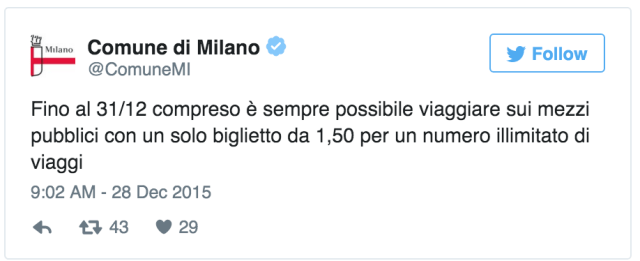
The city is seeking to promote public transportation during the ban, announcing that a single bus or metro ticket would be valid all day long until the end of this year.

Source: Milan local government bans traffic from city due to poor air quality | World news | The Guardian

Posted in Air Quality, Europe, Italy | Tagged , , , , , , , , , , | Leave a comment

Iranian football matches postponed as air pollution soars 

Tehran authorities say residents should refrain from all sports activities as pollution reaches more than twice accepted levels

Two football matches in Iran’s top league were postponed on Sunday as air pollution of more than twice the acceptable level persisted in the capital.

The games in Tehran were rescheduled for Tuesday after the city’s environment authority recommended refraining from all sport activities, the Fars news agency said.

Severe air pollution earlier this week had already led authorities to close schools for three days in and around the capital, where an estimated 14 million people live.

The Air Quality Index in Tehran on Sunday stood at 132, an official told state television, well above the World Health Organisation’s advised level of between zero and 50.

Mohammad Rastegari advised older and sick people and children to stay indoors.

Exhaust fumes from the 5m cars and almost as many motorcycles that use Tehran’s roads account for 80% of its pollution, which increases in winter as emissions fail to rise above cold air.

MPs criticised the government for its response to the situation. Saturday’s “pictures of Tehran, Qazvin, Qom and Esfahan show that the level of air pollution is very high in these provinces”, said one ultra-conservative parliamentarian, who handed out pollution masks to colleagues in protest.

“In the last two years, it has been said that the cause of air pollution was imported petrol,” said Hamid Rasaie. “What is the reason now?”

Last December almost 400 people were hospitalised with heart and respiratory problems caused by heavy pollution in Tehran, with nearly 1,500 others requiring treatment.

In 2012, pollution contributed to the premature deaths of 4,500 people in Tehran and about 80,000 in the country, the health ministry said.

Source: Iranian football matches postponed as air pollution soars | World news | The Guardian

Posted in Air Quality, Iran, Middle East | Tagged , , , | Leave a comment

Italy smog: Milan bans cars for three days to fight pollution 

Italy’s iconic Vespa scooters will vanish from the streets of Milan for three days next week, as authorities ban cars and motorcycles in an attempt to curb the city’s smog problem.

Drivers in the northern city will have to leave their vehicles at home between 10am and 4pm, beginning on Monday.

Authorities have introduced a special “anti-smog” all-day public transport ticket for €1.50 ($1.65).A lack of rainfall has led pollution levels to climb in recent weeks.

Giuliano Pisapia, the mayor of Milan, appealed to all the city’s municipalities to observe the three-day ban. “In these days of major emergency we cannot remain indifferent,” he said in a statement (in Italian).

The administration of the Lombardy region, of which Milan is the capital, also appealed to local officials to cancel traditional firework displays to prevent conditions worsening.

What is smog?

Smog is a type of pollution involving fine particles less than 2.5 microns (0.0025mm) in diameter. It has been linked to lung damage and respiratory illnesses.

Milan was named as Europe’s most polluted city in 2008 and it remains among the worst on the continent. City officials have limited traffic on several occasions in the past, first trying out a ban in 2007.

The capital Rome has limited traffic on several occasions.

Two major Spanish cities have also imposed measures to reduce pollution. A 90km/h (56mph) speed limit was introduced in the Barcelona area last week and parking for most vehicles has twice been banned from the centre of Madrid since last month.

Red alert

Along with Vespas, another Italian staple looked under threat in parts of the country earlier this week, when the mayor of San Vitaliano, just outside Naples, banned the use of wood-fired pizza stoves.

Under the edict, the stoves need to be fitted with special pollution filters before they are allowed back into action.

The Chinese capital Beijing has introduced similar restrictions in recent days after some of the worst smog in the city’s history. The city last week declared a red pollution alert – the most severe of its kind – for the second time this month.

The restrictions in Beijing mean cars can only be driven on alternate days, depending on whether their number plates end in an odd or even number. Statistics show that about 112,800 vehicles violated the rule in just four days, according to Beijing News.

Source: Italy smog: Milan bans cars for three days to fight pollution – BBC News

Posted in Air Quality, Europe, Italy | Tagged , , , , | Leave a comment

Air Pollution In Delhi Breaches ‘Severe’ Levels

Air quality in Delhi last night plunged to the ‘very poor’ level with real-time readings of PM 2.5, the tiniest and most damaging of all the particulate matters, breaching the ‘severe’ category in areas across the national capital.

Around 10 PM, in three stations of System of Air Quality and Weather Forecasting and Research (SAFAR), PM 2.5 fell in the severe category which affects healthy people and seriously impacts those with existing diseases.

Delhi Pollution Control Committee’s (DPCC) reading of Anand Vihar station, one of the most polluted spots in the city, had PM 2.5 at 534 micrograms per cubic metre at 9.50 PM while PM 10 was at 853.

The corresponding safe limits are 60 and 100.

Mandir Marg and Punjabi Bagh, localities far away from each other, had PM 2.5 levels at 271 and 315 micrograms per cubic metre, nearly 5 times above the safe limit respectively.

R K Puram’s PM 10 was at a staggering 1135, 10 times above what is considered safe.

Central Pollution Control Board’s National Air Quality Index was not available and its official website continued to display almost two week figures.

Very poor quality air signifies PM 10 and PM 2.5 levels between 351 and 420, and 211 to 252 micro gram per cubic metre while severe is declared when PM 2.5 and PM 10 cross 253, 421 micro gram per cubic metres respectively.

PM 2.5, microscopic in size, is considered by the World Health Organisation (WHO) as the best indicator of the level of health risks from air pollution.

Source: Air Pollution In Delhi Breaches ‘Severe’ Levels

Posted in Air Quality, Asia, India | Tagged , , , , | Leave a comment

Poor air quality prompts city to activate emergency measures again this morning 

Shanghai environmental authority activated emergency measures against air pollution this morning.

It is the second time such measures were launched within eight days.

Schools and kindergartens have been ordered to cancel outdoor activities, operations at constructions sites within the Outer Ring Road suspended, and vehicles carrying construction waste banned from the roads, after a blue heavy pollution alert was issued at 6 am.

Shanghai Environmental Monitoring Center forecast the pollution yesterday due to a change in wind direction, which was expected to bring pollutants from the northern and western provinces into the city.

The Air Quality Index went beyond 300, or “severely polluted,” at 4 am and lingered around that level since then.

Local education commission issued a notice this morning that all schools and kindergartens should cancel outdoor activities, while students late or absent would not be punished.

Schools are also asked to carry out PE classes indoor and rearrange teaching schedule according to student attendance.

The Shanghai Environmental Protection Bureau also asked housing construction, traffic and other departments to adapt emergency measures to keep road clean and stop works that would increase dust in the air, such as tearing down houses and excavating roads.

Source: Poor air quality prompts city to activate emergency measures again this morning | Shanghai Daily

Posted in Air Quality, Asia, China | Tagged , , | Leave a comment

Weather worsens seasonal air pollution in Italian cities 

Rome is limiting auto circulation, and other Italian cities have been offering free bus rides to encourage public transport use as the country battles seasonal air pollution that has been worsened this year by long spells of no rain and little wind.

As it has done several times this fall, Rome this week limited the number of cars and motorcycles on its roads using a system based on license plates. Vehicles with plates ending in an odd number were banned Monday and vehicles with plates ending in an even number were banned Tuesday.

“The high concentrations of particulate matter and nitrogen dioxide continue, aggravated by the weather situation of high pressure and absence of wind,” Rome’s city hall said. Traffic police scrutinized license plates of passing cars. Violators risk a 150-euro ($165) fine.

In northern Turin, public transport was free for two days this month to try to entice commuters away from cars. Milan recently put limits on more-polluting diesel cars for three days, and the city’s residents were asked to turn down thermostats by 1 degree. Parents accompanying their children to and from Milan’s schools could ride free on buses and trams.

Little relief is in sight, with more rainless days predicted for the rest of the month.

“Smog, there’s an alarm in all of Italy,” read a headline in Turin daily La Stampa Tuesday. Levels of particulate matter, considered especially harmful to health, are expected to run two or three times the level allowed by the European Union, especially in the Milan area, experts have predicted.

The Italian health and environment ministers have agreed to back anti-pollution measures with a special 5-million-euro ($5.5 million) fund, in part to compensate cities for lost revenues when public transport is free on smoggy days.

Rome merchants have voiced fears that limiting cars will discourage shopping in the holiday gift-buying season.

Source: Weather worsens seasonal air pollution in Italian cities | Daily Mail Online

Posted in Air Quality, Europe, Italy | Tagged , , , | Leave a comment