High air pollution warning issued for London until Thursday

The Mayor of London has issued a high air pollution warning for the capital which will stay in place until Thursday.

Sadiq Khan urged Londoners to “look after each other” by walking, cycling and avoiding unnecessary car trips as he warned of the dangerous effects of air pollution.

He said in a tweet: “Toxic air is dangerous, particularly for those with heart & lung problems.

“A high pollution episode is forecast from now to Thursday.

“Please look after each other by walking, cycling, avoiding unnecessary car trips, stopping engine idling & not burning wood or garden waste.”

Mr Khan warned London is “importing pollution from the continent” alongside a build-up of local emissions.

This is the first high air pollution warning to be issued since August 2020, City Hall said.

Mr Khan has been working to tackle London’s air pollution since he took up the mayoral office in 2016.

Fresh proposals to cut pollution includes a Workplace Parking Levy, which is hoped will encourage commuters to switch away from using private vehicles to get to work or school.

The levy would charge employers for the number of parking places they provide that are regularly used by workers.

He also wants to increase the monitoring of pollution caused as a result of traffic on London’s red routes, which only makes up for five per cent of the capital’s roads but sees 30 per cent of the city’s traffic.

Mr Khan has previously said Londoners face a crisis of “filthy air and gridlocked roads” unless car use is reduced.

Last year, a report by Inrix named London as the world’s most congested city.

Simon Birkett, founder and director of Clean Air in London, told the Standard that high levels of particle air pollution in London are “expected to continue into Friday”.

“This episode contains local and EU emissions and residual Saharan Dust from last week,” he said.

“It could come and go into next week. Everyone should read the Mayor’s warning and check updates and health advice. Doing so will save lives.”

Sarah Woolnough, chief executive of Asthma and Lung UK, said it is “extremely concerning that air pollution levels have spiked”.

“In the coming days as it could put 600,000 Londoners who are living with asthma and chronic obstructive pulmonary disease (COPD) at risk.

“Everyone should be able to go outside freely without worrying about their health.”

Zack Polanski, chair of the London Assembly environment committee, said: “We now have high pollution alerts and warnings, but we cannot just wring our hands and say to vulnerable people avoid going outside.

“It is unacceptable for anyone to fear going outside.”

High air pollution warning issued for London until Thursday

Posted in Air Quality | Leave a comment

These countries have the most polluted air in the world, new report says

Not a single country met the World Health Organization’s quality for air in 2021, a new study suggested. And consequently, millions are breathing polluted air that does not satisfy WHO health guidelines, according to the report that analyzed real-time air quality of 6,475 cities.

Only 222 cities have the average air quality that met WHO’s standard, according to the study conducted by IQAir, a Swiss pollution technology company that monitors air quality.

The data was collected by tens of thousands of ground-level regulatory air quality monitoring stations operated by governments, non-profit organizations, research institutions, educational facilities, companies and citizen scientists around the world.

The WHO’s standard is that average annual readings of hazardous airborne particles (PM2.5) not exceed 5 micrograms per cubic meter.

Air pollution is considered the largest environmental threat, leading to 7 million deaths per year and other respiratory problems such as asthma and lung cancer, the report stated. Exposure to PM2.5 increases both the risk of contracting COVID-19 and of suffering more severe symptoms when infected.

Bangladesh was the most polluted country, while New Delhi, India, is the world’s most polluted capital. The countries with the worst air pollution were India, Pakistan and Bangladesh, all exceeding WHO guidelines by 10 times.

Conversely, Denmark, Norway, Sweden, Australia, Canada, Japan and the United Kingdom ranked among the best countries for air quality, only exceeding the guidelines by 1 to 2 times.

Factors that have affected U.S. air pollution are wildfires and dependence on fossil fuels, according to the air quality report. In the U.S. the city with the worst pollution was Los Angeles.

Lower-income communities in the U.S. are the ones that suffer the most burdens from air pollution, the IQAir report summary stated.

“We’ve got the report, we can read it, we can internalize it and really devote ourselves to taking action,” Glory Dolphin Hammes, CEO of IQAir North America, told CNN. “There needs to be a major move toward renewable energy. We need to take drastic action in order to reverse the tide of global warming; otherwise, the impact and the train that we’re on (would be) irreversible.”

The top 10 best air quality countries or regions

1. New Caledonia

2. U.S Virgin Islands

3. Puerto Rico

4. Cape Verde

5. Saba

6. Finland

7. Grenada

8. Bahamas

9. Australia

10. Estonia

The top 10 worst air quality countries or regions

1. Bangladesh

2. Chad

3. Pakistan

4. Tajikistan

5. India

6. Oman

7. Kyrgyzstan

8. Bahrain

9. Iraq

10. Nepal

These countries have the most polluted air in the world, new report says

							
Posted in Air Quality | Leave a comment

Report Finds that 97 Percent of Global Cities Did Not Meet Latest WHO Air Quality Guideline

The 2021 World Air Quality Report finds that only three percent of cities and no single country met the latest World Health Organization’s (WHO) PM2.5 annual air quality guideline. The report analyzes PM2.5 air pollution measurements from air monitoring stations in 6,475 cities in 117 countries, regions and territories.

IQAir’s 2021 World Air Quality Report is the first major global air quality report based on updated annual WHO air quality guideline for PM2.5. The new guideline was released in September 2021 and cut the existing annual PM2.5 guideline value from 10 µg/m3 to 5 µg/m3.

Fine particle pollution, known as PM2.5, is commonly accepted to be the most harmful, widely monitored air pollutant and has been found to be a major contributing factor to health effects such as asthma, stroke, heart and lung diseases. PM2.5 leads to millions of premature deaths every year.

Key findings:

No country met the latest WHO air quality guideline for PM2.5 in 2021.

Only the territories of New Caledonia, U.S. Virgin Islands and Puerto Rico met updated WHO PM2.5 air quality guideline.

Only 222 out of 6,475 global cities covered in the report met updated WHO PM2.5 guideline.

93 cities in the report had annual PM2.5 concentrations exceeding 10 times the WHO PM2.5 guideline.

Of 174 Latin America and the Caribbean cities, only 12 (7 percent) met the WHO PM2.5 guideline.

Of 65 African cities, only one (1.5 percent) met updated annual WHO PM2.5 guideline.

Of 1,887 Asian cities, only four (0.2 percent) met updated WHO PM2.5 guideline.

Of the 1,588 cities in Europe, only 55 (3 percent) met the WHO PM2.5 guideline.

The report covered 2,406 cities in the United States and found that average PM2.5 concentrations rose from 9.6 µg/m3 to 10.3 µg/m3 in 2021 compared to 2020. Of the major cities in the United States, Los Angeles was the most polluted. However, the city of angels saw an overall decrease in PM2.5 pollution of 6 percent compared to 2020.

The top five most polluted countries in 2021 were:

Bangladesh

Chad

Pakistan

Tajikistan

India

New Delhi (India) is the world’s most polluted capital city for the second consecutive year followed by Dhaka (Bangladesh), N’Djamena (Chad), Dushanbe (Tajikistan) and Muscat (Oman).

Air quality in China continued to improve in 2021. More than half of the cities in China included in the report saw lower levels of air pollution when compared to the previous year. Pollution levels within the capital city of Beijing continued a nine-year trend of improved air quality, driven by emission control and reduction of coal power plant activity and other high emission industries.

Central and South Asia had some of the world’s worst air quality in 2021 and was home to 47 of the world’s 50 most polluted cities. The only two cities that met updated WHO PM2.5 guideline were Zhezqazghan and Chu (Kazakhstan).

Air quality monitoring remains sparse in Africa, South America and the Middle East, although progress has been made by low-cost air quality sensors often operated by non-profit organizations and citizen scientists.

“It is a shocking fact that no major city or country is providing safe and healthy air to their citizens according to the latest World Health Organization air quality guideline,” said Frank Hammes, CEO of IQAir. “This report underscores just how much work remains to be done to ensure that everyone has safe, clean and healthy air to breathe. The time for action is now.”

“We understand better than ever before how air pollution damages our health and economies. This report is a wakeup call, revealing how people worldwide are denied access to clean air. Particulate matter air pollution is produced through burning fuels including coal, oil and fossil gas, unsustainable development, and agricultural activities. Addressing the air pollution crisis requires the development of renewable energy resources and clean-powered, accessible public transport. Moreover, solutions to air pollution are also solutions to the climate crisis. Breathing clean air should be a basic human right, not a privilege,” said Greenpeace India Campaign manager Avinash Chanchal.

Click here to download the report.

About the World Air Quality Report

The 2021 World Air Quality Report is based on PM2.5 air pollution data from ground-based air quality monitoring stations in 6,475 cities in 117 countries, regions and territories. Of the air quality monitoring stations included in this report, 44 percent were operated by governmental agencies, while the remainder represent monitoring stations managed by citizen scientists, non-profit organizations and companies.

About IQAir

IQAir is a Swiss-based air quality technology company that empowers individuals, organizations, and communities to breathe cleaner air through information, collaboration and technology solutions. IQAir provides affordable air quality monitoring and data solutions to governments, NGOs, educational institutions, corporations and individuals in over 100 countries.

IQAir World Air Quality Report Finds that 97 Percent of Global Cities Did Not Meet Latest WHO Air Quality Guideline
Posted in Africa, Air Quality, Asia, Australia & Oceania, Brazil, Canada, Chile, China, Colombia, Europe, France, Germany, India, Indonesia, Iran, Iraq, Italy, Japan, Latin America, Malaysia, Mexico, Middle East, Mongolia, Philippines, Poland, Singapore, South Korea, Spain, Taiwan, Thailand, UK, USA & Canada, Vietnam, World News | Tagged , , , , , , , , , , , , , , | Leave a comment

Air pollution linked to depressive symptoms in adolescents: Higher ozone levels predicted increase in depressive symptoms over time, study finds

Higher ozone levels predicted increase in depressive symptoms over time, study finds

Exposure to ozone from air pollution has been linked to an increase in depressive symptoms for adolescents over time, even in neighborhoods that meet air quality standards, according to new research published by the American Psychological Association.

Ozone is a gas that is produced when various pollutants from motor vehicle exhaust, power plants and other sources react to sunlight. Higher ozone levels have been linked to various physical ailments, including asthma, respiratory viruses and premature death from respiratory causes. This study is the first to link ozone levels to the development of depression symptoms in adolescents over time. Those symptoms may include persistent feelings of sadness or hopelessness, difficulty with concentration, sleep disturbances and thoughts about suicide.

“I think our findings really speak to the importance of considering air pollution’s impact on mental health in addition to physical health,” said lead researcher Erika Manczak, PhD, an assistant professor of psychology at the University of Denver.

The researchers analyzed data from a previous study about early life stress with 213 adolescent participants (aged 9 to 13 years old) in the San Francisco Bay area. The researchers compared data about the adolescents’ mental health over a four-year period with Census tracts for their home addresses and air quality data for those tracts from the California Environmental Protection Agency.

Adolescents who lived in areas with relatively higher ozone levels showed significant increases in depressive symptoms over time, even though the ozone levels in their neighborhoods didn’t exceed state or national air quality standards. The findings weren’t affected by the participants’ sex, age, race, household income, parental education or socioeconomic characteristics of their neighborhoods. The research was published online in Developmental Psychology.

“It was surprising that the average level of ozone was fairly low even in the communities with relatively higher ozone exposure,” Manczak said. “This really underscores the fact that even low levels of ozone exposure have potentially harmful effects.”

Ozone and other components of air pollution can contribute to high levels of inflammation in the body, which has been linked to the onset and development of depression. Adolescents may be especially sensitive to these effects because they spend more time outdoors.

The study included a relatively small sample size from one area of the United States. The findings are correlational so it can’t be proven that ozone levels caused an increase in depressive symptoms, only that there is a link between them. It’s also possible that other components of air pollution besides ozone could be a factor.

Because air pollution disproportionately affects marginalized communities, ozone levels could be contributing to health disparities, Manczak said. Communities also should consider ways to reduce ozone exposure, such as holding youth sporting events indoors when necessary and limiting driving during peak hours of air pollution alerts. Investment in clean and renewable energy sources that reduce air pollution also could be helpful.

“I believe state and federal air quality standards should be stricter, and we should have tighter regulations on industries that contribute to pollution,” Manczak said. “Our findings and other studies suggest that even low levels of ozone exposure can pose potentially serious risks to both physical and mental health.”

Air pollution linked to depressive symptoms in adolescents: Higher ozone levels predicted increase in depressive symptoms over time, study finds — ScienceDaily
Posted in Air Quality | Leave a comment

Impacts of El Niño–Southern Oscillation diversity on wintertime PM2.5 pollution in four Chinese megacities

Since 2013, China has implemented a series of emission reduction policies, such as the “Clean Air Action” and the “Blue Sky Protection Campaign.” Accordingly, the concentrations of air pollutants have generally decreased significantly. However, PM2.5 pollution still occurs in China under unfavorable weather conditions. El Niño–Southern Oscillation (ENSO) is the strongest signal that modulates the interannual variations in the ocean–atmosphere system near the equator. It oscillates between its warm period (El Niño) and cold period (La Niña) and can significantly influence aerosol concentrations.

Recently, a team lead by Prof. Yang Yang from Nanjing University of Information Science and Technology studied the variability of wintertime PM2.5 concentrations in four megacity clusters in China during ENSO events from 2014 to 2021.

Their paper reveals that the wintertime PM2.5 concentrations in the Beijing–Tianjin–Hebei and Fenwei Plain regions during El Niño years are higher than those during La Niña years, which can be explained by the anomalous winds during ENSO events. In the Pearl River Delta region, PM2.5 concentrations decrease in El Niño relative to La Niña years owing to the enhanced precipitation in El Niño events. In the Yangtze River Delta region, the comprehensive effects of wind and precipitation anomalies lead to the unpredictability of the impacts of ENSO on PM2.5.

“ENSO’s modulation of PM2.5 can be stronger than the year-by-year emission changes,” says Prof. Yang. The results have been published in Atmospheric and Oceanic Science Letters.

Impacts of El Niño–Southern Oscillation diversity on wintertime PM2.5 pollution in four Chinese megacities
Posted in Air Quality | Leave a comment

Air pollution linked to higher risk of autoimmune diseases

Illnesses including rheumatoid arthritis and Crohn’s more likely after long-term exposure to particulates, study finds

Long-term exposure to air pollution can increase the risk of autoimmune disease, research has found.

Exposure to particulates has already been linked to strokes, brain cancer, miscarriage and mental health problems. A global review, published in 2019, concluded that almost every cell in the body could be affected by dirty air.

Now researchers at the University of Verona have found that long-term exposure to high levels of air pollution was associated with an approximately 40% higher risk of rheumatoid arthritis, a 20% higher risk of inflammatory bowel disease such as Crohn’s and ulcerative colitis, and a 15% higher risk of connective tissue diseases, such as lupus.

The study, published in the journal RMD Open, took comprehensive medical information about 81,363 men and women on an Italian database monitoring risk of fractures between June 2016 and November 2020. About 12% were diagnosed with an autoimmune disease during this period.

Each patient was linked to the nearest air quality monitoring station via their residential postcode.

The study analysed average long-term exposure to fine particulate matter (known as PM10 and PM2.5), which is produced by sources such as vehicles and power stations. Concentration levels of 30µg/m3 for PM10 and 20µg/m3 for PM2.5 are the thresholds generally considered harmful to human health.

The study concluded that overall, long-term exposure to particulates above these levels was associated with, respectively, a 12% and 13% higher risk of developing an autoimmune disease.

Felicity Gavins, the director of the Centre for Inflammation Research and Translational Medicine at Brunel University London, said: “This study further supports the mounting evidence suggesting a link between air pollution exposure and immune-mediated diseases.”

But she cautioned against inferring that dirty air caused these conditions. “Whether air pollution exposure specifically causes autoimmune diseases remains controversial, although there is no doubt that there is a link.”

She also said more research was needed to ascertain why some areas of Italy had seen heightened growth in autoimmune conditions, and to look at the impact of passive smoking on the findings.

The researchers acknowledge their findings do not prove a causal link and that other factors may be at play, including lack of information on when autoimmune disease symptoms began, or that air quality monitoring might not reflect personal exposure to pollutants, and that the findings might not be more widely applicable because study participants largely comprised older women at risk of fractures.

But air pollution has already been linked to immune system abnormalities, and smoking, which shares some toxins with fossil fuel emissions, was a predisposing factor for rheumatoid arthritis, said Dr Giovanni Adami, one of the report’s authors and a rheumatologist at the University of Verona.

“The World Health Organization has recently identified air pollution as one of the greatest environmental risks to health,” he said. “Our study provides new real-life evidence on the link between autoimmune diseases and air pollution exposure. In addition, there is a strong biological rationale underpinning our findings. However, a causal relationship is hard to prove. Indeed, it is unlikely that randomised controlled studies could be conducted on such topic.”

Air pollution linked to higher risk of autoimmune diseases | Air pollution | The Guardian
Posted in Air Quality | Leave a comment

Saharan dust storm rolls into southern Spain turning sky bright ORANGE

A Saharan dust storm rolled into southern Spain on Monday afternoon (March 14) turning the normally blue skies a bright hue of orange. Footage captured in the province of Almeria in Andalucia showed the town of San Jose bathed in the strange light. Fearing respiratory issues and eye irritation, most people stayed indoors waiting for the skies to clear. “Never seen anything like it,” said the filmer. “It looks unreal but this was filmed on a Panasonic GH-5 using the ‘Natural’ colour profile,” he added.

Saharan dust storm rolls into southern Spain turning sky bright ORANGE
Posted in Air Quality, Europe, Spain | Tagged , , | Leave a comment

No Breathing Easy for City Dwellers: Nitrogen Dioxide

NASA-funded scientists have, for the first time, connected health outcomes in cities around the world to satellite and ground-based data on air pollution. The researchers concluded that despite improvements in some parts of the world and for certain pollutants, air quality continues to be an important contributor to disease. Mitigating pollution is crucial to public health, especially for children, who can be particularly susceptible to respiratory diseases such as asthma.

“Nearly everyone in any city around the world is exposed to air that has harmful levels of air pollution in it,” said lead author Susan C. Anenberg, an associate professor of global health at George Washington University and a member of NASA’s Health and Air Quality Applied Sciences team.

Globally, air pollution is the fourth leading risk factor for death. Some pollutants are concentrated around urban areas, where about half the world’s population lives. In highly developed countries, closer to 80 percent of the population lives in urban areas. “We know that air pollution and population are both co-located in urban areas,” Anenberg said, “but we’ve never before had estimates of the burden of disease from air pollution in cities around the world.”

The studies by Anenberg and colleagues focused on nitrogen dioxide (NO2) and fine particulate matter (PM2.5). Nitrogen dioxide—which is largely produced by emissions from cars, trucks, and buses—is associated with the incidence of pediatric asthma. It is also a precursor to ozone and PM2.5—the leading cause of death related to air pollution.

In the studies, the teams combined two decades of satellite observations made across 13,000 urban areas worldwide with health data from the Global Burden of Disease study, a comprehensive study on health, risk factors, disease, and death in 204 countries around the world. “This is the first time that we have concentrations for all urban areas around the world,” Anenberg said. “And not just what concentrations of pollutants people are exposed to, but what this means for their health.”

The map above shows the change in annual average nitrogen dioxide concentrations between 2000 and 2019. The map is based on data from a land use regression model, combined with data from the Ozone Monitoring Instrument on Aura. The team used these datasets to expand several years of ground-based monitoring data up to a global scale at high resolution.

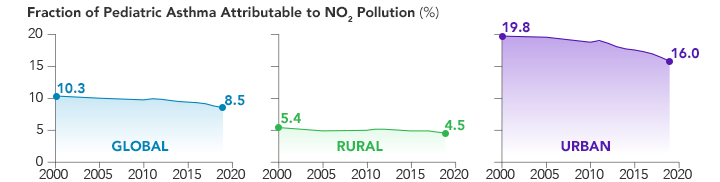
The researchers then paired the NO2 concentrations with population data and asthma rates from the Global Burden of Disease study. This allowed them to estimate the incidence of pediatric asthma attributable to nitrogen dioxide between 2000 and 2019. They estimated that 1.85 million new asthma cases globally in 2019 were attributable to nitrogen dioxide. Two-thirds of these new cases occurred in urban areas.

The chart above shows the fraction of all asthma cases globally, as well as in rural and urban areas, that were attributable to nitrogen dioxide pollution. The urban rate declined (from 19.8 percent to 16.0 percent) but the total number of cases in urban areas stayed about the same, with 1.22 million cases in 2000 and 1.24 million cases in 2019.“

The percentage of asthma cases attributable to nitrogen dioxide went down, and that is good news,” Anenberg said, “but it was balanced out by growth in population. That was why we had about the same number in 2000 versus 2019.”

Urban asthma cases attributable to nitrogen dioxide increased in south Asia, sub-Saharan and north Africa, and the Middle East. Many other areas of the world—both high-income and low-income economies—saw declines in NO2 and asthma rates.

However, despite some declines in nitrogen dioxide concentrations in some regions, it is “not enough to ensure that children are breathing clean air,” Anenberg added. “About three-quarters of cities globally have nitrogen dioxide concentrations that exceed the current World Health Organization guidelines.”

NASA Earth Observatory images by Joshua Stevens, using data courtesy of Anenberg, S. C., et al. (2022). Story by Sara E. Pratt.

No Breathing Easy for City Dwellers: Nitrogen Dioxide

Posted in Air Quality, Health Effects of Air Pollution | Tagged , , , , , , , | Leave a comment