Exercising when air pollution levels are high can do more harm than good

Do you check air pollution levels before exercising outdoors? You should. Although regular exercise is good for us, exercising in poor air may wipe any short-term fitness gains.

Worse still, you could be putting your body at risk of serious illness and – more worryingly – long term, irreversible damage.

Exposure to air pollution is a sad fact of life in any city, particularly in Hong Kong. The “vertical city” is a victim of its design, festering in roadside emissions and regional smog trapped among the city’s many high-rises, particularly on days with little wind.

Pick up the pace and we radically increase the rate and extent of exposure. “When you exercise, the rate of breathing is increased and you take deeper breaths,” says Tse. “At higher intensities, you also breathe through your mouth to get sufficient oxygen, leading to a direct intake of pollutants.

At rest, we have some basic protection measure against pollution – our nose. “The olfactory tissue and nose hairs act as a kind of first defence,” says Dr Michael Tse of the Active Health Clinic at the Institute of Human Performance in Hong Kong.

The lungs and cardiovascular system take the first hit, with every lungful of polluted air damaging the fine tissue, causing inflammation. Signs of exposure include chest tightness, wheeziness, coughing and a burning sensation in the throat and lungs.

“As inflammation is repeated, a person is at greater risk of developing asthma, bronchitis, chronic obstructive pulmonary diseases, damage to the mucous producing glands in the airways, and has an increased risk of pneumonia,” says Professor Anthony Hedley, creator of the Hedley Environmental Index and Emeritus Professor at the University of Hong Kong’s School of Public Health.

Those with a predisposition for respiratory illness, such as asthma sufferers, are at an increased risk.

Seasoned Hong Kong-based ultra-runner Simon Southgate suffered the dangerous combination of air pollution and exercise a few weeks ago while running in the New Territories.

After a six-hour Saturday morning training run in moderate pollution, Southgate, 45, started to feel sick and had a dry cough.

He was diagnosed with exercise-induced bronchitis, given an inhaler, and prescribed heavy antibiotics to expel fine particulate matter trapped in his lungs.

“I was told I was at least the fourth person the doctor had seen over the weekend from exposure. I’ve had some problems with air pollution when training in the past, but nothing like this.”

Southgate was unable to work and train for the best part of two weeks.

And it’s not just our lungs at risk. “Air pollution has the potential to damage virtually every tissue in the body, including the blood vessels which supply critical organs,” says Hedley.

A double-blind, randomised, crossover study by the University of Edinburgh published in the American Heart Association Circular in 2005 demonstrated that inhalation of diesel exhaust impairs blood vessel functioning.

They exposed 30 healthy men aged between 20 to 38 to diluted diesel exhaust or regular air for one hour during intermittent exercise at a moderate level and found damage to the heart and surrounding vessels, providing a link to the development of plaque or lesions in the blood vessels and heart attacks.

Hong Kong’s air pollution is bad, scarily so. Levels are three times that of New York, twice that of London and rank the city behind Singapore and Tokyo for air quality.

“It’s the biggest health crisis in Hong Kong,” says Kwong Sum-yin, chief executive of independent NGO Clean Air Network.

“If you look at data over the past five or so years, you can see that our air pollution is twice or three times higher that the World Health Organisation [WHO] recommended levels,” she says. “Previously air pollution has been an environmental issue, but now it’s a public health issue.”

Air pollutants are a toxic cocktail of noxious gases and each has a different effect on our bodies.

Ozone is like sunburn for your lungs, penetrating deep into the area responsible for vital gas exchange with the blood, resulting in breathing difficulties. Nitrogen dioxide and sulphur dioxides suppress the immune system, placing you at risk of respiratory infection.

Fine particles that hang in the air, particulate matter known as PM2.5, that may include heavy metals and toxic organic compounds, travel deep into our airways and, like in Southgate’s experience, can clog our lungs.

With the worrisome state of our air, is it safe to exercise outdoors? The Air Quality Health Index (AQHI) issued by the Environmental Protection Department (EPD) indicates the cumulative health risk attributable to the three-hour moving average concentrations of these high-risk air pollutants.

Between AQHI 1 to 8, there are no recommendations from the EPD to reduce levels of exercise, although warnings kick in at AQHI 7 for those sensitive to air pollution such as children and the elderly.

Follow these guidelines, says Dr Alfred Tam Yat-cheung, chairman of the HK Asthma Society, and exercising outdoors is “safe”. The key is finding a good location: “Provided you’re away from the roadside, it doesn’t hurt,” he says.

Not everyone agrees, and the AQHI has been widely criticised. Kwong cautions that the new standards still fall well short of those recommended by the WHO, while Hedley believes the air is not fit to breathe, let alone run around in. “The AQHI and the government’s air quality objectives are in no way protective of our health,” says Hedley.

“The WHO guidelines don’t even represent ‘good quality air’. You could think of them as standards for ‘safer air’ … but the criteria continue to change the more we discover.

“The number of days I’d say when risks from poor air quality are significantly reduced enough to exercise in are few and far between,” he says.

Even though Hong Kong is 70 per cent countryside, it makes little difference, says Lai Hak-kan, an assistant professor in epidemiology and biostatistics at the University of Hong Kong’s School of Public Health.

“Residential locations here are densely packed … the positive impact of the country parks is not felt,” he says. “There is a lot of overseas literature that finds proximity of distance from highways and traffic is very important … the closer you are the more exposure.”

Exercising in country parks may help, but on high pollution days it’s not enough. “The ambient levels of air pollution are extremely high across the whole territory,” says Hedley.

Going indoors may make little difference. “It depends on whether the building is equipped with hi-tech air filters, and the extent to which furniture and fittings absorb particles and gases. In general, indoor air quality usually reflects outdoor air quality,” he says.

So is there any hope? Recent research has shown the powerful antioxidative effects of exercise may combat pollution exposure, better yet, the body may even adapt.

A study of mice published in the journal Medicine and Science in Sports and Exercise in 2012 found mice that exercised in pollution over a five-week period underwent bodily changes to combat the harmful effects of the pollution; mice that didn’t exercise, but were still exposed to the same levels of air pollution, suffered an alarming spike in lung inflammations and free radicals.

Although the same link is yet to be made in humans, a 2012 review of epidemiological data published in the New England Journal of Medicineestimated short daily bicycle trips in polluted cities took between 0.8 and 40 days from a person’s average lifespan, but additional exercise lengthened it by three to 14 months.

A prudent approach to exercise is needed, one which minimises exposure to pollution during workouts whenever possible.

Southgate says he has not been put off, despite his scare. “I live in Hong Kong and don’t have the luxury of training overseas. But if I have a long race coming up, I still have to train for it. I’m definitely more conscious of the air quality index. I’d plan my training around – if it is high, I won’t train in it, or I’ll go earlier or later in the day.”

via Exercising when air pollution levels are high can do more harm than good | South China Morning Post.

Posted in Air Quality, Exercise & Air Pollution, Health Effects of Air Pollution, Running, Singapore, Sports | Tagged , , , , , , , | Leave a comment

Pollutionwatch: The world’s dirtiest cities

For the first time in history, over half the world’s population now live in cities. But only 12% of urban dwellers enjoy airborne particle pollutionthat meets World Health Organisation (WHO) guidelines. Globally, lowest city air pollution is in Canada and Iceland and the highest in India (Delhi and Patna) and Pakistan (Karachi and Peshwar).

Half of the world’s mega-cities have air pollution that is more than 2.5 times WHO guidelines, and in most places it is getting worse. Even in the wealthiest parts of the world, across Europe and North America, it is not clear that urban air pollution is getting better. The current emphasis on technical strategies to clean up our air is not working, and in some cases, such progress as has been made is being undone by other trends – Europe’s increased use of diesel cars and more wood burning, for example.

Air pollution from cities also harms the people who live around them. The Chinese mega-cities of Beijing and Tianjin, as well as Karachi in Pakistan, cause more harm to the surrounding population than to their own residents. For other, more typical, mega-cities the impact of black carbon particles on people downwind can still be around 40% of that on the city residents. If the pollution resulting from chemical reactions downwind is considered, then impact on surrounding areas is greater still.

With growing urbanisation, political leadership is needed to tackle this growing world health problem. More than ever we need to transform existing cites through design; reducing growing road transport dependency and providing clean home energy.

via Pollutionwatch: The world’s dirtiest cities | Environment | The Guardian.

Posted in Air Quality, Asia, Australia & Oceania, China, Europe, India, Japan, Latin America, London, Middle East, UK, USA & Canada, World News | Tagged , , , , , , , , , , | Leave a comment

Satellite Images Show That US Air Quality Is Actually Improving

usa

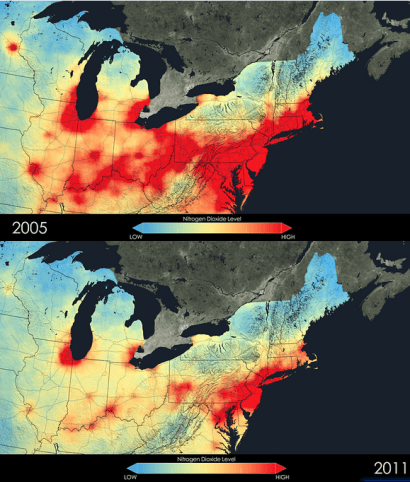
You may not have noticed, but if you’ve been living in a major US city for the past decade, your quality of air has actually been improving. New Images out from NASA satellites show this significant reduction in air pollution levels in a series of striking photographs released this week.

“After ten years in orbit, the Ozone Monitoring Instrument OMI on NASA’s Aura satellite has been in orbit sufficiently long to show that people in major U.S. cities are breathing less nitrogen dioxide – a yellow-brown gas that can cause respiratory problems,” the space agency reported in a recent press release.

According to NASA, Nitrogen dioxide is a common pollutant that falls under strict regulation by the United States Environmental Protection  Agency EPA as it is considered a significant threat to human health. Like many major air pollutants in the US, the gas comes primarily from combustion engines and coal power plants.

Remarkably, NASA points out that levels of Nitrogen Dioxide have decreased – especially along the East Coast where it was most concentrated – even while the number of cars on US roads has increased.

The difference in average pollution levels between 2005-2007 and 2009-20011 is pretty clear to see when presented visually, but NASA is quick to warn that the US isn’t in the clear just yet.

“While our air quality has certainly improved over the last few decades, there is still work to do – ozone and particulate matter are still problems,” said Bryan Duncan, an atmospheric scientist at NASA’s Goddard Space Flight Center.

An estimated 142 million people still live in areas in the US with unhealthy levels of air pollution, the EPA reports. What’s worse, only about ten percent of all urbanites in the word are currently breathing air that can meet recommended safety levels, according to the World Health Organization WHO.

Still, It’s hard not to be encouraged by this latest news. You can check out the data for yourself at NASA’s Earth Right Now, and explore some interactive images here.

via Satellite Images Show That US Air Quality Is Actually Improving : Environment : Nature World News.

Posted in Air Quality, USA & Canada | Tagged , , , , | Leave a comment

Iran sees reduction of air pollution in Tehran

Iran, which is experiencing some big problems relating to air pollution, is trying to resolve the problems through various ways.

As a result of government’s measures to address the problems, air pollution in Iran’s capital city Tehran has diminished recently.

Managing Director of the National Iranian Oil Refining and Distribution Company, Abbas Kazemi, said on June 24, the air pollution in Tehran, which reached to an alarming level in previous years, has been significantly reduced, IRNA news agency reported.

Kazemi noted that since the beginning of distribution of high quality Euro-4 gasoline, the air quality of the capital Tehran has improved very much.

Euro 4 is a globally accepted European emission standard for vehicles, which requires fuel with significantly low amounts of sulfur and benzene.

Iranian government has ordered the Oil Ministry to distribute gasoline meeting Euro-4 standard and high quality diesel oil in big cities.

All the gas stations of Iranian capital, Tehran are currently distributing gasoline conforming to Euro-4 standard.

National Iranian Oil Refining and Distribution Company (NIORDC) distributes daily 44 million liters of gasoline and diesel oil conforming Euro-4 standard in the capital.

Besides, distribution of euro-4 gasoline has started in the northwestern city of Tabriz as part of Iran’s plan to reduce air pollution in big cities.

Kazemi said Tehran, which is considered the most polluted city of the country, experienced 80 days of unpolluted, seven days of polluted and six days of clean air in the first quarter of the current Iranian year (started March 21, 2014).

He noted that based on a report released by the Department of Environment (DOE), Tehran’s air quality improved in the first 70 days of the current year compared to the corresponding period last year.

Environmental experts believe a large part of air pollution in Iran is due to emissions from vehicles using low quality gasoline produced in petrochemical complexes.

Recently, Iranian President Hassan Rouhani blamed choking air pollution in Tehran on gasoline produced by petrochemical plants.

The former government produced gasoline in petrochemical complexes to thwart sanctions imposed on the country, which exacerbated environmental hazards.

Head of the Environmental Protection Organization Massoumeh Ebtekar said in last December that gasoline produced in Iran does not comply with international standards.

Ebtekar accused the government of ex-president Mahmoud Ahmadinejad of failing to meet obligations on fuel standardization.

Iran’s Petroleum Minister Bijan Namdar Zanganeh recently ordered petrochemical plants to stop producing gasoline.

Iran had to produce gasoline in petrochemical plants as it faced restrictions in gasoline purchase due to international sanctions imposed on the country over its disputed nuclear program.

In recent years, air pollution in Tehran and other areas including Khuzestan and Isfahan, reached a critical point. Thus, Iran’s President Rouhani gave a special directive to address air pollution in Tehran.

The air over Iran’s capital is amongst the most polluted in the world, and experts say many Iranians suffer from serious health problems. According to official statistics, currently 12-13 million people reside in Tehran.

The problem of Tehran’s air pollution has repeatedly forced the government to declare some days off in the capital due to the high degree of pollution.

Vehicles are the main reason for air pollution in Tehran. Only 40 percent of people in Tehran use public transport, while 60 percent use their personal cars.

Tehran is wedged between two mountains that trap the fumes of its bumper-to-bumper traffic.

Other major Iranian cities also struggle with air pollution on a seasonal basis.

The fact that some big cities like Isfahan, Mashhad, Arak, Karaj, Qom, and Ahvaz are facing a somewhat similar situation backs up this view.

via Iran sees reduction of air pollution in Tehran – AzerNews.

Posted in Air Quality, Iran, Middle East | Tagged , , , | Leave a comment

Haze hits Malaysia; Moderate air quality expected in S’pore

As the haze makes its presence felt once again, unhealthy levels of air pollution were recorded in several areas of western Peninsular Malaysia, while other parts of the country registered moderate and good readings.

As of 8pm yesterday, the Air Pollutant Index (API) reading in Banting, Selangor, was 128, while Putrajaya, the administrative capital, registered a reading of 121, said Malaysia’s Department of Environment website.

Other areas that recorded a reading above 100 included Cheras in Kuala Lumpur (101); Shah Alam in Selangor (105); Port Klang (114); and Nilai in Negeri Sembilan (105).

An API reading of between zero and 50 indicates good air quality; between 51 and 100, moderate; between 101 and 200, unhealthy; between 201 and 300, very unhealthy; and more than 301, hazardous.

Some areas in Johor, such as Kota Tinggi and Muar, and Malacca had good to moderate readings.

Natural Resources and Environment Minister G Palanivel said on Monday that the haze was caused by burning activities in Central Sumatra, Indonesia and that the south-westerly winds brought it to Malaysia.

He added that the Singapore-based ASEAN Specialised Meteorological Centre (ASMC) said moderate haze was detected from the burning area in the Riau region on Saturday.

“ASMC reported that there were 88 hot spots detected through the National Oceanic and Atmospheric Administration satellite imagery in Sumatra on June 21,” Mr Palanivel said.

The satellite imagery also detected 17 hot spots in Malaysia, including one each in Pahang and Terengganu, five in Sabah and 10 in Sarawak.

Mr Palanivel said he expected the hazy conditions to persist until September.

via Haze hits Malaysia; Moderate air quality expected in S’pore | TODAYonline.

Posted in Air Quality, Asia, Singapore | Tagged , , , , , , , , , | Leave a comment

Study: climate change will worsen air pollution

By the end of the century, more than half of the world’s population could be exposed to “stagnant atmospheric conditions”, which would keep pollutants low in the air, worsening the effects of pollution, according to a new study.

Scientists predicted that in a high greenhouse gas emissions scenario, around 55% of people will experience more air stagnation by 2099, with India, Mexico, western US and the Amazon experiencing this phenomenon for up to 40 days more than currently.

Atmospheric stagnation occurs when light winds and lack of rainfall keep particles, soot, dust and ozone low in the atmosphere instead of allowing them to disperse. The phenomenon, similar to what happened in the UK in April, can worsen the effects of pollution on human health.

These results indicate that anthropogenic climate change is likely to alter the level of pollutant management required to meet future air quality targets”, the study, published in Nature Climate Change, says.

Daniel Horton, a climate modeller at Stanford University and lead author of the study, said, “Much of the air-quality community focuses on pollutants. This study takes a step back and looks at the weather or climate component that can lead to the formation of hazardous air quality.”

Outdoor air pollutants have been recently labelled by the World Health Organisation as the most widespread carcinogenic for humans. Pollution has been found to have possible links with the risk of autism and malfunctioning heart beat.

Figures by Public Health England (PHE), revealed that air pollution represented “the biggest public health risk after smoking”, contributing to the death of about 29,000 people in the UK every year.

via Study: climate change will worsen air pollution – Blue and Green Tomorrow.

Posted in Air Quality | Tagged , , , , , , | Leave a comment

Poor air quality killing 500 city residents a year

It is killing hundreds of people in Sheffield every year, with annual health costs of £160 million.

But tackling the city’s unsafe levels of deadly air pollution effectively means some tough calls for decision makers in Sheffield.

The city was named earlier this year by the World Health Organisation as being among nine urban areas in the UK which are breaching safe levels of air quality.

Coun Jack Scott, Sheffield Council cabinet member for environment, said the authority is doing all it can to tackle the problem – but added changes in people’s behaviour are needed to change the city’s air quality problems.

It comes as the issue of air pollution plays a part in two major planning decisions.

Campaigners against the potential new Ikea in Sheffield – councillors are due to make a decision on the store today – have warned its creation could add to the already ‘atrocious’ air quality in Tinsley, where it is planned the new site would be based.

And those fighting against the building of a new motorway service station on 20 acres of ancient woodland at Smithy Wood near Chapeltown have listed the potential for the site to further damage air quality in South Yorkshire as one of their reasons for objection.

Neil Parry, from the East End Quality of Life Initiative, said air pollution has serious health consequences for people exposed to it.

“It is not just about the deaths, it is the ill health that is caused,” he said.

“This needs to be taken seriously and it is good the WHO is saying these things. It increases pressure to take some action.”

He said people need to be encouraged to use vehicles less and to change their behaviour.

Coun Scott said funding has been secured for a public information campaign that will start this autumn and encourage people to use cars less in a bid to reduce air pollution levels.

The council published an Air Quality Action Plan last year setting out a range of initiatives to tackle the issue.

It said poor air quality is causing an estimated 500 premature deaths a year in Sheffield, with annual health costs of around £160 million.

The report added poor air quality results in increased admissions to hospitals.

The action plan includes proposals such as controlling industrial emissions, mitigating the impact of the M1 by pushing for a speed limit reduction along the road as it passes by Sheffield, and looking into the possibility of introducing a city centre ‘Low Emission Zone’ similar to one operating in London.

A zone was introduced in London in 2008 and charges drivers in an attempt to reduce the number of polluting vehicles on the road.

The council’s air quality action plan suggested a feasibility study should be carried out into whether the policy would work in Sheffield.

Coun Scott said he believes the Government is ‘listening’ on reducing speed limits on the M1, with the council calling for vehicles to be limited to 50mph.

A Highways Agency consultation on reducing the limit to 60mph between junction 28 at Mansfield and junction 35a at Sheffield and Rotherham between 7am and 7pm each day finished in March, with a decision expected later this year.

Coun Scott said buses in the city are among the ‘cleanest and most efficient in the country’.

But he added more needs to be done about encouraging the use of more environmentally-friendly taxis and HGVs.

He said: “Five hundred people a year are dying in Sheffield and we need to take decisive action. The WHO report doesn’t necessarily tell us anything we didn’t know before.

“We are leading the way for cities on this stuff. We know we have got to take this seriously but people need to play their part too.

“If people can use bikes, or for just one journey out of 10 walk instead of using the car, that would have a massive impact in terms of air quality.

“There is no magic lever in the Town Hall. We will be bold and take strong action, but we need people to work with us.

“Our view is that we are on borrowed time in terms of really positive action on this.”

‘Potential new Ikea may lead to more premature deaths’

Sheffield Council’s director of public health has warned the potential new Ikea store could lead to more premature deaths in Sheffield through increased air pollution.

Dr Jeremy Wight said the store will cause ‘negative health effects’ because of the impact on air quality through extra car journeys.

A report to today’s planning meeting, which has recommended the scheme for approval, noted Dr Wight has expressed concerns about the potential for the store to bring about a ‘small number’ of additional deaths from diseases such as heart attacks and strokes.

It said: “The actual worsening of air quality is, in proportional terms, small, but it is a small proportional deterioration of air quality that is already very bad.

“It is the view of the council’s director of public health that the public health harm caused by the slight worsening of already poor air quality, while not precisely quantifiable, will comprise additional cases of respiratory and cardiovascular disease, and will lead to a small number of additional premature deaths.”

And an environmental campaigner wrote to the founder of Ikea asking him to scrap the company’s plans for the store.

Neil Parry, from the East End Quality of Life Initiative, wrote to Ikea founder Ingvar Kampard calling for the company to withdraw its plans because of concerns about its potential impact on already poor air quality levels in Tinsley.

He said: “People there have much worse health than in other areas of Sheffield.

“One of the reasons is that the traffic pollution of the air is atrocious – in fact it is at illegal levels, much beyond the limits set by the European Union.

“An Ikea store there is going to make matters even worse with all the traffic it will attract.”

Ikea says the store would create 700 jobs and it will spend £400,000 on environmental schemes such as planting new trees and green bus technology.

Councillors are meeting at 10am today to discuss the Ikea application.

Fight to stop new Motorway service station on ancient woodland

Those fighting against plans to build a new motorway service station on 20 acres of ancient woodland at Smithy Wood near Chapeltown have listed as one of their reasons for objection the potential for the site to further damage air quality in South Yorkshire.

MP Angela Smith, who represents Penistone and Stocksbridge, is among hundreds of objectors campaigning against plans for a new M1 service station to be built at Smithy Wood.

She said one of her key objections is the potential for the site to further increase air pollution problems. “The area is also within the boundaries of an Air Quality Management Area, an area where because of the poor quality of the air it is proposed to reduce the speed limit on the M1,” she said.

“The extra traffic that would be drawn in by this development would add substantially to decreases in air quality and this I feel is totally unacceptable.”

In their environmental assessment, developers Extra Motorway Service Area say traffic generated by the proposed development may have a ‘slightly adverse’ impact on air quality, but mitigation strategies will be put in place to reduce potential problems.

via Poor air quality killing 500 city residents a year – The Star.

Posted in Air Quality, Europe, UK | Tagged , , , | Leave a comment

Air pollutant reading improves as smoke blows away

All states recorded a moderate to healthy Air Pollutant Index (API) this morning, compared with yesterday when Port Klang reached an unhealthy level. The Department of Environment’s website showed that only the Balak Baru, Kuantan area exceeded an API of 90 as of 7am today. API levels elsewhere ranged from 23 (Tawau, Sabah) to 86 (Batu Muda,…

All states recorded a moderate to healthy Air Pollutant Index (API) this morning, compared with yesterday when Port Klang reached an unhealthy level.

The Department of Environment’s website showed that only the Balak Baru, Kuantan area exceeded an API of 90 as of 7am today.API levelselsewhereranged from 23 (Tawau, Sabah) to 86 (Batu Muda, Kuala Lumpur and Port Dickson, Negri Sembilan).

Sabah and Sarawak remain untouched by smoke, while Terengganu and a few areas in Kelantan and Johor also have healthy readings.

An API reading of between 0 and 50 is considered good; 51 and 100, moderate; 101 and 200, unhealthy; 201 and 300, very unhealthy; and 301 and above, hazardous.

The API calculation is based on five major air pollutants, namely sulphur dioxide (SO2), nitrogen dioxide (NO2), ground level ozone (O3), carbon monoxide (CO) and particulate matter below 10 micrometres (PM10) diameter.

Most of these pollutants come from sources such as industries, motor vehicles, open burning and power generation.

The concentrations of these five pollutants are measured in 52 automatic air quality stations throughout the country, mainly in industrial and urban areas.

The Star reported today that Malaysian Meteorological Department spokesman Dr Hisham Mohd Anip said the situation was likely due to weakening wind conditions, which may have caused the smoke to become stagnant.

“The dry weather has caused the dust and smoke to be suspended in the air. Strong wind for the past couple of weeks has dispersed them but the wind flow was probably weak yesterday,” the English daily quoted him as saying.

He added that the smoky condition was likely caused by local pollution, such as emissions from vehicles and factories.

via Air pollutant reading improves as smoke blows away – MSN Malaysia News.

Posted in Air Quality, Asia | Tagged , , , , , | Leave a comment