Polluting haze blankets the North

Much of northern Thailand as far south as Saraburi lay under a heavy blanket of haze and smoke Friday from hundreds of fires, mostly set on purpose by farmers in Thailand and Myanmar.

The crisis areas were spotted in the far North, the lower North and upper Central provinces. Saraburi, where the air quality index (AQI) touched a dangerous 104 at noon Friday, had an air pollution index of 128 which, roughly translated, means “sensitive groups such as children, older people and asthmatics should stay indoors”.

Any AQI over 100 is dangerous to health, according to the Pollution Control Department, which maintains a website with information from around the country.

The most dangerous place in Thailand Friday afternoon was Mae Hong Son, where the AQI in the “pristine province” was 219. The index says an AQI this high is “an emergency condition. The entire population is more likely to be affected.”

At mid-afternoon Friday, “dangerous” readers were recorded at Chiang Mai City Hall (106), the Lampang Meteorological Station (159), and the Phrae station, which had a reading of 134.

Viewed from the steps to Doi Suthep, the city of Chiang Mai was barely visible through the haze Friday morning.

Dramatic satellite photos and charts from Nasa showed the cause and extent of the wildfires, which are set on purpose every year at this time, supposedly to prepare fields for a new crop when the rainy season begins, in April or May.

The Nasa Worldview website, which shows satellite photos of Earth in near real-time, was a dramatic mass of red dots in northern Thailand and, even more, in next door Myanmar. Each dot represented an individual fire, seen from space.

The ThaiForestFire site, a Google Map mashup showing hot spots in Thailand, was a virtual sea of yellow and red Friday.

Residents of the North described a “hell in the air” throughout the region.

“It is the worst I have seen in years,” said a Lampang resident, who added the haze this week came suddenly on Thursday after a brief rain shower had cleared the air on Wednesday.

“I woke up with the taste of smoke in my throat,” said a Chiang Mai resident.
via Polluting haze blankets the North | Bangkok Post: news.

Posted in Air Quality, Asia | Tagged , , , , , | Leave a comment

Councillor calls for Bristol Low Emission Zone to fight air pollution

A Bristol councillor is calling for a London-style Low Emission Zone (LEZ) in the city centre – for which the most polluting vehicles will be forced to pay a fee to enter.

Cllr Mark Wright said residents – particularly cyclists – in his Cabot ward bore the brunt of high traffic and, thus, air pollution levels.

He said an LEZ should only apply to the most polluting vehicles – such as older buses and lorries – and should encourage owners to upgrade to newer, cleaner fleets.

“It’s crazy. Bristol has some of the highest city cycling rates in the country. Yet it’s cyclists who get to breathe in the worst of Bristol’s poor quality air,” he said.

“I suggest the LEZ would be like the one in London, except that it would only target the most polluting vehicles over a certain tonnage, and so would generally only affect older buses and lorries.

“Users of those vehicles would have to pay a fee to enter the LEZ cordon, which could either be drawn around the whole city (as in London) or just the central areas.

“The daily fee for non-compliant vehicles for the London LEZ starts at around £100 per day for buses and lorries. Bristol’s level would be set independently of that, based on local factors, and would probably be a bit cheaper.”

Cllr Wright intends to make a statement about the plan to the Sustainable Development and Transport Scrutiny Commission later this week, in order to inject some urgency into plans which are, at present, only due for “exploration”.

“This contains no sense of urgency or certainty. I fear that it will not be taken forward with any vigour, and will therefore fall by the wayside,” he added.

London’s LEZ started operating on February 4, 2008 with phased introduction of an increasingly stricter regime through to January last year.

Despite opposition from groups such as haulier, it gained the support of key health organisations such as the British Lung Foundation and the British Heart Foundation.

In Bristol, dozens of streets exceed European air pollution levels, with nitrogen dioxide levels more than twice the EU limit in some roads. The European Commission (EC) last year threatened to prosecute the UK Government over air pollution in 12 cities, including Bristol.

Experts in the city say that while schemes such as this have partial benefits, to really address the issue of air pollution then a cultural, long-term shift is needed to reduce the numbers of all vehicles in the city centre.

via Councillor calls for Bristol Low Emission Zone to fight air pollution | Bristol24-7.

Posted in Air Quality, London, UK | Tagged , , , | Leave a comment

Fresh Air From Beijing?

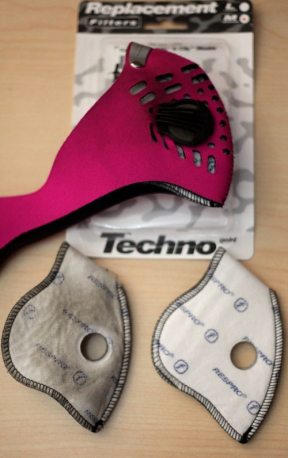
Respro® filter 40 hoursWondering, when you should change your Respro® mask filter?

Pictures of a Respro® filter after ca 40 hours of use in Beijing, China.

Read the Respro® masks FAQ to find answers to this and other questions, or go straight to Do the filters need replacing, if so, how often?

Buy new Techno™ filter twin pack, City filter twin pack, Allergy filter twin pack or Sports filter twin packs here www.respro.com

Respro® filter 40 hours


via Respro Mask Filter Change « China, Asia, Climbing and Fixed Gear Bikes.

Posted in Respro® Products | Tagged | Leave a comment

Parts of Japan smothered in Chinese air pollution

As flights are cancelled and visibility is severely reduced by clouds of sand blown into parts of Japan, authorities warn residents of areas that are most severely affected to wear face masks and avoid going outside.

A dirty, yellow-brown smog rolled across Tokyo Bay like an inexorable wave on Sunday, March 10, engulfing Yokohama’s Bay Bridge, the docks district and the Minato Mirai district of shops, hotels and the largest Ferris wheel in Japan in a haze of dust. What had been a bright spring morning in this coastal city just south of Tokyo had been turned into an afternoon of swirling dirt, with people caught outside choking as they held handkerchiefs to their mouths.

The Japan Meteorological Agency had forecast that the impact of sandstorms in northern China and Mongolia would be felt in the Kanto region surrounding Tokyo over the weekend, although weather patterns have been affecting parts of the country that are closer to mainland China – primarily Kyushu, the most southerly of Japan’s main islands – since early February.

News programs displayed multi-colored graphics showing the progress of the clouds of smog as it rolled across Kyushu and the environment ministry said that its website came close to being overloaded as worried residents attempted to find out how serious the problem was going to be in their districts.

Above official standards

On Saturday, the government of Fukuoka City announced that the average amount of a toxic pollutant in the air known as PM2.5 was above the official national environment standard for a second straight day. The standard is set at 35 micrograms per cubic meter, but it reached 42 micrograms and was the third time since February 15 that the level had surpassed the limit.

PM2.5 is defined as particulate matter that measures smaller than 2.5 microns – or a mere 2.5 thousandths of a millimeter. These particles are usually generated by activities that involve the burning of fossil fuels, such as metal processing and other heavy industrial applications, as well as vehicle emissions.

Experts say this form of airborne pollution can trigger inflammatory responses both in the body’s respiratory tract and blood vessels. Over time, they say, it can cause thickening of the walls of arteries and associated problems.

continue reading Parts of Japan smothered in Chinese air pollution | Asia | DW.DE | 12.03.2013.

Posted in Air Quality, Asia, Japan | Tagged , , , , , , , , , | Leave a comment

Worst air pollution in the world: Beijing, Delhi, Ahwaz, and Ulaanbaatar

I wake up and suck a bowl of charred asbestos through a dirty bong.

Well, that’s what it feels like most winter mornings when I open the door of the fourth-floor New Delhi apartment that I currently call home. Fog-drenched clumps of soot, ozone molecules, and microscopic bundles of nitrogen oxides flow down my trachea and into my chest, where some become lodged. Some of these particles might give me lung cancer. Others will enter my bloodstream, further inflaming old ankle and finger injuries. The airborne detritus puts me in danger of contracting bronchitis, asthma, a lung infection, even hypertension and dementia.

China’s appalling air quality made headlines around the world this winter. But people living in New Delhi and in dozens of other cities throughout the developing world consistently endure air with heavier loads of soot than do the residents of Beijing. While most Americans and Europeans now enjoy cleaner air than they did for much of the last century, air pollution is worsening in Asia, claiming millions of lives every year.

After weeks without a trip outside of Delhi, I gradually stop noticing the filth in the air. There are exceptions, of course, such as that hostile blast of moist air on a foggy winter morning. Or when I’m sitting at a stoplight in an open-air auto rickshaw, feeling fumes wash over me from a honking swarm of vehicles. Or when a layer of darkness veils my drying clothes, coats the inside of my nose, or hangs heavy along a horizon.

With every breath, regardless of how mindful or oblivious I am of the poison that’s filling my lungs, my risk of suffering a stroke or a heart attack increases.

An estimated 3.2 million people died prematurely in 2010 because of the poisonous effects of outdoor air pollution, according to the findings of an exhaustive study of global causes of death published in December in the Lancet. Two-thirds of those killed by air pollution lived in Asia, where air quality continues to worsen.

Outdoor air pollution has become India’s fifth highest killer. Only tobacco, high blood pressure, indoor air pollution typically caused by poorly ventilated stoves, and diets that are poor in fruit and vegetables kill more people here.

continue reading Worst air pollution in the world: Beijing, Delhi, Ahwaz, and Ulaanbaatar. – Slate Magazine.

Posted in Africa, Air Quality, Asia, China, India, Iran, Middle East, USA & Canada, World News | Tagged , , , , , , , , , , , , , , , , , , , , | Leave a comment

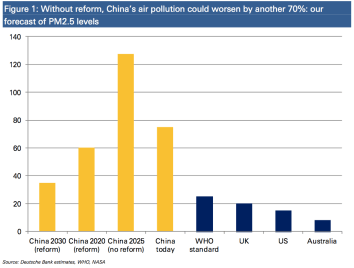
China’s nightmare scenario: By 2025, air quality could be much, much worse

China's air pollution forecast

China’s myriad plans to deal with pollution don’t look so promising. In a research note today, Deutsche Bank analysts gloomily conclude that, barring extreme reforms, Chinese coal consumption and increased car ownership will push pollution levels 70% higher by 2025.

Even if China’s economy slowed to 5% growth each year, its annual coal consumption would still rise to 6 billion tons (5.4 tonnes) by 2022, from the current 3.8 billion tons. Car ownership is expected to increase over the years to 400 million in 2030 from the current 90 million.

With those two figures, it will be very difficult for the government to reduce the national average of PM2.5, or air pollution that is small enough to enter the bloodstream. The current national average is 75 micrograms per cubic meter. In January, PM2.5 levels in Beijing reached 900 micrograms per cubic meter.

For China to meet its goal of reducing particulate matter to 35 micrograms per cubic meter by 2030, China will need to implement aggressive measures, the bank says, like reducing pollutants from coal-fired plants, cutting the number of cars on the road, and massively building up public transportation. Even then, the air pollution level would still above the level deemed safe by the World Health Organization (25 micrograms per cubic meter).

Still, it’s not impossible. Deutsche Bank points out that the United Kingdom rescued the country from under the ”Great Smog” of the 1950s, thick pollution that killed 4,000 people. A key difference between China and the UK during that time, the Financial Times points out, is that China is more reliant on manufacturing for growth. That’s one more incentive for China to move from a manufacturing-based economy to one more focused on a services industry.

via China’s nightmare scenario: By 2025, air quality could be much, much worse – Quartz.

Posted in Air Quality, Asia, China, UK | Tagged , , , , , | Leave a comment

Invisibility of pollution implies such problems are past

The invisibility of modern air pollution gives the impression that air pollution problems are a thing of the past. Today is it rare to see persistent black smoke from a factory chimney or clouds of thick black smoke from traffic. This February provided some good opportunities to see air pollution directly, if you knew where and when to look.

Easterly winds brought cold, polluted air from Europe to the UK. The worst conditions were measured on 19th February in the Midlands, in Birmingham and Nottingham, across Yorkshire and London. This pollution was composed of many tiny particles a few thousandths of a millimetre across. These particles can penetrate deep into our lungs and due to their size they are also effective at scattering light, creating a blue-white haze.

This haze was obvious when looking towards the horizon in the winter sunshine, reducing visibility to a couple of kilometres. Workers in offices in the City of London were also able to look out on a brown haze below caused by air pollution; mainly nitrogen dioxide and particles from traffic exhaust fumes, trapped in a cold air layer close to the ground.

Another place to see air pollution is in our health statistics. More people die and get admitted to hospital on days with high air pollution. People living in polluted places live shorter lives with air pollution contributing to an average six months loss of life expectancy for each of us in the UK.

via Pollutionwatch: Invisibility of pollution implies such problems are past | Environment | The Guardian.

Posted in Air Quality, Europe, London, UK | Tagged , , , , , | Leave a comment

No clearing the air over neighbor’s pollution

Pollutants from China and their resultant problems are nothing new to Japan. Acid rain, principally caused by high levels of sulfur dioxide and nitrogen oxide in industrial pollutants, has been a concern for several decades.

While Kyushu and western Japan are most vulnerable to pollutants from mainland China, Shukan Asahi Feb. 15 quoted Jotaro Urabe, professor at Tohoku University, as saying testing of soil strata on Mt. Hachimantai in Iwate Prefecture indicates metallic precipitates have increased two to fivefold from the levels of the 1950s, serving as evidence that pollution from China extends over nearly the entire Japanese archipelago.

In addition, over the past half decade, the heavy clouds of seasonal huangsha — called kosa in Japanese and referred to alternatively in English as yellow sand or yellow dust — wafting eastward from the Gobi desert each spring have worsened due to ongoing desertification of the region. No longer just a problem for northern China, they darken the skies over Seoul and Korea and have affected commercial air traffic in western Kyushu.From last month, reports of new pollution problems became ubiquitous in the print media here. While tensions over the disputed Senkaku Islands may have piqued some readers’ desire for any coverage that puts China in a negative light, the topic has sufficient momentum to be treated as an independent story.

A headline in Shukan Taishu Feb. 11 screamed about the arrival of “China’s homicidal air from which protective masks won’t defend.” The article noted that pollution levels measured in Beijing had reached 25 times the level deemed safe. By some estimates the poor air quality results in some 300,000 deaths and 600,000 cases of people being hospitalized for respiratory diseases each year.

continue reading No clearing the air over neighbor’s pollution | The Japan Times.

Posted in Air Quality, Asia, China, Japan, South Korea | Tagged , , , , , , , , , | Leave a comment